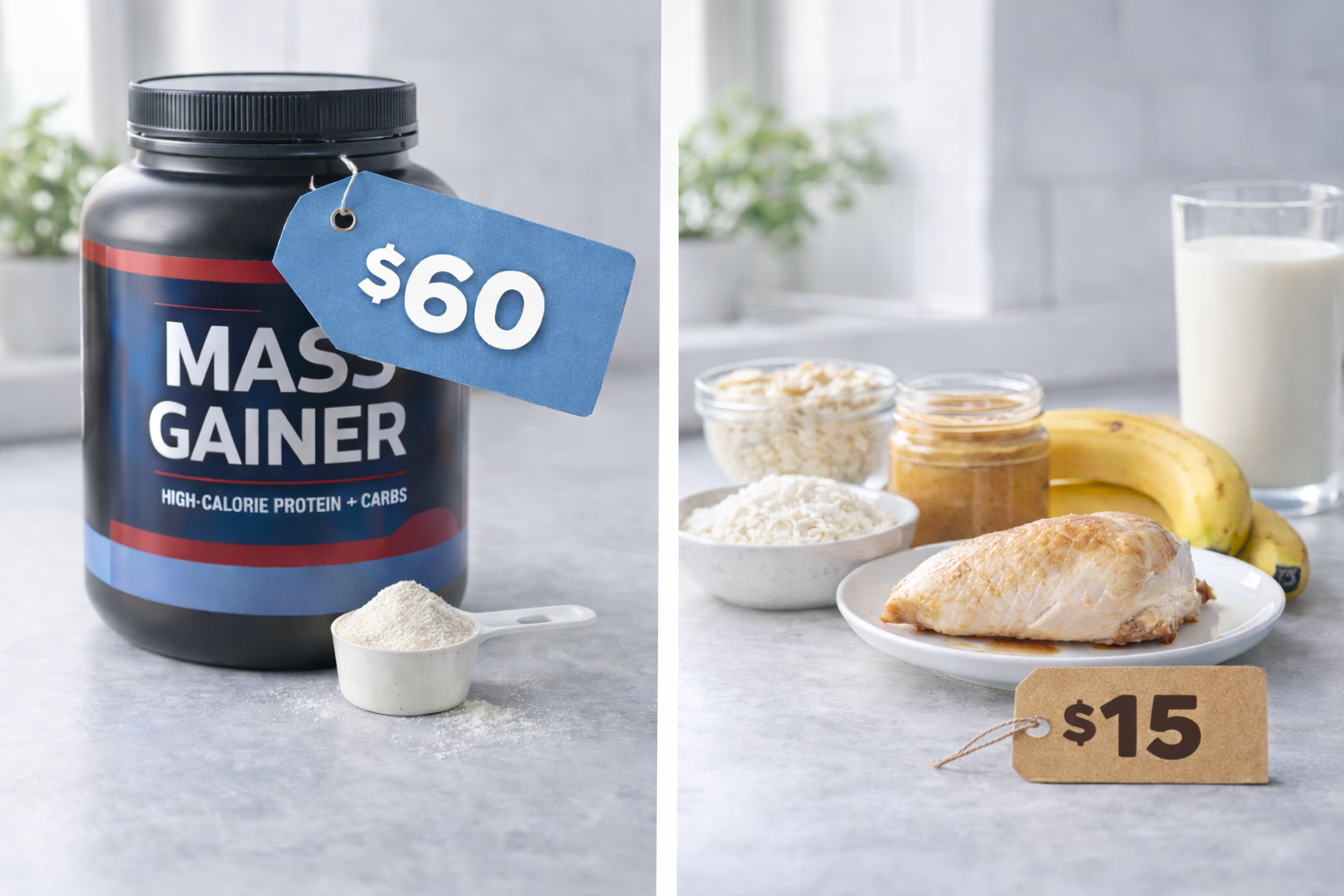
Thinking about spending $40-80 on a mass gainer to build muscle faster? Here’s the brutally honest truth about whether these expensive supplements are worth your money.
You’re struggling to gain weight and build muscle.
You’ve tried eating more, but you just can’t stomach enough food.
Then you see the mass gainer ads:
- “Gain 10 pounds in 4 weeks!”
- “1,250 calories per serving!”
- “The ultimate muscle-building formula!”
- Massive bodybuilders endorsing the product
It looks like the perfect solution, right?
Here’s the uncomfortable truth: Mass gainers CAN be worth it for the specific group of people who genuinely struggle to eat enough calories from whole food. But for most people, they’re an expensive, unnecessary supplement filled with cheap ingredients that you could get far more affordably from real food.
In this comprehensive guide, I’ll explain exactly what mass gainers are and how they work, reveal who actually benefits from them (and who’s wasting money), break down the real advantages and significant disadvantages, show you how to identify quality vs. garbage mass gainers, provide a cost comparison vs. whole food, and help you decide if a mass gainer makes sense for your goals and budget.
Whether you’re a hardgainer desperately trying to bulk or someone considering mass gainers as a shortcut, this article will give you the complete, unbiased picture.
Let’s separate marketing from reality.
TABLE OF CONTENTS
What Exactly Is a Mass Gainer?
Before evaluating whether they’re worth it, you need to understand what you’re actually buying.
The Basic Definition
A mass gainer (also called a weight gainer or hypercaloric supplement) is a high-calorie supplement powder designed to help people gain weight and muscle mass.
Typical mass gainer composition:
Calories per serving: 400-1,250+ (varies dramatically by product)
Macronutrient breakdown:
- Carbohydrates: 75-250g (primary calorie source)
- Protein: 20-60g
- Fat: 5-20g
Additional ingredients (sometimes):
- Vitamins and minerals
- Fiber
- Creatine
- Digestive enzymes
- Various other additions
How Mass Gainers Differ From Protein Powder
This is a critical distinction many people miss.
Whey protein powder:
- Primary goal: Provide high-quality protein
- Calories per serving: 110-130
- Protein per serving: 24-25g
- Carbs per serving: 1-3g
- Fat per serving: 1-3g
- Purpose: Fill protein gaps in your diet
Mass gainer:
- Primary goal: Provide massive calories
- Calories per serving: 400-1,250+
- Protein per serving: 20-60g
- Carbs per serving: 75-250g
- Fat per serving: 5-20g
- Purpose: Create caloric surplus for weight gain
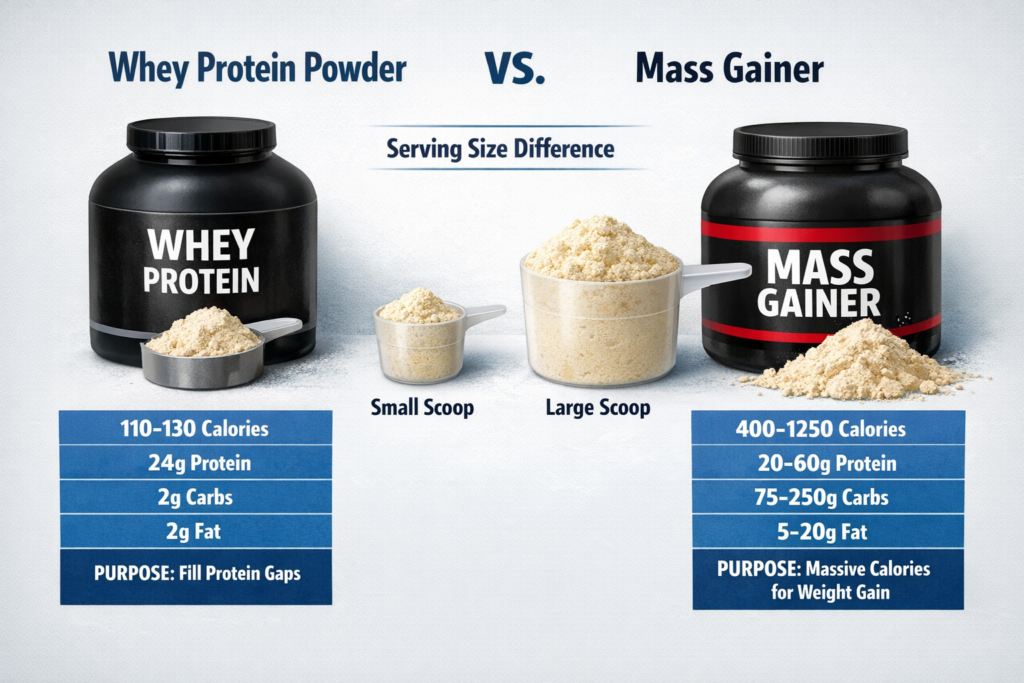
The key difference: Protein powder adds protein. Mass gainer adds calories (mostly from carbs).
The Theoretical Purpose
Mass gainers are designed for people who:
Cannot eat enough food:
- Very high metabolism
- Small appetite
- Busy schedule prevents frequent eating
- Struggle with solid food volume
Need to gain weight:
- Hardgainers (ectomorphs)
- Athletes with extreme caloric needs
- People recovering from illness or injury
- Anyone in a bulking phase
The pitch: Drink 1,000+ calories instead of forcing down multiple meals.
Does this theory work in practice? We’ll examine that shortly.
Are Mass Gainers Actually Worth It?
The answer depends entirely on your specific situation.
When Mass Gainers ARE Worth It
Scenario 1: You’re a genuine hardgainer who cannot eat enough solid food
Characteristics:
- Naturally very lean (under 12% body fat without trying)
- Fast metabolism
- Small appetite despite efforts to increase it
- Struggle to gain weight even when “eating a lot”
- Can’t physically eat 3,500-4,000+ calories daily from whole food
Why mass gainer helps:
- Liquid calories easier to consume than solid food
- Doesn’t require appetite or chewing
- Provides large calorie boost with minimal effort
- Can drink even when full from previous meal
Example: A 140-pound ectomorph trying to bulk to 160 pounds who needs 3,800 calories daily but can only eat 3,000 calories in solid food comfortably.
For this person: A 600-800 calorie mass gainer shake fills the gap affordably and conveniently.
Scenario 2: You have an extremely demanding schedule
Characteristics:
- Working 60+ hours weekly
- No time for meal prep
- Eating opportunities limited
- Need portable nutrition
- Can’t cook or eat proper meals frequently
Why mass gainer helps:
- Mix with water in 30 seconds
- Drink anywhere
- No cooking or prep required
- Saves massive time
Example: Medical resident working 80-hour weeks with irregular meal breaks who needs 3,500 calories but can only manage 2 proper meals daily.
For this person: Mass gainer provides essential calories when real meals aren’t feasible.
Scenario 3: You’re an athlete with extreme caloric needs
Characteristics:
- Training 2-3+ hours daily
- High-intensity sports (wrestling, rowing, swimming, etc.)
- Burning 4,000-5,000+ calories daily
- Need 5,000-6,000+ calories for muscle gain
Why mass gainer helps:
- Impossible to eat this much solid food
- Liquid calories necessary for such high intake
- Recovery demands are extreme
- Convenient between training sessions
Example: College wrestler bulking up a weight class who’s burning 4,500 calories daily through training and needs 5,500 to gain muscle.
For this person: Mass gainer is a practical necessity, not a luxury.
When Mass Gainers Are NOT Worth It (Most People)
Scenario 1: You can eat adequate calories from whole food
If you can comfortably eat:
- 3,000-3,500 calories from regular meals
- Adequate protein (0.8-1g per pound body weight)
- Without feeling stuffed or miserable
Then you don’t need a mass gainer. You’re wasting money on expensive powder when real food works fine.
Scenario 2: You’re not actually a hardgainer
Many people think they’re hardgainers when they’re actually:
- Not tracking calories accurately
- Overestimating how much they eat
- Not eating consistently
- Skipping meals frequently
The test: Track every calorie for one week. If you’re not eating at least 16-18 calories per pound of body weight daily, you’re not eating enough, period.
Example: A 170-pound guy claiming he “eats so much” but only consumes 2,400 calories daily (14 calories per pound). He’s not a hardgainer. He’s just not eating enough.
For this person: Learn to eat more whole food. Don’t buy expensive powder to enable poor eating habits.
Scenario 3: You’re on a budget
Mass gainers are expensive per calorie compared to whole food.
If money is tight, mass gainers are a luxury you can’t afford. Real food provides better nutrition for less money (detailed comparison below).
Scenario 4: You’re cutting or maintaining
If you’re trying to:
- Lose fat
- Maintain current weight
- Get lean
Then you absolutely don’t need mass gainers. They provide excess calories you’re trying to avoid.
Scenario 5: You’re already gaining fat alongside muscle
If you’re bulking but:
- Gaining more than 0.5-1 pound weekly
- Noticing significant fat gain
- Abs disappearing quickly
You’re already in sufficient (or excessive) surplus. Adding more calories via mass gainer will just make you fatter.
The Real Advantages of Mass Gainers
Let’s examine the legitimate benefits when used appropriately.
Advantage 1: High Calorie Density
This is the primary selling point and legitimate advantage.
A single mass gainer shake can provide:
- 600-1,250 calories
- In 16-24oz liquid
- Consumed in 5-10 minutes
Compare to whole food equivalent:
To get 1,000 calories from solid food:
- 8oz chicken breast (560 cal)
- 2 cups cooked rice (400 cal)
- Vegetables (40 cal)
- Total time: 20-30 minutes eating
Mass gainer advantage:
- Drink 1,000 calories in 5 minutes
- No chewing required
- Less filling than solid food
- Easier when appetite is low
For hardgainers, this matters. The difference between drinking calories and forcing down solid food can determine whether they reach their caloric target.
Advantage 2: Ultimate Convenience
Preparation time comparison:
Cooking a meal:
- Prep ingredients: 10 minutes
- Cook: 15-25 minutes
- Eat: 15-20 minutes
- Cleanup: 5-10 minutes
- Total: 45-65 minutes
Mass gainer shake:
- Add powder to shaker: 15 seconds
- Add liquid: 10 seconds
- Shake: 20 seconds
- Drink: 5-10 minutes
- Rinse shaker: 30 seconds
- Total: 7-12 minutes
Time savings: 35-55 minutes per meal
For busy people, this is significant:
- More time for training
- More time for work/school
- More time for sleep
- Less stress about meal timing
Advantage 3: Portability
Mass gainers offer unmatched portability:
Take anywhere:
- Gym bag
- Work or school
- Car
- Travel
- Camping or hiking
No refrigeration needed:
- Powder is shelf-stable
- Mix with water anywhere
- No food prep equipment required
- No utensils needed
Compare to whole food:
- Requires containers
- Often needs refrigeration
- Utensils necessary
- Harder to eat on-the-go
Advantage 4: Multi-Nutrient Profile (When Quality)
Good mass gainers provide more than just calories:
Balanced macros:
- Protein for muscle building (20-60g)
- Carbs for energy (75-200g)
- Some fat for hormones (5-20g)
Additional nutrients (in quality products):
- Vitamins and minerals
- Fiber for digestive health
- Creatine for performance
- Digestive enzymes
Compare to simple carb sources:
- Just drinking sugar water: Only provides carbs
- Eating only rice: Minimal protein or micronutrients
- Mass gainer (quality): Complete nutrition in one shake
This makes quality mass gainers more than just calorie bombs.
Advantage 5: Flexible Usage
Mass gainers offer versatility:
As a shake:
- Standard use
- Quick and easy
In smoothies:
- Add fruit, vegetables, nut butter
- Customize nutrition further
In recipes:
- Protein pancakes
- Protein oatmeal
- Baked goods
Timing flexibility:
- Between meals
- Post-workout
- Before bed
- Anytime you need calories
The Significant Disadvantages of Mass Gainers
Now let’s examine the problems that often outweigh the benefits.
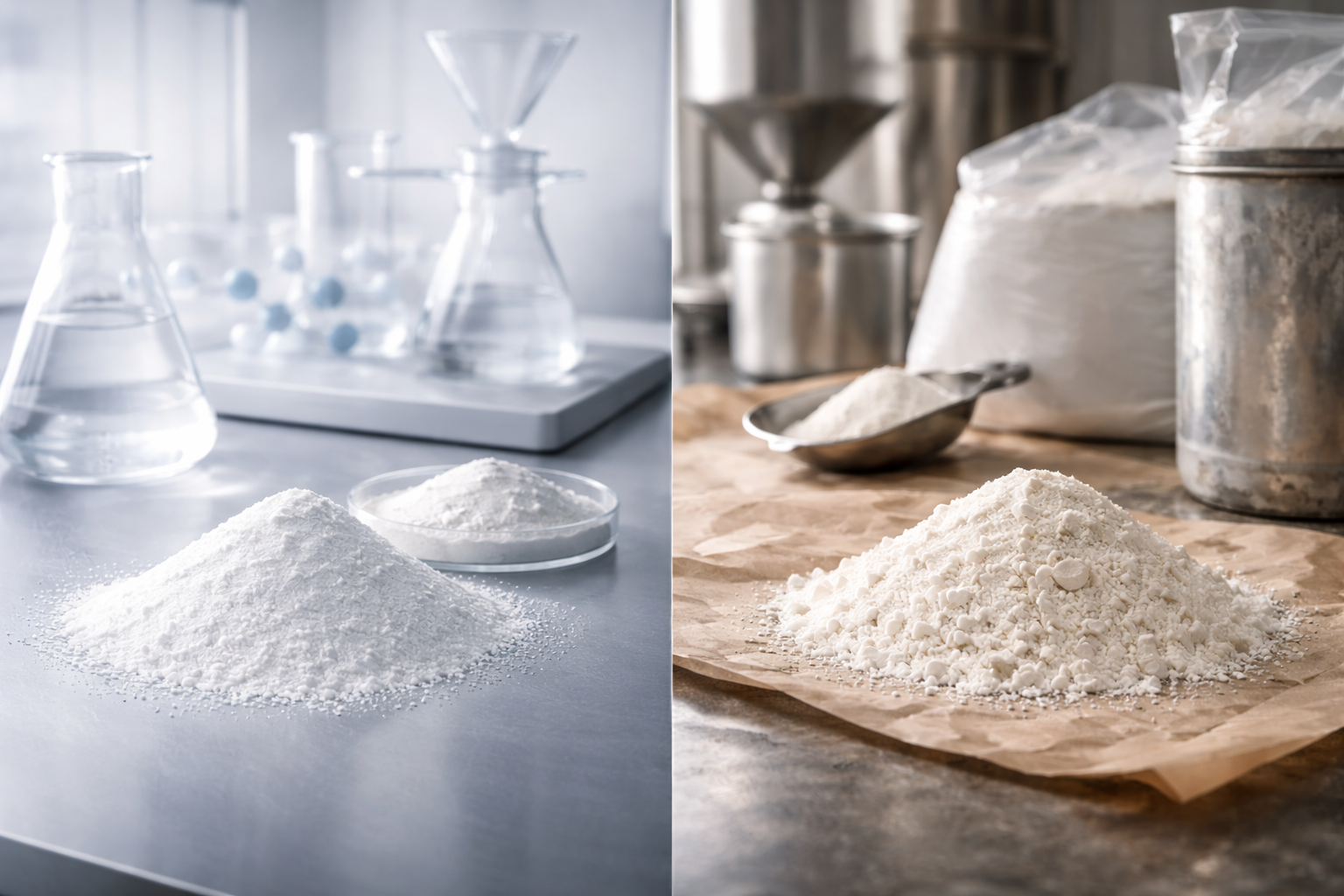
Disadvantage 1: Often Made With Cheap, Low-Quality Ingredients
This is the biggest problem with most mass gainers.
What cheap mass gainers contain:
For carbohydrates:
- Maltodextrin (processed corn starch)
- Dextrose (pure glucose)
- Waxy maize starch
- Other cheap sugar sources
Why this matters:
- Rapid blood sugar spikes
- No nutritional value beyond calories
- No fiber
- Low satiety (get hungry quickly)
For protein:
- Soy protein concentrate (cheapest protein)
- Very small amounts (20-30g despite massive serving size)
- Poor amino acid profile compared to whey
- Lower biological value
Additional junk:
- Artificial flavors
- Artificial colors
- Excessive sweeteners
- Fillers and additives
- Long ingredient lists full of chemicals
The result: You’re paying premium prices for sugar and cheap protein dressed up as a “muscle-building formula.”
Disadvantage 2: Poor Nutrient Balance
Many mass gainers have terrible macronutrient ratios.
Common problem: Massive carbs, minimal protein
Example mass gainer:
- Calories: 1,250
- Protein: 25g (only 8% of calories!)
- Carbs: 250g (80% of calories)
- Fat: 10g (7% of calories)
Why this sucks:
- Protein is what builds muscle
- You’re paying for expensive sugar
- Better off eating rice and taking whey protein separately
- Doesn’t align with muscle-building needs
Optimal macro ratio for muscle building:
- Protein: 25-30% of calories
- Carbs: 45-55% of calories
- Fat: 20-30% of calories
Most mass gainers: Way too high in carbs, way too low in protein.
Disadvantage 3: Digestive Issues
The high calorie density that makes mass gainers convenient also causes problems.
Common digestive complaints:
Bloating:
- 1,000+ calories in liquid form overwhelms digestion
- Rapid gastric distention
- Uncomfortable fullness
Gas:
- Poor quality ingredients ferment in gut
- Cheap protein sources (soy) cause gas
- Artificial sweeteners contribute
Diarrhea:
- Large amount of simple sugars draws water into intestines
- Lactose (if whey-based) causes issues for sensitive individuals
- Digestive system can’t handle the load
Nausea:
- Consuming massive calories quickly
- Sweet flavor becomes sickening
- Thick texture hard to tolerate
Blood sugar crashes:
- Huge carb intake spikes blood sugar
- Insulin response
- Subsequent crash and fatigue
- Especially with cheap simple sugars
For some people, these issues make mass gainers unusable regardless of convenience.
Disadvantage 4: Easy to Gain Excessive Fat
Liquid calories bypass normal satiety signals.
The problem:
With solid food:
- Chewing triggers satiety
- Stomach distention signals fullness
- Takes time to eat
- Natural limit on how much you can consume
With liquid calories:
- No chewing (no satiety signal)
- Goes down quickly
- Can consume massive amounts easily
- Easy to overshoot caloric needs
The result:
Many people:
- Drink mass gainer (1,000 calories)
- Still eat all their regular meals
- End up in excessive caloric surplus (1,000+ over needs)
- Gain mostly fat, not muscle
Optimal muscle gain: 0.5-1 pound per week (250-500 calorie daily surplus)
What happens with mass gainers: 2-3 pounds per week (1,000+ calorie surplus), mostly fat
If you’re not carefully tracking total daily calories, mass gainers make it too easy to get fat.
Disadvantage 5: Expensive Per Calorie vs. Whole Food
This is where mass gainers really fail the cost-benefit analysis.
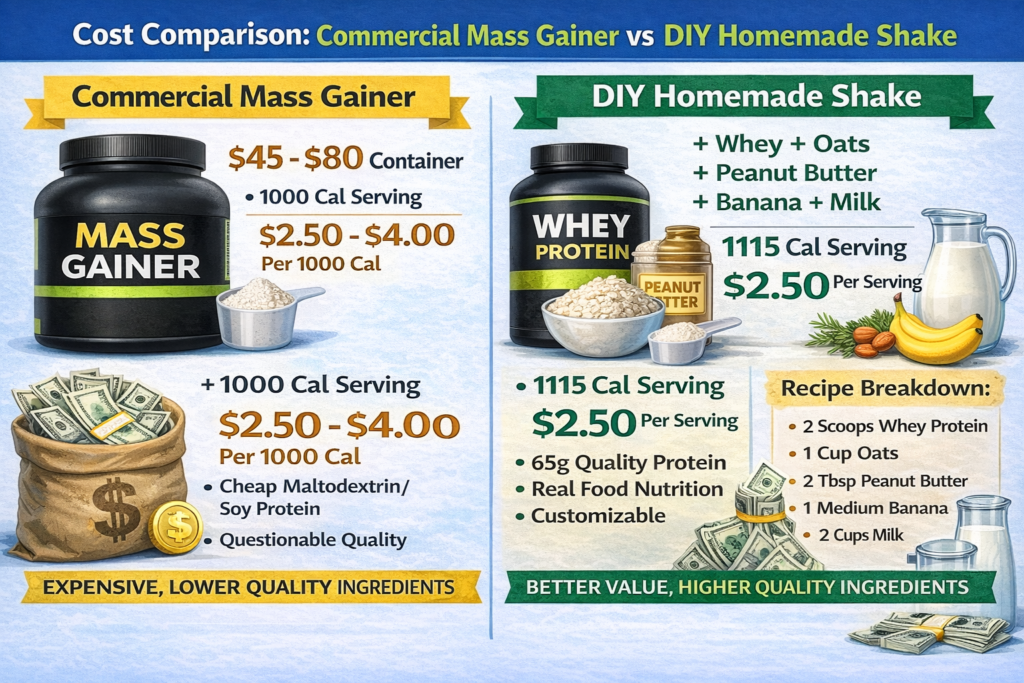
Let’s do the math:
Mass gainer (typical product):
- Price: $45-80 for 12 pounds
- Servings: 16-24
- Calories per serving: 800-1,250
- Cost per 1,000 calories: $2.50-4.00
Whole food alternatives:
Rice + chicken + oil:
- 2 cups cooked rice: $0.40 (400 calories)
- 8oz chicken breast: $2.00 (400 calories)
- 1 tablespoon olive oil: $0.15 (120 calories)
- Total calories: 920
- Cost per 1,000 calories: $2.77 (similar to mass gainer)
Peanut butter + oats + milk:
- 1 cup oats: $0.30 (300 calories)
- 3 tablespoons peanut butter: $0.45 (285 calories)
- 2 cups whole milk: $0.60 (300 calories)
- 1 banana: $0.20 (105 calories)
- Total calories: 990
- Cost per 1,000 calories: $1.56 (43% cheaper than mass gainer)
Pasta + ground beef + sauce:
- 3 cups cooked pasta: $0.60 (600 calories)
- 6oz ground beef (80/20): $1.80 (450 calories)
- Tomato sauce: $0.40 (50 calories)
- Total calories: 1,100
- Cost per 1,000 calories: $2.55 (comparable to mass gainer)
The verdict: Whole food is comparable or cheaper per calorie, with far superior nutrition quality.
You’re paying premium for convenience, not value.
Disadvantage 6: Replaces Developing Proper Eating Habits
This is a long-term problem many people don’t consider.
Using mass gainers as a crutch:
- Avoids learning to eat adequately
- Never develops proper meal planning skills
- Doesn’t teach food preparation
- Creates dependency on supplements
The issue:
Scenario: College student uses mass gainers to bulk
Short-term: Gains weight successfully
Long-term problem: After college, can’t afford expensive supplements, never learned to eat properly, loses all muscle gained because eating habits never developed
Better approach:
- Learn to eat whole food adequately
- Develop meal prep skills
- Build sustainable eating patterns
- Use mass gainer sparingly as needed, not as foundation
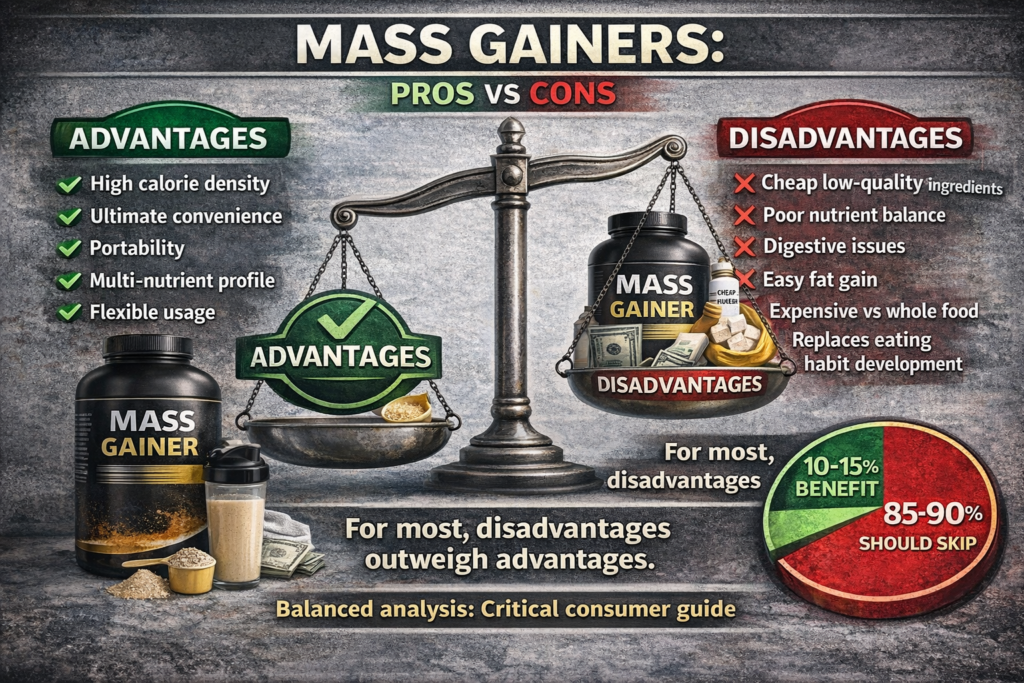
Building good eating habits matters more than short-term convenience.
How to Identify Quality vs. Garbage Mass Gainers
If you decide a mass gainer makes sense, here’s how to choose wisely.
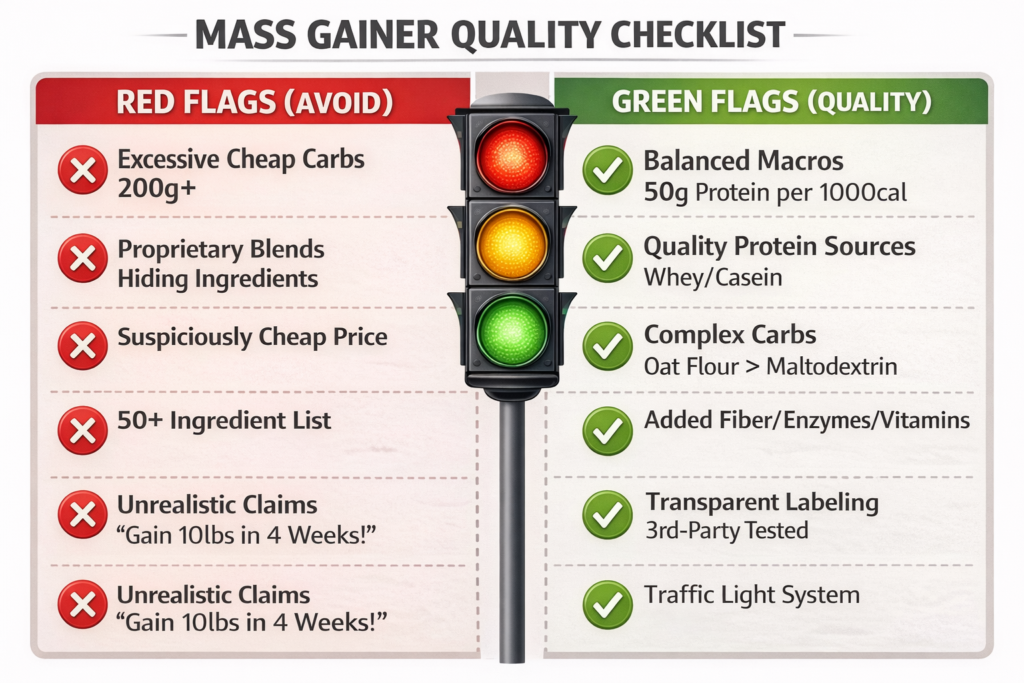
Red Flags (Avoid These Products)
🚩 Red Flag 1: Excessive calories from cheap carbs
Warning signs:
- 1,000+ calories per serving
- 200g+ carbohydrates
- Main carb source: Maltodextrin or dextrose
- Minimal protein (under 40g per 1,000 calories)
What this means: You’re buying expensive sugar. Terrible value.
🚩 Red Flag 2: Proprietary blends
Warning signs:
- “Proprietary protein blend” without specific amounts
- “Advanced carbohydrate complex” (hiding cheap ingredients)
- Vague ingredient lists
What this means: Company is hiding low-quality ingredients. Transparency matters.
🚩 Red Flag 3: Suspiciously cheap
Warning signs:
- Dramatically cheaper than competitors
- Too good to be true pricing
- Unknown brand
What this means: Using lowest-quality ingredients to compete on price. You get what you pay for.
🚩 Red Flag 4: Excessive ingredient list
Warning signs:
- 50+ ingredients
- Lots of chemicals and additives
- Multiple sweeteners and flavoring agents
- Unnecessary “proprietary complexes”
What this means: Trying to confuse you with complexity. Good products are simple.
🚩 Red Flag 5: Unrealistic claims
Warning signs:
- “Gain 10 pounds in 4 weeks!”
- “Triple your muscle gains!”
- “Revolutionary formula!”
- “Doctor recommended!” (unverified)
What this means: Marketing BS. Run away.
Green Flags (Quality Products)
✅ Green Flag 1: Reasonable macronutrient ratio
Good ratios:
- Protein: 20-30% of calories (minimum 50g per 1,000 calories)
- Carbs: 50-65% of calories
- Fat: 10-25% of calories
Example quality product:
- 700 calories
- 50g protein (29% of calories)
- 90g carbs (51% of calories)
- 15g fat (19% of calories)
Why this matters: Balanced nutrition that actually supports muscle building.
✅ Green Flag 2: Quality protein sources
Look for:
- Whey protein concentrate or isolate
- Micellar casein
- Milk protein isolate
- Egg white protein
Avoid:
- Soy protein concentrate (cheapest)
- “Proprietary protein blend” (hiding soy)
✅ Green Flag 3: Complex carbohydrate sources
Better carb sources:
- Oat flour
- Sweet potato powder
- Quinoa
- Brown rice flour
- Real food-based carbs
Worse carb sources:
- Maltodextrin only
- Dextrose only
- Waxy maize only
- Pure simple sugars
Why this matters: Complex carbs provide sustained energy, fiber, and better nutrition.
✅ Green Flag 4: Added beneficial ingredients
Look for:
- Fiber (5-10g per serving)
- Digestive enzymes
- Vitamins and minerals
- Creatine monohydrate
- MCT oil or healthy fats
These additions improve overall nutrition and value.
✅ Green Flag 5: Transparent labeling
Quality indicators:
- Every ingredient clearly listed with amounts
- No proprietary blends hiding information
- Third-party testing certification
- Clear nutritional information
Transparency = company has nothing to hide.
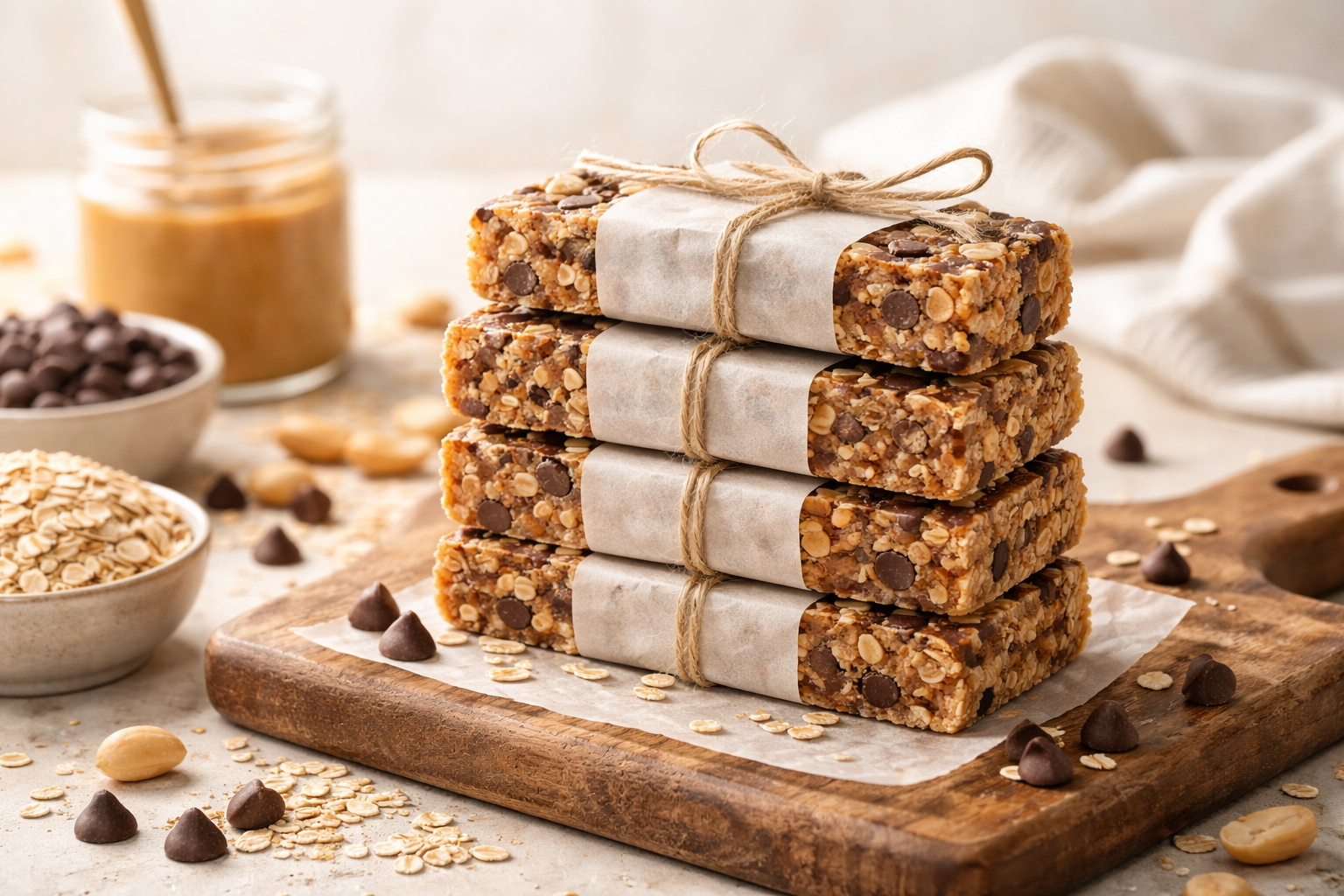
Recommended Approach: Make Your Own
The best “mass gainer” is often homemade.
DIY mass gainer shake recipe:
Ingredients:
- 2 scoops whey protein (50g protein, 220 cal)
- 1 cup oats (300 cal)
- 2 tablespoons peanut butter (190 cal)
- 1 banana (105 cal)
- 2 cups whole milk (300 cal)
Total nutrition:
- Calories: 1,115
- Protein: 65g
- Carbs: 125g
- Fat: 30g
- Cost: ~$2.50
Advantages over commercial mass gainer:
- Higher quality ingredients
- Better protein content
- Real food nutrition
- Cheaper per serving
- Customizable to your needs
- No junk or fillers
You control exactly what goes in.
The Bottom Line: Who Should (and Shouldn’t) Buy Mass Gainers
After examining all the evidence, here’s the verdict:
Buy a Mass Gainer If:
✅ You’re a genuine hardgainer (under 12% body fat, fast metabolism, small appetite)
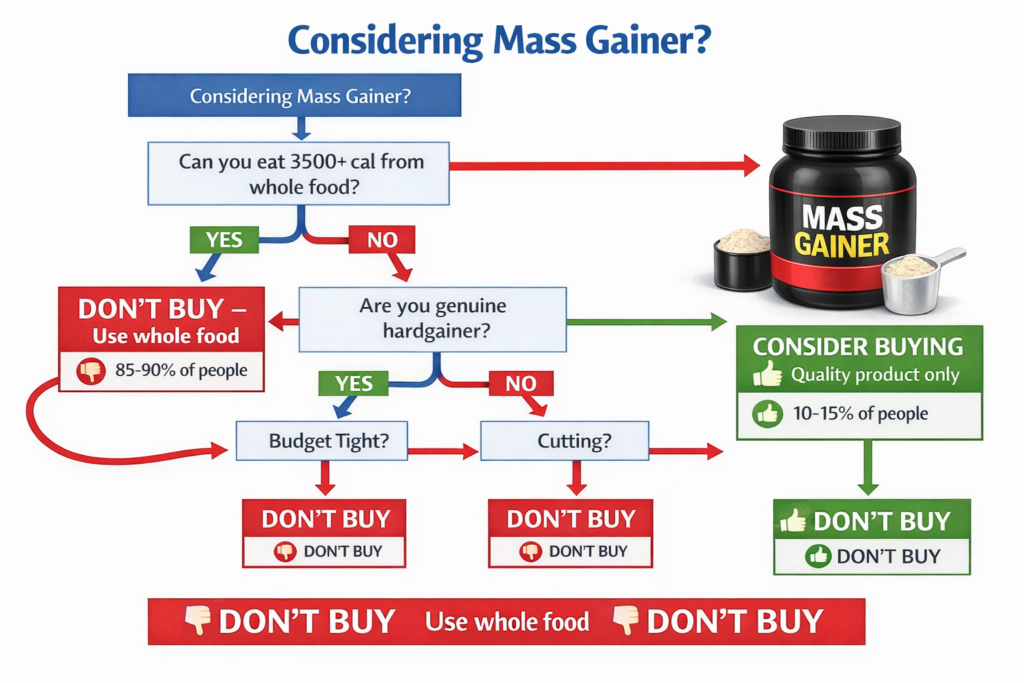
✅ You physically cannot eat 3,500+ calories from whole food daily
✅ You’ve tried increasing solid food intake and still fall short consistently
✅ You have a demanding schedule that prevents adequate whole food consumption
✅ You’re an athlete with extreme caloric needs (5,000+ calories)
✅ Convenience is worth the premium cost to you
✅ You’re choosing a quality product (good macros, quality ingredients)
✅ You’re using it to supplement your diet, not replace it
This describes maybe 10-15% of people considering mass gainers.
Don’t Buy a Mass Gainer If:
❌ You can eat adequate calories from whole food (even if it requires effort)
❌ You’re on a tight budget (whole food is more cost-effective)
❌ You’re cutting or maintaining weight
❌ You’re already gaining more than 1 pound per week
❌ You’re not actually tracking your calories (probably not eating as much as you think)
❌ You’re looking for a magic muscle-building supplement
❌ The product is cheap garbage made with maltodextrin and soy protein
❌ You’re using it to avoid learning proper eating habits
This describes 85-90% of people considering mass gainers.
The Smarter Alternative for Most People
Instead of buying mass gainers:
Step 1: Track your actual caloric intake for one week
- Use MyFitnessPal or similar app
- Weigh and measure everything
- Be honest about portions
- Calculate average daily calories
Step 2: Determine if you’re actually eating enough
- Multiply bodyweight by 18-20 for bulking target
- Compare to actual intake
- Most people aren’t eating as much as they think
Step 3: Add calorie-dense whole foods
- Nut butter (190 cal per 2 tablespoons)
- Olive oil (120 cal per tablespoon, add to meals)
- Nuts and seeds (160-200 cal per ounce)
- Whole milk (150 cal per cup)
- Dried fruit (120-140 cal per ounce)
- Avocado (240 cal per whole avocado)
Step 4: Make your own high-calorie shakes
- Whey protein + oats + peanut butter + banana + milk
- Cheaper than mass gainers
- Better ingredients
- Customizable
Step 5: Only if still falling short, consider a quality mass gainer
- Use as final resort, not first choice
- Choose quality product
- Use to fill remaining gap only
This approach:
- Costs less
- Provides better nutrition
- Develops sustainable eating habits
- Only uses supplements when truly necessary
PRIORITIZE WHOLE FOOD. SUPPLEMENT STRATEGICALLY. BUILD REAL MUSCLE.
Ready to optimize your entire bulking strategy with science-based nutrition that actually works without wasting money on unnecessary supplements? Mass gainers are just one small piece of effective muscle building. Get a complete guide to calculating your exact caloric needs, choosing the right foods for clean bulking, timing your nutrition optimally, and building serious muscle without excessive fat gain. Stop relying on expensive powders. Start eating smarter and growing bigger.

Leave a Reply
You must be logged in to post a comment.