Wondering when you should take egg white protein for maximum muscle-building results? Here’s the science-backed truth about timing and what actually matters.
You’ve got your egg white protein powder. You’re ready to start supplementing.
Then the questions hit:
- Should I take it in the morning or evening?
- Pre-workout or post-workout?
- Before bed for overnight muscle building?
- Does timing even matter?
Everyone seems to have a different opinion, and the internet is full of conflicting advice.
Here’s the truth that will simplify your life: The best time to take egg white protein is whenever you need to consume protein. Total daily protein intake matters far more than precise timing. You can use egg white protein at any meal or snack when you need convenient, high-quality protein.
In this comprehensive guide, I’ll explain exactly what egg white protein is and why timing is overrated, reveal the situations where timing might provide minimal advantages, show you how much to take and how often, compare egg white protein timing to other protein sources, and give you a practical system for using egg white protein effectively.
Whether you’re using egg white protein for the first time or trying to optimize your current routine, this article will cut through the confusion.
Let’s focus on what actually matters.
TABLE OF CONTENTS
What Is Egg White Protein and Why Use It?
Before discussing timing, you need to understand what you’re actually taking.
The Basic Definition
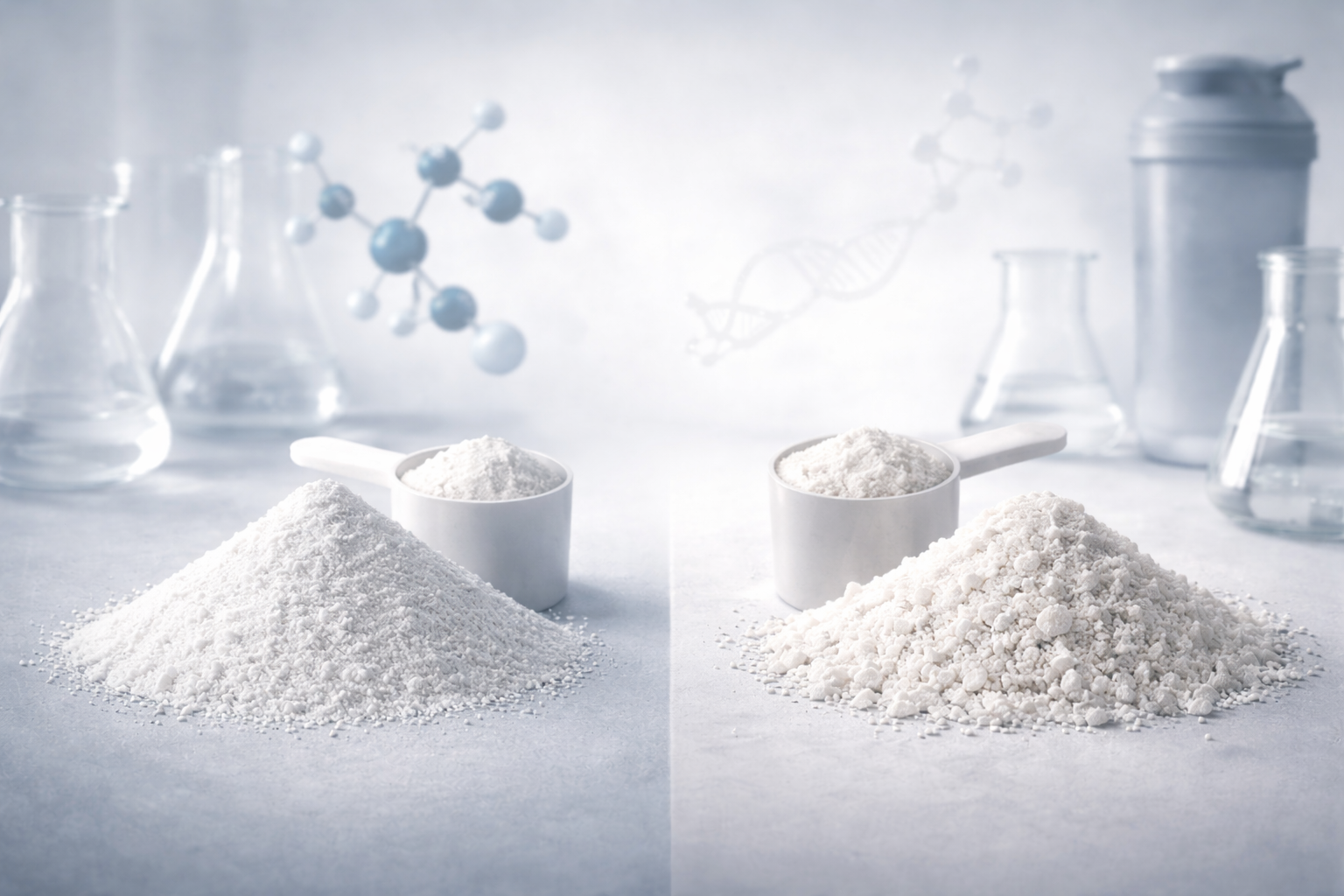
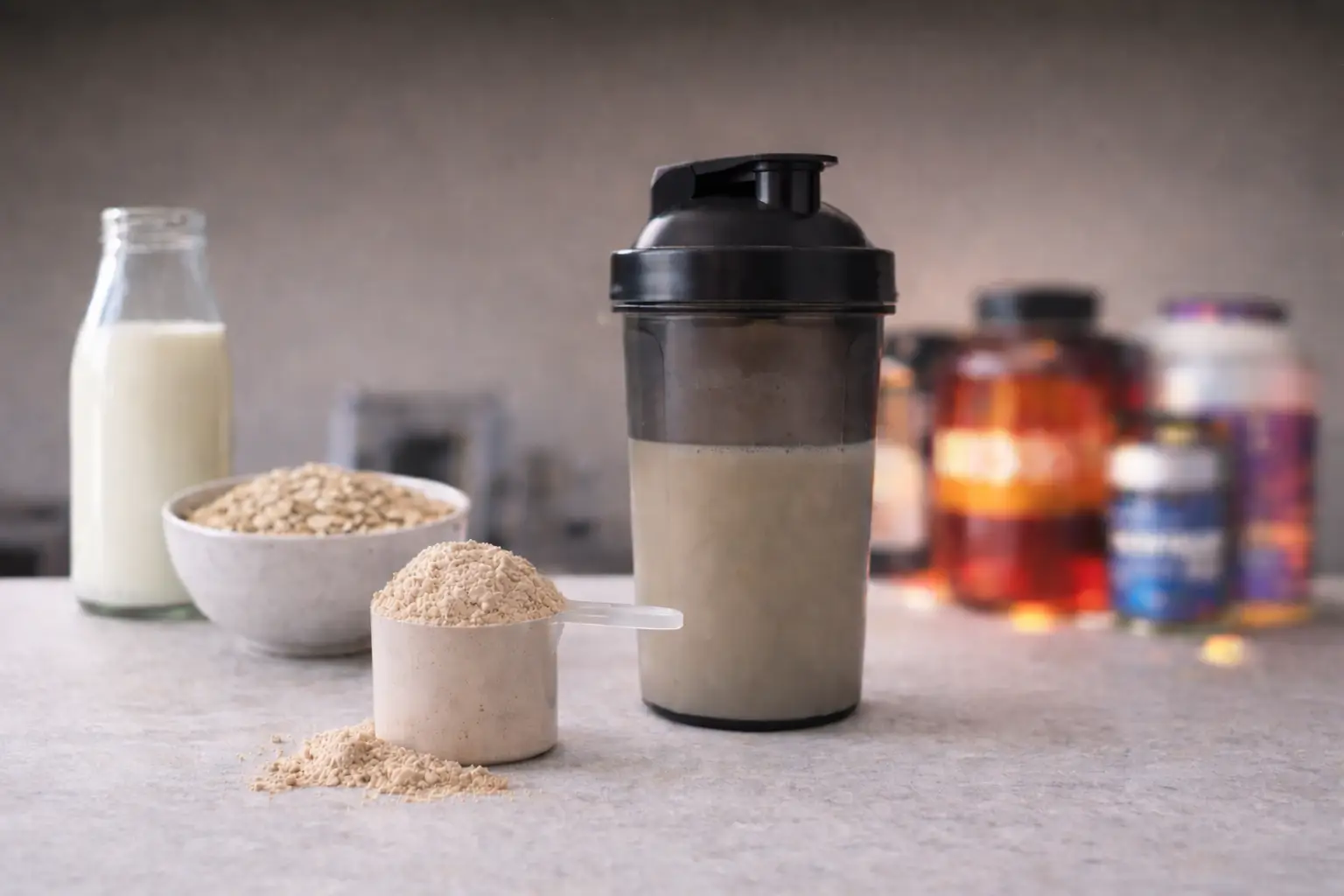
Egg white protein (also called albumin) is dehydrated egg whites in powder form.
What it contains:
- Approximately 80-90% protein by weight
- All nine essential amino acids (complete protein)
- Minimal carbohydrates (1-3g per serving)
- Minimal fat (0-1g per serving)
- No cholesterol (egg whites contain no cholesterol)
Standard serving (30g powder):
- Protein: 24-26g
- Carbs: 1-2g
- Fat: 0-1g
- Calories: 100-110
It’s essentially dried egg whites with nothing else added (in unflavored varieties).
How Egg White Protein Compares to Other Proteins
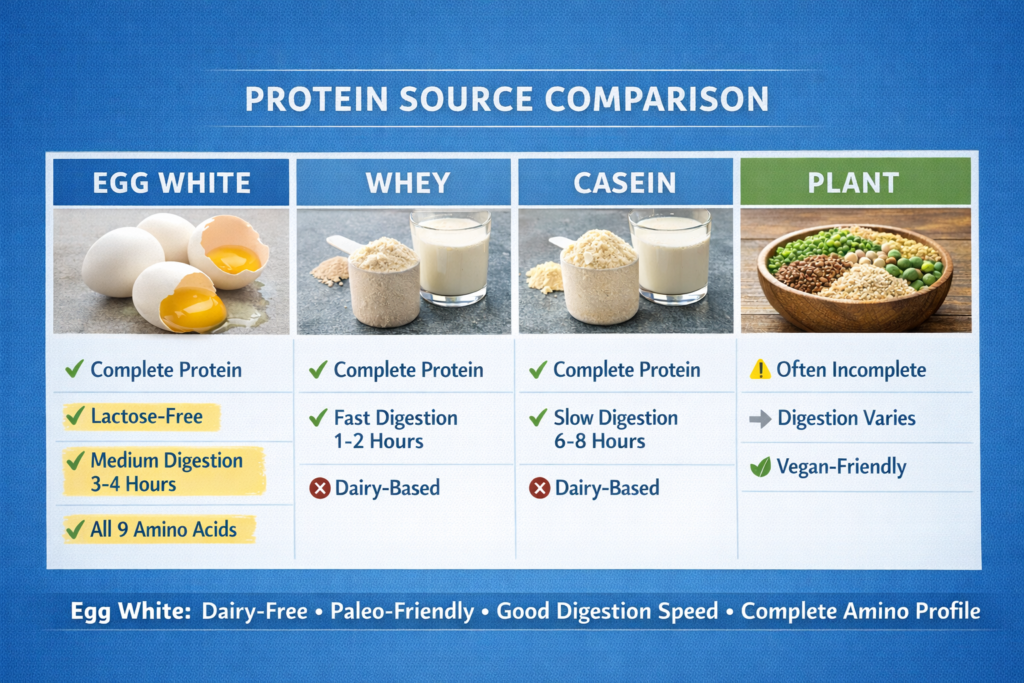
Egg white protein vs. whey protein:
Similarities:
- Both are complete proteins
- Both have high biological value
- Both support muscle building effectively
- Both digest relatively quickly
Differences:
- Egg white: Lactose-free (perfect for lactose intolerant)
- Egg white: Slightly slower digestion than whey
- Whey: Generally cheaper per serving
- Whey: Mixes better in liquid
Egg white protein vs. casein:
Similarities:
- Both are complete proteins
- Both are dairy-free alternatives
Differences:
- Casein: Much slower digestion (6-8 hours)
- Egg white: Medium digestion speed (3-4 hours)
- Casein: Better for overnight protein supply
- Egg white: More versatile timing
Egg white protein vs. plant proteins:
Advantages of egg white:
- Complete amino acid profile (most plant proteins aren’t)
- Higher biological value
- Better amino acid ratios for muscle building
Advantages of plant protein:
- Vegan-friendly
- May have fiber and additional nutrients
Why People Choose Egg White Protein
Primary reasons:
Lactose intolerance:
- Can’t use whey protein
- Need dairy-free complete protein
- Egg white is perfect solution
Allergies:
- Dairy allergy (can’t use whey or casein)
- Soy allergy (can’t use soy protein)
- Egg white often tolerated when other options aren’t
Dietary preferences:
- Paleo diet (dairy not allowed)
- Prefer animal-based proteins over plant
- Want variety in protein sources
Cost:
- Often cheaper than whey
- Good value for quality protein
- Budget-friendly complete protein
Digestive tolerance:
- Some people digest egg white better than whey
- Less bloating than dairy proteins for some
- Gentler on sensitive stomachs
The Truth About Protein Timing
Before discussing specific timing, you need to understand what the science actually says.
What Research Shows About Nutrient Timing
The old belief: Protein timing is critical. You must consume protein within a narrow “anabolic window” or waste your workout.
The reality from current research:
Total daily protein intake is what matters most.
Key research findings:
Study 1 (International Society of Sports Nutrition position stand):
- Total daily protein intake is the primary factor for muscle building
- Timing provides minimal additional benefit
- Consuming adequate protein over 24 hours trumps specific timing
Study 2 (Meta-analysis on protein timing):
- “Anabolic window” is much wider than previously thought (not just 30-60 minutes post-workout)
- Pre-workout protein is as effective as post-workout
- As long as you eat protein within a few hours of training, you’re fine
Study 3 (Total intake vs. timing):
- People consuming adequate total protein showed similar muscle gains regardless of timing
- Those with inadequate total protein didn’t benefit from “perfect” timing
The practical takeaway:
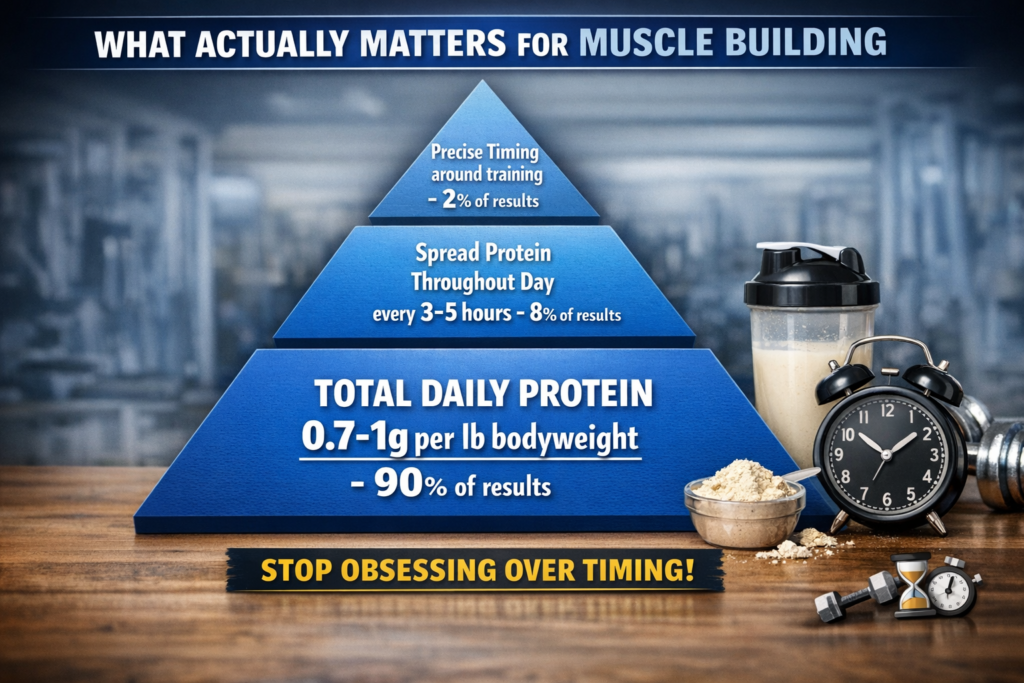
Priority 1: Consume 0.7-1g protein per pound of body weight daily
Priority 2: Spread protein relatively evenly throughout the day
Priority 3 (minor): Maybe consider timing around training
Everything else: Basically irrelevant
Why Timing Is Overrated for Egg White Protein
Egg white protein digests at a moderate speed:
Digestion timeline:
- Consumption: 0 hours
- Stomach processing: 1-2 hours
- Small intestine absorption: 2-4 hours
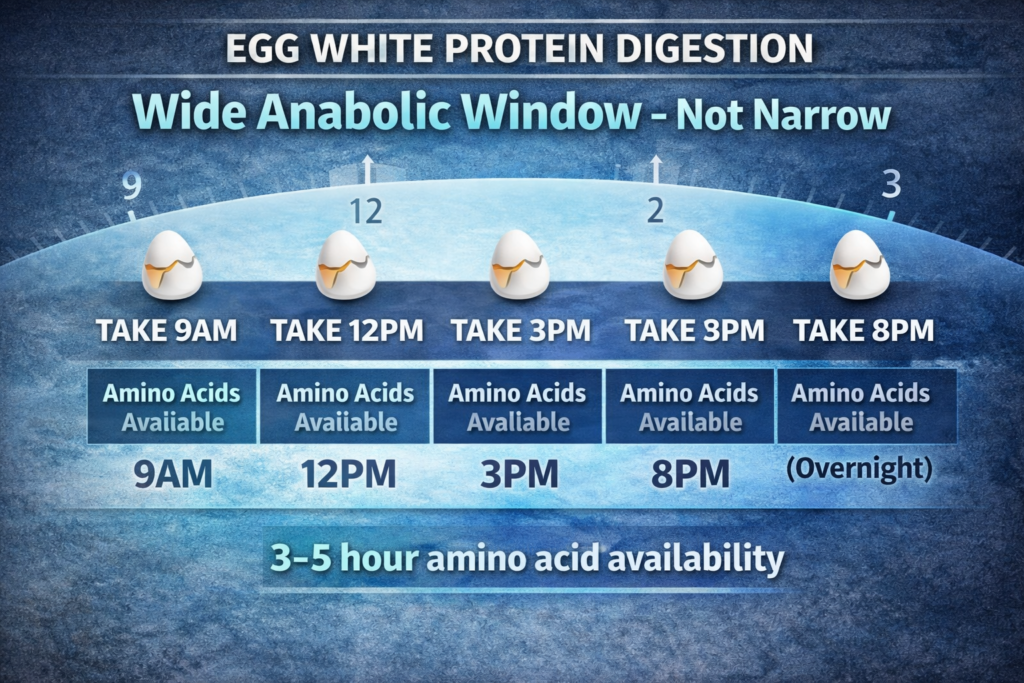
- Amino acids available in bloodstream: 3-5 hours total
What this means:
If you take egg white protein:
- At 9 AM: Amino acids available until 2 PM
- At 12 PM: Amino acids available until 5 PM
- At 3 PM: Amino acids available until 8 PM
- At 8 PM: Amino acids available through the night
With this digestion timeline, your body has protein available for hours regardless of when you take it.
The timing “window” is huge, not narrow.
Situations Where Timing Might Provide Minor Advantages
While timing isn’t critical, certain situations might offer small benefits.
Situation 1: Around Training (Pre or Post-Workout)
Why this might help slightly:
Pre-workout (60-90 minutes before):
- Amino acids available during training
- Supports muscle protein synthesis during workout
- Prevents excessive muscle breakdown
- Provides sustained energy
Post-workout (within 2-3 hours after):
- Muscles are primed for nutrient uptake
- Glycogen depletion creates demand for nutrients
- Enhanced muscle protein synthesis window
- Supports recovery
The science:
Research shows having protein before OR after training produces similar results. The key is having protein somewhere around your training session, not precisely timed to the minute.
Practical recommendation:
If you train at 6 PM:
- Option 1: Egg white protein at 4:30 PM (pre-workout)
- Option 2: Egg white protein at 7:30 PM (post-workout)
- Option 3: Egg white protein at both times if total protein needs require it
All three options work essentially the same.
Don’t stress about precise timing. Just have protein within a few hours of training.
Situation 2: Before Bed (Overnight Protein Supply)
Why this might help:
Sleep is a long fasting period:
- 7-9 hours without food
- Muscle protein synthesis needs amino acid availability
- Breaking down muscle tissue if no amino acids available
Egg white protein before bed:
- Provides amino acids for 4-5 hours
- Supports overnight recovery
- Prevents excessive muscle breakdown
- Moderate digestion speed (not too fast, not too slow)
The science:
Studies on pre-sleep protein show modest benefits for muscle building and recovery, especially for people who train in the evening.
However, the effect is small if total daily protein is adequate.
Practical recommendation:
If you go to bed at 11 PM:
- Consume egg white protein shake at 10-10:30 PM
- Provides amino acids through first half of sleep
- Pairs well with a slower protein (casein) if you have both
Alternative: If you eat a protein-rich dinner at 7-8 PM, you don’t necessarily need additional protein before bed unless total daily protein is still low.
Situation 3: First Thing in the Morning (Breaking Overnight Fast)
Why this might help:
After sleep:
- 8-10 hours since last protein consumption
- Muscle protein synthesis is low
- Cortisol is elevated (catabolic state)
- Need amino acids to shift to anabolic state
Egg white protein upon waking:
- Quickly provides amino acids
- Starts muscle protein synthesis for the day
- Convenient if not hungry for solid breakfast
- Easy to consume before morning training
Practical recommendation:
If you wake at 7 AM:
- Egg white protein shake at 7-7:30 AM
- Either alone or with breakfast
- Especially useful if training early morning
However: If you eat a protein-rich breakfast (eggs, Greek yogurt, etc.), additional egg white protein isn’t necessary unless total daily protein needs require it.
Situation 4: Between Meals (Preventing Protein Gaps)
Why this matters:
Long gaps between protein intake:
- 5-6+ hours without protein
- Muscle protein synthesis drops
- Amino acid availability decreases
Protein timing research suggests:
- Eating protein every 3-5 hours maximizes muscle protein synthesis
- Distributing protein throughout the day better than front-loading
Egg white protein between meals:
- Fills gaps when whole food meals aren’t practical
- Maintains steady amino acid supply
- Convenient portable option
Practical recommendation:
If your meal schedule is:
- Breakfast: 7 AM
- Lunch: 12 PM
- Dinner: 7 PM
This creates a 7-hour gap between lunch and dinner.
Solution: Egg white protein shake at 3-4 PM fills this gap and maintains steady protein intake.
How Much Egg White Protein Should You Take?
Dosage matters more than timing.
Standard Serving Size
Typical serving: 30g powder
Provides:
- Protein: 24-26g
- Carbs: 1-2g
- Fat: 0-1g
- Calories: 100-110
This serving size is sufficient to:
- Trigger muscle protein synthesis
- Provide all essential amino acids
- Support muscle recovery and growth
- Match standard protein supplement serving
Why 30g is standard:
Research shows 20-40g protein per meal/snack maximizes muscle protein synthesis. More than 40g in a single serving doesn’t provide additional benefit.
30g powder (providing 24-26g protein) falls perfectly in this optimal range.
Adjusting Based on Body Weight
More precise dosing:
Per serving target: 0.25-0.4g protein per kg body weight
Or simplified: 0.15-0.2g protein per pound body weight
Examples:
150-pound person (68 kg):
- Target per serving: 17-27g protein
- Standard 30g serving provides 24-26g ✓ Perfect
200-pound person (91 kg):
- Target per serving: 23-36g protein
- Standard 30g serving provides 24-26g ✓ Adequate
- Could use 40g powder (32-34g protein) for upper range
120-pound person (54 kg):
- Target per serving: 14-22g protein
- Standard 30g serving provides 24-26g ✓ Adequate
- Could use 20-25g powder if preferred
For most people, the standard 30g serving works perfectly.
Total Daily Protein Target
More important than serving size is total daily intake.
For muscle building (bulking or maintenance):
- Target: 0.7-1.0g protein per pound of body weight
- Or: 1.6-2.2g per kg body weight
For fat loss (cutting while preserving muscle):
- Target: 1.0-1.2g protein per pound of body weight
- Or: 2.2-2.6g per kg body weight
Examples:
170-pound person bulking:
- Daily protein target: 119-170g
- If using egg white protein for 2 servings: 48-52g from supplements
- Remaining 67-118g from whole food
170-pound person cutting:
- Daily protein target: 170-204g
- If using egg white protein for 2 servings: 48-52g from supplements
- Remaining 118-152g from whole food
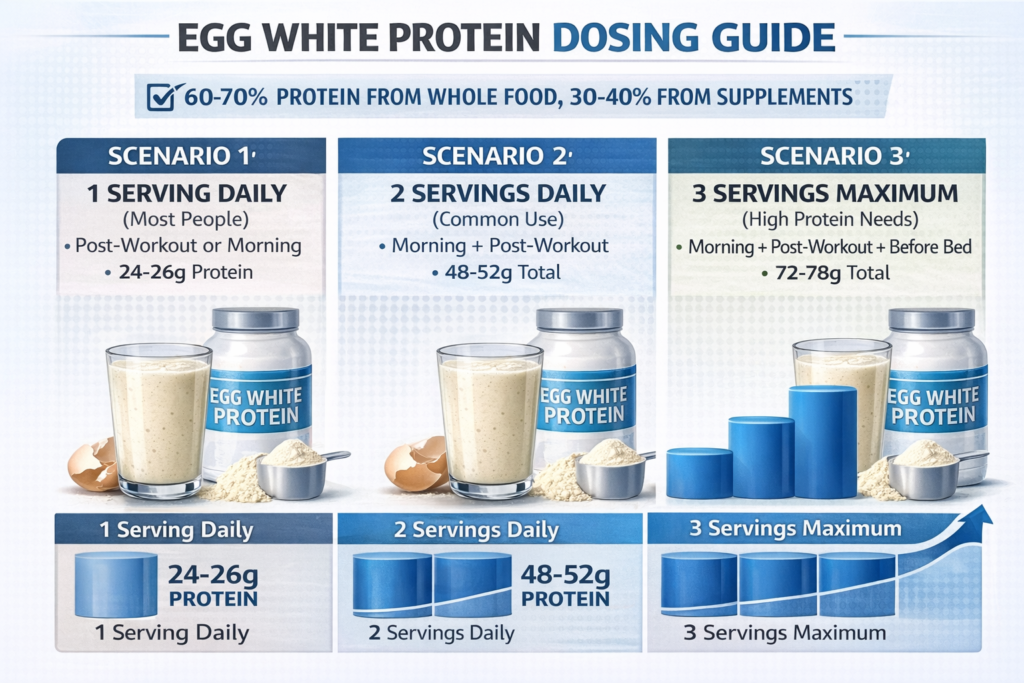
Egg white protein should supplement your diet, not replace whole food protein sources.
How Many Times Per Day Can You Take Egg White Protein?
Frequency matters for total intake and convenience.
Recommended Frequency: 1-3 Servings Daily
Most people: 1-2 servings
Typical use cases:
One serving daily:
- Post-workout shake
- Morning shake if skipping breakfast
- Between-meal snack
- Before bed
Two servings daily:
- Morning + post-workout
- Post-workout + before bed
- Morning + afternoon snack
- Any combination fitting your schedule
Three servings daily:
- Morning, post-workout, before bed
- Useful for very high protein needs
- Common for people over 200 pounds bulking
- Should still prioritize whole food for other meals
Why Not More Than 3 Servings?
Whole food should provide the majority of your nutrition.
Problems with excessive supplement use:
Nutritional deficiency:
- Whole foods provide vitamins, minerals, fiber, phytonutrients
- Supplements don’t replace complete nutrition
- Relying too heavily on powders creates gaps
Digestive issues:
- Too much supplemental protein can cause bloating, gas
- Whole food is easier on digestion when consumed throughout day
- Balance is important
Cost:
- Supplements are more expensive per gram of protein than many whole foods
- Chicken, eggs, Greek yogurt often cheaper
- Better to save money on whole food and supplement strategically
Sustainable habits:
- Learning to eat adequate whole food protein is important long-term
- Supplements should support diet, not replace it
- Building good eating habits matters
Aim for 60-70% of daily protein from whole food, 30-40% from supplements maximum.
Practical Timing Strategies for Different Goals
Here’s how to actually use egg white protein based on your specific situation.
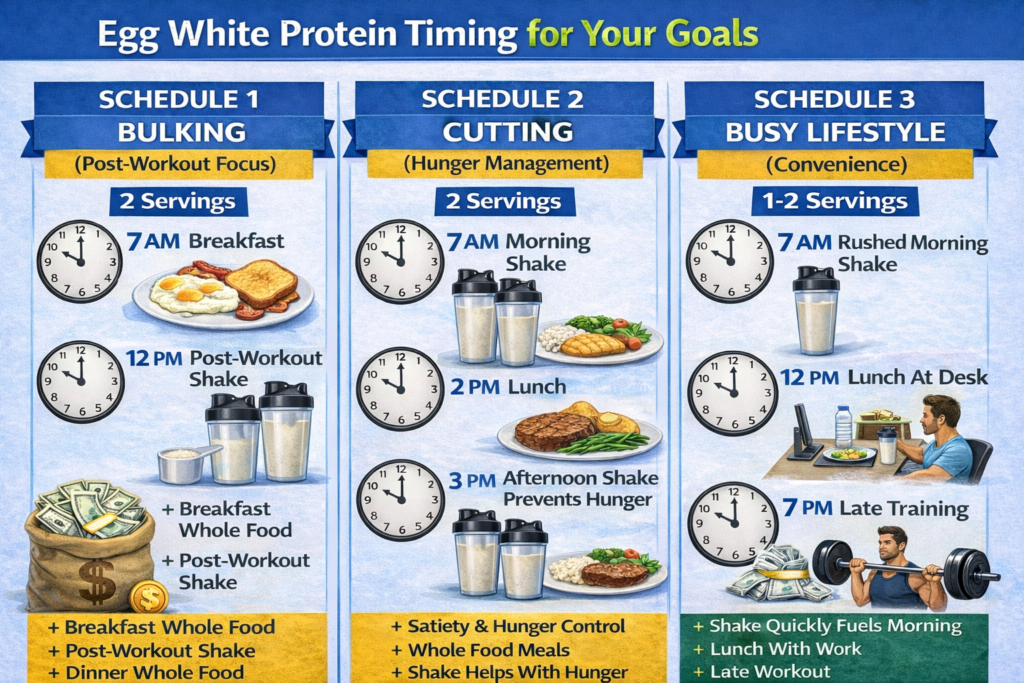
Strategy 1: For Muscle Building (Bulking)
Goal: Maximize muscle protein synthesis, ensure adequate total protein
Recommended approach:
Option A: Post-workout focused
- Breakfast: Whole food protein (eggs, Greek yogurt, etc.)
- Lunch: Whole food protein (chicken, fish, etc.)
- Post-workout (4 PM): Egg white protein shake
- Dinner: Whole food protein
- Before bed: Casein or egg white protein (optional)
Option B: Convenience morning + post-workout
- Morning (7 AM): Egg white protein shake (convenient, fast)
- Lunch: Whole food protein
- Post-workout (5 PM): Egg white protein shake
- Dinner: Whole food protein
Option C: Distributed throughout day
- Breakfast: Whole food
- Mid-morning (10 AM): Egg white protein
- Lunch: Whole food
- Afternoon (3 PM): Egg white protein
- Dinner: Whole food
All three strategies work if total daily protein is adequate (0.8-1g per pound).
Strategy 2: For Fat Loss (Cutting)
Goal: Preserve muscle, control hunger, maintain high protein despite caloric deficit
Recommended approach:
Option A: Strategic hunger management
- Breakfast: Egg white protein shake (low calorie, high protein)
- Lunch: Whole food protein (satiating solid meal)
- Afternoon snack (3 PM): Egg white protein (prevents hunger before dinner)
- Dinner: Whole food protein
Option B: Pre-workout fasted training
- Morning training (6 AM): Fasted
- Post-workout (7 AM): Egg white protein shake
- Lunch: Whole food
- Dinner: Whole food
Option C: Protein distribution
- Breakfast: Whole food
- Lunch: Whole food
- Post-workout: Egg white protein
- Dinner: Light or skip
- Before bed: Egg white protein (prevents overnight hunger)
Key for cutting: High protein (1.0-1.2g per pound) preserves muscle. Timing is secondary to total intake.
Strategy 3: For Busy Schedules
Goal: Convenience, ensure adequate protein despite time constraints
Recommended approach:
The rushed morning:
- Wake at 6:30 AM
- Egg white protein shake at 6:45 AM (fast, portable)
- Drink in car during commute
- Ensures protein intake despite no time for breakfast
The busy workday:
- Breakfast: Whole food
- Lunch at desk (12 PM): Egg white protein shake (no need to leave office)
- Afternoon: Whole food snack if possible
- Dinner: Whole food
The late training schedule:
- Work until 6 PM
- Quick egg white protein shake at 6:15 PM (pre-workout fuel)
- Train 7-8:30 PM
- Late dinner at 9 PM: Whole food
- This ensures protein around training despite late schedule
Common Questions About Egg White Protein Timing
Can I take egg white protein on an empty stomach?
Yes, absolutely.
Egg white protein is gentle on the stomach for most people. Taking it fasted (morning or pre-workout) is fine.
Some people experience:
- Mild nausea if sensitive
- Better tolerance with small amount of food
If you’re sensitive: Have with a piece of fruit or small snack.
Should I take egg white protein with food or separately?
Both work fine. Your choice.
With food:
- May digest slightly slower (not necessarily bad)
- Provides complete meal nutrition
- Can blend into oatmeal, smoothies, etc.
Separately:
- Faster to consume
- Convenient between meals
- Easier to track macros precisely
Doesn’t significantly affect results either way.
Is egg white protein good before bed?
Yes, it’s a decent pre-sleep option.
Digestion speed: Moderate (3-5 hours)
- Not as fast as whey (1-2 hours)
- Not as slow as casein (6-8 hours)
- Provides amino acids for first half of sleep
Ideal pre-sleep combination:
- Mix egg white protein with casein
- Or use egg white protein if you don’t have casein
- Provides both medium and slow-release protein
How long before a workout should I take egg white protein?
60-90 minutes before training is optimal.
Timing breakdown:
60 minutes before:
- Allows digestion to begin
- Amino acids becoming available as you train
- Won’t cause stomach discomfort during training
90-120 minutes before:
- Even better for people with sensitive digestion
- Ensures complete digestion before intense training
30 minutes before:
- Might cause stomach discomfort during training
- Not enough time for proper digestion
- Only if you have very strong stomach
How soon after a workout should I take it?
Within 2-3 hours is fine. 30-60 minutes is convenient but not critical.
The “anabolic window” truth:
- Not as narrow as once thought
- Having protein within several hours post-workout is sufficient
- Immediate post-workout timing provides minimal additional benefit
Practical approach:
- Right after training: Convenient, effective
- 30-60 minutes after: Also perfect
- 90-120 minutes after: Still fine
- 3+ hours after: Start to lose the benefits
Don’t stress if you can’t get protein immediately post-workout.
The Bottom Line: Timing Is Secondary to Total Intake
After examining all the evidence:
The truth about egg white protein timing:
✅ Total daily protein matters most (0.7-1.2g per pound based on goals)
✅ Timing provides minimal additional benefit when total intake is adequate
✅ Spread protein throughout the day (every 3-5 hours optimal)
✅ Have protein around training (pre, post, or both) for small advantage
✅ Use egg white protein whenever convenient (it’s flexible)
What doesn’t matter as much as you think:
- Exact timing to the minute
- Pre vs. post-workout (both work)
- Morning vs. evening (total daily intake matters more)
- With food vs. alone (personal preference)
What actually matters:
- Consuming adequate total daily protein consistently
- Training hard with progressive overload
- Eating well overall
- Getting adequate sleep
- Being patient with the process
Recommended approach for 95% of people:
Step 1: Calculate total daily protein needs
- Bulking/maintaining: 0.7-1.0g per pound
- Cutting: 1.0-1.2g per pound
Step 2: Plan protein distribution
- 4-5 meals/snacks daily
- Each containing 20-40g protein
- Spread relatively evenly
Step 3: Use egg white protein strategically
- 1-2 servings daily
- Whenever whole food isn’t convenient
- Around training if desired
- Fill gaps between meals
Step 4: Stop obsessing over precise timing
- Hit total daily protein consistently
- That’s 95% of what matters
- Perfect timing might add 5% benefit at most
FOCUS ON TOTAL INTAKE. TIME IT CONVENIENTLY. GET RESULTS.
Ready to optimize your entire protein and nutrition strategy for maximum muscle building without overcomplicating the details? Egg white protein timing is just one small piece of effective nutrition. Get a complete guide to calculating your exact protein needs, choosing the right protein sources, timing your meals optimally, and building serious muscle with a simple, sustainable approach. Stop stressing over minor details. Start focusing on what actually drives results.

Leave a Reply
You must be logged in to post a comment.