Confused about the difference between regular caffeine and anhydrous caffeine? Here’s the science-backed truth about which form gives you better results.
Walk into any supplement store and you’ll see dozens of pre-workout products, fat burners, and energy supplements.
Some list “caffeine” on the label. Others specify “anhydrous caffeine.” Some just say “proprietary energy blend.”
What’s the difference? Does it matter which form you take?
Coffee drinkers swear by their morning cup. Pre-workout users claim supplements hit harder and faster. Energy drink fans say their choice is superior.
Who’s right?
Here’s the short answer: Anhydrous caffeine is a dehydrated, concentrated form of caffeine found in supplements, while regular caffeine is found naturally in coffee and tea with water content. Anhydrous caffeine absorbs faster and provides more precise dosing, but both forms deliver the same core benefits.
In this comprehensive guide, I’ll explain exactly what caffeine is and how it works, reveal the real differences between regular and anhydrous caffeine, compare their effects on performance and fat loss, show you which form is better for different goals, and help you use caffeine safely and effectively.
Let’s separate marketing hype from scientific reality.
TABLE OF CONTENTS
- Is anhydrous caffeine "unnatural" or unsafe?
- Can I take anhydrous caffeine every day?
- Will anhydrous caffeine dehydrate me more than coffee?
- Does coffee work better because of the antioxidants?
- Can I mix anhydrous caffeine with coffee?
- Does anhydrous caffeine cause more crashes?
- Is caffeine from green tea different because of L-theanine?
- The Bottom Line: Both Work, Choose Based on Your Needs
Caffeine Basics: How This Powerful Stimulant Works
Before comparing forms, you need to understand what caffeine actually does in your body.
What Caffeine Is
Caffeine is a natural stimulant belonging to a class of compounds called methylxanthines.
It’s found naturally in:
- Coffee beans
- Tea leaves
- Cacao beans
- Guarana berries
- Yerba mate
- Kola nuts
Humans have consumed caffeine for thousands of years, making it the world’s most widely used psychoactive substance.
How Caffeine Works in Your Body
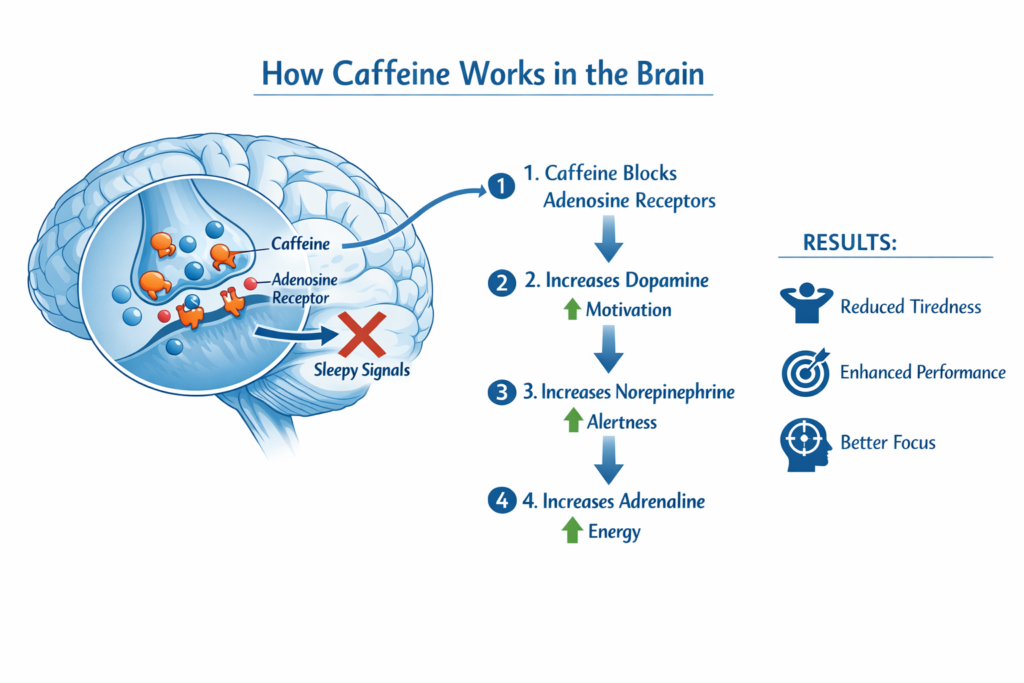
The primary mechanism: Caffeine blocks adenosine receptors in your brain.
What’s adenosine?
Adenosine is a neurotransmitter that accumulates throughout the day, binding to receptors and promoting relaxation and sleepiness. The longer you’re awake, the more adenosine builds up, making you progressively more tired.
What caffeine does:
Caffeine has a similar molecular structure to adenosine, allowing it to bind to adenosine receptors and block them. This prevents adenosine from doing its job.
The result:
- Reduced feelings of tiredness
- Increased alertness and wakefulness
- Enhanced mental clarity
But there’s more. By blocking adenosine, caffeine also triggers a cascade of other effects:
Increased dopamine: Enhanced mood, motivation, and focus.
Increased norepinephrine: Greater arousal, attention, and stress response.
Increased adrenaline (epinephrine): Elevated heart rate, blood pressure, and energy availability.
Enhanced neurotransmitter activity: Better neuronal firing and communication.
The Performance and Fat Loss Effects
Beyond just waking you up, caffeine provides several performance benefits:
Enhanced athletic performance:
- Increased strength and power output
- Improved endurance capacity
- Reduced perceived exertion (exercise feels easier)
- Delayed fatigue onset
- Better focus and motivation during training
Fat loss support:
- Increased metabolic rate (thermogenesis)
- Enhanced fat oxidation (using fat for energy)
- Appetite suppression
- Greater energy expenditure
Cognitive benefits:
- Improved focus and concentration
- Better reaction time
- Enhanced memory and learning
- Increased mental energy
This is why caffeine is the number one ingredient in pre-workout supplements, fat burners, and energy drinks.
What Is Anhydrous Caffeine?
Now let’s examine what makes anhydrous caffeine different.
The Definition
“Anhydrous” literally means “without water.”
Anhydrous caffeine is caffeine that has had all water content removed, resulting in a pure, concentrated, crystalline powder.
How Anhydrous Caffeine Is Made
The production process:
1. Extraction: Caffeine is extracted from natural sources (usually coffee beans or tea leaves).
2. Purification: The extracted caffeine is purified to remove other compounds.
3. Dehydration: All water is removed through a drying process, leaving pure caffeine crystals.
4. Processing: The crystals are ground into a fine white powder.
The result: A powder that is approximately 100% pure caffeine by weight.
Where You Find Anhydrous Caffeine
Anhydrous caffeine appears in:
Pre-workout supplements: Nearly all pre-workouts use anhydrous caffeine for precise dosing.
Fat burners: Most thermogenic supplements contain anhydrous caffeine.
Energy supplements: Caffeine pills and capsules use anhydrous form.
Caffeine powder: Pure anhydrous caffeine sold as bulk powder (use with extreme caution).
Some energy drinks: A few use anhydrous caffeine instead of natural sources.
You rarely find anhydrous caffeine in natural food or beverages because it’s a processed, isolated compound.
Regular Caffeine vs Anhydrous Caffeine: The Real Differences
Let’s compare these forms across every relevant factor.
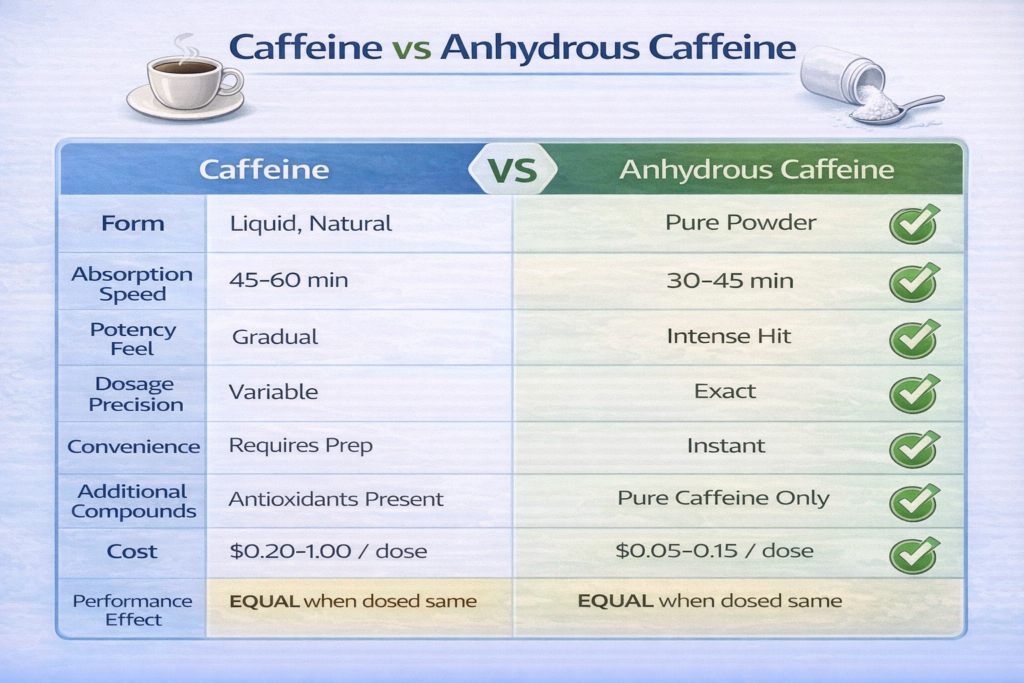
Difference 1: Form and Composition
Regular caffeine (from coffee, tea, etc.):
- Exists in liquid form mixed with water
- Contains caffeine plus other compounds (antioxidants, polyphenols, etc.)
- Variable caffeine concentration
- Includes natural plant compounds that may affect absorption
Anhydrous caffeine:
- Pure, crystalline powder
- 100% caffeine by weight (no water)
- Precise, consistent concentration
- Isolated compound with no other plant substances
Does this matter? Only for dosing precision and absorption speed (covered below).
Difference 2: Absorption Speed
This is where the most significant difference appears.
Regular caffeine (coffee, tea):
- Must be digested along with liquid and other compounds
- Absorption is somewhat slower and more gradual
- Peak blood levels reached in approximately 45-60 minutes
- Effects build gradually
Anhydrous caffeine (supplements):
- Pure compound absorbed more rapidly
- Fewer substances to process
- Peak blood levels reached in approximately 30-45 minutes
- Effects hit faster and more noticeably
Practical difference:
Anhydrous caffeine taken 30 minutes pre-workout will peak right when you start training. Coffee consumed 30 minutes pre-workout might peak mid-workout.
However, the difference is modest (15-30 minutes), not dramatic.
Difference 3: Potency and Intensity
Anhydrous caffeine feels more potent for two reasons:
Reason 1: Concentration
You’re consuming pure caffeine with no dilution. 200mg of anhydrous caffeine delivers exactly 200mg of caffeine to your system.
Coffee with “200mg of caffeine” delivers 200mg plus water, oils, acids, and other compounds that may slightly affect absorption and perception.
Reason 2: Faster absorption
The quicker absorption creates a more noticeable “hit” of energy and alertness.
Important note: The total effect over several hours is similar. Anhydrous just front-loads the experience more.
Difference 4: Precise Dosage Control
This is anhydrous caffeine’s biggest practical advantage.
Regular caffeine (coffee, tea):
- Caffeine content varies significantly
- One cup of coffee can range from 80-200mg depending on brew method, bean type, and serving size
- Difficult to dose precisely
- Variability between servings
Anhydrous caffeine (supplements):
- Exact dosage on label (e.g., 200mg)
- Consistent from dose to dose
- Easy to adjust precisely (add or remove 50mg, 100mg, etc.)
- Reliable effects
Why this matters:
Finding your optimal caffeine dose requires consistency. With anhydrous caffeine, you know exactly what you’re getting. With coffee, you’re guessing.
Difference 5: Convenience and Practicality
Regular caffeine:
- Requires liquid consumption (coffee, tea, energy drink)
- Takes time to brew (coffee) or steep (tea)
- Must consume volume of liquid
- Temperature considerations (hot vs. cold)
- Need access to preparation equipment
Anhydrous caffeine:
- Capsule or powder form (no liquid needed)
- Instant consumption (swallow pill with water)
- Portable (take anywhere)
- No preparation required
- No equipment needed
Practical advantage: Anhydrous caffeine in supplement form is dramatically more convenient, especially for pre-workout use.
However, some people enjoy the ritual and taste of coffee, which has value beyond pure caffeine delivery.
Difference 6: Additional Compounds
Regular caffeine sources contain other beneficial compounds:
Coffee contains:
- Antioxidants (chlorogenic acids)
- Polyphenols
- Diterpenes
- Minerals (magnesium, potassium)
Tea contains:
- L-theanine (promotes calm focus when combined with caffeine)
- Catechins (antioxidants)
- Polyphenols
- Various minerals
These additional compounds may provide health benefits and can affect how you feel.
Example: Green tea’s L-theanine smooths out caffeine’s stimulant effects, reducing jitteriness while maintaining focus.
Anhydrous caffeine:
- Pure caffeine only
- No additional beneficial compounds
- No “smoothing” effects from other substances
Trade-off: You get precise caffeine delivery but miss potential synergistic benefits from other plant compounds.
Difference 7: Cost
Regular caffeine:
- Coffee: $0.20-1.00+ per serving (depending on quality and preparation)
- Tea: $0.10-0.50 per serving
- Energy drinks: $2-4 per serving
Anhydrous caffeine:
- Pure caffeine pills: $0.05-0.15 per 200mg serving
- Pre-workout supplements: $0.50-2.00 per serving (includes other ingredients)
- Bulk powder: $0.02-0.05 per 200mg serving
Anhydrous caffeine in pill form is dramatically cheaper than coffee or energy drinks for equivalent caffeine content.
Difference 8: Effectiveness for Performance
Here’s the critical question: Does one form work better for training and fat loss?
The research shows: When caffeine dosage is equalized, anhydrous and regular caffeine provide essentially the same performance benefits.
Studies comparing different caffeine sources find:
- Similar strength improvements
- Similar endurance enhancements
- Similar fat oxidation increases
- Similar cognitive benefits
The difference: Anhydrous caffeine’s faster absorption might provide slightly better timing for pre-workout use, but the total effect is equivalent.
Bottom line: Both forms work. Choose based on preference, convenience, and desired timing.
Benefits of Anhydrous Caffeine vs Regular Caffeine
Let’s summarize when anhydrous offers practical advantages.
Advantage 1: Faster Onset of Effects
Anhydrous caffeine absorbs more quickly, providing effects 15-30 minutes sooner than coffee or tea.
Best for:
- Pre-workout supplementation (time your dose to peak during training)
- Situations requiring immediate alertness
- Time-sensitive performance needs
Advantage 2: Precise Dosing
Exact caffeine amount allows you to:
- Find your optimal dose through experimentation
- Maintain consistency
- Avoid accidental overconsumption
- Adjust dosage precisely based on tolerance
Best for:
- Optimizing performance
- Managing tolerance
- Sensitive individuals who need exact amounts
Advantage 3: Greater Potency and Intensity
Pure caffeine without dilution creates:
- More noticeable “kick”
- Stronger alertness sensation
- More pronounced energy boost
Best for:
- People who want maximum stimulation
- Those with high caffeine tolerance
- Intense training sessions
Advantage 4: Convenience
No preparation required. Swallow a pill and go.
Best for:
- Busy schedules
- Travel
- Pre-workout supplementation at the gym
- People who don’t enjoy coffee or tea
Advantage 5: No Liquid Volume
Don’t need to consume 8-16oz of liquid to get your caffeine.
Best for:
- People who don’t want liquids before training
- Those who get sloshed stomachs from pre-workout drinks
- Convenience when water isn’t readily available
Advantage 6: Cost-Effectiveness
Significantly cheaper per dose than coffee, tea, or energy drinks.
Best for:
- Budget-conscious users
- Daily caffeine consumers
- Those using caffeine as a tool rather than beverage experience
Side Effects: Is Anhydrous Caffeine More Dangerous?
Anhydrous caffeine shares the same side effects as regular caffeine, but with important considerations.
Common Caffeine Side Effects (Both Forms)
Mild to moderate side effects:
- Jitteriness and nervousness
- Increased heart rate
- Anxiety or restlessness
- Digestive discomfort
- Headaches
- Sleep disruption (if taken too late)
More serious side effects (high doses):
- Rapid heartbeat or palpitations
- High blood pressure
- Severe anxiety or panic
- Tremors
- Nausea and vomiting
Why Anhydrous Caffeine Can Be More Problematic
The concentration makes overdosing easier:
With coffee: Drinking enough coffee to overdose on caffeine would require consuming massive volumes of liquid, which is self-limiting.
With anhydrous powder: A small measuring error can result in dangerous doses. Just 1-2 tablespoons of pure anhydrous caffeine powder can contain 10,000-20,000mg (potentially lethal dose).
Important safety note: Pure anhydrous caffeine powder (sold in bulk) is extremely dangerous and has caused deaths. Never use bulk caffeine powder without precise measuring equipment.
Capsules and tablets are much safer because dosing is pre-measured.
Caffeine Tolerance and Dependence
Both forms can lead to:
Tolerance: Needing progressively higher doses for the same effect.
Dependence: Physical reliance on caffeine to feel normal.
Withdrawal symptoms when stopping:
- Severe headaches
- Fatigue and low energy
- Irritability and mood changes
- Difficulty concentrating
- Flu-like symptoms
These symptoms typically peak 1-2 days after stopping and resolve within 5-7 days.
Safe Caffeine Usage Guidelines
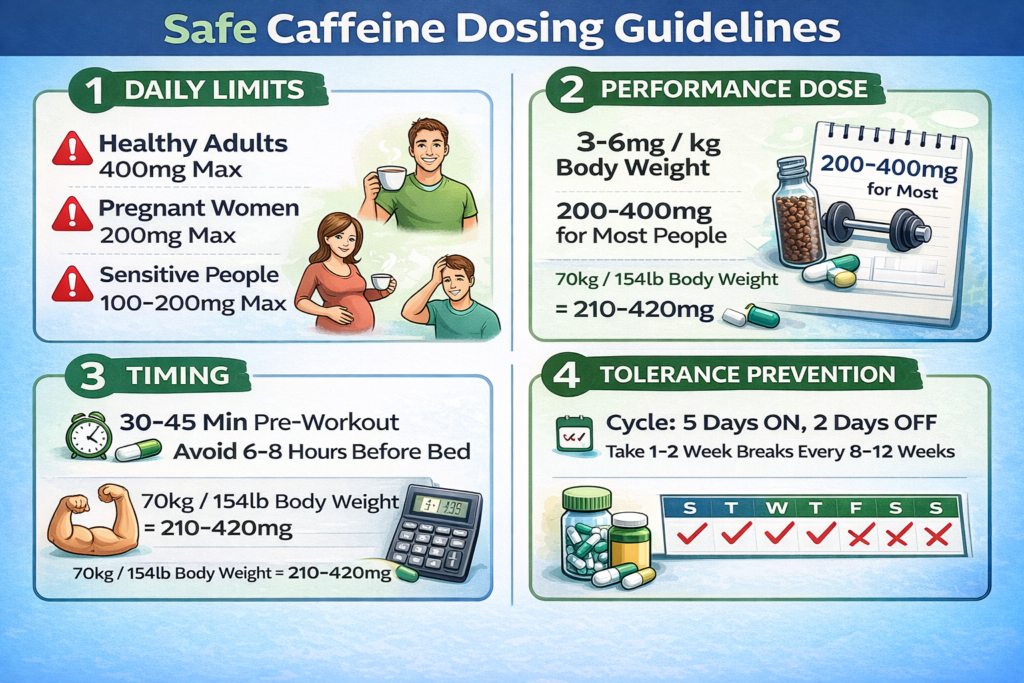
Recommended maximum intake:
- Healthy adults: Up to 400mg daily
- Sensitive individuals: 200mg or less daily
- Pregnant women: Limit to 200mg daily (consult doctor)
For performance and fat loss:
- Effective dose: 3-6mg per kg of body weight (approximately 200-400mg for most people)
- Pre-workout timing: 30-45 minutes before training
To avoid tolerance:
- Cycle caffeine use (e.g., 5 days on, 2 days off)
- Take periodic breaks (1-2 weeks every 8-12 weeks)
- Use minimum effective dose, not maximum
To avoid side effects:
- Start with lower doses (100-200mg) to assess tolerance
- Don’t combine multiple caffeine sources without accounting for total intake
- Avoid caffeine within 6-8 hours of bedtime
- Stay hydrated
- Don’t use on empty stomach if it causes digestive issues
Which Form Should You Choose?
The decision depends on your priorities and preferences.
Choose Regular Caffeine (Coffee, Tea) If:
✅ You enjoy the taste and ritual of coffee or tea
✅ You want additional antioxidants and beneficial compounds
✅ You prefer a more gradual, smooth energy increase
✅ You’re not concerned about precise dosing
✅ You have time to prepare and consume beverages
✅ You want the social aspect of coffee/tea drinking
✅ You’re sensitive to caffeine and prefer lower, variable doses
Choose Anhydrous Caffeine If:
✅ You want precise, consistent dosing
✅ You need faster onset of effects
✅ Convenience is a priority
✅ You’re using it specifically for pre-workout supplementation
✅ You don’t enjoy coffee or tea taste
✅ You want the most cost-effective option
✅ You need portable caffeine for travel
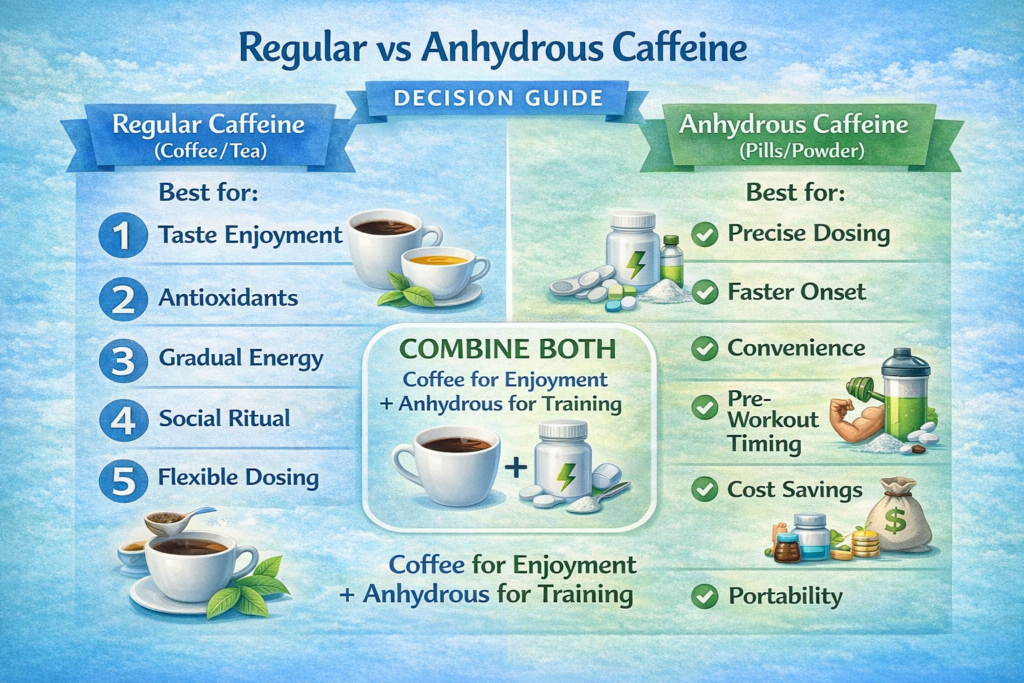
Consider Combining Both
Many people use both forms strategically:
Example 1:
- Morning: Coffee for enjoyment and gradual wake-up
- Pre-workout: Anhydrous caffeine (pill or pre-workout) for precise timing and dosing
Example 2:
- Workdays: Coffee throughout the day
- Training days: Anhydrous caffeine 30 minutes pre-workout
Example 3:
- Most days: Green tea for L-theanine + caffeine synergy
- Intense training: Anhydrous caffeine for maximum effect
There’s no rule against using both. Just track total daily caffeine intake to avoid exceeding safe limits.
How to Use Anhydrous Caffeine Effectively
If you choose anhydrous caffeine, here’s how to use it optimally.
Finding Your Optimal Dose
Start low and adjust:
Week 1: Start with 100-150mg to assess tolerance
Week 2-3: If well-tolerated, increase to 200mg
Week 4+: Adjust based on response:
- If 200mg works well, stay there
- If you need more effect, increase to 300mg
- If you’re sensitive, reduce to 150mg or less
Never exceed 400mg from a single dose or 600mg total daily from all sources.
Timing for Different Goals
Pre-workout (strength/hypertrophy training):
- Take 30-45 minutes before training
- Dose: 3-6mg per kg body weight (200-400mg for most)
- Peaks right when you start lifting
Pre-workout (endurance training):
- Take 45-60 minutes before training
- Dose: 3-6mg per kg body weight
- Endurance activities may benefit from slightly earlier timing
For fat loss:
- Morning dose: 200mg upon waking (boosts metabolism)
- Pre-workout dose: 200mg before training
- Total daily: 300-400mg
For cognitive performance:
- As needed for focus and alertness
- Dose: 100-200mg
- Effects last 3-6 hours
Avoid caffeine within 6-8 hours of bedtime to prevent sleep disruption.
Choosing Quality Anhydrous Caffeine
What to look for:
In standalone caffeine pills:
- Pure caffeine anhydrous (no unnecessary additives)
- USP or third-party tested for purity
- Clear dosage labeling (typically 100mg or 200mg per capsule)
- Reputable brand
In pre-workout supplements:
- Transparent label showing exact caffeine amount
- Anhydrous caffeine (not proprietary blends)
- Reasonable dosage (200-300mg, not 400-500mg)
- Quality additional ingredients (if present)
Avoid:
- Bulk caffeine powder (too dangerous for most people)
- Products with undisclosed caffeine amounts
- Extremely high doses (500mg+ per serving)
- Products combining multiple stimulants without clear labeling
Cycling to Prevent Tolerance
Effective cycling strategies:
Strategy 1: Weekend breaks
- Use caffeine Monday-Friday
- No caffeine Saturday-Sunday
- Maintains sensitivity
Strategy 2: Periodic resets
- Use caffeine for 8-12 weeks
- Take 1-2 weeks completely off
- Resets tolerance significantly
Strategy 3: Dose variation
- Vary doses throughout the week
- High dose (300mg) on heavy training days
- Lower dose (100-200mg) on other days
- No caffeine on rest days
Common Questions About Caffeine Forms
Is anhydrous caffeine “unnatural” or unsafe?
No. Anhydrous caffeine is chemically identical to caffeine from coffee or tea. It’s just isolated and concentrated. The molecular structure is the same.
Can I take anhydrous caffeine every day?
Yes, within safe limits (up to 400mg daily for most people). However, cycling is recommended to prevent tolerance.
Will anhydrous caffeine dehydrate me more than coffee?
No. The “anhydrous” designation means the caffeine powder itself contains no water, not that it dehydrates you. Both forms have similar diuretic effects (mild at moderate doses).
Does coffee work better because of the antioxidants?
For pure performance, no significant difference. The antioxidants in coffee provide health benefits but don’t meaningfully enhance the performance effects of caffeine.
Can I mix anhydrous caffeine with coffee?
Yes, but be careful with total dosage. If you take a 200mg caffeine pill and drink a large coffee (150mg), you’ve consumed 350mg total. Track your total intake.
Does anhydrous caffeine cause more crashes?
The “crash” feeling depends more on dosage than form. High doses of any caffeine form can lead to more pronounced crashes. Moderate doses typically don’t cause severe crashes.
Is caffeine from green tea different because of L-theanine?
Yes, this creates a unique effect. L-theanine in green tea promotes calm focus and can reduce caffeine’s jittery side effects. This is a genuine advantage of tea over pure anhydrous caffeine.
You can replicate this by taking L-theanine (100-200mg) with anhydrous caffeine.
The Bottom Line: Both Work, Choose Based on Your Needs
After examining all the evidence:
Anhydrous caffeine and regular caffeine are equally effective for:
- Enhancing athletic performance
- Supporting fat loss
- Improving cognitive function
- Increasing energy and alertness
The differences are practical, not fundamental:
Anhydrous caffeine wins on:
- Precision of dosing
- Convenience
- Speed of absorption
- Cost-effectiveness
- Portability
Regular caffeine (coffee, tea) wins on:
- Taste and enjoyment
- Additional health compounds
- Gradual, smooth effects
- Social and ritual aspects
- Natural source appeal
What actually matters:
- Using an effective dose (3-6mg per kg body weight for performance)
- Timing it appropriately (30-45 min pre-workout)
- Not exceeding safe limits (400mg daily maximum)
- Managing tolerance through cycling
- Choosing what you’ll actually use consistently
For most people pursuing fitness goals: Anhydrous caffeine in pill or pre-workout form provides superior convenience and precision.
For people who love coffee: Keep enjoying it, just be aware of dosing variability and timing.
You can also use both strategically for different situations.
Stop overthinking the form. Focus on using caffeine intelligently as one tool in your training and nutrition arsenal.
CHOOSE YOUR FORM. TIME IT RIGHT. MAXIMIZE YOUR PERFORMANCE.
Ready to optimize every aspect of your supplementation for maximum results? Caffeine is just one piece of an effective supplement stack. Get a complete, science-based guide to which supplements actually work, how to use them optimally, which are complete wastes of money, and how to build an effective stack without breaking the bank. Stop guessing. Start knowing what delivers real results.
Leave a Reply
You must be logged in to post a comment.