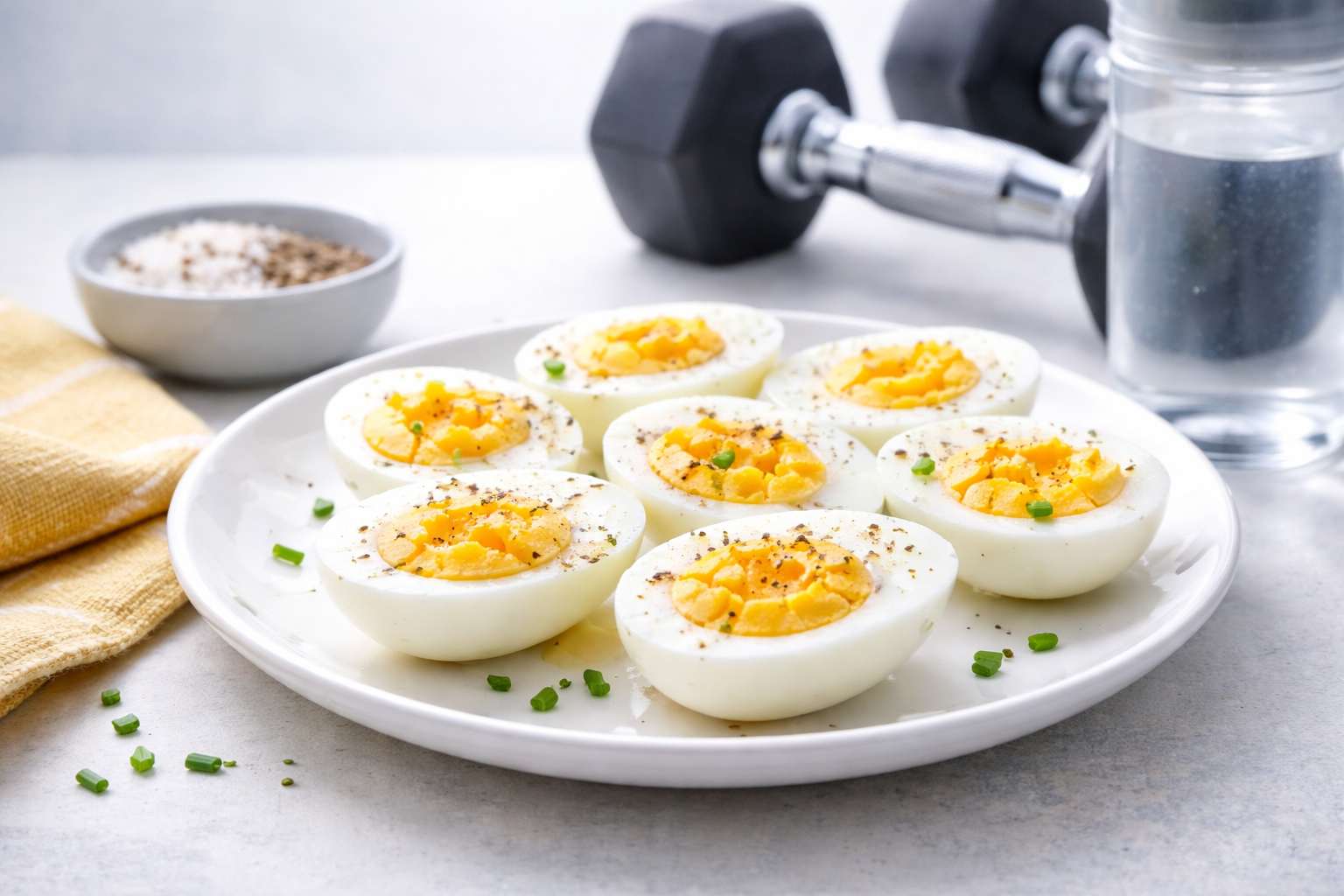
Wondering if eggs make a good pre-workout meal? Here’s the complete truth about benefits, drawbacks, and best practices.
You’re planning your pre-workout meal. Eggs are nutritious, high in protein, and readily available.
But should you eat them before training?
You’ve heard conflicting advice:
- “Eggs are perfect pre-workout protein”
- “The fat will make you sluggish”
- “You need carbs, not protein”
- “Eggs will sit heavy in your stomach”
So what’s the real answer? Do eggs work pre-workout or not?
Here’s the evidence-based truth: Yes, you can eat eggs before a workout, and they provide high-quality protein (6g per egg) and sustained energy. However, the fat content in yolks (5g per whole egg) slows digestion, which can cause fullness or discomfort if eaten too close to training or in large quantities. The ideal approach is 1-2 whole eggs or 3-4 egg whites eaten 1-2 hours before training, preferably combined with carbohydrates for optimal performance.
In this comprehensive guide, I’ll explain exactly why eggs can work pre-workout (and when they don’t), reveal the complete nutritional breakdown and how it affects training, show you the optimal timing and portion sizes to prevent digestive issues, provide the best preparation methods for pre-workout egg consumption, and help you decide when to choose eggs versus faster-digesting alternatives.
Whether you’re training for strength, muscle building, or fat loss, this article will clarify egg usage before workouts.
Let’s optimize your pre-workout nutrition.
Are Eggs a Good Pre-Workout Food?
The nuanced answer with important context.
The Short Answer: Good But Not Perfect
Eggs provide benefits but have limitations for pre-workout use.
What eggs provide:
- High-quality protein (6g per egg)
- Complete amino acid profile
- Healthy fats (5g per whole egg)
- Vitamins and minerals
- Sustained energy release
What eggs lack:
- Carbohydrates (only 0.6g per egg)
- Quick energy for training
- Fast digestion (fat slows absorption)
The verdict: Eggs are a good protein source but incomplete as a standalone pre-workout meal. They work best when combined with carbohydrate sources.
Why Eggs Can Work Pre-Workout
Specific advantages when used correctly.
Advantage 1: High-quality protein prevents muscle breakdown
Protein content:
- 6g protein per large egg
- Complete amino acid profile
- All nine essential amino acids
- High biological value (100)
Pre-workout protein benefits:
- Reduces muscle protein breakdown during training
- Provides amino acids for muscle repair
- Supports muscle protein synthesis
- Prevents catabolic state
Research shows:
- Pre-workout protein reduces exercise-induced muscle damage
- Supports recovery processes
- May enhance muscle building when combined with post-workout protein
- Eggs provide this benefit
Advantage 2: Sustained energy from healthy fats
Fat content (whole eggs):
- 5g fat per large egg
- Primarily unsaturated (healthy fats)
- Provides sustained energy
- Slows carb absorption (if carbs present)
Why this can be beneficial:
- Longer-lasting energy
- Stable blood sugar
- No crash during workout
- Supports hormone production
Advantage 3: Nutrient density
Vitamins and minerals per egg:
- Vitamin A: 270 IU (eye health, immune function)
- Vitamin D: 41 IU (bone health, testosterone support)
- Vitamin B12: 0.6 mcg (energy metabolism)
- Iron: 0.9mg (oxygen transport)
- Selenium: 15.4mcg (antioxidant function)
Why nutrients matter:
- Support energy metabolism
- Aid recovery processes
- Optimize body function
- Overall health support
Advantage 4: Satiety and appetite control
Protein and fat combination:
- Highly satiating
- Prevents hunger during workout
- Reduces urge to overeat after training
- Supports fat loss goals
Research evidence:
- High-protein breakfast reduces daily calorie intake
- Eggs increase satiety more than many alternatives
- Can support weight management
- Useful for cutting phases
Why Eggs Have Limitations Pre-Workout
Understanding the drawbacks prevents mistakes.
Limitation 1: Fat slows digestion
The digestive issue:
- Fat takes 3-4 hours to fully digest
- Delays stomach emptying
- Can feel heavy or full
- Blood diverted to digestion instead of muscles
When this becomes a problem:
- Eating too close to training (<60 minutes)
- Consuming too many eggs (3+ whole eggs)
- High-intensity training (feels uncomfortable)
- Individual digestive sensitivity
The solution:
- Eat 1-2 hours before training (not closer)
- Limit to 1-2 whole eggs
- Or use egg whites only (no fat)
- Know your tolerance
Limitation 2: Lack of carbohydrates
The carb problem:
- Eggs: 0.6g carbs per egg (negligible)
- Training requires glucose for energy
- Protein and fat don’t provide quick fuel
- Performance may suffer
What the research shows:
- Carbs improve high-intensity performance
- Protein alone insufficient for energy
- Fat provides sustained but not quick energy
- Carbs are the primary fuel for training
The solution:
- Combine eggs with carb sources
- Toast, oatmeal, rice, fruit
- Complete pre-workout nutrition
- Optimize performance
Limitation 3: Potential digestive discomfort
Individual variation:
- Some people tolerate eggs well pre-workout
- Others experience bloating, gas, or discomfort
- Varies by preparation method
- Personal tolerance matters
Risk factors for discomfort:
- Eating too many eggs
- Training too soon after eating
- Fried in excessive oil
- Individual sensitivity
Complete Nutritional Breakdown of Eggs
Understanding what you’re actually consuming.
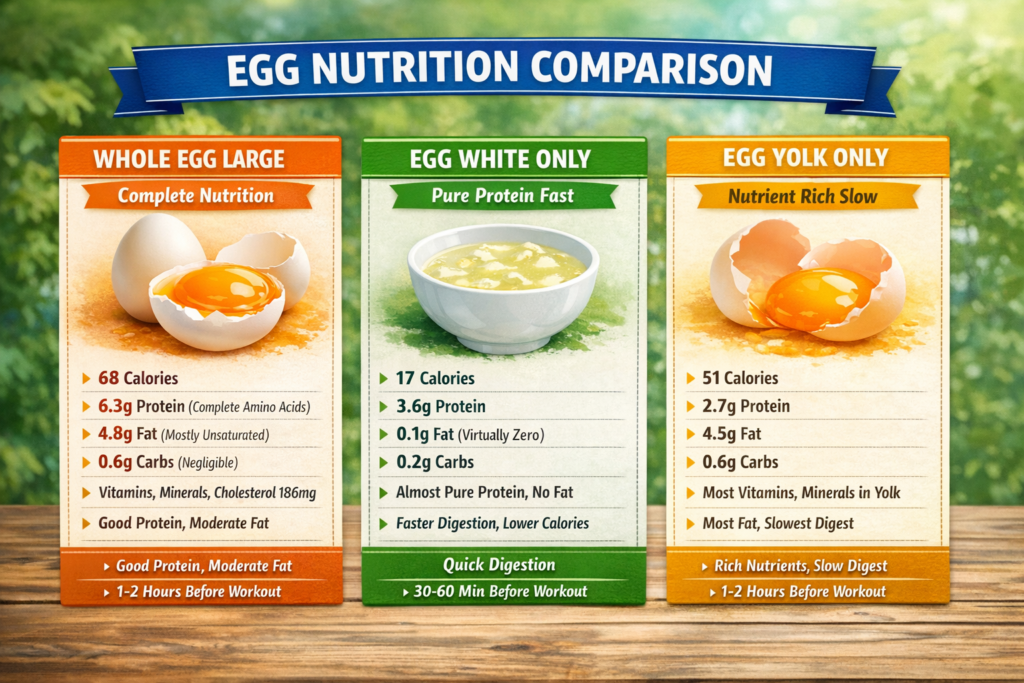
Whole Egg (Large, 50g)
Macronutrients:
- Calories: 68
- Protein: 6.3g
- Fat: 4.8g (mostly unsaturated)
- Carbohydrates: 0.6g
- Fiber: 0g
Micronutrients:
- Cholesterol: 186mg
- Sodium: 65mg
- Potassium: 69mg
- Calcium: 25mg
- Iron: 0.9mg
- Vitamin A: 270 IU
- Vitamin D: 41 IU
- Vitamin B12: 0.6mcg
What this means pre-workout:
- Good protein source
- Moderate fat (slows digestion)
- No carbs (need to add)
- Nutrient-dense
Egg White Only (Large)
Macronutrients:
- Calories: 17
- Protein: 3.6g
- Fat: 0.1g (virtually zero)
- Carbohydrates: 0.2g
Key difference:
- Almost pure protein
- No fat (faster digestion)
- Lower calories
- Less nutrients than whole egg
Pre-workout implications:
- Digests faster than whole eggs
- Can eat closer to training
- Less filling
- Need more to match protein of whole eggs
Egg Yolk Only (Large)
Macronutrients:
- Calories: 51
- Protein: 2.7g
- Fat: 4.5g
- Carbohydrates: 0.6g
Nutrient concentration:
- Most vitamins and minerals in yolk
- Most fat in yolk
- Less protein than white
- Slowest to digest
Advantages of Eating Eggs Before Workout
The specific benefits when used correctly.
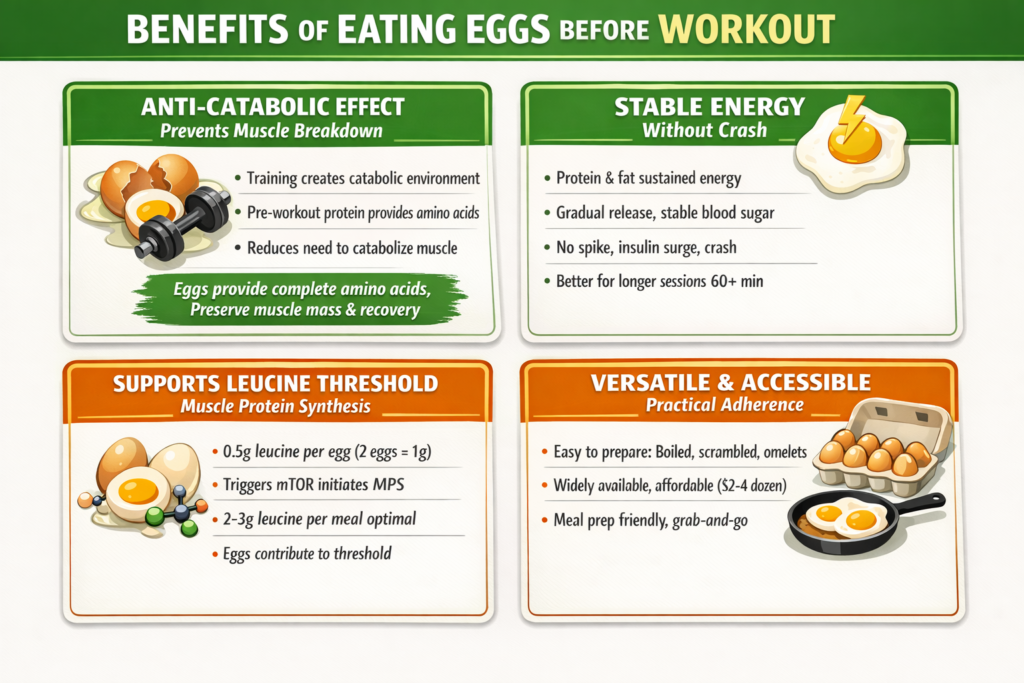
Advantage 1: Anti-Catabolic Effect
Prevents muscle breakdown during training.
The mechanism:
- Training creates catabolic environment
- Body can break down muscle for energy
- Pre-workout protein provides amino acids
- Reduces need to catabolize muscle
Research support:
- Studies show pre-workout protein reduces muscle damage markers
- Amino acid availability during training is beneficial
- Can support better recovery
- Eggs provide complete amino acids
Practical benefit:
- Preserve muscle mass (especially when cutting)
- Support muscle building
- Enhance recovery
- Long-term gains
Advantage 2: Stable Energy Without Crash
Unlike simple carbs, eggs won’t cause energy crashes.
The energy profile:
- Protein provides sustained energy
- Fat provides long-lasting fuel
- No blood sugar spike
- No insulin surge and crash
Comparison:
Simple carbs alone (candy, white bread):
- Quick spike
- Rapid crash
- Energy rollercoaster
- Poor for sustained training
Eggs (protein + fat):
- Gradual energy release
- Stable blood sugar
- No crash
- Better for longer sessions
Best for:
- Longer workouts (60+ minutes)
- Steady-state cardio
- Low to moderate intensity training
Advantage 3: Supports Leucine Threshold
Optimizes muscle protein synthesis.
Leucine content:
- ~0.5g leucine per egg
- 2 eggs = 1g leucine
- 3 eggs = 1.5g leucine
Why leucine matters:
- Triggers mTOR pathway
- Initiates muscle protein synthesis
- 2-3g leucine per meal optimal
- Eggs contribute to this threshold
When combined with post-workout protein:
- Pre-workout eggs + post-workout shake
- Maintains elevated muscle protein synthesis
- Supports muscle building
- Synergistic effect
Advantage 4: Versatile and Accessible
Practical advantages matter for adherence.
Easy to prepare:
- Boiled (prep in advance)
- Scrambled (5 minutes)
- Fried (5 minutes)
- Omelets (10 minutes)
Widely available:
- Every grocery store
- Affordable ($2-4 per dozen)
- Long shelf life
- Easy to store
Meal prep friendly:
- Hard-boil batch for week
- Store in fridge
- Grab and go
- Convenient
Disadvantages of Eating Eggs Before Workout
The realistic limitations and solutions.
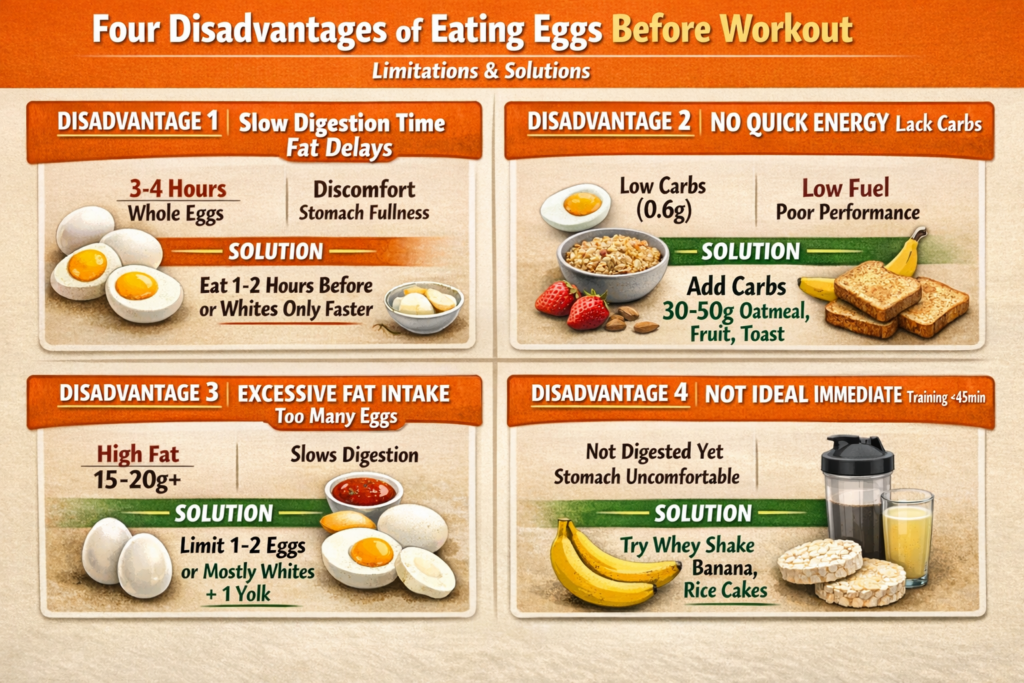
Disadvantage 1: Slow Digestion Time
Fat content delays gastric emptying.
The timeline:
- Whole eggs: 3-4 hours for complete digestion
- Egg whites only: 1.5-2 hours
- Much slower than many alternatives
Why this matters:
- Food sitting in stomach during training
- Uncomfortable feeling
- Blood diverted to digestion
- Reduced workout performance
The solution:
- Eat 1-2 hours before training minimum
- Or use egg whites only (faster)
- Or choose faster-digesting protein (whey)
- Know your personal tolerance
Disadvantage 2: No Quick Energy Source
Lack of carbohydrates limits immediate fuel.
The problem:
- Training requires glucose
- Eggs provide minimal carbs (0.6g)
- Protein converts to energy slowly
- Fat converts to energy very slowly
Performance impact:
- Lower intensity possible
- Reduced power output
- Faster fatigue in high-intensity work
- Suboptimal for most training
The solution (non-negotiable):
- Add carbohydrate sources
- Toast, oatmeal, rice, fruit, potatoes
- 30-50g carbs with eggs
- Complete pre-workout nutrition
Example combinations:
Option 1:
- 2 whole eggs (12g protein, 10g fat)
- 2 slices whole grain toast (30g carbs)
- Banana (27g carbs)
- Complete pre-workout meal
Option 2:
- 3-4 egg whites (14g protein, minimal fat)
- 1 cup oatmeal (27g carbs)
- Berries (15g carbs)
- Balanced nutrition
Disadvantage 3: Potential for Excessive Fat Intake
Too many whole eggs = too much fat.
The math:
- 1 whole egg: 5g fat (manageable)
- 2 whole eggs: 10g fat (still okay)
- 3 whole eggs: 15g fat (getting high)
- 4+ whole eggs: 20g+ fat (excessive pre-workout)
Why excess fat is problematic:
- Slows digestion significantly
- Causes fullness and discomfort
- Delays all nutrient absorption
- Can cause sluggishness
The solution:
- Limit to 1-2 whole eggs
- Or use mostly egg whites + 1 yolk
- Example: 3 egg whites + 1 whole egg (7g fat vs. 20g)
- Balance protein with manageable fat
Disadvantage 4: Not Ideal for Immediate Energy
If training in 30-45 minutes, eggs aren’t optimal.
The timing problem:
- Eggs need 60-120 minutes to digest
- Training in 30-45 minutes doesn’t allow this
- Food sits in stomach
- Discomfort likely
Better alternatives for quick training:
- Whey protein shake (digests in 30-60 min)
- Banana (digests in 20-30 min)
- Rice cakes (digest in 15-20 min)
- Sports drink (immediate availability)
Use eggs when:
- Training in 1-2+ hours
- Time for proper digestion
- Want sustained energy
- Can plan ahead
Optimal Timing: When to Eat Eggs Before Training
Precision timing prevents problems.
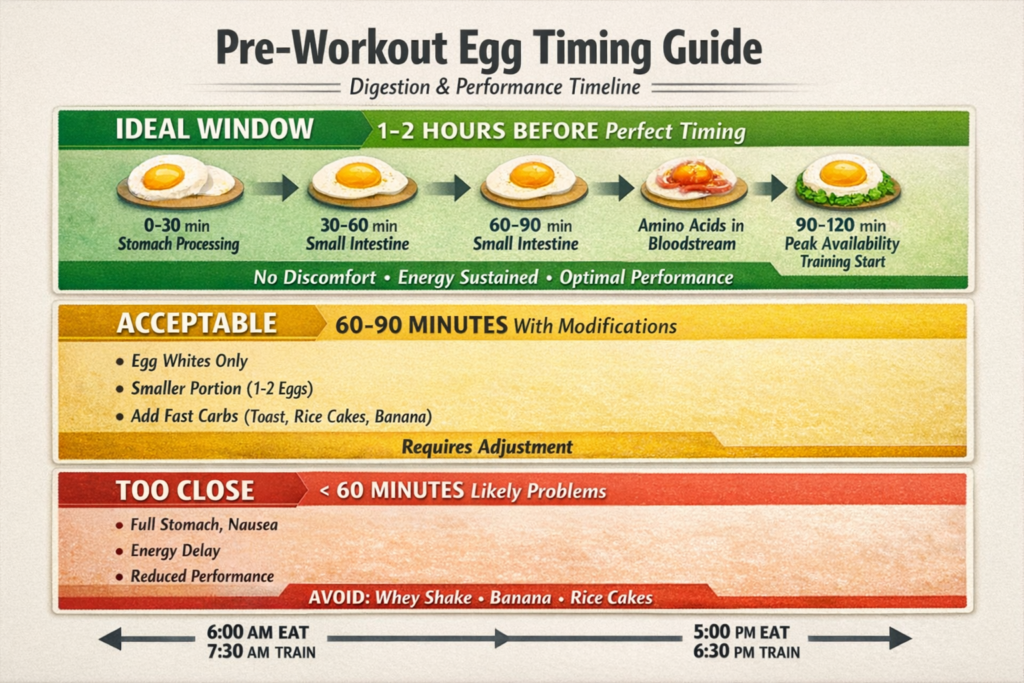
The 1-2 Hour Window (Ideal)
Why this timing works:
Digestion timeline:
- 0-30 min: Stomach processing
- 30-60 min: Moving to small intestine
- 60-90 min: Amino acids entering bloodstream
- 90-120 min: Peak availability
- Perfect for training start
Example schedule:
Morning training:
- 6:00 AM: Eat 2 eggs + toast
- 7:30-8:00 AM: Begin training
- Energy available, no discomfort
Evening training:
- 5:00 PM: Eat 2 eggs + oatmeal
- 6:30-7:00 PM: Begin training
- Proper digestion occurred
What happens with correct timing:
- No stomach discomfort
- Amino acids available during training
- Energy sustained
- Optimal performance
Can You Eat Closer? (60-90 Minutes)
Possible with modifications.
If eating 60-90 minutes before:
Use egg whites only:
- 3-4 egg whites
- Minimal fat
- Faster digestion
- Less likely to cause discomfort
Keep portion smaller:
- 1-2 eggs maximum (not 3-4)
- Less volume to digest
- Reduces risk
Combine with fast carbs:
- White toast or rice cakes
- Banana
- Quick-digesting options
- Provides immediate energy
What If You Eat Too Close? (<60 Minutes)
Likely problems:
Food sitting in stomach:
- Uncomfortable during training
- Feeling heavy or full
- Nausea possible
- Reduced performance
Energy not yet available:
- Protein still digesting
- Not providing fuel yet
- Wasted pre-workout meal
Solution: Choose faster-digesting options if training within 60 minutes (whey shake, banana, rice cakes).
Best Preparation Methods for Pre-Workout Eggs
How you cook eggs matters.
Method 1: Hard-Boiled (Best Option)
Why this is ideal:
No added fat:
- Just egg, water, heat
- Zero extra calories
- Clean protein source
- Easiest to digest
Meal prep friendly:
- Cook dozen at once
- Store in fridge up to one week
- Grab and go
- Ultimate convenience
Precise portions:
- Easy to count eggs
- Track macros accurately
- No guesswork
How to prepare:
- Place eggs in pot
- Cover with cold water
- Bring to boil
- Remove from heat, cover
- Let sit 10-12 minutes
- Ice bath to stop cooking
- Store in fridge
Method 2: Scrambled (Good With Caution)
Can be healthy if done right.
Minimal fat version:
- Use non-stick pan
- Cooking spray only
- No butter or oil
- Similar to boiled
Problem: Easy to add excessive fat
- Butter, oil, cheese common additions
- Can add 10-15g fat easily
- Defeats pre-workout purpose
- Slows digestion significantly
Best practice:
- Non-stick pan + cooking spray
- Or small amount of olive oil (1 tsp)
- No butter, cheese, cream
- Keep it light
Method 3: Poached (Also Good)
Similar benefits to boiled.
Advantages:
- No added fat
- Clean preparation
- Slightly faster (3-4 min)
- Delicate texture
Disadvantages:
- Requires skill
- Less portable
- Must be eaten fresh
- Not meal-prep friendly
Method 4: Fried (Use Sparingly)
Can work but has drawbacks.
The fat problem:
- Typical fried egg: 1-2 tbsp oil (14-28g fat)
- Plus egg fat (5g)
- Total: 19-33g fat
- Way too much pre-workout
When fried works:
- Use minimal oil (1/2 tsp)
- Or cooking spray only
- Over-easy style (minimal cooking fat)
- Occasional variety
Better option: Just boil or scramble with spray
Method 5: Omelet (Can Work)
Depends on preparation.
Light omelet (good):
- 2-3 eggs
- Vegetables
- Minimal cooking fat
- Reasonable pre-workout option
Heavy omelet (bad):
- Cheese
- Excessive oil/butter
- Bacon, sausage
- Too much fat, too heavy
Can You Eat Raw Eggs Before Training?
Short answer: Don’t do it.
Why Raw Eggs Are Not Recommended
Safety risk: Salmonella
- Raw eggs can contain salmonella bacteria
- Food poisoning risk
- Not worth the danger
- Cooking eliminates risk
Reduced protein absorption:
- Raw egg protein: ~50% bioavailable
- Cooked egg protein: ~90% bioavailable
- You absorb almost twice as much from cooked eggs
The science:
- Avidin in raw whites binds biotin (B-vitamin)
- Prevents absorption
- Cooking denatures avidin
- Improves nutrient availability
Digestive issues:
- Raw eggs harder to digest
- Can cause upset stomach
- Cooking pre-digests protein
- Makes it easier on system
The Rocky Myth
Why people think raw eggs work:
- Rocky movies popularized it
- Perceived as “hardcore”
- Belief in instant protein
The reality:
- No benefit over cooked
- Actually worse absorption
- Unnecessary risk
- Not recommended by any nutrition authority
Better approach:
- Cook your eggs
- Get better absorption
- Stay safe
- Same results, zero risk
The Bottom Line: Eggs Work Pre-Workout With Proper Timing and Preparation
After examining all aspects:
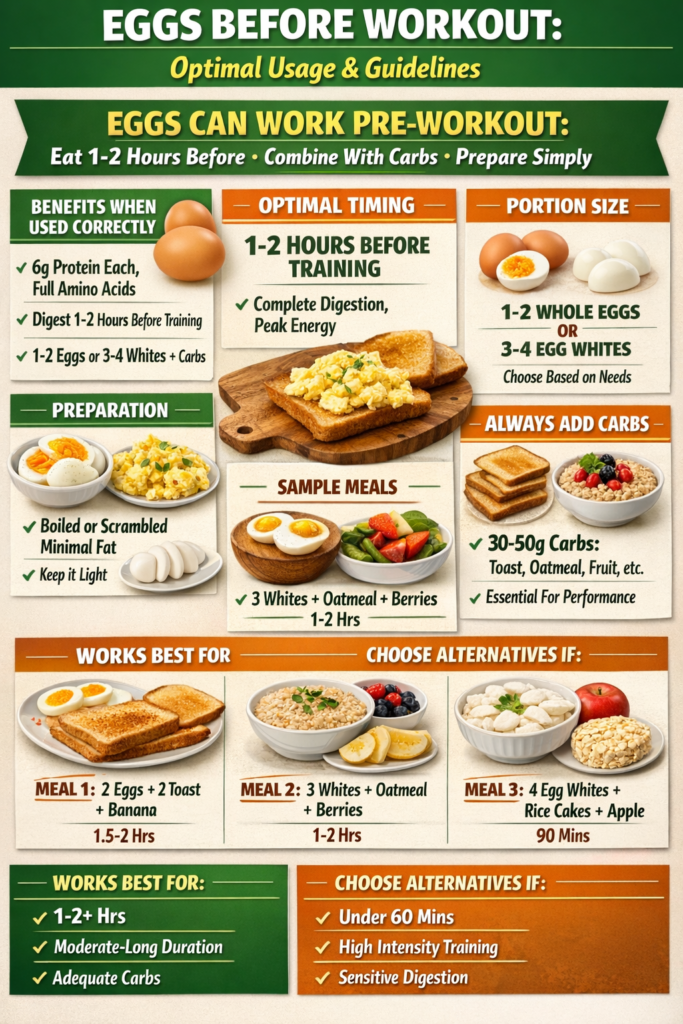
The truth about eggs before training:
✅ Can work well pre-workout when used correctly
✅ Provide high-quality protein (6g per egg, complete amino acids)
✅ Require 1-2 hour digestion time (don’t eat too close to training)
✅ Must be combined with carbohydrates (eggs alone insufficient)
✅ Best in limited quantities (1-2 whole eggs or 3-4 whites)
Optimal usage guidelines:
Timing: 1-2 hours before training
- Allows complete digestion
- Prevents discomfort
- Amino acids available during workout
Portion: 1-2 whole eggs OR 3-4 egg whites
- Whole eggs: More nutrients, more fat, slower digestion
- Egg whites: Less fat, faster digestion, fewer calories
- Choose based on timing and preference
Preparation: Boiled or scrambled (minimal fat)
- Hard-boiled ideal (meal prep, no added fat)
- Scrambled with spray (acceptable)
- Avoid excessive oil, butter, cheese
Combination: Always add carbohydrates
- 30-50g carbs minimum
- Toast, oatmeal, rice, fruit, potatoes
- Provides training energy eggs lack
Sample pre-workout meals:
Meal 1 (1.5-2 hours before):
- 2 whole eggs (hard-boiled or scrambled)
- 2 slices whole grain toast
- 1 banana
- Macros: ~400 calories, 20g protein, 60g carbs, 10g fat
Meal 2 (1-2 hours before):
- 3 egg whites + 1 whole egg
- 1 cup oatmeal
- Berries
- Macros: ~380 calories, 22g protein, 58g carbs, 7g fat
Meal 3 (90 min before):
- 4 egg whites only
- 2 rice cakes with honey
- Apple
- Macros: ~300 calories, 18g protein, 55g carbs, 1g fat
When eggs work best:
- Training in 1-2+ hours
- Moderate to low intensity workouts
- Longer duration sessions
- When combined with adequate carbs
When to choose alternatives:
- Training in <60 minutes (use whey, banana, rice cakes)
- High-intensity training (may want lighter protein)
- You experience digestive issues (individual variation)
What NOT to do:
❌ Eat eggs 30 minutes before training
❌ Eat 4+ whole eggs pre-workout (too much fat)
❌ Eat eggs without carbs (insufficient energy)
❌ Eat raw eggs (safety risk, poor absorption)
❌ Fry in excessive oil/butter (too much added fat)
EGGS CAN WORK PRE-WORKOUT. EAT 1-2 HOURS BEFORE. COMBINE WITH CARBS. PREPARE SIMPLY.
Ready to build a complete, optimized pre and post-workout nutrition strategy with precise meal timing, food combinations, and portion guidelines that maximize performance and recovery for your specific training style and goals? Egg timing is just one piece of effective workout nutrition. Get a comprehensive guide to calculating exact pre-workout macro needs, building complete meals that fuel performance, timing all nutrients optimally, and achieving maximum results from every session. Stop guessing about workout nutrition. Start following science-based strategies that deliver consistent results.
REFERENCES
SECTION 1 — Egg protein quality, digestibility, and leucine content
[1] Evenepoel P et al. — PubMed/Journal of Nutrition, 1998 5 ileostomy patients; stable isotope-labeled egg protein; cooked egg protein true ileal digestibility 90.9 ± 0.8% vs. raw egg protein 51.3 ± 9.8% (p<0.001); heat treatment denatured trypsin inhibitors and proteolysis-resistant protein structures; cooking nearly doubles the amino acid availability from eggs; fundamental justification for consuming only cooked eggs pre-workout https://pubmed.ncbi.nlm.nih.gov/9772141/
[2] van Loon LJC et al. — PMC/Frontiers in Nutrition, 2022 Review: cooked eggs are a high-quality protein source with a highly digestible indispensable amino acid score; ingestion of egg protein robustly increases post-exercise muscle protein synthesis rates; boiled eggs showed greater plasma leucine, BCAA, and EAA increases than raw eggs following exercise; raw eggs should not be used to support post-exercise recovery; whole food eggs provide complete essential amino acids well above WHO/FAO requirements for adults https://pmc.ncbi.nlm.nih.gov/articles/PMC9644172/
[3] Puglisi MJ & Fernandez ML — PMC/Nutrients, 2022 Review of egg protein health benefits; eggs have the highest protein digestibility-corrected amino acid score of all whole foods; eggs, meat, and dairy digested above 90% vs. 45–80% for plant proteins; WHO reports eggs as 97% digestible; egg protein contains all essential amino acids and provides the highest attainable PDCAAS; egg protein protects against sarcopenia and is important to skeletal muscle health https://pmc.ncbi.nlm.nih.gov/articles/PMC9316657/
SECTION 2 — Pre-workout protein and muscle protein breakdown
[4] Cintineo HP et al. — PMC/Frontiers in Nutrition, 2018 Review of protein supplementation on performance and recovery; robust evidence shows pre- and/or post-workout protein induces significant rise in muscle protein synthesis; peri-exercise protein supplementation positively influences recovery for both resistance and endurance training; total daily protein remains most crucial factor; pre-workout protein provides amino acid availability during exercise to reduce net muscle protein breakdown https://pmc.ncbi.nlm.nih.gov/articles/PMC6142015/
[5] Davies RW et al. — European Journal of Clinical Nutrition, 2022 Systematic review and meta-analysis of 29 studies; peri-exercise protein supplementation significantly preserved acute muscle strength and attenuated creatine kinase (muscle damage marker) following muscle-damaging resistance exercise; reductions in isokinetic maximal voluntary contraction significantly attenuated by protein in 8 of 8 trials; protein consumption unlikely to reduce muscle soreness but effectively protects structural muscle function during exercise https://www.nature.com/articles/s41430-022-01250-y
SECTION 3 — Fat content and gastric emptying delay
[6] Gentilcore D et al. — PubMed/Journal of Clinical Endocrinology & Metabolism, 2006 Randomized crossover study; fat ingestion before carbohydrate meal markedly slows gastric emptying (GE) in healthy subjects; high-fat meal significantly delayed GE compared to low-fat; fat in small intestine triggers ileal brake mechanism, inhibiting gastric motility; slowed GE delays protein and carbohydrate absorption — directly explaining why whole eggs require at least 60-90 minutes before training to prevent digestive discomfort https://pubmed.ncbi.nlm.nih.gov/16537685/
[7] Clegg ME & Shearman CP — PubMed/Digestive Diseases and Sciences, 1991 12 healthy males; randomized, double-blind; high-fat meal (37.9g fat) vs. low-fat meal (9.2g fat); gastric emptying was significantly slower after the high-fat meal (p<0.05); antral motility also reduced; fat content of a meal is a primary determinant of gastric emptying rate, with dose-dependent slowing; confirms the physiological basis for timing eggs at least 60-90 minutes before training https://pubmed.ncbi.nlm.nih.gov/1893810/
SECTION 4 — Egg satiety and appetite suppression
[8] Vander Wal JS et al. — PubMed/Journal of the American College of Nutrition, 2005 Overweight and obese subjects; randomized crossover; egg breakfast vs. isocaloric equal-weight bagel breakfast; egg breakfast induced greater satiety and significantly reduced lunch energy intake (2405 vs. 3091 kJ, p<0.0001); lower energy intake extended to the entire day (p<0.05) and the next 36 hours (p<0.001); demonstrates the sustained appetite-suppressing effect of egg protein + fat combination https://pubmed.ncbi.nlm.nih.gov/16373948/
[9] Mollard RC et al. — PMC/Nutrients, 2020 50 overweight or obese adults; crossover trial; eggs and toast vs. cereal with milk and orange juice (isoenergetic); energy intake following egg breakfast significantly reduced vs. cereal breakfast (4518 vs. 5283 kJ, p=0.001); hunger sensation significantly less after egg breakfast (p=0.028); reduced ad libitum energy intake at lunch 4 hours later; confirms egg protein’s satiety benefit is relevant to appetite management around training https://pmc.ncbi.nlm.nih.gov/articles/PMC7432073/


Leave a Reply
You must be logged in to post a comment.