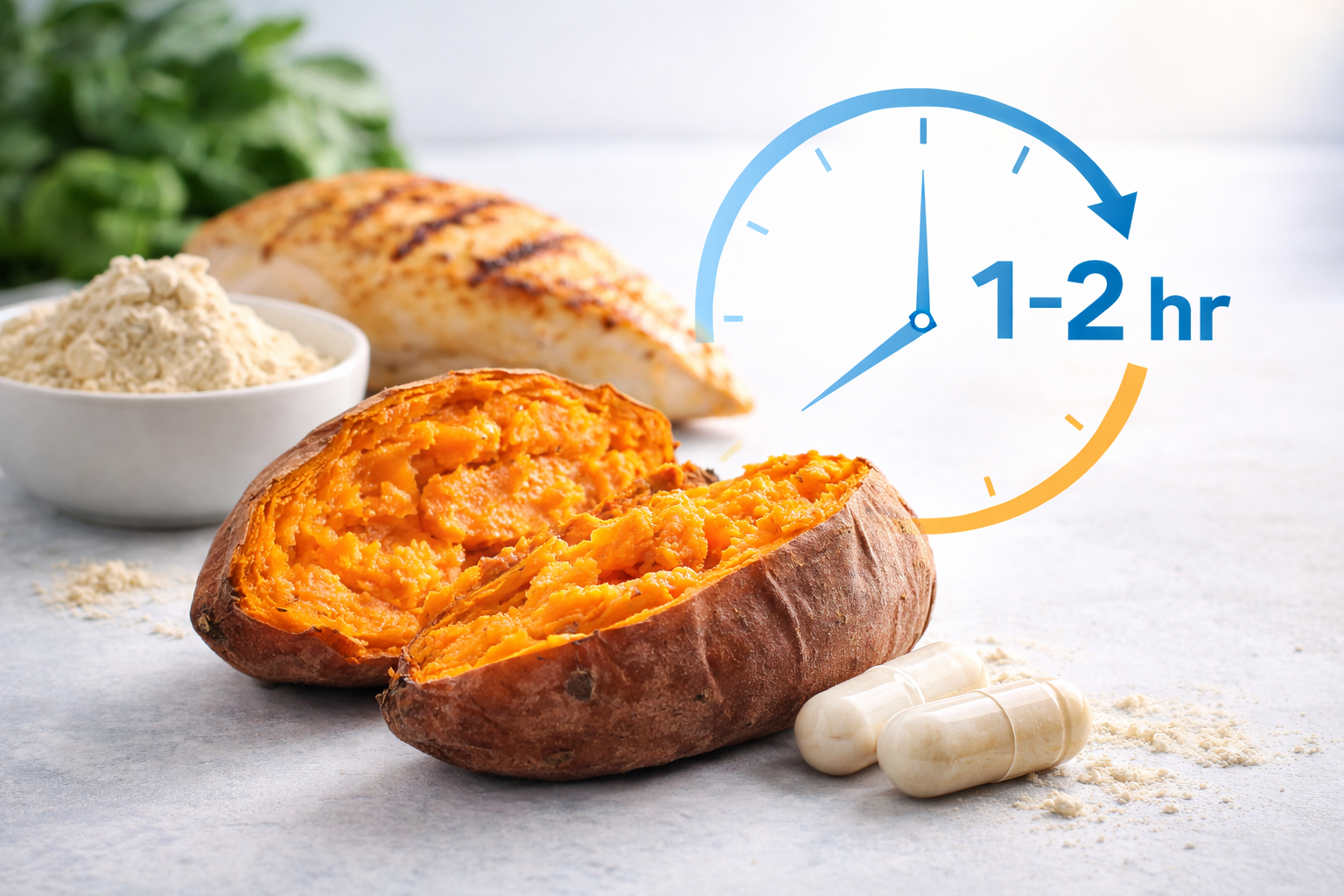
Wondering if sweet potato makes a good pre-workout meal? Here’s the science-backed truth about timing, portions, and effectiveness.
You’re planning your pre-workout meal. You know you need carbs for energy.
Sweet potato sounds healthy. But is it actually good before training?
You’ve heard conflicting advice:
- “Complex carbs are best pre-workout”
- “Sweet potatoes are too slow-digesting”
- “You need fast carbs before training”
- “Sweet potatoes will make you feel sluggish”
So which is it?
Here’s the straightforward answer: Yes, sweet potato is an excellent pre-workout food when eaten 1-2 hours before training. It provides 35-40g of complex carbohydrates from a 150-200g serving, delivers sustained energy throughout your workout, has a low glycemic index that prevents blood sugar crashes, and combines well with protein sources for complete pre-workout nutrition.
In this comprehensive guide, I’ll explain exactly why sweet potato works well pre-workout (and when it doesn’t), reveal the optimal timing for eating sweet potato before training, show you the ideal portion sizes for different goals and body weights, provide easy pre-workout sweet potato recipes that combine carbs and protein, and help you understand when to choose sweet potato versus faster-digesting alternatives.
Whether you’re training for strength, muscle building, or endurance, this article will optimize your pre-workout nutrition.
Let’s fuel your workouts correctly.
TABLE OF CONTENTS
Is Sweet Potato Good Before a Workout?
The direct answer with important context.
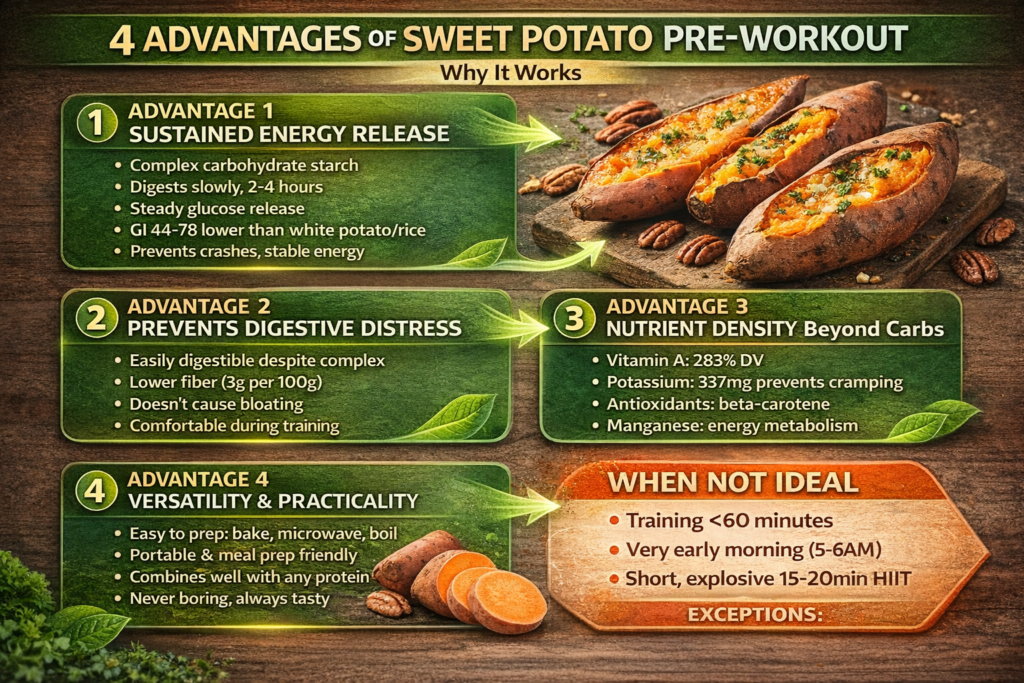
Why Sweet Potato Works Pre-Workout
Sweet potato provides specific advantages for training performance.
Advantage 1: Sustained energy release
Complex carbohydrate composition:
- Primary carb source: Starch (complex carbohydrate)
- Digests slowly over 2-4 hours
- Provides steady glucose release
- Prevents energy crashes mid-workout
Glycemic index: 44-78 (varies by preparation)
- Lower than white potato (85-110)
- Lower than white rice (70-90)
- Prevents rapid blood sugar spikes
- More stable energy levels
Practical benefit:
- Eat 1-2 hours before training
- Energy peaks during workout
- Sustained throughout session
- No crash or fatigue
Advantage 2: Prevents digestive distress
Gentle on stomach:
- Easily digestible despite being complex carb
- Lower fiber than many alternatives (3g per 100g)
- Doesn’t cause bloating for most people
- Comfortable during training
Advantage 3: Nutrient density beyond just carbs
Vitamins and minerals:
- Vitamin A: 14,187 IU per 100g (283% DV)
- Vitamin C: 2.4mg per 100g (4% DV)
- Potassium: 337mg per 100g (prevents cramping)
- Manganese: 0.3mg per 100g (supports energy metabolism)
Additional benefits:
- Antioxidants (beta-carotene)
- Fiber (digestive health)
- Low fat (doesn’t slow digestion)
Advantage 4: Versatility and practicality
Easy preparation:
- Bake in 30-40 minutes
- Microwave in 5-8 minutes
- Boil in 15-20 minutes
- Meal prep friendly (cook in advance)
Portable:
- Store cooked sweet potato in containers
- Doesn’t require refrigeration for several hours
- Eat cold or reheated
- Convenient for on-the-go
Combines well:
- Pairs with any protein source
- Accepts any seasoning
- Sweet or savory preparations
- Never gets boring
When Sweet Potato Might NOT Be Ideal
Specific scenarios where alternatives are better.
Scenario 1: Training in less than 60 minutes
The problem:
- Sweet potato takes 1-2 hours to digest
- Won’t provide energy if training too soon
- May cause stomach discomfort during workout
Better option:
- Banana (fast-digesting, 15-30 min)
- White rice (30-45 min digestion)
- Rice cakes (15-20 min)
Scenario 2: Very early morning training (5-6 AM)
The problem:
- Wake up at 5 AM to train at 6 AM
- Not enough time to digest sweet potato
- Need faster energy source
Better option:
- Liquid carbs (juice, sports drink)
- Banana
- Quick-digesting carbs
- Or train fasted (if short session)
Scenario 3: Short, explosive workouts (15-20 minutes HIIT)
The problem:
- Don’t need sustained energy
- Want quick glucose spike for intensity
- Sweet potato is overkill
Better option:
- Fast carbs 15-30 min before
- Honey, white bread, banana
- Simple sugars work fine
For most people doing standard 45-90 minute training sessions, sweet potato is excellent.
Optimal Timing: How Long Before Workout?
When to eat sweet potato for best results.
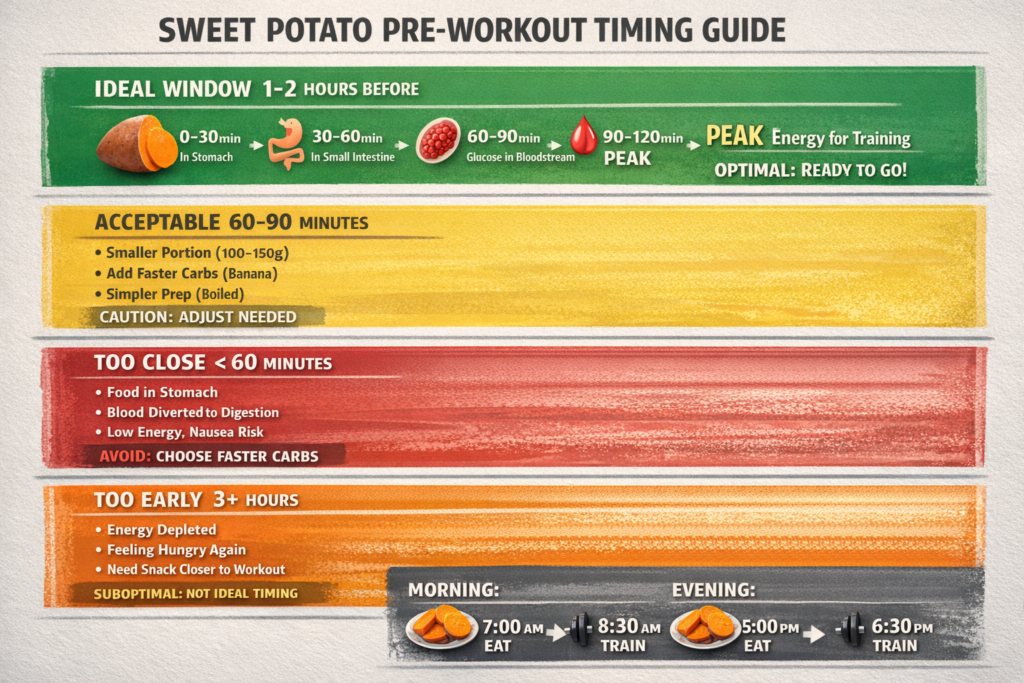
The 1-2 Hour Window (Ideal)
Why this timing works:
Digestion timeline:
- 0-30 min: Stomach processing begins
- 30-60 min: Moves to small intestine
- 60-90 min: Glucose starts entering bloodstream
- 90-120 min: Peak glucose availability
- Perfect timing for training
Example schedule:
Morning training:
- 7:00 AM: Eat sweet potato with protein
- 8:30 AM: Begin training
- Energy peaks during workout
Evening training:
- 5:00 PM: Eat sweet potato meal
- 6:30 PM: Begin training
- Energy sustained throughout
What happens if timing is perfect:
- Feel energized at training start
- Sustained energy entire session
- No hunger during workout
- No stomach discomfort
- Optimal performance
Can You Eat Closer to Training? (60-90 Minutes)
Possible but requires adjustments.
If eating 60-90 minutes before:
Reduce portion size:
- Instead of 200g sweet potato
- Use 100-150g
- Less volume = faster digestion
- Reduces discomfort risk
Combine with faster carbs:
- 100g sweet potato
- 1 banana
- Banana digests quickly
- Sweet potato provides sustained energy
- Best of both worlds
Choose simpler preparation:
- Boiled or microwaved (easier to digest)
- Skip butter, oils, complex seasonings
- Lighter on stomach
What If You Eat Too Close? (<60 Minutes)
Potential issues:
Food sitting in stomach:
- Uncomfortable during training
- Feeling heavy or sluggish
- Blood diverted to digestion instead of muscles
- Nausea possible with intense training
Not enough time for energy:
- Glucose not yet available
- Training on empty despite eating
- Wasted meal timing
Solution: If you must eat close to training, choose faster-digesting options (white rice, banana, white bread).
What If You Eat Too Early? (3+ Hours)
Another potential issue:
Energy depleted before training:
- Glucose from meal already used
- Feeling hungry again
- Energy dip possible
- May need small snack closer to training
Solution: If meal is 3+ hours before training, add small snack 30-60 minutes before (banana, rice cake, sports drink).
Ideal Portion Size: How Much Sweet Potato?
Calculating the right amount for your needs.
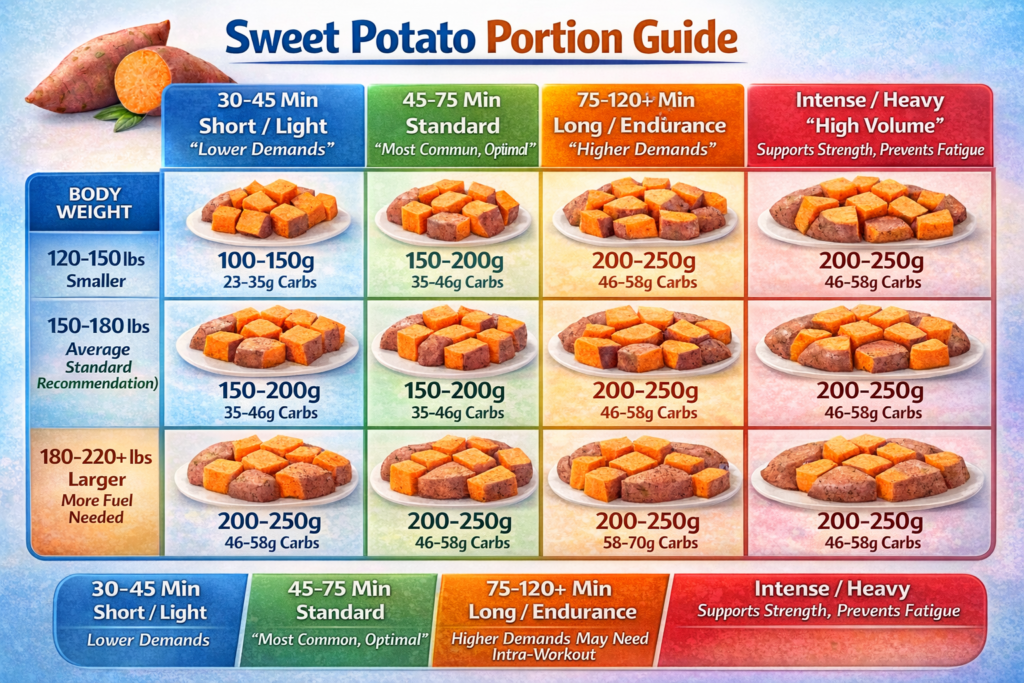
General Guidelines
Standard pre-workout serving: 150-200g cooked sweet potato
What this provides:
- Calories: 130-175
- Carbohydrates: 30-40g
- Protein: 2-3g (minimal)
- Fat: 0-0.3g (negligible)
- Fiber: 4.5-6g
Why this amount works:
- Sufficient carbs for 60-90 min workout
- Not so much that it causes fullness
- Digestible within 1-2 hours
- Provides steady energy
Adjusting for Body Weight
Customize portion based on your size.
Smaller individuals (120-150 pounds):
- 100-150g sweet potato
- Provides 23-35g carbs
- Sufficient for training
- Prevents overeating
Average individuals (150-180 pounds):
- 150-200g sweet potato
- Provides 35-46g carbs
- Standard recommendation
- Ideal balance
Larger individuals (180-220+ pounds):
- 200-250g sweet potato
- Provides 46-58g carbs
- More fuel needed
- Supports size and intensity
Adjusting for Workout Type and Duration
Match carbs to training demands.
Short workout (30-45 minutes):
- 100-150g sweet potato (23-35g carbs)
- Lower energy demands
- Don’t need excessive carbs
- Prevents waste
Standard workout (45-75 minutes):
- 150-200g sweet potato (35-46g carbs)
- Most common scenario
- Standard recommendation
- Optimal for most people
Long workout (75-120+ minutes):
- 200-300g sweet potato (46-70g carbs)
- Or 150-200g sweet potato + additional carb source
- Higher demands require more fuel
- May need intra-workout carbs too
Intense training (heavy compounds, high volume):
- 200-250g sweet potato (46-58g carbs)
- More glucose needed
- Supports strength output
- Prevents mid-workout fatigue
Light training (accessory work, moderate cardio):
- 100-150g sweet potato (23-35g carbs)
- Lower intensity = lower needs
- Don’t overeat for light session
Sweet Potato Before vs. After Workout?
Understanding when to prioritize sweet potato.
Sweet Potato Pre-Workout (What We’ve Discussed)
Primary benefit: Energy for performance
What it does:
- Fuels the workout
- Prevents fatigue
- Supports intensity
- Maintains strength output
Best for:
- Longer workouts (60+ minutes)
- Strength training
- High-volume sessions
- Preventing mid-workout energy crashes
Sweet Potato Post-Workout
Primary benefit: Glycogen replenishment
What it does:
- Replenishes muscle glycogen stores
- Supports recovery
- Provides carbs when insulin sensitive
- Aids protein synthesis (when combined with protein)
Best for:
- After depleting workouts
- Supporting recovery
- Muscle building
- Next-day performance
Can You Eat Sweet Potato Both Times?
Yes, and many people do.
Example daily schedule for serious training:
Pre-workout meal (2 hours before):
- 150g sweet potato
- 6oz chicken breast
- Vegetables
- Provides training fuel
Post-workout meal (within 2 hours after):
- 200g sweet potato
- 8oz lean beef
- Vegetables
- Supports recovery
Total sweet potato: 350g daily
- If bulking or very active: Perfectly fine
- If cutting: May be excessive, adjust portions
The decision:
- Pre-workout if you need training energy
- Post-workout if you need recovery fuel
- Both if training demands are high
- Neither mandatory (whole food flexibility)
Benefits of Sweet Potato Pre-Workout
Beyond just carbohydrates.
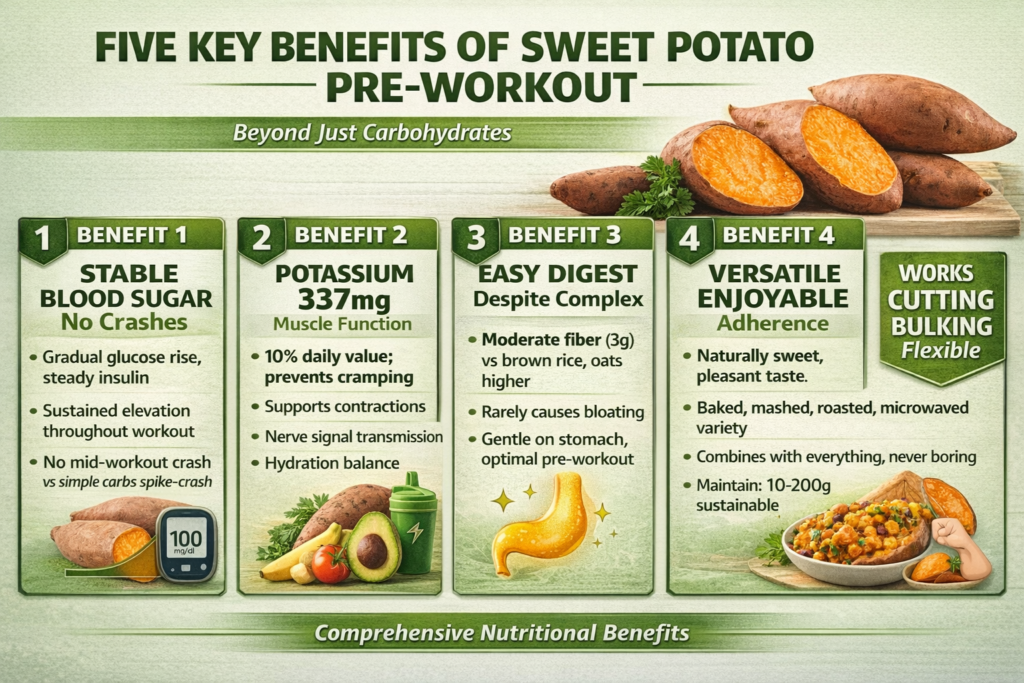
Benefit 1: Stable Blood Sugar
Unlike simple sugars, sweet potato won’t cause crashes.
The blood sugar response:
Simple carbs (candy, white bread, sugar):
- Rapid spike in blood glucose
- Insulin surge
- Quick drop (crash)
- Energy rollercoaster during workout
Sweet potato (complex carb, low GI):
- Gradual rise in blood glucose
- Steady insulin response
- Sustained elevation
- Stable energy throughout workout
Practical advantage:
- No mid-workout crash
- Consistent performance
- Better focus and drive
- More enjoyable training
Benefit 2: Potassium for Muscle Function
Prevents cramping and supports contractions.
Potassium content:
- 337mg per 100g sweet potato
- 10% of daily value
- Electrolyte balance
- Muscle contraction support
Why this matters for training:
- Prevents muscle cramps
- Supports proper contractions
- Nerve signal transmission
- Hydration balance
Combined with pre-workout hydration:
- Drink 16-24oz water with sweet potato meal
- Potassium + hydration = optimal function
- Reduced cramping risk
Benefit 3: Easy to Digest Despite Being Complex
Gentle on stomach unlike some alternatives.
Comparison to other complex carbs:
Brown rice:
- Higher fiber (1.8g vs. 3g per 100g)
- Can cause bloating
- Harder to digest
Oats:
- Very high fiber (10g per 100g)
- Can feel heavy
- Some experience discomfort
Sweet potato:
- Moderate fiber (3g per 100g)
- Easily digestible
- Rarely causes issues
- Optimal for pre-workout
Benefit 4: Versatile and Enjoyable
Adherence matters. Sweet potato tastes good.
Flavor profile:
- Naturally sweet
- Pleasant taste
- Doesn’t require heavy seasoning
- Enjoyable to eat consistently
Preparation variety:
- Baked (classic)
- Mashed (comfort food)
- Cubed and roasted (convenient)
- Microwaved (fastest)
- Chips (if lightly prepared)
Combines with everything:
- Works with any protein
- Sweet or savory
- Never boring
- Easy to stick with long-term
Benefit 5: Works for Cutting and Bulking
Flexible for different goals.
When cutting (fat loss):
- Moderate calorie density (86 cal per 100g)
- Filling due to fiber
- Nutrient-dense
- Supports satiety
- Use 100-150g portions
When bulking (muscle gain):
- Easy to increase portions
- 200-300g provides substantial carbs
- Doesn’t fill you up excessively
- Can eat frequently
- Supports surplus
When maintaining:
- Standard 150-200g portions
- Balanced approach
- Sustainable long-term
Easy Sweet Potato Pre-Workout Recipes
Practical meals combining carbs and protein.
Recipe 1: Classic Sweet Potato and Chicken
Ingredients:
- 200g sweet potato (cubed)
- 6oz (170g) chicken breast
- 1 cup broccoli
- 1 tbsp olive oil
- Salt, pepper, garlic powder
Macros:
- Calories: ~450
- Protein: ~45g
- Carbs: ~46g
- Fat: ~10g
Preparation:
- Cube sweet potato
- Toss with 1/2 tbsp olive oil, salt, pepper
- Roast at 400°F for 25-30 minutes
- Season and bake/grill chicken
- Steam broccoli
- Combine and eat 1.5-2 hours before training
Why it works:
- Complete protein from chicken
- Sustained carbs from sweet potato
- Micronutrients from broccoli
- Easy to digest
Recipe 2: Sweet Potato Protein Pancakes
Ingredients:
- 100g mashed sweet potato (pre-cooked)
- 1 scoop vanilla whey protein
- 1 whole egg
- 1 tbsp oat flour
- Cinnamon to taste
Macros:
- Calories: ~330
- Protein: ~35g
- Carbs: ~35g
- Fat: ~6g
Preparation:
- Mash cooked sweet potato
- Mix all ingredients in bowl
- Heat non-stick pan
- Cook pancakes 2-3 min per side
- Serve with cinnamon
Why it works:
- High protein from whey and egg
- Carbs from sweet potato
- Easy to eat 60-90 min before training
- Tastes great
Recipe 3: Sweet Potato and Tuna Bowl
Ingredients:
- 150g sweet potato (cubed and roasted)
- 1 can tuna in water (drained)
- Mixed greens
- Balsamic vinegar
- Salt and pepper
Macros:
- Calories: ~280
- Protein: ~30g
- Carbs: ~35g
- Fat: ~2g
Preparation:
- Roast sweet potato cubes
- Drain tuna
- Combine over mixed greens
- Dress with balsamic
- Season to taste
Why it works:
- Lean protein from tuna
- Complex carbs from sweet potato
- Very low fat (fast digestion)
- Light but energizing
Sweet Potato Alternatives (5 Equivalents)
When you need variety or don’t have sweet potato.
Alternative 1: Regular Potato (White/Russet)
Comparison:
- Higher glycemic index (faster digestion)
- Similar carb content (17g vs. 20g per 100g)
- Less fiber (2g vs. 3g)
- Less vitamin A
- More potassium
When to use:
- Want faster-digesting carb
- Training in 60-90 minutes
- Prefer taste of white potato
- Same effectiveness for energy
Preparation: Bake with skin on to lower GI
Alternative 2: Yam
Comparison:
- Very similar to sweet potato
- Slightly different micronutrient profile
- Same carb content
- Similar digestion time
- Equally effective
When to use:
- Can’t find sweet potato
- Want variety
- Essentially interchangeable
Alternative 3: Butternut Squash
Comparison:
- Fewer carbs (12g vs. 20g per 100g)
- Similar fiber
- Rich in vitamin A
- Sweeter taste
- Lower calorie
When to use:
- Cutting (lower calories)
- Want similar taste profile
- Need to reduce carb intake slightly
Note: May need larger portion for same carbs
Alternative 4: Cassava (Yuca)
Comparison:
- Higher carbs (38g per 100g)
- More calorie-dense
- Gluten-free
- Complex carbohydrate
- Good energy source
When to use:
- Need more carbs per volume
- Bulking
- Want variety
- Available in your area
Alternative 5: Quinoa
Comparison:
- Similar carbs (21g per 100g)
- Contains protein (4g per 100g)
- Complete amino acid profile
- Grain instead of tuber
- Faster preparation
When to use:
- Want protein + carb combination
- Prefer grain texture
- Meal prep friendly
- Cooks in 15 minutes
The Bottom Line: Sweet Potato Is Excellent Pre-Workout
After examining all aspects:
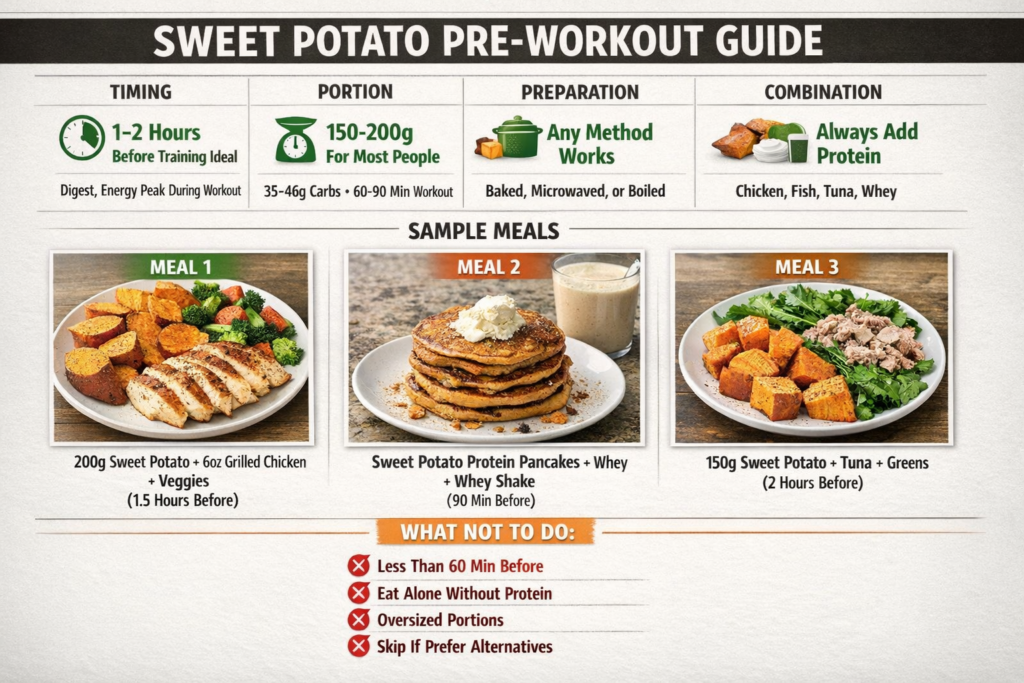
The truth about sweet potato before training:
✅ Excellent pre-workout food when eaten 1-2 hours before
✅ Provides sustained energy through complex carbohydrates
✅ Easy to digest despite being a complex carb
✅ Nutrient-dense beyond just calories (vitamins, minerals, fiber)
✅ Versatile and practical (easy prep, portable, combines well)
Optimal usage guidelines:
Timing: 1-2 hours before training
- Allows complete digestion
- Energy peaks during workout
- No stomach discomfort
Portion: 150-200g for most people
- Provides 35-46g carbs
- Sufficient for 60-90 min workout
- Adjust for body weight and intensity
Preparation: Any method works
- Baked (40 min)
- Microwaved (6-8 min)
- Boiled (20 min)
- All equally effective
Combination: Always add protein
- Sweet potato alone incomplete
- Add chicken, fish, tuna, protein powder
- Complete pre-workout nutrition
When sweet potato works best:
- Standard 45-90 minute workouts
- Strength training
- High-volume training
- When you have 1-2 hours before session
When to choose alternatives:
- Training in <60 minutes (use faster carbs)
- Very early morning training (use liquid carbs or banana)
- Short, intense workouts (simple sugars fine)
Sample pre-workout meals:
Meal 1:
- 200g sweet potato
- 6oz chicken breast
- Vegetables
- 1.5 hours before training
Meal 2:
- Sweet potato protein pancakes (100g sweet potato + whey)
- 90 minutes before training
Meal 3:
- 150g sweet potato
- Tuna
- Mixed greens
- 2 hours before training
What NOT to do:
❌ Eat sweet potato <60 min before training
❌ Eat sweet potato alone (add protein)
❌ Eat excessive portions (causes discomfort)
❌ Skip sweet potato if you prefer alternatives (flexibility matters)
SWEET POTATO = EXCELLENT PRE-WORKOUT CARB. EAT 1-2 HOURS BEFORE. COMBINE WITH PROTEIN. TRAIN STRONG.
Ready to optimize your complete pre and post-workout nutrition strategy with science-based meal timing, portion guidelines, and food combinations that maximize performance and recovery without trial-and-error guesswork? Sweet potato timing is just one piece of effective workout nutrition. Get a comprehensive guide to calculating your exact carb needs, timing all nutrients optimally around training, building complete pre and post-workout meals, and achieving maximum results from every training session. Stop guessing about workout nutrition. Start following proven strategies that work.
REFERENCES
SECTION 1 — Pre-workout carbohydrates: timing and glycogen
[1] Hargreaves M et al. — Journal of Sport Sciences, 2004 Review of carbohydrate ingestion 3-4h before exercise; increases liver and muscle glycogen; enhances performance in prolonged endurance exercise; effects on blood glucose and carbohydrate oxidation persist at least 6h post-ingestion https://pubmed.ncbi.nlm.nih.gov/14971431/
[2] Kerksick CM et al. (ISSN Position Stand) — Journal of the International Society of Sports Nutrition, 2017 ISSN position stand on nutrient timing; 1-4g CHO/kg in the hours pre-exercise maximizes glycogen stores; CHO+PRO ingestion pre-workout maximally stimulates muscle protein synthesis; practical timing recommendations for macronutrients in athletes https://pubmed.ncbi.nlm.nih.gov/28919842/
[3] Ormsbee MJ et al. — PMC/Nutrients, 2014 Review of pre-exercise nutrition; CHO 1-4h before improves performance in sessions ≥60 min; role of glycemic index in pre-workout context; low-GI meals (such as sweet potato) reduce hyperglycemia and hyperinsulinemia at the onset of exercise https://pmc.ncbi.nlm.nih.gov/articles/PMC4042570/
SECTION 2 — Low glycemic index and sustained energy
[4] Thomas DE et al. — British Journal of Nutrition, 1991 8 trained cyclists; low-GI vs. high-GI pre-exercise meal; plasma glucose and insulin more stable with low-GI (30-60 min post-ingestion, p<0.05); time to exhaustion 20 min longer in low-GI group; first study demonstrating advantage of low-GI foods pre-exercise https://pubmed.ncbi.nlm.nih.gov/1860741/
[5] Heung-Sang Wong S et al. — International Journal of Sports Physiology and Performance, 2008 Systematic review and meta-analysis (19 studies, 188 participants); low-GI pre-exercise meals (30-240 min before) tend toward improved performance vs. high-GI; low-GI feeding reduces likelihood of hyperglycemia/hyperinsulinemia at exercise onset; recommendation for low-GI foods 30-60 min before training https://pubmed.ncbi.nlm.nih.gov/27677914/
SECTION 3 — Sweet potato nutrition: micronutrients and antioxidants
[6] Zhou Y et al. — Bioscience Methods (meta-analysis), 2025 Comprehensive review of sweet potato nutritional composition; bioactive compounds including carotenoids, flavonoids, anthocyanins, and phenolic acids; beta-carotene with potent antioxidant properties; reduction of oxidative stress via free radical neutralization; anti-inflammatory properties relevant to post-exercise recovery https://bioscipublisher.com/index.php/bm/article/html/3999/
[7] Fato JB et al. — PubMed, 2025 Systematic review and meta-analysis of RCTs on carotenoid supplementation and exercise-induced oxidative stress; carotenoid supplementation attenuates post-exercise oxidative stress and inflammatory response; improvements in antioxidant levels and metabolic capacity https://pubmed.ncbi.nlm.nih.gov/40404130/
SECTION 4 — Potassium, electrolytes and muscle function
[8] Chang WH et al. — Journal of Applied Physiology, 2010 Consumption of purple sweet potato leaves (rich in polyphenols) for 7 days in runners; improved antioxidant status and reduced exercise-induced oxidative damage vs. control group; role of sweet potato micronutrients in protecting muscle during endurance exercise https://pubmed.ncbi.nlm.nih.gov/20947713/
[9] Weaver CM — PMC/Advances in Nutrition, 2013 Potassium as essential electrolyte for muscle contraction and nerve impulse transmission; sodium-potassium pump and muscle cramp prevention; recommended intake 4700mg/day for adults; sweet potato provides ~540mg potassium per medium unit (~20% DV), making it a meaningful dietary source https://pmc.ncbi.nlm.nih.gov/articles/PMC3650509/
SECTION 5 — Protein + carbohydrates pre-workout (recipe context)
[10] Kerksick CM et al. — PMC/Journal of the International Society of Sports Nutrition, 2008 CHO+PRO combination pre-workout maximizes muscle protein synthesis and energy support; CHO:PRO ratio of 3-4:1 optimizes glycogen resynthesis and muscle repair; scientific rationale for pairing sweet potato with a protein source (chicken, tuna, whey) https://pmc.ncbi.nlm.nih.gov/articles/PMC2575187/


Leave a Reply
You must be logged in to post a comment.