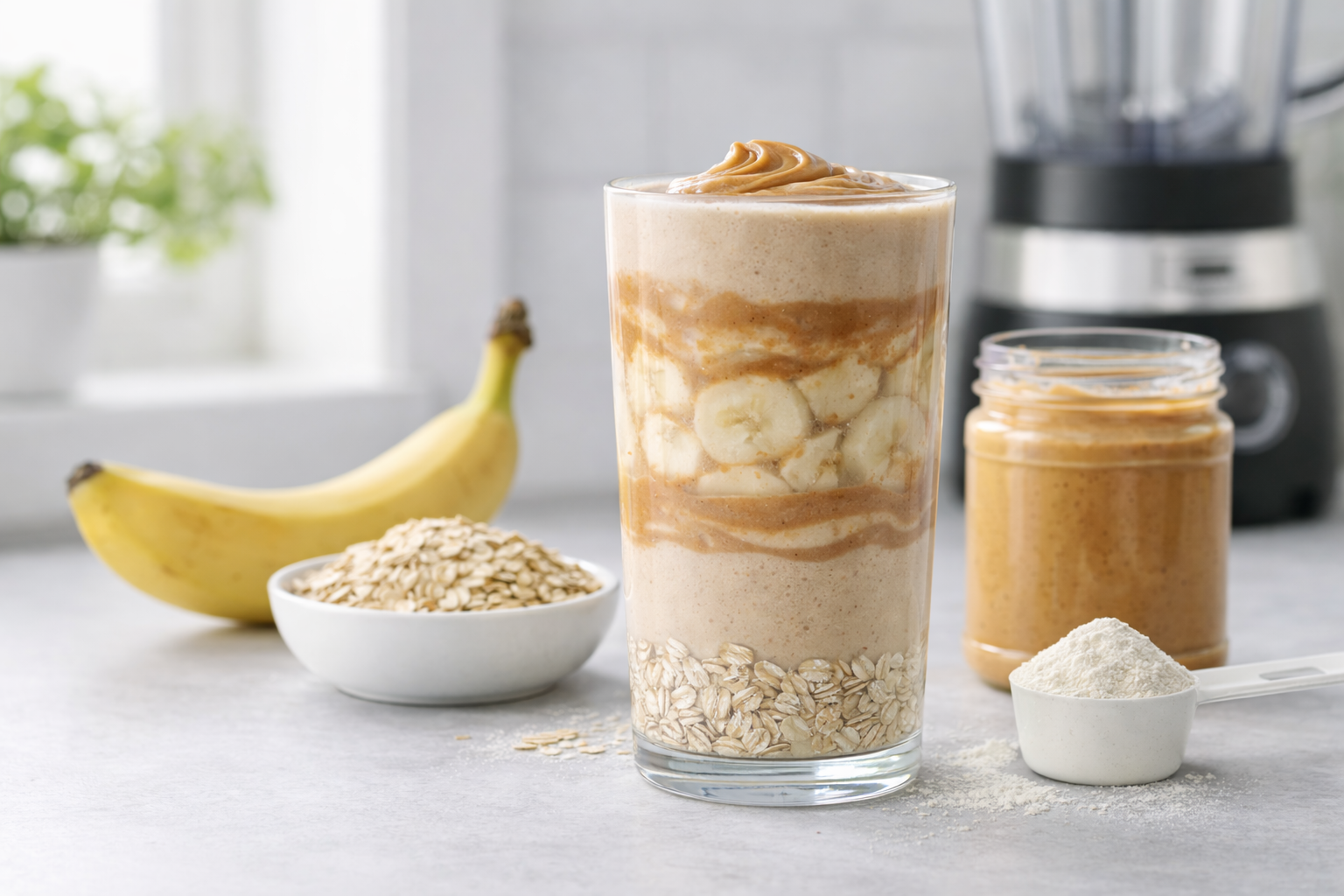
Thinking about replacing meals with protein shakes for convenience? Here’s the science-backed truth about when it works, when it doesn’t, and how to do it correctly.
You’re busy. Meal prep takes time. Cooking is tedious.
Then you look at your tub of whey protein and wonder: Can I just drink protein shakes instead of eating actual meals?
It’s tempting:
- Mix powder with water
- Drink in 30 seconds
- Get your protein
- Move on with your day
But is it actually a good idea?
Here’s the reality: You CAN replace meals with whey protein, but doing it correctly requires more than just protein powder and water. Whey alone lacks the carbs, fats, fiber, and micronutrients your body needs. For a proper meal replacement, you must add whole food ingredients to create a complete nutritional profile.
In this comprehensive guide, I’ll explain exactly when replacing meals with whey makes sense (and when it doesn’t), reveal the advantages and significant disadvantages you need to know, show you how to build a complete meal replacement shake (with recipe), answer how many meals you can realistically replace, and help you decide if this approach fits your goals.
Whether you’re cutting and need convenient meals, bulking and struggling to eat enough, or just exploring options for busy days, this article will give you the complete picture.
Let’s separate convenience from nutrition.
TABLE OF CONTENTS
Can You Actually Replace Meals With Whey Protein?
The short answer is yes, but with important qualifications.
What Whey Protein Actually Provides
A standard scoop of whey protein (30g) typically contains:
Macronutrients:
- Protein: 24-25g
- Carbohydrates: 1-3g
- Fat: 1-3g
- Calories: 110-130
That’s it.
What’s missing:
- Adequate carbohydrates for energy
- Healthy fats for hormone production
- Fiber for digestive health
- Vitamins and minerals (minimal amounts)
- Phytonutrients and antioxidants
- Satiety from whole foods
A scoop of whey protein is NOT a complete meal by itself.
Why Whey Alone Isn’t Sufficient
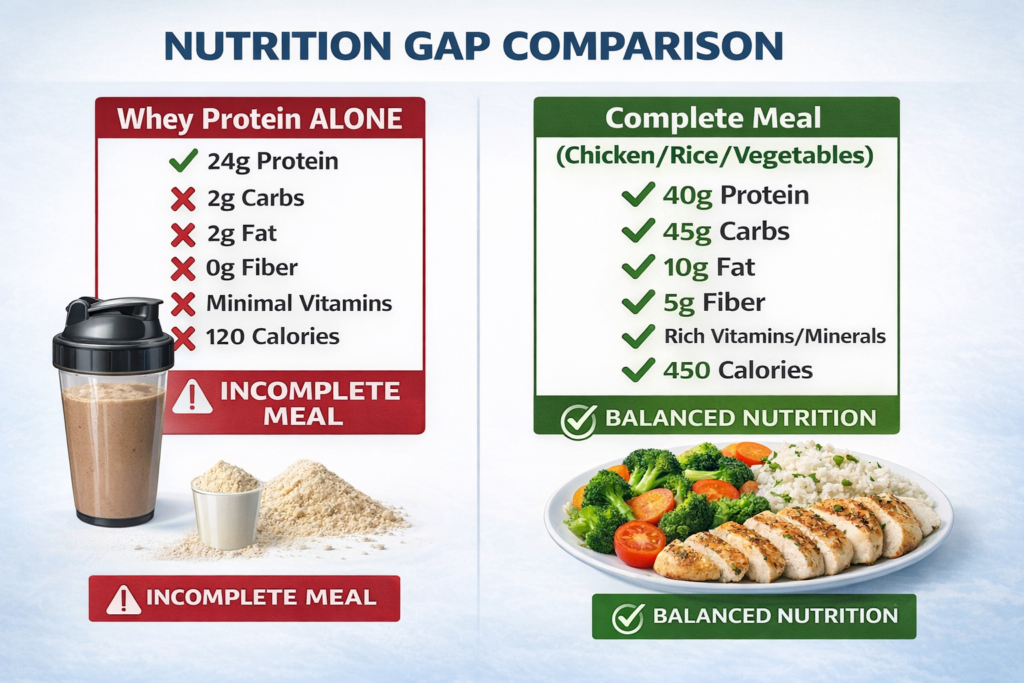
Think about a typical whole food meal:
Example: Chicken, rice, and vegetables
- Protein: 40g (6oz chicken breast)
- Carbs: 45g (1 cup cooked rice)
- Fat: 10g (cooking oil, chicken)
- Fiber: 5g (vegetables, rice)
- Vitamins: A, C, K, B vitamins (vegetables, chicken)
- Minerals: Iron, magnesium, potassium (chicken, rice, vegetables)
- Calories: 400-450
Compared to whey protein alone:
- Protein: 24g ✓
- Carbs: 2g ✗ (nowhere near enough)
- Fat: 2g ✗ (inadequate)
- Fiber: 0g ✗ (none)
- Vitamins: Minimal ✗
- Minerals: Minimal ✗
- Calories: 120 ✗ (far too low)
Drinking just whey protein:
- Provides protein
- Leaves massive nutritional gaps
- Won’t keep you satisfied
- Doesn’t provide energy for training or daily activities
- Can’t sustain health long-term
The Correct Approach: Whey PLUS Whole Foods
To properly replace a meal with whey, you must add:
Carbohydrates:
- Fruit (banana, berries, mango)
- Oats
- Sweet potato (yes, you can blend it)
Healthy fats:
- Nut butter (peanut, almond, cashew)
- Avocado
- Coconut oil
- Nuts/seeds
Fiber:
- Fruit (especially berries)
- Oats
- Flaxseed or chia seeds
- Vegetables (spinach blends well)
Micronutrients:
- Fruit (vitamins, antioxidants)
- Vegetables (spinach, kale)
- Dairy or plant milk (calcium, vitamin D)
When you combine whey with these whole food ingredients, you create an actual meal replacement that:
- Provides complete nutrition
- Keeps you satisfied
- Supports your training and recovery
- Maintains health
- Delivers adequate calories
This is the key: Whey is the protein foundation. Whole foods complete the meal.
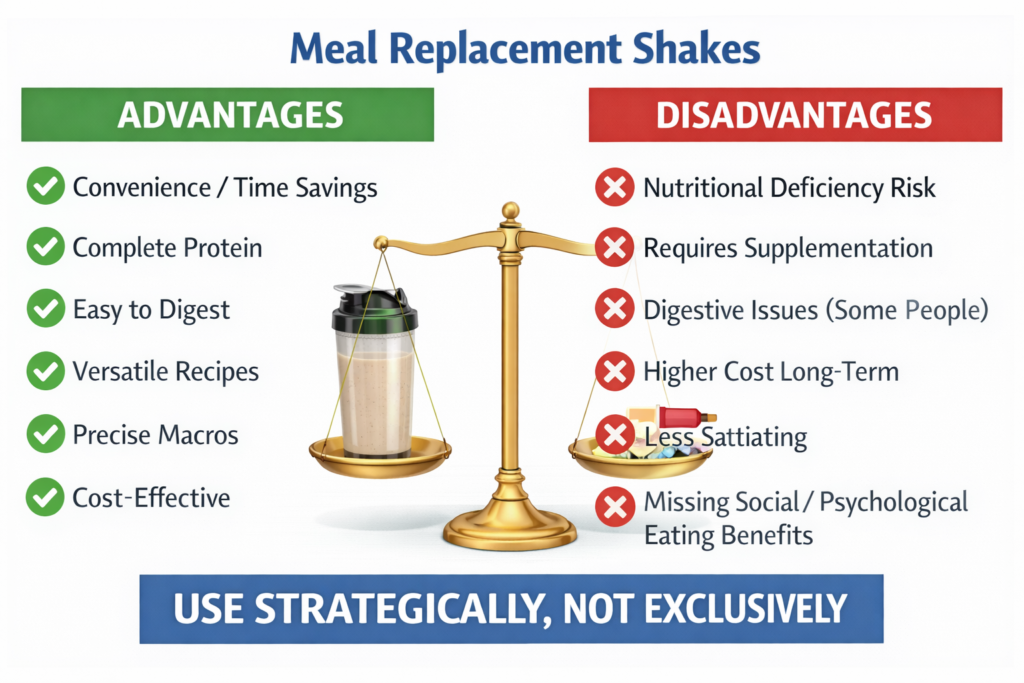
Advantages of Replacing Meals With Whey
When done correctly, meal replacement shakes offer legitimate benefits.
Advantage 1: Unmatched Convenience
This is the primary reason people consider meal replacement shakes.
Time savings:
- Blend ingredients: 2 minutes
- Drink shake: 3-5 minutes
- Cleanup: 1 minute
- Total time: 6-8 minutes
Compare to cooking a meal:
- Prep ingredients: 10 minutes
- Cook: 15-20 minutes
- Eat: 15-20 minutes
- Cleanup: 5-10 minutes
- Total time: 45-60 minutes
When this matters:
- Extremely busy mornings
- Between work and training
- Late night when you’re tired
- Traveling or commuting
- Any time you’re rushed
Portability:
- Blend at home, take in shaker
- Drink in car, at work, at gym
- No refrigeration needed for 2-3 hours
- No utensils or plates required
Advantage 2: High-Quality Complete Protein
Whey protein is arguably the best protein source available.
Why whey is superior:
High biological value:
- Approximately 104 BV (higher than any whole food)
- Your body uses nearly all the protein you consume
- Minimal waste
Complete amino acid profile:
- Contains all nine essential amino acids
- Optimal ratios for muscle building
- High leucine content (critical for muscle protein synthesis)
Fast absorption:
- Digests and absorbs quickly
- Amino acids available within 30-60 minutes
- Ideal for post-workout nutrition
When you use whey in meal replacements:
- Guaranteed to hit protein targets
- Know exact protein amount (unlike estimating with chicken)
- Optimal amino acids for muscle building
- Easy to digest and absorb
Advantage 3: Easy to Consume and Digest
Some situations make solid food difficult or unpleasant.
When liquid nutrition is superior:
Low appetite:
- Early morning (many people aren’t hungry for breakfast)
- Post-workout (training suppresses appetite temporarily)
- During cuts (appetite reduced from caloric deficit)
- Illness or stress
Digestive sensitivity:
- Before training (solid food can cause discomfort during exercise)
- After intense training (digestive system stressed)
- For people with IBS or digestive issues
- When you need quick nutrition without stomach heaviness
Bulking challenges:
- Hard gainers struggle to eat enough solid food
- Liquid calories easier to consume in volume
- Less filling than equivalent solid food
- Can drink shake even when full from previous meal
Advantage 4: Incredible Versatility
Meal replacement shakes aren’t limited to basic protein + water.
You can create unlimited variations:
Sweet options:
- Chocolate banana peanut butter
- Strawberry vanilla
- Blueberry muffin
- Cookies and cream
- Cinnamon roll
Savory options:
- Yes, you can make savory shakes (tomato, herbs, vegetables)
- Less common but possible
Texture variations:
- Thin and drinkable
- Thick smoothie bowl
- Ice cream-like texture
- Warm shake (in cold weather)
Beyond just drinking:
- Pour into bowl and eat with spoon (smoothie bowl)
- Freeze into popsicles
- Use as pancake batter
- Make protein ice cream
Recipe adaptability:
- Low calorie for cutting (300-400 calories)
- High calorie for bulking (800-1,200+ calories)
- Adjust protein, carbs, fats independently
- Customize to exact macro targets
Advantage 5: Precise Macro Control
With whole food meals, exact macros require weighing everything.
With shakes, precision is easy:
Exact measurements:
- 1 scoop whey = 24g protein (known exactly)
- 1 banana = 27g carbs (consistent)
- 2 tablespoons peanut butter = 16g fat (precise)
- Total shake macros = very accurate
Easy adjustments:
- Need more protein? Add half scoop
- Need more carbs? Add another banana
- Need more calories? Add tablespoon of nut butter
- Immediate, precise modifications
For people tracking macros meticulously:
- Shakes provide certainty
- No guessing about portion sizes
- Hit targets exactly
- Easier than weighing cooked chicken and rice
Advantage 6: Cost-Effective (Potentially)
Depending on ingredients, meal replacement shakes can be economical.
Cost comparison:
Restaurant or takeout meal:
- Average cost: $10-15
- Unknown macros
- Often poor nutrition
Prepared convenience meals:
- Average cost: $6-10
- Better macros
- Still expensive over time
Homemade meal:
- Average cost: $4-7
- Good macros if planned well
- Requires time and effort
Meal replacement shake:
- Average cost: $2-5
- Exact macros
- Minimal time required
When shakes save money:
- Replacing expensive convenience meals
- Avoiding restaurants during busy times
- Preventing food waste (shakes use exactly what you need)
When shakes cost more:
- Compared to very cheap home-cooked meals (rice, beans, chicken thighs)
- If using expensive specialty ingredients
Disadvantages of Replacing Meals With Whey
Despite the advantages, there are significant downsides to consider.
Disadvantage 1: Nutritional Deficiency Risk
This is the primary concern.
Whey protein is a processed supplement, not a whole food.
What it lacks:
Micronutrients:
- Vitamins A, C, E, K
- B-complex vitamins (minimal amounts)
- Minerals like iron, magnesium, potassium
- Trace minerals
Phytonutrients:
- Antioxidants from fruits and vegetables
- Polyphenols
- Flavonoids
- Carotenoids
Fiber:
- Zero fiber in whey protein
- Essential for digestive health
- Important for satiety
- Supports gut microbiome
The risk:
If you replace multiple meals daily with just whey + water:
- Vitamin and mineral deficiencies develop
- Digestive issues from lack of fiber
- Compromised immune function
- Poor energy levels
- Suboptimal health
Even with added whole foods in shakes:
- Still less diverse than varied whole food diet
- May miss certain nutrients
- Shouldn’t replace majority of meals long-term
Disadvantage 2: Requires Supplementation
To make a complete meal replacement, whey alone isn’t enough.
You must add:
Carbohydrate sources:
- Fruit (adds cost and prep)
- Oats (need to have on hand)
- Other carb sources
Fat sources:
- Nut butter ($10-15 per jar)
- Nuts and seeds
- Oils or avocado
Micronutrient sources:
- Fresh fruit (perishable, requires shopping)
- Vegetables
- Fortified milk
The complexity:
- Not as simple as “just drink a shake”
- Requires shopping for multiple ingredients
- Need to keep ingredients fresh
- More expensive than whey alone
- Still requires some meal planning
If you don’t add these ingredients:
- Your meal replacement is nutritionally inadequate
- You’re just drinking protein powder, not replacing a meal
Disadvantage 3: Digestive Issues for Some People
Whey protein can cause problems for certain individuals.
Lactose intolerance:
- Whey concentrate contains lactose
- Causes gas, bloating, diarrhea in sensitive people
- Whey isolate has less lactose but still some
- Not everyone tolerates dairy-based protein
Digestive discomfort:
- Some people feel bloated after liquid meals
- Large volume of liquid can cause stomach distention
- Drinking too quickly causes gas
- Individual tolerance varies
Solutions:
- Use whey isolate (less lactose)
- Try plant-based protein instead
- Drink shake slowly
- Take digestive enzymes
- Accept that shakes might not work for you
If shakes consistently cause digestive issues, this approach isn’t suitable.
Disadvantage 4: Higher Cost Long-Term
While potentially cost-effective compared to restaurants, frequent meal replacement can get expensive.
The math:
Quality whey protein:
- 5-pound tub: $50-70
- Approximately 70 servings
- Cost per serving: $0.70-1.00
Complete shake ingredients (per serving):
- Whey: $1.00
- Banana: $0.30
- Oats: $0.15
- Peanut butter: $0.40
- Milk: $0.40
- Total: $2.25 per shake
If replacing 2 meals daily:
- Daily cost: $4.50
- Monthly cost: $135
- Annual cost: $1,642
Compared to home-cooked whole food meals:
- Often cheaper ($1.50-3.00 per meal)
- More nutrient-dense
- Greater variety
The verdict: Shakes are convenient but not the cheapest option long-term.
Disadvantage 5: Satiety Issues
Liquid calories are less satiating than solid food.
The science:
Why solid food keeps you fuller:
- Chewing triggers satiety signals
- Physical volume in stomach
- Slower digestion
- Psychological satisfaction of eating
Why liquid meals are less satisfying:
- No chewing (reduced satiety signaling)
- Faster to consume
- Digests quicker
- Less psychological satisfaction
Practical problems:
When cutting (caloric deficit):
- Shake doesn’t keep you full as long
- Get hungry sooner after drinking vs. eating
- Harder to stick to diet
- May lead to snacking between meals
This is why meal replacement shakes work better for bulking than cutting.
Disadvantage 6: Missing the Social and Psychological Benefits of Eating
Food is more than just nutrients.
What you lose with liquid meals:
Social connection:
- Meals with family and friends
- Conversations over dinner
- Cultural and social rituals
- Relationship building
Psychological satisfaction:
- Pleasure of eating delicious food
- Variety in textures and flavors
- Visual appeal of plated meals
- Mindful eating experience
These factors matter for:
- Quality of life
- Relationship health
- Long-term diet adherence
- Mental well-being
Replacing too many meals with shakes can:
- Reduce quality of life
- Make you feel like you’re “always on a diet”
- Cause social isolation (not eating with others)
- Lead to burnout and diet abandonment
How to Replace a Meal With Whey Correctly (Complete Recipe)
Here’s how to build a nutritionally complete meal replacement shake.
The Complete Meal Replacement Formula
A proper meal replacement shake needs these components:
1. Protein (whey protein powder):
- Provides: Amino acids for muscle building
- Amount: 25-40g protein (1-1.5 scoops)
2. Carbohydrates (fruit + oats):
- Provides: Energy, fiber, vitamins
- Amount: 40-80g carbs (depending on goals)
3. Healthy fats (nut butter or nuts):
- Provides: Hormone production, satiety, vitamin absorption
- Amount: 10-20g fat
4. Liquid base (milk or plant milk):
- Provides: Additional protein, calcium, creaminess
- Amount: 300-400ml
5. Optional add-ins:
- Greens powder (micronutrients)
- Chia/flax seeds (omega-3s, fiber)
- Cinnamon, vanilla, cocoa (flavor, antioxidants)
The Recipe: Complete Meal Replacement Shake
This shake provides balanced nutrition equivalent to a whole food meal.
Ingredients:
Protein:
- 1 scoop (30g) whey protein concentrate (vanilla or chocolate)
Carbohydrates:
- 1 medium banana (provides natural sweetness, potassium, fiber)
- 50g rolled oats (provides complex carbs, fiber, sustained energy)
Fats:
- 2 tablespoons peanut butter or almond butter
Liquid:
- 300ml whole milk (or plant milk like oat, soy, almond)
Optional:
- Handful of spinach (doesn’t affect taste, adds vitamins)
- 1 tablespoon ground flaxseed (omega-3s, fiber)
- 1/2 teaspoon cinnamon (flavor, blood sugar control)
- Ice cubes (for cold, thick texture)
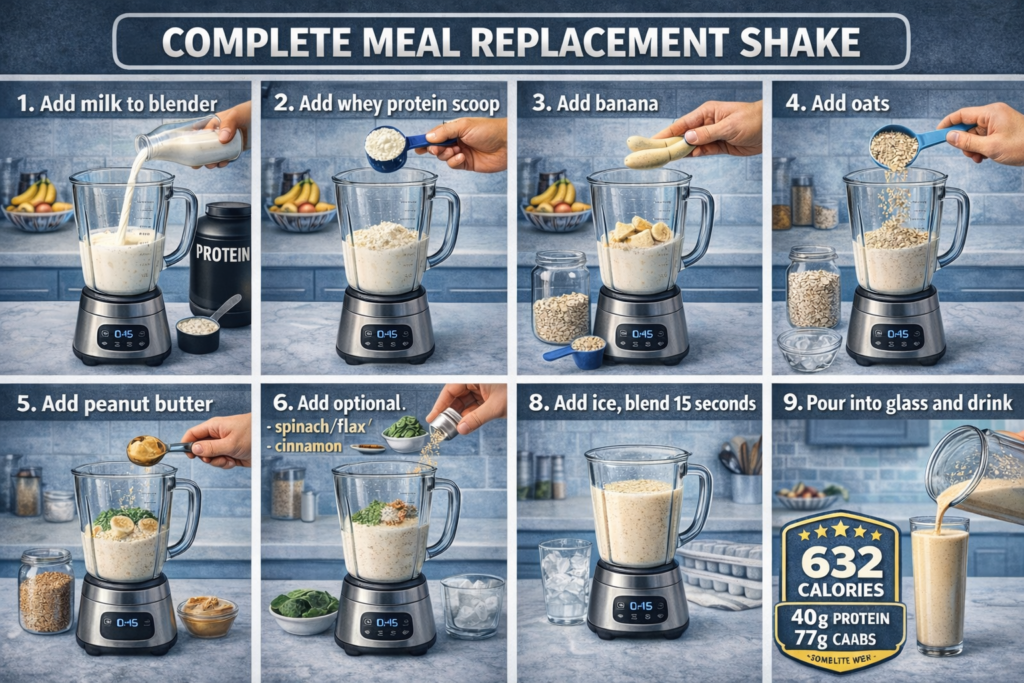
Preparation:
Step 1: Add liquid to blender first (prevents powder from sticking to bottom)
Step 2: Add whey protein powder
Step 3: Add banana (can be frozen for thicker shake)
Step 4: Add oats
Step 5: Add peanut butter
Step 6: Add any optional ingredients
Step 7: Blend on high for 45-60 seconds until completely smooth
Step 8: Add ice and blend another 15-20 seconds if desired
Step 9: Pour into large glass or shaker and drink within 30-60 minutes
Nutritional Breakdown
Complete shake macros:
Protein: 40g
- Whey: 24g
- Milk: 10g
- Oats: 3g
- Peanut butter: 3g
Carbohydrates: 77g
- Banana: 27g
- Oats: 27g
- Milk: 15g
- Peanut butter: 8g
Fat: 20g
- Peanut butter: 16g
- Milk: 8g
- Whey: 2g
Fiber: 8g
- Oats: 4g
- Banana: 3g
- Peanut butter: 1g
Calories: 632
This provides:
- Balanced macros for muscle building
- Adequate fiber for digestive health
- Vitamins and minerals from whole foods
- Sustained energy for 3-4 hours
- Suitable as a complete meal replacement
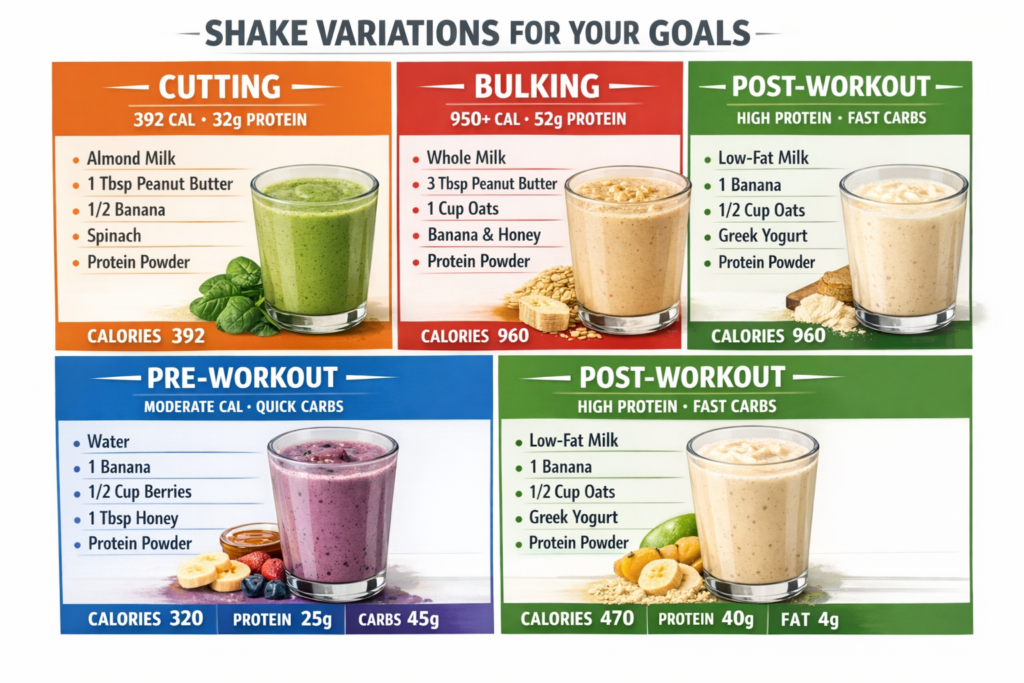
Variations for Different Goals
For cutting (lower calories):
Modifications:
- Use 200ml unsweetened almond milk instead of whole milk
- Use 1 tablespoon peanut butter instead of 2
- Remove oats or reduce to 25g
- Add more ice for volume
Result:
- Protein: 32g
- Carbs: 42g
- Fat: 12g
- Calories: 392
For bulking (higher calories):
Modifications:
- Use 400ml whole milk
- Add 3 tablespoons peanut butter
- Add 75g oats
- Add 2 bananas
- Add 1 tablespoon honey
Result:
- Protein: 52g
- Carbs: 125g
- Fat: 30g
- Calories: 950+
For pre-workout:
Modifications:
- Reduce fat (1 tablespoon peanut butter)
- Increase simple carbs (add berries or honey)
- Consume 90-120 minutes before training
For post-workout:
Modifications:
- Increase protein (1.5 scoops whey)
- Keep carbs moderate-high
- Consume within 60 minutes post-training
How Many Meals Can You Replace Per Day?
This is a critical question for long-term health.
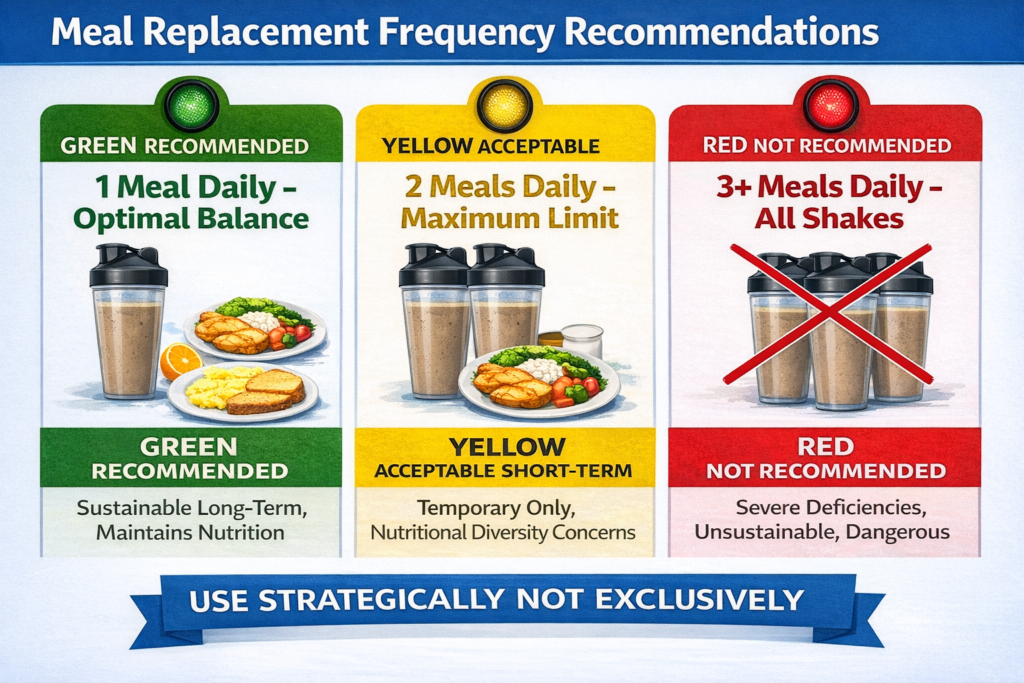
The Maximum Recommendation: Two Meals
You should replace NO MORE than 2 meals per day with whey-based shakes.
Why this limit matters:
Nutritional diversity:
- Even complete shakes can’t match the nutrient variety of whole foods
- Different foods provide different micronutrient profiles
- Eating diverse whole foods ensures you get everything you need
Digestive health:
- Gut microbiome thrives on dietary variety
- Fiber from varied sources supports different beneficial bacteria
- Too much liquid nutrition can affect digestion
Psychological sustainability:
- Replacing all meals with shakes is mentally exhausting
- Food provides pleasure and satisfaction
- Social aspects of eating matter
- Long-term adherence suffers
Practical cost:
- Replacing all meals with quality shakes gets expensive
- Whole food meals are often more economical
The Ideal Approach: One Meal Replacement
For most people, replacing ONE meal daily with a shake works best:
Why one meal is optimal:
Maintains nutritional balance:
- Two whole food meals provide diverse nutrients
- One shake adds convenience without compromising health
- Best of both worlds
Sustainable long-term:
- Doesn’t feel overly restrictive
- Still enjoy regular meals
- Social eating remains possible
- Easy to maintain indefinitely
Cost-effective:
- Saves time on one meal
- Keeps supplement costs reasonable
- Can still cook and enjoy whole foods
Provides flexibility:
- Use shake for busiest meal of your day
- Adjust which meal based on schedule
- Maintain overall diet quality
When Two Meals Might Work
Replacing two meals can be acceptable short-term in specific situations:
Very busy periods:
- Finals week for students
- Work deadline crunch
- Travel schedule
- Temporary convenience need
Specific diet phases:
- Short-term aggressive cut (4-6 weeks)
- Bulking phase where eating enough solid food is difficult
- Competition prep
Important: This should be temporary (weeks, not months), with return to normal eating patterns.
Best Timing for Whey Meal Replacements
When should you replace meals with shakes?
Option 1: Post-Workout (Most Common and Effective)
Why post-workout is ideal:
Physiological benefits:
- Muscles are primed for nutrient absorption
- Fast-digesting protein ideal for this window
- Carbs replenish glycogen effectively
- Liquid nutrition easy on post-training digestive system
Practical benefits:
- Training suppresses appetite temporarily
- Liquid meal easier to consume when not hungry
- Convenient at gym or on way home
- Saves time when you need to shower and get back to life
Optimal post-workout shake:
- 30-40g protein
- 60-80g carbs
- Moderate fat
- Consumed within 60-90 minutes post-training
Option 2: Breakfast (Second Most Common)
Why breakfast works well:
Common challenges breakfast solves:
- No appetite in morning (common)
- Rushed mornings (no time to cook)
- Struggle to eat protein at breakfast (eggs get boring)
- Need portable meal for commute
Benefits:
- Jump-starts protein intake for the day
- Convenient and fast
- Can drink in car or at work
- Ensures you don’t skip breakfast
Breakfast shake considerations:
- May need to reduce fat slightly (easier digestion)
- Include coffee if desired (can blend together)
- Prepare night before for grab-and-go convenience
Option 3: Lunch (For Busy Professionals)
Why lunch replacement works:
Workplace challenges:
- Limited time for lunch break
- No access to kitchen
- Expensive or unhealthy restaurant options nearby
- Need to keep working while eating
Shake advantages:
- Drink at desk while working
- No need to leave office
- Saves money vs. eating out
- Precise macros vs. unknown restaurant food
Option 4: Late Night Meal (For Specific Goals)
When late night shakes make sense:
Bulking scenarios:
- Need extra calories before bed
- Struggle to eat enough during day
- Want protein before 7-8 hour sleep
- Liquid calories easier to add
Considerations:
- Keep fat moderate (too much affects sleep)
- Include casein protein if available (slow-digesting)
- Drink 60-90 minutes before bed (not right before)
The Worst Time: Multiple Meals Throughout Day
Don’t replace breakfast, lunch, AND dinner with shakes.
Why this fails:
- Nutritional deficiencies develop
- Socially isolating
- Mentally exhausting
- Not sustainable
- Defeats purpose of healthy eating
Use shakes strategically for 1-2 specific meals, not as your entire diet.
Frequently Asked Questions
Can I replace all my meals with protein shakes?
No, absolutely not recommended.
Reasons:
- Severe nutritional deficiencies will develop
- Inadequate micronutrients, fiber, phytonutrients
- Not sustainable psychologically
- Digestive health suffers
- Quality of life decreases
- Will eventually fail and rebound
Maximum: 2 meals replaced, and even that should be temporary.
Is whey protein a meal replacement or supplement?
Whey protein is primarily a SUPPLEMENT, not a meal replacement.
As a supplement:
- Fills protein gaps in your diet
- Convenient way to increase protein intake
- Complements whole food meals
Can become meal replacement when:
- Combined with whole food ingredients
- Provides complete macronutrient profile
- Includes adequate calories
- Contains fiber and micronutrients from added foods
Never use whey alone as a meal replacement.
Will I lose muscle if I replace meals with shakes?
Not if done correctly with adequate protein and calories.
Muscle preservation requires:
- Adequate total protein (0.7-1g per pound body weight)
- Sufficient total calories (especially when bulking)
- Progressive resistance training
- Proper recovery
Shakes can provide all of this when:
- Built with complete ingredients (protein + carbs + fats)
- Consumed as part of balanced daily nutrition
- Total protein and calories are adequate
- Used for 1-2 meals, not all meals
You WILL lose muscle if:
- Only drinking whey + water (inadequate calories)
- Replacing all meals (nutritional deficiency)
- Not training properly
- In excessive caloric deficit
Can I replace meals with shakes while cutting?
Yes, but with caution.
Advantages for cutting:
- Easy to control exact calories
- High protein prevents muscle loss
- Convenient when appetite is low
- Precise macro tracking
Disadvantages for cutting:
- Less satiating than solid food
- May get hungry sooner
- Harder to stick to deficit long-term
Best practices for cutting:
- Use shakes for 1 meal maximum
- Make shake as satiating as possible (high fiber, adequate volume)
- Include solid meals for satiety
- Monitor hunger levels and adjust
Should I use a pre-made meal replacement or make my own?
Making your own is superior in almost every way.
Pre-made meal replacements (Soylent, Huel, etc.):
Pros:
- Ultimate convenience
- No preparation needed
- Shelf-stable
Cons:
- Expensive ($3-5 per meal)
- Highly processed
- Often taste mediocre
- Limited control over ingredients
- Less fresh nutrients
Homemade shakes:
Pros:
- Much cheaper ($1.50-3 per meal)
- Control exact ingredients
- Fresh whole foods
- Customizable to your taste
- Better nutrient quality
Cons:
- Requires shopping for ingredients
- Need blender
- 5 minutes prep time
- Ingredients can spoil
For 95% of people, homemade shakes are better.
The Bottom Line: Use Shakes Strategically, Not Exclusively
After examining all the evidence:
Yes, you can replace meals with whey protein, BUT:
✅ Must add whole food carbs, fats, and fiber (not just whey + water)
✅ Should replace maximum 1-2 meals per day
✅ Best used strategically for convenience (post-workout, busy mornings)
✅ Requires complete ingredients to match whole food nutrition
✅ Not sustainable as primary diet long-term
The ideal approach:
Replace 1 meal daily with a complete shake:
- Post-workout is optimal for most people
- Breakfast works well for busy mornings
- Ensures adequate protein intake
- Saves time on busiest meal
- Maintains overall diet quality with other whole food meals
Your shake must include:
- Whey protein (25-40g protein)
- Whole food carbs (banana, oats, fruit)
- Healthy fats (nut butter, nuts, avocado)
- Adequate liquid (milk or plant milk)
- Optional: greens, seeds, spices
What matters most:
- Total daily protein (0.7-1g per pound)
- Total daily calories (deficit for cutting, surplus for bulking)
- Micronutrient diversity from varied whole foods
- Training consistency
- Long-term adherence
Use meal replacement shakes as a tool for convenience, not as your entire nutrition strategy.
BLEND COMPLETE SHAKES. USE STRATEGICALLY. PRIORITIZE WHOLE FOODS.
Ready to optimize your entire nutrition approach with strategies that actually work long-term without sacrificing convenience or results? Meal replacement shakes are just one tool in a complete nutrition system. Get a science-based meal planning guide that shows you exactly when to use shakes, how to build perfect whole food meals, and how to create a sustainable eating approach that delivers results without burnout. Stop struggling with nutrition. Start eating smarter.



Leave a Reply
You must be logged in to post a comment.