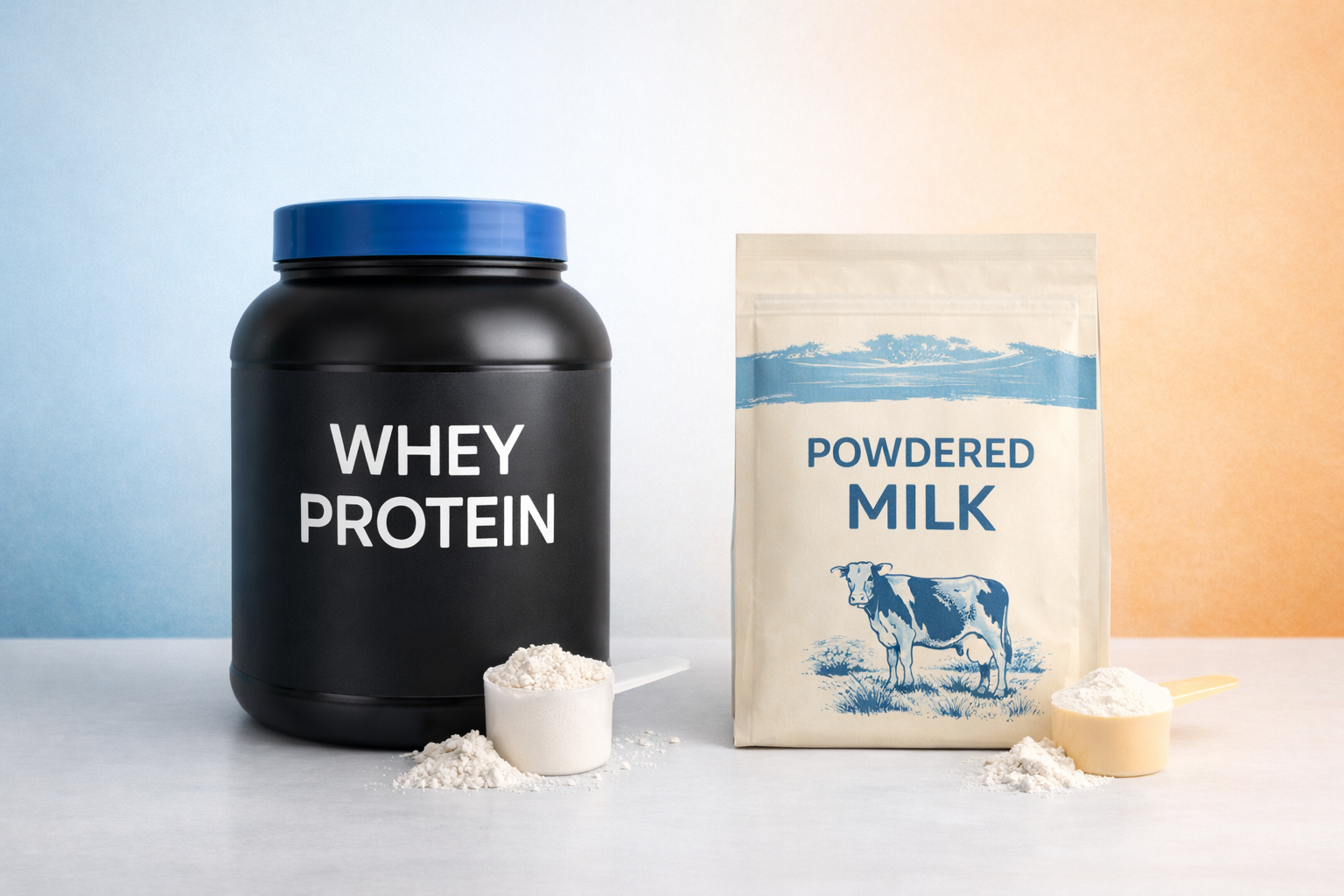
Considering switching to powdered milk to save money? Here’s the complete truth about whether it actually works as a whey replacement.
You’re spending $50+ on whey protein every month. You see powdered milk at the grocery store for $15.
Could you just use powdered milk instead and save money?
It seems logical:
- Both are dairy products
- Both contain protein
- Powdered milk is much cheaper
- “Protein is protein, right?”
But is it actually a viable replacement?
Here’s the uncomfortable truth: Powdered milk is NOT an effective replacement for whey protein if your goal is increasing protein intake. While 100g of whey provides 70-80g protein with minimal carbs and fats, 100g of powdered milk provides only 26g protein along with 38g carbs and 27g fat. You’d need to consume 3x as much powdered milk (with 3x the calories) to match whey’s protein content, making it impractical for muscle building despite lower cost.
In this comprehensive guide, I’ll reveal the complete nutritional comparison between whey and powdered milk with exact numbers, explain why powdered milk fails as a direct protein replacement, show you when powdered milk actually makes sense (specific scenarios), provide better whey alternatives that actually work, and help you make cost-effective protein choices without sabotaging your results.
Whether you’re trying to save money or just exploring options, this article will give you the honest analysis.
Let’s compare these products objectively.
TABLE OF CONTENTS
- Is powdered milk a good protein source?
- What do I lose by replacing whey with powdered milk?
- Will using powdered milk affect my muscle-building results?
- When does it make sense to use powdered milk instead of whey?
- Can powdered milk cause fat gain?
- What's the best way to use powdered milk as a protein supplement?
- The Bottom Line: Powdered Milk Is NOT a Whey Replacement
Can You Replace Whey Protein With Powdered Milk?
The direct answer with critical context.
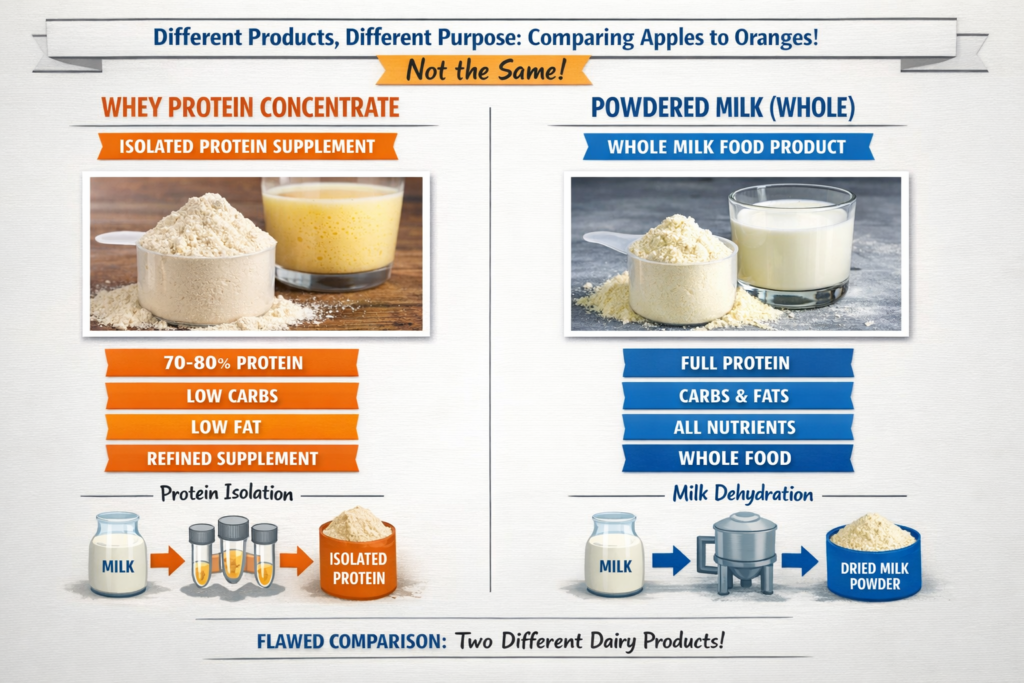
The Short Answer: Not Really
Technically possible but practically problematic.
Why people think it works:
- Both are dairy products
- Both contain protein
- Powdered milk is cheaper
- “Close enough” mentality
Why it doesn’t actually work:
- Protein concentration vastly different
- Macro ratios completely different
- Would need 3x the volume
- Results in excessive carbs and fats
The bottom line: If powdered milk were an effective whey replacement, the supplement industry would be out of business and everyone would just use powdered milk.
Understanding the Fundamental Difference
Whey protein is isolated, powdered milk is whole food.
Whey protein (concentrate):
- Isolated protein fraction from milk
- Processing removes most carbs and fats
- Concentrated to 70-80% protein by weight
- Designed specifically for protein supplementation
Powdered milk (whole):
- Entire milk dehydrated
- Nothing removed or isolated
- Contains all milk components
- Same macro ratio as liquid milk
- General food product, not protein supplement
The comparison is flawed from the start: Whey is a refined supplement. Powdered milk is dehydrated whole milk. Completely different products despite both being dairy.
Complete Nutritional Comparison
The numbers reveal the stark differences.
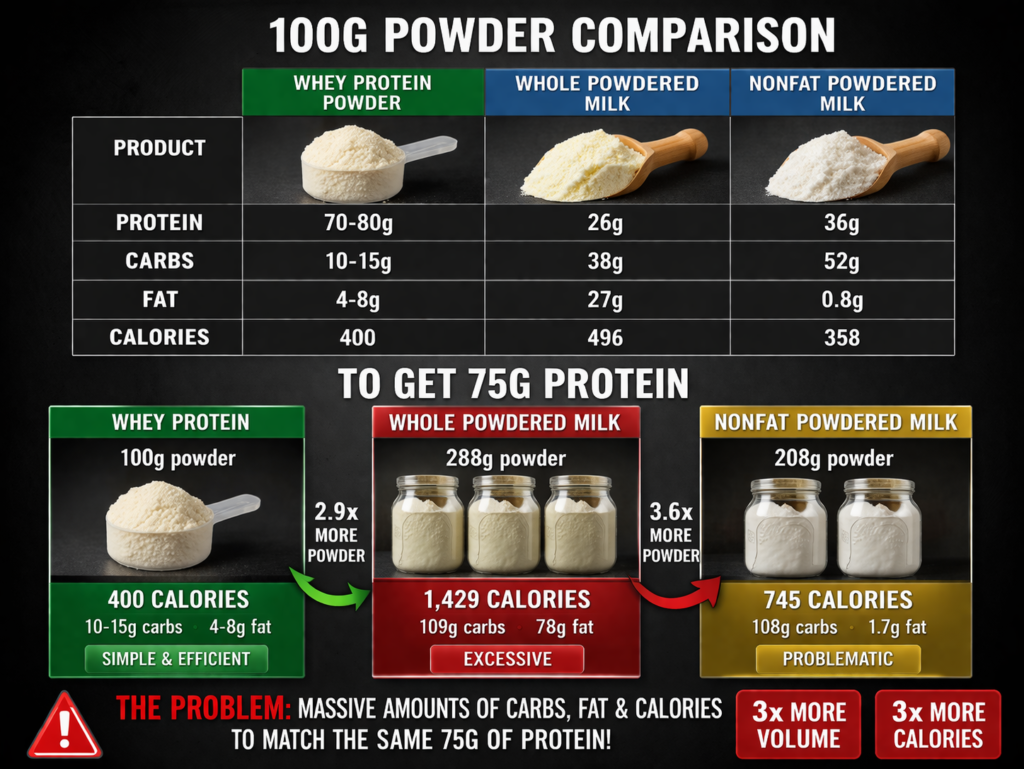
Head-to-Head: 100g Powder Comparison
Whey protein concentrate (100g):
- Calories: 400
- Protein: 70-80g
- Carbohydrates: 10-15g
- Fat: 4-8g
- Cholesterol: 50-80mg
- Sodium: 200-400mg
- Calcium: 400-600mg
- Protein concentration: 70-80%
Whole powdered milk (100g):
- Calories: 496
- Protein: 26g
- Carbohydrates: 38g
- Fat: 27g (mostly saturated)
- Cholesterol: 97mg
- Sodium: 371mg
- Calcium: 912mg
- Potassium: 1,300mg
- Protein concentration: 26%
What This Means in Practice
To get equivalent protein (75g):
Using whey protein:
- Amount needed: 100g powder
- Calories: 400
- Carbs: 10-15g
- Fat: 4-8g
- Simple and efficient
Using powdered milk:
- Amount needed: 288g powder
- Calories: 1,429
- Carbs: 109g
- Fat: 78g
- Nearly 3x the calories for same protein
The problem is obvious: To match whey’s protein, you consume massive amounts of carbs, fats, and total calories.
Nonfat/Skim Powdered Milk: Better But Still Problematic
Removing fat helps but doesn’t solve the core issue.
Nonfat powdered milk (100g):
- Calories: 358
- Protein: 36g
- Carbohydrates: 52g
- Fat: 0.8g
- Better protein ratio but still carb-heavy
To get 75g protein:
- Amount needed: 208g nonfat powder
- Calories: 745
- Carbs: 108g
- Fat: 1.7g
- Still 2x the calories, massive carb load
The persistent problem: Even removing fat, powdered milk has too many carbs relative to protein.
When Does Powdered Milk Make Sense?
Specific scenarios where it can be useful.
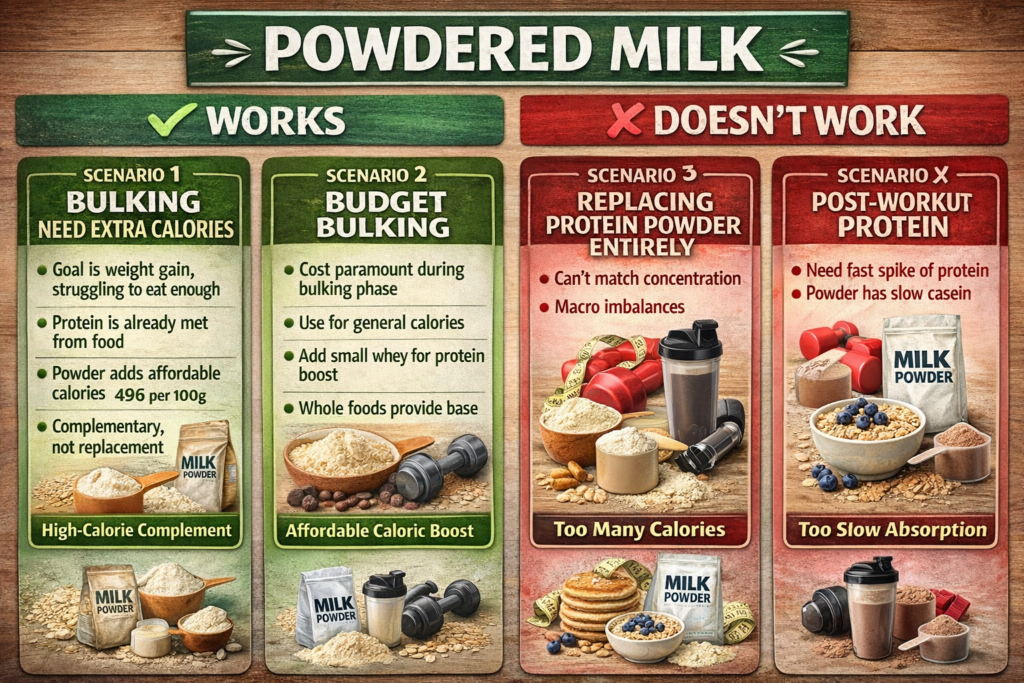
Scenario 1: Bulking and Need Extra Calories
If your goal is gaining weight, not just protein:
The situation:
- Bulking, need 3,500+ calories daily
- Struggling to eat enough
- Want easy liquid calories
- Protein targets already met from whole food
How powdered milk helps:
- 100g powder = 496 calories
- Add to shakes for calorie boost
- Provides some protein (26g) as bonus
- Cheaper than mass gainer supplements
Example mass gainer shake:
- 150g powdered milk (744 cal, 39g protein, 57g carbs)
- 2 scoops whey (240 cal, 48g protein, 6g carbs)
- 2 bananas (210 cal, 54g carbs)
- 2 tbsp peanut butter (190 cal, 8g protein, 16g fat)
- Total: 1,384 calories, 95g protein, 117g carbs
This works because:
- Goal is total calories, not pure protein
- Powdered milk adds affordable calories
- Whey provides concentrated protein
- Complementary, not replacement
Scenario 2: Budget Bulking
When cost is paramount and you’re bulking:
The math:
- Whey: $50-60 per 5 pounds
- Powdered milk: $15-25 per 3 pounds
- Powdered milk ~50% cheaper per pound
The strategy:
- Use powdered milk for general calories
- Add small amount of whey for protein boost
- Rely on whole foods (chicken, eggs) for base protein
- Powdered milk as calorie filler, not protein source
Example approach:
- Breakfast: Eggs and oatmeal (whole food protein)
- Lunch: Chicken and rice (whole food protein)
- Snack: Shake with 75g powdered milk (19g protein, 300 cal)
- Dinner: Beef and potatoes (whole food protein)
- Powdered milk provides supplemental calories cheaply
Scenario 3: Adding to Other Protein Sources
Using powdered milk to enhance existing meals:
Protein oatmeal:
- 1 cup oats (5g protein)
- 50g powdered milk (13g protein)
- 1 scoop whey (24g protein)
- Total: 42g protein, complete meal
Protein pancakes:
- Pancake batter
- 75g powdered milk mixed in
- Adds 19g protein, 285 calories
- Bonus calcium and potassium
In recipes:
- Baked goods
- Smoothies
- Soups
- Nutrient booster, not sole protein
When Powdered Milk Does NOT Work
Critical failures to avoid:
Scenario: Cutting (fat loss)
- Need high protein, low calories
- Powdered milk too calorie-dense
- Carbs and fats unwanted
- Whey far superior
Scenario: Replacing protein powder entirely
- Can’t match protein concentration
- Creates macro imbalances
- Excessive calories
- Not viable replacement
Scenario: Post-workout protein
- Need fast protein spike
- Powdered milk has casein (slow)
- Whole milk characteristics
- Whey better choice
Better Whey Alternatives (That Actually Work)
If cost is the concern, these are real alternatives.
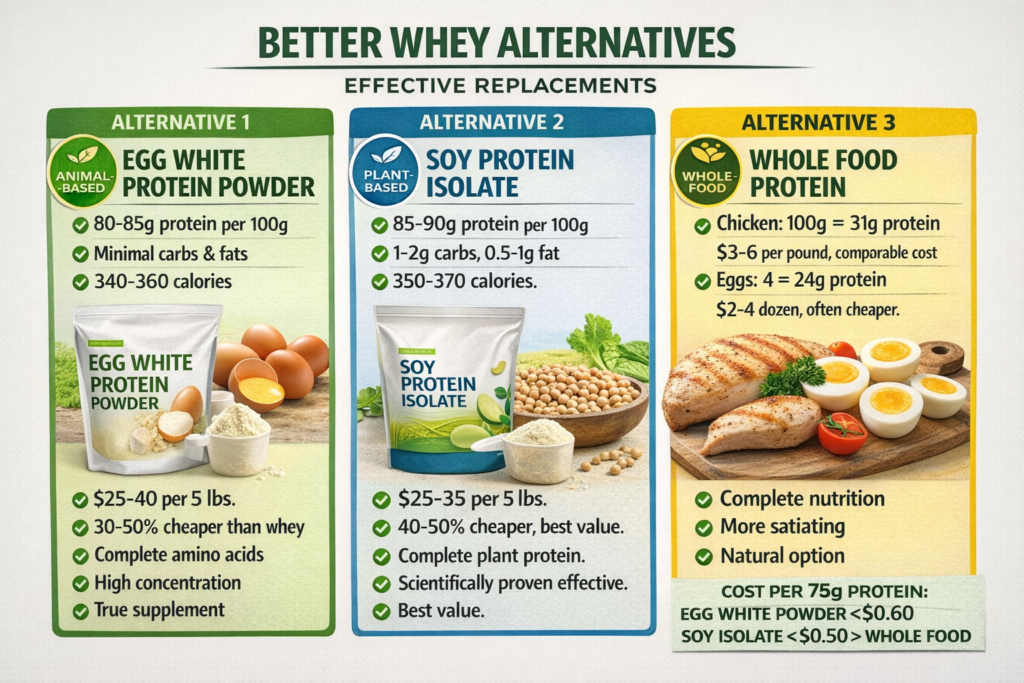
Alternative 1: Egg White Protein Powder
Better replacement than powdered milk.
Nutritional comparison (100g):
- Protein: 80-85g
- Carbohydrates: <1g
- Fat: <1g
- Calories: 340-360
- Actually comparable to whey
Cost:
- $25-40 per 5 pounds
- 30-50% cheaper than whey
- Better value than whey in many cases
Why it works:
- Complete amino acid profile
- High protein concentration
- Minimal carbs and fats
- True protein supplement
Alternative 2: Soy Protein Isolate
Cheapest quality protein powder.
Nutritional comparison (100g):
- Protein: 85-90g
- Carbohydrates: 1-2g
- Fat: 0.5-1g
- Calories: 350-370
- Equal or better than whey
Cost:
- $25-35 per 5 pounds
- Often 40-50% cheaper than whey
- Best value for quality protein
Why it works:
- Complete plant protein
- High concentration
- Scientifically proven effective
- Actual whey alternative
Alternative 3: Whole Food Protein
Often overlooked but effective.
Chicken breast:
- 100g = 31g protein
- $3-6 per pound
- 75g chicken = 23g protein for $0.50-1.00
- Comparable cost to whey
Eggs:
- 4 eggs = 24g protein
- $2-4 per dozen
- 4 eggs = $0.65-1.30
- Often cheaper than whey
Why whole food works:
- Complete nutrition
- More satiating
- Natural option
- Valid alternative to supplements
The Cost-Benefit Analysis
Honest comparison of actual value.
Cost Per 75g Protein
Whey protein:
- Amount: 100g powder
- Cost per serving: $0.70-1.00
- Additional calories: Minimal (carbs/fats)
- Baseline comparison
Whole powdered milk:
- Amount: 288g powder
- Cost per serving: $0.60-0.80
- Additional calories: 1,029 (mostly carbs/fats)
- Cheaper but adds 1,000+ unwanted calories
Nonfat powdered milk:
- Amount: 208g powder
- Cost per serving: $0.50-0.70
- Additional calories: 345 (mostly carbs)
- Slightly cheaper, still adds 330 unwanted calories
Egg white protein:
- Amount: 95g powder
- Cost per serving: $0.50-0.70
- Additional calories: Minimal
- Cheaper AND equivalent
Soy protein isolate:
- Amount: 85g powder
- Cost per serving: $0.45-0.65
- Additional calories: Minimal
- Cheapest quality option
The Real Savings Calculation
What you actually save (or don’t):
Switching whey to powdered milk:
- Save: $0.10-0.20 per serving
- Cost: 1,000+ extra calories to manage
- False economy if cutting or maintaining
Switching whey to egg white protein:
- Save: $0.20-0.30 per serving
- Cost: Nothing (equivalent nutrition)
- True savings
Switching whey to soy protein:
- Save: $0.25-0.35 per serving
- Cost: Nothing (equivalent nutrition)
- Best savings
The verdict: If saving money on protein, choose egg white or soy protein. Don’t use powdered milk as protein supplement.
Frequently Asked Questions
Common concerns addressed.
Is powdered milk a good protein source?
Mediocre at best.
Protein content:
- 26g per 100g (whole milk powder)
- 36g per 100g (nonfat milk powder)
- Moderate concentration
Protein quality:
- Complete amino acids (whey + casein mix)
- Good biological value
- Quality is fine, concentration is the issue
Better protein sources:
- Whey: 75g per 100g
- Egg white powder: 80g per 100g
- Soy isolate: 85g per 100g
- Chicken: 31g per 100g
- Many better options exist
What do I lose by replacing whey with powdered milk?
Several critical advantages:
Lost benefit 1: Protein concentration
- Can’t efficiently increase protein
- Must consume excessive volume
- Creates macro imbalances
Lost benefit 2: Calorie efficiency
- 3x the calories for same protein
- Makes cutting impossible
- Harder to manage macros
Lost benefit 3: Convenience
- Need much larger servings
- More powder to carry/store
- Less practical
Lost benefit 4: Fast absorption
- Powdered milk has casein (slow)
- Whey digests in 30-60 min
- Powdered milk takes 3-6 hours
- Different use case
Will using powdered milk affect my muscle-building results?
Potentially yes, in multiple ways:
If cutting:
- Impossible to get adequate protein without excess calories
- Likely to fail diet due to hunger or macro issues
- Results will suffer
If bulking:
- Might work if total protein adequate from whole foods
- Powdered milk just adds calories
- Results okay if total daily protein sufficient
If maintaining:
- Difficult to manage macros
- Excess carbs and fats problematic
- Suboptimal approach
The key: Total daily protein matters most. If powdered milk prevents hitting protein target, results suffer.
When does it make sense to use powdered milk instead of whey?
Very limited scenarios:
Scenario 1: Aggressive bulking
- Need 4,000+ calories daily
- Struggling to eat enough
- Want cheap liquid calories
- Protein targets met from whole food
- Powdered milk works as calorie source
Scenario 2: Extreme budget constraints
- Cannot afford any protein powder
- Need to maximize calories per dollar
- Willing to accept macro compromises
- Last resort option
Scenario 3: Recipe ingredient
- Baking, cooking
- Adding nutrition to meals
- Not sole protein source
- Complementary use
For most people most of the time: Not a good choice.
Can powdered milk cause fat gain?
Yes, if not accounting for total calories.
The calorie problem:
- 288g powder needed for 75g protein
- Contains 1,429 total calories
- 109g carbs, 78g fat (whole milk powder)
- Very easy to overconsume calories
If eating at maintenance:
- Adding 1,400 calories from powdered milk
- Creates 1,400 calorie surplus
- Rapid fat gain
If accounting for it:
- Include in daily calorie budget
- Reduce other foods
- Manage total intake
- Fat gain preventable
The issue: Most people don’t properly account for it and exceed calorie targets.
What’s the best way to use powdered milk as a protein supplement?
Don’t use it as protein supplement. Use it as food ingredient.
Better approach:
In recipes:
- Protein pancakes
- Protein oatmeal
- Smoothies (with actual protein powder too)
- Baked goods
As calorie booster:
- Mass gainer shakes (with whey)
- Bulking phase only
- When need extra calories cheaply
Combined with other proteins:
- Never as sole protein source
- Always with whey, egg white, or whole foods
- Complementary role only
The principle: Use powdered milk for what it is (affordable calories and nutrients), not for what it isn’t (concentrated protein supplement).
The Bottom Line: Powdered Milk Is NOT a Whey Replacement
After examining all aspects:
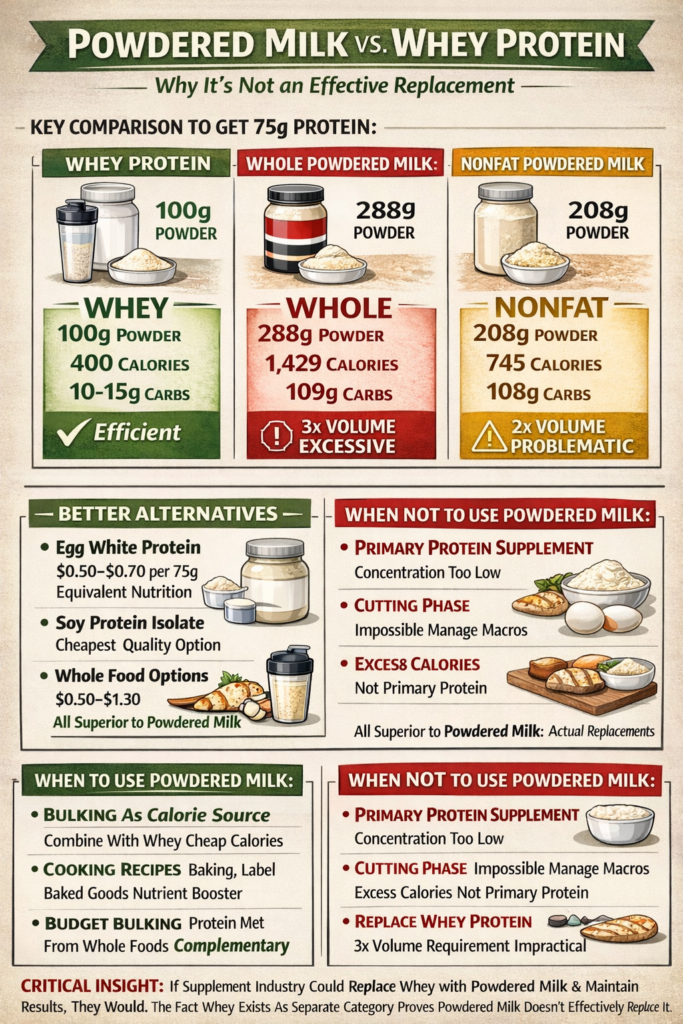
The truth about replacing whey with powdered milk:
❌ Not an effective replacement for protein supplementation (too low in protein concentration)
❌ Requires 3x the volume for equivalent protein (288g vs. 100g)
❌ Adds excessive carbs and fats (1,000+ extra calories for same protein)
❌ Makes cutting virtually impossible (can’t manage macros)
✅ Can work as calorie source during aggressive bulk (if protein needs met elsewhere)
✅ Useful in recipes as ingredient (not as primary protein)
Nutritional comparison:
To get 75g protein:
Whey protein:
- Amount: 100g
- Calories: 400
- Carbs: 10-15g
- Fat: 4-8g
Whole powdered milk:
- Amount: 288g
- Calories: 1,429
- Carbs: 109g
- Fat: 78g
Nonfat powdered milk:
- Amount: 208g
- Calories: 745
- Carbs: 108g
- Fat: 1.7g
The difference is massive and makes powdered milk impractical as protein supplement.
Better whey alternatives (if cost is concern):
For protein supplementation:
- Egg white protein powder ($0.50-0.70 per 75g protein)
- Soy protein isolate ($0.45-0.65 per 75g protein)
- Plant protein blends ($0.50-0.75 per 75g protein)
For whole food protein:
- Chicken breast ($0.50-1.00 per 75g protein)
- Eggs ($0.65-1.30 per 75g protein)
- Cottage cheese ($0.85-1.10 per 75g protein)
All are better protein sources than powdered milk.
When to actually use powdered milk:
Bulking (as calorie source):
- Add to mass gainer shakes
- Combine with whey protein
- Cheap calories with some protein bonus
Cooking/baking:
- Protein pancakes
- Protein oatmeal
- Add to recipes
- Nutrient booster
Budget bulking:
- When need cheap calories
- Protein needs met from whole foods
- Not relying on it for protein
When NOT to use powdered milk:
❌ As primary protein supplement ❌ During cutting phase ❌ To replace whey protein ❌ When trying to increase protein intake specifically
The key insight:
If the supplement industry could replace whey with powdered milk and maintain results, they would. The fact that whey protein exists as a separate category proves powdered milk doesn’t effectively replace it.
Powdered milk is whole milk in powder form. Whey is isolated protein. Completely different products serving different purposes.
POWDERED MILK ≠ PROTEIN SUPPLEMENT. USE EGG WHITE OR SOY PROTEIN TO REPLACE WHEY. USE POWDERED MILK AS INGREDIENT, NOT PROTEIN SOURCE.
Ready to build a complete, cost-optimized nutrition plan that hits your protein targets with the most effective and affordable sources, eliminates unnecessary supplement spending, and delivers maximum muscle-building results without wasting money on ineffective alternatives? Understanding protein powder options is just the start. Get a comprehensive guide to calculating exact protein needs, choosing the best protein sources for your budget and goals, building sustainable high-protein meal plans, and achieving your physique without overspending on supplements. Stop wasting money on poor protein choices. Start using smart, evidence-based strategies that deliver results.
REFERENCES
SECTION 1 — Total daily protein intake is the primary driver of muscle building
[1] Morton RW et al. — PMC/British Journal of Sports Medicine, 2018 Meta-analysis of 49 RCTs with 1,863 participants; dietary protein supplementation significantly increased fat-free mass (+0.30 kg), one-repetition maximum strength (+2.49 kg), and muscle fiber cross-sectional area during resistance exercise training; protein supplementation beyond total intakes of approximately 1.62 g/kg/day produced no further gains in fat-free mass; training status and age moderated effects; foundational evidence that total daily protein intake — not specific protein source — is the key variable; directly supports the article’s claim that powdered milk can work if total protein targets are met from other sources https://pmc.ncbi.nlm.nih.gov/articles/PMC5867436/
SECTION 2 — Whey protein: fast absorption and muscle protein synthesis
[2] van Loon LJC et al. — PMC/Frontiers in Nutrition, 2022 Review on protein quality and bioavailability for muscle building; whey protein is characterized as a “fast” protein with rapid digestion and absorption — amino acids peak in circulation within 60–90 minutes; whey is rich in leucine and essential amino acids, producing a rapid but transient elevation in plasma amino acids and muscle protein synthesis; casein (comprising ~80% of milk protein, including in powdered milk) digests slowly over 3–7 hours with a more sustained but lower peak; the distinction between whey (fast) and casein (slow) is directly relevant to the article’s claim that powdered milk — which contains predominantly casein — is a slower-absorbing protein source with different post-workout characteristics https://pmc.ncbi.nlm.nih.gov/articles/PMC9644172/
[3] Soop M et al. — PMC/American Journal of Physiology, 2012 Study comparing whey protein alone, casein alone, and co-ingestion of both; even when consumed together, casein retained its slower absorption profile and produced greater sustained leg muscle protein accretion at 4 hours post-ingestion; whey produced a larger acute protein synthesis spike but less sustained nitrogen retention; validates that mixing milk proteins (as in whole milk powder, which contains both whey and casein) produces intermediate absorption kinetics — relevant to why powdered milk behaves differently from isolated whey supplement https://pmc.ncbi.nlm.nih.gov/articles/PMC3404559/
SECTION 3 — Egg white protein and soy isolate as effective, concentrated whey alternatives
[4] Puglisi MJ & Fernandez ML — PMC/Nutrients, 2022 Review of egg protein nutritional value; whole egg has nitrogen protein utilization of 98%, comparable to whey and casein; biological value rates 88–100; 20g egg protein maximally stimulates muscle protein synthesis equivalent to 20g whey; eggs are 97% digestible (WHO data), the highest of any food protein source; complete amino acid profile; validates egg white protein powder as an effective, high-quality, concentrated whey alternative — as the article recommends — not powdered milk https://pmc.ncbi.nlm.nih.gov/articles/PMC9316657/
[5] Messina M et al. — PubMed/International Journal of Sport Nutrition and Exercise Metabolism, 2018 Meta-analysis of soy vs. animal protein supplementation during resistance training; no significant difference in strength gains or lean body mass between soy and whey groups in long-term studies; soy protein isolate (~85–90% protein by weight) provides equivalent muscle-building results to whey; directly supports the article’s recommendation of soy protein isolate as a cost-effective, concentrated whey alternative — one that actually matches whey’s protein-per-gram ratio, unlike powdered milk https://pubmed.ncbi.nlm.nih.gov/29722584/
SECTION 4 — Protein quality: PDCAAS and digestibility scores
[6] Gorissen SHM et al. — PMC/Amino Acids, 2018 Quantitative comparison of amino acid composition across 10 plant-based and multiple animal protein sources using UPLC-MS/MS; animal proteins (whey, casein, egg) have higher essential amino acid and leucine content per gram than plant proteins; provides the systematic amino acid compositional data that explains why protein concentration (grams of protein per 100g powder) and amino acid completeness matter when evaluating whether a protein supplement like powdered milk can substitute for a concentrated protein source; validates that protein source selection hinges on amino acid density, not just nominal “protein presence” https://pmc.ncbi.nlm.nih.gov/articles/PMC6245118/


Leave a Reply
You must be logged in to post a comment.