Cutting calories and wondering if simple sugars like dextrose will ruin your fat loss? Most people avoid all fast carbs when cutting. Here’s why that might be a mistake.
You’re in a calorie deficit. You’re trying to lose fat. Someone offers you pure sugar (dextrose) to take around your workouts.
You think they’re crazy. “Sugar while cutting? That’ll make me fat!” But you’re wrong about the context.
You believe:
- All simple carbs are bad during a cut
- Sugar automatically gets stored as fat
- Fast-digesting carbs kill fat loss
- Only complex carbs are allowed when cutting
Most of this is oversimplified. The truth: You can use dextrose strategically while cutting and still lose fat effectively. Taking 20-30g dextrose pre, intra, or post-workout provides immediate energy for training, preserves muscle mass, and enhances recovery without compromising fat loss IF it fits your daily calorie target. The key is strategic timing (around training only) and calorie accounting (include it in your daily total). Random dextrose consumption throughout the day? That’s a problem. Calculated dextrose around training? That’s strategic.
In this comprehensive guide, I’ll explain what dextrose actually is (the fast-digesting carb), reveal the benefits for cutting (performance and muscle preservation), show you the potential drawbacks (calorie control and GI issues), provide optimal timing protocols (pre, intra, or post-workout), and compare dextrose to other carb sources (simple vs. complex).
Whether you’re deep in a cut or planning one, understanding strategic carb timing can preserve performance and muscle.
Let’s clarify dextrose use during cutting phases.
TABLE OF CONTENTS
What Is Dextrose?
Understanding the carbohydrate.
The Chemical Composition
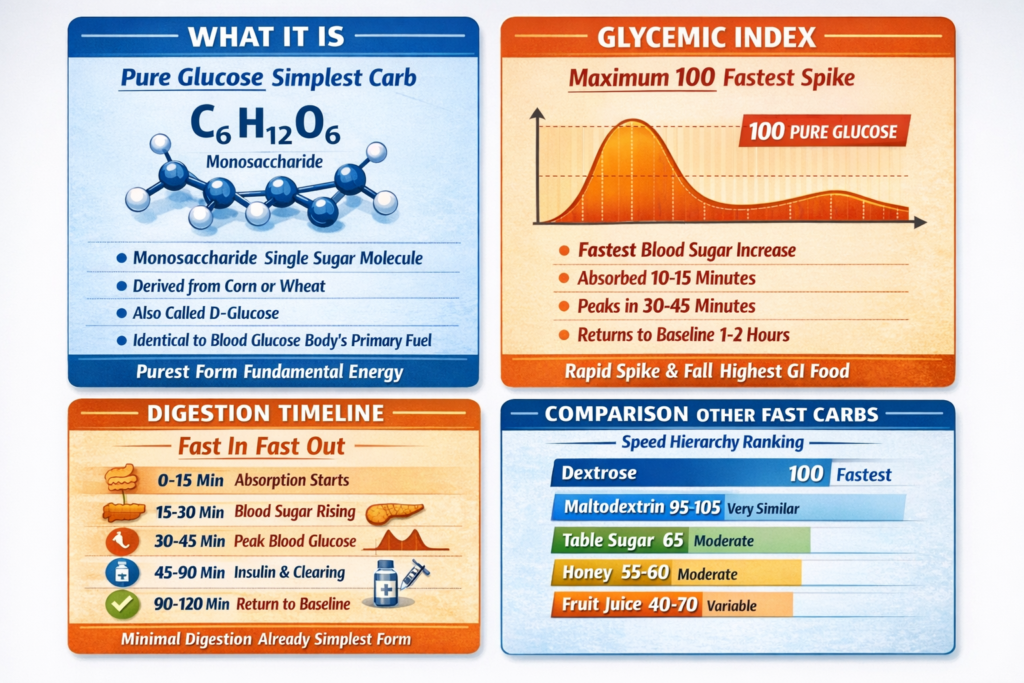
What dextrose is:
- Pure glucose (monosaccharide)
- Simplest form of carbohydrate
- Derived from corn or wheat
- Also called: D-glucose, corn sugar
- Single sugar molecule
Chemical structure:
- C₆H₁₂O₆ (six-carbon sugar)
- Identical to blood glucose
- Body’s primary fuel source
- Fundamental energy molecule
How it differs from other sugars:
- Table sugar (sucrose): Glucose + fructose (disaccharide)
- Fructose: Different structure (metabolized in liver first)
- Dextrose: Pure glucose (ready for immediate use)
- Purest form
The Glycemic Index
What glycemic index (GI) means:
- Measures how quickly food raises blood sugar
- Scale: 0-100 (pure glucose = 100)
- High GI: 70+ (rapid spike)
- Medium GI: 56-69 (moderate rise)
- Low GI: <55 (slow rise)
- Blood sugar impact measurement
Dextrose glycemic index:
- GI: 100 (maximum)
- Fastest blood sugar increase possible
- Identical to pure glucose (it IS pure glucose)
- Highest GI food
What this means:
- Absorbed almost instantly
- Enters bloodstream within 10-15 minutes
- Blood sugar peaks 30-45 minutes after consumption
- Returns to baseline 1-2 hours later
- Rapid spike and fall
How Dextrose Is Digested
The digestion process:
Step 1: Consumption
- Dextrose consumed (powder mixed in water)
- No chewing required (liquid form)
- Oral intake
Step 2: Minimal digestion needed
- Already in simplest form (glucose)
- No breakdown required
- Passes through stomach quickly
- No digestive work
Step 3: Absorption
- Absorbed in small intestine
- Transported directly into bloodstream
- Nearly 100% absorption
- Rapid uptake
Step 4: Blood sugar spike
- Blood glucose rises rapidly
- Pancreas detects increase
- Insulin released
- Hormonal response
Step 5: Cellular uptake
- Insulin shuttles glucose into cells
- Muscle cells (if glycogen depleted)
- Liver (if muscle glycogen full)
- Fat cells (if both muscle and liver full)
- Distribution to tissues
The timeline:
- 0-15 minutes: Absorption beginning
- 15-30 minutes: Blood sugar rising
- 30-45 minutes: Peak blood glucose
- 45-90 minutes: Insulin working, glucose clearing
- 90-120 minutes: Return to baseline
- Fast in, fast out
Dextrose vs. Other Fast Carbs
Dextrose (pure glucose):
- GI: 100
- Absorption: Fastest
- Use: Immediate energy
- Speed champion
Maltodextrin:
- GI: 95-105 (varies by source)
- Multiple glucose molecules chained (but rapidly broken)
- Slightly slower than dextrose (marginally)
- Very similar to dextrose
Table sugar (sucrose):
- GI: 65
- 50% glucose + 50% fructose
- Fructose processed in liver first (slower)
- Moderately fast
Honey:
- GI: 55-60
- Mix of glucose and fructose
- Additional compounds slow absorption slightly
- Moderate speed
Fruit juice:
- GI: 40-70 (depends on fruit)
- Fructose dominant in some
- Fiber removed (faster than whole fruit)
- Variable
The ranking (fastest to slowest):
- Dextrose (pure glucose)
- Maltodextrin
- White bread
- Table sugar
- Honey
- Fruit juice
- Speed hierarchy
Benefits of Dextrose While Cutting
Strategic advantages.
Benefit 1: Immediate Energy for Training
The cutting energy problem:
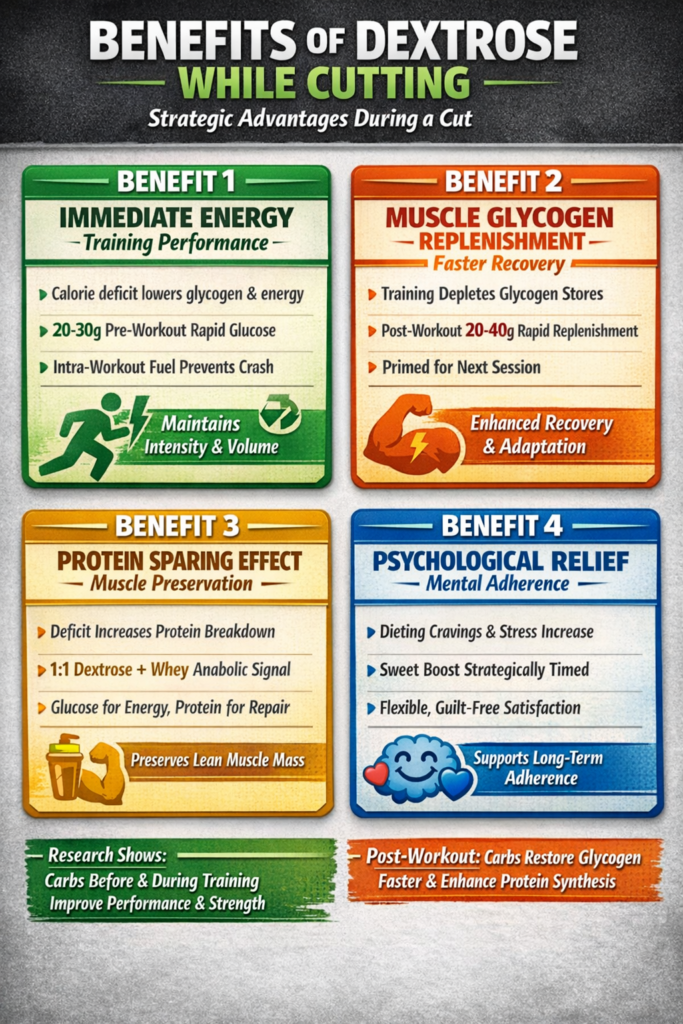
- Calorie deficit reduces glycogen stores
- Lower glycogen = less energy for training
- Performance suffers (strength, endurance, volume)
- Training quality decreases
- Energy deficit impact
How dextrose helps:
Pre-workout timing (30-60 minutes before):
- 20-30g dextrose consumed
- Blood glucose rises rapidly
- Glucose available for high-intensity work
- Maintains training intensity
- Performance preservation
Intra-workout timing (during training):
- Sipping 20-30g dextrose throughout session
- Continuous glucose supply
- Prevents mid-workout energy crash
- Sustains performance for longer sessions
- Sustained energy
The research:
- Carbs consumed before/during training improve performance
- Maintains strength output
- Allows higher training volume
- Better muscle preservation (training quality maintained)
- Evidence-based benefit
The practical impact:
- Without dextrose: Struggle through final sets, reduce weight, fewer reps
- With dextrose: Maintain intensity throughout, complete planned volume
- Performance difference
Benefit 2: Muscle Glycogen Replenishment
The glycogen depletion issue:
- Cutting depletes muscle glycogen
- Training further depletes glycogen
- Low glycogen impairs next workout
- Recovery slower
- Cumulative depletion
How post-workout dextrose helps:
The glycogen replenishment window:
- Post-workout: Muscles primed for glycogen uptake
- Insulin sensitivity elevated
- Glucose uptake into muscle enhanced
- Optimal timing
The protocol:
- 20-40g dextrose immediately post-workout
- Rapid glycogen replenishment
- Faster recovery
- Better performance next session
- Recovery enhancement
The research:
- Post-workout carbs restore glycogen faster than delayed intake
- Combination with protein enhances effect
- Important for frequent training (5-6x weekly)
- Documented benefit
Benefit 3: Protein Sparing Effect
The protein problem during cutting:
- Calorie deficit increases protein breakdown risk
- Body may use amino acids for energy
- Muscle loss risk
- Catabolic environment
How dextrose helps (post-workout):
The insulin spike:
- Dextrose causes rapid insulin release
- Insulin is anabolic hormone
- Signals cells to uptake nutrients
- Hormonal response
The protein sparing:
- With carbs available (dextrose), body uses glucose for energy
- Doesn’t need to convert protein to glucose
- Protein used for muscle repair/growth instead
- Spares dietary and muscle protein
The combination effect (dextrose + protein):
- 30g dextrose + 30g whey protein post-workout
- Insulin spike enhances protein absorption
- Protein directed to muscle repair
- Not used for energy (dextrose handles that)
- Synergistic effect
The research:
- Carbs + protein post-workout superior to protein alone for recovery
- Insulin helps shuttle amino acids into muscle
- Enhanced muscle protein synthesis
- Evidence supports combination
Benefit 4: Psychological Relief
The mental aspect of cutting:
- Restrictive eating is psychologically taxing
- Cravings for sweets increase
- Adherence challenged
- Mental fatigue
How strategic dextrose helps:
- Small amount of sweetness (30g dextrose = sweet taste)
- Satisfies sugar craving
- Strategically timed (around training, not random)
- Guilt-free (serves purpose, fits macros)
- Psychological benefit
The adherence factor:
- Small strategic indulgences improve long-term adherence
- All-or-nothing approach leads to binge eating
- Flexible approach more sustainable
- Mental health matters
Drawbacks of Dextrose While Cutting
Potential problems.
Drawback 1: Calorie Control Issues
The primary risk:
- Dextrose tastes sweet (very palatable)
- Easy to overconsume
- “Just a little more” adds up
- Exceeds calorie target
- Overconsumption risk
The math problem:
- 1g dextrose = 4 calories
- 30g dextrose = 120 calories
- 60g dextrose = 240 calories
- Easy to double or triple serving
- Calories add up fast
The cutting sabotage:
- Cutting requires calorie deficit (typically 300-500 cal below maintenance)
- Unaccounted dextrose eliminates deficit
- No deficit = no fat loss
- Diet failure
Example scenario:
Planned:
- Daily target: 2,000 calories
- 30g dextrose post-workout: 120 calories (accounted for)
- Deficit maintained
- On track
Reality:
- 30g post-workout: 120 cal
- “A little more” pre-workout: 40g = 160 cal
- “Tastes good” during workout: 30g = 120 cal
- Total dextrose: 100g = 400 calories
- Unplanned 280 calories
- Deficit reduced from 500 to 220 (or eliminated)
- Progress slowed or stopped
The solution:
- Pre-measure dextrose servings
- Track every gram in food log
- Include in daily calorie/carb totals
- Choose ONE timing window only (pre, intra, OR post, not all three)
- Strict accounting
Drawback 2: Gastrointestinal Distress
The problem:
- Dextrose is osmotically active
- Draws water into intestines
- Can cause digestive issues
- GI sensitivity
Common symptoms:
- Bloating
- Gas
- Cramping
- Diarrhea (in severe cases)
- Nausea (if taken in large amounts)
- Digestive discomfort
Who’s affected:
- Individual variation (some people very sensitive)
- Dose-dependent (higher doses = more risk)
- Timing matters (taking on empty stomach worse)
- Not everyone, but common enough
The mechanism:
- High osmolality (concentration of particles)
- Water rushes into gut to dilute
- Increased fluid in intestines
- Faster transit time
- Water redistribution
Impact on training:
- Mid-workout bathroom trips
- Cramping during exercise
- Reduced performance
- Training disruption
The solutions:
Solution 1: Start with lower dose
- Begin with 15-20g
- Assess tolerance
- Increase gradually if tolerated
- Conservative start
Solution 2: Dilute properly
- Use more water (400-500ml per 30g dextrose)
- Reduces osmolality
- Easier on stomach
- Dilution helps
Solution 3: Sip slowly (intra-workout)
- Don’t chug all at once
- Sip throughout workout
- Easier to digest
- Gradual consumption
Solution 4: Take with protein/food
- Post-workout: Mix with protein shake
- Slows absorption slightly
- Reduces GI issues
- Buffer effect
Solution 5: Try different timing
- If pre-workout causes issues, try intra or post
- Find what works for you
- Timing adjustment
Solution 6: Consider alternatives
- Maltodextrin (slightly slower, may be better tolerated)
- Highly branched cyclic dextrin (more expensive but gentler)
- Alternative carbs
Drawback 3: Blood Sugar Rollercoaster (For Some)
The potential issue:
- Rapid blood sugar spike
- Rapid insulin response
- Potential reactive hypoglycemia (blood sugar crash)
- Sugar crash risk
Who’s affected:
- Individuals with insulin sensitivity issues
- Those prone to blood sugar swings
- Not everyone experiences this
- Individual variation
The symptoms (if it occurs):
- Energy crash 1-2 hours after dextrose
- Irritability
- Hunger spike
- Shakiness
- Rebound effect
When this is a problem:
- Taking dextrose at random times (not around training)
- Taking very large amounts (50g+)
- Taking on empty stomach (not around workout)
- Poor timing/dosing
When this is NOT a problem:
- Taking around training (muscles absorb glucose, less blood sugar spike)
- Moderate amounts (20-30g)
- Combined with protein (slows absorption)
- Strategic use
The solution:
- Only use dextrose peri-workout (around training)
- Don’t use randomly throughout day
- Keep doses moderate
- Combine with protein post-workout
- Controlled use
How to Take Dextrose While Cutting
Strategic protocols.
The Three Timing Options
Important note:
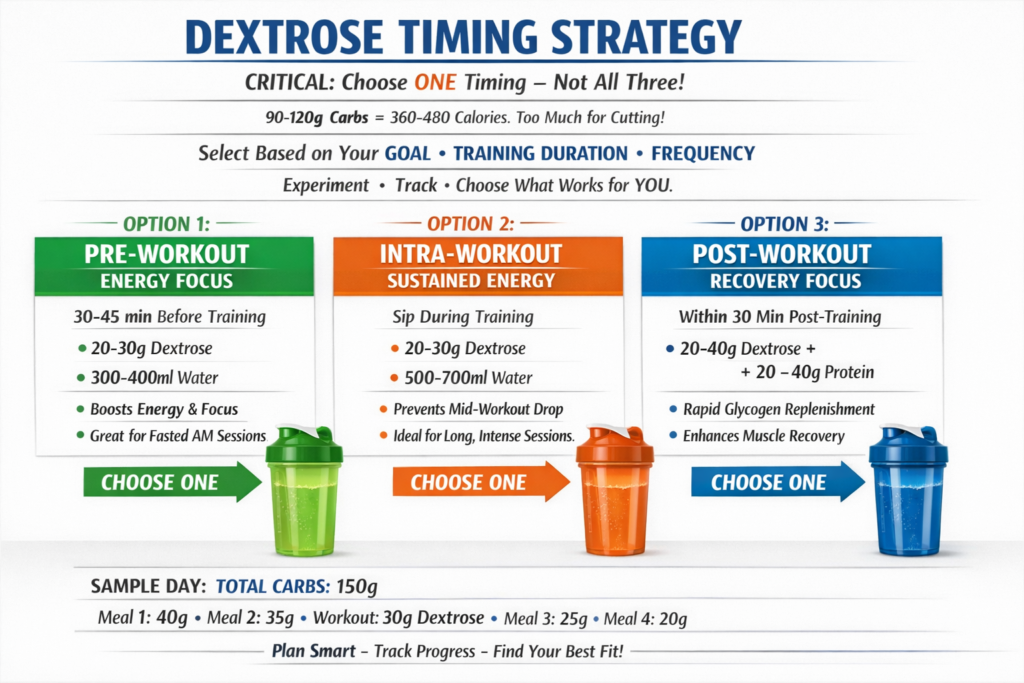
- Choose ONE timing window, not all three
- Using dextrose pre, intra, AND post = 90-120g carbs (360-480 calories)
- Too many calories for most cutting diets
- Choose strategically
Option 1: Pre-Workout Dextrose
The protocol:
- Timing: 30-45 minutes before training
- Dose: 20-30g dextrose
- Mixing: 300-400ml water
- Consumption: Drink 20-30 min before first set
- Pre-workout energy
Why this timing:
- Provides energy for upcoming workout
- Blood glucose elevated during training
- Maintains intensity and volume
- Performance support
Best for:
- Morning trainers (low energy from overnight fast)
- Those who struggle with energy mid-workout
- Fasted trainers (nothing eaten for 3+ hours before)
- Low-energy situations
Considerations:
- If you eat a meal 2-3 hours before training, may not need dextrose
- Assess energy levels
- Individual need
Option 2: Intra-Workout Dextrose
The protocol:
- Timing: During training session
- Dose: 20-30g dextrose
- Mixing: 500-700ml water
- Consumption: Sip throughout workout
- Sustained energy
Why this timing:
- Continuous glucose supply during training
- Prevents mid-workout energy drop
- Particularly valuable for long sessions (90+ min)
- Sustained performance
Best for:
- Long training sessions (90+ minutes)
- High-volume sessions (20+ sets)
- Those who experience mid-workout fatigue
- Extended training
Considerations:
- Shorter sessions (<60 min) may not need intra-workout carbs
- Glycogen stores usually sufficient for brief sessions
- Duration-dependent
Option 3: Post-Workout Dextrose
The protocol:
- Timing: Immediately post-workout (within 30 minutes)
- Dose: 20-40g dextrose
- Protein: Add 20-40g whey protein (1:1 ratio recommended)
- Mixing: 400-500ml water or milk
- Recovery shake
Why this timing:
- Rapid glycogen replenishment
- Enhanced protein absorption (insulin spike)
- Protein sparing (dextrose used for energy, protein for recovery)
- Recovery optimization
The 1:1 ratio:
- 30g dextrose + 30g protein = optimal
- Insulin response helps amino acid uptake
- Both glycogen and muscle repair addressed
- Synergistic effect
Best for:
- Frequent trainers (5-6x weekly, need rapid recovery)
- Those training multiple sessions daily
- Prioritizing muscle preservation during cut
- Recovery focus
Considerations:
- If training only 3-4x weekly, post-workout dextrose less critical
- Normal meals will restore glycogen over 24-48 hours
- Frequency-dependent
Choosing Your Timing
Decision matrix:
If your goal is:
- Better performance THIS workout → Pre-workout
- Sustained energy DURING workout → Intra-workout
- Faster recovery FOR NEXT workout → Post-workout
- Goal-based selection
If your training is:
- Morning/fasted → Pre-workout
- Long sessions (90+ min) → Intra-workout
- Frequent (5-6x weekly) → Post-workout
- Training-based selection
Personal preference:
- Experiment with each timing
- Track performance and recovery
- Choose what works best for you
- Individualize
Sample Daily Integration
Example cutting day (2,000 calories, 200g protein, 150g carbs, 60g fat):
Meal 1 (8 AM, pre-workout):
- 30g dextrose: 120 cal, 30g carbs
- Black coffee
- Pre-training fuel
Training (8:30-9:30 AM)
Meal 2 (10 AM, post-workout):
- 30g whey protein: 120 cal, 24g protein, 2g carbs
- 200g berries: 100 cal, 3g protein, 22g carbs
- Recovery meal
Meal 3 (1 PM):
- 200g chicken breast: 330 cal, 62g protein, 7g fat
- 200g rice: 260 cal, 56g carbs, 2g protein
- Vegetables
- Main meal
Meal 4 (4 PM):
- 200g salmon: 420 cal, 50g protein, 24g fat
- 200g sweet potato: 180 cal, 42g carbs
- Second main meal
Meal 5 (7 PM):
- Greek yogurt, berries, nuts
- 300 cal, 30g protein, 8g carbs, 18g fat
- Evening meal
Daily totals:
- Calories: ~2,000
- Protein: ~200g
- Carbs: ~150g (30g from dextrose, 120g from food)
- Fat: ~60g
- Dextrose integrated into plan
The key:
- 30g dextrose accounted for in daily carb total
- Not “extra” on top of plan
- Included, not added
Dextrose vs. Other Carbs While Cutting
Comparison and context.
Simple Carbs vs. Complex Carbs
Simple carbs (sugars):
- Glucose, fructose, sucrose, lactose
- Rapid digestion and absorption
- Quick energy spike
- Minimal satiety
- Fast-acting
Complex carbs (starches):
- Rice, oats, potatoes, bread, pasta
- Slower digestion
- Sustained energy release
- Higher satiety
- Often contain fiber
- Slow-acting
The role during cutting:
Simple carbs (including dextrose):
- Use: Around training only (strategic timing)
- Amount: 20-40g daily (if used)
- Purpose: Performance, recovery
- Tactical application
Complex carbs:
- Use: Bulk of daily carb intake
- Amount: Remainder of carb allotment (100-200g depending on diet)
- Purpose: Sustained energy, satiety, nutrition
- Foundation carbs
The ratio:
- 80-90% complex carbs (meals throughout day)
- 10-20% simple carbs (around training if using dextrose)
- Balanced distribution
Dextrose vs. Whole Food Carbs Around Training
Pre-workout carb options:
Dextrose (20-30g):
- Pros: Fast absorption, no GI distress (if tolerated), liquid (easy)
- Cons: No micronutrients, costs money
- Convenience and speed
Banana (medium, 27g carbs):
- Pros: Natural, contains potassium, fiber (small amount)
- Cons: Slower absorption, some people get GI issues
- Whole food option
White rice (50g dry, 40g carbs):
- Pros: Very well tolerated, familiar food
- Cons: Must eat 1-2 hours before (not immediate), solid food
- Traditional pre-workout carb
The verdict:
- Dextrose fastest and most convenient
- Whole foods provide nutrition but require earlier timing
- Both work, personal preference
- Choose based on goals and tolerance
Post-workout carb options:
Dextrose (30g) + whey (30g):
- Pros: Fastest glycogen replenishment, convenient, precise macros
- Cons: Costs money, liquid calories (less satiating)
- Speed and precision
Rice (100g cooked, 28g carbs) + chicken (100g, 30g protein):
- Pros: Real food, satiating, nutritious
- Cons: Slower glycogen replenishment, requires prep
- Whole food option
The verdict:
- Dextrose + whey if prioritizing speed (frequent training, multiple sessions daily)
- Whole food if you have time and prefer eating
- Both effective, different contexts
- Context-dependent choice
The Fiber Consideration
Why fiber matters during cutting:
- Increases satiety (feel fuller longer)
- Slows digestion (stable blood sugar)
- Supports digestive health (regularity)
- Typically 25-38g daily recommended
- Crucial for adherence
The problem with dextrose:
- Zero fiber
- Doesn’t contribute to satiety
- Purely energy, no fullness
- No satiety benefit
The solution:
- Get fiber from complex carb sources
- Vegetables, oats, whole grains, beans
- Dextrose is small part of total carbs (20-40g of 150g total)
- Remaining carbs (100-130g) from fiber-containing sources
- Balanced intake
The recommendation:
- Don’t replace all carbs with dextrose (terrible for satiety and health)
- Use dextrose strategically around training only
- Bulk of carbs from whole foods with fiber
- Strategic, not dominant
Common Mistakes
What to avoid.
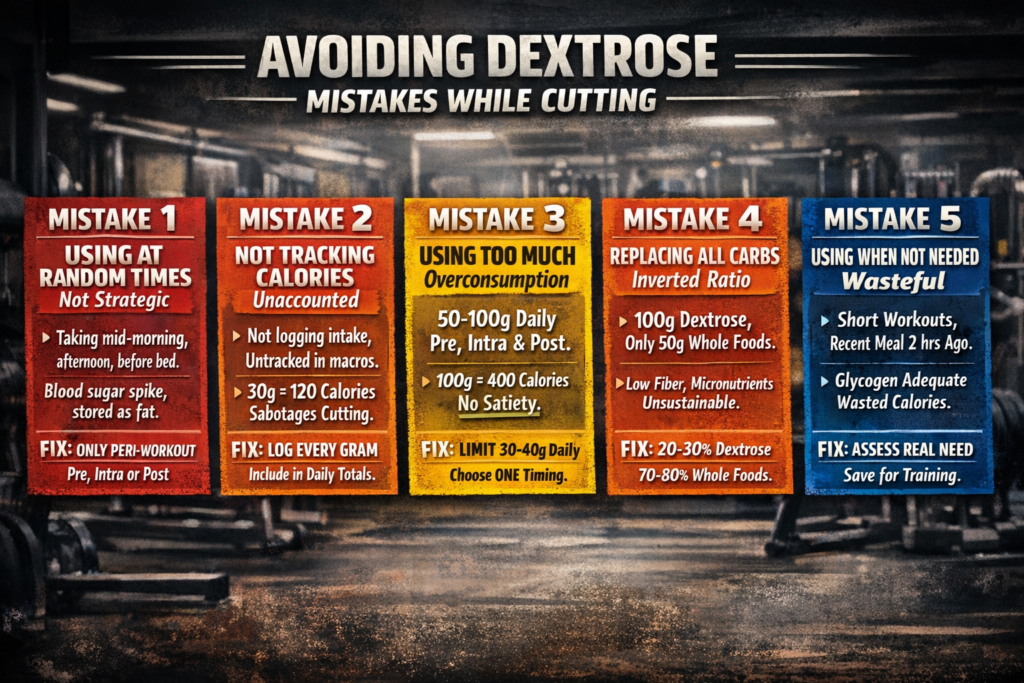
Mistake 1: Using Dextrose at Random Times
The error:
- Taking dextrose mid-morning, mid-afternoon, before bed
- Not around training
- Just because it tastes good
- Random consumption
Why this is bad:
- No performance benefit (not training)
- Blood sugar spike with no purpose
- Likely to be stored as fat (not used)
- Wastes calories on non-productive purpose
- Ineffective and counterproductive
The fix:
- ONLY use dextrose peri-workout (pre, intra, or post)
- Never at random times
- Strategic timing only
Mistake 2: Not Tracking Dextrose Calories
The error:
- “It’s just sugar, doesn’t count”
- Drinking dextrose without logging
- Not including in daily macros
- Unaccounted calories
Why this is bad:
- 30g dextrose = 120 calories
- Untracked calories eliminate deficit
- No deficit = no fat loss
- Sabotages cutting
The fix:
- Log every gram of dextrose
- Include in daily carb and calorie totals
- Reduce other carbs if adding dextrose
- Strict accounting
Mistake 3: Using Too Much Dextrose
The error:
- 50-100g dextrose daily
- Using pre, intra, AND post
- “More is better”
- Overconsumption
Why this is bad:
- 100g dextrose = 400 calories
- Massive portion of cutting calories wasted on sugar
- No satiety benefit
- Difficult to fit remaining nutrition needs
- Poor calorie allocation
The fix:
- Maximum 30-40g dextrose daily
- Choose ONE timing window
- Prioritize whole foods for remaining carbs
- Moderation
Mistake 4: Replacing All Carbs with Dextrose
The error:
- 150g daily carb target
- Taking 100g as dextrose
- Only 50g from whole foods
- Inverted ratio
Why this is bad:
- Zero satiety (won’t feel full)
- Miserable cutting experience
- Lacking fiber (digestive issues)
- Missing micronutrients
- Poor adherence
- Unsustainable
The fix:
- Maximum 20-30% of carbs from dextrose (30g of 150g = 20%)
- 70-80% of carbs from whole foods
- Proper balance
Mistake 5: Using Dextrose When Not Needed
The error:
- Short workouts (30-45 min)
- Ate large meal 2 hours before training
- Only training 3x weekly
- Still taking dextrose
- Unnecessary use
Why this may be wasteful:
- Glycogen stores likely adequate for short session
- Recent meal provides energy
- Infrequent training allows glycogen recovery between sessions
- Dextrose not adding value
- Wasted calories
When dextrose MOST valuable:
- Long sessions (90+ min)
- Training fasted or 4+ hours after eating
- Training 5-6x weekly (need rapid recovery)
- Very low carb cutting diet (<100g daily)
- Highest value scenarios
The fix:
- Assess actual need
- Don’t use just because others do
- Save calories if not needed
- Strategic application
The Bottom Line: Strategic Dextrose Can Work While Cutting
After explaining everything:
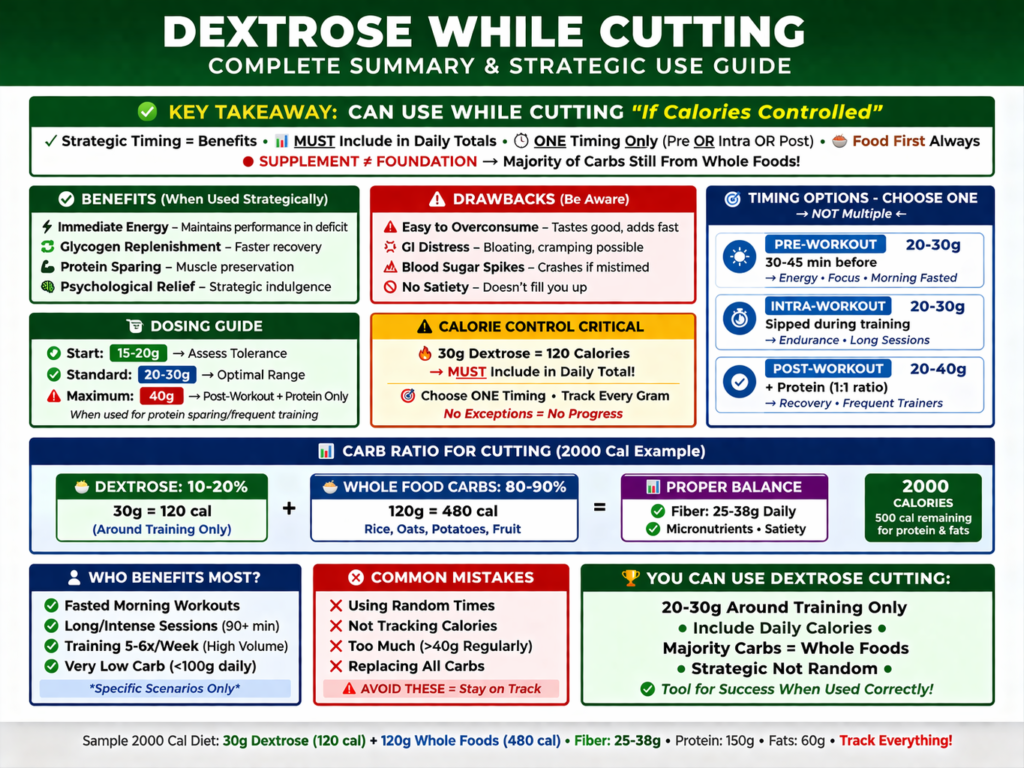
The truth about dextrose while cutting:
✅ You CAN use dextrose while cutting and still lose fat (if calories controlled)
✅ Strategic timing around training provides performance benefits (energy, recovery, muscle preservation)
✅ Must be included in daily calorie/carb totals (not “free” calories)
✅ Use ONE timing window only, not multiple (pre, intra, OR post)
✅ Majority of carbs should still come from whole foods (dextrose is supplement, not foundation)
Key takeaways:
What dextrose is:
- Pure glucose (simplest carbohydrate)
- Derived from corn or wheat
- Glycemic index: 100 (highest possible, fastest blood sugar spike)
- Absorbed within 10-15 minutes
- Fastest-acting carb
Benefits while cutting:
- Provides immediate energy for training (maintains performance in deficit)
- Replenishes muscle glycogen post-workout (faster recovery)
- Protein sparing effect (when combined with protein, spares muscle)
- Psychological relief (small sweet taste, strategic indulgence)
- Performance and recovery support
Drawbacks:
- Easy to overconsume (tastes good, adds up fast)
- GI distress possible (bloating, cramping, diarrhea in some people)
- Blood sugar rollercoaster risk (if used at wrong times)
- No satiety (doesn’t make you feel full)
- Requires discipline
Strategic timing options (choose ONE):
Pre-workout:
- 20-30g dextrose, 30-45 min before training
- Provides energy for workout
- Best for: Morning/fasted trainers, low energy
- Performance focus
Intra-workout:
- 20-30g dextrose sipped during training
- Sustained energy throughout session
- Best for: Long sessions (90+ min), high volume
- Endurance focus
Post-workout:
- 20-40g dextrose + 20-40g protein (1:1 ratio)
- Rapid glycogen replenishment, protein sparing
- Best for: Frequent trainers (5-6x weekly), muscle preservation priority
- Recovery focus
Dosing guidelines:
- Start: 15-20g (assess tolerance)
- Standard: 20-30g
- Maximum: 40g (only post-workout with protein)
- Moderation key
GI issues prevention:
- Start with lower dose (15-20g)
- Dilute properly (400-500ml water per 30g)
- Sip slowly if intra-workout (don’t chug)
- Take with protein post-workout (slows absorption)
- Tolerance management
Calorie control (critical):
- 1g dextrose = 4 calories
- 30g dextrose = 120 calories
- MUST be included in daily totals
- Choose ONE timing, not all three
- Track every gram
- Strict accounting
Dextrose vs. other carbs:
- Simple carbs (dextrose): 10-20% of daily carbs (around training only)
- Complex carbs (rice, oats, potatoes): 80-90% of daily carbs (meals throughout day)
- Balanced distribution
Who benefits most:
- Training fasted or morning workouts
- Long/intense sessions (90+ min, 20+ sets)
- Training 5-6x weekly (frequent recovery needs)
- Very low carb cuts (<100g daily, need strategic carbs)
- Specific scenarios
Who may not need it:
- Short workouts (<60 min)
- Training 3-4x weekly (adequate recovery time)
- Eating meal 2-3 hours pre-workout (already have energy)
- Higher carb cuts (150g+ daily, plenty of energy from food)
- Less critical scenarios
Common mistakes:
- Using at random times (not around training)
- Not tracking calories (sabotages deficit)
- Using too much (50-100g daily, wastes calories)
- Replacing all carbs with dextrose (no satiety, unsustainable)
- Using when not needed (wasting calories)
- Avoid these
Sample integration:
- 2,000 cal cutting diet, 150g carbs daily
- 30g dextrose pre-workout (120 cal, 30g carbs)
- Remaining 120g carbs from whole foods (rice, oats, fruit, vegetables)
- Proper balance
The fiber priority:
- Dextrose has zero fiber
- Get 25-38g fiber daily from whole food carbs
- Fiber crucial for satiety and digestion
- Don’t neglect fiber
Priority actions:
- Determine if dextrose needed (assess training duration, frequency, timing)
- If yes: Choose ONE timing window (pre, intra, or post)
- Start with 20g dextrose (assess tolerance)
- Include in daily calorie/carb totals (track strictly)
- Get remaining carbs from whole foods (rice, oats, potatoes, vegetables)
- Monitor performance and fat loss (adjust if needed)
- Implementation checklist
YOU CAN USE DEXTROSE WHILE CUTTING. TAKE 20-30G AROUND TRAINING ONLY. INCLUDE IN DAILY CALORIES. MAJORITY OF CARBS FROM WHOLE FOODS. STRATEGIC, NOT RANDOM.
Ready to build a complete cutting nutrition strategy with precise macro targets, meal timing protocols, supplement optimization, and progressive fat loss systems that preserve muscle and performance? Understanding dextrose is just one piece. Get comprehensive cutting guidance. Stop guessing about supplements. Start cutting strategically.
REFERENCES
SECTION 1 — Carbohydrate, glycogen, and training performance
[1] Mata F et al. — PMC/Nutrients, 2022 Systematic review of 49 studies on carbohydrate intake and resistance training performance; acute carbohydrate intake did not improve performance in fed-state workouts of up to 10 sets per muscle group; however, carbohydrate supplementation improved performance after glycogen depletion, particularly during high-volume (>10 sets) and fasted training sessions; ergogenic effect of carbohydrates on resistance training volume most pronounced after an 8+ hour fast — directly supports the article’s claim that dextrose is most valuable for fasted or long, high-volume sessions https://pmc.ncbi.nlm.nih.gov/articles/PMC8878406/
[2] Jeukendrup AE & Killer SC — PubMed/Journal of Sports Sciences, 2010 Narrative review of pre-exercise carbohydrate ingestion; consuming carbohydrates 3–4 hours before exercise increases liver and muscle glycogen stores and significantly enhances subsequent exercise performance; ingestion in the hour before exercise can transiently raise insulin and lower free fatty acids but generally does not impair performance; individual variability exists; provides foundational evidence for timed pre-workout carbohydrate as a performance strategy https://pubmed.ncbi.nlm.nih.gov/14971431/
[3] Margolis LM et al. — PubMed/Sports Medicine, 2023 Study with reduced-glycogen subjects performing HIIT; carbohydrate consumption before and during exercise under reduced muscle glycogen conditions provided a significant performance benefit (time-to-exhaustion: CHO 7.1 min vs. placebo 2.5 min, d=0.98, p<0.05); CHO ingestion did not suppress fat oxidation under these conditions; confirms that strategic carbohydrate use during calorie restriction can rescue performance when glycogen is low without eliminating fat-burning capacity https://pubmed.ncbi.nlm.nih.gov/36897400/
SECTION 2 — Post-workout glycogen replenishment: timing and mechanisms
[4] Ivy JL — PubMed/International Journal of Sports Medicine, 1998 Foundational review on post-exercise glycogen resynthesis; a carbohydrate supplement of ≥1.0g/kg body weight consumed immediately after exercise maximizes glycogen resynthesis (6–8 mmol/kg wet wt/hr); delaying intake by several hours reduces the resynthesis rate by approximately 50%; glucose and glucose polymers (such as dextrose/maltodextrin) are the most effective forms for muscle glycogen replenishment; fructose more effective for liver glycogen; addition of protein to carbohydrate can synergistically increase glycogen storage via enhanced insulin secretion https://pubmed.ncbi.nlm.nih.gov/9694422/
[5] Burke LM et al. — PubMed/Journal of Applied Physiology, 2017 Comprehensive review of post-exercise glycogen resynthesis; in the early post-exercise window (0–4h), glycogen depletion provides a strong drive for resynthesis and ~1g/kg body mass of carbohydrate optimizes this process; high-GI carbohydrates significantly enhance glycogen restoration compared to low-GI (106 vs. 72 mmol/kg wet weight over 24h); during later recovery (4–24h), total carbohydrate intake matters more than timing or type; co-ingestion of protein when carbohydrate is sub-optimal (≤0.8g/kg/hr) accelerates glycogen resynthesis through enhanced insulin response https://journals.physiology.org/doi/full/10.1152/japplphysiol.00860.2016
SECTION 3 — Carbohydrate + protein post-workout: protein sparing and MPS
[6] Poole C et al. — PMC/Journal of Sports Science and Medicine, 2010 Review of post-exercise carbohydrate and protein on glycogen and muscle protein synthesis; delaying carbohydrate intake by two hours after exercise decreases glycogen synthesis by 45% over the subsequent 4-hour period (Ivy 1988); simple carbohydrates are the most effective form for glycogen resynthesis; carbohydrate + protein combination generates an anabolic state by simultaneously restoring glycogen and stimulating muscle protein synthesis; carbohydrate availability directs dietary amino acids toward repair rather than oxidation (protein-sparing mechanism); directly supports the article’s recommendation for dextrose + whey post-workout https://pmc.ncbi.nlm.nih.gov/articles/PMC3761704/
[7] Kerksick CM et al. — PubMed/Journal of the International Society of Sports Nutrition, 2017 ISSN position stand on nutrient timing; carbohydrate consumed during or after resistance exercise increases muscle glycogen, reduces muscle damage markers, and facilitates greater chronic training adaptations; CHO+protein combination reduces catabolic hormone cortisol, decreases markers of muscle protein breakdown (26% reduction vs. 52% increase in controls), and increases muscle fiber cross-sectional area compared to carbohydrate alone; recommends 30–60g carbohydrate per hour during exercise for sustained sessions; pre- and/or post-exercise carbohydrate+protein as an effective strategy for improvements in strength and body composition https://pubmed.ncbi.nlm.nih.gov/28919842/
SECTION 4 — Calorie deficit, muscle preservation, and the role of training
[8] Longland TM et al. — PubMed/American Journal of Clinical Nutrition, 2016 RCT; 40 young men in a 40% calorie deficit for 4 weeks; higher protein group (2.4g/kg/day) gained 1.2kg lean mass while lower protein group (1.2g/kg/day) gained only 0.1kg; fat mass loss was similar; both groups performed resistance + HIIT training 6 days/week; demonstrates that during a cut, total calorie and protein intake govern muscle retention outcomes; carbohydrates are tools to support training quality within this protein-calorie framework — not independent fat-loss drivers https://pubmed.ncbi.nlm.nih.gov/26817506/





Leave a Reply
You must be logged in to post a comment.