
Want to pack on serious muscle without turning into a marshmallow? Here’s your science-backed roadmap to building lean mass the smart way.
Let’s get real for a second.
Most people trying to bulk up end up looking more like they’re training for a hot dog eating contest than a bodybuilding show.
They follow outdated advice like “eat everything in sight” and “you gotta get fat to get big,” then spend months miserably cutting away all the excess fat they gained.
There’s a better way. A smarter way.
In this comprehensive guide, I’m going to show you exactly how to create a muscle-building diet that actually works one that fits your lifestyle, doesn’t require you to live in the kitchen, and helps you build muscle WITHOUT packing on unnecessary body fat.
Sound too good to be true? Keep reading.
TABLE OF CONTENTS
The Fatal Flaw in Traditional Bulking Diets
When most people decide to gain muscle, they eventually stumble across the concept of “bulking.”
Bulking is essentially a period where you adjust your diet to gain weight, understanding that some of that weight will be muscle (the goal) and some will be fat (the unfortunate side effect).
This is typically followed by a “cutting” phase where you try to strip away the fat while keeping the muscle.
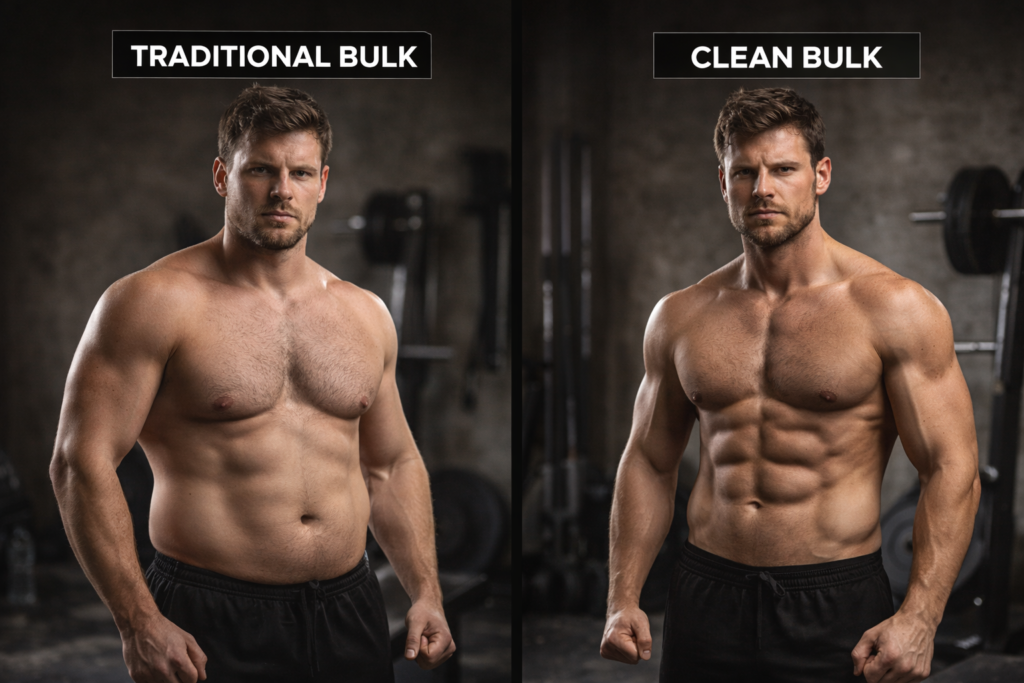
On paper, this makes sense. To build muscle, you need to eat more. Muscle weighs something, so weight gain is inevitable.
Where Most People Go Horribly Wrong
Here’s the problem: most people completely butcher the execution.
They eat massive amounts of food, gain weight rapidly, and assume all that weight is precious muscle. You’ll hear advice like:
- “Eat like a monster to grow like one”
- “If you’re not gaining a pound per week, you’re not trying”
- “Dirty bulk now, worry about abs later”
The logic seems simple: faster weight gain equals faster muscle growth.
But it’s completely wrong.
The Harsh Truth About Muscle Growth Limits
Here’s what nobody wants to hear: there’s a biological ceiling on how fast you can build muscle.
This limit is determined by factors completely outside your control:
- Your genetics
- Your age and gender
- Your training experience
- How much muscle you’ve already built
These factors create a hard cap on your muscle-building potential. You can’t exceed them naturally, no matter how much you eat.
When you try to gain weight faster than your body can build muscle, the excess weight becomes fat. Pure and simple.
Even if you’re eating “clean” foods, even if you’re taking every supplement under the sun, even if you’re training six days a week eating beyond your body’s muscle-building capacity just makes you fatter.
This is how most people approach bulking. They end up gaining 20 pounds in three months, with maybe 5 pounds being actual muscle and 15 pounds being fat they’ll have to torture themselves to lose later.
The Smart Alternative: Clean Bulking
Here’s where the concept of “clean bulking” or “lean bulking” comes in:
Clean bulking is a strategic approach to nutrition where you maximize muscle gain while minimizing fat accumulation to the greatest realistic extent possible.
The goal isn’t just to build muscle anymore. The goal is to build muscle while staying relatively lean throughout the entire process.
This approach offers massive advantages:
- Better body composition year-round
- Less time wasted cutting later
- Improved nutrient partitioning (your body directs more calories to muscle, not fat)
- Better insulin sensitivity
- More sustainable long-term progress
That’s what this guide is designed to help you achieve. Let’s dive into the 12 critical steps.
Step 1: Get Lean First (If Necessary)
I know you’re excited to start building muscle right now. But here’s an uncomfortable truth: if you’re currently carrying too much body fat, you need to lean down first.
“Why?” you might ask. “I thought we’re trying to bulk up!”
The Science of Nutrient Partitioning
The answer lies in something called calorie partitioning your body’s ability to direct incoming energy toward muscle building versus fat storage.
The leaner you are, the better your calorie partitioning. This means more of the calories you eat get funneled into muscle growth, and fewer get stored as fat.
When you start a muscle-building phase while already overweight, three bad things happen:
- Poor muscle-to-fat gain ratio: You’ll gain more fat and less muscle than you should
- Terrible optics: Going from “kinda fat” to “really fat” is demoralizing and won’t keep you motivated
- Extended cutting phase: The more fat you accumulate, the longer you’ll spend dieting it off later (essentially wasting time you could spend building muscle)
Leading experts in sports nutrition consistently recommend starting a caloric surplus from a lean starting point.
The Ideal Starting Body Fat Percentage
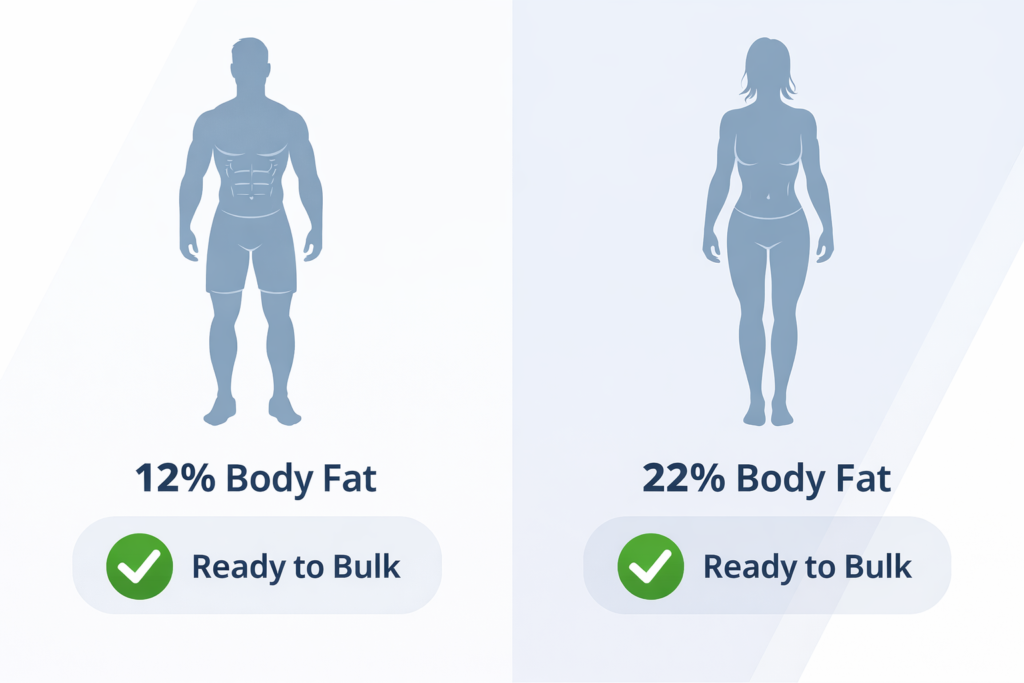
Here are the recommended starting points for an effective lean bulk:
- Men: 12% body fat or lower
- Women: 22% body fat or lower
If you’re within these ranges, you’re ready to roll. Skip to Step 2.
If you’re above these percentages, here’s what to do:
For beginners: Focus on losing fat until you hit the ideal range. The good news? As a beginner who needs to lose fat, you can actually build muscle while losing fat simultaneously. To maximize this effect, maintain a moderate calorie deficit (10-20% below maintenance), consume adequate protein, and follow a well-designed strength training program.
For intermediate/advanced lifters: You also need to lean down first. Unlike beginners, you’re unlikely to build significant muscle while in a calorie deficit. Your primary goal during this fat-loss phase is maintaining the muscle and strength you already have, ensuring the weight you lose is fat, not hard-earned muscle.
Step 2: Calculate Your Daily Calorie Needs
Now we’re ready to build your muscle-building diet.
Like any nutrition plan for any goal, everything starts with calories.
To figure out how many calories you need, we first need to determine your maintenance calorie level the number of calories you need to consume daily to maintain your current weight.
Why Maintenance Calories Matter
Understanding your maintenance level is critical because:
- Eating below maintenance = calorie deficit = weight loss (ideally fat)
- Eating above maintenance = calorie surplus = weight gain (ideally muscle)
For muscle building, we need that second scenario a modest calorie surplus.
How to Estimate Your Maintenance Calories
There are complex equations and fancy calculators, but here’s the simplest, most effective method:
Multiply your current body weight (in pounds) by 14-16.
For example, a 180-pound person would calculate: 180 × 14 = 2,520 calories and 180 × 16 = 2,880 calories, giving a maintenance range of approximately 2,520-2,880 calories daily.
Who should use the lower end? Women and less active individuals (sedentary jobs, minimal daily movement, less frequent training).
Who should use the higher end? Men and more active individuals (active jobs, high daily step counts, frequent intense training).
If you’re unsure, pick the middle.
What If My Estimate Is Wrong?
Don’t stress if your maintenance estimate isn’t perfectly accurate right now. We’re looking for a reasonable starting point based on calculation, not random guessing.
The real magic happens in the next step, where we’ll monitor and adjust based on actual results.
Step 3: Create Your Calorie Surplus
The most critical element of any muscle-building diet is providing your body with the extra energy it needs to construct new muscle tissue.
Without this extra energy, your muscle-building efforts will fail. Period.
Two Sources of Energy for Muscle Building
This energy can come from two places:
1. Internal energy sources: In certain cases, stored body fat can be burned for fuel to support muscle building. However, this scenario only works well for a small group: absolute beginners who are overweight, enhanced athletes using performance-enhancing drugs, or detrained individuals with muscle memory returning to training.
2. External energy sources: For everyone else (the vast majority of people reading this), the extra energy must come externally through diet specifically, through a calorie surplus.
This is THE most important component of a muscle-building diet. Nothing works without it. Nothing.
The Optimal Surplus Size
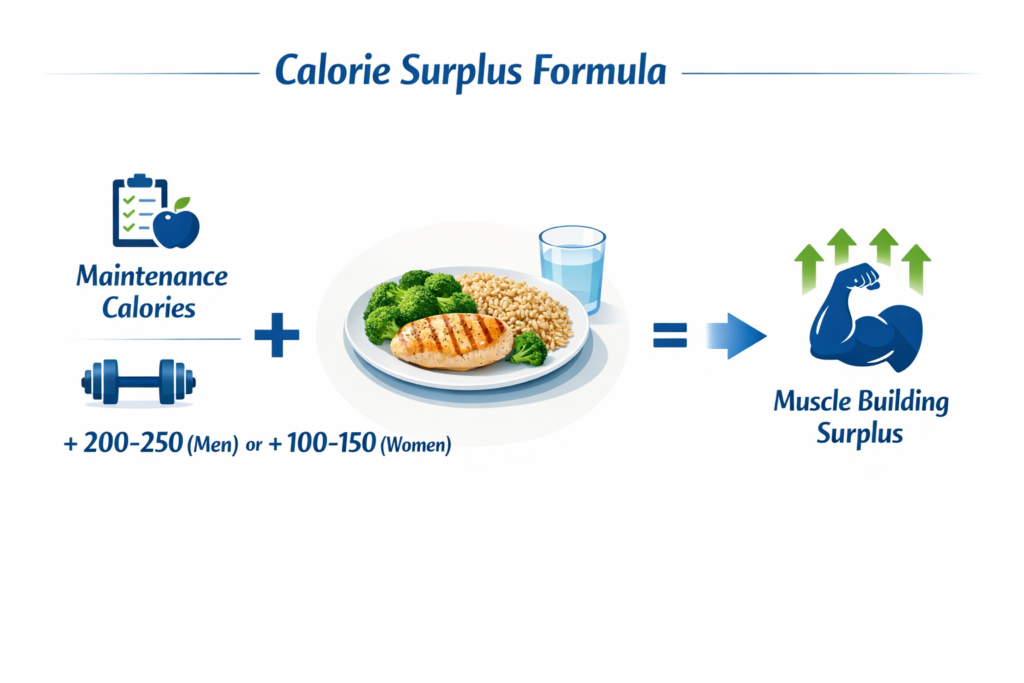
Your calorie surplus needs to hit a sweet spot: small enough to minimize fat gain, but large enough to maximize muscle growth.
Here’s my recommended starting point based on what works for most people:
- Men: 200-250 calorie daily surplus above maintenance
- Women: 100-150 calorie daily surplus above maintenance
For example, if your estimated maintenance is 2,500 calories, a man would eat 2,700-2,750 calories daily, while a woman would eat 2,600-2,650 calories daily.
Why such a modest surplus? Because muscle grows slowly (more on this soon), and eating beyond what your body can use for muscle building just creates unnecessary fat gain.
Step 4: Determine Your Ideal Rate of Weight Gain
You’ve calculated your maintenance calories and created a surplus. Great.
But how do you know if it’s actually working?
The simplest answer: track your weight week by week.
Using Weight Gain as Your GPS
Your rate of weight gain serves as a roadmap, helping you determine whether your calorie intake is optimal:
- Gaining too fast? You’re eating too much and accumulating excessive fat
- Gaining too slowly or not at all? You’re not eating enough to maximize muscle growth
- Gaining at the ideal rate? Perfect keep doing exactly what you’re doing
The Ideal Rate of Weight Gain for Lean Bulking
For those pursuing smart muscle building (maximizing muscle while minimizing fat), here’s what to aim for:
- Men: Gain 1-2 pounds per month (approximately 0.25-0.5 lbs per week)
- Women: Gain 0.5-1 pound per month (approximately 0.12-0.25 lbs per week)
This tends to be the sweet spot for most natural lifters.
“That Seems Incredibly Slow!”
I know. It seems that way because the fitness industry has completely warped our expectations.
You’ve probably seen countless ads, articles, and supplement companies claiming you can “Gain 20 Pounds of Muscle in 8 Weeks!” or similar nonsense.
It’s all lies.
The Reality of Natural Muscle Growth
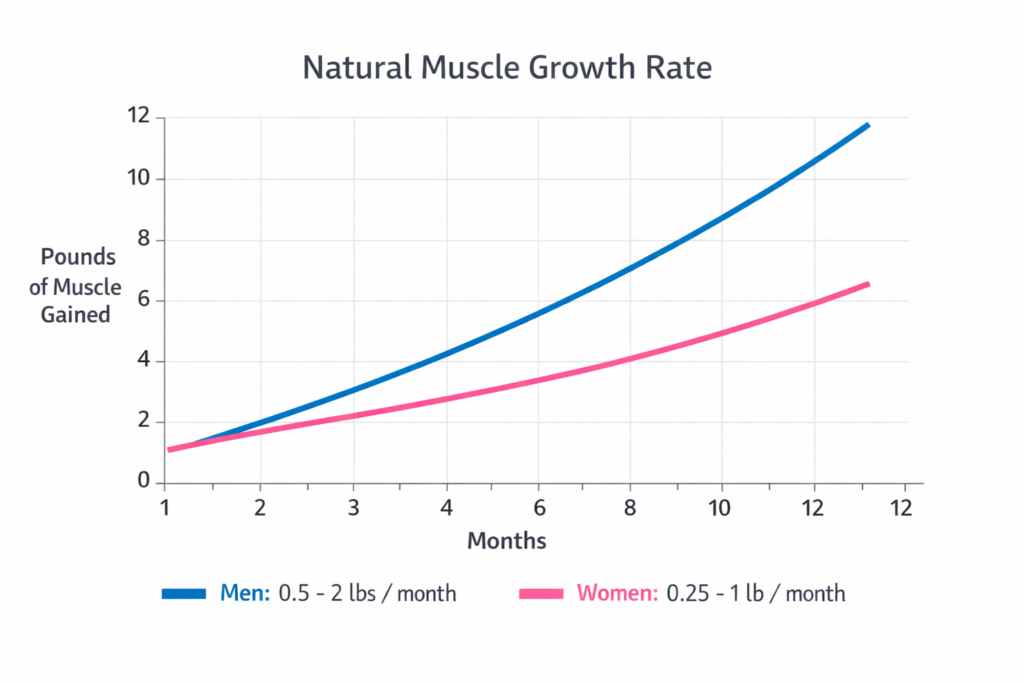
Here’s the truth about how fast muscle actually grows:
Men with average genetics: Lucky to gain 0.5-2 pounds of actual muscle per month
Women with average genetics: Lucky to gain 0.25-1 pound of actual muscle per month
And those are the UPPER limits. Only beginners, young trainees, or those with exceptional genetics will hit the higher end of these ranges. Most people will land in the middle or lower portion.
This is why my recommended weight gain rates might seem slow because realistic muscle growth IS slow.
We’re designing your diet around biological reality, not marketing hype.
Ready to accelerate your muscle-building journey? Understanding proper nutrition is just one piece. Combining the right diet with an intelligently designed training program can help you build muscle more efficiently than you ever thought possible.
Step 5: Monitor Progress and Make Adjustments
Remember how we’re using your weight gain rate as a GPS to guide your calorie intake?
This step is where that concept comes to life.
If you’re not eating enough calories to support muscle growth, your diet won’t deliver results. If you’re eating more than your body can actually use for muscle building, you’ll just get fat.
The Simple Monitoring System
Here’s your action plan:
- Weigh yourself once weekly, same day each week, first thing in the morning before eating or drinking anything
- Resist daily weigh ins daily fluctuations are normal and meaningless; focus on the weekly trend
- After 2-3 weeks, ask yourself: Is my weight increasing at the target rate?
- If yes: Perfect! Continue eating the same amount and keep monitoring
- If no: Adjust calorie intake in small increments (100-300 calories at a time), wait another 2-3 weeks, and reassess
Repeat this cycle until you’re consistently hitting your target rate of weight gain, then maintain that calorie level as long as it keeps working.
Advanced Tracking Tips
- Take progress photos monthly from multiple angles
- Track body measurements (chest, arms, waist, thighs)
- Monitor strength progression in key lifts
- Pay attention to how your clothes fit
These additional metrics help confirm that your weight gain is primarily muscle, not fat.
Step 6: Dial In Your Protein Intake
With calories determined, the next most critical component is protein.
Protein is one of three macronutrients (along with carbs and fats), but it’s by far the most important for muscle building because it provides the amino acid building blocks that construct muscle tissue.
Optimal Daily Protein Intake
Consume 0.7-1.0 grams of protein per pound of body weight daily.
For a 180-pound person, that’s 126-180 grams of protein per day.
Research consistently shows this range maximizes muscle protein synthesis, recovery, and muscle growth. Going below this compromises results; going significantly higher provides minimal additional benefit.
Quality Protein Sources
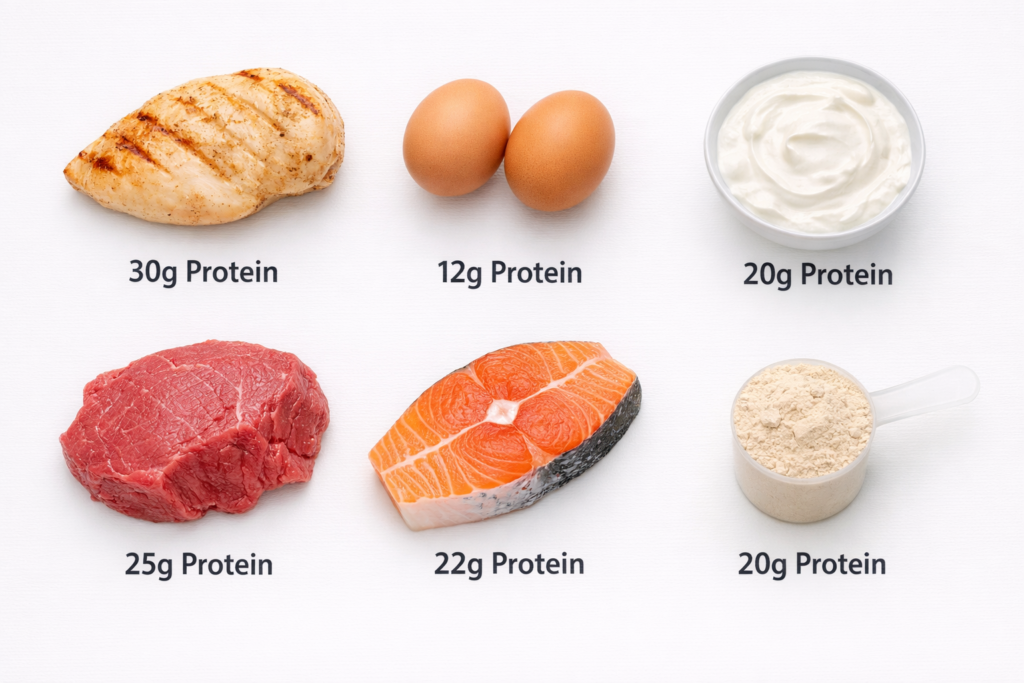
Top protein sources for muscle building include:
- Chicken breast
- Turkey
- Lean beef
- Fish (salmon, tilapia, cod)
- Eggs and egg whites
- Greek yogurt
- Cottage cheese
- Protein powder (whey, casein, plant-based)
Choose the most affordable and convenient options for your situation.
Important note: 1 gram of protein contains 4 calories. Keep this in mind it’ll be useful soon.
Step 7: Set Your Fat Intake
The next macronutrient to nail down is dietary fat.
Like protein, adequate fat intake is crucial for overall health and body function in numerous ways, including absorption of fat-soluble vitamins (A, D, E, K).
More importantly for muscle building, dietary fat is essential for optimal hormone production, including testosterone a key hormone for muscle growth.
Optimal Daily Fat Intake
Get 20-30% of your total daily calories from fat.
Here’s an example calculation:
- Person needs 2,500 calories daily
- Decides on 25% from fat
- 25% of 2,500 = 625 calories from fat
- Since fat contains 9 calories per gram: 625 ÷ 9 = approximately 69 grams of fat daily
Your personal preferences and needs should determine where you land within that 20-30% range.
Quality Fat Sources
Excellent fat sources include:
- Nuts (almonds, walnuts, cashews)
- Seeds (chia, flax, pumpkin)
- Olive oil and avocado oil
- Coconut oil
- Avocados
- Fatty fish (salmon, mackerel, sardines)
- Natural nut butters
- Egg yolks
Select your favorites and build them into your meal plan.
Step 8: Fill the Rest with Carbohydrates
The third and final macronutrient is carbohydrates.
Unlike protein and fat both considered “essential” because they provide nutrients your body needs but cannot produce (essential amino acids and essential fatty acids) carbohydrates don’t technically provide any “essential” nutrients.
However, adequate carb intake is still vital for optimal muscle building.
Why Carbs Matter for Muscle Growth
Carbohydrates:
- Fuel intense training sessions
- Maximize workout performance
- Optimize recovery between workouts
- Replenish muscle glycogen stores
- Support hormone production
- Allow you to extract maximum benefit from the muscle-building process
Optimal Daily Carb Intake
Whatever calories remain after setting protein and fat.
Confused? Here’s a detailed example:
- Person weighs 180 pounds, needs 2,800 calories daily
- Protein: 180 lbs × 0.8g = 144g × 4 calories = 576 calories
- Fat: 25% of 2,800 = 700 calories from fat ÷ 9 = 78g of fat
- Total so far: 576 + 700 = 1,276 calories
- Remaining: 2,800 – 1,276 = 1,524 calories
- Carbs: 1,524 remaining calories ÷ 4 = approximately 381g of carbs daily
Simply repeat this process using your own numbers.
Quality Carb Sources
Excellent carbohydrate sources include:
- White rice and brown rice
- Sweet potatoes and regular potatoes
- Oats and oatmeal
- Quinoa
- Whole grain bread and pasta
- Beans and lentils
- Fruits (bananas, berries, apples)
- Vegetables (though these contribute minimal calories)
Choose what you enjoy and what fits your budget.
Step 9: Optimize Pre- and Post-Workout Nutrition
Your pre- and post-workout meals the meals you consume before and after training play a meaningful role in a muscle-building diet.
But let’s get something straight right now.
The Truth About Nutrient Timing
Is workout nutrition super, mega, ultra-important for muscle building? Will it make or break your results?
No. Not even close.
When it comes to building muscle, your total daily calories and macronutrients (in that order: protein > carbs > fat) are ALWAYS the most important factors. By far.
Everything else is secondary or tertiary in comparison.
That said, getting your workout nutrition right can still provide a meaningful boost to your results, so you should do it.
Ideal Pre- and Post-Workout Nutrition
Consume a meal containing quality protein and carbohydrates 1-3 hours before training, and again 1-3 hours after training.
That’s it. Really.
People love to overcomplicate workout nutrition with endless rules about exact timing, specific supplement stacks, and magical anabolic windows. But the research shows it’s much simpler than that.
What This Looks Like in Practice
Pre-workout meal options:
- Chicken and rice
- Greek yogurt with fruit and granola
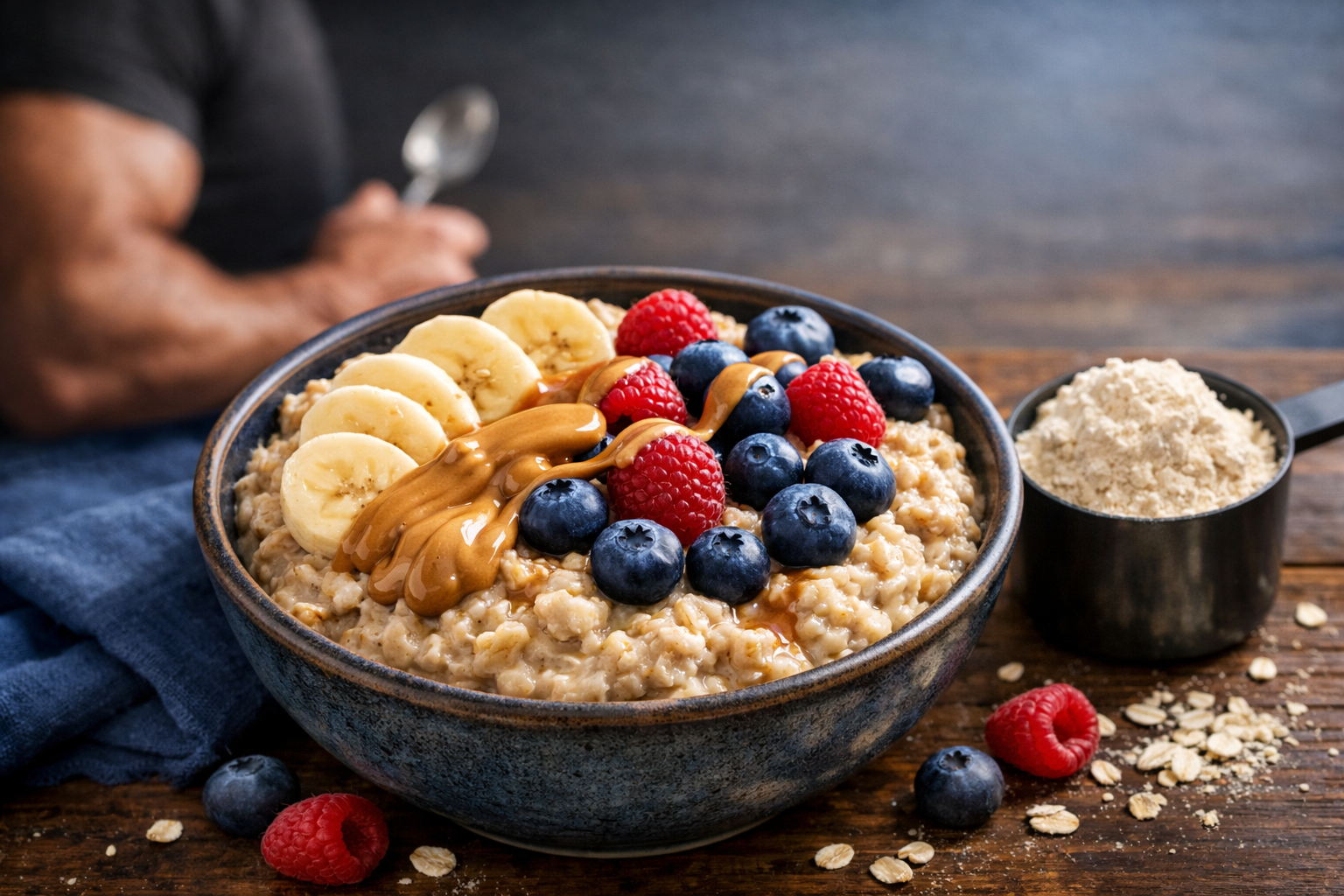
- Oatmeal with protein powder
- Turkey sandwich on whole grain bread
Post-workout meal options:
- Salmon with sweet potato
- Protein shake with banana
- Beef with pasta
- Eggs with toast and fruit
The specific foods matter far less than hitting adequate protein and carbs in a reasonable timeframe around your training.
Step 10: Make Everything P.A.C.S.
If you’ve made it this far, you now understand:
- Why traditional bulking fails and clean bulking succeeds
- Your ideal rate of weight gain
- Exactly how many calories and macros you need
- How to monitor progress and adjust accordingly
- The fundamentals of workout nutrition
Your muscle-building diet is nearly complete. But several questions remain…
The Questions Everyone Asks
- Large meals or small meals?
- Eat frequently or infrequently?
- Every 2-3 hours or every 4-5 hours?
- Strict diet or flexible approach?
- Clean eating 100% or 80/20 approach?
- Three meals daily or six?
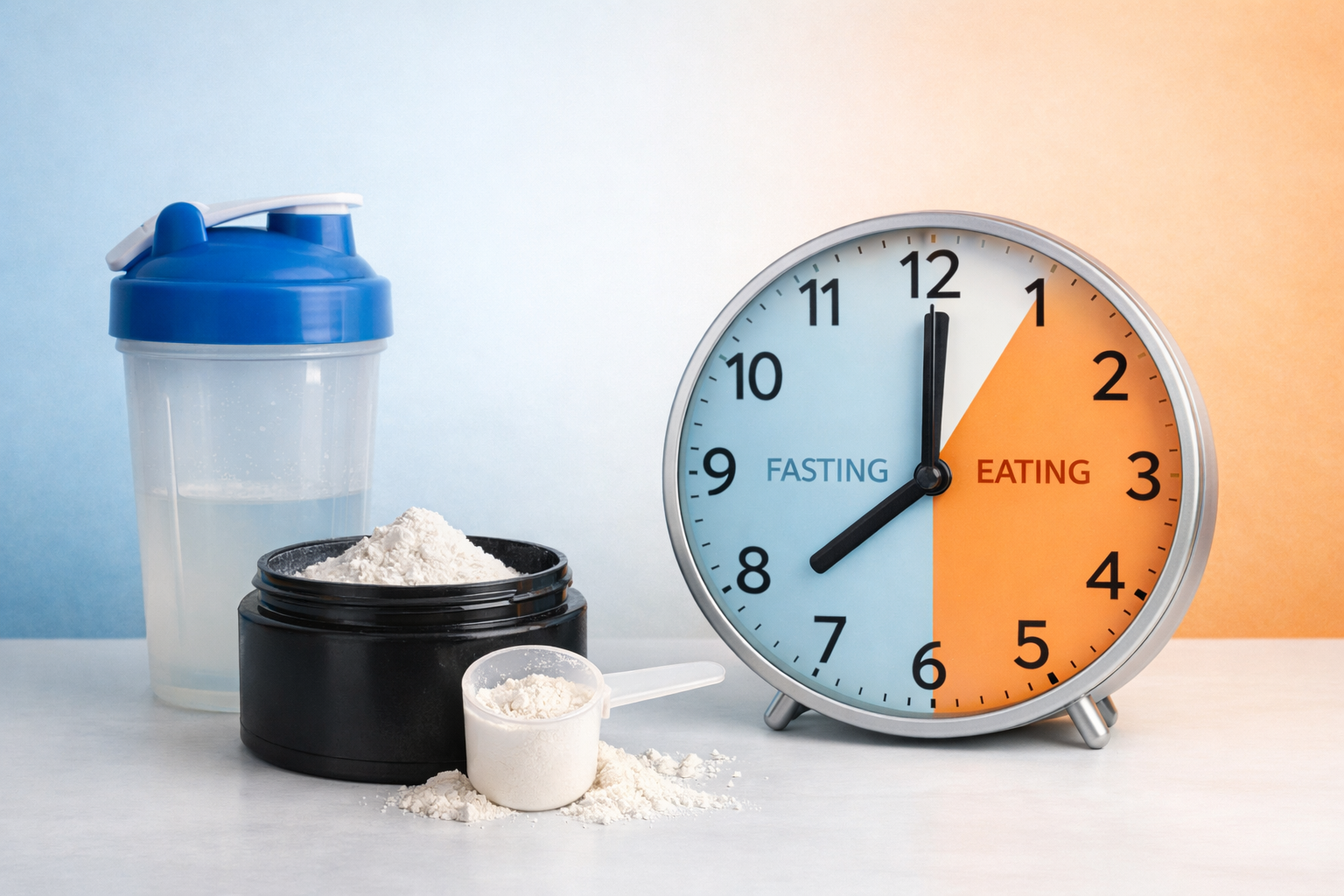
- Intermittent fasting or regular eating?
- Eat early or late in the day?
- Eat or skip breakfast?
- Carbs earlier or later?
The simple answer to all these questions:
As long as you’re consistently hitting your total daily calories and macros, these factors will have minimal to zero impact on your results.
In most cases, literally zero impact.
Why These Details Don’t Matter Much
Body composition changes happen primarily as a result of your overall protein, carb, and fat intake.
The specific food sources, the exact timing, and the particular meal frequency don’t play nearly as significant a role.
When the Small Details DO Matter
These factors don’t directly affect your ability to build muscle or minimize fat gain. However, they can indirectly affect results by influencing your ability to consistently adhere to the parts of your diet that actually matter.
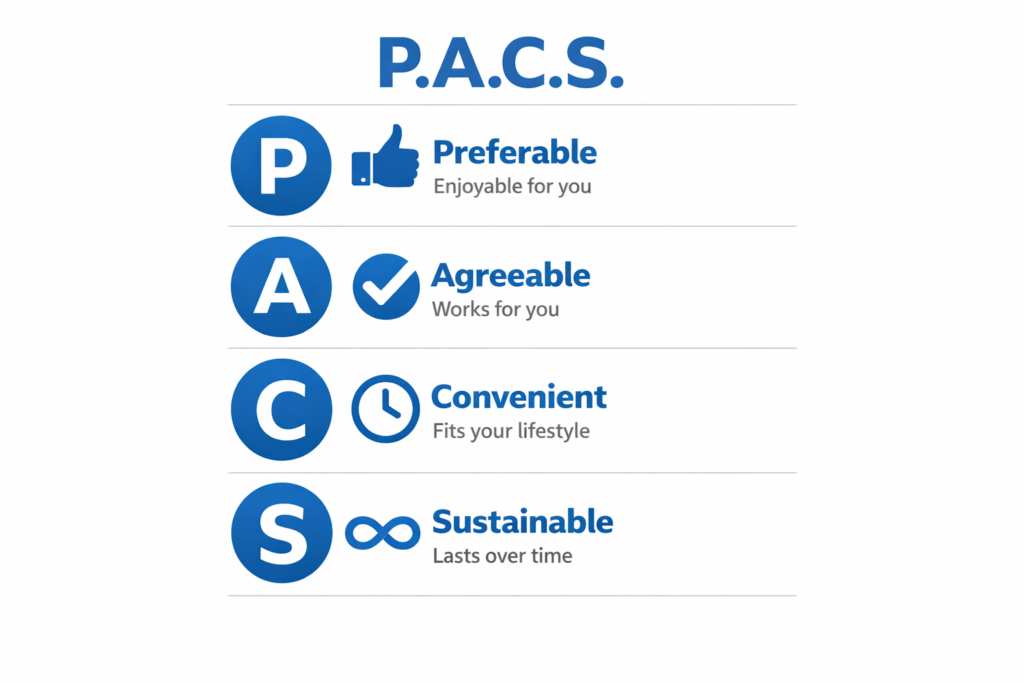
These details meal frequency, eating style, food choices, diet structure determine whether your diet ends up being P.A.C.S. for you:
- Preferable
- Agreeable
- Convenient
- Sustainable
No matter how effective any diet is on paper, you’ll always fail if you can’t stick to it consistently long-term.
How to Make Things Work
Do whatever helps you consistently hit your total daily calorie and macro targets.
Whatever is most Preferable, Agreeable, Convenient, and Sustainable (P.A.C.S.!) for your life, your schedule, and your personal food preferences that’s what you should do.
When deciding how many meals to eat, when to eat them, how strict or flexible to be, or any similar questions about your daily eating pattern, the only factor worth considering is your own personal preferences.
Do what works for YOU.
Because that’s what will make you nail the important stuff consistently. Simple as that.
Step 11: Consider Strategic Supplementation (Optional)
Since supplements go hand-in-hand with muscle building and nutrition, we need to address them.
But let me be brutally honest:
- Do you NEED supplements to build muscle? No.
- Will any supplement by itself build muscle? No.
- Will any supplement transform your results from mediocre to amazing? No.
- Are there a few supplements that are safe, proven, and provide modest benefits? Yes.
The Short List of Worthwhile Supplements
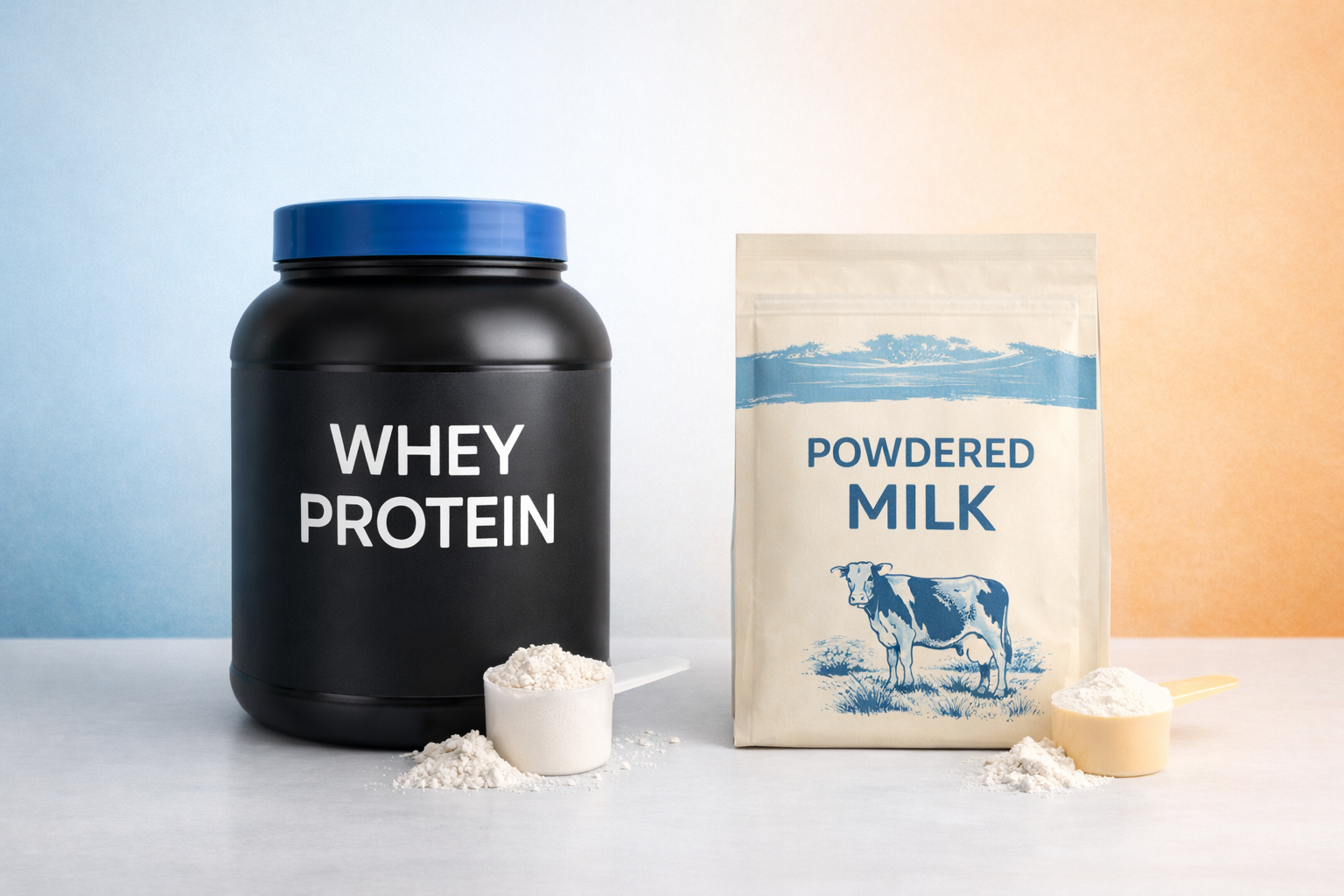
Whey Protein Powder: Simply a convenient protein source. Not magic, just practical.
Creatine Monohydrate: The single most proven muscle-building supplement. It enhances strength and performance slightly, which supports muscle growth over time. Take 5g daily.
Fish Oil (Omega-3s): More of a health supplement than anything, but omega-3 fatty acids provide various benefits, some of which may improve nutrient partitioning and reduce inflammation.
Vitamin D3: Another health supplement with indirect roles in muscle building and hormone production. Many people are deficient.
Individual Vitamins or Minerals: Address any deficiencies your diet doesn’t cover. For example, if you’re lactose intolerant and don’t eat dairy, calcium supplementation makes sense.
Caffeine: Effective as a pre-workout stimulant for improved training performance.
Multivitamin: Basic insurance against micronutrient gaps (though whole foods should be your primary source).
What About All Those Other Supplements?
The supplement industry thrives on selling hope in a bottle. Most supplements claiming to boost muscle growth, increase testosterone, or accelerate results are either completely useless or provide such minimal benefit that they’re not worth the money.
Focus your energy and money on getting your diet and training right. That’s where 95% of your results come from.
Step 12: Pair Your Diet with Effective Training
This technically isn’t about diet, but it’s too important not to mention.
Your training program and how effectively it stimulates muscle growth is absolutely crucial for two reasons:
- Building muscle in the first place (obviously)
- Avoiding excessive fat gain (less obvious but equally important)
Why Training Quality Determines Fat vs. Muscle
Remember, you’re in a calorie surplus. You’re feeding your body extra energy.
That energy can be directed toward either muscle growth or fat storage. Two scenarios are possible:
Scenario 1 – Effective Training: The stronger your muscle-building stimulus (through intelligent, progressive training), the more likely your body uses those surplus calories for muscle construction.
Scenario 2 – Ineffective Training: The weaker your training stimulus, the higher the likelihood those surplus calories get stored as body fat.
How to Ensure Scenario 1
Use an intelligently designed training program specifically developed for muscle growth that includes:
- Progressive overload (systematically increasing weight, reps, or volume)
- Adequate training volume (enough sets per muscle group weekly)
- Appropriate exercise selection (compound movements + targeted isolation)
- Proper training frequency (hitting each muscle 2-3x per week)
- Strategic periodization and deloads
Without effective training, even a perfect diet won’t build much muscle.
The nutrition provides the building materials and energy, but training provides the stimulus that tells your body to actually use those materials to construct new muscle tissue.
Sample Muscle-Building Meal Plan
To wrap everything up, here’s a sample meal plan that hits all three macronutrients and provides everything your body needs for optimal muscle growth.
Important reminder: The specific quantities will vary based on YOUR individual calorie and macro needs calculated earlier. This is just a template to show how the principles work in practice.
Meal 1 – 8:00 AM
Option A: Whole egg omelet with oats and berries
Option B: Protein smoothie with peanut butter, banana, and oats
Meal 2 – 12:00 PM
Option A: Brown rice with grilled chicken breast and broccoli
Option B: Sweet potato with lean ground beef and vegetables
Meal 3 – 4:00 PM (Pre-Workout)
Option A: Greek yogurt mixed with granola and honey
Option B: Banana with whey protein shake
Meal 4 – 7:00 PM (Post-Workout)
Option A: Grilled salmon with jasmine rice and asparagus
Option B: Whole grain sandwich with turkey breast and avocado
Meal 5 – 10:00 PM
Option A: Lean beef burger with baked potato
Option B: Brown rice with black beans and grilled chicken
The Individualization Factor
If you’ve been paying attention, you already know that macro quantities in each meal will change based on YOUR specific needs.
There’s no one-size-fits-all muscle-building diet that works for everyone.
Beware of “done-for-you” meal plans promising to work for everyone. They’re about as likely to match your specific needs as winning the lottery.
Only a qualified sports nutritionist or dietitian can create a truly customized meal plan for you. However, if that’s not accessible to you right now, that’s exactly why this guide exists to teach you the principles so you can build your own effective plan.
The Bottom Line
You now have everything you need to create a muscle-building diet that actually works.
If you’re smart enough to pursue clean bulking (maximizing muscle while minimizing fat gain) instead of just traditional dirty bulking, the 12 steps outlined in this guide represent your roadmap to success.
Your Next Steps
- Calculate your maintenance calories
- Create your modest surplus
- Set your protein, fat, and carb targets
- Design a meal structure that’s P.A.C.S. for you
- Start tracking your weight weekly
- Adjust based on results
- Pair everything with intelligent progressive training
- Stay consistent for months, not weeks
Building impressive muscle naturally is a marathon, not a sprint. But with the right approach, you can make steady, sustainable progress without yo-yoing between bulking and cutting phases or wasting time spinning your wheels.
Ready to transform your physique the smart way? Stop following outdated bro-science and start applying evidence-based nutrition principles that actually work. Your future, more muscular self is waiting.
Want a complete system that eliminates the guesswork? The right muscle-building program combines optimized nutrition with progressive training protocols designed to maximize your natural muscle-building potential. Stop wasting time with trial and error get the proven blueprint that delivers real results.

Leave a Reply
You must be logged in to post a comment.