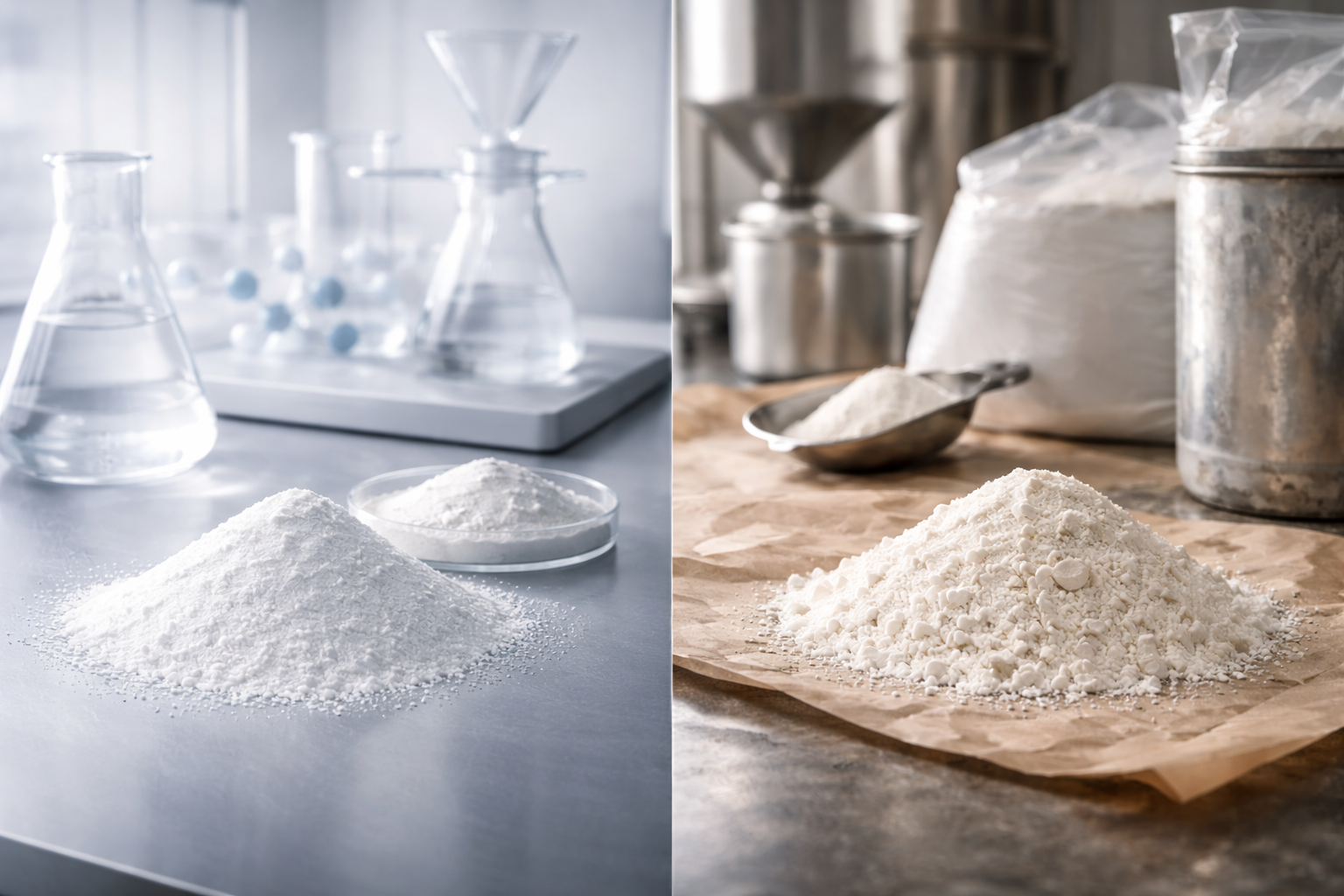
Paying extra for Creapure-branded creatine? Here’s the truth about whether this “premium” certification justifies the higher price or if regular creatine works just as well.
You’re standing in the supplement aisle (or browsing online) looking at creatine options.
Some products boldly display the “Creapure” logo and cost $35-45 for a month’s supply.
Others simply say “creatine monohydrate” with no special certification and cost $15-25 for the same amount.
Same supplement. Same dosage. Wildly different prices.
The expensive ones claim superior purity, German manufacturing standards, rigorous testing, and guaranteed quality.
The cheaper ones… well, they just say “creatine monohydrate” and hope you’ll buy based on price.
Which should you choose?
Here’s the short answer: Creapure is a quality certification for creatine monohydrate, not a different type of creatine. It guarantees high purity and quality control. Whether it’s worth the premium depends on the price difference and your priorities.
In this comprehensive guide, I’ll explain exactly what Creapure is, how it differs from regular creatine, examine the actual benefits of the certification, reveal when it’s worth paying more (and when it’s not), and help you make an informed purchasing decision.
Let’s separate marketing from reality.
TABLE OF CONTENTS
What Exactly Is Creapure?
Before we can compare, you need to understand what Creapure actually represents.
Creapure Is NOT a Type of Creatine
This is the most important point to understand:
Creapure is creatine monohydrate. It’s not a special form, advanced formulation, or different chemical structure. It’s the same creatine monohydrate that’s been researched for decades.
What makes it different is the manufacturing process and quality certification, not the actual creatine molecule.
Creapure Is a Quality Seal
Think of Creapure like “organic” certification for produce:
Organic vegetables and regular vegetables are the same vegetables. The certification indicates they were grown according to specific standards and verified by third parties.
Similarly:
Creapure creatine and regular creatine are both creatine monohydrate. The Creapure certification indicates it was manufactured according to specific standards and verified for purity.
Where Creapure Comes From
Creapure is manufactured by AlzChem Trostberg GmbH in Germany.
Key facts:
Single-source production: All Creapure creatine comes from one facility in Trostberg, Germany.
Established standards: The manufacturing process follows strict German pharmaceutical standards.
Patented process: The production method is proprietary and designed to minimize impurities.
Third-party testing: Independent laboratories verify purity and absence of contaminants.
Transparent traceability: You can actually research where and how it’s made, unlike many competitors.
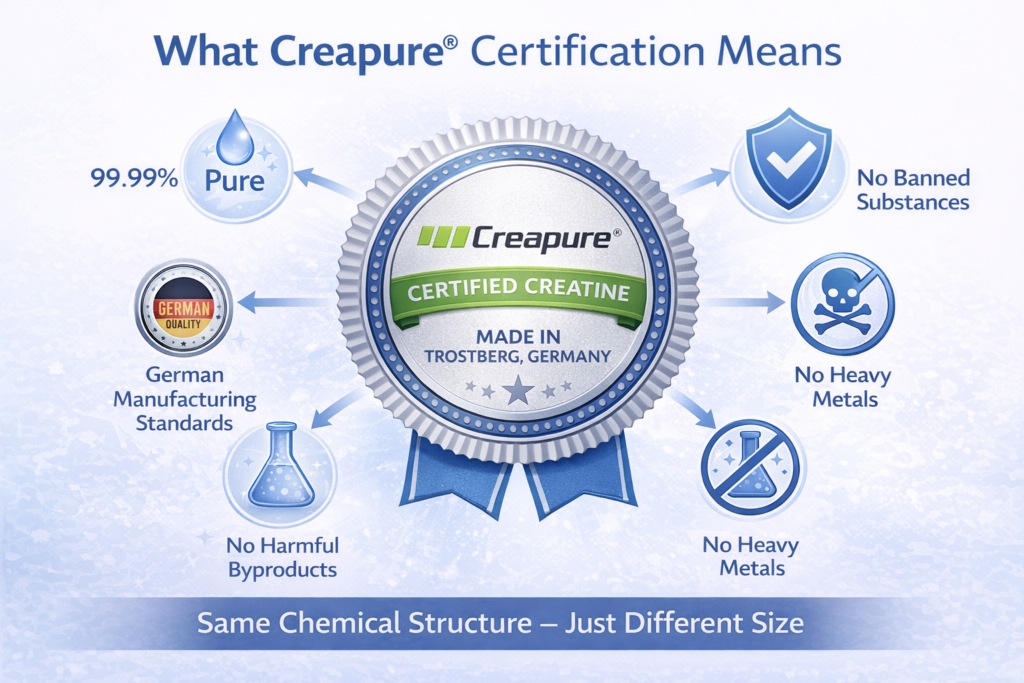
What Creapure Guarantees
The Creapure certification promises:
99.99% pure creatine monohydrate: Maximum purity with minimal impurities.
No banned substances: Tested to ensure no prohibited substances that could cause failed drug tests in athletes.
No heavy metals: Verified absence of dangerous contaminants like mercury, lead, and arsenic.
No harmful byproducts: The manufacturing process is designed to avoid creating toxic byproducts like dicyandiamide (DCD) and dihydrotriazine (DHT), which can occur in lower-quality production.
Consistent quality: Every batch meets the same rigorous standards.
Vegan and vegetarian: No animal-derived ingredients.
How Creatine Is Actually Made (And Why Quality Matters)
To understand why Creapure might be superior, you need to know how creatine is manufactured.
The Synthesis Process
Most people don’t realize this, but creatine is synthetically produced.
You cannot sustainably extract creatine from natural sources (meat and fish contain it, but extracting pure creatine from these sources would be prohibitively expensive and impractical).
Instead, creatine is created through chemical synthesis:
The basic process:
- Sarcosine (an amino acid derivative) is combined with cyanamide
- Under controlled conditions with catalysts, these react to form creatine
- The resulting creatine is purified and crystallized
- It’s dried and milled into powder form
Sounds simple, but the details matter enormously.
Why Manufacturing Quality Matters
The chemical synthesis process can create unwanted byproducts and impurities if not done correctly:
Potential contaminants from poor manufacturing:
Dicyandiamide (DCD): A toxic byproduct that can form during creatine synthesis if temperature and pH aren’t properly controlled.
Dihydrotriazine (DHT): Another unwanted byproduct of improper synthesis conditions. Not to be confused with the hormone dihydrotestosterone.
Creatinine: The breakdown product of creatine. High levels indicate degraded or old product.
Heavy metals: Can contaminate products if raw materials or manufacturing equipment aren’t properly controlled.
Unknown compounds: Poorly controlled synthesis can create various unknown byproducts.
The concern: When you buy cheap, uncertified creatine, you might be getting less pure creatine with more contaminants.
Important context: Most creatine sold today, even without Creapure certification, is reasonably pure and safe. But there’s a range of quality, and Creapure sits at the top end of that range.
Creapure vs Regular Creatine: The Real Differences
Let’s examine exactly how Creapure compares to non-certified creatine monohydrate.
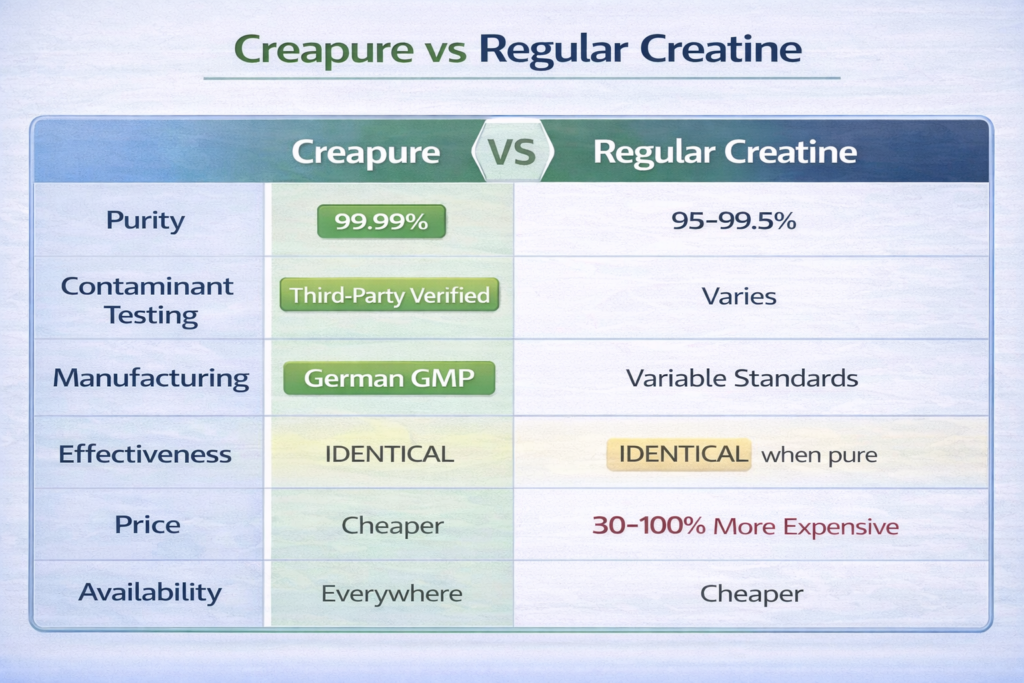
Difference 1: Purity Levels
Creapure:
- Guaranteed 99.99% pure creatine monohydrate
- Less than 0.01% impurities
- Consistently tested and verified
Regular creatine:
- Typically 95-99.5% pure
- Variable purity depending on manufacturer
- May contain higher levels of impurities
- Often not independently tested
Does this difference matter?
For most people, probably not significantly. Even 98% pure creatine provides nearly the same amount of actual creatine per serving.
However:
- Higher impurity levels mean less actual creatine per dose
- Unknown contaminants could potentially cause issues in sensitive individuals
- For competitive athletes subject to drug testing, purity matters more
Difference 2: Contaminant Testing
Creapure:
- Tested for heavy metals (mercury, lead, arsenic, cadmium)
- Screened for banned substances
- Verified absence of harmful byproducts (DCD, DHT)
- Regular batch testing
- Transparent test results available
Regular creatine:
- Testing varies dramatically by brand
- Some brands test thoroughly
- Many don’t test at all or don’t publish results
- Unknown levels of potential contaminants
- You’re trusting the manufacturer’s word
Does this difference matter?
Yes, for peace of mind and safety. While serious contamination is rare, it does occur. Third-party testing provides verification you can trust.
Difference 3: Manufacturing Standards
Creapure:
- Produced under German pharmaceutical manufacturing standards (GMP)
- Single facility with consistent processes
- Strict quality control at every step
- Traceable production chain
Regular creatine:
- Manufacturing standards vary by country and facility
- Often produced in China with variable oversight
- Quality control varies from excellent to poor
- Less transparency about production processes
Does this difference matter?
It provides confidence in consistency. When you buy Creapure-certified products, you know what you’re getting. With uncertified creatine, quality can vary even between batches from the same brand.
Difference 4: Effectiveness
Here’s the critical question: Does Creapure work better than regular creatine?
The answer: No, assuming the regular creatine is reasonably pure.
Both forms:
- Increase muscle phosphocreatine stores equally
- Enhance strength and power equally
- Support muscle growth equally
- Provide the same ergogenic benefits
The key qualifier: “Assuming the regular creatine is reasonably pure.”
If regular creatine is only 95% pure, you’re getting 5% less actual creatine per serving. Over time, this could theoretically matter, but in practice, the difference is minimal.
If regular creatine contains harmful contaminants, those could potentially cause issues, though this is rare with products from reputable brands.
The verdict: When comparing pure creatine monohydrate to pure creatine monohydrate, there’s no difference in effectiveness. Creapure’s advantage is guaranteed purity, not superior muscle-building properties.
Difference 5: Price
This is where things get important.
Creapure-certified creatine typically costs:
- $0.20-0.40 per serving (5g)
- $30-60 for 150 servings (750g)
Regular creatine monohydrate typically costs:
- $0.10-0.25 per serving (5g)
- $15-35 for 150 servings (750g)
The premium: You’re often paying 30-100% more for Creapure certification.
Is this justified? That depends on your priorities and the specific price difference.
Difference 6: Availability
Creapure:
- Widely available in premium supplement brands
- Easy to identify (Creapure logo on label)
- Consistent across products using it
Regular creatine:
- Available from virtually every supplement brand
- Quality varies dramatically
- Harder to verify what you’re actually getting
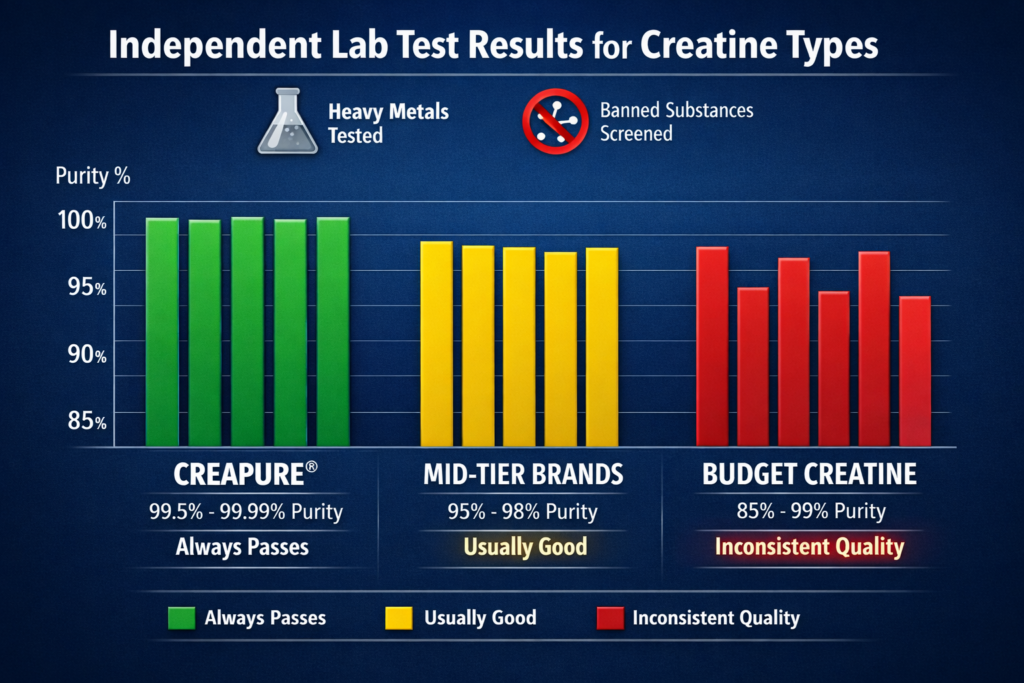
Independent Testing: What Third-Party Labs Found
Several independent laboratories have tested various creatine products.
What they discovered:
Creapure-certified products:
- Consistently met purity claims
- No concerning contaminants
- Accurate labeling
- Reliable quality
Non-certified budget creatine:
- Highly variable purity (ranging from 85% to 99%)
- Some contained concerning levels of contaminants
- Some contained less creatine than claimed on label
- Inconsistent quality even within the same brand
Non-certified mid-tier brands:
- Generally good purity (95-98%)
- Mostly accurate labeling
- Occasional contamination issues
- More reliable than budget options but less than Creapure
The takeaway: Creapure provides guaranteed quality. Non-certified creatine is a gamble that usually turns out fine but occasionally doesn’t.
When Creapure Is Worth the Premium
Let’s get practical about when you should pay more for Creapure.
Scenario 1: Small Price Difference (10-20%)
If Creapure costs only slightly more than regular creatine:
Example:
- Regular creatine: $20 for 250g
- Creapure creatine: $24 for 250g
In this scenario, Creapure is absolutely worth it. For an extra $4, you get guaranteed purity, third-party testing, and peace of mind. This is a no-brainer.
Scenario 2: You’re a Competitive Athlete Subject to Drug Testing
If you compete in tested sports:
The risk: Some poorly manufactured creatine could theoretically contain banned substances or compounds that trigger false positives.
Creapure testing: Specifically screens for banned substances, providing protection against accidental positive tests.
The verdict: The premium is worth it to protect your athletic career.
Scenario 3: You Have Digestive Sensitivity
If you’ve experienced issues with creatine in the past:
Potential cause: Impurities and contaminants in lower-quality creatine can cause digestive discomfort more than pure creatine.
Creapure benefit: Maximum purity might reduce digestive issues.
The verdict: Worth trying Creapure to see if purity makes a difference in your tolerance.
Scenario 4: You Want Maximum Confidence in What You’re Taking
If peace of mind matters to you:
Some people simply prefer knowing exactly what they’re putting in their bodies and want the highest quality available.
The Creapure advantage: Transparent manufacturing, third-party testing, verified purity.
The verdict: If this is important to you and you can afford the premium, Creapure delivers confidence.
Scenario 5: You’re Taking Creatine Long-Term
If you plan to supplement with creatine indefinitely:
The consideration: Even small amounts of contaminants could theoretically matter over years or decades of daily use.
Creapure benefit: Verified absence of heavy metals and harmful compounds.
The verdict: For long-term use, guaranteed purity might be worth the investment.
When Regular Creatine Is the Better Choice
Now let’s cover when you should save your money.
Scenario 1: Large Price Difference (50%+ more)
If Creapure costs dramatically more:
Example:
- Regular creatine: $15 for 250g
- Creapure creatine: $40 for 250g
In this scenario, the premium is hard to justify for most people. While Creapure is purer, regular creatine from a reputable brand is still quite pure and effective.
Better strategy: Buy quality regular creatine from an established, reputable brand that does their own testing.
Scenario 2: You’re Buying From a Reputable Brand With Third-Party Testing
If the non-Creapure product has:
- Third-party testing (NSF, Informed-Sport, Informed-Choice)
- Good reputation and reviews
- Transparent labeling
- Established brand history
The verdict: These products often match Creapure’s quality at lower cost. The third-party testing provides similar assurance.
Scenario 3: Budget Is Your Primary Concern
If money is tight:
The reality: Quality regular creatine from a reputable brand will still deliver 95%+ of the benefits at significantly lower cost.
Better allocation: Spend saved money on quality whole foods, which matter more for results than the difference between Creapure and good regular creatine.
The verdict: Don’t skip creatine entirely because Creapure is expensive. Buy quality regular creatine instead.
Scenario 4: You’re Just Starting Out
If you’re new to creatine and testing whether it works for you:
The approach: Start with quality regular creatine to see how your body responds and whether you notice benefits.
The reasoning: No point paying premium prices if you’re not sure you’ll continue using it long-term.
The verdict: Prove that creatine works for you with regular creatine first. Upgrade to Creapure later if desired.
How to Choose Quality Regular Creatine (Non-Creapure)
If you decide to save money with non-Creapure creatine, here’s how to ensure you get a quality product.
Look for Third-Party Testing
Even without Creapure, look for these certifications:
NSF Certified for Sport:
- Tests for banned substances
- Verifies label accuracy
- Screens for contaminants
Informed-Sport or Informed-Choice:
- Similar to NSF
- Popular in the athletic community
- Provides batch-testing
These certifications provide similar assurance to Creapure, just from different testing organizations.
Choose Reputable Brands
Established supplement companies with good reputations tend to use quality creatine:
Good signs:
- Been in business for years
- Positive customer reviews
- Transparent about sourcing and testing
- Responsive customer service
- Clear labeling
Red flags:
- Brand new company with no track record
- No information about testing or sourcing
- Mostly negative reviews
- Vague or misleading labeling
Verify It’s Creatine Monohydrate
Make sure the label clearly states “creatine monohydrate.”
Avoid:
- Proprietary blends that don’t specify amounts
- Products listing multiple creatine types without clear breakdown
- Exotic creatine forms (ethyl ester, buffered, etc.) that cost more but aren’t proven superior
Check for Transparent Labeling
The label should clearly show:
- Exact amount of creatine per serving
- No proprietary blends hiding the dose
- Minimal additional ingredients
- Manufacturing location (if provided)
Be Wary of Extremely Low Prices
If creatine costs dramatically less than all competitors:
Example: Everyone else charges $15-30 for 250g, but you found it for $8.
This could indicate:
- Lower purity
- Poor manufacturing
- Contamination risk
- False labeling
The supplement industry is competitive. Prices cluster around similar points for a reason. Dramatically lower prices often mean compromised quality.
Reasonable range: $15-30 for 250g of quality creatine monohydrate (not Creapure).
The Truth About Creatine Counterfeiting
One selling point for Creapure is protection against counterfeiting. How big is this risk?
The Reality of Creatine Counterfeiting
Creatine counterfeiting exists but is not widespread for several reasons:
Creatine is already cheap: There’s less profit margin in counterfeiting an inexpensive supplement compared to expensive products.
Easy to produce: Legitimate creatine production is cost-effective, reducing incentive to create fakes.
Lower-value target: Counterfeiters focus on high-margin products (exotic “super supplements,” not basic creatine).
Most “counterfeiting” is actually: Poor quality production rather than completely fake products. The container has creatine, just impure or low-quality creatine.
Where Counterfeiting Risk Is Higher
Situations with elevated risk:
- Buying from unknown sellers on unregulated marketplaces
- Purchasing from non-authorized retailers
- International sellers with no accountability
- Deals that are “too good to be true”
Risk is minimal when:
- Buying from authorized retailers
- Purchasing established brands
- Shopping at reputable stores (online or physical)
Creapure’s Advantage
The Creapure logo is trademarked and monitored. Unauthorized use can result in legal action, making it risky for counterfeiters to fake.
However, buying quality regular creatine from reputable retailers carries minimal counterfeiting risk.
The Bottom Line: When to Choose Creapure vs Regular
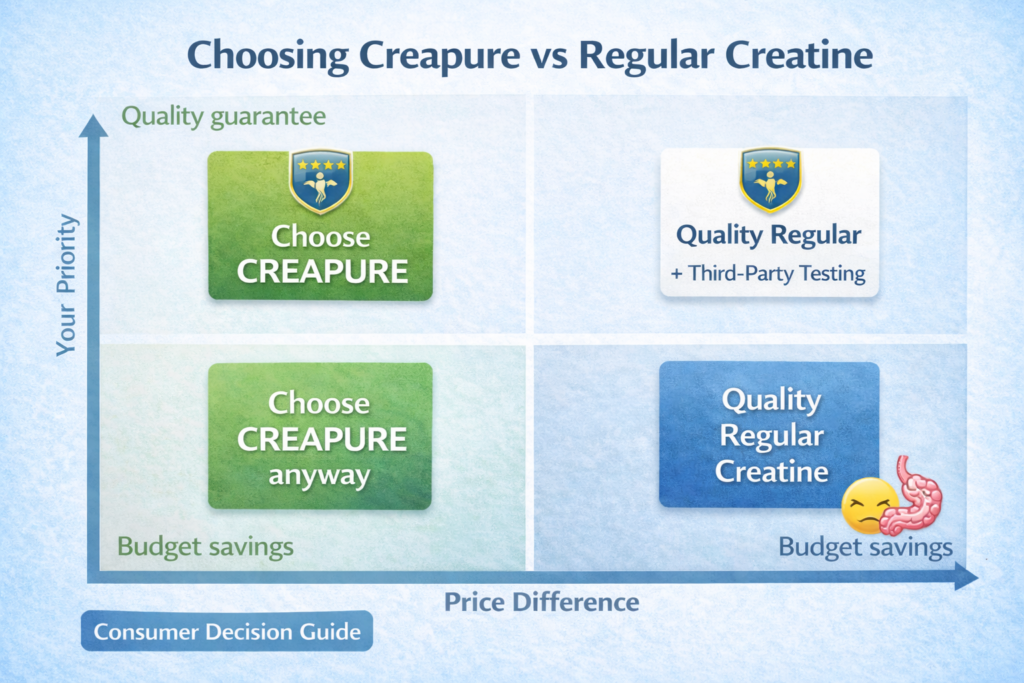
After examining all the evidence, here’s the practical decision framework:
Choose Creapure If:
✅ The price difference is small (10-30% more)
✅ You’re a competitive athlete subject to drug testing
✅ You want maximum confidence in purity and quality
✅ You plan to use creatine long-term (years)
✅ You’ve had digestive issues with other creatine
✅ Budget isn’t your primary concern
✅ You value transparent, verified manufacturing
Choose Quality Regular Creatine If:
✅ Creapure costs 50%+ more
✅ The regular creatine has third-party testing (NSF, Informed-Sport)
✅ It’s from a reputable, established brand
✅ Budget is a significant concern
✅ You’re just starting with creatine
✅ The regular option has excellent reviews and reputation
Never Choose:
❌ Suspiciously cheap creatine from unknown brands
❌ Products without clear labeling
❌ Exotic creatine forms claiming superiority to monohydrate
❌ Proprietary blends hiding actual creatine content
❌ Products making outrageous claims
The Nuanced Reality
Both Creapure and quality regular creatine work. The difference is primarily about guaranteed quality, purity verification, and peace of mind, not muscle-building effectiveness.
For most people, the decision comes down to: How much more are you paying, and is that premium worth it for guaranteed quality?
A $5-10 difference? Get Creapure.
A $20-30 difference? Quality regular creatine from a reputable brand is a smarter choice.
How to Use Creatine (Creapure or Regular)
Regardless of which you choose, here’s how to use it correctly.
The Standard Protocol
Dose: 3-5g daily (5g is standard)
Timing: Whenever convenient and consistent
Loading (optional): 20g daily for 5-7 days, then 3-5g daily maintenance
Cycling: Not necessary; continuous use is safe
With food: Either way works; with food may reduce any digestive issues
Mixing and Consumption
Both Creapure and regular creatine:
- Mix in water, juice, or protein shakes
- Don’t need to be taken at a specific time
- Should be consumed daily, even on rest days
- Don’t require cycling or breaks
Expected Results
With either form:
- Increased strength and power within 1-2 weeks
- Enhanced training capacity
- 2-4 pounds of water weight (inside muscles)
- Greater muscle growth over months of consistent use and training
The type of creatine doesn’t change these outcomes. What matters is consistent daily use combined with proper training.
Final Recommendation: Make an Informed Choice
Stop stressing about Creapure vs regular creatine.
The truth is simpler than the marketing suggests:
Creapure guarantees quality. If the premium is reasonable, it’s worth it for peace of mind.
Quality regular creatine works just as well. If the savings are significant and you choose wisely, you’ll get the same muscle-building benefits.
What actually matters:
- Using creatine monohydrate (not exotic forms)
- Taking it consistently (3-5g daily)
- Buying from reputable sources
- Training hard and eating properly
The difference between Creapure and quality regular creatine will have virtually zero impact on your actual results in the gym.
Pick based on your budget and priorities, then move on to things that actually matter: your training program, nutrition, sleep, and consistency.
CHOOSE WISELY. TRAIN HARD. STOP OVERTHINKING SUPPLEMENTS.
Ready to optimize your entire supplement strategy and stop wasting money on unnecessary products? Creapure vs regular creatine is just one decision. Get a complete, evidence-based guide to which supplements actually work, which are worthless, how to build an effective stack without breaking the bank, and how to maximize your training and nutrition for serious results. Stop guessing. Start knowing what matters.


Leave a Reply
You must be logged in to post a comment.