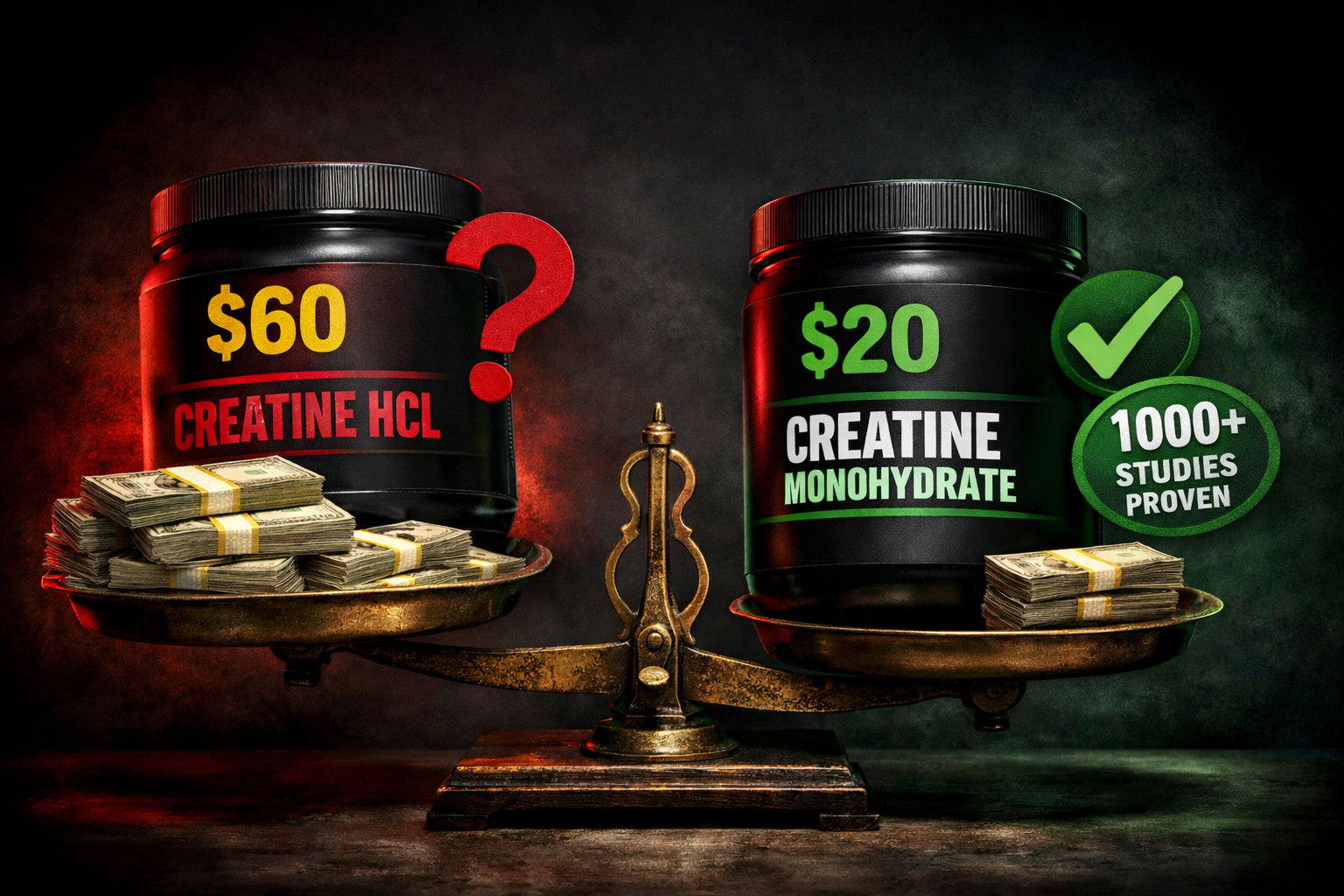
Considering creatine HCL because of promises of better absorption and no bloating? Here’s the science-backed truth about whether this expensive form delivers on its claims.
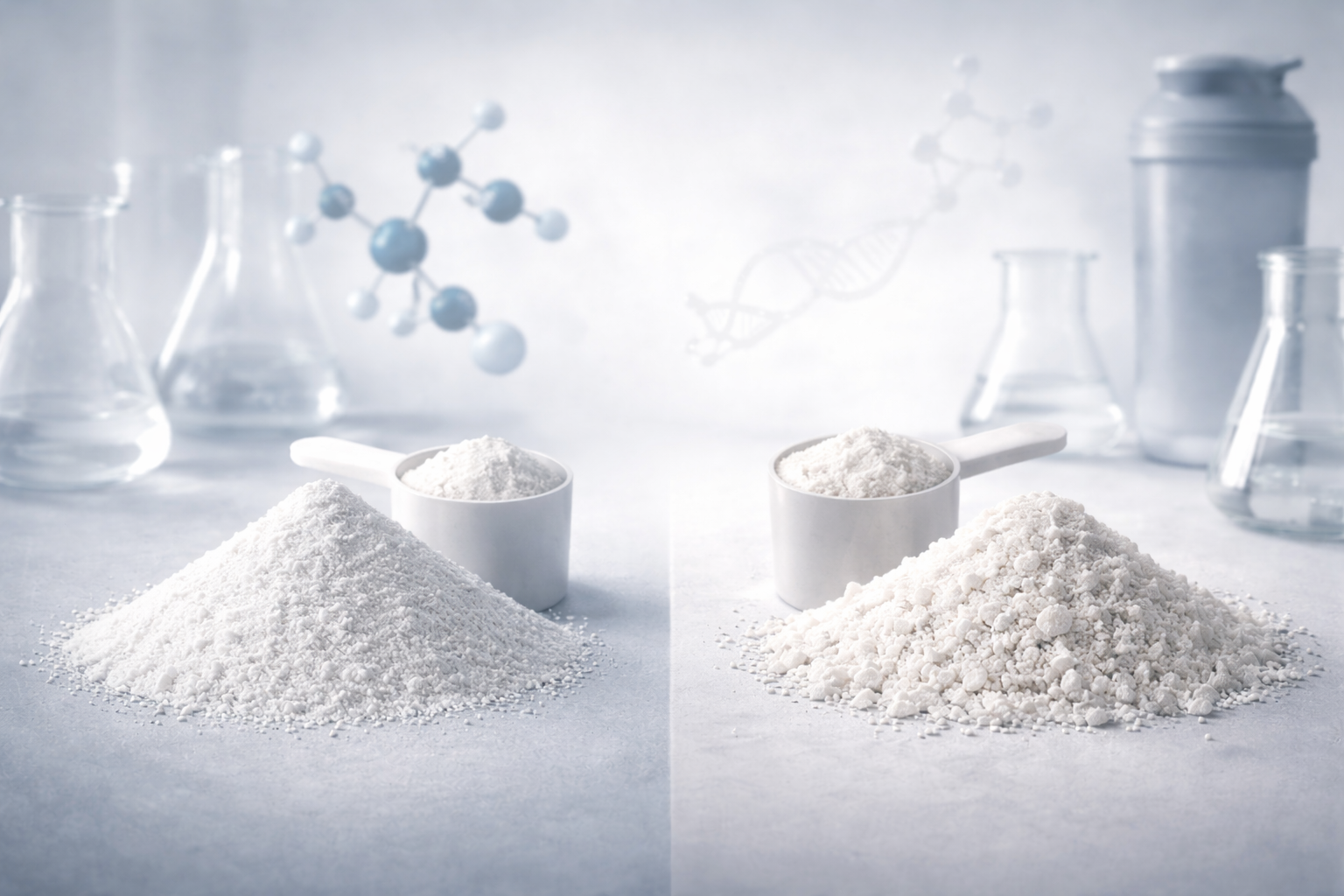
Walk into any supplement store and you’ll see them side by side.
Creatine monohydrate: $15-25 for a 3-month supply. Been around for decades. Thousands of studies proving it works.
Creatine HCL: $35-60 for a 1-month supply. Relatively new. Marketed as the “superior” form.
The creatine HCL marketing promises are seductive:
- Superior absorption (you need less)
- No bloating or water retention
- No loading phase required
- No stomach discomfort
- Better results than “old-fashioned” monohydrate
- More concentrated and powerful
These claims make it sound like a no-brainer upgrade, right?
Here’s the reality: Creatine HCL is primarily a marketing innovation, not a scientific breakthrough. While it does have some legitimate differences from monohydrate, none of them justify paying 2-3x more for equivalent results.
In this comprehensive guide, I’ll explain exactly what creatine HCL is and how it differs chemically, compare it to monohydrate across every factor that matters, examine the actual scientific evidence (not marketing hype), reveal the real pros and cons, break down the cost analysis, and help you make an informed decision about which form to buy.
This isn’t what supplement companies want you to read. But it’s what you need to know before spending your money.
Let’s separate marketing from reality.
TABLE OF CONTENTS
What Is Creatine HCL?
Before comparing it to monohydrate, you need to understand what creatine HCL actually is.
The Basic Chemistry
HCL stands for hydrochloride.
Creatine HCL is creatine bound to hydrochloric acid (the same acid found in your stomach).
The chemical process:
- Take creatine molecules
- Bind them to hydrochloric acid molecules
- Result: Creatine hydrochloride
Why this binding matters:
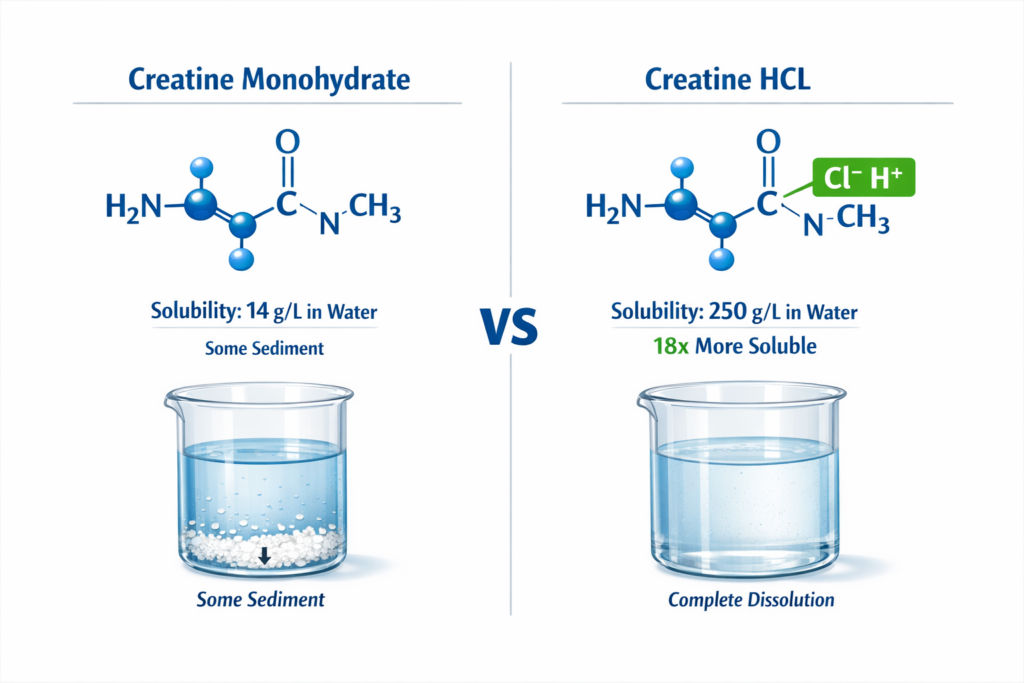
The hydrochloride molecule makes creatine significantly more soluble in water compared to creatine monohydrate.
Solubility comparison:
- Creatine monohydrate: Dissolves at approximately 14g per liter of water
- Creatine HCL: Dissolves at approximately 250g per liter of water (nearly 18x more soluble)
This dramatic difference in solubility is the foundation for all creatine HCL marketing claims.
How Creatine HCL Was Developed
Creatine HCL is not a natural form of creatine.
It was developed in laboratories as an attempt to improve upon creatine monohydrate by addressing perceived drawbacks:
- Poor solubility (doesn’t mix well)
- Gastrointestinal discomfort in some users
- Water retention concerns
- Need for loading phases
The solution: Bind creatine to hydrochloric acid to dramatically increase water solubility.
The theory: Better solubility means better absorption, which means better results with smaller doses.
Does the theory hold up in practice? We’ll examine this shortly.
What Creatine HCL Claims to Offer
Supplement companies market creatine HCL with these key selling points:
Claim 1: Superior absorption
- “Absorbed up to 60% better than monohydrate”
- “Bioavailability is significantly higher”
- “Your body uses more of what you take”
Claim 2: Smaller effective dose
- “Need only 750mg-1g instead of 5g monohydrate”
- “More concentrated and powerful”
- “One serving of HCL equals multiple servings of monohydrate”
Claim 3: No water retention or bloating
- “Won’t make you look puffy”
- “No subcutaneous water retention”
- “Maintain a lean, dry look”
Claim 4: No gastrointestinal issues
- “Gentle on your stomach”
- “No cramping or discomfort”
- “Better tolerated than monohydrate”
Claim 5: No loading phase needed
- “Works immediately”
- “Saturates muscles faster”
- “No need for 20g daily loading”
These claims sound compelling. Let’s examine whether they’re actually true.
Creatine HCL vs Monohydrate: The Real Differences
Let’s compare these forms across every factor that actually matters for your results and your wallet.
Difference 1: Water Solubility
This is the one legitimate, measurable difference.
Creatine monohydrate:
- Solubility: ~14g per liter
- Doesn’t fully dissolve in cold water
- Some sediment typically remains in shaker
- Gritty texture when drinking
Creatine HCL:
- Solubility: ~250g per liter (18x more soluble)
- Dissolves completely even in cold water
- No sediment or grit
- Smooth texture
Does this difference matter for results? Not really.
Why solubility doesn’t equal effectiveness:
Your digestive system is highly efficient at breaking down and absorbing nutrients regardless of how well they dissolved in your shaker bottle.
Whether creatine dissolves in your drink or dissolves in your stomach makes no meaningful difference to muscle uptake.
The verdict: Creatine HCL mixes better. This is a convenience factor, not a performance factor.
Difference 2: Absorption and Bioavailability
This is where marketing claims diverge from scientific reality.
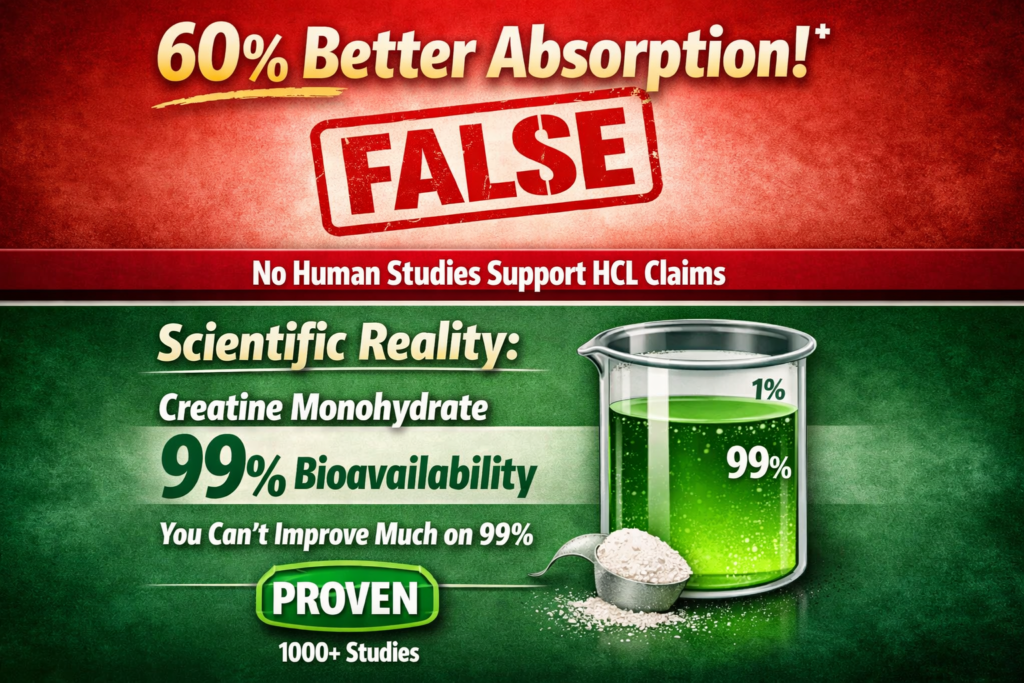
The claim: “Creatine HCL is absorbed 60% better than monohydrate.”
The science:
There are NO peer-reviewed studies directly comparing creatine HCL absorption to monohydrate absorption in humans.
The “60% better absorption” claim appears to be based on:
- In vitro (test tube) studies, not human trials
- Theoretical calculations, not actual measurements
- Marketing extrapolation, not scientific evidence
What we know about creatine monohydrate absorption:
Creatine monohydrate has approximately 99% bioavailability. Nearly 100% of the creatine you consume gets absorbed into your bloodstream.
If monohydrate is already 99% absorbed, how can HCL be “60% better”?
It can’t. The math doesn’t work.
The theoretical mechanism:
Proponents claim that because HCL is more soluble, it reaches the small intestine in a more absorbable form.
The problem: Creatine monohydrate also reaches near-complete absorption. There’s no absorption problem to solve.
The verdict: The absorption claims are not supported by human research. Monohydrate is already absorbed nearly completely.
Difference 3: Effective Dosage
The claim: “You only need 750mg-1.5g of creatine HCL instead of 5g monohydrate.”
The science:
This claim is based on the flawed absorption theory. If absorption were truly 60% better, smaller doses might work.
However:
- There’s no evidence HCL is absorbed better
- There’s no research showing smaller HCL doses saturate muscle creatine stores as effectively as 5g monohydrate
What the research on muscle saturation shows:
Studies consistently demonstrate that:
- 3-5g daily creatine monohydrate saturates muscle creatine stores
- This saturation is what produces performance benefits
- No research has shown creatine HCL achieves the same saturation with lower doses
The chemical reality:
Creatine is creatine. Once absorbed (which happens at nearly 100% with monohydrate), your muscles need a certain amount to reach saturation.
The chemical form (monohydrate vs HCL) doesn’t change how much creatine your muscles can store or how much they need for saturation.
The verdict: There’s no evidence that smaller HCL doses are as effective as standard monohydrate doses. This is marketing, not science.
Difference 4: Water Retention and Bloating
The claim: “Creatine HCL doesn’t cause water retention or bloating like monohydrate does.”
The science:
First, let’s clarify what creatine water retention actually is:
Intracellular water retention:
- Water pulled into muscle cells
- Creates fuller, larger-looking muscles
- This is GOOD and is how creatine partially works
- Both monohydrate and HCL cause this
Subcutaneous water retention:
- Water stored under the skin
- Creates a smooth, “bloated” appearance
- This is what people worry about
- Creatine monohydrate does NOT typically cause this
The reality of creatine and water:
When you start taking creatine (any form), you typically gain 2-4 pounds of water weight in the first week. This is water inside muscle cells, not under your skin.
This intracellular water retention:
- Makes muscles look fuller and larger
- Supports the muscle-building process
- Is a positive effect, not a negative one
Does creatine HCL avoid this water retention?
No. If creatine HCL is working (increasing muscle creatine stores), it will also increase intracellular water retention. This is part of how creatine functions.
If creatine HCL didn’t cause any water retention, it would mean it’s not working.
What about the “bloating” some people experience with monohydrate?
When this occurs (which is rare), it’s typically due to:
- Taking too much at once
- Taking it on an empty stomach
- Poor quality creatine with impurities
- Individual digestive sensitivity
These issues can often be resolved by:
- Splitting doses throughout the day
- Taking with food
- Using high-quality monohydrate (Creapure certified)
- Drinking adequate water
The verdict: Both forms cause beneficial intracellular water retention. The “no bloating” claim for HCL is misleading marketing.
Difference 5: Gastrointestinal Tolerance
The claim: “Creatine HCL is easier on your stomach and causes no digestive issues.”
The science:
Some people do experience digestive discomfort with creatine monohydrate:
- Bloating
- Cramping
- Diarrhea
- Stomach upset
Why this happens:
- Taking too large a dose at once (especially during loading)
- Poor quality creatine with impurities
- Taking on an empty stomach
- Individual sensitivity
Does creatine HCL solve this?
Possibly, for some people. The higher solubility might reduce digestive issues in sensitive individuals.
However:
Most digestive issues with monohydrate can be solved by:
- Using high-quality monohydrate (Creapure)
- Skipping the loading phase (just take 5g daily from the start)
- Taking with food
- Splitting into smaller doses (2.5g twice daily)
- Ensuring adequate hydration
If you’ve tried these solutions and still have issues, creatine HCL might be worth trying.
The verdict: Creatine HCL may cause fewer digestive issues for some people, but most monohydrate problems can be solved with simple adjustments.
Difference 6: Loading Phase Requirement
The claim: “Creatine HCL works immediately without loading. Monohydrate requires a loading phase.”
The science:
First, let’s clarify loading phases:
Loading (optional for monohydrate):
- Take 20g daily for 5-7 days
- Saturates muscles quickly
- Then maintain with 3-5g daily
No loading (also fine for monohydrate):
- Take 3-5g daily from day one
- Saturates muscles gradually over 3-4 weeks
- Reach the same endpoint, just slower
Loading is OPTIONAL with monohydrate, not required.
Does creatine HCL eliminate the need for loading?
The claim is meaningless because:
- Loading isn’t necessary with monohydrate either
- If HCL does saturate muscles faster, it would still take time (you can’t bypass the saturation process)
- No research has compared saturation timelines between forms
The verdict: This is a false distinction. Loading is optional for both forms.
Difference 7: Research and Evidence Base
This is where the comparison becomes extremely one-sided.
Creatine monohydrate:
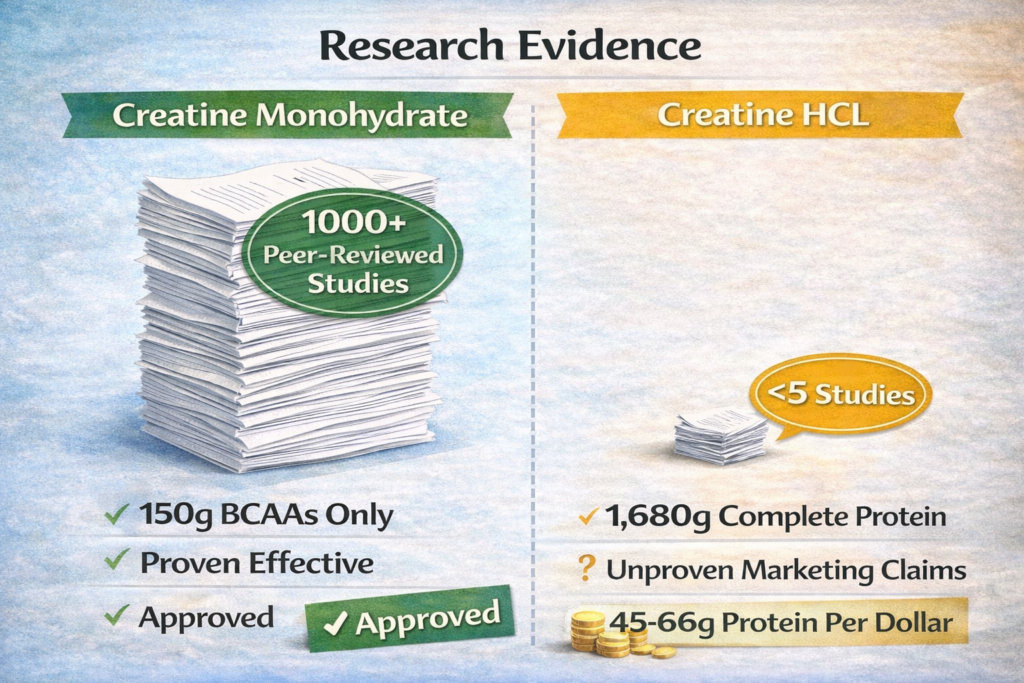
- Over 1,000 peer-reviewed studies
- 30+ years of research
- Proven safe and effective
- Used in studies showing:
- 5-15% strength increases
- 5-10% power output improvements
- Enhanced muscle growth over time
- Cognitive benefits
- Therapeutic applications
Creatine HCL:
- Fewer than 5 published studies
- No long-term safety data
- No studies directly comparing it to monohydrate for muscle building
- No research proving the marketing claims
- Limited evidence base
The practical implication:
When you take creatine monohydrate, you’re using a supplement with decades of research proving it works and is safe.
When you take creatine HCL, you’re using a supplement with minimal research and unproven marketing claims.
The verdict: Monohydrate has overwhelming scientific support. HCL has minimal evidence.
Difference 8: Cost
This is the most important practical difference.
Creatine monohydrate (quality brands):
- $15-30 for 100-200 servings (500g-1kg)
- 5g serving = $0.07-0.15 per serving
- 3-month supply = $20-45
Creatine HCL:
- $35-60 for 30-60 servings (30-60g)
- 750mg-1.5g serving = $0.58-2.00 per serving
- 3-month supply = $105-360
Cost comparison for 3 months:
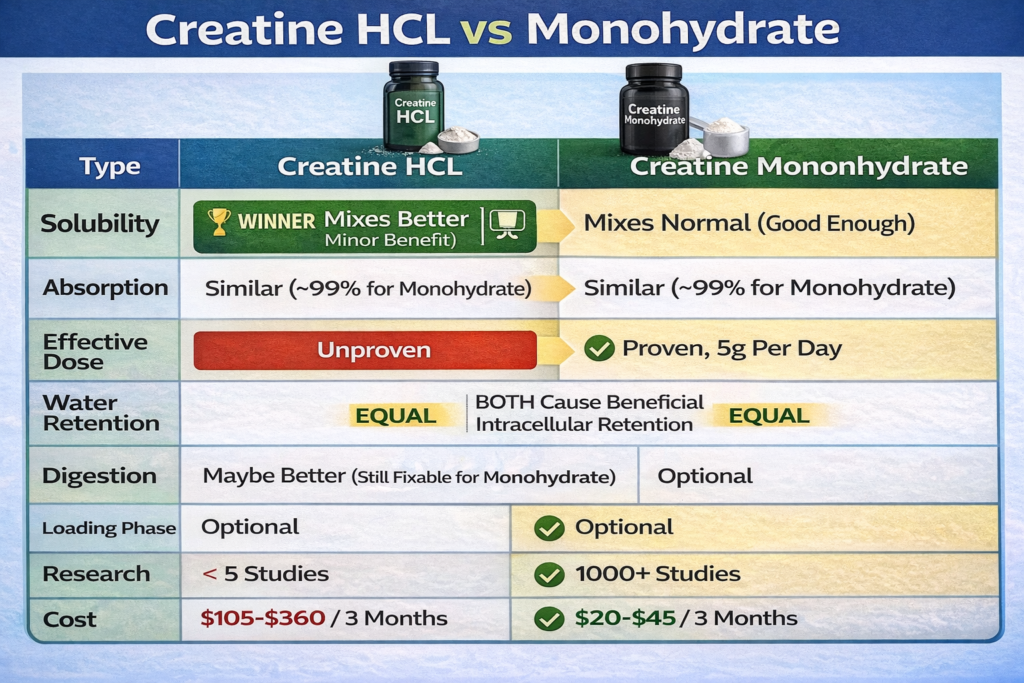
- Monohydrate: $20-45
- HCL: $105-360
You’re paying 2-8x more for creatine HCL with no proven additional benefit.
Is it worth it? Only you can decide, but the evidence doesn’t support the premium.
The Scientific Evidence: What Research Actually Shows
Let’s examine what actual peer-reviewed research says about creatine HCL.
Study 1: Solubility Research (In Vitro)
What was tested: Solubility of different creatine forms in water.
Results: Creatine HCL dissolved significantly better than monohydrate.
Conclusion: Creatine HCL is more water-soluble.
Limitations:
- Test tube study, not human trial
- Solubility doesn’t equal effectiveness
- Doesn’t measure muscle uptake or performance
What this means: We know HCL mixes better in water. That’s it.
Study 2: Theoretical Bioavailability Calculations
What was done: Mathematical modeling suggesting HCL might be better absorbed based on solubility.
Results: Theoretical models suggested potential for improved absorption.
Conclusion: HCL might theoretically absorb better.
Limitations:
- Not an actual human study
- Theoretical calculations, not measured results
- Hasn’t been validated in practice
- Monohydrate is already ~99% absorbed
What this means: Someone made calculations that haven’t been proven in humans.
Study 3: Digestive Tolerance Anecdotal Reports
What was observed: Some users report fewer digestive issues with HCL.
Results: Mixed individual experiences.
Conclusion: Some people may tolerate HCL better.
Limitations:
- Not controlled research
- Anecdotal reports, not scientific studies
- May reflect quality differences or placebo effect
- Most monohydrate digestive issues can be resolved with simple adjustments
What this means: Some people might prefer HCL for digestive reasons, but this isn’t proven in controlled studies.
What’s Missing From Creatine HCL Research
No published studies comparing:
- Muscle creatine saturation: HCL vs monohydrate
- Strength gains: HCL vs monohydrate
- Muscle growth: HCL vs monohydrate
- Performance improvements: HCL vs monohydrate
- Long-term safety: HCL vs monohydrate
- Optimal dosing: What’s the true effective dose of HCL?
This is a massive problem.
Supplement companies make bold claims about HCL being superior, but there’s no research actually proving these claims.
The Research Verdict
What we know for certain:
- Creatine HCL dissolves better in water (proven)
- Creatine monohydrate works (proven by 1,000+ studies)
What we don’t know:
- Whether HCL is absorbed better (unproven)
- Whether HCL produces better results (unproven)
- Whether smaller HCL doses are effective (unproven)
- Long-term safety of HCL (unknown)
When choosing supplements, proven effectiveness matters more than theoretical advantages.
The Real Pros and Cons of Creatine HCL
Let’s be balanced and examine legitimate advantages and disadvantages.
Legitimate Advantages of Creatine HCL
Advantage 1: Superior mixability
Creatine HCL dissolves completely in water with no grit or sediment. If texture and mixability are important to you, this is a genuine benefit.
Advantage 2: Potentially better for sensitive stomachs
If you’ve tried quality monohydrate (Creapure) with food and adequate water and still experience digestive issues, HCL might work better for you.
Advantage 3: Portability
Smaller doses mean less powder to carry. If you travel frequently and want minimal bulk, this could be convenient.
Advantage 4: Taste
Some people prefer the taste of HCL supplements (less chalky). This is subjective but valid for some users.
That’s it. Those are the legitimate advantages, and they’re all convenience factors, not performance benefits.
Disadvantages of Creatine HCL
Disadvantage 1: Dramatically higher cost
2-8x more expensive than monohydrate for no proven additional benefit.
Disadvantage 2: Minimal research
Unproven effectiveness. You’re essentially beta-testing a supplement with limited evidence.
Disadvantage 3: Unknown optimal dosing
No research establishing the truly effective dose. Marketing claims aren’t science.
Disadvantage 4: Unknown long-term safety
Monohydrate has 30+ years of safety data. HCL doesn’t.
Disadvantage 5: Marketing vs. science
Most claims are unproven marketing hype, not scientific fact.
Disadvantage 6: Unnecessary for most people
The problems HCL claims to solve (poor absorption, bloating, digestive issues) either don’t exist or can be solved with monohydrate.
Who Should (and Shouldn’t) Use Creatine HCL
Let’s get practical about when HCL might make sense.
You MIGHT Consider Creatine HCL If:
✓ You’ve tried high-quality monohydrate (Creapure certified)
✓ You’ve taken it with food and adequate water
✓ You’ve tried skipping loading and using 5g daily
✓ You’ve split your dose (2.5g twice daily)
✓ You STILL experience digestive issues
✓ Money is no object
✓ The convenience of better mixability is worth 3x the cost to you
This describes maybe 5% of creatine users.
You Should Stick With Monohydrate If:
✓ You want proven effectiveness (1,000+ studies)
✓ Cost matters to you
✓ You want the best value for your money
✓ You don’t have digestive issues with monohydrate
✓ You prefer evidence-based supplementation
✓ You want long-term safety data
This describes 95% of creatine users.
You Definitely Don’t Need HCL If:
❌ You’ve never tried creatine before
❌ You haven’t tried quality monohydrate
❌ You believe marketing claims about “superior absorption”
❌ You think it will work better for muscle building
❌ You’re on a budget
Start with monohydrate. Only consider HCL if you have specific, proven issues with monohydrate.
Cost-Benefit Analysis: Is Creatine HCL Worth It?
Let’s examine whether the premium price provides proportional value.
Annual Cost Comparison
Creatine monohydrate (5g daily):
- Cost per serving: $0.10
- Daily cost: $0.10
- Monthly cost: $3.00
- Annual cost: $36
Creatine HCL (1.5g daily, per marketing claims):
- Cost per serving: $1.00-1.50
- Daily cost: $1.00-1.50
- Monthly cost: $30-45
- Annual cost: $360-540
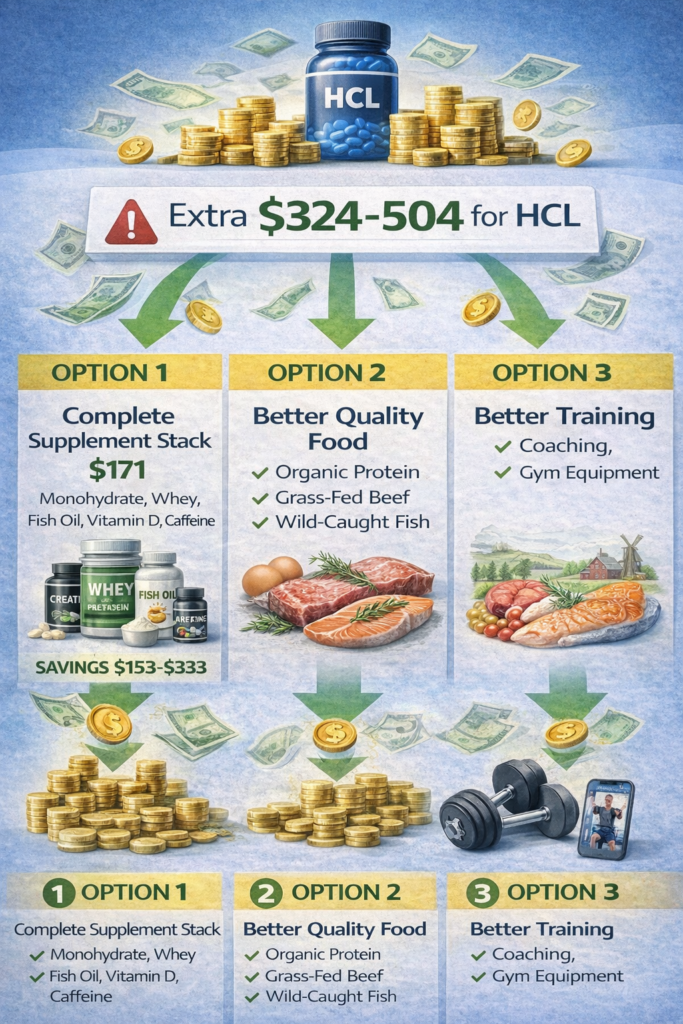
Difference: You pay $324-504 more annually for HCL.
What Do You Get for That Extra Money?
Proven benefits: None (no research showing superior muscle building or performance)
Potential benefits:
- Better mixability (worth $300+ to you?)
- Maybe easier digestion (if you have issues with monohydrate)
That’s it.
Alternative Use of That Money
Instead of spending an extra $324-504 on creatine HCL, you could buy:
Option 1: Complete supplement stack
- Creatine monohydrate: $36
- Quality whey protein (5 lbs): $60
- Fish oil (annual supply): $40
- Vitamin D (annual supply): $15
- Caffeine (annual supply): $20
- Total: $171
- Money remaining: $153-333 for food or other supplements
Option 2: Better food
- Use the $300+ to buy higher-quality protein sources, organic vegetables, grass-fed beef, wild-caught fish, etc.
- Nutrition quality matters more than creatine form
Option 3: Better training
- Invest in coaching, better gym membership, or equipment
- Training quality matters more than supplement form
The point: There are far better uses for that money than paying a premium for unproven benefits.
The Value Verdict
For 95% of people, creatine HCL is poor value for money.
The marginal convenience benefits don’t justify 8-10x higher costs when monohydrate is already proven, effective, and safe.
How to Use Creatine Monohydrate to Avoid Any Issues
If you’re worried about the “problems” HCL claims to solve, here’s how to use monohydrate optimally.
Strategy 1: Choose Quality Monohydrate
Look for Creapure certification:
- Highest purity standard (99.99% pure)
- Made in Germany under strict standards
- No impurities or contaminants
- Third-party tested
Avoid:
- Extremely cheap creatine from unknown sources
- Products without quality certifications
- Chinese-manufactured creatine (variable quality)
Quality monohydrate costs only slightly more than cheap versions but dramatically reduces any risk of digestive issues.
Strategy 2: Skip the Loading Phase
Loading (20g daily for 5-7 days) can cause digestive issues.
Instead:
- Take 5g daily from day one
- Saturates muscles in 3-4 weeks instead of 1 week
- Reaches the same endpoint
- Eliminates most digestive problems
The extra 2-3 weeks to full saturation is irrelevant for long-term results.
Strategy 3: Take With Food
Creatine on an empty stomach can cause discomfort.
Better approach:
- Take with a meal
- Preferably with carbohydrates (may enhance uptake slightly)
- This solves most digestive issues
Timing options:
- With breakfast
- Post-workout with protein shake and carbs
- With any meal (timing doesn’t matter much)
Strategy 4: Split Your Dose
If 5g at once bothers you:
Try:
- 2.5g twice daily
- 1.7g three times daily
Same total dose, gentler on digestion.
Strategy 5: Ensure Adequate Hydration
Creatine draws water into muscle cells.
Prevent any issues by:
- Drinking 8-10 glasses water daily
- More if training intensely
- More in hot weather
Dehydration can cause cramping that people mistakenly blame on creatine.
Strategy 6: Mix It Properly
Even though monohydrate doesn’t dissolve perfectly:
Best practices:
- Use warm water (dissolves better than cold)
- Mix thoroughly
- Drink any sediment at bottom
- Or mix with juice or protein shake
The slight grittiness has zero impact on effectiveness.
The Result
Following these strategies, 95% of people tolerate creatine monohydrate perfectly without needing to pay 3-8x more for HCL.
The Bottom Line: Save Your Money
After examining all the evidence, the conclusion is clear:
Creatine HCL is primarily a marketing innovation, not a scientific breakthrough.
What’s proven:
- Creatine monohydrate works (1,000+ studies)
- Creatine monohydrate is safe (30+ years of data)
- Creatine monohydrate is affordable ($36 annually)
- Creatine HCL dissolves better in water (true but irrelevant for results)
What’s NOT proven:
- HCL is absorbed better (no evidence)
- HCL works better for muscle building (no evidence)
- HCL requires smaller doses (no evidence)
- HCL eliminates water retention (false, and water retention is beneficial anyway)
The legitimate advantages of HCL:
- Better mixability (convenience, not performance)
- Might be easier on sensitive stomachs (most monohydrate issues are solvable)
The disadvantages of HCL:
- 3-8x more expensive ($324-504 more annually)
- Minimal research
- Unproven marketing claims
- Unknown optimal dosing
- Limited long-term safety data
The smart choice for 95% of people:
✅ Buy quality creatine monohydrate (Creapure certified)
✅ Take 5g daily (skip loading)
✅ Take with food
✅ Stay hydrated
✅ Save $300-500 annually
✅ Get the same muscle-building results
The only valid reason to choose HCL:
If you’ve tried quality monohydrate with all the optimization strategies above and still have digestive issues, HCL might be worth trying.
For everyone else, creatine HCL is an expensive solution to problems that either don’t exist or can be solved much more affordably.
Don’t fall for the marketing hype. Stick with proven, affordable creatine monohydrate.
SAVE YOUR MONEY. USE MONOHYDRATE. GET THE SAME RESULTS.
Ready to optimize your entire supplement strategy with evidence-based choices that actually deliver results without wasting money? Creatine HCL is just one of many overhyped, overpriced supplements marketed as “superior” to proven basics. Get a complete guide to building an effective supplement stack on a budget, avoiding expensive scams, and maximizing your training and nutrition with supplements that actually have scientific support. Stop falling for marketing. Start getting results.
Leave a Reply
You must be logged in to post a comment.