Confused by different creatine types? Here’s the science-backed truth about whether micronized creatine is worth the extra cost or just marketing hype.
Walk into any supplement store and you’ll see multiple versions of creatine lining the shelves:
Creatine monohydrate. Micronized creatine. Creatine HCL. Buffered creatine. Creatine ethyl ester.
The labels promise superior absorption, better results, reduced side effects, and faster gains. The prices vary wildly, with some “premium” versions costing 2-3x more than basic creatine monohydrate.
One of the most common questions: What’s the difference between micronized creatine and regular creatine monohydrate? Is micronized worth the extra cost?
Here’s the short answer that might save you money: Micronized creatine is just creatine monohydrate with smaller particles. The difference is minimal, and for most people, it doesn’t justify any price premium.
But let’s dive deeper into the science, examine the actual differences, and help you make an informed decision about which type to buy.
This comprehensive guide will explain exactly what each type is, compare them across every relevant factor, reveal whether the marketing claims hold up to scrutiny, and tell you which one you should actually buy.
Let’s separate facts from marketing.
TABLE OF CONTENTS
- Can I mix micronized and regular creatine?
- Will micronized creatine load faster?
- Does micronized creatine taste different?
- Can I take micronized creatine on an empty stomach?
- Is micronized creatine better for cutting?
- Should women use micronized instead of regular?
- Does micronized creatine cause less water retention?
- The Bottom Line: Save Your Money, Buy Regular Monohydrate
What Is Creatine Monohydrate?
Before we can compare, you need to understand what creatine monohydrate actually is.
The Gold Standard
Creatine monohydrate is the simplest, safest, and most effective form of creatine available.
It’s been used in research for over 30 years and has more scientific backing than any other supplement in sports nutrition.
The Chemical Structure
Creatine monohydrate consists of:
- One creatine molecule
- One water molecule (hence “monohydrate”)
- Approximately 88% pure creatine by weight
- The remaining 12% is the water molecule
How It Works
Creatine monohydrate functions by:
Increasing muscle phosphocreatine stores: When you supplement with creatine, your muscles store more phosphocreatine.
Enhancing ATP regeneration: During high-intensity exercise, phosphocreatine donates its phosphate group to regenerate ATP (your cells’ energy currency) faster.
Improving performance: More available ATP means you can perform more reps, lift heavier weights, and recover faster between sets.
Stimulating muscle growth: The enhanced training capacity leads to greater muscle growth over time.
The Research Foundation
Creatine monohydrate has:
- Over 1,000 peer-reviewed studies
- Decades of use in millions of people
- Proven safety and effectiveness
- The most robust evidence base of any sports supplement
This is the form against which all other creatine types are compared.
What Is Micronized Creatine?
Now let’s understand what makes micronized creatine different.
The Micronization Process
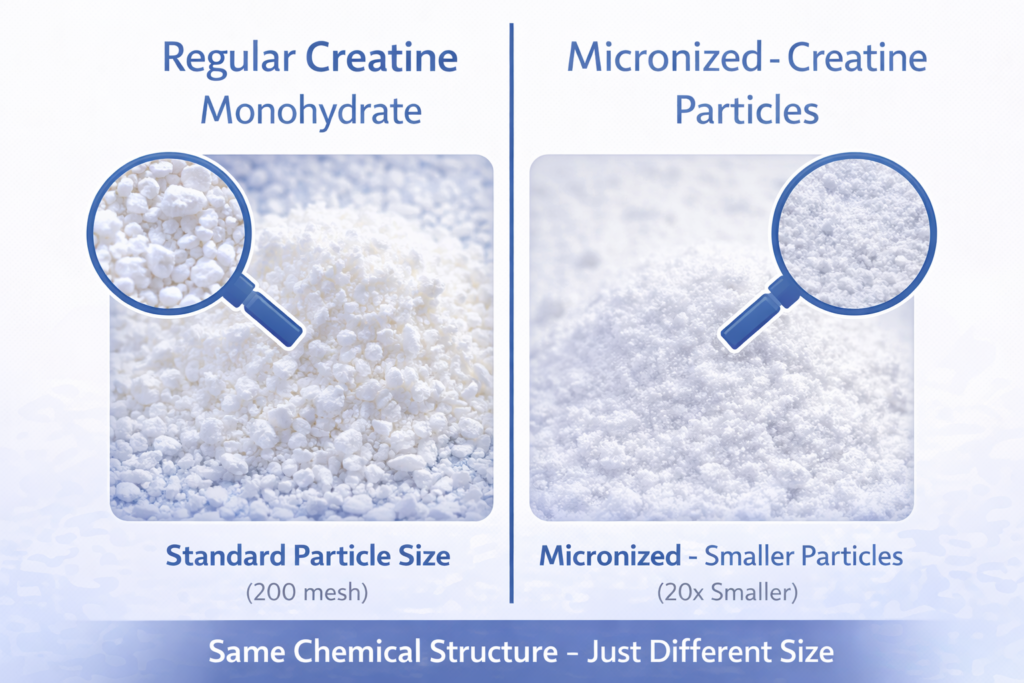
Micronized creatine is creatine monohydrate that has undergone an additional processing step called micronization.
What happens during micronization:
The creatine monohydrate powder is mechanically processed to reduce particle size, typically by a factor of 20 or more.
Standard creatine monohydrate: Particle size around 200 mesh (relatively large)
Micronized creatine: Particle size around 200 microns or smaller (much finer)
Important point: The chemical structure remains identical. You’re still getting creatine monohydrate, just in smaller particles.
The Claimed Benefits
Supplement companies market micronized creatine with several claims:
Better solubility: Smaller particles dissolve more easily in liquid.
Improved absorption: Better dissolution supposedly leads to better absorption in the digestive system.
Reduced side effects: Less undissolved creatine in the stomach means less gastrointestinal discomfort.
Enhanced effectiveness: Some marketing suggests micronized is more effective (though this is not scientifically supported).
Let’s examine whether these claims hold up to scientific scrutiny.
The Key Differences: Micronized vs Regular Monohydrate
Let’s compare these two forms across every relevant factor.
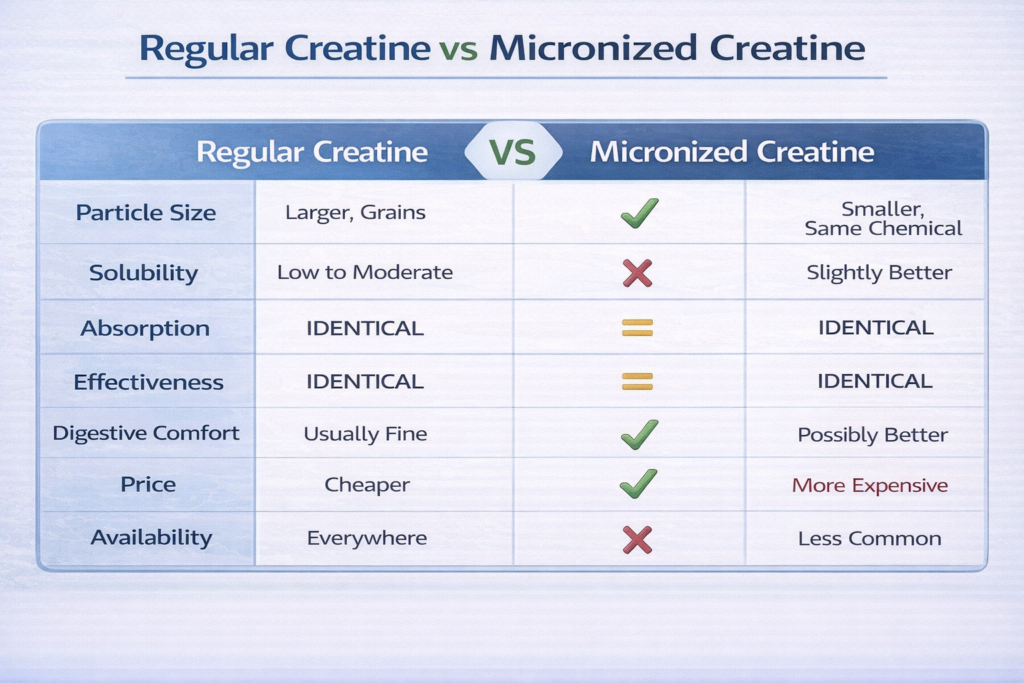
Difference 1: Particle Size and Appearance
This is the only guaranteed, verifiable difference.
Regular creatine monohydrate:
- Larger particles
- Grainier texture
- Can feel slightly gritty
- May have some visible crystals
Micronized creatine:
- Much smaller particles
- Finer, powder-like texture
- Smoother feel
- More uniform appearance
Does this matter? Only for mixing convenience. The actual creatine is identical.
Difference 2: Solubility (Mixing in Liquid)
The claimed advantage: Micronized creatine dissolves better in water and other liquids.
What the science shows:
Based on research with other micronized compounds, micronization does generally improve solubility. Smaller particles have more surface area relative to volume, allowing faster dissolution.
For creatine specifically, anecdotal reports suggest micronized versions mix slightly better, with less sediment settling at the bottom of your shaker.
However, the practical difference is minimal:
- Regular monohydrate still dissolves adequately in water
- Warm or room temperature water improves dissolution for both types
- Neither dissolves perfectly (you’ll see some sediment either way)
- Both deliver the same amount of creatine to your body
The verdict: Micronized probably mixes slightly better, but this is a minor convenience factor, not a performance difference.
Difference 3: Absorption and Bioavailability
The claimed advantage: Better dissolution leads to better absorption.
What the science actually shows:
There is NO evidence in the scientific literature showing that solubility of creatine affects its bioavailability or effectiveness.
Research on creatine HCL (a genuinely more soluble form) found no significant difference in absorption or muscle saturation compared to regular monohydrate despite dramatically better solubility.
Why solubility doesn’t matter much:
Your digestive system is highly efficient at breaking down and absorbing nutrients, regardless of how well they initially dissolved in water.
Regular creatine monohydrate already has excellent bioavailability (nearly 100% absorption), so improving solubility provides no meaningful benefit.
The verdict: No difference in actual absorption or effectiveness. Your muscles don’t care how well the creatine dissolved in your shaker bottle.
Difference 4: Effectiveness for Muscle Growth and Strength
The claimed advantage: Some marketing suggests micronized is more effective.
What the science shows:
Zero evidence that micronized creatine produces superior results compared to regular monohydrate.
Both forms:
- Increase muscle phosphocreatine stores equally
- Enhance strength and power output equally
- Support muscle growth equally
- Provide the same ergogenic benefits
Once your muscles are saturated with creatine (which happens with consistent daily use of either form), there is absolutely no performance difference.
The verdict: Identical effectiveness. Don’t pay extra expecting better results.
Difference 5: Digestive Comfort and Side Effects
The claimed advantage: Micronized causes less bloating and stomach discomfort.
What the science and anecdotal evidence suggest:
This is the one area where micronized might offer a minor advantage for some people.
The theory: Smaller particles dissolve more completely, leaving less undissolved creatine sitting in your stomach, potentially reducing digestive discomfort.
The reality:
- Most people experience no digestive issues with either form
- Side effects from creatine (bloating, cramping) are rare and mild
- When they do occur, they’re often related to dose (too much at once) or taking it on an empty stomach, not particle size
Who might benefit from micronized:
- People with sensitive digestive systems
- Those who experienced mild discomfort with regular monohydrate
- Individuals taking large doses (though this isn’t recommended)
Important note: If you experience digestive issues with regular monohydrate, simple solutions often work just as well as switching to micronized:
- Take it with food
- Split your daily dose (2.5g twice daily instead of 5g once)
- Use warm water to improve dissolution
- Ensure you’re drinking enough water throughout the day
The verdict: Micronized might cause slightly less digestive discomfort in sensitive individuals, but for most people, there’s no difference.
Difference 6: Price
This is where things get important.
Regular creatine monohydrate:
- Typically $10-20 for a month’s supply (150g)
- Widely available
- Consistent pricing across brands
Micronized creatine:
- Sometimes priced identically to regular monohydrate
- Often $5-10 more expensive for the same amount
- Some premium brands charge significantly more
The price difference varies by brand and retailer, but you’ll often pay a 20-50% premium for micronized versions.
Is the premium justified? For the vast majority of people, no. The benefits don’t warrant the additional cost.
Difference 7: Availability and Brand Options
Regular creatine monohydrate:
- Available from virtually every supplement brand
- Easy to find in stores and online
- Many budget-friendly options
- Quality options like Creapure-certified products
Micronized creatine:
- Somewhat less common
- Fewer brand options
- Often marketed as “premium” or “advanced”
The verdict: If you don’t see micronized readily available or it’s significantly more expensive, don’t bother seeking it out.
Comparing Other Creatine Forms
While we’re discussing creatine types, let’s quickly compare micronized to other alternatives.
Creatine HCL (Hydrochloride)
What it is: Creatine bound to hydrochloric acid, creating a more water-soluble form.
Claims: Better absorption, requires smaller doses, less bloating.
Reality:
- More soluble than monohydrate (this is true)
- No evidence of better absorption or effectiveness
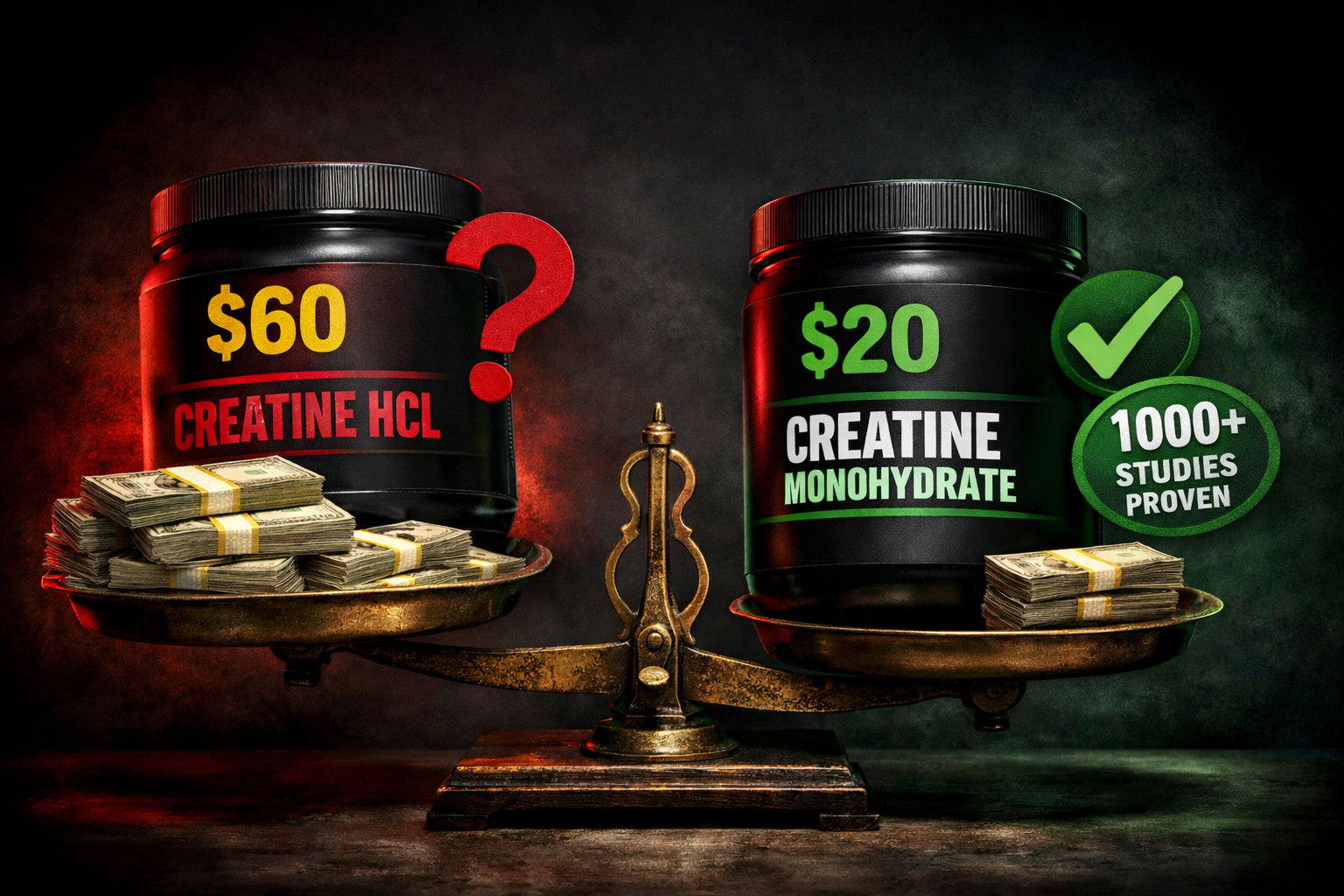
- Significantly more expensive
- Less research supporting its use
- No advantage over regular monohydrate
Verdict: Not worth the extra cost for most people.
Buffered Creatine (Kre-Alkalyn)
What it is: Creatine with an alkaline powder added, supposedly preventing conversion to creatinine (a waste product).
Claims: Better absorption, no loading phase needed, reduced side effects.
Reality:
- Research shows no advantage over monohydrate
- More expensive
- Marketing claims not supported by evidence
- Creatine conversion to creatinine in the stomach is not actually a problem
Verdict: Save your money. Stick with monohydrate.
Creatine Ethyl Ester
What it is: Creatine with an ester group attached, supposedly improving absorption.
Claims: Superior absorption, better results.
Reality:
- Research shows it’s LESS effective than monohydrate
- Breaks down into creatinine before reaching muscles
- More expensive
- Proven inferior in head-to-head studies
Verdict: Actively avoid this form. It’s been proven worse than monohydrate.
Creatine Nitrate
What it is: Creatine bound to a nitrate group.
Claims: Better solubility, potential pump benefits from nitrate.
Reality:
- More soluble (true)
- No evidence of superior muscle-building effects
- More expensive
- Less research than monohydrate
- Theoretical nitrate benefits are unproven
Verdict: Interesting but unproven. Not worth the premium.
Creatine Magnesium Chelate
What it is: Creatine bound to magnesium.
Claims: Better absorption, bonus magnesium benefits.
Reality:
- Limited research
- No proven advantage over monohydrate
- More expensive
- If you need magnesium, supplement it separately for less cost
Verdict: Unnecessary combination. Stick with monohydrate and supplement magnesium separately if needed.
The Pattern
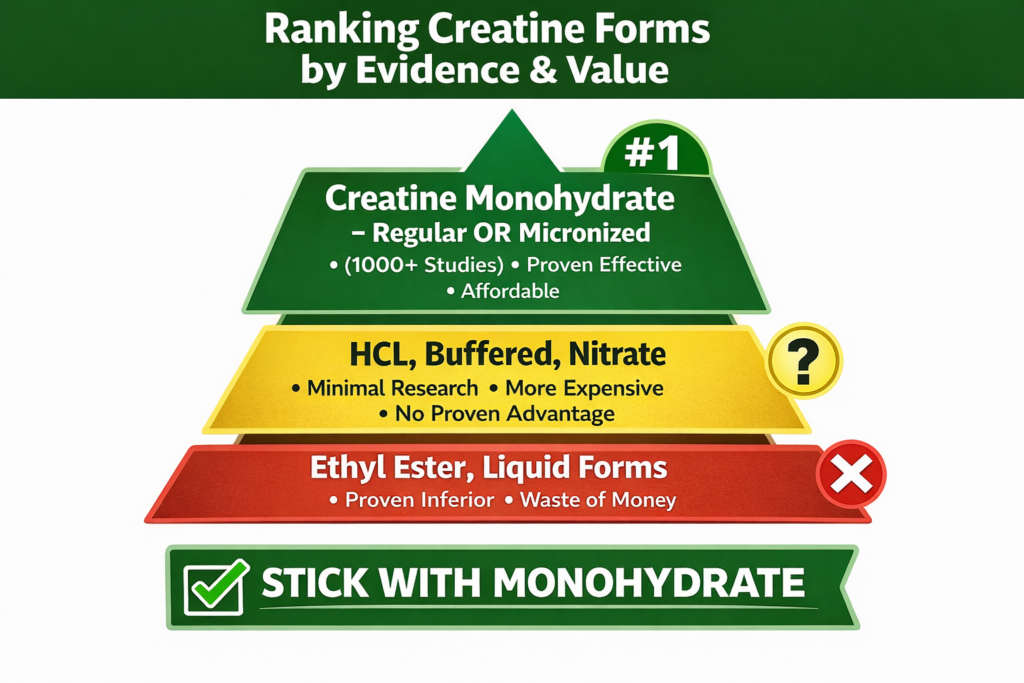
Notice the trend? Every alternative form of creatine:
- Claims to be superior to monohydrate
- Costs significantly more
- Lacks substantial research support
- Shows no meaningful advantage in actual studies
Micronized is the least problematic alternative because it’s still monohydrate, just processed differently. But even here, the benefits are minimal.
Is Micronized Creatine Worth Buying?
Let’s answer the key question directly.
When Micronized Might Be Worth It
Scenario 1: Identical or minimal price difference
If micronized costs the same or only $2-3 more for a month’s supply, and you prefer the finer texture and better mixing, go for it. The minor convenience might be worth a small premium.
Scenario 2: You experienced digestive issues with regular monohydrate
If you tried regular creatine monohydrate and experienced bloating, cramping, or stomach discomfort, micronized might help.
However, try these solutions with regular monohydrate first:
- Take it with food
- Use warm water
- Split your dose (2.5g twice daily)
- Ensure adequate hydration
Only if those don’t help should you consider switching to micronized.
Scenario 3: You’re extremely particular about texture
Some people strongly dislike the grittiness of regular monohydrate. If this bothers you enough that you won’t use it consistently, micronized’s smoother texture might improve adherence.
When Micronized Is NOT Worth It
Scenario 1: Significant price premium (20%+ more)
If micronized costs substantially more than regular monohydrate, don’t waste your money. The benefits absolutely do not justify a significant price increase.
Scenario 2: Expecting better results
If you’re buying micronized because you think it will build more muscle or increase strength more effectively, save your money. It won’t.
Scenario 3: You tolerate regular monohydrate fine
If you’re using regular creatine monohydrate without any issues, there’s zero reason to switch to micronized.
The Bottom Line Recommendation
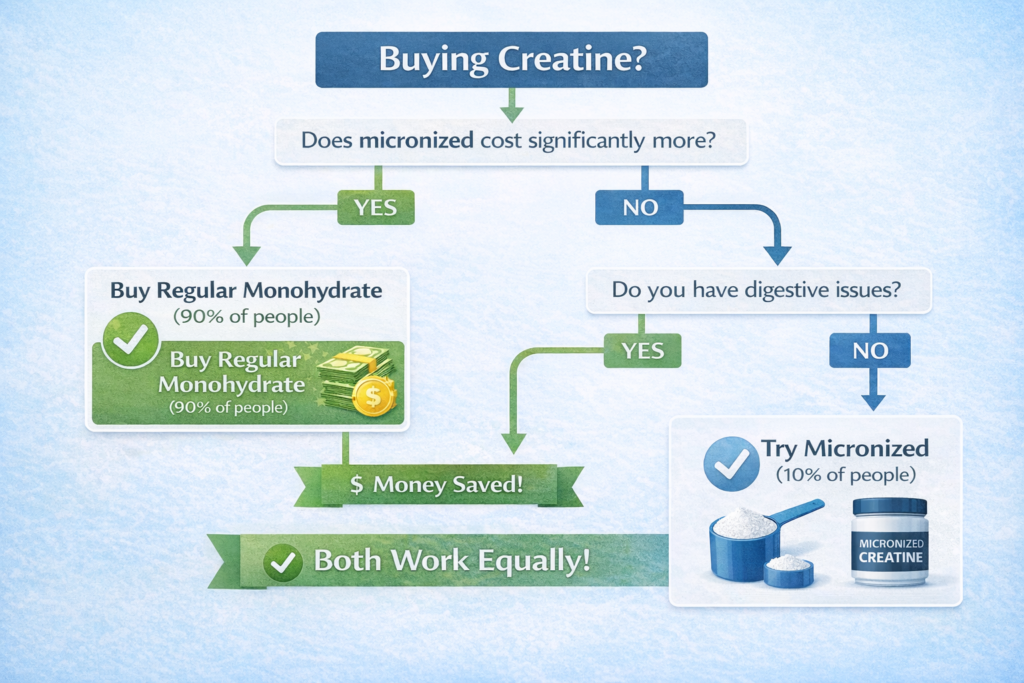
For 90% of people: Buy regular creatine monohydrate.
It’s cheaper, equally effective, and backed by decades of research. The benefits of micronization are too minor to justify seeking it out or paying extra for it.
For the 10% with specific needs: If you genuinely have digestive sensitivity or mixing texture is important to you, micronized might be worth a small premium.
But always prioritize:
- Creatine monohydrate (micronized or not)
- Quality certification (Creapure, NSF, Informed-Sport)
- Fair pricing
- Reputable brand
Never buy: Exotic creatine formulations (HCL, ethyl ester, buffered) expecting superior results. Research doesn’t support the marketing claims.
How to Choose Quality Creatine (Micronized or Regular)
Regardless of which type you choose, here’s how to ensure you’re getting a quality product.
Look for These Quality Markers
Creapure certification:
Creapure is a German-manufactured creatine monohydrate known for high purity and quality. Products with the Creapure logo guarantee:
- 99.99% pure creatine monohydrate
- No contaminants or impurities
- Consistent quality
- Made under strict quality controls
Third-party testing:
Look for certifications from:
- NSF Certified for Sport
- Informed-Sport
- Informed-Choice
- BSCG (Banned Substances Control Group)
These verify: No banned substances, accurate labeling, product purity.
Transparent labeling:
The label should clearly state:
- Exact amount of creatine per serving
- Form (monohydrate, micronized, etc.)
- No proprietary blends
- Minimal additional ingredients
Reputable brand:
Stick with established supplement companies with good reputations and customer reviews.
Avoid These Red Flags
Proprietary blends:
If the label doesn’t tell you exactly how much creatine is in each serving, avoid it.
Too cheap to be true:
If it’s dramatically cheaper than other options, quality might be compromised. However, basic monohydrate should still be affordable.
Excessive additives:
Some products add unnecessary ingredients. Pure creatine (with maybe flavoring if you prefer) is ideal.
Exotic formulations:
Products combining multiple creatine types or adding unnecessary ingredients are usually just charging more for no benefit.
Outrageous claims:
“Build 10 pounds of muscle in 30 days!” or similar claims indicate marketing over substance.
How to Use Creatine Properly (Any Type)
Whether you choose micronized or regular, here’s how to use it correctly.
The Simple Daily Dose Protocol
Recommended for most people:
Dose: 3-5g daily (5g is standard)
Timing: Whenever convenient and consistent
Loading: Optional (faster results but not necessary)
Cycling: Not necessary
With or without food: Either works, though with food may reduce any digestive discomfort
Mixing: Water, juice, protein shake, or any beverage
The Loading Protocol (Optional)
If you want maximum benefits within 5-7 days:
Loading phase (days 1-7):
- 20g daily divided into 4 doses of 5g each
- Take with meals to minimize digestive issues
Maintenance phase (day 8 onward):
- 3-5g daily
- Continue indefinitely
Note: Loading gets you to saturation faster but isn’t necessary. You’ll reach the same endpoint with 3-5g daily; it just takes 3-4 weeks instead of 1 week.
Mixing Tips for Better Dissolution
For regular monohydrate:
- Use warm or room temperature water (dissolves better than cold)
- Mix vigorously
- Drink it with some sediment; it all gets absorbed
For micronized:
- Dissolves better in cold water than regular monohydrate
- Still benefits from vigorous mixing
- Less sediment but still may have some
For both types:
- Don’t pre-mix and store (creatine degrades in liquid over time)
- Mix right before consumption
- The sediment at the bottom is normal and harmless
Hydration Considerations
Creatine draws water into muscle cells, so adequate hydration is important.
Practical guidance:
- Drink 8-10 glasses (64-80oz) of water daily
- More if training intensely or in hot weather
- Monitor urine color (pale yellow is ideal)
- Don’t obsess over exact amounts
Common Questions About Micronized vs Regular
Can I mix micronized and regular creatine?
Yes, absolutely. If you have both, using them together is fine. You’re just getting creatine monohydrate from both sources.
Will micronized creatine load faster?
No. Loading speed depends on total daily dose, not particle size. 20g of regular monohydrate loads just as fast as 20g of micronized.
Does micronized creatine taste different?
No. Both are flavorless or have minimal taste. The only difference is texture (micronized is smoother).
Can I take micronized creatine on an empty stomach?
Yes, though taking any creatine with food may reduce digestive discomfort if you’re sensitive.
Is micronized creatine better for cutting?
No. Both types have the same effects on body composition. Creatine helps preserve muscle during caloric deficits regardless of particle size.
Should women use micronized instead of regular?
No reason to. Both are equally safe and effective for women. Choose based on price and preference, not gender.
Does micronized creatine cause less water retention?
No. Both cause the same intracellular water retention (water inside muscle cells). This is a normal part of how creatine works.
The Bottom Line: Save Your Money, Buy Regular Monohydrate
After examining all the evidence, here’s what you need to know:
The differences between micronized and regular creatine monohydrate are minimal:
✅ Both are creatine monohydrate (the best form)
✅ Both saturate your muscles equally
✅ Both provide identical strength and muscle-building benefits
✅ Both are safe for long-term use
✅ Both are backed by extensive research
The only real differences:
▪ Micronized has smaller particles (true but mostly irrelevant)
▪ Micronized mixes slightly better (minor convenience)
▪ Micronized might cause less digestive discomfort in sensitive individuals (unproven)
▪ Micronized often costs more (confirmed and important)
The smart buying strategy:
Buy regular creatine monohydrate if:
- Price is your priority
- You don’t have digestive issues
- You want the most researched form
- You value proven effectiveness over minor conveniences
This applies to 90% of people.
Consider micronized if:
- It costs the same or nearly the same as regular
- You experienced digestive issues with regular monohydrate (after trying other solutions)
- Mixing texture is important to you
Never buy exotic creatine forms expecting:
- Better muscle growth
- Superior strength gains
- Faster results
- Magical benefits
Research consistently shows monohydrate (regular or micronized) is still the gold standard.
The final word:
Stop overthinking creatine. Buy quality creatine monohydrate (Creapure-certified if possible, third-party tested ideally), take 3-5g daily, and let it do what decades of research have proven it does.
Whether the particles are big or small makes virtually no difference to your muscles.
IGNORE THE MARKETING. FOLLOW THE SCIENCE. SAVE YOUR MONEY.
Ready to maximize your supplement strategy with evidence-based recommendations that actually work? Creatine is just the beginning. Get a complete guide to the supplements worth taking (and the many you should avoid), how to optimize your nutrition for your specific goals, and how to train for maximum results without wasting money on useless products. Stop guessing. Start knowing what actually works.

Leave a Reply
You must be logged in to post a comment.