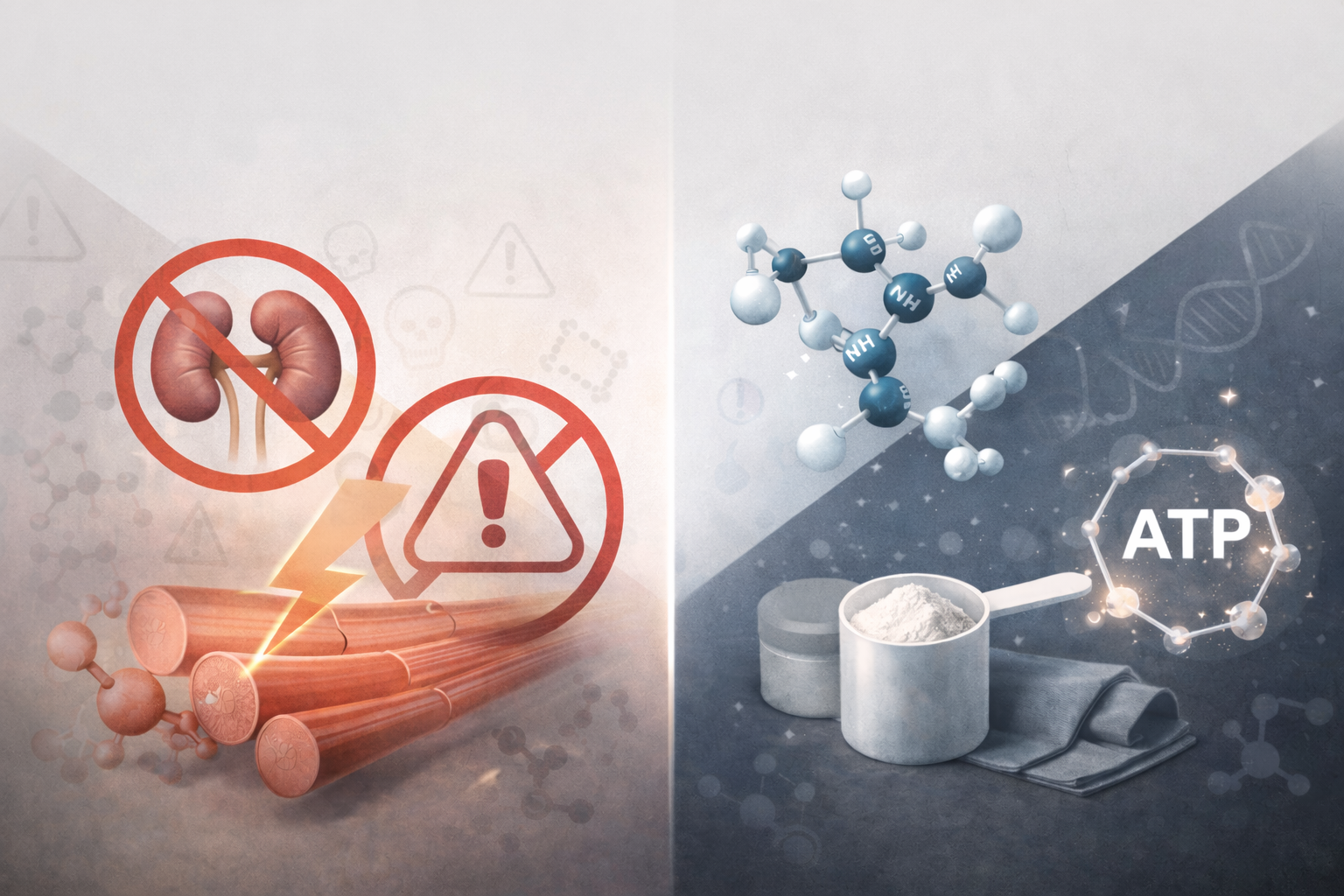
Think you know everything about creatine? The most researched supplement in history is surrounded by myths that prevent people from using it effectively. Here’s the science-backed truth.
Walk into any gym and ask about creatine, and you’ll hear a dozen different opinions:
“It makes you bloated and puffy.”
“You need to cycle it or your kidneys will fail.”
“It only works if you load it first.”
“Women shouldn’t use it.”
“It causes hair loss.”
“You have to drink a gallon of water daily or it’s dangerous.”
Here’s the problem: most of what people believe about creatine is completely wrong.
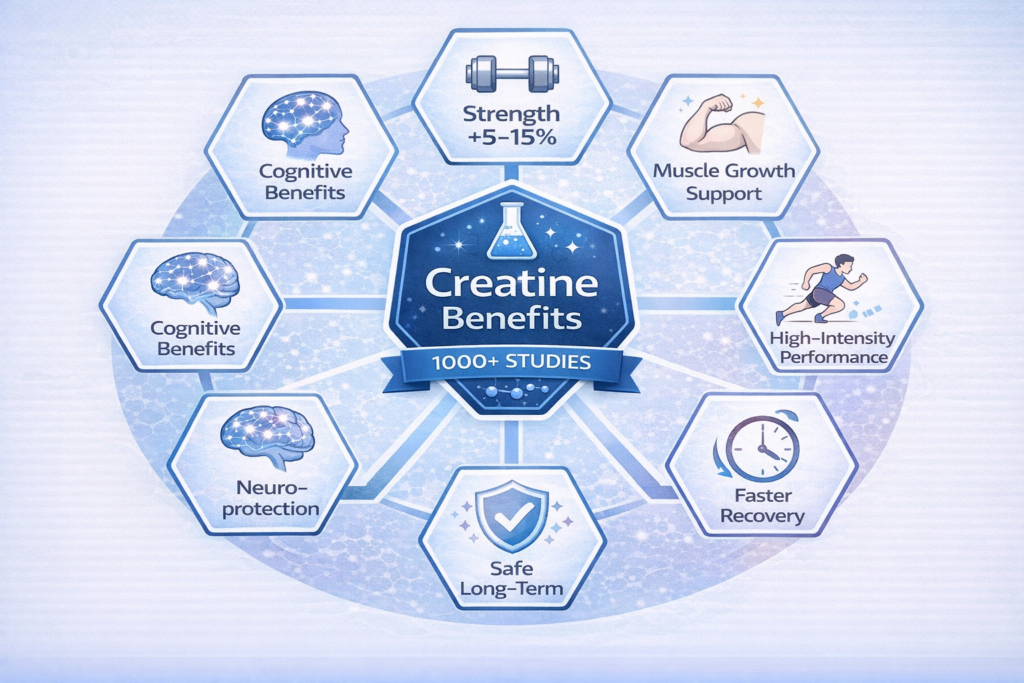
Creatine is the most extensively researched supplement in sports nutrition history, with over 1,000 peer-reviewed studies examining its effects, safety, and optimal use. Yet misinformation spreads faster than facts, leaving people confused, scared, or using it incorrectly.
In this comprehensive guide, I’m going to separate myths from reality, explain exactly what creatine is and how it works, reveal its proven benefits (and limitations), show you how to use it correctly, and answer every common question with actual scientific evidence.
Whether you’re considering trying creatine for the first time or you’ve been using it for years, this article will give you the knowledge to use it safely and effectively.
Let’s cut through the noise and get to the truth.
TABLE OF CONTENTS
- Benefit 1: Increased Strength and Power Output
- Benefit 2: Enhanced Muscle Growth (Indirectly)
- Benefit 3: Improved High-Intensity Exercise Performance
- Benefit 4: Faster Recovery Between Sets and Training Sessions
- Benefit 5: Cognitive Benefits
- Benefit 6: Potential Neuroprotective Effects
- Benefit 7: Safe for Long-Term Use
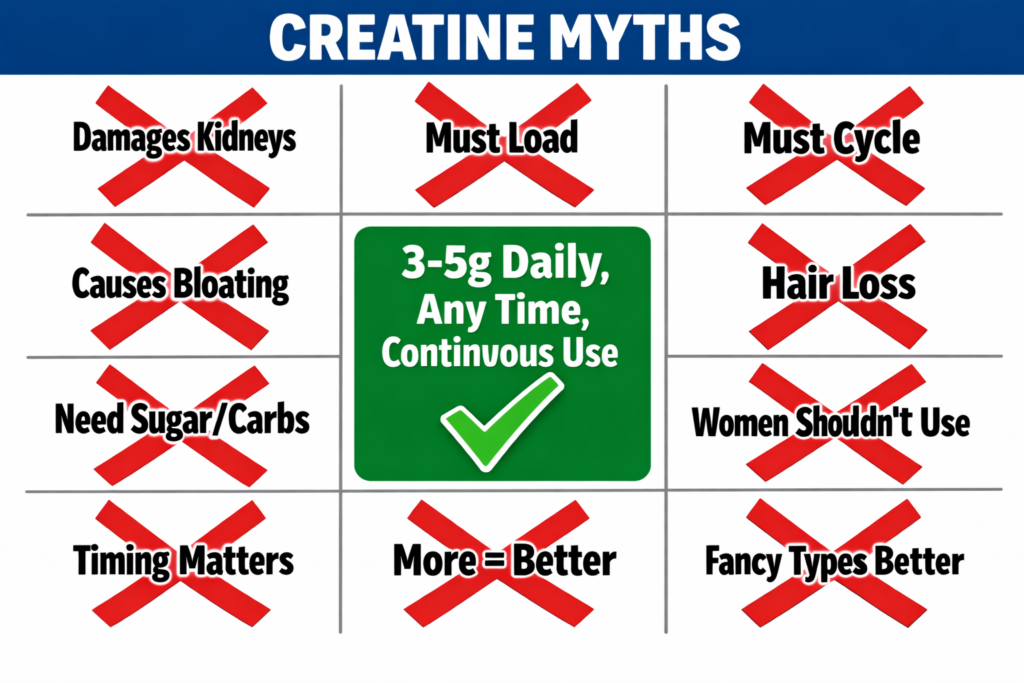
- Myth 1: Creatine Damages Your Kidneys
- Myth 2: You Must Load Creatine for It to Work
- Myth 3: You Must Cycle Creatine
- Myth 4: Creatine Causes Bloating and Makes You Look Puffy
- Myth 5: Creatine Causes Hair Loss
- Myth 6: Women Shouldn't Use Creatine
- Myth 7: You Need to Take Creatine With Sugar/Carbs
- Myth 8: Timing Matters (Take It Post-Workout)
- Myth 9: More Creatine Equals Better Results
- Myth 10: All Creatine Types Are Equal
- Does creatine work for women?
- Will I lose my gains when I stop taking creatine?
- Can I take creatine while cutting/losing fat?
- How long does it take to see results?
- Is creatine a steroid?
- Can I take creatine with other supplements?
- What about creatine and caffeine?
- Should I take creatine on rest days?
- Does creatine expire?
- The Bottom Line: Creatine Is Simple and Effective
What Exactly Is Creatine?
Before we can separate myths from facts, you need to understand what creatine actually is.
The Basic Science
Creatine is a naturally occurring compound made from three amino acids: arginine, glycine, and methionine.
Where it’s found:
Your body produces it: Your liver, kidneys, and pancreas synthesize approximately 1-2 grams of creatine daily.
You consume it through food: Primarily found in meat and fish. A pound of raw beef contains about 1-2 grams of creatine.
You can supplement it: Creatine monohydrate powder provides concentrated doses far exceeding what’s practical to obtain through diet alone.
How Creatine Works in Your Body
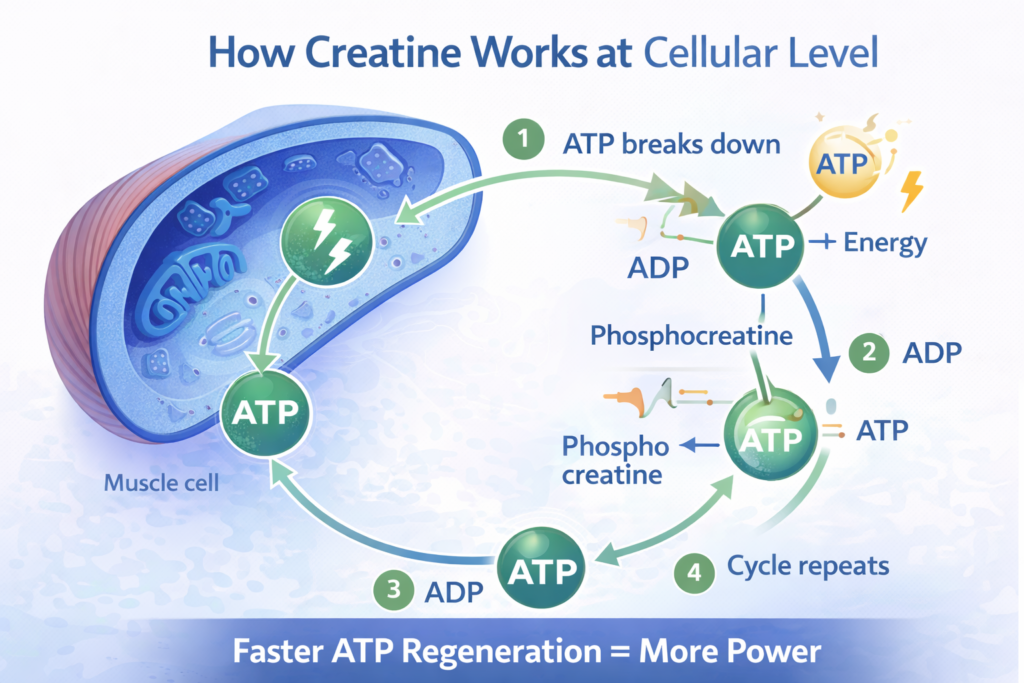
The energy currency: ATP
Your muscles use ATP (adenosine triphosphate) as their immediate energy source for contraction. Think of ATP as your cells’ energy currency.
The problem: Your muscles store only enough ATP for about 10 seconds of maximum effort. After that, ATP must be rapidly regenerated to continue high-intensity activity.
Creatine’s role:
Creatine is stored in your muscles as phosphocreatine (creatine phosphate). When you perform intense exercise:
- ATP breaks down into ADP (adenosine diphosphate) + energy
- Phosphocreatine donates its phosphate group to ADP
- ADP becomes ATP again
- You can continue high-intensity effort
The result: More available creatine means faster ATP regeneration, allowing you to maintain high-intensity effort longer and recover faster between sets.
Why This Matters for Performance
Creatine supplementation increases your muscles’ phosphocreatine stores by approximately 20-40% (depending on your baseline levels).
This translates to:
- More reps before failure
- Greater power output
- Faster recovery between sets
- Enhanced training volume over time
- Greater muscle growth through increased training capacity
Important distinction: Creatine doesn’t directly build muscle. It enhances your ability to train harder, and that increased training stimulus builds muscle.
The Proven Benefits of Creatine Supplementation
Let’s examine what science actually shows creatine does.
Benefit 1: Increased Strength and Power Output
The evidence: This is creatine’s most well-established benefit.
Meta-analyses of dozens of studies consistently show:
- 5-15% increase in maximum strength
- 5-15% increase in power output
- Greatest effects on exercises requiring maximum effort for 30 seconds or less
Practical translation:
If you bench press 200 pounds for 5 reps, creatine supplementation might help you achieve:
- 210-215 pounds for 5 reps, OR
- 200 pounds for 6-7 reps
This doesn’t sound dramatic, but compounded over months and years, these small increases create significantly greater muscle growth.
Benefit 2: Enhanced Muscle Growth (Indirectly)
The mechanism: Creatine doesn’t directly build muscle tissue, but it facilitates muscle growth through multiple pathways.
How it works:
Increased training volume: More reps and sets means greater muscle stimulus.
Cell volumization: Creatine draws water into muscle cells, creating a more anabolic environment and potentially signaling muscle growth pathways.
Reduced protein breakdown: Some research suggests creatine may reduce muscle protein breakdown during training.
Enhanced satellite cell activation: Emerging evidence suggests creatine may help activate satellite cells, which are crucial for muscle repair and growth.
The research:
Studies show that people using creatine while resistance training gain significantly more lean muscle mass than those training without it.
Typical results: An additional 2-4 pounds of lean muscle over 8-12 weeks compared to training without creatine.
Benefit 3: Improved High-Intensity Exercise Performance
Beyond just lifting weights, creatine enhances performance in any activity requiring repeated bursts of high-intensity effort:
Sprinting: Faster sprint times and better repeated sprint performance.
Jumping: Greater jump height and power.
High-intensity intervals: Better performance maintenance across multiple rounds.
Team sports: Basketball, soccer, football, hockey all involve repeated high-intensity efforts that benefit from creatine.
Important limitation: Creatine provides minimal benefit for pure endurance activities (long-distance running, cycling) because these don’t rely heavily on the phosphocreatine energy system.
Benefit 4: Faster Recovery Between Sets and Training Sessions
Creatine helps you recover faster in two ways:
Between sets: Faster ATP regeneration means shorter rest periods needed between sets.
Between training sessions: Enhanced glycogen replenishment and reduced markers of muscle damage may improve day-to-day recovery.
Practical benefit: You can train with higher frequency and volume without overtraining.
Benefit 5: Cognitive Benefits
Emerging research suggests creatine may benefit brain function:
The brain uses significant ATP for cognitive tasks, and creatine supplementation may enhance:
- Mental energy and reduced fatigue
- Working memory
- Processing speed
- Performance under sleep deprivation or stress
The evidence is strongest for:
- Vegetarians and vegans (who have lower baseline creatine from no dietary meat)
- Elderly individuals
- People under cognitive stress or sleep deprivation
More research is needed, but preliminary findings are promising.
Benefit 6: Potential Neuroprotective Effects
Early research suggests creatine may have neuroprotective properties:
Studies are investigating its potential role in:
- Traumatic brain injury recovery
- Neurodegenerative disease prevention
- Depression treatment (as an augmentation to standard therapy)
Important caveat: This research is preliminary. Don’t use creatine as a treatment for any medical condition without professional guidance.
Benefit 7: Safe for Long-Term Use
Perhaps creatine’s most important “benefit” is its exceptional safety record.
Decades of research and millions of users have established that creatine monohydrate is:
- Safe for healthy individuals
- Well-tolerated with minimal side effects
- Effective for long-term continuous use
- One of the safest supplements available
This isn’t a “benefit” in the traditional sense, but it’s crucial: creatine works AND it’s safe.
The Biggest Myths About Creatine (Completely Debunked)
Now let’s destroy the most persistent myths with actual science.
Myth 1: Creatine Damages Your Kidneys
The myth: “Creatine is dangerous for your kidneys and will cause kidney damage or failure.”
The truth: In healthy individuals with normal kidney function, creatine does NOT cause kidney damage.
The science:
Hundreds of studies examining kidney function in creatine users (including long-term studies of 5+ years) show no adverse effects on kidney health in healthy individuals.
The confusion:
Creatine supplementation increases creatinine levels in the blood. Creatinine is a waste product of creatine metabolism and is used as a marker of kidney function.
Elevated creatinine can indicate kidney problems. However, in creatine users, elevated creatinine simply reflects increased creatine metabolism, NOT kidney dysfunction.
Think of it this way: Your car’s fuel gauge showing “empty” means you’re out of gas. But if you just added a second fuel tank, the gauge showing “full” doesn’t mean anything is wrong. Context matters.
Important exception: People with pre-existing kidney disease or dysfunction should consult their doctor before using creatine. For everyone else, it’s safe.
Bottom line: Decades of research confirm creatine is safe for healthy kidneys.
Myth 2: You Must Load Creatine for It to Work
The myth: “You need to do a loading phase (20-25g daily for 5-7 days) or creatine won’t work.”
The truth: Loading is optional. It’s faster but not necessary.
How it actually works:
With loading:
- Take 20-25g daily (divided into 4-5 doses) for 5-7 days
- Muscle creatine stores saturate quickly
- Switch to 3-5g daily maintenance
- Full benefits within 1 week
Without loading (maintenance dose from day one):
- Take 3-5g daily from the start
- Muscle creatine stores saturate gradually
- Full benefits within 3-4 weeks
- Same endpoint, just slower
The only difference is speed of saturation, not final effectiveness.
Why loading exists:
Research studies needed to show results quickly (within weeks, not months), so they used loading protocols. This created the impression that loading was necessary.
Practical recommendation:
Load if: You want maximum benefits as quickly as possible and don’t mind the higher dose.
Don’t load if: You prefer simplicity, want to minimize costs, or experience digestive discomfort from high doses.
Either way, you’ll reach the same saturated state.
Myth 3: You Must Cycle Creatine
The myth: “You need to cycle creatine (use for 8-12 weeks, then stop for 4 weeks) or your body will stop producing it naturally.”
The truth: Cycling is completely unnecessary. Continuous use is safe and effective.
Why this myth exists:
Some people confuse creatine with prohormones or steroids, which require cycling to manage side effects and hormonal suppression. Creatine has no such issues.
The science on your body’s production:
Your body’s natural creatine production does decrease slightly when supplementing, but:
- It’s a minor reduction
- It’s a normal regulatory response
- Production returns to normal within a few weeks of stopping supplementation
- This poses no health concern
Research shows continuous creatine use for years is safe and effective with no diminishing returns or negative consequences.
Practical recommendation: Don’t cycle unless you simply want to save money during periods when you’re not training intensely.
Myth 4: Creatine Causes Bloating and Makes You Look Puffy
The myth: “Creatine makes you retain water and look bloated and soft.”
The truth: Creatine causes intracellular water retention (inside muscle cells), not subcutaneous water retention (under the skin).
The critical distinction:
Intracellular water retention:
- Water pulled into muscle cells
- Makes muscles look fuller and larger
- Does NOT create a bloated, puffy appearance
- Actually improves muscle aesthetics
Subcutaneous water retention:
- Water stored under the skin
- Creates a smooth, puffy appearance
- This is what people actually mean by “bloating”
- Creatine does NOT cause this
The typical experience:
Most users gain 2-4 pounds of water weight in the first week of creatine use. This is water inside muscle cells, creating a fuller, more muscular appearance, not a bloated look.
Important note: A small percentage of people may experience digestive discomfort or genuine bloating from creatine, particularly from:
- Very high doses (loading phase)
- Poor-quality creatine
- Taking it on an empty stomach
Solution: Use high-quality creatine monohydrate, take it with food, and skip the loading phase if digestive issues occur.
Myth 5: Creatine Causes Hair Loss
The myth: “Creatine increases DHT (dihydrotestosterone) and causes male pattern baldness.”
The truth: One poorly controlled study created this myth. Subsequent research has found no connection.
The single study:
A 2009 study on rugby players found increased DHT levels after creatine supplementation. This created panic because elevated DHT is associated with hair loss in genetically susceptible individuals.
Problems with that study:
- Small sample size (only 20 participants)
- No control group
- DHT levels remained within normal physiological range
- No actual measurement of hair loss
- Has never been replicated
Subsequent research:
Multiple larger, better-controlled studies have found:
- No increase in DHT from creatine
- No increase in testosterone
- No effect on hair loss
The scientific consensus: There is no credible evidence that creatine causes hair loss.
If you’re genetically predisposed to male pattern baldness, you may lose hair eventually regardless of creatine use. Blaming the creatine is confirmation bias.
Myth 6: Women Shouldn’t Use Creatine
The myth: “Creatine is for men. Women will get bulky or experience side effects from using it.”
The truth: Creatine is equally safe and effective for women, with no masculinizing effects.
Why this myth is ridiculous:
Creatine is not a hormone. It doesn’t affect testosterone, estrogen, or any other hormones. It simply provides energy for muscle contractions.
The science:
Research on women using creatine shows:
- Same performance benefits as in men
- Same safety profile as in men
- No hormonal changes
- No masculinizing effects
- No increased “bulkiness” beyond normal muscle growth from training
The “bulky” fear:
Women using creatine will NOT get bulky unless they:
- Train specifically for muscle growth
- Eat in a caloric surplus
- Do this consistently for years
And even then, natural female hormonal profiles make getting “bulky” extremely difficult without pharmaceutical assistance.
Creatine helps women:
- Perform better in training
- Build lean muscle more effectively
- Recover faster
- Achieve a more toned, defined physique
Practical recommendation: Women should use creatine the same way men do: 3-5g daily, continuously.
Myth 7: You Need to Take Creatine With Sugar/Carbs
The myth: “Creatine must be taken with simple sugars or carbohydrates for absorption.”
The truth: While insulin can slightly enhance creatine uptake, the difference is minimal and unnecessary for results.
The science:
Early research suggested insulin (stimulated by carbs/sugar) improved creatine transport into muscles. This led to recommendations to take creatine with grape juice or dextrose.
Subsequent research showed:
- The effect is minimal
- You’ll reach saturation with or without carbs
- Taking creatine with protein works equally well
- Taking it with nothing at all still works
Practical recommendation:
Take creatine whenever convenient:
- With a meal (any meal)
- With a protein shake
- By itself with water
Timing and co-ingestion don’t matter much. Consistency matters.
Myth 8: Timing Matters (Take It Post-Workout)
The myth: “You must take creatine immediately post-workout for maximum benefits.”
The truth: Timing is largely irrelevant. Daily consistency is what matters.
The science:
Some studies suggest a minor benefit to taking creatine around training (before or after), but the difference is so small it’s practically insignificant.
What actually matters: Taking 3-5g daily, every day, consistently. Your muscles gradually saturate regardless of when you take it.
Practical recommendation:
Take creatine whenever it’s most convenient and you’ll actually remember to do it:
- With breakfast
- Post-workout with your protein shake
- Before bed
- Literally any consistent time
Consistency beats optimization. Taking it at a “suboptimal” time every day is infinitely better than taking it at the “optimal” time sporadically.
Myth 9: More Creatine Equals Better Results
The myth: “If 5g is good, 10-20g must be even better.”
The truth: Once your muscles saturate, additional creatine provides no extra benefit and just wastes money.
The science:
Your muscles can only store a finite amount of creatine. Once saturated (which happens with 3-5g daily), extra creatine is simply excreted through urine.
Taking more doesn’t:
- Build more muscle
- Increase strength further
- Provide any additional benefit
It only:
- Wastes money
- Potentially increases digestive discomfort
- Creates expensive urine
Practical recommendation: Stick to 3-5g daily. More is not better.
Myth 10: All Creatine Types Are Equal
The myth: “Fancy new creatine formulations (buffered, ethyl ester, HCL, etc.) are better than basic creatine monohydrate.”
The truth: Creatine monohydrate is still the gold standard, with the most research and best cost-to-benefit ratio.
The supplement industry problem:
Companies can’t profit much from basic creatine monohydrate because:
- It’s off-patent
- Anyone can make it
- It’s very cheap
So they create “improved” versions they can patent and charge more for:
- Creatine ethyl ester
- Buffered creatine (Kre-Alkalyn)
- Creatine HCL
- Creatine nitrate
- Liquid creatine
- And many others
The research:
Studies directly comparing these alternatives to creatine monohydrate consistently show:
- No superior benefits
- Often worse absorption
- Sometimes less effective
- Always more expensive
The only possible exception: Creatine HCL may cause less digestive discomfort in sensitive individuals, though creatine monohydrate taken with food usually solves this issue at lower cost.
Practical recommendation: Save your money. Buy quality creatine monohydrate. Ignore the marketing hype around “advanced” formulations.
How to Use Creatine Correctly
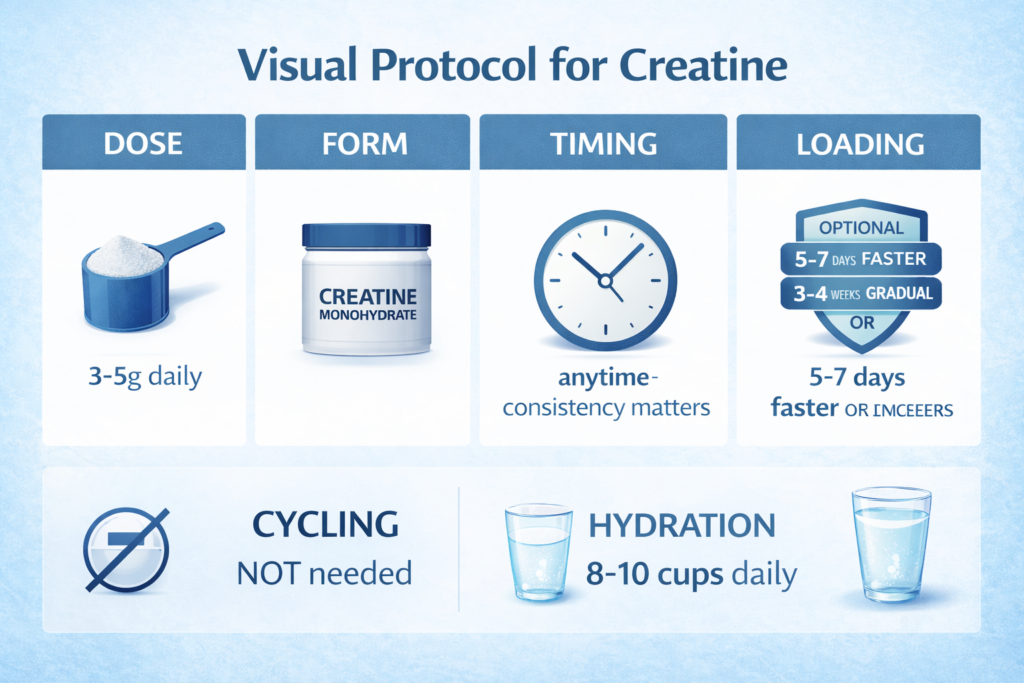
Now that we’ve cleared up the myths, here’s the evidence-based approach to creatine supplementation.
The Simple Protocol (Recommended for Most People)
Dose: 3-5g daily (5g is standard, 3g works for smaller individuals)
Timing: Whenever convenient and consistent
Form: Creatine monohydrate powder
Loading: Optional (faster results but not necessary)
Cycling: Not necessary
Duration: Continuous use is safe and effective
That’s it. Creatine is remarkably simple when you ignore the marketing noise.
The Loading Protocol (Optional, For Faster Results)
If you want maximum benefits within 7-10 days instead of 3-4 weeks:
Loading phase:
- 20-25g daily for 5-7 days
- Divided into 4-5 doses throughout the day (e.g., 5g four times daily)
- Take with meals to minimize digestive discomfort
Maintenance phase:
- Switch to 3-5g daily after loading
- Continue indefinitely
Who should load:
- People wanting results as quickly as possible
- Athletes preparing for competition
- Those starting creatine before a training program begins
Who should skip loading:
- People with sensitive digestion
- Those preferring simplicity
- Anyone wanting to minimize costs
Choosing Quality Creatine
What to look for:
Creatine monohydrate: The form with the most research and proven effectiveness.
Micronized: Smaller particles dissolve better and may cause less digestive discomfort.
Third-party tested: Look for certifications from NSF, Informed-Choice, or similar organizations verifying purity and absence of banned substances.
Creapure: A German-produced creatine monohydrate known for high purity and quality. Not essential but a good indicator of quality.
What to avoid:
Proprietary blends: Products that don’t tell you exactly how much creatine is in each serving.
Unnecessary additives: Sugar, artificial flavors, fillers (unless you prefer flavored for taste).
Fancy formulations: Creatine ethyl ester, buffered, or other expensive alternatives with no proven advantages.
Extremely cheap products: If it’s significantly cheaper than other brands, quality may be compromised.
Liquid creatine: Unstable in liquid form; powder is more reliable.
How to Take Creatine
Mixing:
Creatine monohydrate dissolves in water but not perfectly. You may see some sediment at the bottom. This is normal.
Mix with:
- Water (simplest)
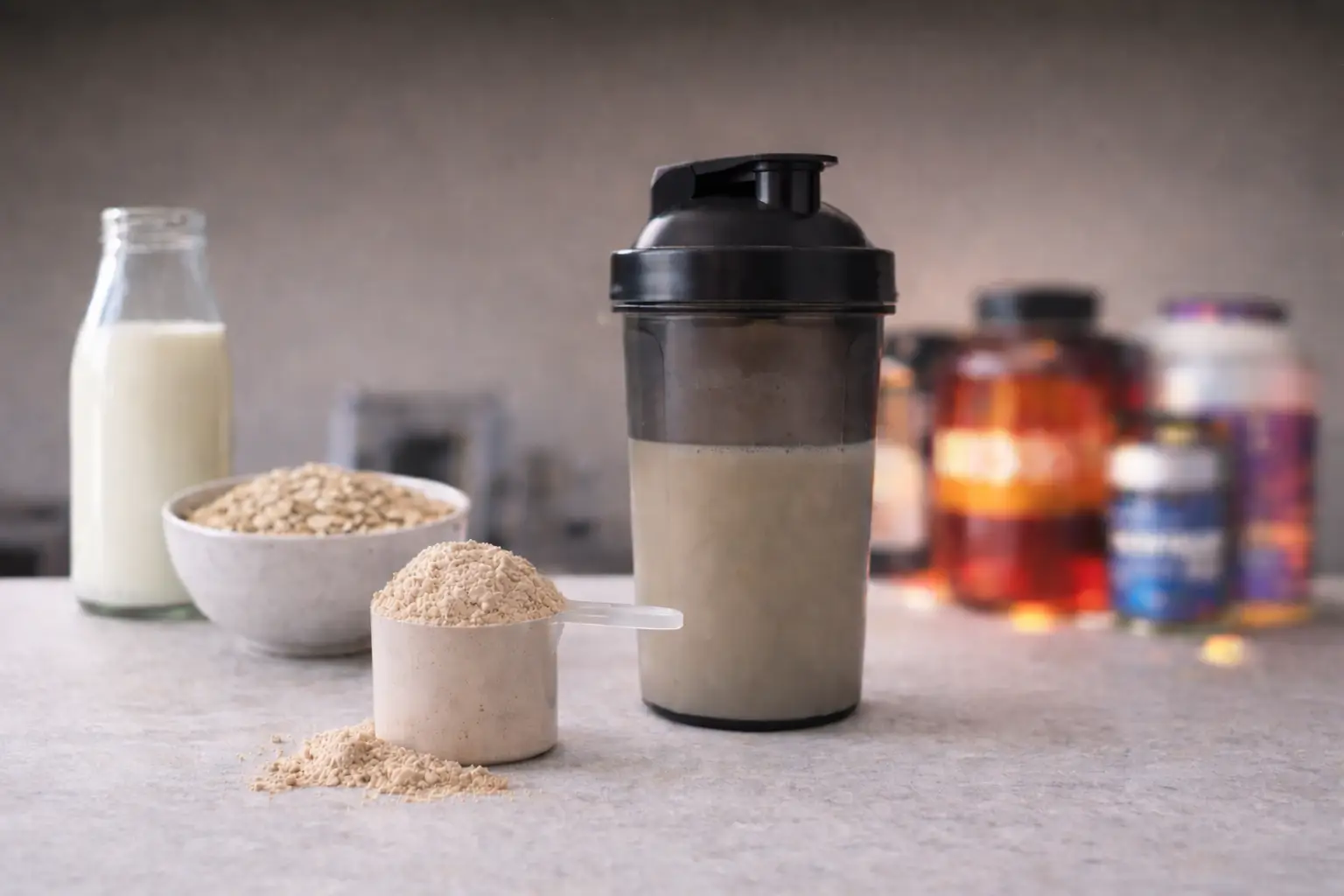
- Protein shake
- Juice (unnecessary but fine)
- Any beverage you’ll consistently drink
Temperature: Some people find it dissolves better in warm or room temperature water than cold.
Texture: Creatine is virtually tasteless. Unflavored powder is fine for most people.
Hydration Considerations
Creatine pulls water into muscle cells, so adequate hydration is important.
Practical guidance:
Drink enough water to maintain:
- Pale yellow urine (not clear, not dark)
- No persistent thirst
- Good energy levels
For most people, this means:
- 8-10 glasses (64-80 oz) of water daily
- More if training intensely or in hot weather
- More if consuming caffeine or alcohol
You do NOT need to:
- Drink a gallon of water daily
- Obsessively monitor every ounce
- Worry excessively about hydration
Just drink when thirsty and monitor urine color. Your body has excellent built-in hydration regulation.
Who Benefits Most From Creatine?
While creatine helps almost everyone who trains, certain groups benefit more than others.
People Who Benefit Most
Strength and power athletes:
- Powerlifters
- Olympic weightlifters
- Strongman competitors
- Throwers (shot put, discus, javelin)
Bodybuilders and physique athletes:
- Enhanced training capacity leads to greater muscle growth over time
Team sport athletes:
- Football, basketball, soccer, hockey, rugby (any sport with repeated high-intensity efforts)
Sprinters and jumpers:
- Track and field athletes in power-based events
High-intensity interval training enthusiasts:
- CrossFit, HIIT, circuit training
Vegetarians and vegans:
- No dietary creatine from meat, so lower baseline levels mean greater response to supplementation
Older adults:
- Creatine may help preserve muscle mass and strength during aging
- Potential cognitive benefits
People wanting cognitive benefits:
- Students, high-stress professionals, anyone doing demanding mental work
People Who Benefit Less
Pure endurance athletes:
- Marathon runners, ultra-distance cyclists, long-distance swimmers
- These activities don’t rely heavily on the phosphocreatine energy system
- May experience minor benefits or none at all
People not training:
- Without training stimulus, creatine provides minimal benefit
- You won’t build muscle just from taking creatine
Who Should Avoid or Use Caution
People with pre-existing kidney disease: Consult your doctor before use.
People taking medications affecting kidney function: Discuss with your healthcare provider.
Pregnant or breastfeeding women: Not enough research to confirm safety. Best to avoid unless your doctor specifically recommends it.
People with rare metabolic disorders affecting creatine: Very rare conditions that contraindicate supplementation.
For everyone else, creatine is safe to use.
Common Questions Answered
Does creatine work for women?
Yes, absolutely. Creatine is equally effective and safe for women. It doesn’t cause masculinization, excessive muscle gain, or any gender-specific side effects.
Will I lose my gains when I stop taking creatine?
You’ll lose the water weight inside muscle cells (2-4 pounds), which may make muscles look slightly less full.
You will NOT lose muscle tissue that you built through training. The strength and muscle gains from your training remain.
Can I take creatine while cutting/losing fat?
Yes. Creatine helps preserve muscle and strength during caloric deficits, making it valuable for fat loss phases.
The water retention is intracellular (inside muscles), not subcutaneous (under skin), so it doesn’t affect definition or appearance negatively.
How long does it take to see results?
With loading: 5-7 days for strength improvements, 2-4 weeks for noticeable muscle growth
Without loading: 2-3 weeks for strength improvements, 4-6 weeks for noticeable muscle growth
Is creatine a steroid?
No. Creatine is a naturally occurring compound in your body and in food. It has no relationship to anabolic steroids.
It doesn’t affect hormones and is completely legal in all sports and organizations.
Can I take creatine with other supplements?
Yes. Creatine is safe to combine with:
- Protein powder
- Pre-workouts (contains caffeine usually, which is fine)
- BCAAs
- Multivitamins
- Any other common supplements
No dangerous interactions exist with common supplements.
What about creatine and caffeine?
Early research suggested caffeine might blunt creatine’s effects. Subsequent research has largely disproven this concern.
Taking creatine and caffeine together is fine. Millions of people do this daily without issues.
Should I take creatine on rest days?
Yes. Take creatine every day, including rest days. Maintaining saturated muscle stores requires consistent daily intake.
Does creatine expire?
Dry creatine powder is very stable and remains effective for years if stored properly (cool, dry place, sealed container).
Check expiration dates, but properly stored creatine often remains good beyond listed dates.
Creatine mixed into liquid degrades quickly. Don’t pre-mix and store for days. Mix right before consumption.
The Bottom Line: Creatine Is Simple and Effective
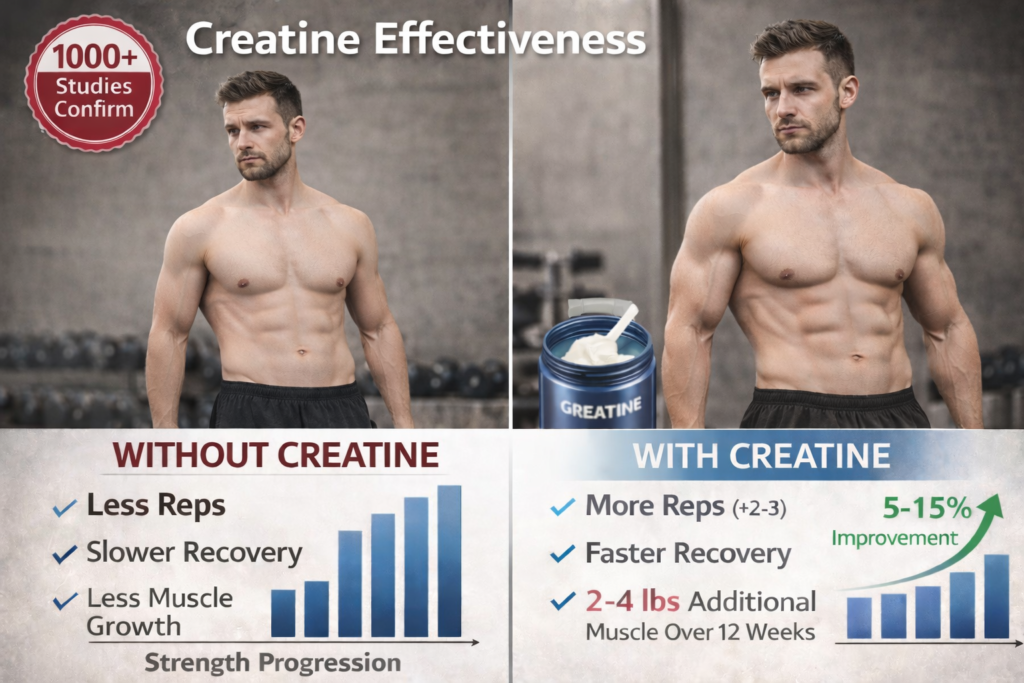
After cutting through all the myths and marketing, here’s what you need to know:
Creatine monohydrate is:
✅ The most researched supplement in sports nutrition
✅ Proven to increase strength, power, and muscle growth
✅ Safe for long-term use in healthy individuals
✅ Effective for both men and women
✅ Simple to use (just 3-5g daily)
✅ Inexpensive and cost-effective
✅ Requires no cycling or complex protocols
✅ One of the few supplements that actually works
What creatine is NOT:
❌ A steroid or hormone
❌ Dangerous for healthy kidneys
❌ Something that needs to be cycled
❌ Only for men or bodybuilders
❌ Requiring complex timing or loading protocols
❌ Better in expensive “advanced” formulations
The simple truth:
If you train with any intensity and want to maximize your results, creatine is probably worth taking. It’s safe, effective, well-researched, and affordable.
The practical approach:
Buy: Quality creatine monohydrate powder
Dose: 3-5g daily
Timing: Whenever convenient
Duration: Continuous use
Hydration: Drink adequate water (8-10 glasses daily)
Expectations: Modest but real improvements in strength, power, and muscle growth over time
Stop overthinking it. Creatine is one of the simplest, most effective supplements available. Just use it consistently and let it do what decades of research have proven it does.
IGNORE THE MYTHS. FOLLOW THE SCIENCE. MAXIMIZE YOUR RESULTS.
Ready to maximize your training results with a complete, science-based approach to supplementation and nutrition? Creatine is just one tool in a comprehensive strategy. Get a proven system that shows you exactly what supplements actually work (and which are wastes of money), how to optimize your nutrition for your goals, and how to train for maximum results. Stop guessing. Start knowing.

Leave a Reply
You must be logged in to post a comment.