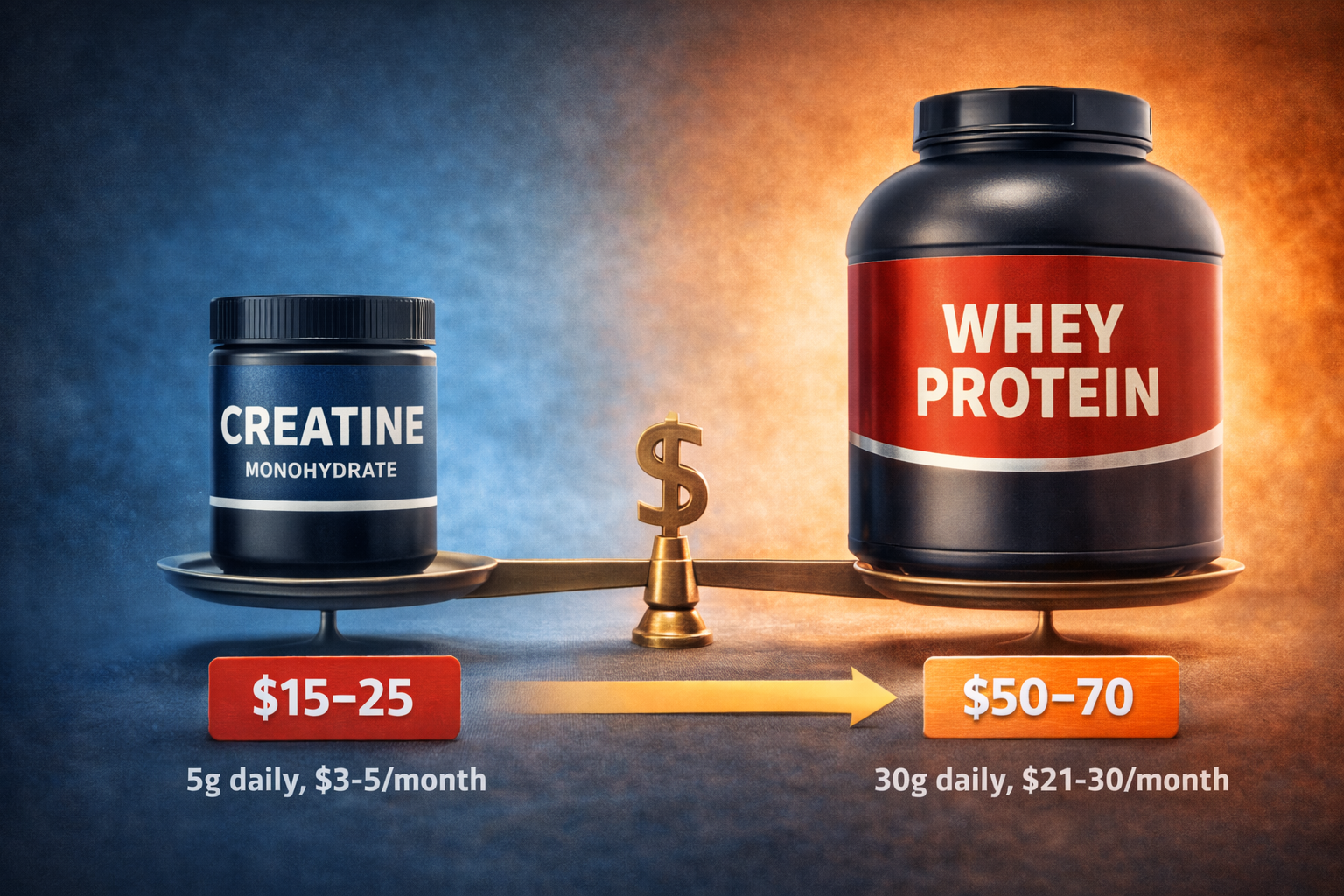
Confused about whether to buy creatine or whey protein first? Here’s the science-backed truth about which supplement you actually need.
You’re standing in the supplement aisle (or browsing online) trying to decide where to spend your limited budget.
Creatine or whey protein?
Everyone has an opinion:
- Your gym buddy swears by creatine
- Instagram influencers push whey protein constantly
- Your training partner uses both
- The supplement store employee wants to sell you everything
You just want to know which one will actually help you build muscle.
Here’s the truth that will simplify your decision: Both creatine and whey protein help build muscle through different mechanisms and work best together. However, if forced to choose only one, creatine provides unique benefits impossible to get from food, while whey protein simply provides convenient protein you can get from whole foods. For most people on a budget, creatine is the better first supplement investment.
In this comprehensive guide, I’ll explain exactly what each supplement does and how it works, compare them directly across every factor that matters, reveal which one provides better value for your money, show you when to choose one over the other, and explain why using both together creates synergy for maximum results.
Whether you’re buying your first supplement or reconsidering your current stack, this article will end the confusion.
Let’s make the smart choice.
TABLE OF CONTENTS
What Creatine Does (The Basics)
Before comparing, you need to understand what creatine actually provides.
The Simple Explanation
Creatine is a compound made from three amino acids (glycine, arginine, and methionine).
Your body:
- Produces small amounts naturally (1-2g daily)
- Stores it in muscles as phosphocreatine
- Uses it for quick energy during intense exercise
When you supplement:
- Increase muscle creatine stores by 20-40%
- Enhance ATP (energy) production
- Improve performance in the gym
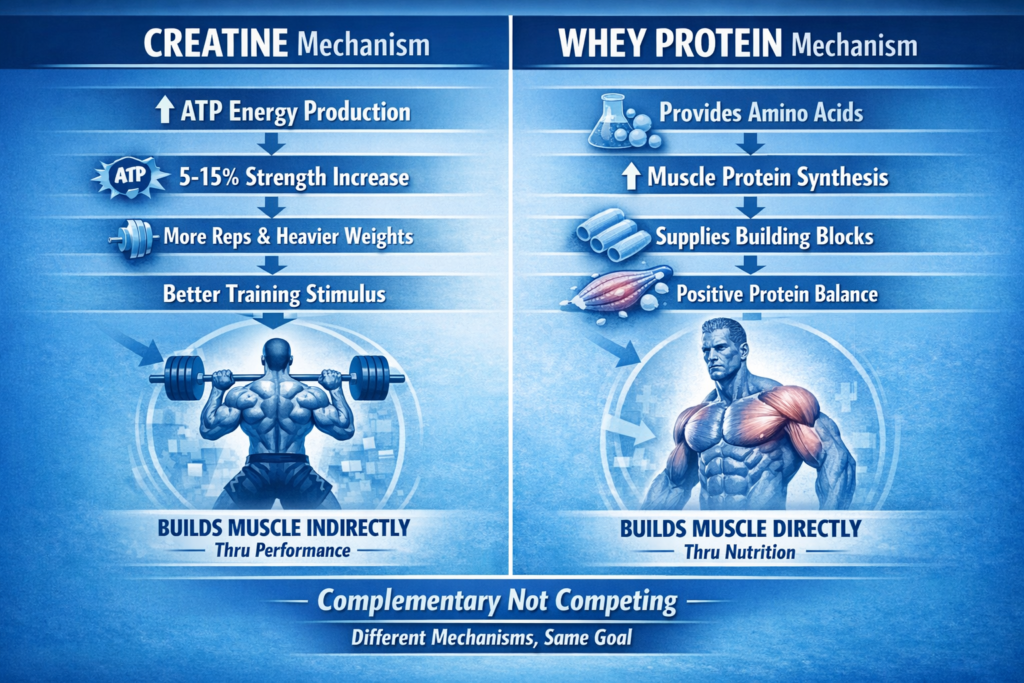
How Creatine Helps Build Muscle
Creatine doesn’t build muscle directly. It helps you train harder, which builds muscle.
The mechanism:
Step 1: Enhanced energy production
- Muscles use ATP (adenosine triphosphate) for energy
- ATP depletes quickly during intense exercise (seconds)
- Phosphocreatine rapidly regenerates ATP
- More creatine = faster ATP regeneration
Step 2: Improved training performance
- 5-15% increase in strength
- 1-3 additional reps per set
- Better power output
- Enhanced training capacity
Step 3: Progressive overload becomes easier
- Lift heavier weights
- Complete more total reps
- Increase training volume
- Provide stronger stimulus for muscle growth
Step 4: Muscle growth occurs
- Superior training stimulus from enhanced performance
- Greater mechanical tension on muscles
- More muscle damage (good kind)
- Enhanced adaptation and growth
Additional benefit: Cell volumization
- Creatine draws water into muscle cells
- Muscles appear fuller and larger
- May create anabolic environment
- Contributes to overall muscle size
The Key Point About Creatine
You cannot get sufficient creatine from diet alone to maximize muscle stores.
Food sources:
- Red meat: 1-2g per pound
- Fish: 1-2g per pound
- Chicken: Minimal amounts
To get 5g creatine from food:
- Eat 2.5 pounds of red meat daily
- Or 2.5 pounds of fish daily
- Expensive and impractical
- Excessive calories from food needed
Supplementation:
- $0.10-0.15 per 5g serving
- Pure creatine without calories
- Convenient and affordable
- Proven effective
This makes creatine a unique supplement: it provides benefits impossible to achieve through normal diet.
What Whey Protein Does (The Basics)
Now let’s examine the alternative.
The Simple Explanation
Whey protein is a high-quality protein powder derived from milk during cheese production.
What it provides:
- Complete protein (all nine essential amino acids)
- High leucine content (triggers muscle protein synthesis)
- Fast absorption (1-2 hours)
- Convenient protein source
How Whey Protein Helps Build Muscle
Whey protein provides the building blocks (amino acids) muscles need to grow.
The mechanism:
Step 1: Protein consumption
- You consume whey protein
- Digestion breaks it down to amino acids
- Amino acids absorbed in small intestine
- Enter bloodstream and circulate
Step 2: Muscle protein synthesis triggered
- Amino acids (especially leucine) signal muscle building
- mTOR pathway activated
- Protein synthesis machinery turns on
- Muscle repair and growth initiated
Step 3: Positive protein balance
- Muscle protein synthesis > muscle protein breakdown
- Net muscle gain occurs
- Over time, muscles grow
- Requires adequate total daily protein
Step 4: Recovery and growth
- Damaged muscle fibers repaired
- New muscle tissue created
- Strength and size increase
- Adaptation to training occurs
The Key Point About Whey Protein
You CAN get all necessary protein from whole food. Whey is a convenience, not a necessity.
Whole food protein sources:
- Chicken breast: 30g protein per 4oz
- Greek yogurt: 20g protein per cup
- Eggs: 6g protein each
- Fish: 25-30g protein per 4oz
- Lean beef: 25g protein per 4oz
To get 150g protein daily from whole food:
- 6oz chicken (45g) + 6 eggs (36g) + 1 cup Greek yogurt (20g) + 6oz fish (45g) = 146g
- Completely achievable
- Provides additional nutrients
- More satiating than powder
Whey protein:
- Convenient when whole food not available
- Quick to prepare and consume
- Precise protein dosing
- Portable nutrition
- But not essential if diet is adequate
This makes whey protein optional: it provides convenience, not unique benefits.
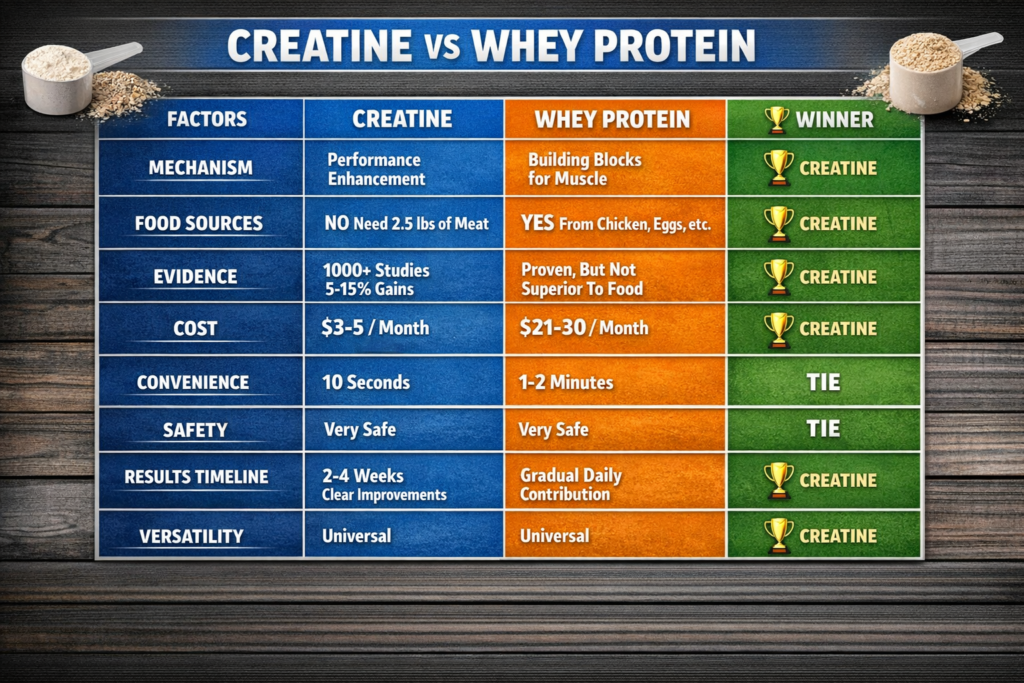
Creatine vs Whey Protein: Direct Comparison
Let’s compare these supplements across every relevant factor.
Comparison 1: Mechanism of Action
Creatine:
- Enhances training performance
- Increases strength and power
- Allows more reps and heavier weights
- Builds muscle indirectly through better training
Whey protein:
- Provides amino acids for muscle building
- Triggers muscle protein synthesis
- Supports recovery and repair
- Builds muscle directly (if total protein adequate)
Key difference:
- Creatine improves what you can do in gym
- Whey protein provides building blocks for growth
- Complementary, not competing
Comparison 2: Can You Get It From Food?
Creatine: ❌ NO, not in effective amounts
- Would need 2.5 pounds red meat daily for 5g
- Impractical and expensive
- Creates excessive calorie intake
- Supplementation necessary for optimal levels
Whey protein: ✅ YES, easily from whole foods
- Chicken, fish, eggs, dairy, beans all provide protein
- Adequate protein achievable through normal eating
- Whole food often superior (more nutrients, fiber, satiety)
- Supplementation optional, not required
Winner for necessity: Creatine (provides something diet cannot easily provide)
Comparison 3: Scientific Evidence
Creatine:
- 1,000+ studies over 30+ years
- Proven 5-15% strength increase
- Documented muscle mass gains
- One of most researched supplements ever
- Consistent, reliable results
- Recommended by every major sports science organization
Whey protein:
- Hundreds of studies
- Proven effective for muscle building
- Supports recovery
- High-quality protein source
- But not superior to whole food protein in equivalent amounts
- Convenience, not magic
Winner for evidence: Tie (both extensively proven, but creatine shows unique benefits beyond diet)
Comparison 4: Cost and Value
Creatine monohydrate:
- Price: $15-25 for 500g-1kg
- Servings: 100-200
- Daily dose: 5g
- Cost per day: $0.10-0.15
- Monthly cost: $3-5
- Annual cost: $36-60
Whey protein:
- Price: $50-70 for 5 pounds
- Servings: 70
- Daily dose: 30g (if using once daily)
- Cost per day: $0.70-1.00
- Monthly cost: $21-30
- Annual cost: $252-360
Cost comparison to achieve similar protein from whole food:
Whey protein: $252-360 annually
Equivalent whole food protein:
- Chicken breast: $3.00 per pound, provides ~100g protein
- To replace one daily whey shake (24g protein): ~0.25 pounds chicken = $0.75 daily
- Annual cost: $274
Verdict:
- Creatine: Incredibly affordable, no whole food equivalent
- Whey: More expensive, whole food often comparable or cheaper
- Winner: Creatine (better value, unique benefits)
Comparison 5: Convenience
Creatine:
- Mix 5g with any liquid
- Takes 10 seconds
- No taste (unflavored)
- Timing doesn’t matter (take anytime)
- Can mix with protein shake, water, juice, anything
- Ultimate convenience
Whey protein:
- Mix 30g with liquid
- Takes 1-2 minutes
- Various flavors available
- Best around training (optional)
- Requires shaker or blender
- Very convenient
Winner: Tie (both extremely convenient, creatine slightly edges out for simplicity)
Comparison 6: Side Effects and Safety
Creatine:
- Extremely safe (30+ years research)
- Minimal side effects for most people
- Possible: slight water retention (in muscles, good thing)
- Possible: mild digestive issues (rare, usually from loading)
- No long-term health risks identified
- Safe for healthy individuals
Whey protein:
- Generally safe for most people
- Possible: digestive issues (lactose intolerance)
- Possible: bloating or gas (individual tolerance)
- Possible: acne (some people sensitive to dairy)
- No long-term health risks from moderate use
- Safe for healthy individuals
Winner: Tie (both very safe)
Comparison 7: Results Timeline
Creatine:
- Week 1-2: Muscle saturation beginning
- Week 2-3: Strength improvements noticeable
- Week 3-4: Full benefits achieved
- Ongoing: Sustained performance enhancement
- Requires consistent daily use
- Benefits disappear 2-4 weeks after stopping
Whey protein:
- Immediate: Contributes to daily protein total
- Short-term: Supports recovery from that day’s training
- Long-term: Supports muscle growth over weeks/months
- Benefits tied to total protein intake, not whey specifically
- No loading or saturation period
- Simply part of daily nutrition
Winner: Creatine (clear, measurable performance improvements within weeks)
Comparison 8: Versatility
Creatine:
- Works for all training types (strength, hypertrophy, endurance)
- Benefits all age groups
- Helps both men and women equally
- Useful for cutting and bulking
- Even has cognitive benefits (emerging research)
- Universal supplement
Whey protein:
- Necessary for everyone (as part of total protein intake)
- More important when cutting (preserve muscle)
- Less critical when bulking (easier to hit protein from food)
- Benefits all training types
- Age-agnostic
- Nearly universal
Winner: Tie (both highly versatile)
Which Should You Choose If You Can Only Afford One?
The practical decision-making framework.
Choose Creatine If:
✅ Your diet already provides adequate protein
- Eating 0.7-1g protein per pound body weight
- Getting protein from chicken, fish, eggs, dairy, beans
- No trouble hitting protein targets with whole food
- Whey would be redundant
✅ You’re on a tight budget
- Creatine costs $3-5 monthly
- Provides unique benefits impossible from food
- Best value per dollar in supplements
- Can always add whey later if budget allows
✅ You want maximum performance improvement
- 5-15% strength increase meaningful to you
- Want to lift heavier weights
- Care about progressive overload
- Training performance is priority
✅ You value simplicity
- One supplement to take daily
- Timing doesn’t matter
- Mix with anything
- Minimal thought required
This describes 60-70% of people choosing their first supplement.
Choose Whey Protein If:
✅ You struggle to eat enough protein from whole food
- Can’t stomach enough chicken, fish, eggs
- Busy schedule prevents adequate protein meals
- Vegetarian with limited protein sources
- Consistently fall short of 0.7g per pound
✅ You need convenient protein for specific situations
- Post-workout when whole food not available
- Traveling frequently
- Work schedule prevents meal prep
- Convenience worth the cost
✅ You’re cutting and need high protein with low calories
- Whey provides 24g protein, 120 calories
- Helps hit protein targets in deficit
- More difficult to overeat than whole food
- Supports muscle preservation
✅ You prefer dairy-based supplements
- Tolerate whey well
- Enjoy the taste and variety
- Don’t mind higher cost
- Convenience valuable to you
This describes 30-40% of people choosing their first supplement.
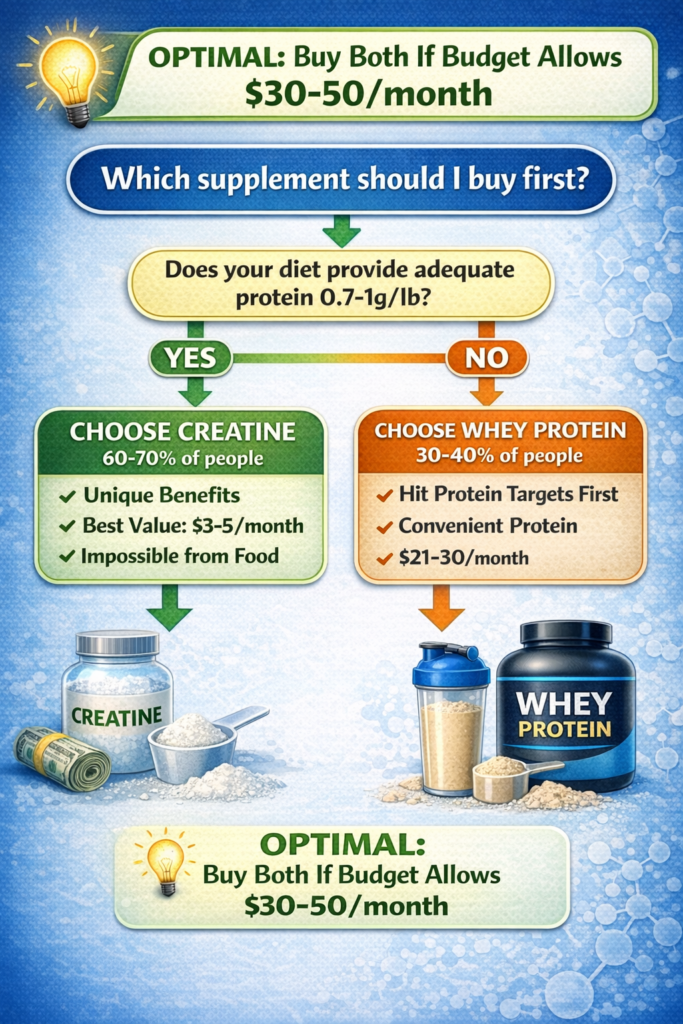
The Optimal Budget Strategy
If you have $30-50 monthly for supplements:
Priority 1: Creatine ($3-5)
- Non-negotiable
- Best value in all of supplements
- Unique benefits
- Proven results
Priority 2: Remaining budget toward whey ($25-45)
- If protein intake from food inadequate
- Provides convenience
- Helps hit daily targets
- Optional if diet is solid
Total: $28-50 monthly for both
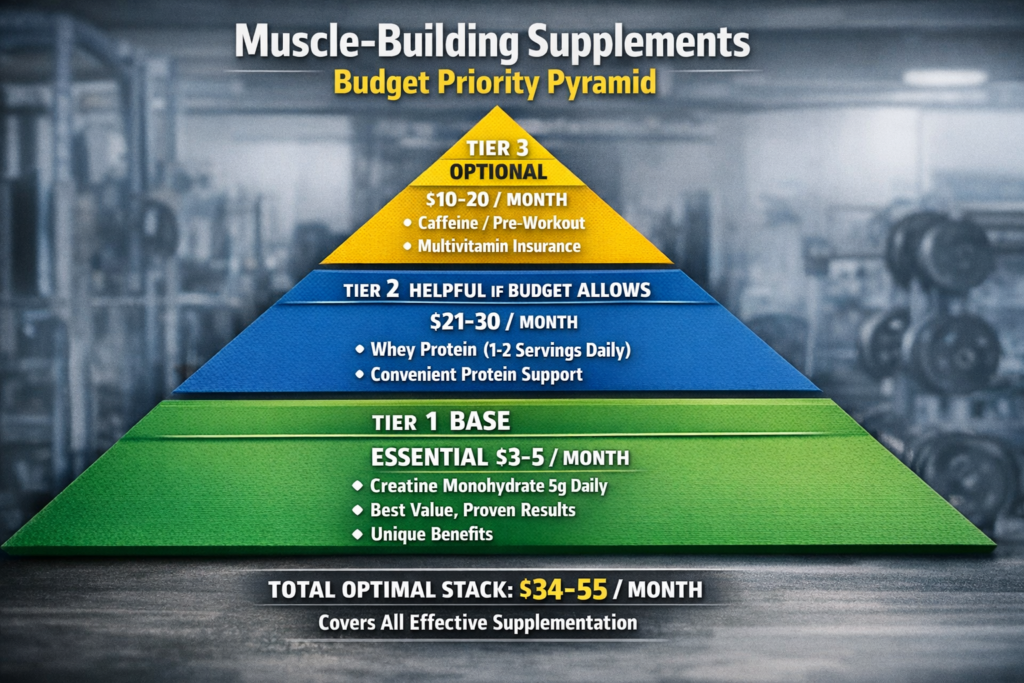
This covers 95% of effective supplementation for muscle building.
Can You Mix Creatine and Whey Protein?
Yes, and this creates synergy.
Why Combining Works
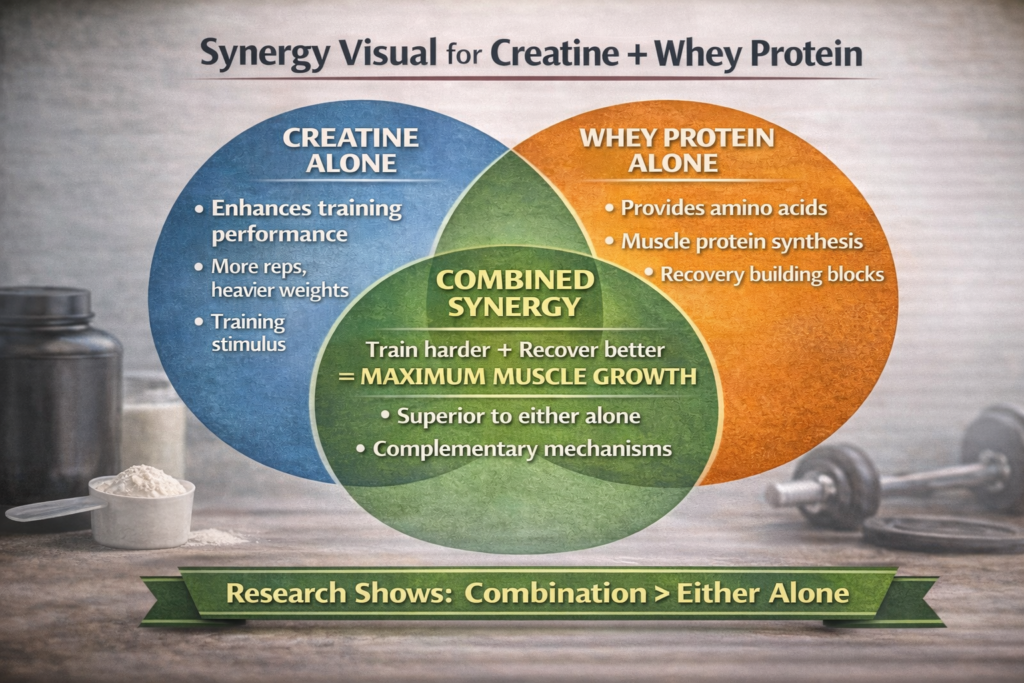
Complementary mechanisms:
Creatine:
- Enhances training performance
- Allows heavier weights and more reps
- Provides stimulus for growth
Whey protein:
- Provides amino acids for recovery
- Supports muscle protein synthesis
- Supplies building blocks for growth
Together:
- Train harder (creatine)
- Recover better (whey protein)
- Build more muscle (combination)
The Science of Combining
Research shows:
- Creatine + protein superior to either alone
- Enhanced muscle growth compared to single supplement
- Greater strength gains with combination
- Synergistic effects documented
Why synergy exists:
- Creatine improves training stimulus
- Protein provides recovery and building materials
- Both necessary for optimal muscle building
- Combination addresses both performance and recovery
How to Mix Them
The simple approach:
Post-workout shake:
- 30g whey protein
- 5g creatine monohydrate
- 8-12oz liquid (water or milk)
- Optional: 50g carbs (banana, oats, or dextrose)
Why add carbs:
- Insulin helps drive nutrients into muscles
- Enhances creatine uptake slightly
- Supports glycogen replenishment
- Provides energy for recovery
Important note: Carbs helpful but not essential. Creatine works fine without insulin spike.
Alternative: Take Separately
You don’t have to mix them:
Creatine:
- Take anytime during day
- Timing doesn’t matter
- Just take 5g daily consistently
- Mix with water, juice, coffee, anything
Whey protein:
- Take when you need convenient protein
- Post-workout common
- Between meals as snack
- Anytime replacing whole food protein
Both approaches work. Mixing is convenient, separating is fine.
The Bottom Line: Creatine for Most People, Both Is Optimal
After examining all the evidence:
The truth about creatine vs whey protein:
✅ Both help build muscle through different mechanisms
✅ Creatine provides unique benefits impossible to get from food
✅ Whey protein provides convenience but can be replaced by whole food
✅ Creatine is better value ($3-5 monthly vs $21-30)
✅ If choosing only one, creatine wins for most people
✅ Combining both creates synergy for maximum results
The decision framework:
If you can afford both ($30-50 monthly):
- Use both for maximum results
- Creatine for performance
- Whey for convenient protein
- Optimal approach
If budget limited ($5-15 monthly):
- Choose creatine
- Get protein from whole food
- Best value investment
- Add whey later if desired
If protein intake from food is inadequate:
- Choose whey protein first
- Hit protein targets (0.7-1g per pound)
- Add creatine when budget allows
- Protein is non-negotiable for muscle building
What matters most:
- Total daily protein intake (0.7-1g per pound)
- Progressive resistance training
- Adequate calories (surplus for muscle gain)
- Consistency over months and years
- Supplements enhance but don’t replace these fundamentals
The optimal supplement stack for muscle building:
Tier 1 (essential, $3-5 monthly):
- Creatine monohydrate 5g daily
Tier 2 (helpful if budget allows, $21-30 monthly):
- Whey protein 1-2 servings daily (if diet insufficient)
Tier 3 (optional, $10-20 monthly):
- Caffeine for pre-workout
- Multivitamin for nutritional insurance
Total: $34-55 monthly covers all effective supplementation
Everything beyond this provides minimal additional benefit for exponentially higher cost.
The priority system:
Priority 1: Build diet on whole food
- Quality protein sources (chicken, fish, eggs, dairy, beans)
- Adequate total protein (0.7-1g per pound)
- Sufficient calories (surplus for muscle gain)
- This is 80-90% of results
Priority 2: Add creatine
- $3-5 monthly
- Proven 5-15% performance boost
- Impossible to get from food
- Best supplement investment
Priority 3: Add whey if needed
- Only if diet falls short on protein
- Convenience factor
- Helps hit targets easily
- Optional if diet is solid
Priority 4: Focus on training and recovery
- Progressive overload in gym
- Adequate sleep (7-9 hours)
- Stress management
- Patience and consistency
CHOOSE CREATINE FIRST. ADD WHEY IF NEEDED. PRIORITIZE WHOLE FOOD NUTRITION.
Ready to optimize your entire muscle-building strategy with a science-based approach that maximizes results without wasting money on unnecessary supplements? Choosing between creatine and whey protein is just one decision in building an effective training and nutrition plan. Get a complete guide to calculating your exact protein and calorie needs, building a whole food diet that works, training for maximum muscle growth, and using supplements only when they truly add value. Stop overthinking supplements. Start building serious muscle with smart, evidence-based strategies.




Leave a Reply
You must be logged in to post a comment.