
Waiting to “feel motivated” to train? You’ll be waiting forever. Motivation is unreliable. Discipline is what actually works.
You wake up and your alarm goes off. Time for the gym. You don’t feel like going.
You tell yourself “I’ll go tomorrow when I feel more motivated.” Tomorrow comes. Still don’t feel like it. The cycle repeats.
You think successful people are just naturally motivated:
- They love training every day
- They wake up excited to work out
- They never struggle to get to the gym
- They have some secret willpower gene
Wrong. Successful people feel unmotivated constantly. They just go anyway. That’s the only difference. They built discipline, not motivation.
Here’s what’s actually happening: Motivation is an emotion. Emotions are temporary and unreliable. Your brain’s limbic system (emotional center) is designed to seek immediate pleasure and avoid discomfort. Waiting for motivation means waiting for your emotional brain to approve of hard work which it never will. Discipline is the prefrontal cortex (rational brain) overriding the limbic system. It’s a skill you build through repeated action despite how you feel. The neuroscience is clear: people who rely on discipline have fundamentally different neural pathways than those who rely on motivation.
In this comprehensive guide, I’ll explain why motivation fails you (the neurological mechanism), reveal how discipline actually works in the brain (it’s trainable), show you the 7-step protocol to build discipline (actionable system), provide the science of habit formation (automate behaviors), and explain why feelings are irrelevant to results (uncomfortable truth).
Whether you’re trying to lose fat, build muscle, or achieve any goal, understanding discipline vs. motivation changes everything.
Let’s build the neural pathways for consistent action regardless of feelings.
TABLE OF CONTENTS
The Neuroscience of Motivation (And Why It Fails)
Understanding what motivation actually is.
What Motivation Is (Neurologically)
The brain systems:
Limbic system (emotional brain):
- Amygdala (emotion center)
- Nucleus accumbens (reward center)
- Generates feelings and urges
- Seeks immediate pleasure
- Avoids immediate discomfort
- The “I don’t feel like it” voice
Dopamine system:
- Neurotransmitter of motivation
- Released in anticipation of reward
- Drives approach behavior
- Feels good
- The “I want to do this” feeling
What motivation feels like:
- Excited to train
- Can’t wait to get to gym
- Energized by the thought of working out
- Driven by anticipated reward
- Positive emotional state
The mechanism:
- Brain predicts reward (muscle gain, fat loss, feeling good)
- Dopamine releases in anticipation
- Creates desire to pursue activity
- Feels motivated
- Reward anticipation
Why Motivation Is Unreliable
Reason 1: Dopamine adaptation
The process:
- First few workouts: Novel, exciting, dopamine high
- Weeks 2-3: Less novel, less dopamine
- Month 2: Routine, minimal dopamine
- Novelty wears off
The result:
- Initial excitement fades
- No longer feels exciting
- Brain habituates to stimulus
- Motivation disappears
- Predictable decline
The science:
- Dopamine responds to novelty and surprise
- Predictable rewards produce less dopamine
- Same workout every week = less dopamine = less motivation
- Adaptation is inevitable
Reason 2: Delayed rewards
The problem:
- Training today doesn’t produce visible results today
- Results appear weeks or months later
- Brain struggles with delayed gratification
- Temporal discounting
The mechanism:
- Limbic system prioritizes immediate rewards
- Immediate comfort (skipping gym) > delayed reward (physique months later)
- Brain mathematically discounts future rewards
- Present bias
The research:
- Brain values $100 today more than $150 in year
- Same principle: comfort today > fitness later
- Evolutionary trait (immediate survival > distant goals)
- Hard-wired bias
Reason 3: Mood-dependent activation
The pattern:
- Good mood = feel motivated
- Bad mood = feel unmotivated
- Stress = feel unmotivated
- Tired = feel unmotivated
- Fluctuates constantly
Why this happens:
- Dopamine influenced by current state
- Stress hormones (cortisol) suppress dopamine
- Fatigue reduces dopamine sensitivity
- Mood disorders (depression) impair dopamine
- External factors control it
The problem:
- Can’t control mood perfectly
- Life stress inevitable
- Bad days happen
- Relying on motivation = inconsistency
- Unreliable foundation
Reason 4: Immediate discomfort override
The conflict:
- Gym = immediate discomfort (effort, sweating, fatigue)
- Skipping = immediate comfort (relaxation, no effort)
- Limbic system screams “avoid discomfort!”
- Immediate pain wins
The mechanism:
- Brain’s primary function: keep you alive and comfortable
- Discomfort signals potential threat
- Avoidance is protective
- Motivation can’t override survival wiring
- Biology working against you
The Motivation Trap
The cycle:
Week 1:
- New program, excited
- High motivation
- Perfect adherence
- Feel great
- Honeymoon phase
Week 2-3:
- Novelty wearing off
- Motivation declining
- Still going but harder
- Starting to miss sessions
- Motivation fading
Week 4+:
- Motivation gone
- Relying on willpower alone
- Missing more sessions
- Eventually quit
- Failure
The restart cycle:
- Quit for weeks/months
- Feel bad about self
- Get motivated again (temporarily)
- Restart
- Repeat entire cycle
- Endless loop
The pattern:
- Start strong, finish weak
- Inconsistent results
- Never build momentum
- Blame self for “lack of willpower”
- Frustration and failure
The truth:
- Not a willpower problem
- System design problem
- Relying on wrong mechanism
- Motivation is the wrong tool
What Discipline Actually Is (Neurologically)
The brain mechanism that works.
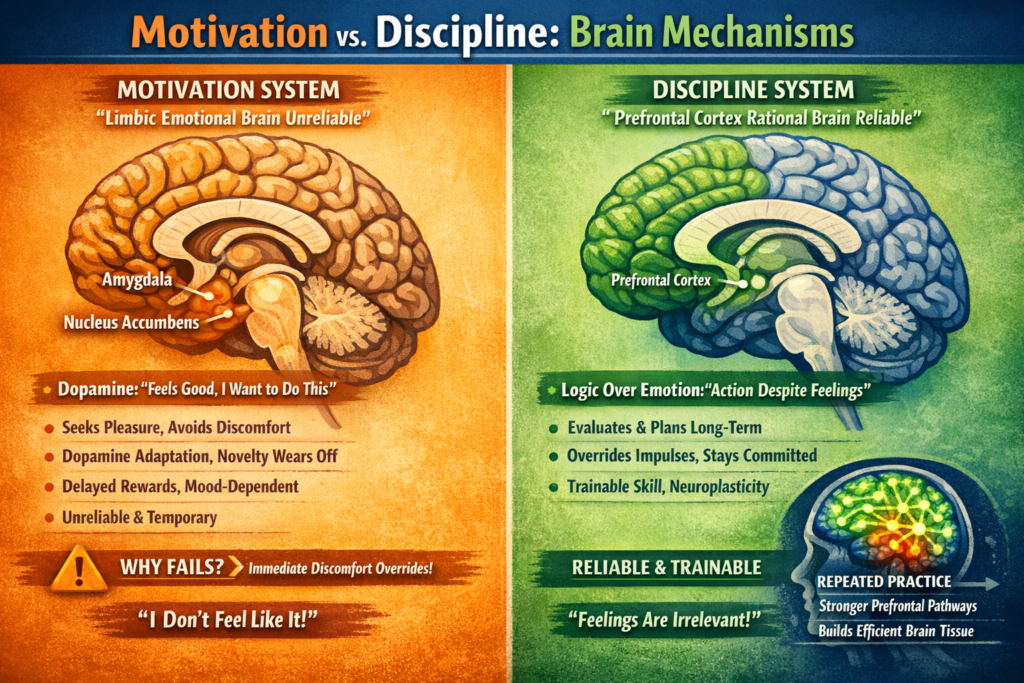
The Prefrontal Cortex Override
What the prefrontal cortex does:
- Rational decision-making
- Long-term planning
- Impulse control
- Goal-directed behavior
- Executive function
- The adult in the room
How it works:
- Evaluates situation rationally
- Considers long-term consequences
- Overrides emotional impulses
- Initiates action despite feelings
- Logic over emotion
The discipline mechanism:
Step 1: Limbic system signals
- “I don’t want to go to gym”
- “This will be uncomfortable”
- Emotional resistance
- Feeling unmotivated
Step 2: Prefrontal cortex response
- “Feelings are irrelevant”
- “I committed to training today”
- “Long-term goal matters more than current comfort”
- Decision to act anyway
- Rational override
Step 3: Action initiation
- Start getting ready
- Drive to gym
- Begin workout
- Despite feelings
- Execution regardless of emotion
Step 4: Reinforcement
- Complete workout
- Feel accomplished after
- Brain learns: action despite feelings → positive outcome
- Neural pathway strengthened
- Learning occurs
The key difference:
- Motivation: Act BECAUSE you feel like it
- Discipline: Act DESPITE not feeling like it
- Opposite mechanisms
Discipline as a Trainable Skill
The neuroplasticity principle:
- Brain changes based on repeated action
- Neural pathways strengthen with use
- Discipline is muscle, not trait
- You build it through practice
The process:
Initial state:
- Weak prefrontal cortex control
- Strong limbic system influence
- Emotions dominate decisions
- Untrained
After repeated practice:
- Stronger prefrontal cortex activation
- Reduced limbic system influence
- Easier to override emotions
- Trained discipline
The research:
- Brain scans show prefrontal cortex activity increases with self-control practice
- Becomes more efficient (requires less effort)
- Literally builds neural tissue
- Measurable brain changes
The implication:
- First few times extremely difficult
- Gradually becomes easier
- Eventually becomes default
- Progressive development
The Anterior Cingulate Cortex (The Conflict Detector)
What it does:
- Detects conflict between impulses and goals
- “I want comfort BUT I have a goal”
- Activates prefrontal cortex
- Conflict resolution center
How discipline trains it:
- Each time you choose goal over comfort
- ACC strengthens
- Becomes better at detecting conflicts
- Faster prefrontal activation
- Improved self-regulation
The benefit:
- Less internal struggle over time
- Decisions become faster
- Less willpower required
- Efficiency increases
Gray Matter Volume in Self-Control Regions
The finding:
- People with high self-discipline have more gray matter in:
- Dorsolateral prefrontal cortex
- Ventromedial prefrontal cortex
- Anterior cingulate cortex
- Physical brain differences
The question:
- Born this way or developed?
- Answer: Developed through practice
- Trainable trait
The evidence:
- Intervention studies show gray matter increases
- Self-control training changes brain structure
- Meditation increases prefrontal cortex thickness
- Discipline builds brain tissue
Why Feelings Are Irrelevant to Results
The uncomfortable truth.
Feelings Don’t Determine Outcomes
The principle:
- Results come from actions
- Actions can occur regardless of feelings
- Feelings don’t prevent action
- Therefore feelings are irrelevant
- Logic chain
The examples:
You can train while feeling:
- Tired
- Unmotivated
- Stressed
- Sore
- Distracted
- Annoyed
- Any emotional state
The workout quality:
- Might not be your best
- But you still trained
- Still got stimulus
- Still progressing
- Action occurred
The result:
- “Motivated” workout: Muscle stimulus → growth
- “Unmotivated” workout: Muscle stimulus → growth
- Same biological outcome
- Feelings didn’t matter
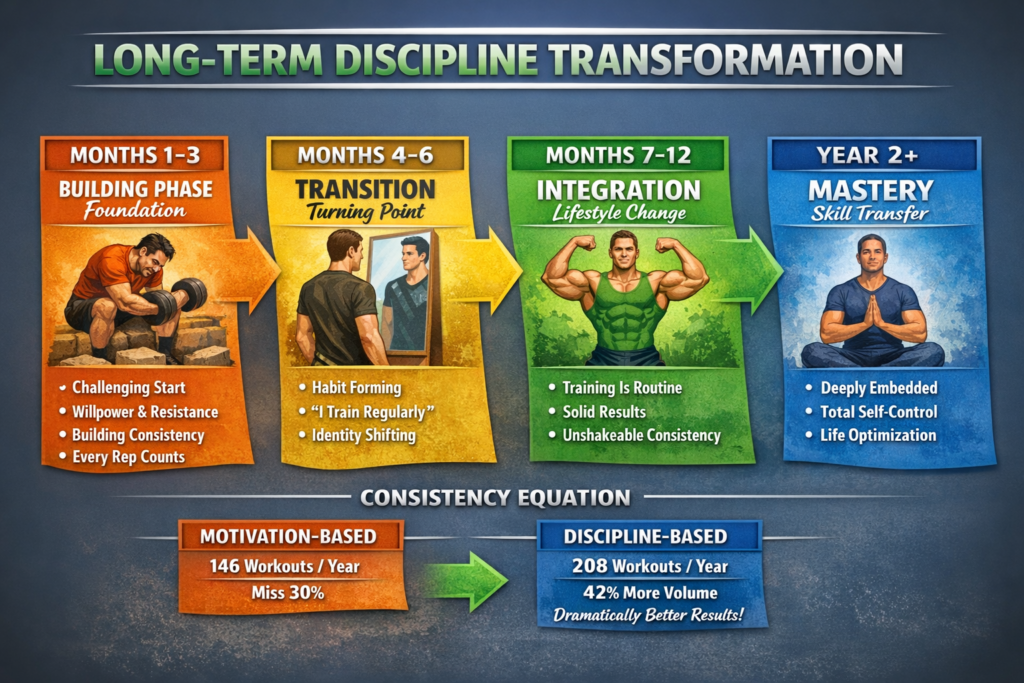
The Consistency Equation
The math:
- 52 weeks per year
- Training 4x per week = 208 workouts annually
- Miss 30% because “not motivated” = 146 workouts
- Train regardless of feelings = 208 workouts
- 42% more training volume
Over 5 years:
- Motivation-based: 730 workouts
- Discipline-based: 1040 workouts
- 310 more workouts
The result:
- 42% more volume = significantly better physique
- Consistency compounds
- Discipline wins
The Motivation Paradox
The phenomenon:
- Don’t feel like training
- Force yourself to go anyway
- 10 minutes in, feeling better
- Finish workout feeling great
- Motivation appears AFTER starting
Why this happens:
- Action generates dopamine
- Movement increases energy
- Accomplishment feels good
- Mood improves with activity
- Reverse causation
The lesson:
- Waiting for motivation backwards
- Action creates motivation, not vice versa
- “I’ll go when I feel like it” never happens
- “I’ll feel like it after I start” always happens
- Start first, feelings follow
The research:
- “Behavioral activation” for depression
- Action precedes motivation
- Movement improves mood
- Waiting perpetuates inaction
- Clinically proven
Feelings Lie
The deception:
Feeling says: “You’re too tired to train” Reality: Not physically exhausted, just mentally resistant
Feeling says: “You’ll have a terrible workout” Reality: Workout often fine or even good
Feeling says: “Missing one session doesn’t matter” Reality: Pattern of missing builds, consistency breaks
Feeling says: “You deserve rest today” Reality: Already rested yesterday, this is avoidance
The pattern:
- Feelings are poor predictors
- Often wrong about capability
- Biased toward comfort
- Unreliable information source
The solution:
- Don’t consult feelings for action decisions
- Consult pre-made commitment
- “Does calendar say train today? Then train.”
- Bypass emotional input
The 7-Step Protocol to Build Discipline
Actionable system for developing self-discipline.
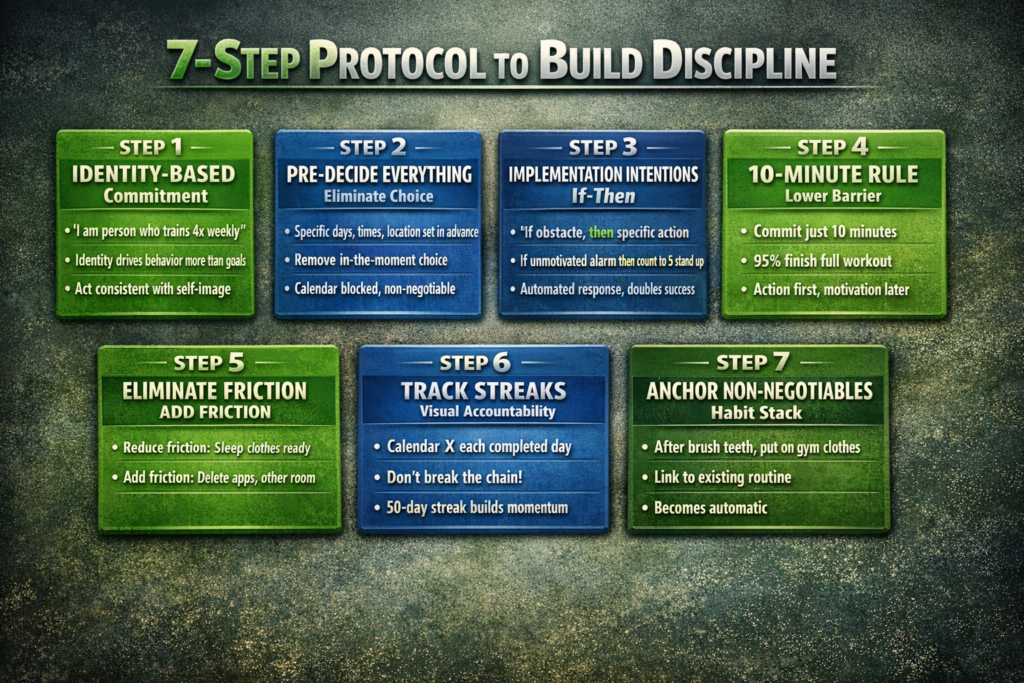
Step 1: Make Identity-Based Commitment
What it means:
- “I am a person who trains 4x weekly”
- Not “I’m trying to train more”
- Identity, not goal
- Self-concept shift
Why it works:
- Identity drives behavior more than goals
- “I’m a runner” → runs even when unmotivated
- “I want to run more” → runs only when motivated
- Identity overrides emotion
The research:
- People act consistently with self-image
- Identity-based habits more sustainable
- Self-perception powerful behavior driver
- Evidence-based approach
How to implement:
- Declare identity: “I am an athlete”
- “I am someone who never misses training”
- Repeat daily
- Act consistent with identity
- Internalize identity
The effect:
- Missing training conflicts with identity
- Creates cognitive dissonance
- Stronger motivation to maintain consistency
- Self-concept protection
Step 2: Pre-Decide Everything
The principle:
- Make decisions in advance
- Remove in-the-moment choice
- Eliminate decision fatigue
- Automate commitment
What to pre-decide:
Training days:
- Specific days (Monday, Wednesday, Friday, Saturday)
- Non-negotiable
- Written down
- Fixed schedule
Training time:
- Specific time (6:00 AM, 5:00 PM, etc.)
- Same time each training day
- Calendar blocked
- Consistency
Training location:
- Which gym
- Which area if home
- Remove options
- One choice
What you’ll do:
- Program written in advance
- No deciding at gym
- Execute predetermined plan
- Zero improvisation
Why this works:
- Decision fatigue depletes willpower
- Each decision costs mental energy
- Pre-decisions preserve willpower
- Execution becomes mechanical
- Conservation of willpower
The implementation:
- Sunday: Plan entire week
- Write training days, times, exercises
- Set reminders/alarms
- No deviations
- Complete planning
Step 3: Create Implementation Intentions
What they are:
- “If-then” statements
- Pre-planned responses to obstacles
- Reduces decision-making
- Contingency planning
The format:
- “If [obstacle], then [specific action]”
- Concrete and specific
- Predetermined response
- Automatic execution
Examples:
If I feel unmotivated when alarm goes off:
- Then I will count to 5 and stand up immediately
If I want to skip training:
- Then I will put on gym clothes and commit to just 10 minutes
If I’m tired after work:
- Then I will change into gym clothes before sitting down
If gym is crowded:
- Then I will do alternative exercises I’ve pre-planned
Why they work:
- Reduces mental effort during execution
- Brain follows pre-set pattern
- No willpower needed to decide
- Automated response
The research:
- Implementation intentions double success rate
- Reduces procrastination
- Increases follow-through
- Proven intervention
Step 4: Use the 10-Minute Rule
The principle:
- Commit to just 10 minutes
- If after 10 minutes still want to quit, can leave
- Almost always continue after starting
- Lower barrier to entry
Why it works:
Psychological:
- 10 minutes feels manageable
- Reduces overwhelm
- Gets you through door
- Mental barrier reduced
Physiological:
- Body warms up
- Energy increases
- Mood improves
- State change occurs
Neurological:
- Action initiates dopamine release
- Motivation appears after starting
- Momentum builds
- Reverse causation
The outcome:
- 95% of time, complete full workout
- 5% of time, do 10 minutes (still better than zero)
- Almost always full session
The implementation:
- Feel resistance
- Tell self “just 10 minutes”
- Start
- Re-evaluate after 10 minutes
- Almost always continue
- Proven technique
Step 5: Eliminate Friction and Add Friction
Reduce friction for desired behavior:
For morning training:
- Sleep in gym clothes
- Shoes next to bed
- Bag packed night before
- Pre-workout prepared
- Zero barriers
For evening training:
- Gym clothes in car
- Bag always packed
- Route home passes gym
- Convenient path
The principle:
- Every obstacle reduces likelihood
- Remove all obstacles
- Make it as easy as possible
- Path of least resistance
Add friction to undesired behavior:
If you skip to scroll phone:
- Delete social media apps
- Turn off wifi
- Phone in other room
- Make procrastination harder
If you skip to watch TV:
- Unplug TV
- Hide remote
- Cancel streaming subscriptions
- Add barriers
The principle:
- Every obstacle reduces likelihood
- Add obstacles to bad habits
- Make it harder to fail
- Reverse friction
Step 6: Track and Enforce Streaks
The tracking system:
- Calendar with X for each completed training day
- Visual representation of consistency
- “Don’t break the chain”
- Visible accountability
Why it works:
Psychological:
- Seeing streak builds pride
- Motivation to maintain streak
- Breaking streak feels like failure
- Loss aversion
Neurological:
- Visual progress activates reward centers
- Dopamine from accomplishment
- Reinforces behavior
- Positive feedback loop
The implementation:
- Physical calendar on wall (better than app)
- Big red X for each training day
- Hung in visible location
- Review daily
- Constant reminder
The power:
- 5-day streak: Moderate motivation to continue
- 20-day streak: Strong motivation to continue
- 50-day streak: Will train injured rather than break
- Momentum builds
Important:
- If break streak, start immediately (don’t wait for Monday)
- One miss doesn’t erase progress
- Just restart
- Resilience
Step 7: Anchor to Non-Negotiables
The concept:
- Link training to activities you already do without question
- Leverage existing discipline
- Habit stacking
Examples of non-negotiables:
- Eating meals
- Brushing teeth
- Showering
- Going to work
- Things you never skip
How to anchor:
Morning training:
- “After I brush teeth, I put on gym clothes”
- “After gym clothes, I drive to gym”
- Chain behaviors
- Sequential automation
Evening training:
- “After I leave work, I drive to gym (before going home)”
- “After gym, I shower, then eat dinner”
- Integrated routine
Why it works:
- Leverages existing neural pathways
- Reduces decision-making
- Becomes as automatic as brushing teeth
- Habit formation
The result:
- Training becomes default
- Skipping feels abnormal
- Consistency automatic
- Discipline internalized
The Science of Habit Formation
Making discipline automatic.
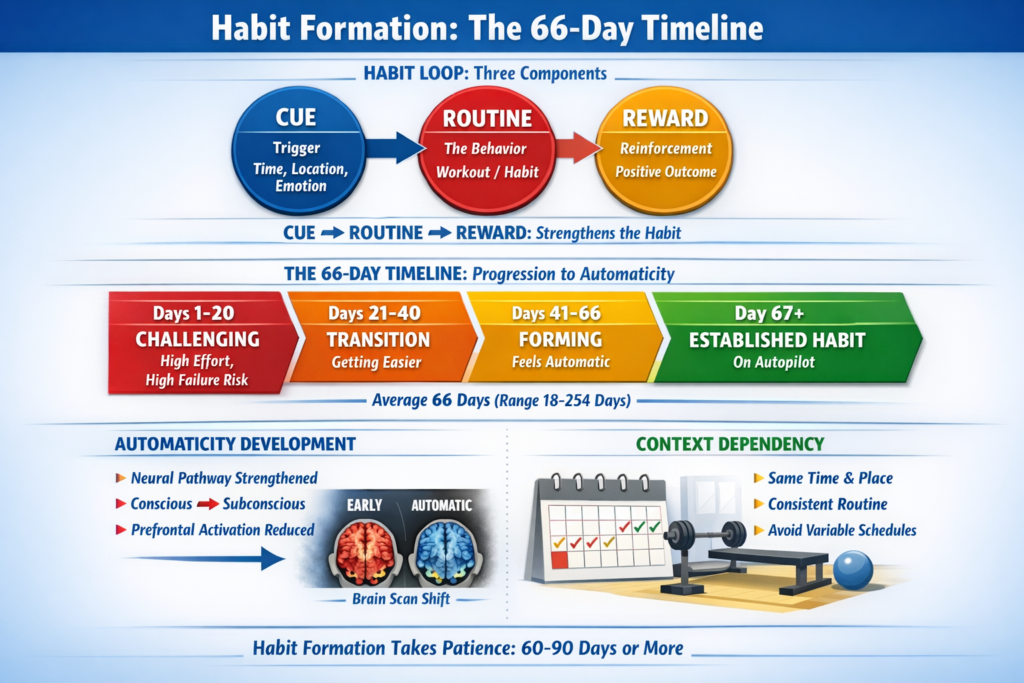
The Habit Loop
The components:
1. Cue (trigger):
- Specific time (6:00 AM alarm)
- Location (leaving work building)
- Emotional state (stress)
- Preceding action (finishing breakfast)
- Initiating stimulus
2. Routine (behavior):
- The action itself
- Going to gym
- Completing workout
- The habit
3. Reward (reinforcement):
- Feeling accomplished
- Endorphin release
- Progress toward goal
- Visual check on calendar
- Positive outcome
The loop:
- Cue → Routine → Reward
- Reward reinforces cue-routine connection
- Strengthens over repetitions
- Becomes automatic
- Neural pathway formation
The 66-Day Timeline
The research:
- Average time to form habit: 66 days
- Range: 18-254 days depending on complexity
- Training habit: ~60-90 days
- Patience required
The progression:
Days 1-20:
- Requires high willpower
- Significant effort each time
- Feels unnatural
- High failure risk
- Most difficult phase
Days 21-40:
- Becoming easier
- Still requires willpower
- Starting to feel more natural
- Moderate failure risk
- Transition phase
Days 41-66:
- Requires less willpower
- Feels more automatic
- Skipping feels wrong
- Low failure risk
- Habit forming
Day 67+:
- Largely automatic
- Minimal willpower needed
- Default behavior
- Very low failure risk
- Habit established
The implication:
- First 2 months hardest
- Must persist through difficulty
- Gets dramatically easier
- Temporary suffering, permanent gain
Automaticity Development
What automaticity means:
- Behavior occurs without conscious thought
- Like brushing teeth or driving familiar route
- Don’t need to “motivate” yourself
- Just do it
- True habit
How it develops:
Neural efficiency:
- Repeated action strengthens neural pathway
- Signal travels faster
- Less conscious processing needed
- Becomes subconscious
- Brain optimization
Reduced prefrontal activation:
- Initially: High prefrontal cortex activity (conscious control)
- After automation: Low prefrontal activity (subconscious)
- Brain scans show this shift
- Cognitive efficiency
The benefit:
- Preserves willpower for other tasks
- Training doesn’t drain you
- Sustainable long-term
- Effortless consistency
Context Dependency
The principle:
- Habits linked to specific contexts
- Same time, place, preceding action
- Context becomes trigger
- Environmental cueing
The strategy:
- Train same days, same times, same location
- Consistency in context
- Builds stronger association
- Leverage environment
The mistake:
- Variable schedule (sometimes morning, sometimes evening)
- Different gyms constantly
- Inconsistent context
- Habit never forms
- Prevents automaticity
The fix:
- Maximum consistency in all contextual elements
- Same time (within 30 minutes)
- Same location
- Same day of week
- Rigid structure
Discipline in Different Life Contexts
How to maintain consistency through challenges.
High Stress Periods
The challenge:
- Work deadlines
- Family issues
- Financial problems
- Multiple stressors
- Cognitive overload
Why discipline matters more:
- Stress depletes willpower
- Motivation completely absent
- If relying on motivation, will quit
- Discipline independent of stress
- Resilience mechanism
The approach:
Reduce volume, maintain frequency:
- 4 sessions per week → 3 sessions
- 60 minutes → 30 minutes
- Maintain habit, reduce load
- Consistency over volume
Why this works:
- Habit breaking is biggest risk
- Reduced volume sustainable under stress
- Maintains momentum
- Prevents full derailment
- Strategic adaptation
The mindset:
- “Something is better than nothing”
- Perfect is enemy of good
- Maintain streak at all costs
- Flexibility within structure
Travel and Disrupted Routine
The challenge:
- Different environment
- No usual cues
- Contextual triggers absent
- Easy to skip
- Disruption risk
The solution:
Pre-plan completely:
- Research hotel gym or nearby gym
- Pack resistance bands or bodyweight plan
- Schedule exact time
- No improvisation
- Eliminate uncertainty
Create new cues:
- Morning: After hotel breakfast, train
- Evening: After work obligations, train
- Anchor to remaining routines
- Temporary context
Lower barrier:
- 20-minute hotel gym session counts
- Bodyweight routine in room counts
- Any movement counts
- Maintain habit, adjust intensity
Injury or Illness
The challenge:
- Can’t do normal training
- Easy excuse to quit entirely
- Momentum break risk
- Legitimate obstacle
The approach:
Train around injury:
- Lower body injury → upper body only
- Upper body injury → lower body only
- Cardio injury → resistance training
- Adapt, don’t eliminate
Active recovery:
- Walking
- Stretching
- Light mobility work
- Counts as “training day”
- Maintain streak
Why this matters:
- All-or-nothing thinking dangerous
- Complete cessation breaks habit
- Something maintains identity
- Psychological preservation
Motivation Completely Absent
The scenario:
- Zero desire to train
- Dreading it all day
- Every fiber wants to skip
- Maximum resistance
The discipline protocol:
Step 1: Acknowledge feeling
- “I really don’t want to train”
- Don’t fight the feeling
- Accept emotion
Step 2: Separate feeling from action
- “Feeling is valid AND irrelevant”
- “I can feel this way and still train”
- Decouple emotion and behavior
Step 3: Focus on just next action
- Not whole workout
- Just put on gym clothes
- Micro-commitment
Step 4: Use 10-minute rule
- “Just 10 minutes”
- Start
- Re-evaluate
- Lower threshold
Step 5: Execute
- Do it anyway
- Despite feelings
- Mechanical execution
- Action independent of emotion
The outcome:
- Almost always complete workout
- Feel better after
- Discipline muscle strengthened
- Growth occurs
The Long-Term Transformation
What happens when discipline becomes default.
Months 1-3: The Building Phase
What’s happening:
- Establishing neural pathways
- Prefrontal cortex strengthening
- Habit beginning to form
- Still difficult
- Foundation building
The experience:
- Requires significant willpower
- Many days of resistance
- Victories feel hard-won
- Effortful period
The progress:
- Consistency improving
- Missing fewer sessions
- Building momentum
- Early success
The mindset:
- “This is temporary difficulty”
- “Building the skill”
- “Each rep makes next easier”
- Growth perspective
Months 4-6: The Transition
What’s happening:
- Habit solidifying
- Automaticity developing
- Requires less conscious effort
- Turning point
The experience:
- Some days still hard
- But many days automatic
- Training feels more natural
- Skipping feels wrong
- Behavioral shift
The transformation:
- Identity shifting
- “I’m a person who trains consistently”
- Self-concept aligning
- Internal change
Months 7-12: The Integration
What’s happening:
- Habit fully formed
- Largely automatic
- Integrated into identity
- Lifestyle change
The experience:
- Training is just what you do
- Like brushing teeth
- Don’t question it
- Minimal willpower needed
- Effortless consistency
The results:
- Dramatic physique changes
- Strength gains substantial
- Consistency unshakeable
- Compound progress
The realization:
- “I can’t imagine not training”
- Discipline became default
- Motivation irrelevant
- Permanent transformation
Year 2+: The Mastery
What’s happening:
- Complete automaticity
- Discipline extends to all areas
- Generalized self-control
- Skill transfer
The experience:
- Training non-negotiable
- Same as eating or sleeping
- Core part of identity
- Deeply integrated
The unexpected benefits:
Discipline transfers:
- Nutrition easier to manage
- Work productivity increases
- Relationships improve (follow-through)
- Financial discipline improves
- General life improvement
Confidence increases:
- Proof of ability to commit
- Self-trust developed
- Know you can achieve goals
- Self-efficacy
Resilience strengthened:
- Ability to persist through adversity
- Mental toughness developed
- Handle stress better
- Psychological strength
The Bottom Line: Discipline Beats Motivation Every Time
After explaining everything:
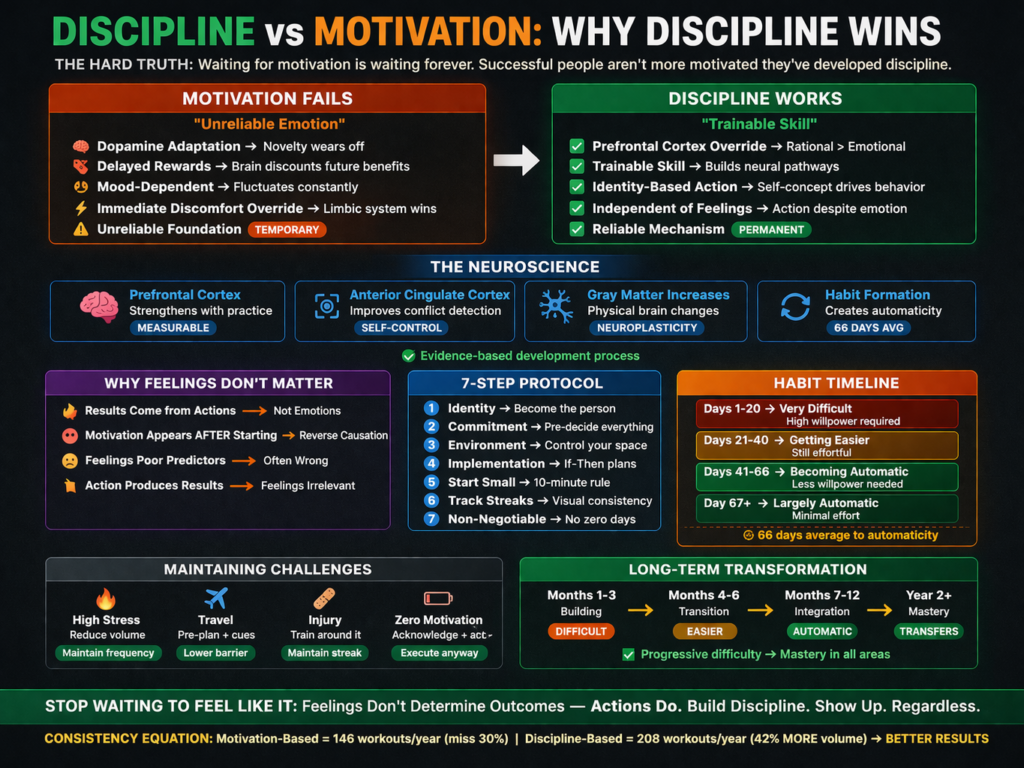
The truth about discipline vs. motivation:
✅ Motivation is an emotion, emotions are unreliable (limbic system seeking immediate comfort)
✅ Discipline is prefrontal cortex overriding emotions (trainable neural skill)
✅ Feelings are irrelevant to results (action produces outcomes, not emotions)
✅ Consistency beats intensity (208 workouts/year beats 100 “motivated” ones)
✅ Discipline is a skill you build, not a trait you’re born with (neuroplasticity)
Key takeaways:
Why motivation fails:
- Dopamine adaptation (novelty wears off)
- Delayed rewards (brain discounts future benefits)
- Mood-dependent (fluctuates constantly)
- Immediate discomfort override (limbic system wins)
- Unreliable foundation
What discipline actually is:
- Prefrontal cortex override (rational brain controls emotional brain)
- Trainable skill (builds neural pathways)
- Identity-based action (self-concept drives behavior)
- Independent of feelings (action despite emotion)
- Reliable mechanism
The neuroscience:
- Prefrontal cortex strengthens with practice
- Anterior cingulate cortex improves conflict detection
- Gray matter increases in self-control regions
- Habit formation creates automaticity
- Measurable brain changes
Why feelings don’t matter:
- Results come from actions, not emotions
- Can train in any emotional state
- Motivation appears AFTER starting (reverse causation)
- Feelings are poor predictors (often wrong)
- Action produces results
The 7-step discipline protocol:
- Identity-based commitment (“I am someone who trains 4x weekly”)
- Pre-decide everything (days, times, exercises in advance)
- Implementation intentions (if-then responses to obstacles)
- 10-minute rule (commit to just 10 minutes, almost always continue)
- Eliminate friction (remove barriers) and add friction (to skipping)
- Track streaks (visual calendar, don’t break chain)
- Anchor to non-negotiables (habit stack with existing routines)
- Actionable system
Habit formation timeline:
- Days 1-20: Very difficult, high willpower required
- Days 21-40: Getting easier, still effortful
- Days 41-66: Becoming automatic, less willpower
- Day 67+: Largely automatic, minimal effort
- 66 days average to automaticity
Maintaining through challenges:
- High stress: Reduce volume, maintain frequency
- Travel: Pre-plan, create new cues, lower barrier
- Injury: Train around it, maintain streak
- Zero motivation: Acknowledge feeling, separate from action, execute anyway
- Adaptability
Long-term transformation:
- Months 1-3: Building foundation (difficult)
- Months 4-6: Transition (becoming easier)
- Months 7-12: Integration (automatic)
- Year 2+: Mastery (transfers to all life areas)
- Progressive development
The consistency equation:
- Motivation-based: 146 workouts/year (miss 30% from “not feeling it”)
- Discipline-based: 208 workouts/year (train regardless)
- 42% more volume = dramatically better results
- Discipline wins
Priority actions:
- Declare identity: “I am someone who never misses training”
- Pre-decide this week’s training (specific days, times)
- Create 3 implementation intentions (if-then statements)
- Buy physical calendar, mark Xs for each training day
- Commit to 66 days minimum (habit formation period)
- Start building now
The hard truth:
- Waiting for motivation = waiting forever
- Successful people aren’t more motivated
- They just developed discipline
- You can too
- Trainable skill
STOP WAITING TO FEEL LIKE IT. FEELINGS DON’T DETERMINE OUTCOMES. ACTIONS DO. BUILD DISCIPLINE. SHOW UP REGARDLESS.
Ready to build a complete discipline and habit formation system with neuroscience-based protocols, environmental design strategies, identity transformation techniques, and accountability structures that guarantee consistent action regardless of motivation levels? Understanding discipline is just the beginning. Get a comprehensive guide to building unshakeable consistency, automating desired behaviors, developing bulletproof self-control, and achieving any goal through systematic discipline development. Stop relying on feelings. Start building discipline.
REFERENCES
SECTION 1 — Dopamine, novelty habituation, and why motivation fades
[1] Schultz W — PubMed/Journal of Neurophysiology, 1998 Foundational neurophysiology study; midbrain dopamine neurons show phasic activation to novel and rewarding stimuli; novelty responses habituate as stimuli become familiar and predictable, decaying gradually with repetition; dopamine signals unexpected rewards (prediction error) — when outcomes become predictable, dopamine response diminishes; explains the neurobiological mechanism by which initial excitement about a new training program fades over weeks as novelty wears off, producing the motivation decline described in the article https://pubmed.ncbi.nlm.nih.gov/9580531/
[2] Bromberg-Martin ES et al. — PMC/Neuron, 2010 Review of dopamine’s role in motivational control; dopamine neurons respond to both reward value and alerting/novel events; DA burst responses triggered by novel stimuli habituate as stimuli become familiar, in parallel with habituation of orienting reactions; surprising and novel events evoke DA release that shapes reward processing; phasic DA reward signals underpin approach motivation — their habituation with repeated familiar stimuli provides the mechanistic explanation for why motivation is emotion-dependent and declines with routine https://pmc.ncbi.nlm.nih.gov/articles/PMC3032992/
SECTION 2 — Prefrontal cortex, self-control, and neuroplasticity of discipline
[3] Hofmann W et al. — PMC/Frontiers in Behavioral Neuroscience, 2019 Review of non-invasive brain stimulation and self-regulation; self-regulation is achieved through top-down control from the prefrontal cortex (particularly DLPFC) over subcortical reward and threat processing in the limbic system; self-regulatory failure occurs when top-down control is diminished; a 40-year longitudinal follow-up of children who participated in Mischel’s delay of gratification study showed that those who delayed gratification showed preferential DLPFC recruitment during inhibitory control tasks as adults; directly validates the article’s PFC-overrides-limbic-system model of discipline https://www.frontiersin.org/journals/behavioral-neuroscience/articles/10.3389/fnbeh.2018.00337/full
[4] Tang YY et al. — PMC/Journal of Integrative Neuroscience, 2025 Review of self-directed neuroplasticity; training-induced changes in gray matter volume confirmed in frontoparietal areas, anterior cingulate cortex (ACC), and striatum; self-control training modulates and reorganizes brain structure over time; the ACC plays a central role in conflict detection and autonomic regulation of self-control; effortful self-control practice leads to measurable structural brain changes; supports the article’s claim that discipline is a trainable skill that physically builds neural tissue in self-control regions https://www.imrpress.com/journal/JIN/24/11/10.31083/JIN46733/
SECTION 3 — Implementation intentions and the if-then planning system
[5] Gollwitzer PM & Sheeran P — PubMed/Advances in Experimental Social Psychology, 2006 Meta-analysis of 94 independent tests with more than 8,000 participants; implementation intentions (if-then plans specifying when, where, and how to act) had a medium-to-large positive effect on goal attainment (d=0.65); effective in promoting initiation of goal striving, shielding ongoing goal pursuit from unwanted influences, and disengagement from failing courses of action; implementation intentions work by making the specified situation highly cognitively accessible and automating the linked response — removing the need for conscious deliberation; directly supports the article’s Step 3 protocol of pre-planned if-then responses to training obstacles https://www.sciencedirect.com/science/chapter/bookseries/abs/pii/S0065260106380021
[6] Achtziger A et al. — PubMed/European Journal of Social Psychology, 2008 Two field experiments on dieting (Study 1) and athletic goals (Study 2); forming if-then plans enhanced the rate of goal attainment in both experiments; implementation intentions specifically geared at controlling interfering inner states (food cravings, disruptive thoughts, and physiological states) during athletic goal pursuit were effective; action control by implementation intentions was faster and required less effort than conscious deliberation; provides direct athletic evidence base for the article’s training-specific if-then planning recommendations https://pubmed.ncbi.nlm.nih.gov/18272806/
SECTION 4 — Habit formation: the 66-day timeline and automaticity
[7] Lally P et al. — Wiley/European Journal of Social Psychology, 2010 96 volunteers chose an eating, drinking, or physical activity behavior to perform daily in the same context for 12 weeks; self-report habit index (SRHI) completed daily; habit automaticity followed an asymptotic curve; time to reach 95% of maximum automaticity ranged from 18 to 254 days; average was 66 days; simpler behaviors (drinking water) automated faster than complex ones (50 sit-ups); missing one day did not materially harm habit formation process; foundational study establishing the realistic timeline the article uses — and refuting the popular “21-day” myth https://onlinelibrary.wiley.com/doi/abs/10.1002/ejsp.674
[8] Keller J et al. — PMC/International Journal of Environmental Research and Public Health, 2024 Systematic review and meta-analysis of 20 studies, 2601 participants; time to reach habit automaticity for health behaviors varied widely — median 59–66 days, mean 106–154 days, with individual range of 4–335 days; consistency of repetition in stable contexts was the critical determinant of automaticity development; physical activity habits (n=8 studies) followed same asymptotic curve as other health behaviors; training in the same context (same time, place, preceding action) was the strongest predictor of successful automaticity; validates the article’s advice on maximizing contextual consistency https://pmc.ncbi.nlm.nih.gov/articles/PMC11641623/
SECTION 5 — Action precedes motivation: behavioral activation evidence
[9] Cuijpers P et al. — PubMed/Journal of Clinical Psychology, 2007 Meta-analysis of 16 randomized studies with 780 subjects of behavioral activation (activity scheduling) for depression; pooled effect size of 0.87 (95% CI: 0.60–1.15) — a large effect; behavioral activation was equivalent to cognitive therapy (ES=0.02); demonstrates clinically that structured action in the absence of motivation produces mood improvement, not the reverse; the core mechanism — action generates mood change rather than mood change enabling action — directly supports the article’s “motivation appears AFTER starting” principle and the reversal-of-causation argument https://pubmed.ncbi.nlm.nih.gov/17184887/




Leave a Reply
You must be logged in to post a comment.