Wondering if bananas can contribute to your daily protein intake? Here’s the complete nutritional truth about protein in bananas.
You’re trying to hit your protein targets. You eat a banana as a snack.
Someone asks: “How much protein is in that?”
You realize you have no idea. You’ve always thought of bananas as “healthy” but never considered the protein content.
Quick Google search shows conflicting information. Some sources say bananas have protein. Others dismiss it as negligible.
So which is it?
Here’s the straightforward answer: Yes, bananas contain protein, but only about 1.3g per 100g (medium banana). This is too low to consider bananas a protein source. However, bananas excel as a carbohydrate source providing quick energy, potassium for muscle function, and various vitamins and minerals. They’re best combined with actual protein sources rather than relied upon for protein intake.
In this comprehensive guide, I’ll provide the complete nutritional breakdown of bananas including exact protein content, explain whether banana protein has any practical value in your diet, reveal how bananas fit into muscle-building and fitness nutrition, show you how to combine bananas with protein for optimal snacks, and identify fruits that actually contain significant protein if you’re looking for alternatives.
Whether you’re tracking macros precisely or just trying to eat healthier, this article will clarify bananas’ nutritional role.
Let’s examine the facts.
TABLE OF CONTENTS
The Direct Answer: Banana Protein Content
Getting the numbers out of the way first.
Exact Protein Content
Per medium banana (100g):
- Protein: 1.3g
- Percentage of banana’s calories from protein: ~5%
For context:
Compared to actual protein sources:
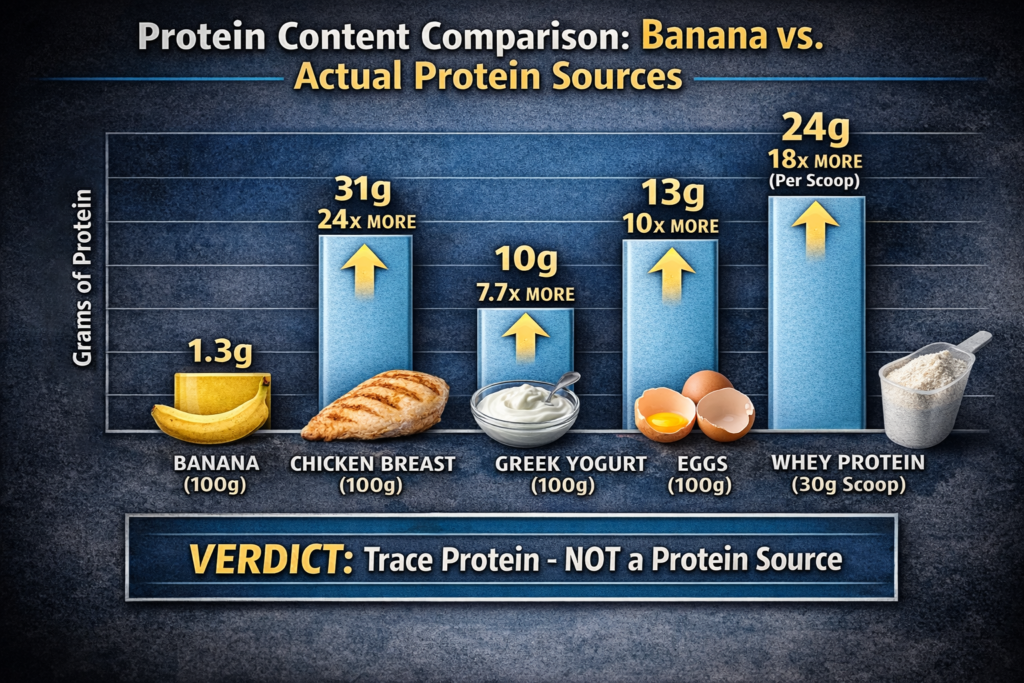
- Chicken breast (100g): 31g protein (24x more)
- Greek yogurt (100g): 10g protein (7.7x more)
- Eggs (100g): 13g protein (10x more)
- Whey protein (30g scoop): 24g protein (18x more per 30g)
Compared to other carb sources:
- White rice (100g cooked): 2.7g protein (2x more)
- Oats (100g dry): 13g protein (10x more)
- Sweet potato (100g): 2g protein (1.5x more)
The verdict: Bananas contain trace amounts of protein, but nowhere near enough to be considered a protein source.
Why Bananas Aren’t a Protein Source
Classification of protein sources:
High protein foods (>20% calories from protein):
- Meat, fish, eggs
- Protein powders
- Greek yogurt
- Legumes
Moderate protein foods (10-20% calories from protein):
- Whole grains
- Some dairy
- Nuts and seeds
Low protein foods (<10% calories from protein):
- Most fruits (including bananas at ~5%)
- Most vegetables
- Simple carb sources
Bananas fall into the “low protein” category and should not be counted as contributing meaningfully to daily protein intake.
Complete Nutritional Breakdown of Bananas
Understanding what bananas actually provide.
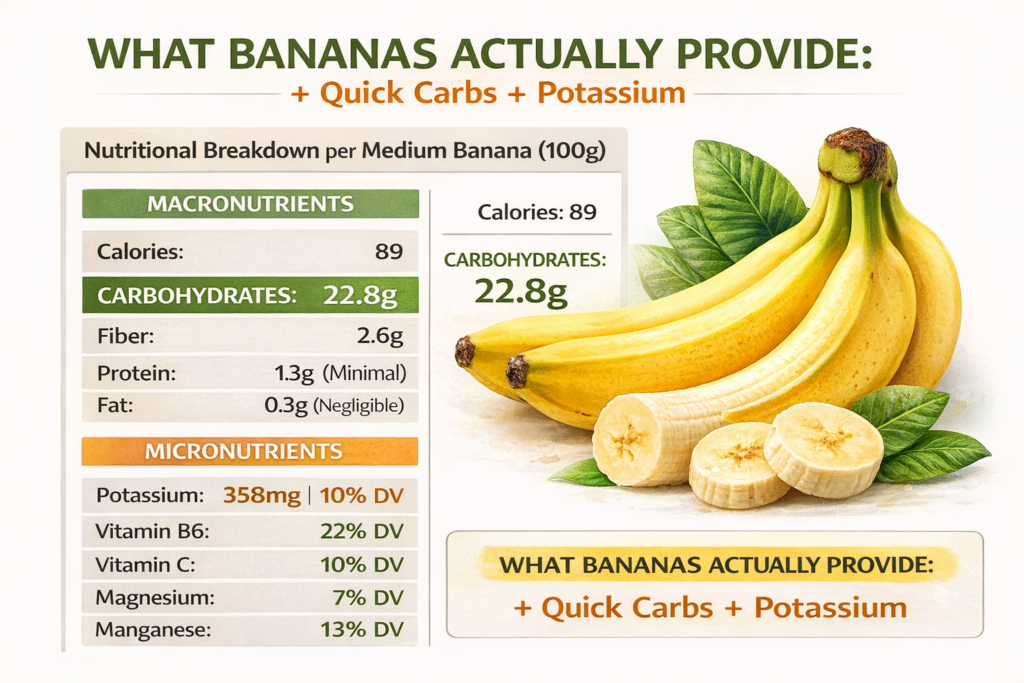
Macronutrients (per medium banana, ~100g)
Calories: 89
- Easily digestible
- Quick energy source
- Moderate calorie density
Carbohydrates: 22.8g
- Primary macronutrient in bananas
- Composition changes with ripeness:
- Unripe (green): More resistant starch
- Ripe (yellow): More simple sugars
- Very ripe (brown spots): Mostly simple sugars
- Provides quick and sustained energy
Protein: 1.3g
- Negligible for practical purposes
- Not relied upon for protein intake
Fat: 0.3g
- Essentially fat-free
- Not a significant source
Fiber: 2.6g
- Supports digestive health
- Aids satiety slightly
- Beneficial for gut microbiome
Micronutrients (per medium banana, ~100g)
Potassium: 358mg (10% DV)
- Muscle function
- Fluid balance
- Blood pressure regulation
- This is what bananas are famous for
Vitamin B6: 0.4mg (22% DV)
- Protein metabolism
- Neurotransmitter production
- Immune function
- Significant amount
Vitamin C: 8.7mg (10% DV)
- Antioxidant function
- Immune support
- Collagen synthesis
- Moderate amount
Magnesium: 27mg (7% DV)
- Muscle and nerve function
- Energy production
- Bone health
- Modest contribution
Manganese: 0.3mg (13% DV)
- Antioxidant function
- Bone development
- Metabolism support
What Bananas Are Actually Good For
Their real nutritional strengths.
Strength 1: Quick, convenient carbohydrates
- Pre-packaged by nature
- No refrigeration needed
- Portable anywhere
- Fast-digesting energy
Strength 2: Potassium for muscle function
- Prevents cramping
- Supports muscle contractions
- Electrolyte balance
- Especially beneficial for athletes
Strength 3: Natural sweetness without added sugar
- Satisfies sweet cravings
- Whole food source
- Fiber included (unlike juice or candy)
Strength 4: Digestive health support
- Pectin (soluble fiber)
- Resistant starch (in less ripe bananas)
- Prebiotic effects
- Gentle on stomach
Strength 5: Convenience
- Grab and go
- No preparation needed
- Travels well
- Affordable
Does Banana Protein Have Any Practical Value?
Honest assessment of protein contribution.
The Mathematical Reality
If eating a medium banana (1.3g protein):
To hit daily protein targets from bananas alone:
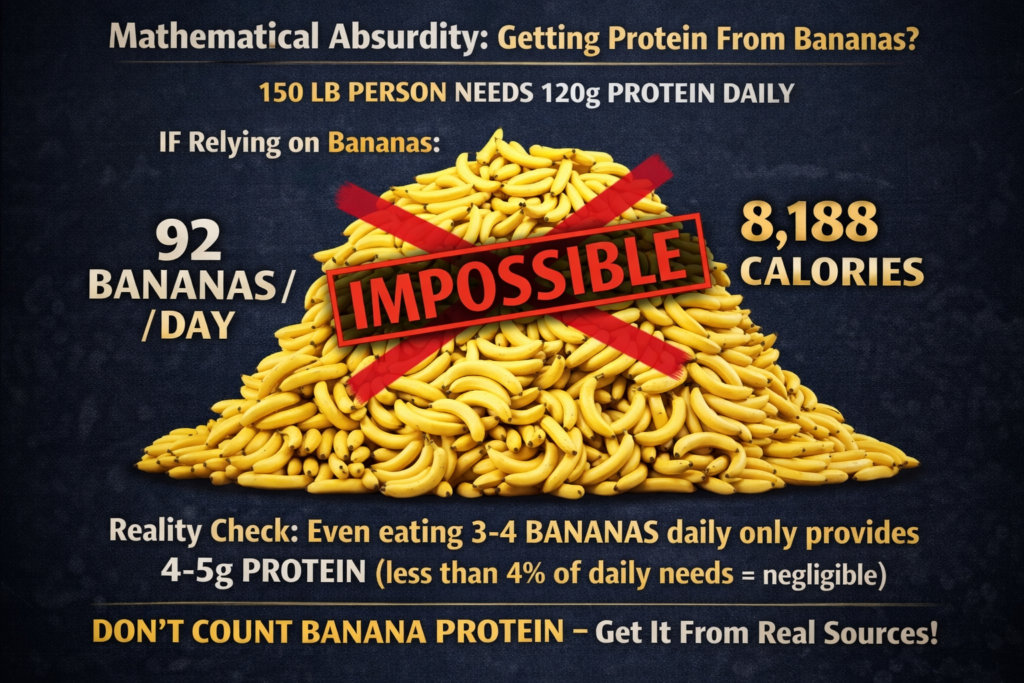
For 150-pound person needing 120g protein daily:
- Would need: 92 bananas daily
- Total calories: 8,188 calories
- Completely impractical and absurd
For any realistic protein intake:
- Bananas contribute <2% of daily protein needs
- Even eating 3-4 bananas daily only provides 4-5g protein
- Negligible contribution
When Banana Protein “Counts”
The only scenarios where banana protein matters:
Scenario 1: Very precise macro tracking
- Tracking every gram from all sources
- 1.3g adds to total daily
- Every little bit counted
- Still minimal impact
Scenario 2: Completely plant-based diet with limited options
- Every plant protein source matters
- Combining multiple sources for complete profile
- Bananas one of many contributors
- Still shouldn’t be relied upon
Scenario 3: Extreme caloric surplus eating
- Eating 6-8 bananas daily for easy carbs
- Incidentally getting 8-10g protein
- Not the goal, just a side effect
For 99% of people: Don’t count banana protein toward daily totals.
The Protein Quality Question
Beyond quantity, quality matters.
Banana protein amino acid profile:
- Incomplete protein (doesn’t have all essential amino acids in optimal ratios)
- Low leucine content (key for muscle protein synthesis)
- Poor biological value
- Even if quantity were higher, quality is subpar
Comparison to complete proteins:
- Animal proteins: Complete amino acid profiles
- Soy, quinoa: Complete plant proteins
- Bananas: Incomplete, poor quality
- Not suitable as protein source
How to Use Bananas in a Muscle-Building Diet
Strategic incorporation despite low protein.
Pre-Workout Carb Source
Why bananas work well pre-workout:
Timing: 30-60 minutes before training
- Fast-digesting carbs
- Provides quick energy
- Doesn’t sit heavy in stomach
- Potassium supports muscle function
How to use:
- 1-2 bananas alone
- Or banana + small amount protein (protein shake)
- Easily digestible
- Supports training performance
Example pre-workout snack:
- 1 large banana (27g carbs)
- Small whey shake (120 cal, 24g protein)
- Provides carbs for energy, protein for muscle support
Post-Workout Carbohydrate
For glycogen replenishment:
Timing: Within 2 hours post-workout
- Fast carbs beneficial
- Replenishes muscle glycogen
- Supports recovery
- Convenient option
How to use:
- 1-2 bananas in protein shake
- Banana + protein yogurt
- Part of post-workout meal
- Always combined with actual protein source
Example post-workout shake:
- 2 scoops whey protein (240 cal, 48g protein)
- 1 large banana (105 cal, 27g carbs)
- 1 cup milk (150 cal, 8g protein)
- Total: 495 calories, 56g protein, 50g carbs
Between-Meal Snack (With Protein Addition)
Bananas alone aren’t filling. Combine with protein.
Poor snack: Banana alone
- 1 banana: 89 calories, 1.3g protein
- Not satiating
- Blood sugar spike then crash
- Hungry again in 30-60 minutes
Smart snack: Banana + protein source
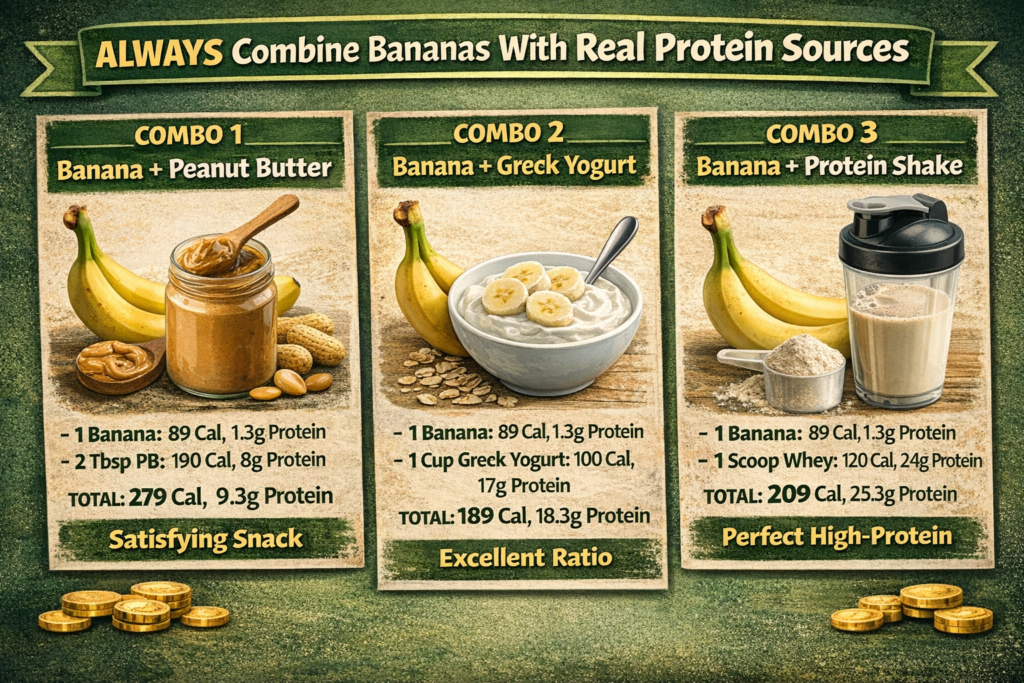
Option 1: Banana + peanut butter
- 1 banana: 89 cal, 1.3g protein
- 2 tbsp peanut butter: 190 cal, 8g protein
- Total: 279 cal, 9.3g protein
- Much more satisfying
Option 2: Banana + Greek yogurt
- 1 banana: 89 cal, 1.3g protein
- 1 cup Greek yogurt: 100 cal, 17g protein
- Total: 189 cal, 18.3g protein
- Excellent protein-to-calorie ratio
Option 3: Banana + protein shake
- 1 banana: 89 cal, 1.3g protein
- 1 scoop whey: 120 cal, 24g protein
- Total: 209 cal, 25.3g protein
- Perfect high-protein snack
The pattern: Always combine bananas with actual protein sources.
Bulking Calories (Strategic Use)
When gaining muscle, bananas provide easy calories.
Advantages for bulking:
- Calorie-dense enough (89 cal each)
- Easy to eat multiple
- Don’t fill you up excessively
- Taste good (compliance factor)
How to use strategically:
- 3-4 bananas daily
- In shakes, with meals, as snacks
- Provides 270-360 easy carb calories
- Helps hit caloric surplus
Example bulking shake:
- 2 cups whole milk (300 cal)
- 2 scoops whey protein (240 cal)
- 2 bananas (210 cal)
- 1/2 cup oats (150 cal)
- 2 tbsp peanut butter (190 cal)
- Total: 1,090 calories, 60g protein
Not Ideal for Cutting
When fat loss is the goal, bananas are less useful.
Why:
- Relatively high calorie for volume
- Not very filling (low protein, low fiber)
- Better options exist for cutting
Better fruit choices when cutting:
- Berries (lower calorie, higher fiber)
- Apples (more filling)
- Grapefruit (very low calorie)
- Watermelon (high volume, low calorie)
Exception: If you really love bananas and can fit them in your calorie budget, they’re fine in moderation (1 per day maximum when cutting).
Do Banana Peels Have Protein?
Addressing this unusual question.
The Truth About Banana Peels
Yes, banana peels contain protein, but:
Protein content:
- 1-3% of peel weight is protein
- Slightly more than banana flesh
- Still extremely low in absolute terms
Why this doesn’t matter:
Digestibility issues:
- Human digestive system not designed for peels
- Tough fiber difficult to break down
- Most nutrients not bioavailable
- Can cause digestive distress
Taste and texture:
- Bitter and unpleasant
- Tough and chewy
- Not enjoyable to eat
- Requires extensive preparation to be palatable
Practical reality:
- No one should eat banana peels for protein
- Any marginal protein benefit not worth the negatives
- Use actual protein sources instead
The verdict: While technically containing protein, banana peels are not a practical or recommended protein source.
Fruits With More Protein Than Bananas
If seeking fruit protein sources (still not high protein).
Higher-Protein Fruits
Guava: 2.6g protein per 100g
- Double banana’s protein
- High in vitamin C
- Good fiber content
- Still not a “protein source” but better than banana
Avocado: 2g protein per 100g
- 1.5x banana’s protein
- Healthy fats (main benefit)
- Nutrient-dense
- Higher calorie
Passion Fruit: 2.2g protein per 100g
- 1.7x banana’s protein
- Excellent fiber (10g per 100g)
- Rich in vitamins
Blackberries: 2g protein per 100g
- 1.5x banana’s protein
- Very high fiber (5g per 100g)
- Low calorie (43 cal per 100g)
- Antioxidant-rich
Jackfruit: 1.7g protein per 100g
- Slightly more than banana
- Popular meat substitute when cooked
- Decent fiber
The Reality Check
Even “high-protein” fruits aren’t protein sources:
To get 30g protein from guava (highest on list):
- Need to eat 1,150g (over 2.5 pounds)
- Total calories: 780
- Completely impractical
Better approach:
- Eat fruits for vitamins, minerals, fiber, and carbs
- Get protein from actual protein sources
- Don’t rely on fruit for protein
The Bottom Line: Bananas Are Carbs, Not Protein
After examining all the evidence:
The truth about protein in bananas:
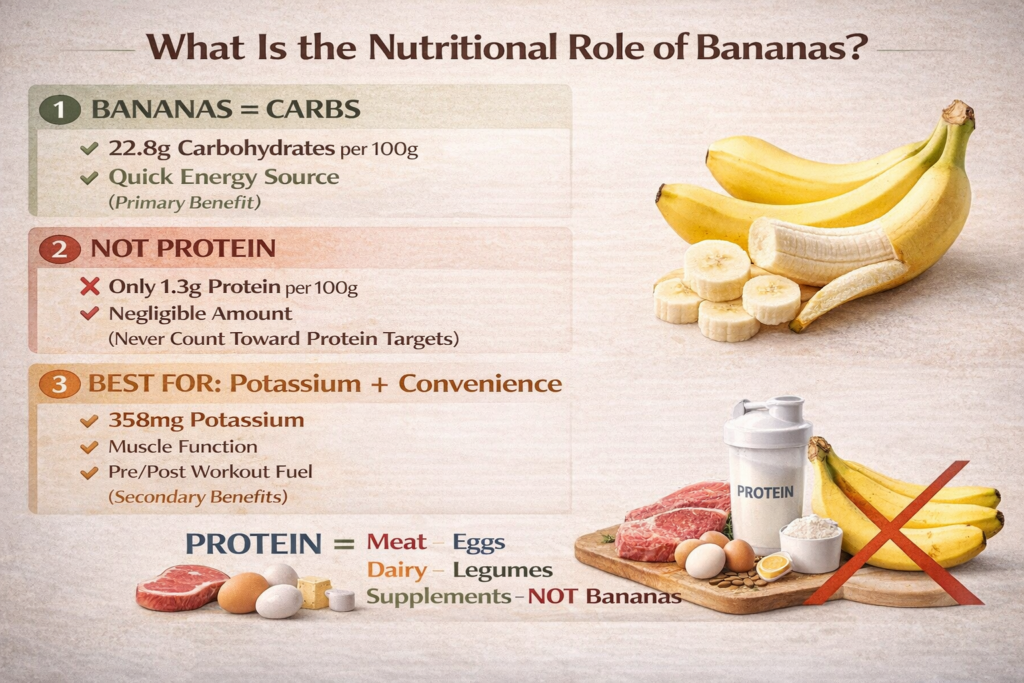
✅ Bananas contain 1.3g protein per 100g (factual)
❌ This amount is negligible for practical purposes (don’t count it)
✅ Bananas excel as carbohydrate sources (22.8g carbs per 100g)
✅ High in potassium and other beneficial nutrients (this is their value)
❌ Should never be relied upon for protein intake (use actual protein sources)
What bananas are actually good for:
Primary benefits:
- Quick, convenient carbohydrates (22.8g per banana)
- Potassium for muscle function (358mg per banana)
- Pre-workout energy source
- Post-workout glycogen replenishment
- Easy calories when bulking
- Natural sweetness without added sugar
How to use bananas correctly:
For muscle building:
- Pre-workout: 1-2 bananas 30-60 min before training
- Post-workout: 1-2 bananas in protein shake
- Bulking: 3-4 daily for easy carb calories
- Always combined with actual protein sources
Protein-enhanced banana combinations:
Snack 1:
- 1 banana + 2 tbsp peanut butter
- 279 calories, 9g protein, 30g carbs
Snack 2:
- 1 banana + 1 cup Greek yogurt
- 189 calories, 18g protein, 35g carbs
Snack 3:
- 1 banana blended in protein shake
- 1 scoop whey + 1 banana + 1 cup milk
- 375 calories, 32g protein, 50g carbs
What NOT to do:
❌ Count banana protein toward daily protein targets
❌ Eat bananas thinking you’re getting protein
❌ Rely on bananas for muscle building
❌ Replace actual protein sources with bananas
What TO do:
✅ Enjoy bananas for carbs, potassium, and convenience
✅ Combine with actual protein sources (yogurt, protein powder, nut butter)
✅ Use strategically around training
✅ Get your protein from meat, fish, eggs, dairy, legumes, or protein supplements
If you need protein from fruit (you don’t, but if you must):
- Guava: 2.6g per 100g (still very low)
- Avocado: 2g per 100g (plus healthy fats)
- Passion fruit: 2.2g per 100g
- But realistically, don’t rely on any fruit for protein
The proper perspective:
Bananas are excellent foods. They provide quick energy, essential minerals, vitamins, and are incredibly convenient.
But they are not, and never will be, a protein source.
Eat them for what they actually provide. Get your protein from actual protein sources.
BANANAS = CARBS + POTASSIUM. PROTEIN = MEAT, EGGS, DAIRY, LEGUMES, SUPPLEMENTS.
Ready to build a complete, optimized nutrition plan that gets your macros from the right sources, eliminates confusion about food choices, and delivers consistent muscle-building or fat-loss results without overthinking every food decision? Understanding individual food nutrients is just the beginning. Get a comprehensive guide to calculating your exact macro needs, choosing the best foods for each macro, building sustainable meal plans, and achieving your physique goals with clarity and confidence. Stop second-guessing food choices. Start following a proven nutrition system.
REFERENCES
SECTION 1 — Banana Nutritional Composition
[1] U.S. Department of Agriculture — FoodData Central, Bananas, raw, 2019 Bananas, raw — per 100g: 89 kcal, 1.09g protein, 22.84g carbohydrates, 0.33g fat, 2.6g fiber, 358mg potassium, 0.367mg vitamin B6, 8.7mg vitamin C, 27mg magnesium, 0.27mg manganese; primary macronutrient is carbohydrate https://fdc.nal.usda.gov/fdc-app.html#/food-details/1105314/nutrients
SECTION 2 — Banana Protein Quality and Amino Acid Profile
[2] Pereira A & Maraschin M — Food Chemistry, 2015 Banana (Musa spp.) from peel to pulp: ethnopharmacology, source of bioactive compounds and its relevance for human health — amino acid composition of banana pulp; low leucine and lysine content relative to animal proteins; incomplete essential amino acid profile; poor biological value for muscle protein synthesis applications https://pubmed.ncbi.nlm.nih.gov/25308899/
[3] Witard OC et al. — Journal of Nutrition, 2014 Myofibrillar muscle protein synthesis rates subsequent to a meal in response to small and large bolus doses of dairy and soy protein — leucine threshold for maximal muscle protein synthesis stimulation; plant proteins with low leucine content (including fruit proteins) fail to maximally stimulate MPS; leucine content ~0.8–2.5g required per meal for anabolic signaling https://pubmed.ncbi.nlm.nih.gov/24284442/
SECTION 3 — Protein Requirements and Practical Contributions
[4] Morton RW et al. — British Journal of Sports Medicine, 2018 A systematic review, meta-analysis and meta-regression of the effect of protein supplementation on resistance training-induced gains in muscle mass and strength — optimal protein intake 1.62g/kg/day for muscle gain; protein source quality and completeness matters; insufficient protein from low-quality sources leads to suboptimal muscle retention https://pubmed.ncbi.nlm.nih.gov/28698222/
[5] Stokes T et al. — Nutrients, 2018 Recent perspectives regarding the role of dietary protein for the promotion of muscle hypertrophy with resistance exercise training — 0.4g/kg per meal minimum threshold; distribution across meals important; incomplete proteins from fruits contribute negligibly to anabolic targets; leucine as primary trigger of mTORC1 pathway https://pubmed.ncbi.nlm.nih.gov/29462923/
SECTION 4 — Banana Carbohydrates and Athletic Performance
[6] Nieman DC et al. — PLOS ONE, 2012 Bananas as an energy source during exercise: a metabolic footprint — bananas vs. sports drinks during 75km cycling time trial; bananas provided equivalent fueling to commercial sports drinks; dopamine and serotonin metabolites elevated post-banana; banana carbohydrates (glucose/fructose/sucrose) effectively sustain athletic performance https://pubmed.ncbi.nlm.nih.gov/22616015/
[7] Blaak EE et al. — Obesity Reviews, 2012 Impact of postprandial glycaemia on health and prevention of disease — resistant starch in unripe bananas produces lower glycemic response vs. ripe bananas; starch-to-sugar conversion during ripening; ripe bananas provide rapidly available glucose for glycogen replenishment; pre/post-workout carbohydrate timing https://pubmed.ncbi.nlm.nih.gov/22958314/
SECTION 5 — Potassium, Micronutrients and Muscle Function
[8] Clarkson PM & Haymes EM — Medicine & Science in Sports & Exercise, 1995 Exercise and mineral status of athletes: calcium, magnesium, phosphorus, and iron — potassium critical for muscle contraction and nerve transmission; deficiency causes cramps and impaired performance; banana’s 358mg potassium per 100g contributes meaningfully to daily requirement (3,500–4,700mg); vitamin B6 role in protein metabolism and glycogen utilization https://pubmed.ncbi.nlm.nih.gov/7791586/
SECTION 6 — Banana Peel Protein (Supplementary)
[9] Someya S et al. — Food Chemistry, 2002 Antioxidant compounds from bananas (Musa Cavendish) — banana peel composition analysis; peel contains 1–3% protein by dry weight, slightly higher than pulp; tough cell wall structures reduce digestibility and bioavailability in humans; primary compounds of interest are phenolic antioxidants, not protein https://pubmed.ncbi.nlm.nih.gov/14759741/
SECTION 7 — Protein Content of Other Fruits (Comparative)
[10] U.S. Department of Agriculture — FoodData Central, Multiple Fruit Entries, 2019 Comparative fruit protein data — guava 2.55g/100g; passion fruit 2.2g/100g; blackberries 1.39g/100g; avocado 2.0g/100g; jackfruit 1.72g/100g; all fruits classified as low-protein foods (<10% calories from protein); none suitable as primary protein source regardless of relative differences https://fdc.nal.usda.gov/

Leave a Reply
You must be logged in to post a comment.