Doing intermittent fasting and wondering if your creatine dose ruins your fast? Most people are confused about this. Here’s what actually happens.
You’re fasting. Your feeding window doesn’t start for 4 hours. But you want to take your daily creatine dose.
You’re worried. Will creatine break your fast? Will it spike insulin? Does the timing even matter?
You’ve heard:
- “Anything except water breaks a fast”
- “Creatine triggers insulin response”
- “Only take supplements during feeding window”
- “Artificial sweeteners ruin fasting benefits”
Most of this is wrong or oversimplified. The truth: Pure creatine monohydrate mixed with water does NOT break a fast. It contains zero calories, doesn’t affect blood glucose, and doesn’t trigger insulin response. However, flavored creatine with added sugars or carbs WILL break your fast. The timing of creatine doesn’t matter for results, only daily consistency matters. Take it whenever convenient, fasted or fed.
In this comprehensive guide, I’ll explain what actually breaks a fast (the metabolic definition), reveal whether creatine affects fasting (the insulin and calorie question), show you which creatine products are safe during fasting (and which aren’t), address potential side effects of fasted creatine (digestive considerations), and provide optimal timing strategies (fasted vs. fed window).
Whether you’re doing 16:8, OMAD, or any fasting protocol, understanding creatine compatibility is important.
Let’s clarify creatine and intermittent fasting once and for all.
TABLE OF CONTENTS
What Does “Breaking a Fast” Actually Mean?
Understanding the metabolic definition.
The Physiological State of Fasting
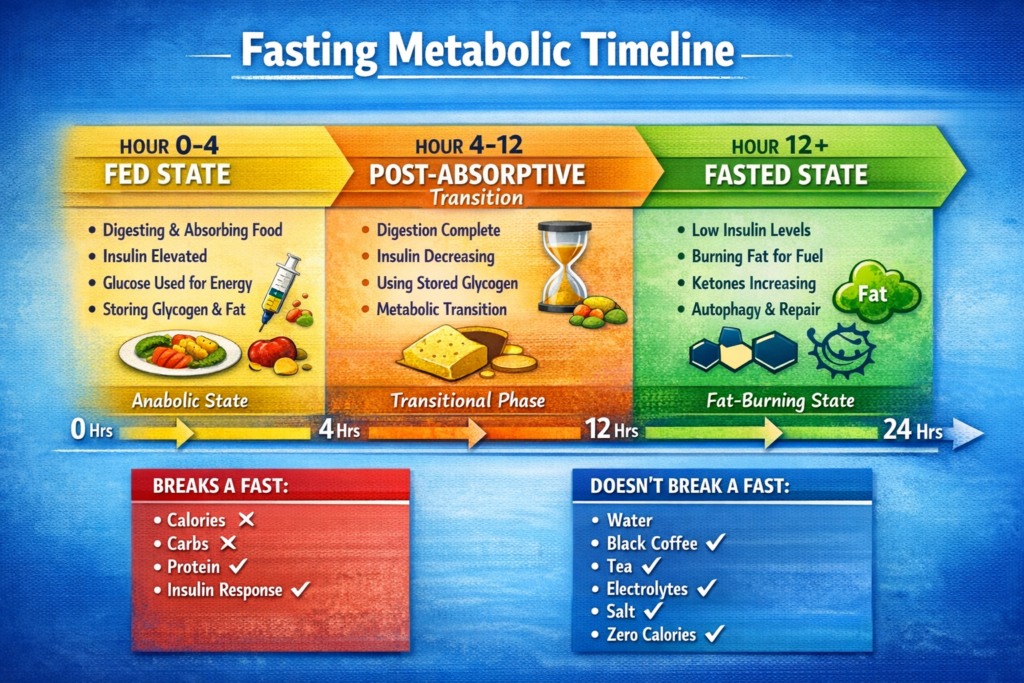
What happens during a fast:
Hour 0-4 (fed state):
- Digesting and absorbing food
- Insulin elevated
- Glucose being used for energy
- Storing excess as glycogen and fat
- Anabolic state
Hour 4-12 (post-absorptive):
- Food digestion complete
- Insulin returning to baseline
- Shifting from glucose to stored glycogen
- Beginning metabolic transition
- Transitional state
Hour 12+ (fasted state):
- Insulin at baseline (low)
- Glycogen stores being used
- Fat oxidation increasing
- Autophagy processes activating
- Ketone production beginning (if prolonged)
- Catabolic/fat-burning state
The key metabolic markers:
- Low insulin levels
- Stable/low blood glucose
- Increased fat oxidation
- Activated cellular cleanup (autophagy)
- Fasting benefits
What Breaks a Fast (Metabolically)
The primary factor: Calories
Caloric intake:
- Anything with calories triggers digestive processes
- Insulin released to handle incoming nutrients
- Shifts body from fasted to fed state
- Metabolic transition
The insulin response:
- Carbohydrates: Strong insulin response
- Protein: Moderate insulin response
- Fat: Minimal insulin response
- Macronutrient differences
The calorie threshold:
- Strict definition: 0 calories (water only)
- Practical definition: <5-10 calories (negligible impact)
- Flexible definition: <50 calories (maintains most benefits)
- Different standards
What definitively breaks a fast:
- Food (any solid food)
- Sugary drinks (juice, soda, sweetened beverages)
- Milk or creamer (contains protein, fat, carbs)
- Protein shakes (calories and insulin response)
- Pre-workout with carbs (calories and sugar)
- Clear fast-breakers
What’s debated (gray area):
- Black coffee (negligible calories, may enhance fasting)
- Tea (negligible calories)
- Zero-calorie sweeteners (no calories, but possible insulin response)
- BCAAs (small amount of calories, insulin response)
- Controversial items
What doesn’t break a fast:
- Water (zero calories)
- Black coffee (2-5 calories, generally accepted)
- Plain tea (0-2 calories)
- Electrolytes in water (zero-calorie versions)
- Salt (zero calories)
- Safe during fasting
The Different Fasting Goals
Why you’re fasting affects the answer:
Goal 1: Fat loss (calorie restriction)
- Primary mechanism: Calorie deficit
- Strict fast not necessary
- <50 calories likely fine
- Flexible approach
Goal 2: Autophagy (cellular cleanup)
- Requires very low insulin
- Stricter approach needed
- Avoid anything that spikes insulin
- Strict approach
Goal 3: Metabolic health (insulin sensitivity)
- Requires low insulin levels
- Moderate approach
- Small amounts okay if no insulin response
- Moderate approach
Goal 4: Convenience (eating window preference)
- Least strict
- More about timing than metabolic state
- Flexibility in what’s allowed
- Relaxed approach
The implication:
- Your fasting goal determines what breaks YOUR fast
- No universal answer
- Personalize to goals
- Context-dependent
Does Creatine Break Intermittent Fasting?
The definitive answer.
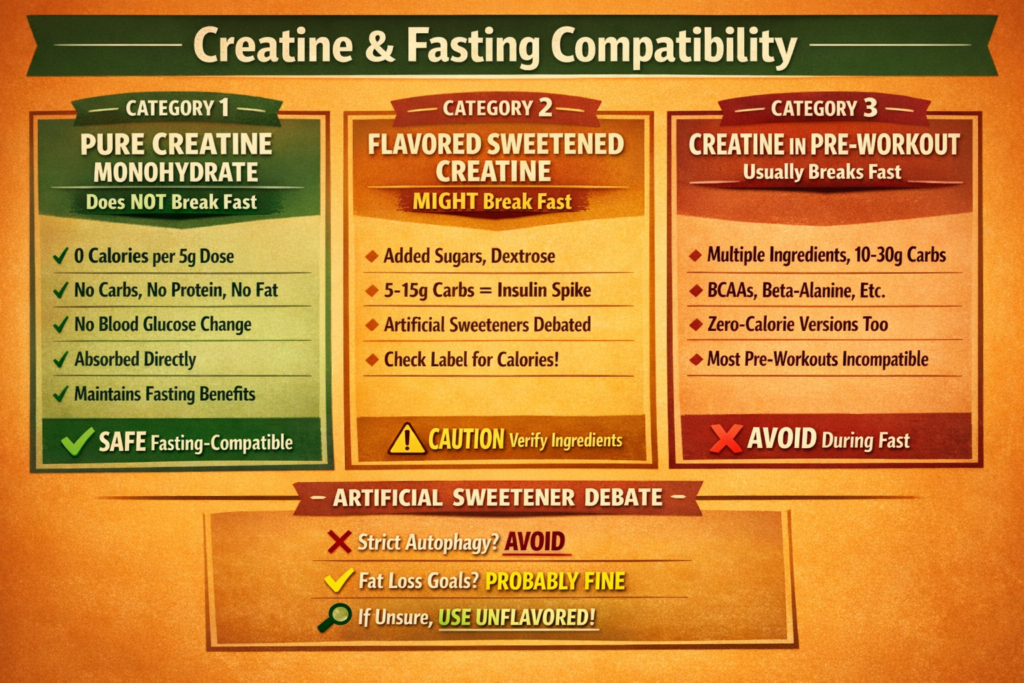
Pure Creatine Monohydrate: Does NOT Break a Fast
The composition:
- Creatine monohydrate: 0 calories per 5g dose
- No carbohydrates
- No protein
- No fat
- Zero caloric content
The metabolic impact:
- No blood glucose change
- No insulin response
- No digestive processes required
- Absorbed directly
- No metabolic disruption
The verdict:
- Pure creatine monohydrate mixed with water does NOT break a fast
- Safe to take during fasting window
- Maintains all fasting benefits
- Fasting-compatible
The science:
- Creatine absorbed in small intestine
- No need for insulin
- No caloric energy provided
- No interruption of fat oxidation or autophagy
- Metabolically neutral
Flavored or Sweetened Creatine: MIGHT Break a Fast
The problem ingredients:
Added sugars/carbohydrates:
- Many flavored creatines contain dextrose or maltodextrin
- 5-15g carbs per serving common
- Definite insulin response
- Breaks the fast
Artificial sweeteners (debated):
- Sucralose, aspartame, acesulfame-K
- Zero calories
- Possible insulin response (debated, minimal if any)
- Gray area
How to identify:
- Check nutrition label
- If “Calories: 0” and “Total Carbohydrates: 0” → Safe during fast
- If any calories listed → Breaks fast
- Label reading essential
Common culprits:
- Creatine HCL with flavoring (often has carbs)
- Flavored creatine blends
- Creatine gummies (definitely have carbs/sugar)
- Check labels
Creatine in Pre-Workout: Usually Breaks a Fast
The issue:
- Pre-workouts contain multiple ingredients
- Usually include carbs (for energy)
- Often 10-30g carbs per serving
- Multi-ingredient products problematic
Common pre-workout ingredients that break fasts:
- Dextrose, maltodextrin (carbs)
- BCAAs (small calories, insulin response)
- Beta-alanine (may have slight insulin effect)
- Combination effect
The verdict:
- Most pre-workouts break a fast
- Even “zero-calorie” versions may contain artificial sweeteners
- If fasting strictly, avoid
- Generally incompatible
The alternative:
- Take pure creatine separately during fast
- Save pre-workout for feeding window
- Separate supplementation
The Artificial Sweetener Debate
The question:
- Do zero-calorie sweeteners trigger insulin?
- Does this “break” the fast?
- Ongoing debate
Research findings:
Study 1 (insulin response):
- Some sweeteners may trigger cephalic phase insulin response
- Body tastes sweet, expects sugar, releases small amount insulin
- Effect is minimal and short-lived
- Possible minor response
Study 2 (no insulin response):
- Other studies show no insulin response to artificial sweeteners
- No blood glucose changes
- No metabolic disruption
- Contradictory findings
The practical reality:
- Even if minor insulin response occurs, it’s very small
- Unlikely to significantly impact fasting benefits
- Much less than actual sugar would cause
- Minimal practical impact
The conservative approach:
- If doing strict autophagy-focused fast: Avoid sweeteners
- If doing fat loss-focused fast: Sweeteners likely fine
- If unsure: Use pure unflavored creatine
- Risk-based decision
Can You Take Creatine While Fasting?
Safety and side effects.
General Safety: Yes, It’s Safe
The baseline:
- Creatine is safe to take on empty stomach
- No food required for absorption
- No safety concerns
- Generally well-tolerated
The research:
- Creatine studied extensively
- Fasted vs. fed timing doesn’t affect safety
- No contraindications for fasted intake
- Safety established
Potential Digestive Issues (Minority of Users)
The problem:
- Some people experience GI distress when taking creatine fasted
- Nausea, cramping, diarrhea
- Not common, but reported
- Individual sensitivity
Why it happens:
The mechanism:
- Creatine draws water into intestines (osmotic effect)
- On empty stomach, more noticeable
- Can cause temporary GI discomfort
- Water redistribution
Who’s affected:
- People with sensitive stomachs
- Those taking high doses (>5g at once)
- Those doing loading phase (20g daily)
- Susceptible individuals
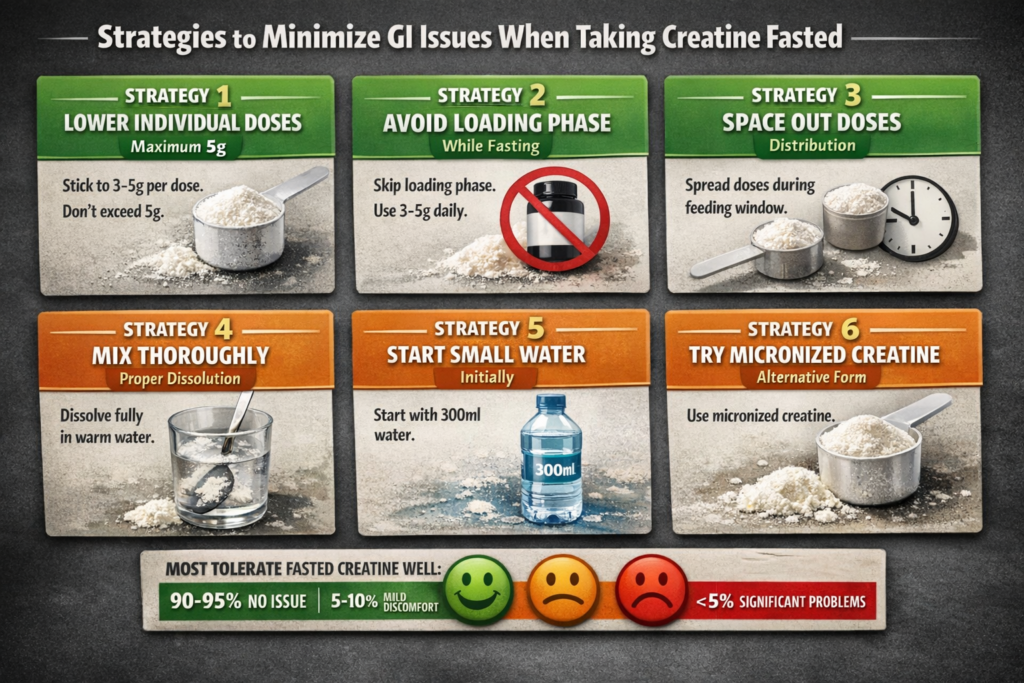
The prevalence:
- Most people: No issues
- 5-10% of users: Mild discomfort
- <5% of users: Significant problems
- Minority experience
How to Minimize GI Issues
Strategy 1: Lower individual doses
- Don’t exceed 5g per dose
- Research shows >5g increases GI risk
- Stick to 3-5g
- Dose management
Strategy 2: Avoid loading phase while fasting
- Loading phase: 20g daily (4 doses of 5g)
- Higher risk of GI issues fasted
- Skip loading, use maintenance dose (3-5g daily)
- Protocol adjustment
Research note:
- Loading phase not necessary (faster saturation only)
- Maintenance dose alone saturates muscles in 3-4 weeks
- Same final result
- Loading optional
Strategy 3: Space out doses
- If taking multiple doses daily
- Spread throughout fasting and feeding windows
- Don’t take all at once fasted
- Distribution
Strategy 4: Mix thoroughly
- Ensure creatine fully dissolved
- Undissolved creatine more likely to cause issues
- Use warm water for better dissolution
- Proper mixing
Strategy 5: Take with small amount of water initially
- Start with 300ml water
- If no issues, can adjust
- More water dilutes but increases volume in stomach
- Find your sweet spot
Strategy 6: Try micronized creatine
- Smaller particle size
- May be easier on stomach
- Better dissolution
- Alternative form
When to Avoid Fasted Creatine
If you experience:
- Persistent nausea
- Diarrhea or cramping
- Significant discomfort
- Move to feeding window
Better approach for sensitive individuals:
- Take creatine during feeding window
- With food or protein shake
- Eliminates GI issues
- Simple solution
The reality:
- Most people tolerate fasted creatine fine
- If you don’t, just adjust timing
- Results don’t depend on fasted vs. fed timing
- Flexibility available
Optimal Timing: Fasted vs. Fed Window
Does timing matter for results?
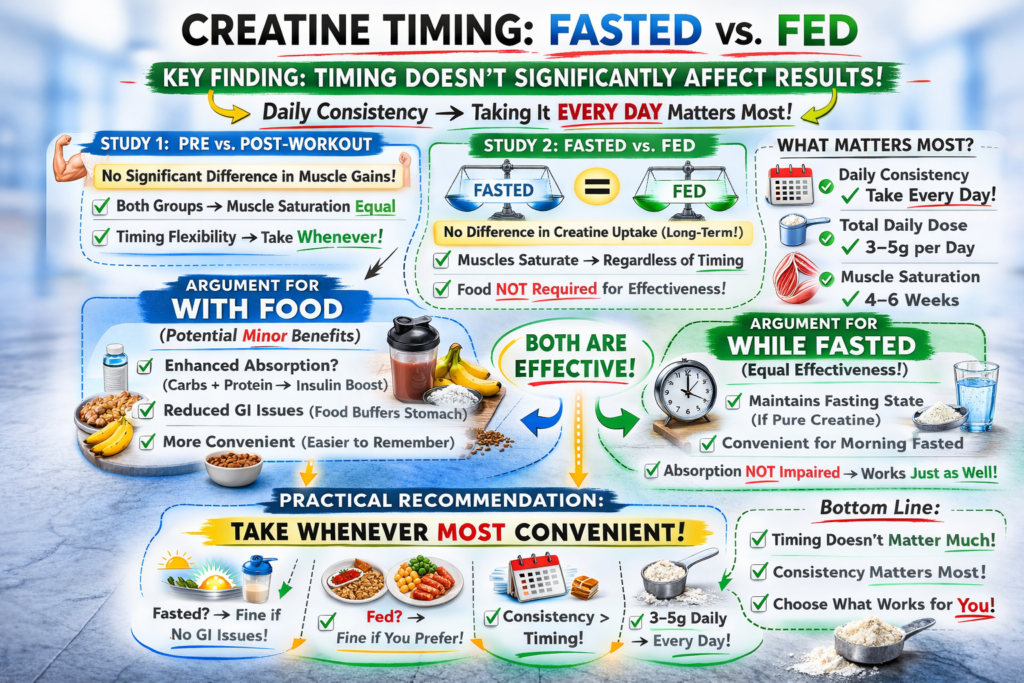
The Research on Creatine Timing
The key finding:
- Timing of creatine intake doesn’t significantly affect results
- What matters: Daily consistency (taking it every day)
- When you take it: Largely irrelevant
- Consistency over timing
Study 1 (pre vs. post-workout):
- No significant difference in muscle gains
- Both groups saturated muscles equally
- Timing flexibility
Study 2 (fasted vs. fed):
- No difference in creatine uptake long-term
- Muscles saturate regardless of timing
- Fed state not required
The implication:
- Take creatine whenever convenient
- Fasted or fed doesn’t matter for results
- Personal preference
The Argument for Taking Creatine with Food
Potential benefits:
Benefit 1: Enhanced absorption (debated)
- Some research suggests carbs + protein improve creatine uptake
- Insulin may help shuttle creatine into muscles
- Effect is small and may not matter long-term
- Minor potential benefit
Benefit 2: Reduced GI issues
- Food buffers stomach
- Less likely to experience nausea
- Easier on sensitive stomachs
- Comfort benefit
Benefit 3: Convenient routine
- Easy to remember (take with meal)
- Can mix in protein shake
- Convenience
The caveat:
- These benefits are minor
- Not necessary for results
- More about comfort than efficacy
- Optional, not essential
The Argument for Taking Creatine Fasted
Potential benefits:
Benefit 1: Maintains fasting state
- Doesn’t break fast (if pure creatine)
- Preserves fasting benefits
- Fasting compatibility
Benefit 2: Convenience for morning fasters
- Take upon waking (during fast)
- Don’t have to wait for feeding window
- Daily consistency easier
- Routine simplicity
Benefit 3: Absorption not impaired
- Creatine absorbed fine without food
- No evidence of reduced efficacy
- Effective fasted
The verdict:
- Fasted creatine works just as well
- Choose based on comfort and schedule
- Equally effective
The Practical Recommendation
For most people:
- Take creatine whenever most convenient
- Fasted window: Fine if no GI issues
- Fed window: Fine if you prefer
- Personal preference
For sensitive stomachs:
- Take during feeding window with food
- Eliminates GI issues
- Same results
- Comfort prioritized
For strict fasters (autophagy focus):
- Pure creatine monohydrate during fast is acceptable
- Avoid flavored versions
- Maintains fasting state
- Strict compatibility
For flexible fasters (fat loss focus):
- Take whenever
- Minor insulin response from sweeteners (if any) won’t significantly impact fat loss
- Relaxed approach
The key principle:
- Consistency matters (daily intake)
- Timing doesn’t matter (for results)
- Comfort matters (for adherence)
- Prioritize consistency
Practical Guidelines
Simple implementation.
If Taking Creatine During Fasting Window
Choose:
- Pure creatine monohydrate
- Unflavored
- No added ingredients
- Clean product
Mix with:
- 300ml (10 oz) water
- Plain water only (no juice, milk, etc.)
- Ensure fully dissolved
- Simple preparation
Timing:
- Anytime during fasting window
- Upon waking common (convenient)
- Pre-workout if training fasted
- Flexible timing
Monitor:
- Any GI discomfort
- If issues arise, move to feeding window
- Listen to body
If Taking Creatine During Feeding Window
Choose:
- Any creatine form (flavored okay now)
- Can include in pre-workout if desired
- More options
Mix with:
- Protein shake (convenient)
- Juice (if you want)
- With meal
- Flexible mixing
Timing:
- With first meal of feeding window
- Post-workout meal
- Any meal
- Anytime in window
Sample Fasting Schedules with Creatine
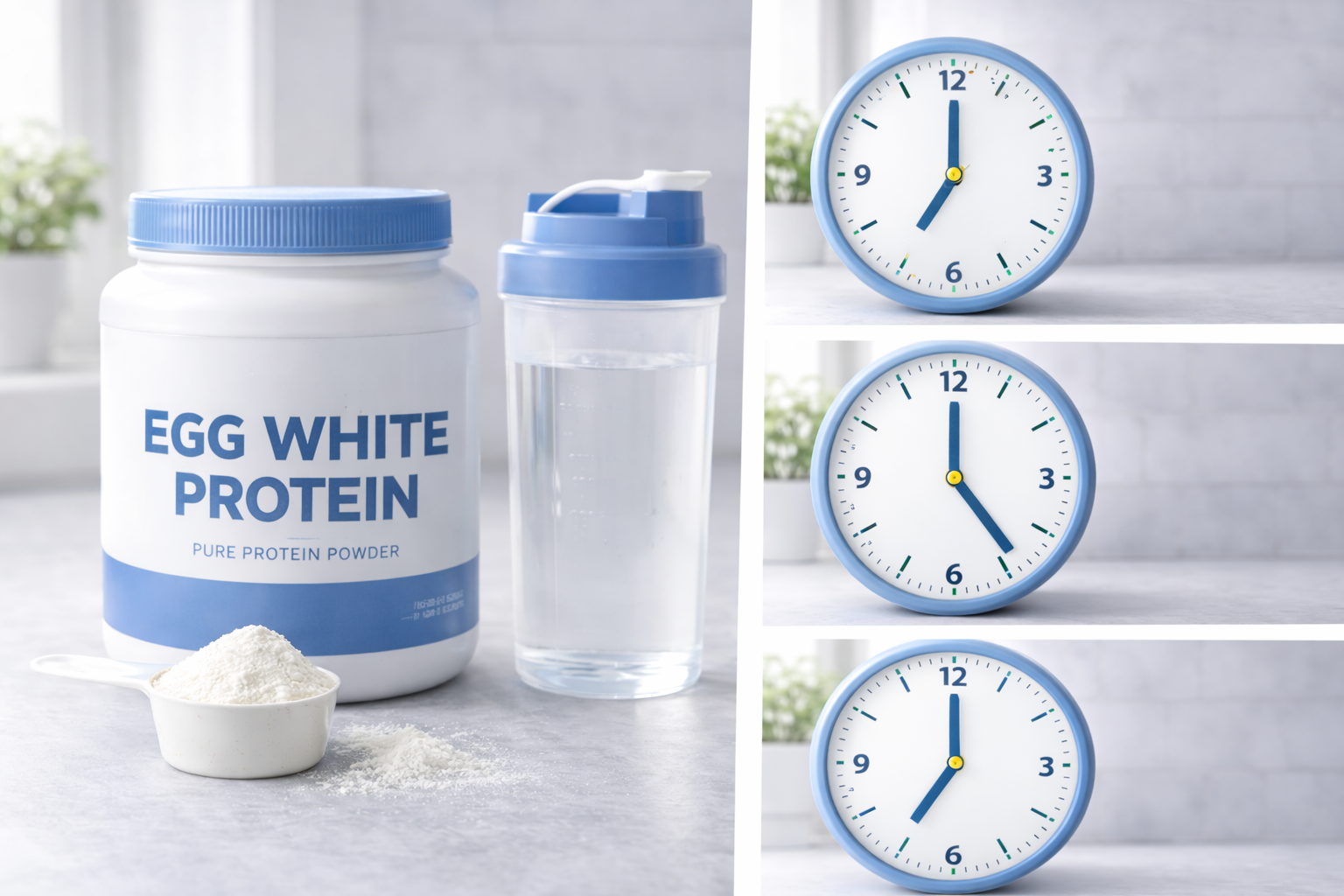
16:8 Protocol (fast 16 hours, eat 8 hours):
Option A: Fasted creatine
- 7 AM: Wake, take creatine with water (fasted)
- 12 PM: First meal (break fast)
- 8 PM: Last meal (feeding window closes)
- Fasted morning dose
Option B: Fed creatine
- 7 AM: Wake (fasted)
- 12 PM: First meal + creatine (break fast)
- 8 PM: Last meal (feeding window closes)
- First meal dose
Both work equally well
OMAD (One Meal a Day):
Option A: Fasted creatine
- Morning: Take creatine with water during 23-hour fast
- Evening: One large meal
- Separate from meal
Option B: With meal
- 23-hour fast
- Evening: Creatine with or immediately before large meal
- Meal-based
Both work equally well
Alternate Day Fasting:
Fasting days:
- Take creatine with water (doesn’t break fast)
- Maintains daily consistency
- Fasted dose
Eating days:
- Take with any meal
- Fed dose
Consistency across days maintained
Common Questions
Addressing confusion.
“Will creatine kick me out of ketosis?”
The answer:
- No, creatine doesn’t affect ketosis
- Zero carbs, doesn’t impact blood glucose
- Ketone production unaffected
- Keto-compatible
For keto + IF:
- Creatine safe during fast
- Doesn’t interfere with either protocol
- Double compatible
“Should I take creatine before fasted cardio?”
The answer:
- Creatine doesn’t provide immediate energy
- Works by saturating muscles over time (takes weeks)
- Taking it immediately before cardio doesn’t help performance that session
- But doesn’t hurt either
- Timing doesn’t matter
The recommendation:
- Take whenever convenient
- Daily consistency more important
- Flexible timing
“Can I take creatine with black coffee during my fast?”
The answer:
- Yes, both are fasting-compatible
- Black coffee: 2-5 calories (negligible)
- Pure creatine: 0 calories
- Combination fine
- Safe together
The method:
- Mix creatine in water, drink separately from coffee
- Or mix in coffee if you don’t mind taste
- Both options work
“Does creatine affect autophagy?”
The answer:
- No evidence that creatine impairs autophagy
- Zero calories means no metabolic interference
- Autophagy triggered by absence of nutrients
- Creatine is not a nutrient in the caloric sense
- Autophagy-compatible
For autophagy-focused fasters:
- Pure creatine safe
- Maintains autophagy benefits
- No conflict
“What about creatine ethyl ester or other forms?”
The answer:
- Same principles apply as creatine monohydrate
- If pure form (no added ingredients): Doesn’t break fast
- If flavored/sweetened: Check label for calories
- Label verification needed
The recommendation:
- Stick with creatine monohydrate (most researched, cheapest, effective)
- Other forms offer no significant advantages
- Monohydrate preferred
The Bottom Line: Pure Creatine Doesn’t Break Your Fast
After explaining everything:
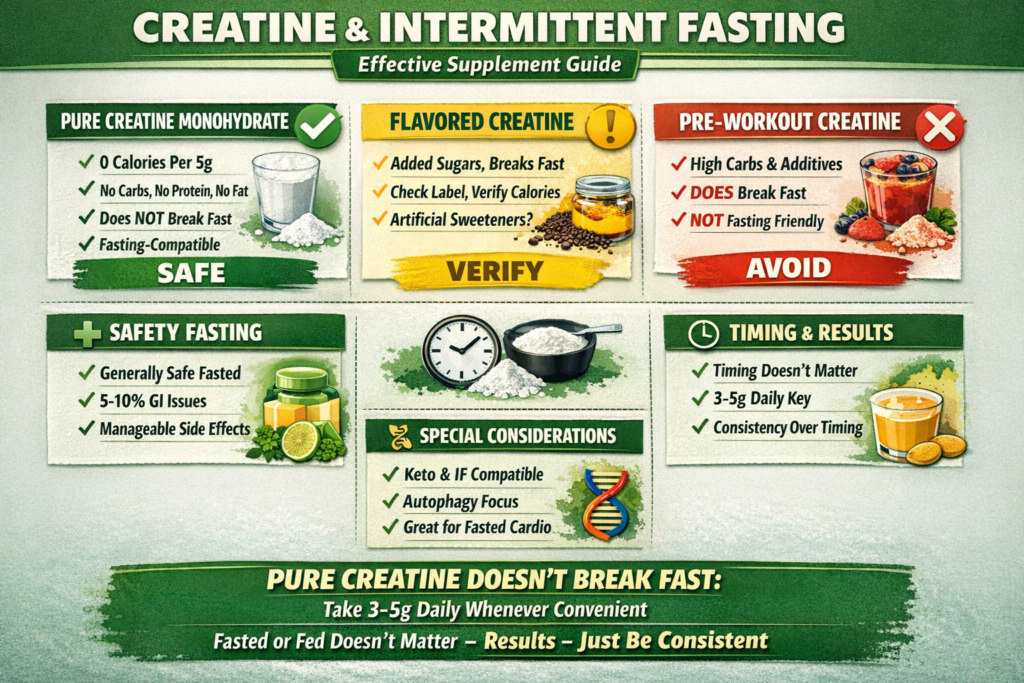
The truth about creatine and intermittent fasting:
✅ Pure creatine monohydrate does NOT break a fast (zero calories, no insulin response)
✅ Flavored creatine with added sugars DOES break a fast (check labels for calories)
✅ Timing doesn’t matter for results, only daily consistency (take whenever convenient)
✅ Most people tolerate fasted creatine fine (GI issues rare, manageable if occur)
✅ Choose based on comfort and schedule, not efficacy (both timings work equally)
Key takeaways:
What breaks a fast:
- Anything with calories (food, sugary drinks, protein)
- Carbohydrates (strong insulin response)
- Protein (moderate insulin response)
- Threshold: Generally >5-10 calories
- Caloric intake
Pure creatine monohydrate:
- 0 calories per 5g dose
- No carbs, protein, or fat
- No blood glucose change
- No insulin response
- Does NOT break fast
- Fasting-compatible
Flavored/sweetened creatine:
- Often contains added sugars or carbs
- Check label: If any calories → breaks fast
- Artificial sweeteners: Debated, likely minimal impact
- Conservative approach: Use unflavored
- Verify on label
Creatine in pre-workout:
- Usually contains multiple ingredients
- Often includes carbs (10-30g common)
- Generally DOES break fast
- Take separately if fasting
- Incompatible
Safety while fasting:
- Generally safe to take creatine fasted
- 5-10% of users may experience GI discomfort
- Nausea, cramping possible in sensitive individuals
- Usually well-tolerated
Minimizing GI issues:
- Use ≤5g doses (don’t exceed)
- Skip loading phase while fasting (use 3-5g maintenance)
- Mix thoroughly in water
- Try micronized form if issues
- Move to feeding window if persistent problems
- Management strategies
Timing for results:
- Research shows timing doesn’t significantly matter
- Daily consistency is what matters
- Muscles saturate over weeks regardless of timing
- Consistency over timing
Taking with food (potential benefits):
- May slightly enhance absorption (insulin effect, debated)
- Reduces GI issues (food buffers stomach)
- Convenient routine (easy to remember)
- Benefits are minor, not necessary
- Optional, not essential
Taking while fasted (benefits):
- Maintains fasting state (if pure creatine)
- Convenient for morning fasters
- Absorption not impaired
- Works just as well
- Equally effective
Practical guidelines:
During fasting window:
- Pure creatine monohydrate only
- Mix with 300ml plain water
- Anytime during fast okay
- Monitor for GI issues
- Simple protocol
During feeding window:
- Any creatine form acceptable
- Can mix with protein shake, juice, or food
- Convenient timing
- No GI issues
- Flexible options
Sample schedules:
- 16:8: Take creatine at 7 AM (fasted) or 12 PM (first meal)
- OMAD: Take during 23-hour fast or with meal
- Alternate day: Maintain daily consistency (fasted on fast days, fed on eating days)
- All schedules compatible
Special considerations:
- Keto + IF: Creatine compatible with both
- Autophagy focus: Pure creatine doesn’t impair autophagy
- Fasted cardio: Can take creatine before (though timing doesn’t affect that session)
- No conflicts
Priority actions:
- Choose pure creatine monohydrate (unflavored if fasting)
- Check label for calories (0 cal = safe during fast)
- Take 3-5g daily (consistency matters, timing doesn’t)
- During fast: Mix with plain water only
- During feeding window: Mix with anything
- If GI issues: Move to feeding window
- Simple implementation
PURE CREATINE DOESN’T BREAK YOUR FAST. TAKE 3-5G DAILY WHENEVER CONVENIENT. FASTED OR FED DOESN’T MATTER FOR RESULTS. JUST BE CONSISTENT.
Ready to optimize your entire supplement protocol for intermittent fasting with evidence-based guidance on what breaks your fast, what doesn’t, and how to maximize results? Understanding creatine is just one piece. Get comprehensive IF supplementation guidance. Stop overthinking every supplement. Start focusing on consistency.
REFERENCES
SECTION 1 — Fasting physiology: metabolic state and autophagy
[1] de Cabo R & Mattson MP — PMC/Nutrients, 2022 Review of intermittent fasting and metabolic health; fasting depletes liver glycogen and activates AMPK, inhibiting mTOR and shifting metabolism from anabolic to catabolic; fasting promotes fatty acid β-oxidation, ketone production, and autophagy; circulating glucose and insulin levels drop during fasting, reducing GLUT4 activity at resting muscle; fasting-induced autophagy and AMPK activation are driven by the absence of caloric energy substrates (glucose, fatty acids, amino acids) https://www.mdpi.com/2072-6643/14/3/631
[2] Shabkhizan R et al. — PMC/Advances in Nutrition, 2023 Review of fasting-induced autophagy; fasting inhibits mTORC1, dephosphorylating TFEB which translocates to the nucleus and stimulates autophagy and lysosomal activity; AMPK is activated by increased AMP/ATP ratio during nutrient deprivation; short-term fasts of 16–24 hours primarily activate macroautophagy in metabolically active tissues (liver, muscle, brain); autophagy is a response to the absence of caloric nutrients, not to all ingested substances equally https://pmc.ncbi.nlm.nih.gov/articles/PMC10509423/
SECTION 2 — Creatine’s effect on insulin and blood glucose
[3] Gualano B et al. — PubMed/Amino Acids, 2008 22 sedentary healthy males; double-blind, randomized, placebo-controlled; creatine ~10g/day for 12 weeks combined with aerobic training; creatine group showed significant decrease in oral glucose tolerance test area under the curve vs. placebo (p=0.034); no differences in fasting insulin or HOMA insulin resistance index; results show creatine does not acutely spike insulin — it does not trigger an insulin response in the way that caloric macronutrients do https://pubmed.ncbi.nlm.nih.gov/17396216/
[4] Newman J et al. — PubMed/Medicine & Science in Sports & Exercise, 2003 17 healthy untrained men; randomized; loading phase 20g/day for 5 days + maintenance 3g/day for 28 days; neither acute nor short-term creatine supplementation influenced skeletal muscle glycogen content, glucose tolerance, or measures of insulin sensitivity; creatine increased muscle total creatine content but produced no significant changes in insulin action in healthy active untrained men https://pubmed.ncbi.nlm.nih.gov/12544638/
[5] Gualano B et al. — PMC/Nutrients, 2021 Narrative review of creatine’s potential in glucose management; creatine is absorbed in the small intestine without requiring insulin for transport into the bloodstream; creatine does not provide caloric energy (zero calories); multiple human studies show no change in fasting insulin or HOMA-IR with creatine supplementation; creatine may benefit glucose metabolism when combined with exercise via GLUT-4 translocation, but this is a chronic adaptive effect, not an acute insulin-triggering response https://pmc.ncbi.nlm.nih.gov/articles/PMC7915263/
SECTION 3 — Creatine timing and daily consistency
[6] Forbes SC, Krentz JR, Candow DG — PubMed/Journal of Sports Medicine and Physical Fitness, 2021 Within-subject design in young adults; creatine supplementation immediately before or after unilateral resistance training; significant improvements in muscle thickness, strength, and relative strength over time (p<0.01); no differences between creatine ingestion strategies; creatine timing did not alter gains in muscle hypertrophy or strength; daily consistency of creatine intake is the primary driver of results, not the specific timing relative to training https://pubmed.ncbi.nlm.nih.gov/34610729/
[7] Antonio J & Ciccone V — PMC/Journal of the International Society of Sports Nutrition, 2013 19 recreational male bodybuilders; randomized; 5g creatine pre-workout vs. 5g post-workout for 4 weeks; no significant interactions between groups for fat-free mass or bench press (no p-value threshold reached); trend toward post-workout superiority but difference was not statistically significant; on non-training days, subjects took creatine at their convenience — supporting the conclusion that flexibility in timing is acceptable, and daily intake matters more than the specific window https://pmc.ncbi.nlm.nih.gov/articles/PMC3750511/
[8] Candow DG et al. — PMC/Nutrients, 2021 Review of creatine timing around exercise; emerging evidence shows possible modest advantage to post-workout creatine for muscle mass, but methodological limitations prevent solid conclusions; muscle creatine saturation occurs over days to weeks regardless of timing; no studies demonstrate that fasted vs. fed timing meaningfully affects long-term creatine loading outcomes; daily consistency of supplementation identified as the primary factor for muscle creatine saturation https://pmc.ncbi.nlm.nih.gov/articles/PMC8401986/

Leave a Reply
You must be logged in to post a comment.