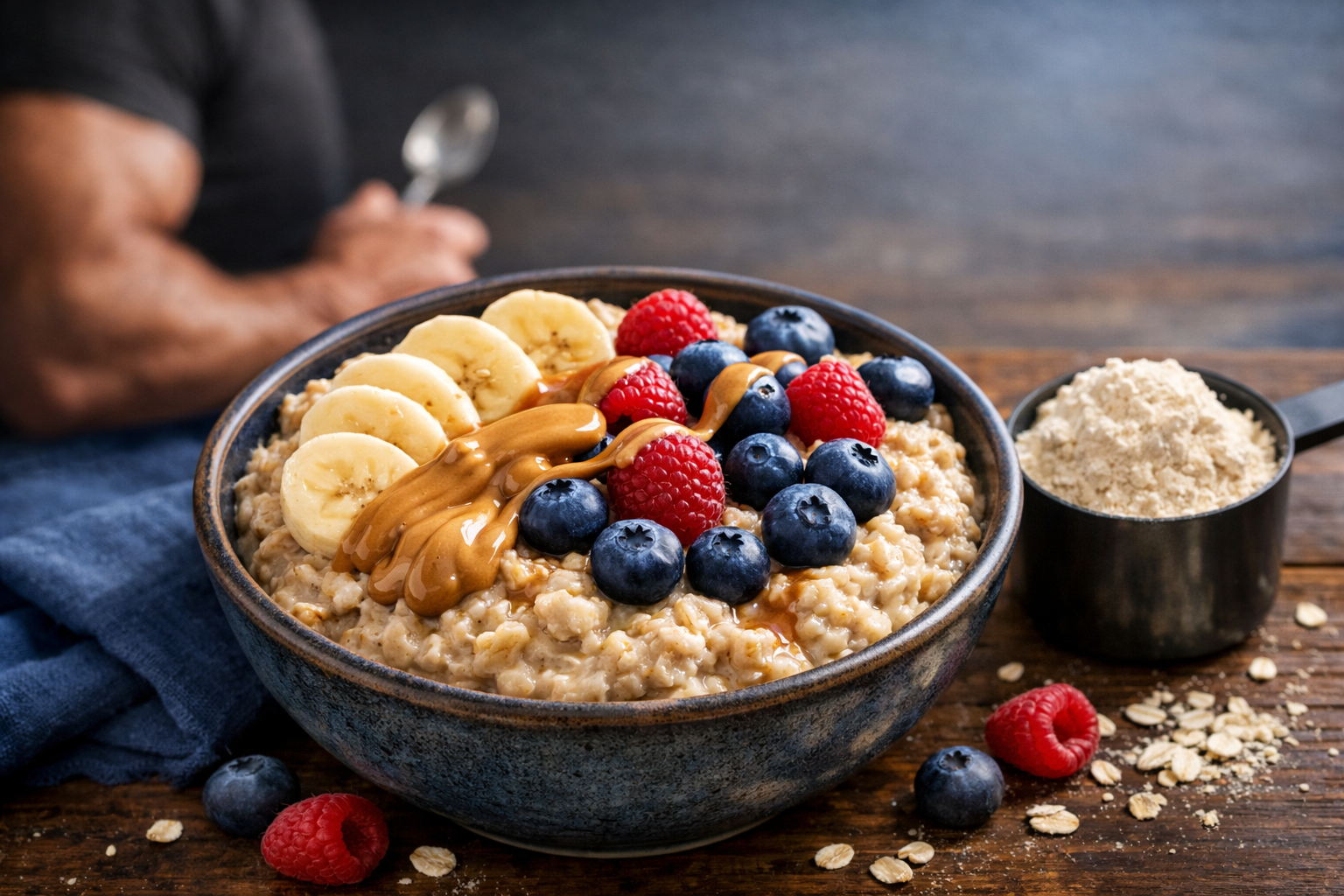
Want to maximize muscle growth? Here’s the science-backed truth about whether oatmeal deserves a place in your bulking diet.
Walk into any bodybuilder’s kitchen and you’ll likely find a massive container of oats.
Oatmeal for breakfast. Oats in protein shakes. Oat-based recipes everywhere.
But does oatmeal actually help build muscle, or is this just bro-science tradition?
Here’s the direct answer: Yes, oatmeal helps build muscle by providing quality carbohydrates for energy and caloric surplus, plus a surprisingly high protein content for a grain (11g per cup). It’s one of the best carb sources for muscle gain.
In this comprehensive guide, I’ll explain exactly how oatmeal supports muscle growth, break down its complete nutritional profile, reveal the advantages and potential drawbacks for bulking, compare different types of oats, and show you how to use oatmeal optimally for maximum gains.
Whether you’re struggling to eat enough calories, looking for quality carb sources, or just wondering if oats are worth the hype, this article has the answers.
Let’s get into it.
TABLE OF CONTENTS
How Oatmeal Helps Build Muscle
Before examining the nutritional details, you need to understand the fundamental mechanism.
The Caloric Surplus Requirement
Building muscle requires eating more calories than you burn (a caloric surplus).
Why this matters:
Your body needs energy to:
- Maintain all normal bodily functions
- Fuel your training
- Support daily activities
- BUILD new muscle tissue
Without excess energy, your body has nothing to “invest” in muscle growth. Even with perfect training and adequate protein, you won’t build muscle in a caloric deficit.
This is where oatmeal becomes valuable.
Oatmeal’s Role in Muscle Building
Oatmeal helps build muscle by:
Providing dense, quality calories: One cup of dry oats contains approximately 300 calories, making it easy to create the surplus needed for growth.
Supplying sustained energy: Complex carbohydrates fuel intense training and support recovery without the crash of simple sugars.
Contributing protein: 11g of protein per cup adds to your daily protein intake, supporting muscle protein synthesis.
Delivering micronutrients: Vitamins and minerals support overall health, recovery, and muscle-building processes.
Important clarification: Oatmeal alone doesn’t “build” muscle. You still need:
- Adequate total protein intake (0.7-1g per pound body weight)
- Quality protein sources with all essential amino acids (especially leucine)
- Progressive resistance training
- Adequate recovery
Oatmeal provides the caloric foundation and energy substrate that makes muscle growth possible.
The Practical Application
Effective bulking strategy:
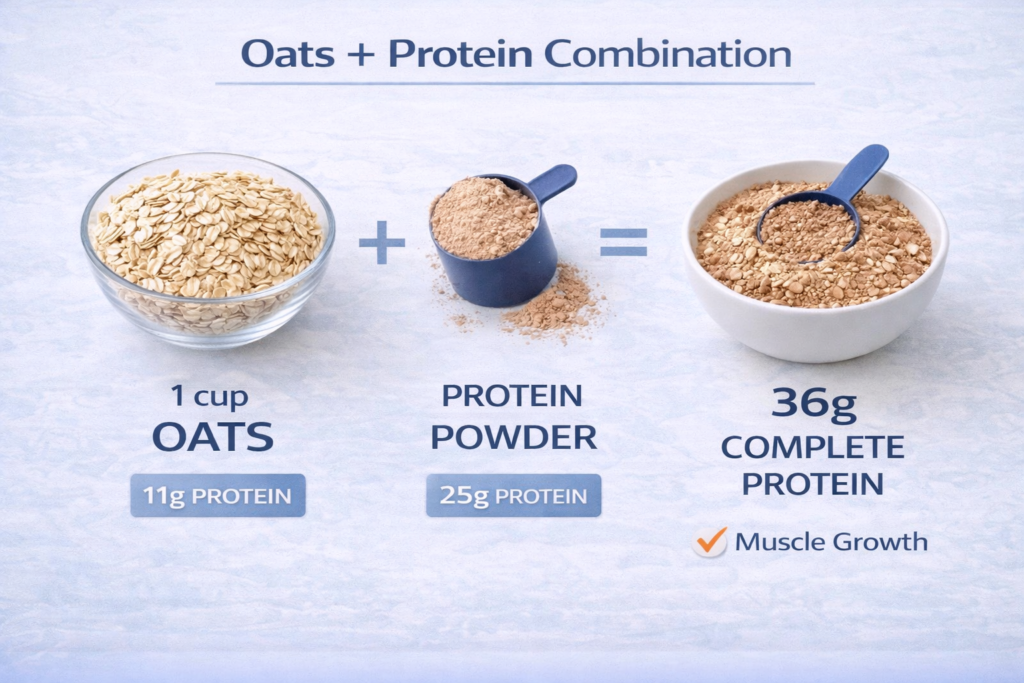
Combine oatmeal with protein powder to create a complete muscle-building meal:
- Oatmeal provides carbs and calories
- Protein powder provides amino acids
- Together they support muscle growth
Example meal:
- 1 cup dry oats: 307 calories, 11g protein, 55g carbs
- 1 scoop whey protein: 120 calories, 25g protein, 3g carbs
- Total: 427 calories, 36g protein, 58g carbs
This combination delivers everything needed for post-workout recovery or any muscle-building meal.
Oatmeal Nutrition: Complete Breakdown
Let’s examine exactly what you get from oatmeal.
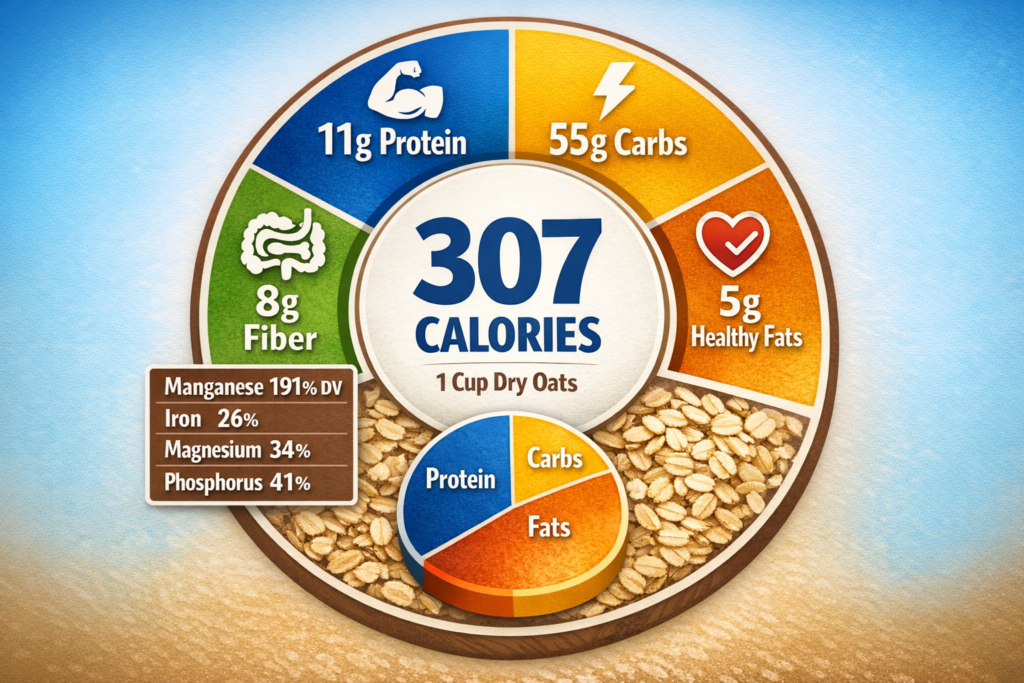
Macronutrients (Per 1 Cup / 81g Dry Oats)
Calories: 307
Carbohydrates: 54.8g
- Dietary fiber: 8.2g
- Net carbs: 46.6g
- Sugars: 0.8g (minimal)
Protein: 10.7g
Fat: 5.3g
- Saturated fat: 0.9g
- Monounsaturated fat: 1.6g
- Polyunsaturated fat: 1.9g
Micronutrients (Notable Amounts)
Vitamins:
- Thiamine (B1): 39% DV
- Folate (B9): 14% DV
- Pantothenic acid (B5): 13% DV
Minerals:
- Manganese: 191% DV (extremely high)
- Phosphorus: 41% DV
- Magnesium: 34% DV
- Copper: 31% DV
- Iron: 26% DV
- Zinc: 26% DV
Additional beneficial compounds:
- Beta-glucan (soluble fiber)
- Avenanthramides (unique antioxidants)
- Various polyphenols
What This Nutritional Profile Means for Muscle Building
Carbohydrate-dominant: Oats are primarily a carb source, perfect for fueling training and creating caloric surplus.
Significant protein for a grain: 11g protein per cup is impressive for a non-animal source.
Healthy fats: The small amount of fat is mostly unsaturated (anti-inflammatory).
Micronutrient-dense: Supports overall health, recovery, and muscle-building processes.
High fiber: Promotes satiety and digestive health (though this can be a drawback for extreme bulking).
Advantages of Oatmeal for Muscle Gain
Let’s examine why oatmeal is such a popular bulking food.
Advantage 1: Incredible Versatility
Oatmeal has virtually no distinct flavor, making it adaptable to countless recipes and preparations.
Sweet preparations:
- Classic oatmeal with berries and honey
- Protein oats with chocolate protein powder
- Overnight oats with fruits and nuts
- Oatmeal pancakes
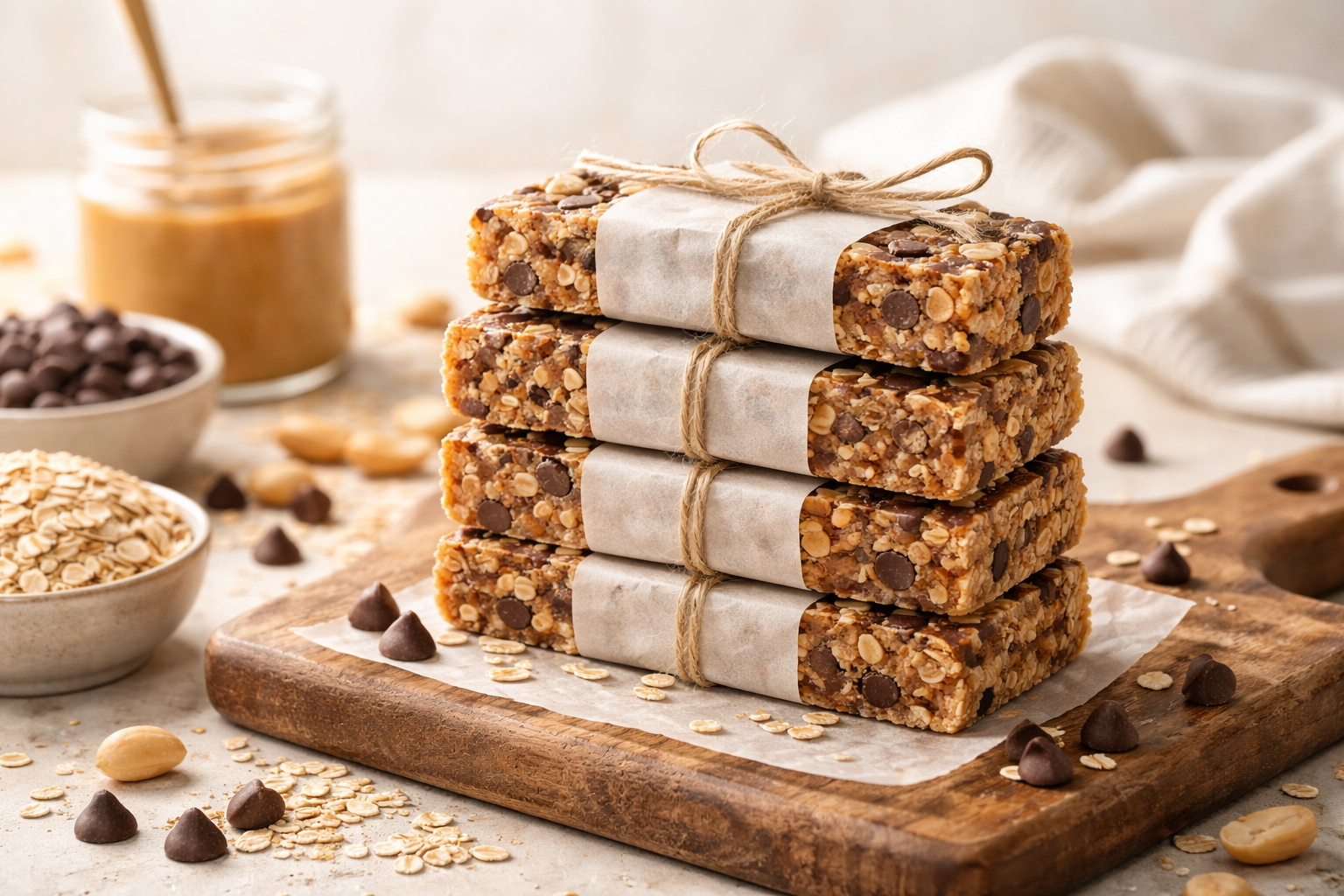
- Protein cookies or bars
Savory preparations:
- Savory oats with eggs and vegetables
- Oatmeal “risotto” style
- As a binder in meatballs or burgers
In shakes and smoothies:
- Blend raw oats directly into protein shakes
- No cooking required
- Instant carb and calorie boost
- Improves shake thickness and satiety
Flavor customization:
- Add peanut butter (or any nut butter) for calories and healthy fats
- Mix with protein powder for complete meals
- Combine with fruits, nuts, seeds, honey, maple syrup, cinnamon, cocoa powder, etc.
Availability: Found in virtually every grocery store worldwide at affordable prices.
Advantage 2: Gluten-Free Option
For people with celiac disease or gluten sensitivity, finding quality carb sources can be challenging.
Oats are naturally gluten-free, making them a perfect carbohydrate for muscle building if you have this dietary restriction.
Important caveat: Look for certified gluten-free oats. While oats themselves contain no gluten, they’re often processed in facilities that also process wheat, barley, and rye, leading to cross-contamination.
Certified gluten-free labels guarantee:
- No cross-contamination
- Safe for celiacs
- Tested to contain <20ppm gluten
If you’re gluten-intolerant, oats can be a staple carb source instead of relying solely on rice, potatoes, and gluten-free processed foods.
Advantage 3: Contains Significant Protein (For a Grain)
Unlike most grains, oats contain a respectable amount of protein.
Comparison to other grains (per 100g):
- Oats: 13g protein
- Brown rice: 7.5g protein
- Quinoa: 14g protein (higher, but quinoa is more expensive)
- White rice: 7g protein
- Whole wheat: 13g protein (but contains gluten)
For muscle building, this protein content helps you:
- Reach daily protein targets more easily
- Create complete meals when combined with protein powder
- Get amino acids throughout the day
One cup of oats provides 11g protein. While not a complete protein source by itself, it contributes meaningfully to your daily total.
When combined with protein powder:
- Oats + whey = complete amino acid profile
- Provides both fast (whey) and slow (oat) protein
- Supports sustained muscle protein synthesis
Advantage 4: Sustained Energy Release
Oats are a complex carbohydrate with a low to medium glycemic index (GI of 55).
What this means:
Gradual glucose release: No blood sugar spike and crash like white bread or candy.
Sustained energy: Powers training and daily activities for hours.
Stable insulin: Avoiding insulin spikes may support better body composition during bulking.
Reduced hunger: The combination of fiber and slow digestion keeps you satisfied longer.
Practical benefit: Eating oatmeal 1-2 hours pre-workout provides steady energy throughout your training session without digestive discomfort.
Advantage 5: High in Beneficial Fiber
Oats contain 8.2g of fiber per cup, including unique beta-glucan soluble fiber.
Benefits of oat fiber:
Improved digestion: Supports regular bowel movements and gut health.
Heart health: Beta-glucan reduces LDL cholesterol levels.
Blood sugar control: Slows glucose absorption, preventing spikes.
Satiety: Keeps you feeling full, which can help control total calorie intake (useful if you’re doing a lean bulk).
Gut microbiome support: Fiber feeds beneficial gut bacteria.
Important for bulking: While fiber is generally healthy, excessive fiber can be problematic when trying to eat large amounts of food (covered in disadvantages section).
Advantage 6: Antioxidant Properties Support Recovery
Oats contain unique antioxidants called avenanthramides.
How these support muscle building:
Reduced inflammation: Heavy training creates inflammation; antioxidants help manage it.
Enhanced recovery: Less oxidative stress means faster recovery between workouts.
Improved blood flow: Avenanthramides may enhance nitric oxide production, improving nutrient delivery to muscles.
While the effect is modest, every little bit helps when you’re training hard for muscle growth.
Advantage 7: Budget-Friendly
Oats are one of the most cost-effective carbohydrate sources available.
Price comparison (approximate per pound):
- Oats: $1.50-3.00
- Rice: $1.00-2.00
- Quinoa: $4.00-8.00
- Pasta: $1.50-3.00
- Sweet potatoes: $1.50-3.00
For the nutritional value provided, oats offer exceptional bang for your buck.
When bulking requires eating 3,000-4,000+ calories daily, cost matters. Oats help you afford the volume of food needed without breaking the bank.
Disadvantages of Oatmeal for Muscle Gain
Nothing is perfect. Let’s examine the potential downsides.
Disadvantage 1: Gastrointestinal Symptoms
Some people experience digestive issues from oats:
Bloating: Fiber fermentation can cause gas and bloating.
Abdominal discomfort: Particularly when consumed before training.
Gas: The fiber and resistant starch can create flatulence.
Individual variation: Some people tolerate oats perfectly, others struggle.
Solutions if you experience issues:
Cook your oats: Raw oats are harder to digest. Cooked oats cause fewer problems.
Start with smaller amounts: Build up tolerance gradually (1/2 cup, then 3/4, then full cup).
Ensure certified gluten-free: If you’re sensitive to gluten contamination.
Try different forms: Steel-cut vs. rolled vs. instant (covered later).
Time it away from training: Don’t eat oats immediately before intense workouts if they cause discomfort.
If problems persist despite these adjustments, oats might not be the best carb source for you. Try rice, potatoes, or other alternatives.
Disadvantage 2: High Fiber Can Limit Appetite
While fiber is generally beneficial, it can be problematic during aggressive bulking.
The problem:
Fiber increases satiety dramatically. One cup of oats provides 33% of your daily recommended fiber intake.
When you’re trying to eat 3,500-4,500 calories daily, feeling full is the enemy.
If your primary carb source is high-fiber oats, you may struggle to consume enough total calories to support maximal muscle growth.
The solution:
Vary your carb sources:
- Oats for some meals
- White rice for others (low fiber, easy to eat in volume)
- Potatoes
- Pasta
- Bread
Don’t rely exclusively on oats. Use them strategically as part of a diverse carb intake.
Balance fiber throughout the day:
- Lower fiber meals when you need to eat large volumes
- Higher fiber meals for satiety and health
For extreme bulking (eating 4,500+ calories), you may need to limit oat consumption to avoid excessive fullness.
Disadvantage 3: Not Ideal Immediately Pre-Workout
While oats can work pre-workout for some people, they’re not optimal for everyone.
Potential issues:
Fiber and bulk: Can cause sluggishness or digestive discomfort during intense training.
Digestion time: Takes longer to digest than simple carbs.
Individual tolerance: Some people handle it fine, others feel heavy and uncomfortable.
Better pre-workout carbs for most people:
- White rice (fast-digesting, low fiber)
- White potatoes
- Rice cakes
- Bananas
- Simple carb sports drinks
When oats work pre-workout:
- Consumed 2-3 hours before training (enough digestion time)
- Moderate portions (1/2 to 3/4 cup instead of full cup)
- Well-cooked (easier to digest than raw)
- For individuals who tolerate fiber well
Experiment to find what works for you. If oats make your training feel sluggish, use them post-workout or at other meals instead.
Which Type of Oats Is Best for Muscle Building?
Oats come in several forms. Which should you choose?
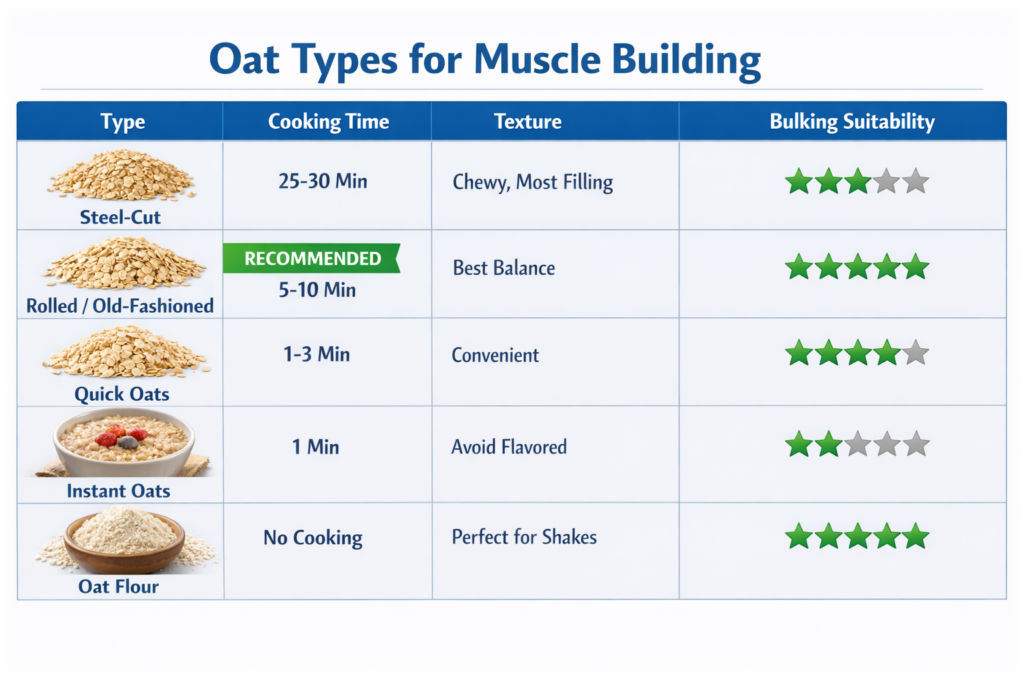
Steel-Cut Oats (Irish Oats)
What they are: Whole oat groats cut into pieces with steel blades.
Characteristics:
- Largest, chunkiest form
- Longest cooking time (20-30 minutes)
- Chewy, dense texture
- Nuttiest flavor
- Lowest glycemic index
For muscle building:
Advantages:
- Most filling (highest satiety)
- Best for controlled, lean bulking
- Maximum nutrients retained
Disadvantages:
- Time-consuming to prepare
- Very filling (hard to eat in volume)
- Difficult to add to recipes or shakes
Best use: Occasional breakfast when you have time and want maximum satiety.
Rolled Oats (Old-Fashioned Oats)
What they are: Oat groats steamed and rolled flat.
Characteristics:
- Moderate size and thickness
- Moderate cooking time (5-10 minutes)
- Creamy texture when cooked
- Slightly lower GI than instant
For muscle building:
Advantages:
- Versatile (cooking, baking, smoothies)
- Reasonable prep time
- Good balance of nutrition and convenience
- Mix well in protein shakes
- Ideal texture for most recipes
Disadvantages:
- Still require cooking for best digestion
- Can be somewhat filling
Best use: Primary go-to oat form for most muscle builders. Works for breakfast, recipes, and shakes.
This is the recommended form for most people.
Quick Oats
What they are: Rolled oats cut into smaller pieces.
Characteristics:
- Smaller flakes than rolled oats
- Very quick cooking (1-3 minutes)
- Softer, mushier texture
- Slightly higher GI than rolled
For muscle building:
Advantages:
- Fast preparation
- Easy to digest
- Mix even better in shakes than rolled
- Less filling than steel-cut or rolled
Disadvantages:
- Mushier texture (some don’t like it)
- Less nutritious than less-processed forms
Best use: When convenience matters most. Great for protein shakes.
Instant Oats
What they are: Pre-cooked, dried, and often pre-flavored oats.
Characteristics:
- Finest texture
- No cooking needed (just add hot water)
- Often contains added sugar and flavoring
- Highest GI of all oat forms
For muscle building:
Advantages:
- Ultimate convenience
- Easiest to digest
- Least filling (easier to eat in volume)
- Can be consumed anywhere
Disadvantages:
- Often loaded with added sugar (check labels)
- Most processed form
- Less nutritious than whole oat forms
- Can be expensive for what you get
Best use: Emergency carb source when nothing else is available, or post-workout when you want fast-digesting carbs.
Avoid flavored instant oats (high sugar, low nutrition). If using instant, buy plain and flavor yourself.
Oat Flour
What it is: Finely ground oats.
Characteristics:
- Powder form
- No cooking required (can be used raw)
- Mixes completely into liquids
- Same nutrition as whole oats
For muscle building:
Advantages:
- Perfect for protein shakes (zero texture)
- Easy to add to any recipe
- No lumps or chunks
- Can consume large amounts easily
- Less filling than whole oats
Disadvantages:
- More expensive than whole oats
- Very easy to overdo (less satiety cue)
- May be too processed for some people’s preferences
Best use: Protein shakes, smoothies, baking, any recipe where you want oat nutrition without oat texture.
Highly recommended for bulking when you need to consume large amounts without feeling overly full.
Oat Bran
What it is: The outer layer of the oat groat (removed during processing).
Characteristics:
- Very high fiber
- Lower in carbohydrates than whole oats
- Fine texture
- Slightly nutty flavor
For muscle building:
Advantages:
- Maximum fiber and micronutrients
- Good for digestive health
Disadvantages:
- Much lower carb content (not ideal for bulking)
- Extremely filling
- Not the best choice when you need calories and energy
Best use: Not recommended as primary oat form for muscle building. Better suited for cutting or general health.
The Verdict: Best Oat Types for Muscle Building
Primary choice: Rolled oats (old-fashioned)
- Best balance of nutrition, versatility, and convenience
- Works for everything: breakfast, recipes, shakes
Secondary choice: Oat flour
- Perfect for shakes and recipes where texture matters
- Easier to consume in volume
Occasional use: Quick oats or instant (plain only)
- When convenience is paramount
- Post-workout quick carbs
Avoid for bulking: Oat bran
- Too much fiber, not enough carbs
- Better for cutting or maintenance
Should You Eat Oats Before or After Training?
The timing question everyone asks.
The Short Answer
Oats work for both pre and post-workout, but individual tolerance varies.
What matters most: Total daily intake, not precise timing. As long as you’re eating quality carbs around your training, the specific food choice is less critical.
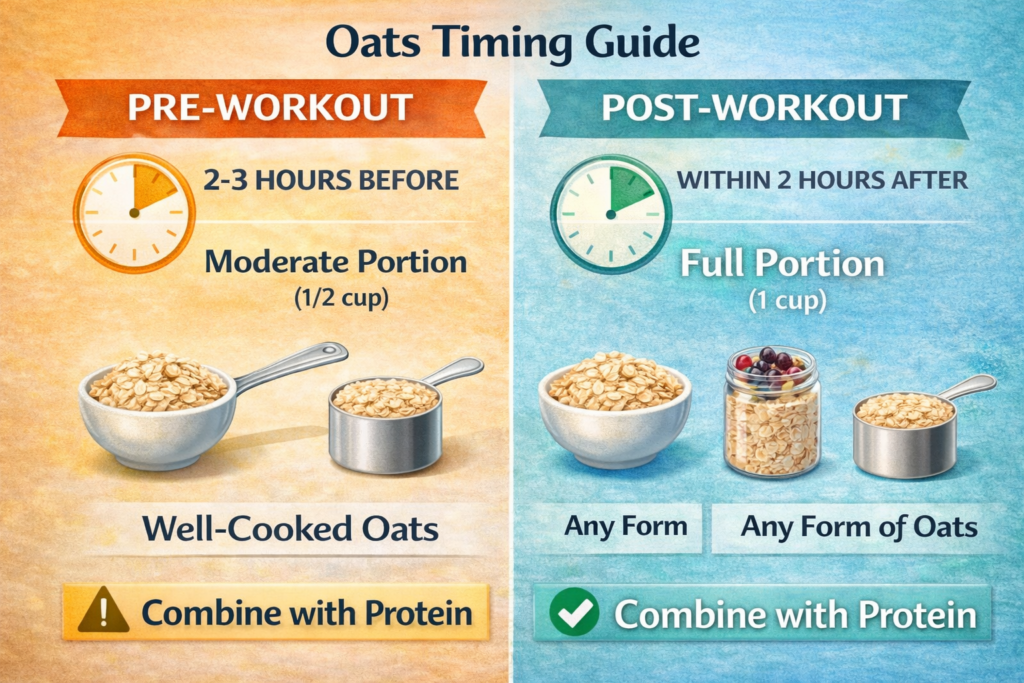
Pre-Workout Oats: Pros and Cons
Advantages:
Sustained energy: Complex carbs provide steady fuel throughout your workout.
Prevents hunger: Won’t get hungry mid-training.
Stable blood sugar: No mid-workout crash.
Disadvantages:
Potential digestive discomfort: Fiber can cause issues during intense exercise.
Slower digestion: Takes longer to become available as energy.
Timing requirements: Need to eat 1.5-3 hours before training for proper digestion.
Best practices for pre-workout oats:
Timing: 2-3 hours before training (minimum 90 minutes)
Portion: Moderate serving (1/2 to 3/4 cup dry oats)
Form: Well-cooked oats (easier digestion than raw)
Combination: Pair with easily digestible protein (whey, egg whites)
Hydration: Drink adequate water
Post-Workout Oats: Pros and Cons
Advantages:
Replenishes glycogen: Carbs restore muscle energy stores depleted during training.
No digestive interference: Not training, so fiber won’t cause performance issues.
Supports recovery: Combined with protein, promotes muscle repair and growth.
Flexible timing: Can eat immediately or within 1-2 hours post-workout.
Disadvantages:
Slower absorption: Not the fastest carb source (though this doesn’t matter much).
Best practices for post-workout oats:
Timing: Within 30-120 minutes post-training
Portion: Full serving (1 cup or more if needed)
Form: Any form works (rolled, quick, instant, flour)
Combination: MUST combine with fast-acting protein (whey protein ideal)
Recipe example:
- 1 cup cooked oats
- 1 scoop whey protein
- 1 tablespoon peanut butter
- Banana
- Total: 650+ calories, 40g+ protein, 80g+ carbs
Any-Time-of-Day Oats
Realistically, oats work well at any meal:
Breakfast: Classic oatmeal to start the day with quality carbs and sustained energy.
Mid-morning snack: Oats + protein shake for a complete muscle-building meal.
Lunch: Savory oats or oat-based recipes.
Afternoon snack: Another opportunity for oats + protein.
Dinner: Less common but works if it fits your macros.
Before bed: Slower-digesting carbs can support overnight recovery (though not necessary).
The key: Hit your total daily carb and calorie targets. When you eat oats matters less than eating them consistently.
How to Use Oatmeal for Maximum Muscle Growth
Practical strategies for optimal results.
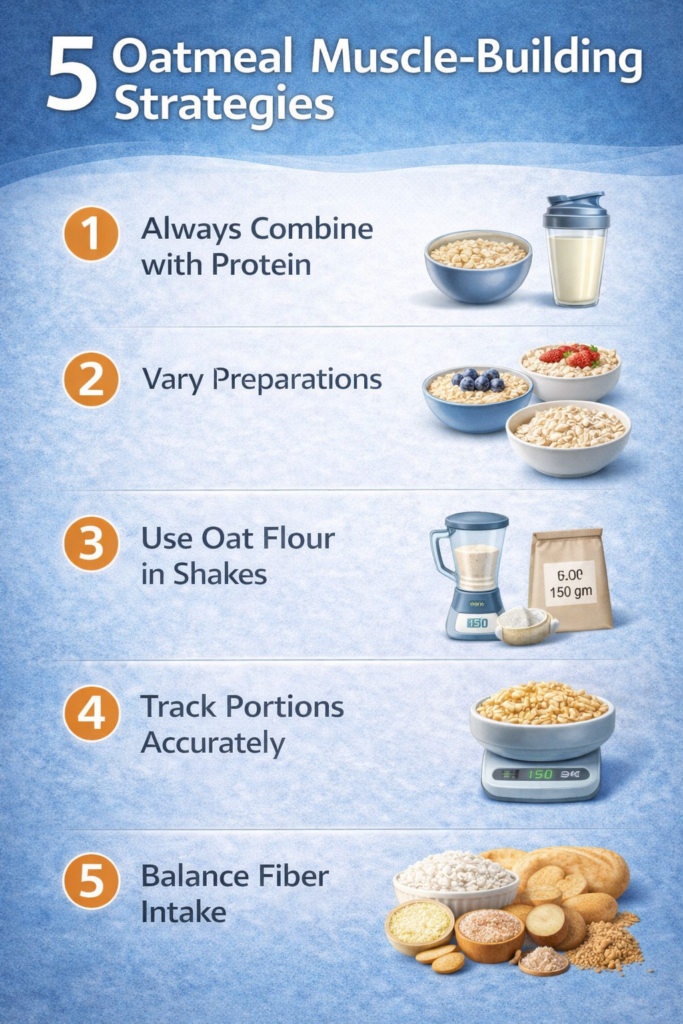
Strategy 1: Combine Oats With Protein
Never eat oats alone for muscle building.
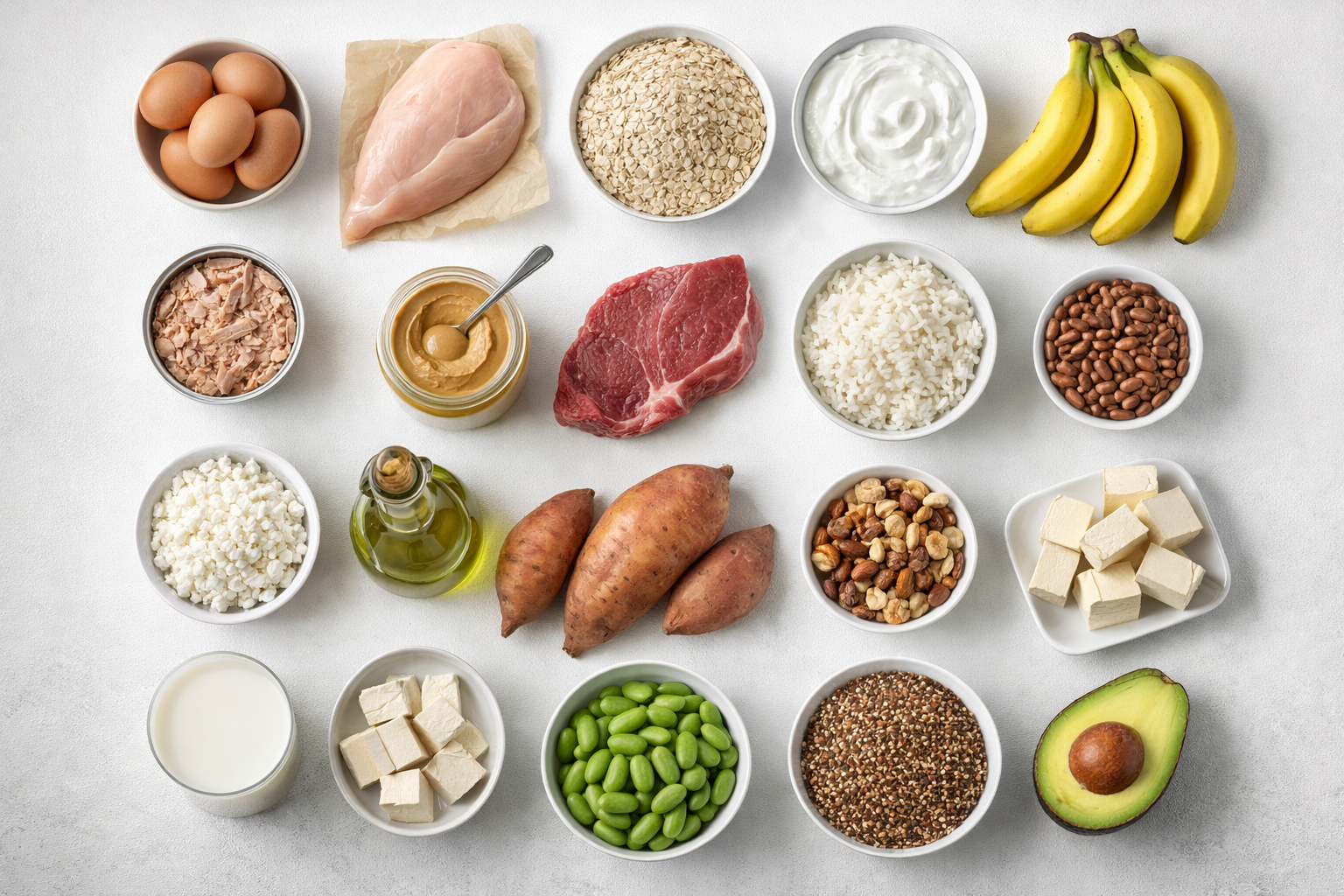
Always pair with protein:
- Protein powder (easiest)
- Eggs
- Greek yogurt
- Cottage cheese
- Milk
This ensures every meal supports muscle protein synthesis.
Strategy 2: Vary Your Oat Preparations
Don’t eat the same boring oatmeal every day.
Try different preparations:
- Traditional cooked oatmeal
- Overnight oats
- Protein oats (oats + protein powder)
- Oatmeal pancakes
- Oat-based protein bars or cookies
- Oats in smoothies
- Savory oat bowls
Variety prevents boredom and ensures consistency.
Strategy 3: Use Oat Flour in Shakes for Easy Calories
When bulking requires high calories, oat flour is your friend:
Simple mass-gainer shake:
- 2 scoops whey protein
- 1/2 to 1 cup oat flour
- 2 tablespoons peanut butter
- Banana
- Milk
- Total: 800-1,000 calories
Benefits:
- Easy to consume
- No chewing required
- Minimal fullness
- Complete nutrition
Strategy 4: Track Your Oat Intake
Don’t eyeball portions. Track accurately.
Use a food scale:
- Measure dry oats before cooking
- 1 cup dry oats ≈ 81g ≈ 307 calories
- Track in MyFitnessPal or similar app
This ensures you’re actually hitting your calorie and carb targets.
Strategy 5: Balance Fiber Across the Day
Don’t eat only high-fiber carbs:
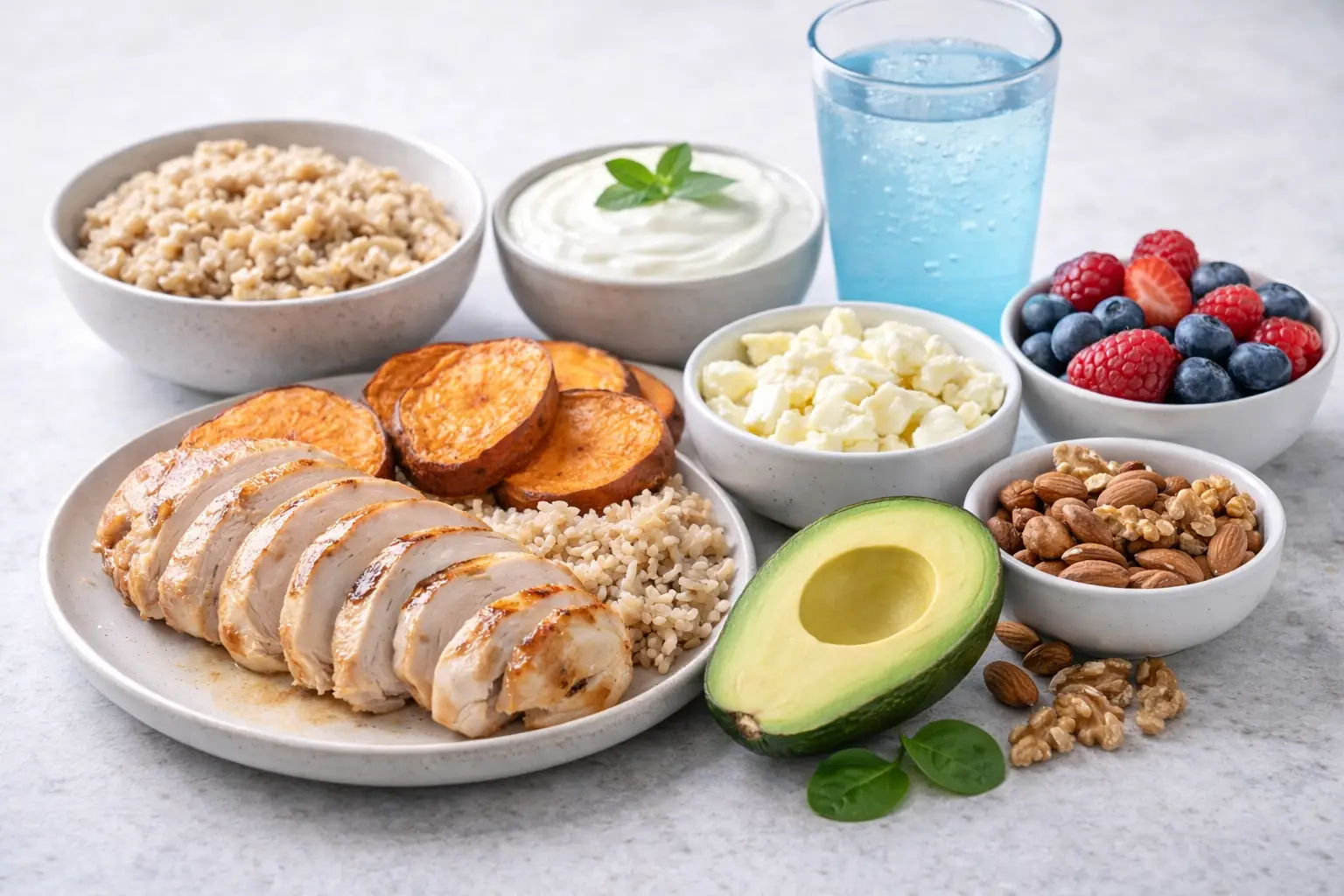
Example daily carb sources:
- Breakfast: Oats (high fiber)
- Post-workout: White rice (low fiber)
- Dinner: Potatoes (moderate fiber)
This provides adequate fiber for health without excessive fullness that prevents eating enough calories.
The Bottom Line: Oatmeal Earns Its Place in Bulking Diets
After examining all the evidence:
Oatmeal helps build muscle by:
✅ Providing quality calories for caloric surplus (307 per cup)
✅ Supplying sustained energy for training and recovery
✅ Contributing meaningful protein (11g per cup)
✅ Delivering essential micronutrients for health and performance
✅ Offering incredible versatility and convenience
✅ Being affordable and accessible
Best practices for using oats:
✅ Choose rolled oats or oat flour for best results
✅ Always combine with protein sources
✅ Use around training (2-3 hours pre-workout or post-workout)
✅ Vary preparations to prevent boredom
✅ Balance with other carb sources to manage fiber intake
✅ Track portions accurately
Oats won’t build muscle alone, but combined with adequate protein, progressive training, and overall caloric surplus, they’re one of the best carbohydrate sources available.
Add oats to your bulking diet. Your muscles and wallet will thank you.
EAT YOUR OATS. HIT YOUR MACROS. BUILD YOUR MUSCLE.
Ready to optimize every aspect of your bulking diet for maximum muscle growth? Oatmeal is just one piece of a complete nutrition strategy. Get a science-based meal plan that shows you exactly what to eat, when to eat it, and how much, plus proven training programs designed for serious muscle growth. Stop guessing. Start growing.


Leave a Reply
You must be logged in to post a comment.