Training fasted and wondering if your pre-workout ruins your fast? The answer isn’t simple. It depends on what’s actually in your pre-workout.
You wake up. You’re fasting. Your feeding window doesn’t start for 4 hours. But you want to hit the gym now and need energy.
You reach for your pre-workout. Then pause. “Will this break my fast?” You’re confused because you’ve heard conflicting information.
You’ve been told:
- “Any supplement breaks a fast”
- “Pre-workout is fine during fasting”
- “Only caffeine is allowed”
- “BCAAs don’t count”
Most of this is oversimplified or wrong. The truth: Whether pre-workout breaks your fast depends entirely on the specific ingredients. A pre-workout with zero calories, no BCAAs, and no carbs does NOT break a fast. A pre-workout with BCAAs, maltodextrin, or significant calories DOES break your fast. You need to check the label and understand each ingredient’s metabolic impact. Most commercial pre-workouts contain at least some fast-breaking ingredients.
In this comprehensive guide, I’ll explain what actually breaks a fast (the metabolic definition), reveal which pre-workout ingredients break fasting (BCAAs, carbs, sweeteners analyzed), show you which ingredients are safe (caffeine, beta-alanine, citrulline), provide strategies for fasted training (pre-workout alternatives), and address benefits and risks of fasted pre-workout use (energy vs. side effects).
Whether you’re doing 16:8, OMAD, or any fasting protocol, understanding pre-workout compatibility is crucial.
Let’s break down pre-workout ingredients and fasting scientifically.
TABLE OF CONTENTS
What Does “Breaking a Fast” Actually Mean?
The metabolic definition.
The Physiological State of Fasting
What happens during fasting:
Early fasting (0-8 hours):
- Recent meal digestion complete
- Insulin levels declining
- Beginning to use stored glycogen
- Transition phase
Deep fasting (8-16+ hours):
- Insulin at baseline (very low)
- Glycogen stores depleting
- Fat oxidation increasing
- Ketone production beginning (if prolonged)
- Autophagy activating
- Fasted metabolic state
The key metabolic markers:
- Low insulin
- Stable/low blood glucose
- Elevated fat oxidation
- Ketone production (longer fasts)
- Cellular cleanup processes active
- Fasting benefits
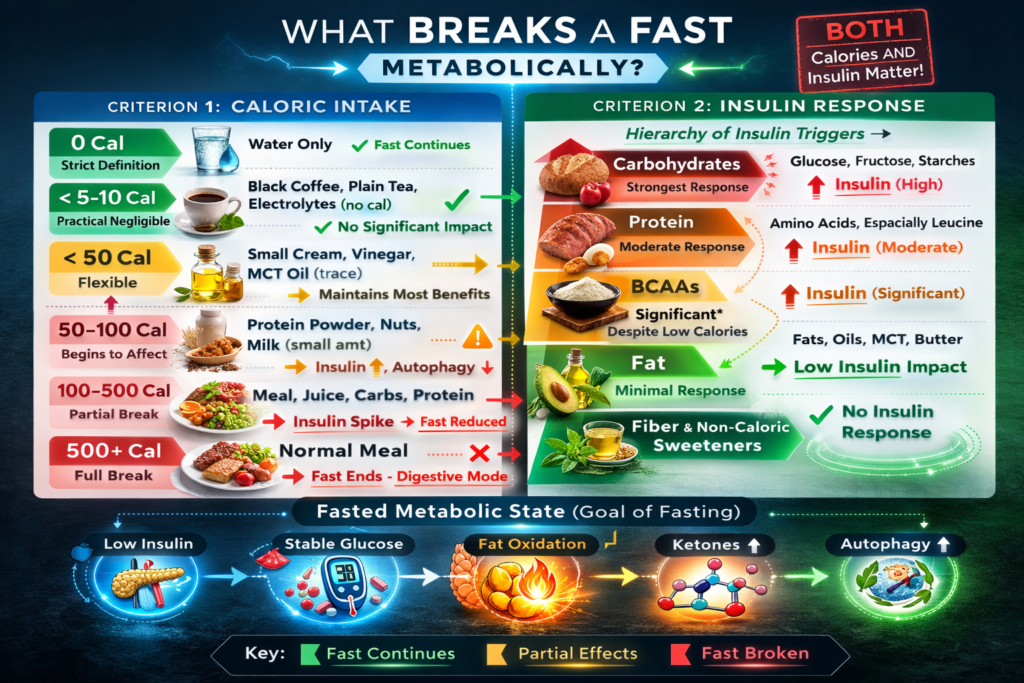
What Breaks a Fast (The Criteria)
Primary factor 1: Caloric intake
- Consuming calories triggers metabolic shift
- Digestive processes activated
- Shifts from fasted to fed state
- Calorie threshold
The calorie standards:
- Strict definition: 0 calories (water only)
- Practical definition: <5-10 calories (negligible)
- Flexible definition: <50 calories (maintains most benefits)
- Different approaches
Primary factor 2: Insulin response
- Insulin signals fed state
- Halts fat burning
- Stops autophagy
- Hormonal signal
What triggers insulin:
- Carbohydrates (strongest response)
- Protein (moderate response)
- BCAAs (significant response despite low calories)
- Fat (minimal response)
- Macronutrient hierarchy
The combination:
- Both calories AND insulin response matter
- Some ingredients have calories but no insulin (fats)
- Some trigger insulin despite few calories (BCAAs)
- Dual consideration
Pre-Workout Ingredients: Do They Break Your Fast?
Ingredient-by-ingredient analysis.
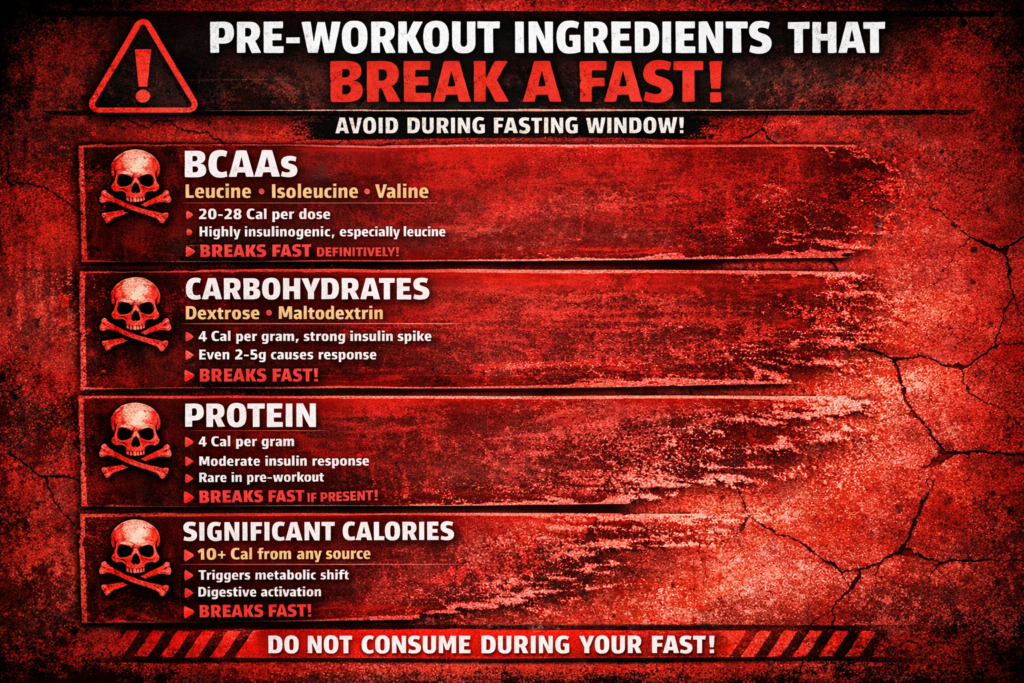
Ingredients That BREAK a Fast
1. BCAAs (Branched-Chain Amino Acids)
What they are:
- Leucine, isoleucine, valine
- Proteinogenic amino acids
- Common in pre-workouts
- Amino acid trio
Calorie content:
- ~4 calories per gram (like protein)
- Typical pre-workout dose: 5-7g
- ~20-28 calories
- Caloric impact
Insulin response:
- BCAAs are highly insulinogenic
- Trigger insulin release significantly
- Leucine especially potent
- Strong insulin effect
The verdict:
- BCAAs definitively break a fast
- Both calories AND insulin response
- Fasting incompatible
2. Carbohydrates (Dextrose, Maltodextrin)
What they are:
- Simple, fast-digesting carbs
- Added for energy and taste
- High glycemic index
- Sugar sources
Common amounts in pre-workouts:
- 2-10g per serving (varies widely)
- Some “pump” formulas have 20-30g
- Variable content
Calorie content:
- 4 calories per gram
- 5g carbs = 20 calories
- Caloric load
Insulin response:
- Strong and immediate
- Blood glucose spike
- Insulin released rapidly
- Major insulin trigger
The verdict:
- Carbs definitively break a fast
- Even small amounts (2-5g) cause insulin response
- Fasting incompatible
3. Protein
Rarely in pre-workout, but if present:
- 4 calories per gram
- Moderate insulin response
- Breaks fast
- Not common but possible
4. Significant Calories from Any Source
The threshold:
- 10 calories generally considered fast-breaking
- 50 calories definitely breaks fast
- Calorie limit
Check label:
- If “Calories: 15” or higher → Breaks fast
- If “Calories: 0-5” → Likely safe (but check ingredients)
- Label reading essential
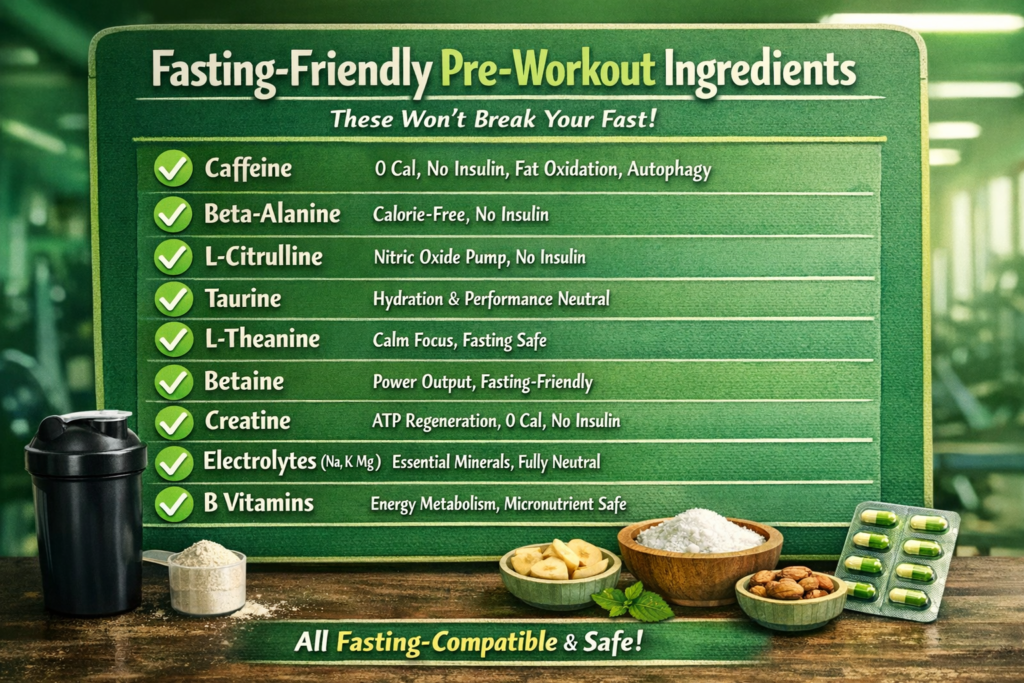
Ingredients That DON’T Break a Fast
1. Caffeine
What it is:
- Stimulant from coffee beans or synthetic
- Primary active ingredient in most pre-workouts
- Energy driver
Calorie content:
- 0 calories
- Zero caloric impact
Insulin response:
- No insulin release
- May actually improve insulin sensitivity
- No hormonal disruption
Metabolic effects:
- Increases fat oxidation (beneficial for fasting)
- Enhances autophagy (doesn’t impair it)
- May suppress appetite
- Fasting-compatible metabolic effects
Typical dose in pre-workout:
- 150-300mg per serving
- Equivalent to 1.5-3 cups coffee
- Standard range
The verdict:
- Caffeine does NOT break a fast
- Actually may enhance fasting benefits
- Fasting-compatible
2. Beta-Alanine
What it is:
- Non-proteinogenic amino acid
- Buffers lactic acid
- Causes tingling sensation
- Performance enhancer
Calorie content:
- Technically has calories (like all amino acids)
- But metabolically used differently than proteinogenic amino acids
- Not used for energy or protein synthesis
- Generally considered calorie-free in context
- Functionally zero calories
Insulin response:
- No insulin trigger
- No hormonal effect
The verdict:
- Beta-alanine does NOT break a fast
- Fasting-compatible
3. L-Citrulline
What it is:
- Non-proteinogenic amino acid
- Increases nitric oxide production
- Improves blood flow
- Pump enhancer
Calorie/insulin status:
- Functionally calorie-free (like beta-alanine)
- No insulin response
- Metabolically neutral
The verdict:
- L-citrulline does NOT break a fast
- Fasting-compatible
4. Taurine
What it is:
- Non-proteinogenic amino acid
- Supports hydration and performance
- Common ingredient
Calorie/insulin status:
- Functionally calorie-free
- No insulin response
- Metabolically neutral
The verdict:
- Taurine does NOT break a fast
- Fasting-compatible
5. L-Theanine
What it is:
- Amino acid from tea
- Reduces jitters from caffeine
- Promotes calm focus
- Calming agent
Calorie/insulin status:
- Functionally calorie-free
- No insulin response
- Metabolically neutral
The verdict:
- L-theanine does NOT break a fast
- Fasting-compatible
6. Betaine
What it is:
- Compound from beets
- Supports power output
- Performance ingredient
Calorie/insulin status:
- Functionally calorie-free
- No insulin response
- Metabolically neutral
The verdict:
- Betaine does NOT break a fast
- Fasting-compatible
7. Creatine
What it is:
- Compound for ATP regeneration
- Increases strength and power
- Well-researched ergogenic
Calorie/insulin status:
- 0 calories
- No insulin response
- Metabolically neutral
The verdict:
- Creatine does NOT break a fast
- (We’ve covered this in detail in previous article)
- Fasting-compatible
8. Electrolytes (Sodium, Potassium, Magnesium)
What they are:
- Minerals for hydration and function
- Often in pre-workouts for pumps
- Mineral blend
Calorie/insulin status:
- 0 calories
- No insulin response
- Completely neutral
The verdict:
- Electrolytes do NOT break a fast
- Fasting-compatible
9. B Vitamins
What they are:
- Vitamins for energy metabolism
- Common in pre-workouts
- Micronutrients
Calorie/insulin status:
- 0 calories
- No insulin response
- Metabolically neutral
The verdict:
- B vitamins do NOT break a fast
- Fasting-compatible
The Artificial Sweetener Question
The debate:
- Do zero-calorie sweeteners trigger insulin?
- Do they “break” a fast?
- Controversial
Common sweeteners in pre-workouts:
- Sucralose
- Acesulfame-K
- Stevia
- Zero-calorie options
The research:
Some studies suggest:
- Possible minor insulin response (cephalic phase)
- Body tastes sweet, expects sugar, releases small insulin
- Potential minor effect
Other studies show:
- No insulin response
- No blood glucose changes
- No effect
The practical reality:
- Even if minor insulin response occurs, it’s very small
- Much less than actual sugar
- Impact on fat loss minimal
- Likely negligible
The conservative approach:
- Strict autophagy-focused fast: Avoid sweeteners
- Fat loss-focused fast: Sweeteners probably fine
- If concerned: Choose unsweetened pre-workout
- Risk-based decision
Most people’s approach:
- Artificial sweeteners in pre-workout acceptable
- Benefits outweigh potential minimal insulin effect
- Practical permissiveness
Does YOUR Pre-Workout Break Your Fast?
How to determine.
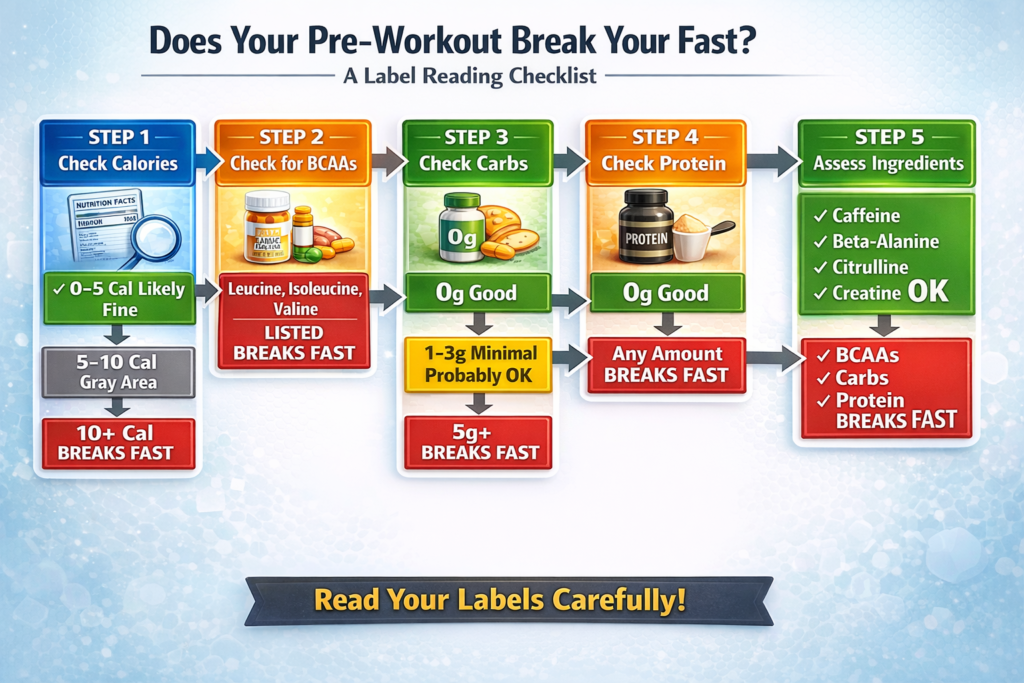
The Label Reading Method
Step 1: Check calorie content
- Look at “Calories:” on nutrition label
- 0-5 calories: Likely fine (check ingredients still)
- 5-10 calories: Gray area
- 10+ calories: Probably breaks fast
- Calorie threshold
Step 2: Check for BCAAs
- Look at ingredient list
- If contains: Leucine, Isoleucine, Valine, or “BCAAs”
- Breaks fast (even if low calories listed)
- BCAA check
Step 3: Check for carbs
- Look at “Total Carbohydrates:”
- 0g: Good
- 1-3g: Minimal (likely from sweeteners, probably okay)
- 5g+: Breaks fast
- Carb content
Step 4: Check for protein
- Look at “Protein:”
- 0g: Good
- Any amount: Breaks fast
- Protein content
Step 5: Assess ingredients
- Caffeine, beta-alanine, citrulline, taurine, creatine, betaine: All fine
- BCAAs, carbs, protein: Break fast
- Ingredient evaluation
Common Pre-Workouts Evaluated
Example 1: C4 Original
- Calories: 0
- Carbs: 0g
- Protein: 0g
- No BCAAs
- Verdict: Does NOT break fast
Example 2: Pre JYM
- Calories: 5
- Contains BCAAs (6g)
- Verdict: BREAKS fast (due to BCAAs despite low calories)
Example 3: Legion Pulse
- Calories: 0
- Carbs: 0g
- No BCAAs
- Verdict: Does NOT break fast
Example 4: Pre-workout with carbs (some pump formulas)
- Calories: 80
- Carbs: 20g
- Verdict: Definitely BREAKS fast
The pattern:
- Many basic stimulant-focused pre-workouts: Safe
- Pre-workouts with BCAAs: Break fast
- Pre-workouts with carbs: Break fast
- Check your specific product
Benefits of Pre-Workout During Fasting
Why use it while fasted.
Benefit 1: Energy and Focus
The fasted training challenge:
- No recent food intake
- Lower glycogen stores
- Reduced energy for training
- Mental fog possible
- Energy deficit
How pre-workout helps:
- Caffeine provides energy and alertness
- Improves focus and concentration
- Enhances mind-muscle connection
- Offsets fasted fatigue
- Performance support
The research:
- Caffeine improves performance regardless of fed/fasted state
- May be even more valuable when fasted (compensates for energy deficit)
- Evidence-based benefit
Benefit 2: Faster Absorption
The mechanism:
- Empty stomach = faster absorption
- No food competing for absorption
- Ingredients enter bloodstream quicker
- Accelerated uptake
The timeline:
- Fasted: Feel effects in 10-20 minutes
- Fed: Feel effects in 30-45 minutes
- Time difference
The advantage:
- Can take pre-workout closer to training
- More precise timing
- Peak effects during workout
- Timing optimization
Benefit 3: Enhanced Fat Oxidation
The synergy:
- Fasted state: Already burning fat for fuel
- Caffeine: Increases fat oxidation further
- Combined effect greater than either alone
- Synergistic fat burning
The research:
- Caffeine enhances lipolysis (fat breakdown)
- Effect magnified in fasted state
- May support fat loss goals
- Fat loss benefit
Benefit 4: Maintained Training Performance
The importance:
- Training quality crucial for muscle retention during cut
- Fasted training can compromise performance
- Pre-workout preserves intensity
- Performance maintenance
The benefit:
- Maintain strength and volume despite calorie deficit
- Better muscle preservation
- More effective cut
- Training quality support
Risks of Taking Pre-Workout on Empty Stomach
Potential side effects.
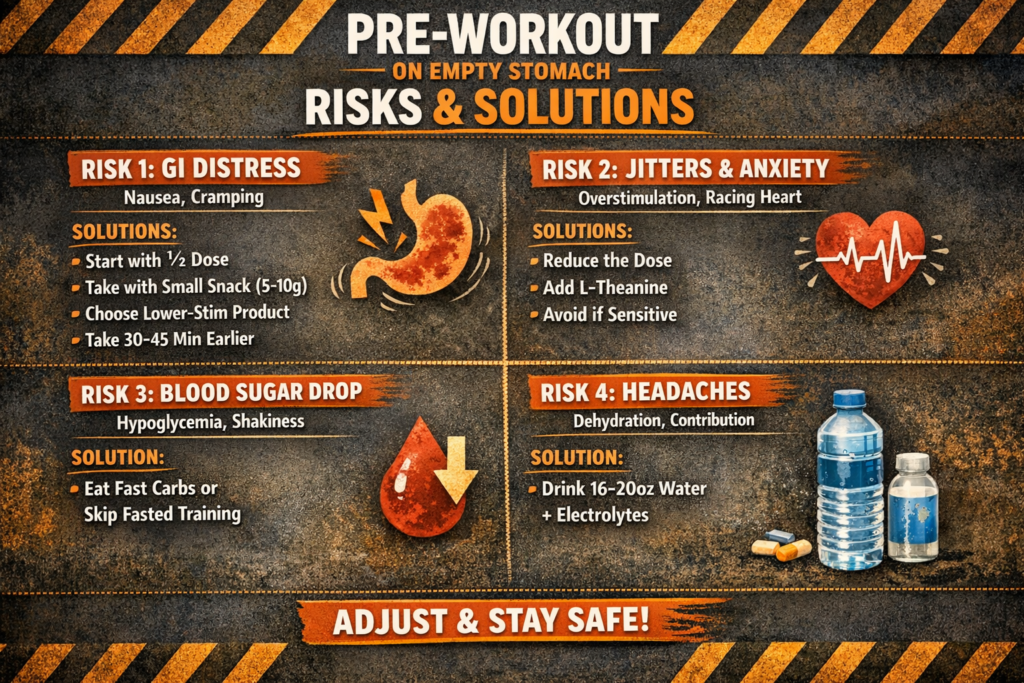
Risk 1: GI Distress
The problem:
- Pre-workout on empty stomach can cause nausea
- Cramping possible
- Digestive discomfort
- Stomach sensitivity
Who’s affected:
- People with sensitive stomachs
- Those taking high-stimulant pre-workouts
- Individual variation
- Not everyone
Why it happens:
- Concentrated ingredients without food buffer
- Caffeine stimulates gastric acid production
- Beta-alanine can irritate on empty stomach
- Multiple factors
The solutions:
Solution 1: Start with half dose
- Assess tolerance
- Increase if tolerated
- Conservative approach
Solution 2: Take with small amount food
- 5-10g protein or small piece fruit
- Technically “breaks” fast but minimally
- Eliminates GI issues
- Trade-off option
Solution 3: Choose different pre-workout
- Lower stimulant content
- Fewer irritating ingredients
- Product switch
Solution 4: Take earlier
- 30-45 minutes before training (instead of 15-20)
- More time to settle
- Timing adjustment
Risk 2: Jitters and Anxiety
The problem:
- Caffeine on empty stomach hits harder
- Excessive jitters possible
- Anxiety or nervousness
- Racing heart
- Overstimulation
Who’s affected:
- Caffeine-sensitive individuals
- Those taking high-dose pre-workouts (300mg+ caffeine)
- Susceptible people
The solutions:
Solution 1: Lower dose
- Half serving of pre-workout
- Or switch to lower-caffeine product
- Dose reduction
Solution 2: Add L-theanine
- Many pre-workouts include this
- Reduces jitters from caffeine
- Calming agent
Solution 3: Avoid if too sensitive
- Some people just can’t tolerate fasted caffeine
- Train fasted without pre-workout instead
- Skip it
Risk 3: Blood Sugar Drop
The rare problem:
- Some people experience reactive hypoglycemia
- Blood sugar drops after caffeine
- Shakiness, weakness, lightheadedness
- Uncommon but possible
Who’s affected:
- People with blood sugar regulation issues
- Very sensitive individuals
- Minority
The solution:
- Small amount fast-acting carbs before training
- Breaks fast slightly but prevents issue
- Or avoid fasted training entirely
- Safety first
Risk 4: Headaches
The problem:
- Fasted + caffeine = headaches for some
- Dehydration contribution
- Discomfort
The solution:
- Ensure adequate hydration
- Drink 16-20 oz water with pre-workout
- Electrolytes may help
- Hydration focus
Strategies for Fasted Training
Practical approaches.
Option 1: Fasting-Compatible Pre-Workout
The approach:
- Choose pre-workout with no BCAAs, no carbs, no protein
- Take as normal (30-45 min before training)
- Maintains fasted state
- True fasted training
Recommended products:
- C4 Original
- Legion Pulse
- Transparent Labs PreSeries Lean
- Any caffeine + citrulline + beta-alanine formula without BCAAs/carbs
- Fasting-friendly options
Option 2: DIY Caffeine Stack
The approach:
- Skip commercial pre-workout
- Make your own from individual ingredients
- Custom blend
The stack:
- 200mg caffeine (pill or black coffee)
- 5g citrulline malate (optional, for pumps)
- 3g beta-alanine (optional, for endurance)
- 5g creatine (optional, can take anytime)
- Simple and fasting-compatible
The advantage:
- Complete control over ingredients
- Zero risk of hidden BCAAs or carbs
- Often cheaper
- Maximum certainty
Option 3: Just Black Coffee
The minimalist approach:
- 1-2 cups black coffee
- 95-190mg caffeine
- 0 calories
- Simplest option
The benefits:
- Definitely doesn’t break fast
- Cheap
- Effective
- Natural
- Classic choice
The limitations:
- No other performance ingredients (citrulline, beta-alanine)
- Lower caffeine than many pre-workouts
- Basic but works
Option 4: Train Completely Fasted (No Pre-Workout)
The purist approach:
- No supplements at all
- Just water
- True fasted training
When this works:
- If training intensity doesn’t suffer
- If energy levels adequate
- If you don’t need stimulation
- Individual tolerance
The consideration:
- Performance may be suboptimal
- But some people train fine fasted
- Personal variation
Option 5: Small Pre-Workout Meal (Break Fast Slightly)
The compromise:
- Small amount protein + carbs before training
- 10-20g protein, 10-20g carbs
- Take pre-workout with this
- Minimal fast-breaking
When this makes sense:
- If fasted training causes too many issues
- If performance suffering significantly
- If GI distress bad
- Practical compromise
The example:
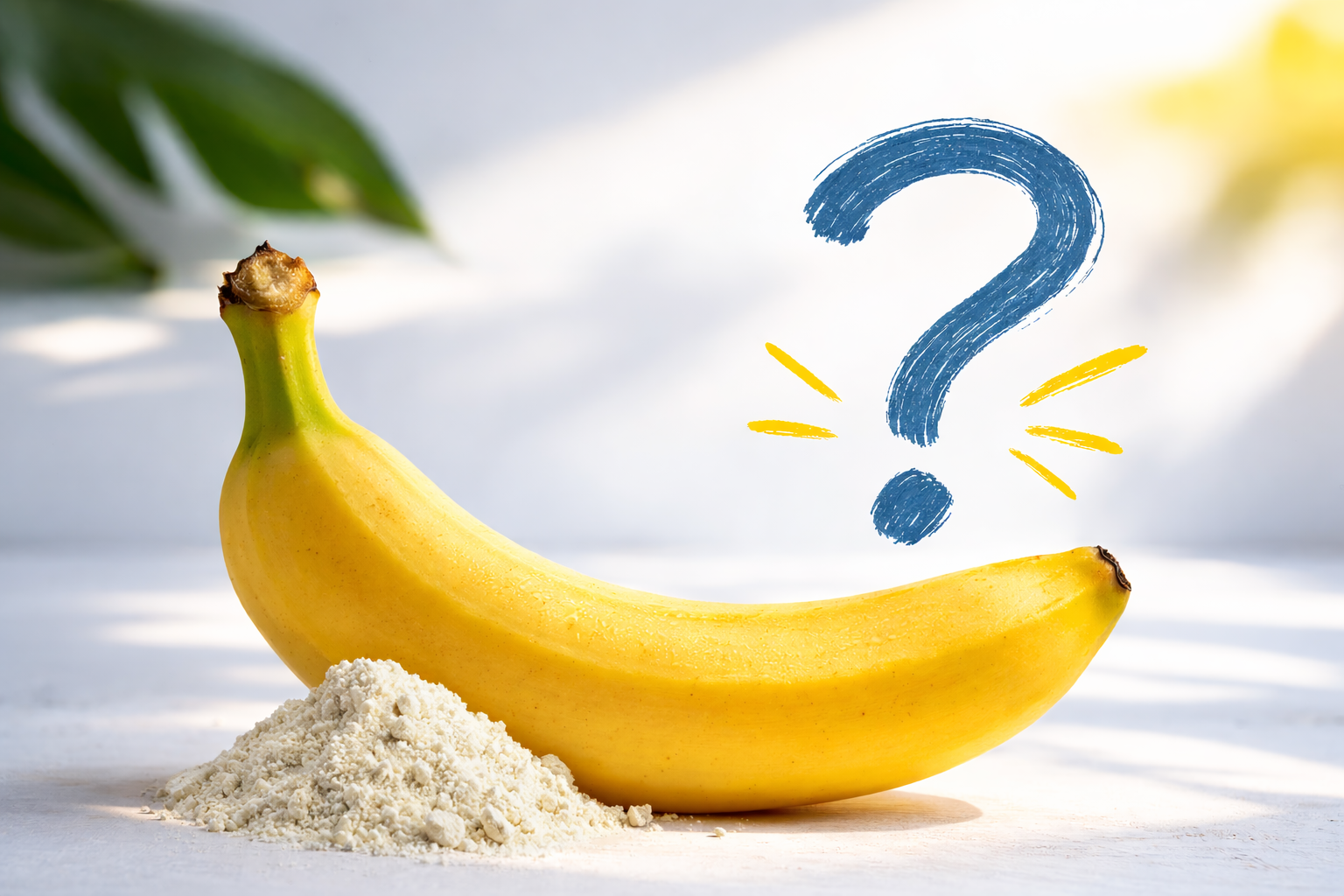
- Banana + 1 scoop whey (or equivalent)
- Wait 30 min, then train
- Technically breaks fast but enables quality training
- Trade-off decision
Common Questions
Addressing confusion.
“Will taking pre-workout during my fast ruin my fat loss?”
The answer:
- If pre-workout has no calories/BCAAs/carbs: No, won’t impact fat loss
- If has small amounts (5-20 cal): Minimal impact, likely fine
- Fat loss primarily about total daily calories
- Bigger picture matters
The perspective:
- Don’t sabotage training quality to be ultra-strict about fasting
- Quality training preserves muscle during cut
- More important than perfect fasting
- Priorities
“Can I take pre-workout during a 24+ hour fast?”
The answer:
- Yes, if it’s fasting-compatible (no BCAAs, carbs, calories)
- Caffeine may be even more helpful during extended fasts
- Extended fast compatible
The consideration:
- Caffeine on very empty stomach (24+ hours) might cause more GI issues
- Start with lower dose
- Increased sensitivity
“Should I take pre-workout before fasted cardio?”
The answer:
- Caffeine helps with fasted cardio performance
- Fat oxidation may be enhanced
- Can be beneficial
The note:
- Pre-workout designed for resistance training
- For cardio, might just need caffeine (not all the other ingredients)
- Black coffee might be sufficient
- Adjust to activity
“Does pre-workout break ketosis?”
The answer:
- If it contains carbs: Yes, temporarily
- If it’s carb-free: No, maintains ketosis
- Carb-dependent
For keto + IF:
- Choose zero-carb pre-workout
- Maintains both ketosis and fasting state
- Double compatible
“Will pre-workout impair autophagy?”
The answer:
- Fasting-compatible pre-workout (no BCAAs, carbs, protein): Does not impair autophagy
- BCAAs or protein: May reduce autophagy (insulin response)
- Ingredient-dependent
For autophagy-focused fasts:
- Very strict: Avoid all supplements, water only
- Moderate: Caffeine and non-caloric ingredients okay
- Strictness level
The Bottom Line: Check Your Pre-Workout’s Label
After explaining everything:
The truth about pre-workout and intermittent fasting:
✅ Whether pre-workout breaks your fast depends on specific ingredients (not all pre-workouts are the same)
✅ BCAAs and carbs break a fast (insulin response and calories)
✅ Caffeine, beta-alanine, citrulline, creatine do NOT break fast (zero calories, no insulin)
✅ Many commercial pre-workouts are fasting-compatible (if they don’t contain BCAAs or carbs)
✅ Benefits often outweigh risks for fasted training (energy and performance support)
Key takeaways:
What breaks a fast:
- Caloric intake (generally >10 calories)
- Insulin response (from carbs, protein, BCAAs)
- Dual criteria
Pre-workout ingredients that BREAK fast:
- BCAAs (leucine, isoleucine, valine): Highly insulinogenic despite low calories
- Carbohydrates (dextrose, maltodextrin): 2-10g typical, triggers insulin
- Protein: If present (rare in pre-workout)
- 10 calories from any source
- Fast-breakers
Pre-workout ingredients that DON’T break fast:
- Caffeine: 0 calories, no insulin, may enhance fasting benefits
- Beta-alanine: Non-proteinogenic, functionally calorie-free
- L-citrulline: Non-proteinogenic, no insulin
- Taurine: No insulin or calories
- L-theanine: Calming agent, fasting-safe
- Betaine: Performance enhancer, fasting-safe
- Creatine: 0 calories, no insulin
- Electrolytes: Minerals, completely neutral
- B vitamins: Micronutrients, no impact
- Fasting-compatible ingredients
Artificial sweeteners:
- Sucralose, acesulfame-K, stevia common
- Debate exists (possible minor insulin response)
- Practically: Impact likely minimal
- Conservative: Avoid if strict autophagy focus
- Flexible: Generally acceptable
- Gray area, likely fine
How to check YOUR pre-workout:
- Check calories (0-5 = likely okay, 10+ = breaks fast)
- Check for BCAAs in ingredients (if present = breaks fast)
- Check carbs (0-1g okay, 5g+ = breaks fast)
- Check protein (0g = okay, any amount = breaks fast)
- Evaluate individual ingredients
- Label reading process
Common pre-workouts:
- C4 Original, Legion Pulse: Fasting-compatible (no BCAAs/carbs)
- Pre JYM: Breaks fast (contains BCAAs)
- Pump formulas with carbs: Break fast
- Check specific product
Benefits of fasted pre-workout:
- Energy and focus (caffeine offsets fasted fatigue)
- Faster absorption (empty stomach = quicker effects)
- Enhanced fat oxidation (synergy with fasted state)
- Maintained training performance (preserves intensity)
- Performance support
Risks/side effects:
- GI distress (nausea, cramping in sensitive individuals)
- Jitters and anxiety (caffeine hits harder fasted)
- Blood sugar drop (rare, hypoglycemia-prone people)
- Headaches (dehydration factor)
- Manageable with dose adjustment
Risk management:
- Start with half dose
- Ensure hydration (16-20 oz water)
- Take 30-45 min before training (not right before)
- Choose lower-stim if sensitive
- Gradual approach
Fasted training strategies:
Option 1: Fasting-compatible commercial pre-workout (C4, Legion Pulse) Option 2: DIY stack (caffeine + citrulline + beta-alanine) Option 3: Black coffee only (simplest) Option 4: Train completely fasted (no supplements) Option 5: Small pre-workout meal (breaks fast slightly but supports performance)
- Multiple approaches
Priority actions:
- Read your pre-workout label (check calories, BCAAs, carbs)
- If contains BCAAs or 5g+ carbs: Breaks fast (move to feeding window or switch products)
- If 0 calories, no BCAAs, no carbs: Safe during fast
- Start with half dose if taking fasted (assess tolerance)
- Hydrate well (16-20 oz water with pre-workout)
- Time 30-45 min before training
- Implementation checklist
CHECK YOUR PRE-WORKOUT LABEL. NO BCAAS, NO CARBS, 0-5 CALORIES = FASTING-COMPATIBLE. BCAAS OR CARBS = BREAKS FAST. CAFFEINE, BETA-ALANINE, CITRULLINE ARE SAFE.
Ready to optimize your entire fasted training protocol with evidence-based supplement timing, performance strategies, and nutrition systems that maximize fat loss while preserving muscle and training intensity? Understanding pre-workout compatibility is just one piece. Get comprehensive fasted training guidance. Stop guessing about supplements. Start fasting strategically.
REFERENCES
SECTION 1 — What Does “Breaking a Fast” Actually Mean?
[1] de Cabo R, Mattson MP. — New England Journal of Medicine, 2019 Effects of Intermittent Fasting on Health, Aging, and Disease https://www.nejm.org/doi/full/10.1056/NEJMra1905136
SECTION 2 — BCAAs Break a Fast (Insulin Response + Calories)
[2] Yang J et al. — PubMed / Journal of Biological Chemistry, 2012 Leucine stimulates insulin secretion via down-regulation of surface expression of adrenergic α2A receptor through the mTOR pathway https://pubmed.ncbi.nlm.nih.gov/22645144/
[3] Yoshikawa et al. — Nutrition & Diabetes (Nature Portfolio), 2024 BCAAs acutely drive glucose dysregulation and insulin resistance https://pubmed.ncbi.nlm.nih.gov/38844453/
SECTION 3 — Carbohydrates Break a Fast
[4] Labonté CC et al. — Frontiers in Nutrition, 2021 Plasma BCAAs Are Associated With Greater Fasting and Postprandial Insulin Secretion https://pubmed.ncbi.nlm.nih.gov/33996878/
SECTION 4 — Caffeine Does NOT Break a Fast + Fat Oxidation
[5] Collado-Mateo D et al. — Nutrients (MDPI), 2020 Effect of Acute Caffeine Intake on the Fat Oxidation Rate during Exercise: A Systematic Review and Meta-Analysis https://pubmed.ncbi.nlm.nih.gov/33255240/
[6] Fernández-Sáez J et al. — Nutrients (MDPI), 2024 Effect of Acute Caffeine Intake on Fat Oxidation Rate during Fed-State Exercise: A Systematic Review and Meta-Analysis https://pubmed.ncbi.nlm.nih.gov/38257100/
SECTION 5 — The Artificial Sweetener Debate
[7] Pepino MY et al. — Diabetes Care, 2013 Sucralose Affects Glycemic and Hormonal Responses to an Oral Glucose Load https://pubmed.ncbi.nlm.nih.gov/23633524/
[8] Dalenberg JR et al. — Cell Metabolism, 2020 Short-Term Consumption of Sucralose with, but Not without, Carbohydrate Impairs Neural and Metabolic Sensitivity to Sugar in Humans https://www.cell.com/cell-metabolism/fulltext/S1550-41312030057-7
[9] Lertrit A et al. — Nutrition, 2018 Effects of sucralose on insulin and glucagon-like peptide-1 secretion in healthy subjects: a randomized, double-blind, placebo-controlled trial https://pubmed.ncbi.nlm.nih.gov/30005329/
Leave a Reply
You must be logged in to post a comment.