
Feeling overwhelmed by constant stimulation? Dopamine fasting might be the reset your brain desperately needs. Here’s everything you need to know about this Silicon Valley trend rooted in ancient philosophy.
Your phone buzzes. You check Instagram. Thirty minutes disappear.
You feel bored. You open TikTok. Another hour vanishes.
You crave something. You order food delivery. The cycle continues.
Sound familiar?
Welcome to the dopamine hijacking of modern life. We’re surrounded by an endless parade of instant gratification that leaves us perpetually unsatisfied, unable to focus, and constantly chasing the next hit of stimulation.
Dopamine fasting has emerged as a powerful antidote to this problem. While the name might sound trendy and new, the concept is actually ancient wisdom repackaged for our hyperconnected age.
In this comprehensive guide, I’ll explain exactly what dopamine fasting is, how it works, why it’s become so popular in Silicon Valley, and most importantly, how to implement it effectively to reclaim your focus, motivation, and appreciation for life’s simple pleasures.
Let’s dive in.
TABLE OF CONTENTS
- Benefit 1: Increased Determination and Willpower
- Benefit 2: Less Dependency, More Freedom
- Benefit 3: Greater Appreciation for What You Have
- Benefit 4: Improved Focus and Productivity
- Benefit 5: Resensitization to Simple Pleasures
- Benefit 6: Improved Emotional Regulation
- Benefit 7: Reclaimed Time and Energy
- The Bottom Line: Ancient Wisdom for Modern Problems
Understanding Dopamine: The Molecule of Motivation
Before we can discuss dopamine fasting, you need to understand what dopamine actually does and why it’s so powerful.
The Two Systems of Reward
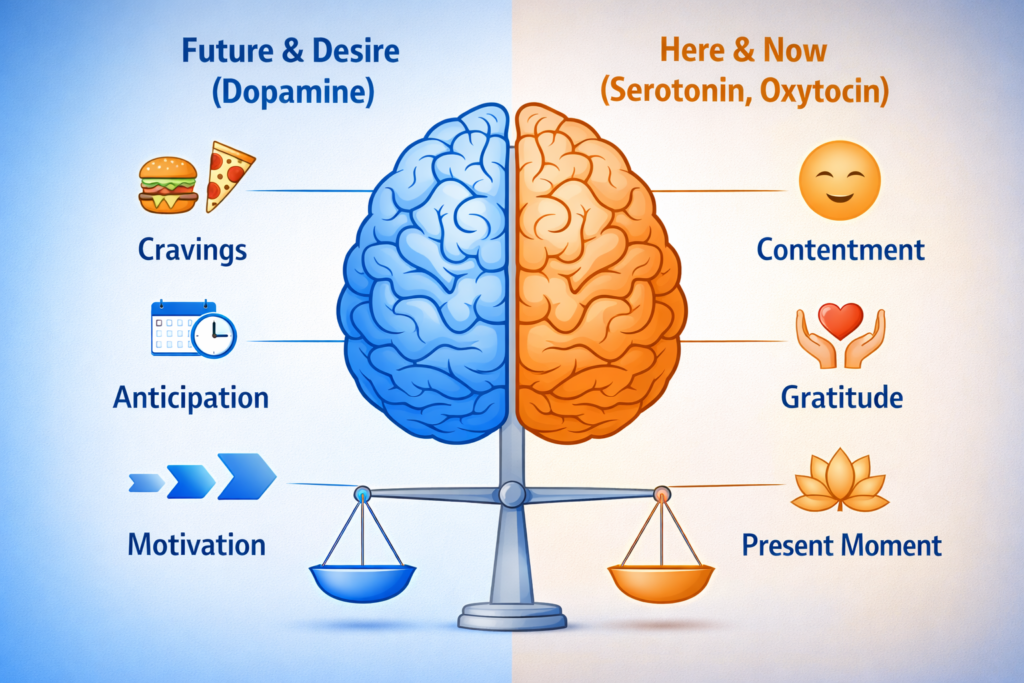
Our brain’s reward system operates through two distinct types of neurotransmitters:
The “Here and Now” Neurotransmitters:
- Serotonin
- Oxytocin
- Endorphins
- Endocannabinoids
These help us enjoy what we currently have. They make us appreciate good food, sunshine, physical activity, and social connection in the present moment.
The “Future and Desire” Neurotransmitters:
Here, dopamine reigns supreme. When you crave fast food, feel compelled to check social media, or desperately want that new gadget, dopamine is the primary driver.
What Dopamine Actually Does
Contrary to popular belief, dopamine doesn’t create pleasure. It creates desire and anticipation.
Think about our ancestors. They couldn’t consume distant prey animals by simply painting them on cave walls. They needed motivation to actually hunt, procreate, and explore new territories. Dopamine provided that fuel.
Dopamine is the molecule of motivation, the fuel of our dreams. Without it, we wouldn’t make any effort toward future goals.
The Dopamine Paradox
Here’s where things get interesting and problematic:
Dopamine is triggered by the possibility of something new:
- A new meal
- A new romantic partner
- A new supplement or gadget
- A new experience
But when the same stimulus repeats, the novelty disappears. The future becomes the present, and dopamine deactivates.
This is why we’re rarely satisfied with what we have. This phenomenon is called hedonic adaptation. Things that initially brought us joy eventually leave us indifferent, and we start craving something new again.
Dopamine is interested in the chase, not the possession.
The Problem With Dopamine
Desire makes promises that pleasure cannot fulfill.
Dopamine doesn’t process real-world experiences. It operates in an imaginary ideal world. The reward is rarely as gratifying as dopamine imagined it would be. Even when pleasure is genuinely intense, it typically doesn’t last long.
Desire is persistent. Satisfaction is fleeting.
Without control, dopamine can lead to:
- Addiction
- Impulsive behavior
- Sacrificing the present for the illusion of a better future
- Perpetual dissatisfaction
No matter what you have, dopamine always wants more.
The key is balancing future-oriented neurotransmitters with present-focused ones. Ancient practices like gratitude help us appreciate what we have, counterbalancing the desire for what we lack.
And that’s where dopamine fasting enters the picture.
The Dopamine Traps of Modern Society
Things worth having require sacrifice and effort. You need motivation to improve your health, learn new skills, find a partner, or improve your financial situation. Dopamine helps you persevere through the process.
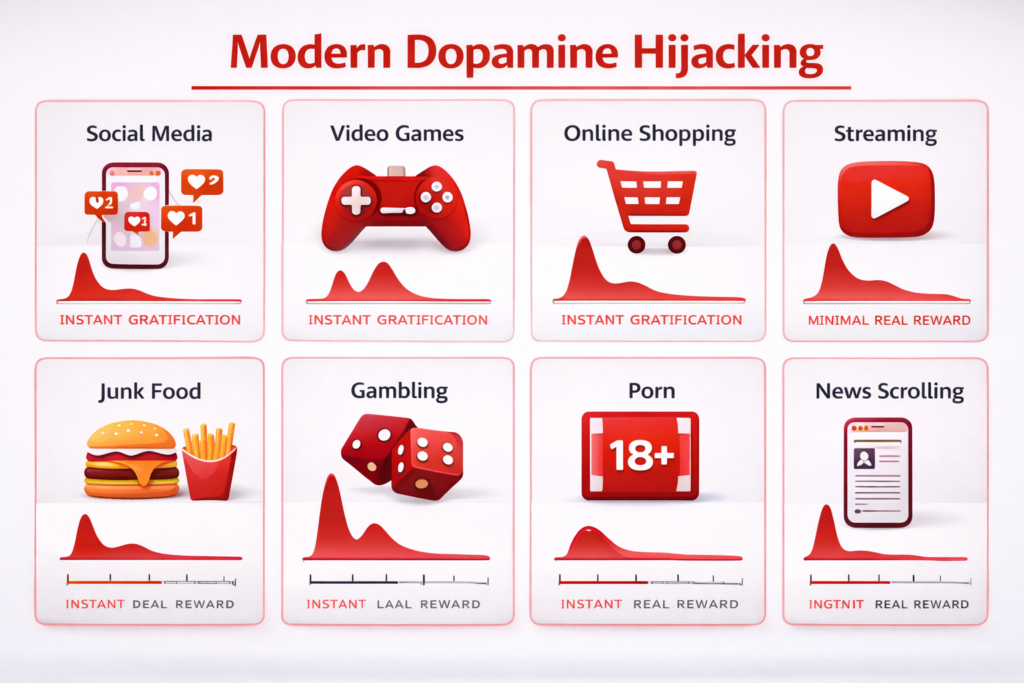
The problem? Modern society has hijacked our dopamine systems.
How Your Attention Gets Hijacked
Companies and platforms have become incredibly sophisticated at capturing your attention and directing it toward their products. They stimulate your dopamine in exchange for empty rewards.
The result: We constantly overstimulate dopamine with activities requiring minimal effort that provide minimal genuine satisfaction.
Examples of dopamine hijacking:
Social media likes: Digital drugs obtained effortlessly but providing no real value. You get a quick hit of dopamine without achieving anything meaningful.
Video games: Experience the thrill of competition and status pursuit while remaining sedentary. You get the dopamine reward of “achievement” without actual real-world accomplishment.
Online gambling: The anticipation and possibility of winning trigger massive dopamine spikes, leading to addiction despite consistently losing money.
Pornography: Unlimited novelty and variety create dopamine surges that real relationships can’t match, potentially damaging your ability to form genuine connections.
Online shopping: One-click purchasing provides instant gratification and the dopamine hit of acquiring something new, often leading to buyer’s remorse and clutter.
Junk food delivery apps: Effortless access to highly palatable foods triggers dopamine without the effort of hunting, preparing, or even leaving your house.
The Core Problem
These activities share common characteristics:
- Easy access (no effort required)
- Immediate gratification
- Infinite novelty
- No delayed reward
- Artificial stimulation
They trick your brain into thinking you’re making progress toward important goals when you’re actually just spinning in place.
Temporarily stepping away from these stimuli helps recalibrate our brain’s reward system. That’s precisely what dopamine fasting proposes.
How to Do a Dopamine Fast: Complete Step-by-Step Guide
Just as intermittent fasting helps you avoid depending on food every few hours, dopamine fasting reduces your attraction to unproductive behaviors.
The goal: Temporarily limit access to activities that spike your dopamine without requiring effort. This isn’t necessarily about eliminating these activities entirely, but ensuring they don’t replace what’s important and are engaged with consciously.
Identifying Your Dopamine Triggers
First, recognize which behaviors are hijacking your dopamine:
Common culprits:
- Social media scrolling (Instagram, TikTok, Twitter, Facebook)
- Video games
- Online shopping
- Streaming services (binge-watching)
- Junk food and delivery apps
- Gambling or sports betting
- Pornography
- Compulsive news checking
- Even caffeine (for some people)
Ask yourself:
- What activities do I engage in impulsively without planning?
- What do I turn to when I’m bored or uncomfortable?
- What makes hours disappear without me noticing?
- What do I struggle to moderate or control?
These are your prime candidates for dopamine fasting.
The Three-Level Strategy
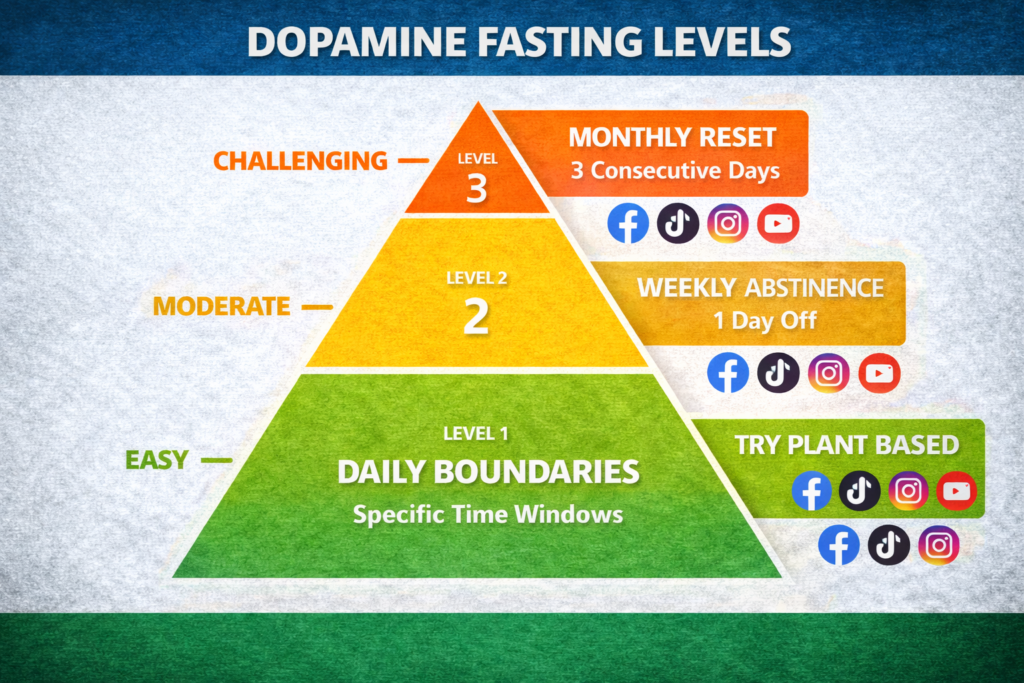
Just as there are various intermittent fasting protocols, multiple approaches exist for dopamine fasting. The ideal strategy depends largely on which behavior you want to control.
Level 1: Daily Boundaries
Instead of constantly giving in to impulses, concentrate these behaviors into specific time windows.
Examples:
Social media: Instead of checking every 10 minutes all day, limit it to two 30-minute windows (11:00-11:30 AM and 6:00-6:30 PM).
Video games: Rather than playing whenever the urge strikes, designate specific hours (e.g., 8:00-10:00 PM only).
Junk food: Instead of snacking constantly, limit treats to one designated time daily.
Benefits:
- Reduces constant distraction
- Gradually improves self-control
- Maintains enjoyment without letting behaviors control you
Level 2: Weekly Abstinence
Choose one day per week to completely avoid your problematic behavior.
Examples:
- “Social Media Sundays” where you don’t check any platforms
- Gaming-free Wednesdays
- No online shopping on Fridays
This builds stronger willpower and gives you a taste of life without constant stimulation.
Level 3: Monthly Reset
Once per month, commit to avoiding the tempting activity for three consecutive days.
This extended break:
- Breaks behavioral patterns more thoroughly
- Allows dopamine receptors to resensitize
- Provides perspective on how much the activity controls you
- Makes you appreciate it more when you return (if you choose to)
Practical Implementation Examples
Problem: Social media addiction
Daily: Limit to two 30-minute windows (morning and evening)
Weekly: Complete social media blackout every Sunday
Monthly: Three-day social media detox on the first weekend of each month
Problem: Video game overuse
Daily: Gaming only after completing work/study tasks, maximum 2 hours
Weekly: No gaming on Wednesdays (use time for reading, exercise, or social activities)
Monthly: First weekend of the month is game-free
Problem: Compulsive online shopping
Daily: No browsing shopping sites during work hours
Weekly: No purchases allowed on Tuesdays
Monthly: The 15th-17th of each month is a complete shopping freeze
Problem: Fast food dependence
Daily: Home-cooked meals only on weekdays
Weekly: No fast food on Sundays (meal prep day)
Monthly: Complete fast food elimination for the first week of each month
Important Clarifications
Despite the name, the goal isn’t actually to reduce dopamine levels. The goal is to avoid falling into the dopamine trap of being dominated by impulsive, unproductive behaviors.
You can even apply this to beneficial substances. For example, coffee is generally healthy, but many people become overly dependent on it. Periodic abstinence helps break dependency and makes you appreciate it more after the break.
The Ancient Wisdom Connection
This isn’t a new idea. Over 2,000 years ago, Stoic philosophers proposed the concept of “voluntary discomfort.”
Seneca wrote:
“Set aside a certain number of days, during which you shall be content with the scantiest and cheapest fare, with coarse and rough dress. Then say to yourself, ‘Is this the condition that I feared?’”
The Stoics encouraged enjoying life’s pleasures when available, from wealth to feasts. But they also warned of the dangers of becoming captured by pleasure and comfort, losing freedom in the process.
Their strategy for maintaining freedom? Temporarily avoiding some things we enjoy, even things we think we need.
The Science-Backed Benefits of Dopamine Fasting
While dopamine fasting is a modern term, the benefits of periodic abstinence from pleasurable stimuli are well-documented.
Benefit 1: Increased Determination and Willpower
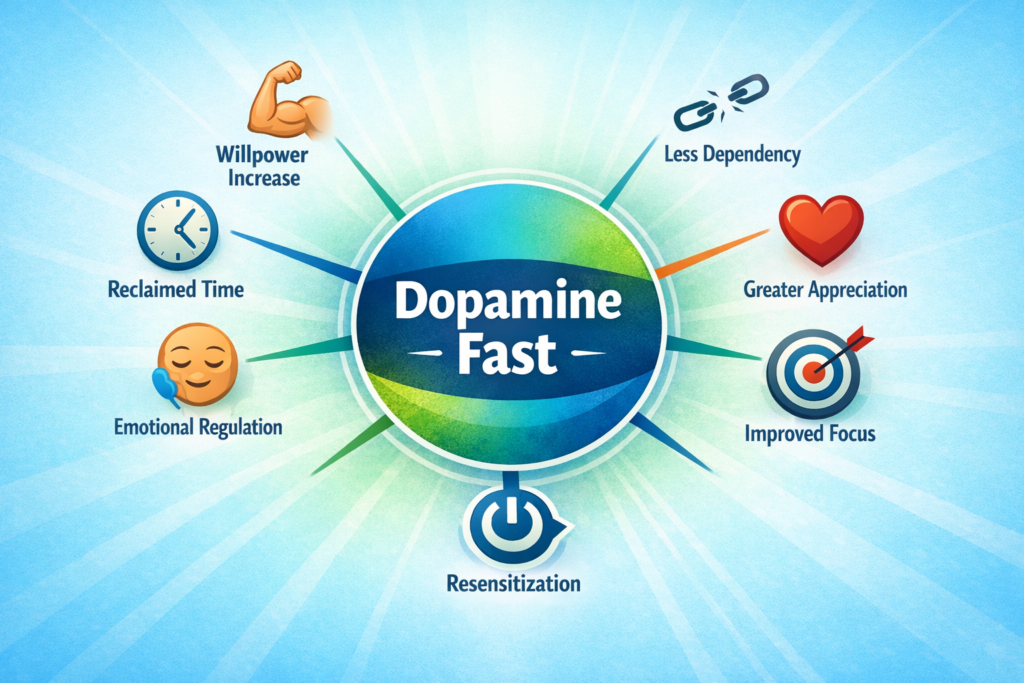
The Stoics understood that many things harm us in excess but strengthen us when applied in appropriate doses. This concept is called hormesis, and it’s a fundamental principle of biology.
Examples of hormesis:
- Too much exercise harms you, but complete absence also harms you
- Very long fasts have negative effects, but short fasts improve health
- The same applies to cold, heat, and many other stressors
Musonius Rufus wrote:
“The health of many, weakened by excessive luxury and comfort, is strengthened by exile, forcing them to live a simpler and more vigorous life.”
The benefit isn’t just physical, but psychological.
We become accustomed to living in our comfort zone, avoiding anything that causes fear or discomfort. Over time, our world becomes smaller and routine dominates our lives.
We must regularly exit this comfort zone and spend time in what’s called the learning or growth zone.
However, as Paracelsus said, the dose makes the poison. Excess comfort is bad, but excess discomfort is also harmful.
We don’t want to be constantly uncomfortable or expose ourselves to psychological stressors that exacerbate our fears (entering the panic or danger zone). We seek appropriate and frequent doses of discomfort, gradually applied and considering our individual capacity.
The principle: The more we suffer voluntarily, the less we’ll suffer involuntarily.
Those who challenge themselves during easy times resist better during difficult times. You also gain satisfaction watching your body and mind strengthen, becoming capable of things that seemed impossible just months ago.
Benefit 2: Less Dependency, More Freedom
Anxiety often arises from fear of losing what we have. Temporarily depriving ourselves of what we think we need helps us realize we’re prepared to handle its absence, reducing anxiety.
Historical context:
In ancient Rome, fortune was especially changeable. If you lost a ruler’s favor, you could be stripped of all possessions or exiled to a distant island.
To overcome fear of exile or poverty, Stoics recommended living like a poor person for a few days periodically. Upon realizing that what they feared wasn’t so terrible, they could enjoy their lives without fear of losing what they had.
Modern applications:
Intermittent fasting: If you practice regular fasting, you’ll feel less anxiety about food. You can go on a mountain hike without fear of feeling sick from not eating or worrying about finding suitable food options.
Through fasting, you understand there’s no problem restricting food temporarily, and you actually learn to enjoy the process. While most people need to interrupt their day multiple times to eat, you maintain focus on more important things.
While some live to eat, you eat to live.
Cold exposure: The same principle applies to cold, another stressor the Stoics discussed extensively. Those who most protect themselves from cold develop fear of it.
Both Seneca and Musonius Rufus recommended experiencing cold and walking barefoot occasionally. Science confirms today that both behaviors improve our health while teaching us we need less than we think.
And the less you need, the freer you are.
This voluntary discomfort reminds us to value the essential. It teaches that life’s truly important and essential things are few. Many blows of fate stop frightening us because they only remove superfluous things we can live without.
Benefit 3: Greater Appreciation for What You Have
Temporarily renouncing things you enjoy helps you appreciate them more.
Food tastes better after a fasting period. The warmth of home is more enjoyable after exposing yourself to cold. Deprivation intensifies pleasure.
Seneca wrote:
“Barley porridge, or a crust of bread and water, are not a very appetizing diet, but nothing gives greater pleasure than the ability to take pleasure in even this, and the feeling of having achieved something that cannot be taken away from us by any unjust blow of fate.”
Whenever something good enters our lives, we experience a brief period of joy. But soon the new becomes normal, and we stop appreciating it. Temporarily doing without these elements allows us to appreciate what we have more and think less about what we lack.
As they say, we don’t know what we have until we lose it. Losing some things voluntarily and temporarily helps us value them more.
Benefit 4: Improved Focus and Productivity
When you’re not constantly checking your phone, refreshing social media, or seeking the next dopamine hit, something magical happens: you can actually concentrate.
Research shows:
- Constant task-switching reduces productivity by up to 40%
- It takes an average of 23 minutes to fully refocus after an interruption
- Deep work requires sustained attention without dopamine-seeking distractions
Dopamine fasting creates space for:
- Deep, focused work sessions
- Creative thinking
- Problem-solving
- Learning and skill development
Benefit 5: Resensitization to Simple Pleasures
When you’re constantly bombarding your brain with supernormal stimuli (social media, video games, junk food), normal pleasures pale in comparison.
After dopamine fasting:
- A conversation with a friend feels more engaging
- A home-cooked meal tastes more satisfying
- A walk in nature provides more enjoyment
- Reading a book holds your attention better
Your dopamine receptors resensitize, allowing you to derive pleasure from activities that couldn’t compete with digital dopamine hits before.
Benefit 6: Improved Emotional Regulation
Constant dopamine seeking often masks underlying emotions like boredom, anxiety, loneliness, or stress.
When you remove the escape routes:
- You’re forced to actually feel and process emotions
- You develop healthier coping mechanisms
- You gain self-awareness about triggers
- You build genuine resilience
Benefit 7: Reclaimed Time and Energy
Calculate how much time you spend on dopamine-seeking behaviors:
Conservative estimate:
- Social media: 2 hours daily
- Video games or streaming: 2 hours daily
- Mindless browsing: 1 hour daily
Total: 5 hours daily, 35 hours weekly, 140 hours monthly
That’s nearly 1,700 hours per year. Imagine redirecting even half of that toward meaningful activities.
Common Mistakes to Avoid
Mistake 1: Going Too Extreme Too Fast
The problem: Trying to eliminate all pleasurable activities simultaneously on day one.
Why it fails: This creates massive resistance and usually leads to giving up entirely within days.
The solution: Start with one behavior. Master that. Then add another. Build gradually.
Mistake 2: Making It a Punishment
The problem: Approaching dopamine fasting with a mindset of deprivation and suffering.
Why it fails: Negative associations make the practice unsustainable and unpleasant.
The solution: Frame it as gaining freedom and control, not losing pleasure. You’re choosing when and how to engage with these activities, rather than being controlled by them.
Mistake 3: Not Having Replacement Activities
The problem: Removing dopamine-triggering activities without filling the void with anything meaningful.
Why it fails: Boredom and emptiness drive you right back to old behaviors.
The solution: Plan replacement activities in advance:
- Reading
- Exercise
- Creative hobbies
- Social connection
- Learning new skills
- Meditation or reflection
Mistake 4: Expecting Immediate Euphoria
The problem: Thinking dopamine fasting will instantly make you feel amazing.
Why it fails: The first few days or weeks can actually feel uncomfortable as your brain adjusts.
The reality: Initial discomfort is normal and actually indicates the practice is working. Benefits emerge over time, not immediately.
Mistake 5: All-or-Nothing Thinking
The problem: Believing one slip-up means complete failure.
Why it fails: Perfectionism leads to giving up entirely after minor setbacks.
The solution: If you break your dopamine fast, simply acknowledge it and resume. Progress isn’t ruined by imperfection.
Creating Your Personal Dopamine Fasting Plan
Ready to implement this practice? Follow these steps to create a sustainable plan.
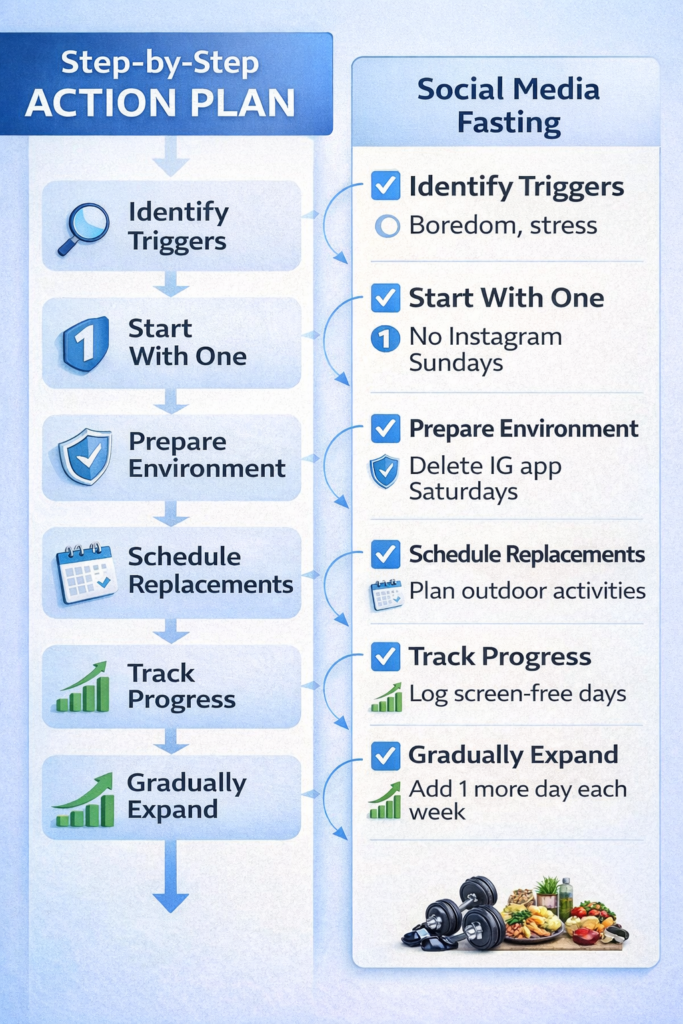
Step 1: Identify Your Top 3 Dopamine Triggers
Make a list of behaviors that:
- You engage in impulsively
- Make time disappear
- You struggle to moderate
- Provide instant gratification
- You turn to when uncomfortable
Rank them by impact on your life. Choose the top 3 to address.
Step 2: Start With One Behavior
Choose the easiest or most impactful (depending on your preference).
Define clear boundaries:
- When will you engage in this activity?
- For how long?
- What will trigger engagement (specific times, not feelings)?
Example:
Behavior: Social media scrolling
Daily boundary: Only 11:00-11:30 AM and 8:00-8:30 PM (30 minutes total)
Weekly challenge: Complete blackout on Sundays
Monthly reset: First weekend of each month (Friday-Sunday)
Step 3: Prepare Your Environment
Remove temptations:
- Delete apps from phone (or use app blockers)
- Move gaming console to storage during fasting periods
- Clear junk food from your house
- Block distracting websites during work hours
The easier you make it to succeed, the more likely you’ll follow through.
Step 4: Schedule Replacement Activities
Don’t just remove; replace.
For the time previously spent on dopamine-seeking:
- Morning: Replace social media with reading or journaling
- Evening: Replace gaming with exercise or creative hobby
- Weekends: Replace streaming with outdoor activities or socializing
Step 5: Track Your Progress
Keep a simple log:
- Date
- Did you follow your plan?
- How did you feel?
- What challenges arose?
- What benefits did you notice?
Tracking creates accountability and helps you notice patterns.
Step 6: Gradually Expand
After 2-4 weeks of successfully managing one behavior, add the second.
After another 2-4 weeks, add the third.
This gradual approach builds sustainable habits rather than creating overwhelming, unsustainable restrictions.
The Bottom Line: Ancient Wisdom for Modern Problems
Dopamine fasting isn’t really about dopamine. It’s about reclaiming control over your attention, time, and life from the constant pull of instant gratification.
The practice offers:
- Improved focus and productivity
- Greater appreciation for simple pleasures
- Increased willpower and self-control
- Freedom from compulsive behaviors
- More time for meaningful activities
- Better emotional regulation
But it requires:
- Honest self-assessment
- Gradual implementation
- Consistent effort
- Patience with the process
- Willingness to feel uncomfortable temporarily
The Stoics understood this 2,000 years ago. Temporary voluntary discomfort builds resilience, appreciation, and freedom.
Modern neuroscience confirms it. Reducing overstimulation allows your dopamine system to recalibrate, making you more motivated toward meaningful goals and less dependent on empty pleasures.
Start small. Pick one behavior. Set one boundary. Follow through for one week.
Then expand from there.
Your attention is your most valuable resource. Stop letting it be hijacked by companies and platforms optimized to exploit your dopamine system.
Take it back. One conscious choice at a time.
RECLAIM YOUR FOCUS. RESET YOUR BRAIN. REDISCOVER REAL PLEASURE.
Ready to transform your relationship with instant gratification and build unshakeable focus? Dopamine fasting is just one tool in a complete system for optimizing your mental performance, building discipline, and achieving your biggest goals. Stop being controlled by your impulses and start directing your energy toward what truly matters. Your focused, intentional future self is waiting.






Leave a Reply
You must be logged in to post a comment.