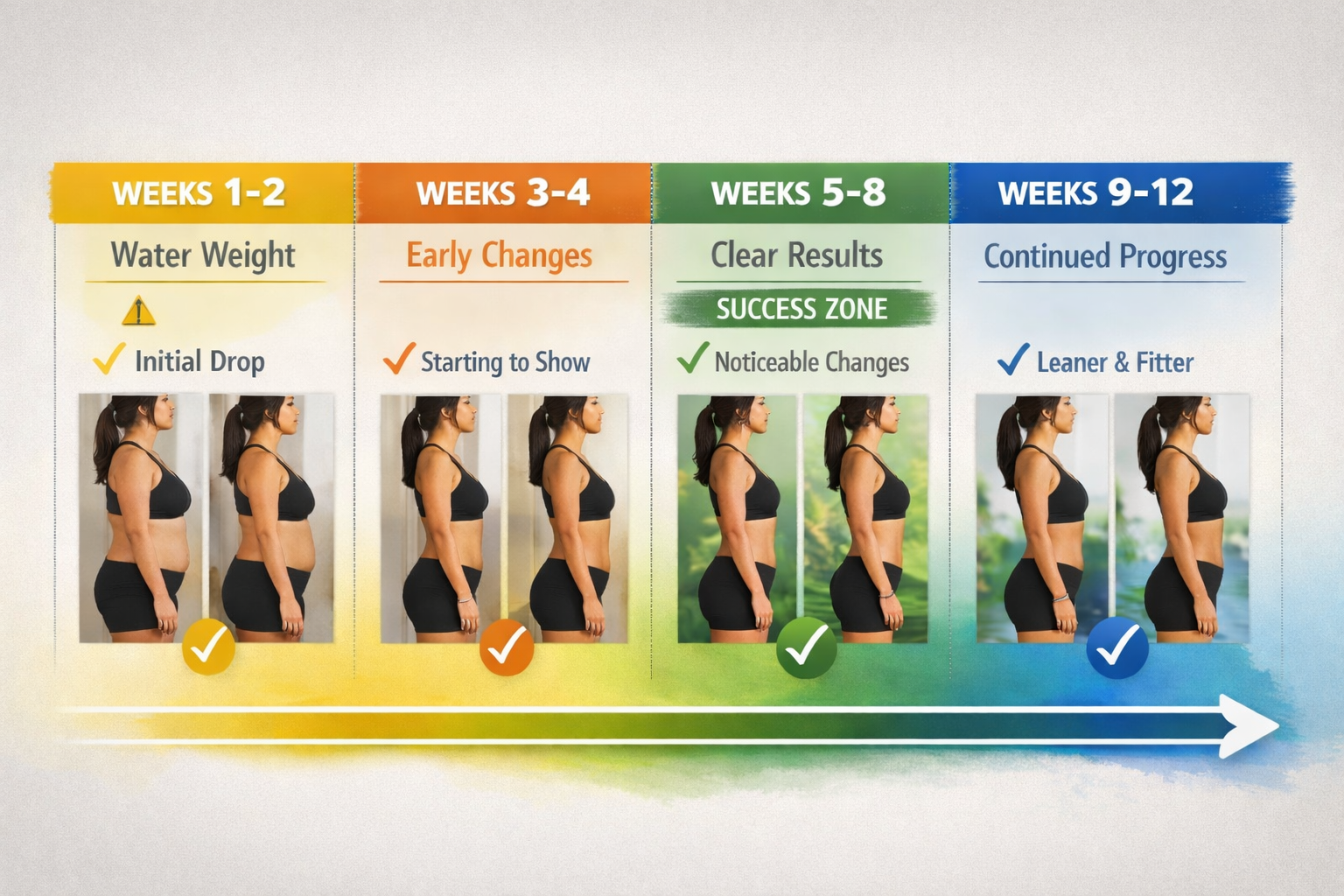
Started a new diet for muscle building or fat loss but wondering when you’ll actually see results? Here’s the honest, science-backed timeline for bodybuilding nutrition.
You’ve committed to a proper diet. You’re tracking your macros. Meal prepping on Sundays. Hitting your protein targets.
But when will you actually see changes in the mirror?
You step on the scale daily. Check the mirror constantly. Measure your arms and waist obsessively.
Nothing seems to be happening fast enough.
Here’s the truth that will set realistic expectations: You can see initial changes within the first week, but these are mostly water weight fluctuations and shouldn’t be considered real progress. Genuine body composition changes become noticeable between weeks 2-4, with clear, undeniable results appearing between weeks 4-8 when diet and training are consistent.
In this comprehensive guide, I’ll provide a week-by-week timeline of what actually happens when you start a bulking or cutting diet, explain why the first week’s changes are misleading and what’s really occurring, reveal when you should expect real, measurable progress, show you the critical mistakes that sabotage results during each phase, and help you set realistic expectations that prevent frustration and quitting.
Whether you’re bulking to build muscle or cutting to lose fat, this article will tell you exactly what to expect and when.
Let’s establish realistic timelines for real results.
TABLE OF CONTENTS
Week-by-Week Diet Results Timeline
Here’s what actually happens during each phase of a proper nutrition plan.
Important Context Before We Begin
This timeline assumes:
✅ You’re following an actual structured diet plan (not just “eating healthy”)
✅ Your calories and macros are calculated for your specific goal
✅ You’re training consistently with progressive overload
✅ You’re tracking your intake and adherence accurately
✅ You’re being honest about compliance (not lying to yourself)
For simplicity:
- “Bulking” = caloric surplus diet for muscle gain
- “Cutting” = caloric deficit diet for fat loss
- These principles apply to both goals with opposite effects
Let’s examine what happens each week.
Week 1: Metabolic Adjustment (Not Real Progress)
What’s actually happening:
For bulking (muscle gain):
What you might notice:
- Slight energy increase
- Muscles feel “fuller” or more pumped
- Weight on scale goes up 2-5 pounds
- Feel less hungry between meals
What’s actually happening:
- Increased glycogen storage in muscles (each gram of glycogen holds 3-4g water)
- Water retention from higher carb and sodium intake
- Digestive system adjusting to more food volume
- Zero actual muscle gain yet
For cutting (fat loss):
What you might notice:
- Weight drops 3-7 pounds
- Feel “lighter” and less bloated
- Muscles look slightly smaller or flatter
- More hunger, lower energy
What’s actually happening:
- Glycogen depletion from muscles (losing water weight)
- Reduced digestive contents (eating less food volume)
- Lower sodium intake reducing water retention
- Zero actual fat loss yet
The critical truth about Week 1:
DO NOT make decisions based on Week 1 changes:
- Weight fluctuations are water and glycogen, not muscle or fat
- Visual changes are inflammation and bloating, not body composition
- Energy changes are adaptation, not indication of plan quality
- Hunger/fullness changes are adjustment, not metabolic issue
What you should do:
✅ Stay the course exactly as planned
✅ Track your weight daily but don’t react to it
✅ Take progress photos but don’t analyze them yet
✅ Focus on consistency and habit formation
✅ Understand this is metabolic adjustment, not results
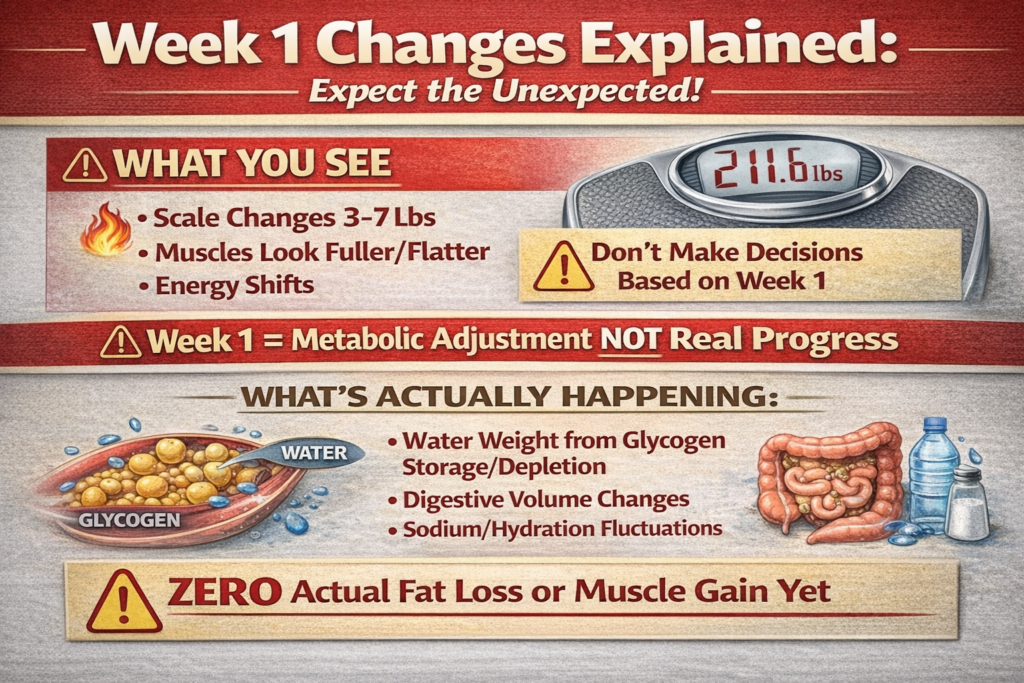
Week 1 is about adaptation, not transformation. Patience is essential.
Week 2: Early Adaptation (Still Not Real Progress)
What’s actually happening:
For bulking:
What you might notice:
- Slight strength increase (5-10 pounds on major lifts)
- Muscles feel fuller and tighter
- Weight stabilizes or continues gradual increase
- Training feels slightly easier
What’s actually happening:
- Enhanced muscle glycogen allowing better performance
- Better hydration supporting muscle function
- Neurological adaptation to training
- Minimal actual muscle tissue gain (maybe 0.1-0.2 pounds)
For cutting:
What you might notice:
- Weight loss continues (1-2 pounds this week)
- Measurements might decrease slightly
- Muscles look less full or pumped
- Energy fluctuates
What’s actually happening:
- Continued water weight loss as glycogen depletes
- Slight reduction in inflammation
- Body adapting to lower caloric intake
- Minimal actual fat loss yet (maybe 0.3-0.5 pounds)
The critical truth about Week 2:
Still too early for major changes:
- Most changes remain water weight and glycogen
- Body is still in adaptation phase
- Metabolic adjustments ongoing
- Real results need more time
Common mistakes in Week 2:
❌ Thinking diet isn’t working (too early to tell)
❌ Making drastic changes to plan (unnecessary)
❌ Comparing to other people’s results (individual variation huge)
❌ Getting discouraged by small changes (unrealistic expectations)
What you should do:
✅ Continue following the plan exactly
✅ Track everything consistently
✅ Trust the process (only 2 weeks in)
✅ Focus on training quality and recovery
✅ Be patient (real changes coming soon)
Week 2 is still adaptation. Real body composition changes start next.
Weeks 2-4: Real Changes Begin
What’s actually happening:
For bulking:
What you should notice:
- Consistent strength gains across most lifts
- Slight increase in muscle fullness and size
- Weight gain of 0.5-1 pound per week
- Better workout performance and recovery
What’s actually happening:
- Muscle protein synthesis exceeding breakdown (net muscle gain)
- Actual muscle tissue being built (slow but real)
- Enhanced recovery from adequate calories
- Estimated 0.5-1.5 pounds actual muscle gain by week 4
For cutting:
What you should notice:
- Weight loss of 1-2 pounds per week
- Measurements decreasing (waist, hips, etc.)
- Slight increase in definition
- Clothes fitting differently
What’s actually happening:
- Body mobilizing fat stores for energy
- Actual fat tissue being oxidized (burned)
- Muscle mass being preserved (if protein adequate)
- Estimated 2-4 pounds actual fat loss by week 4
The critical truth about Weeks 2-4:
This is where real change starts:
- Body composition actually shifting
- Not just water weight anymore
- Measurable progress occurring
- Visible changes beginning
Critical mistakes during this phase:
❌ Changing the plan because results aren’t dramatic yet (they’re just starting)
❌ Comparing yourself to influencer transformations (often fake timelines or enhanced)
❌ Getting impatient and drastically cutting/increasing calories (disrupts adaptation)
❌ Stopping because “it’s not working fast enough” (95% of people quit here)
What you should do:
✅ Celebrate small wins (strength going up, weight trending correctly)
✅ Take progress photos weekly (changes more visible in photos than mirror)
✅ Trust the process (real results take 4-8 weeks minimum)
✅ Stay consistent (this phase determines long-term success)
✅ Adjust expectations (you’re building/losing, not transforming overnight)
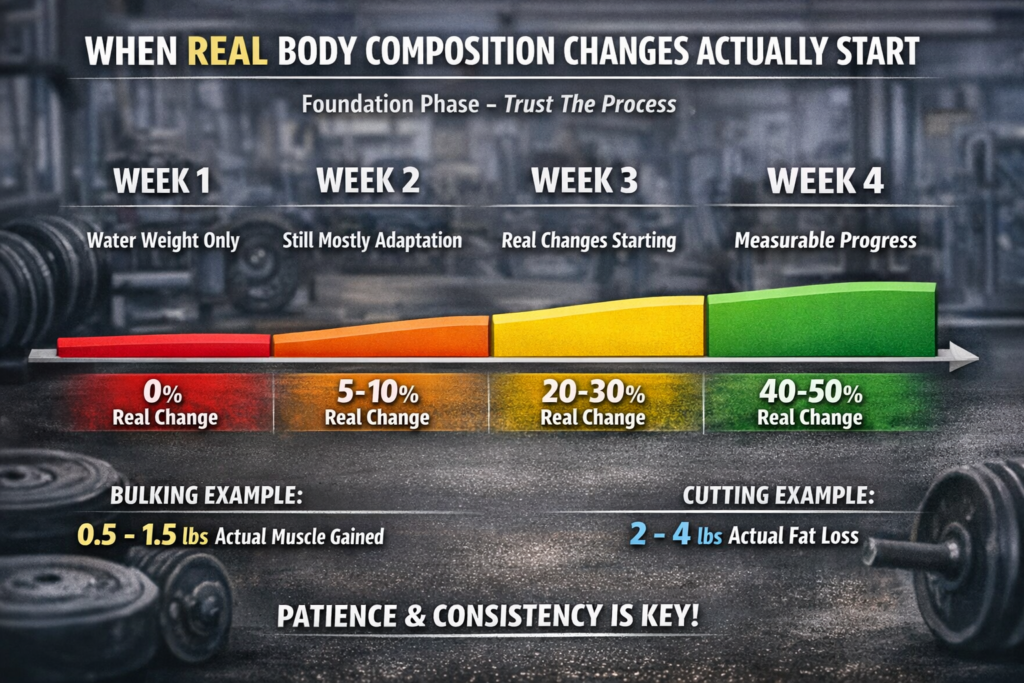
Weeks 2-4 are when the foundation is laid. Patience here determines success.
Weeks 4-8: Clear, Undeniable Progress
What’s actually happening:
For bulking:
What you should clearly notice:
- Significant strength increases (10-20% stronger on major lifts)
- Visible muscle size increase
- Weight gain of 4-8 pounds total from start
- Clothes fitting tighter (shoulders, chest, arms)
What’s actually happening:
- Substantial muscle tissue built
- Enhanced metabolic adaptation to surplus
- Improved nutrient partitioning
- Estimated 3-6 pounds actual muscle gain from baseline
If NOT seeing these results:
- Calories insufficient (increase 200-300)
- Protein inadequate (check 0.8-1g per pound)
- Training stimulus weak (progressive overload missing)
- Recovery insufficient (sleep, stress issues)
For cutting:
What you should clearly notice:
- Weight loss of 8-16 pounds total from start
- Significant reduction in measurements
- Clear increase in muscle definition
- Visible fat loss (abs appearing, face leaner, etc.)
What’s actually happening:
- Substantial fat oxidation occurring
- Body efficiently using fat for energy
- Muscle mass being preserved
- Estimated 6-12 pounds actual fat loss from baseline
If NOT seeing these results:
- Deficit insufficient (reduce calories 200-300)
- Not actually tracking accurately (lying to yourself)
- Protein too low (muscle loss occurring)
- Excessive cardio burning muscle (dial back)
The critical truth about Weeks 4-8:
This is the “proof of concept” phase:
- Results should be undeniable
- You look different from starting photos
- Others may start noticing changes
- You feel different (energy, performance, confidence)
Critical decision point:
If seeing good results: Keep doing exactly what you’re doing. Don’t change anything major.
If NOT seeing results: Something is wrong and needs adjustment:
- Calories are incorrect (too high or too low)
- Protein intake inadequate
- Training program insufficient
- Tracking inaccurate (not actually following plan)
- Recovery inadequate (sleep, stress killing progress)
What you should do:
✅ Compare Week 4-8 to Week 0-1 photos (not day-to-day)
✅ Take measurements (waist, chest, arms, thighs)
✅ Track performance (lifts going up significantly?)
✅ Assess honestly (really following plan 90%+ of time?)
✅ Make calculated adjustments if needed (not drastic changes)
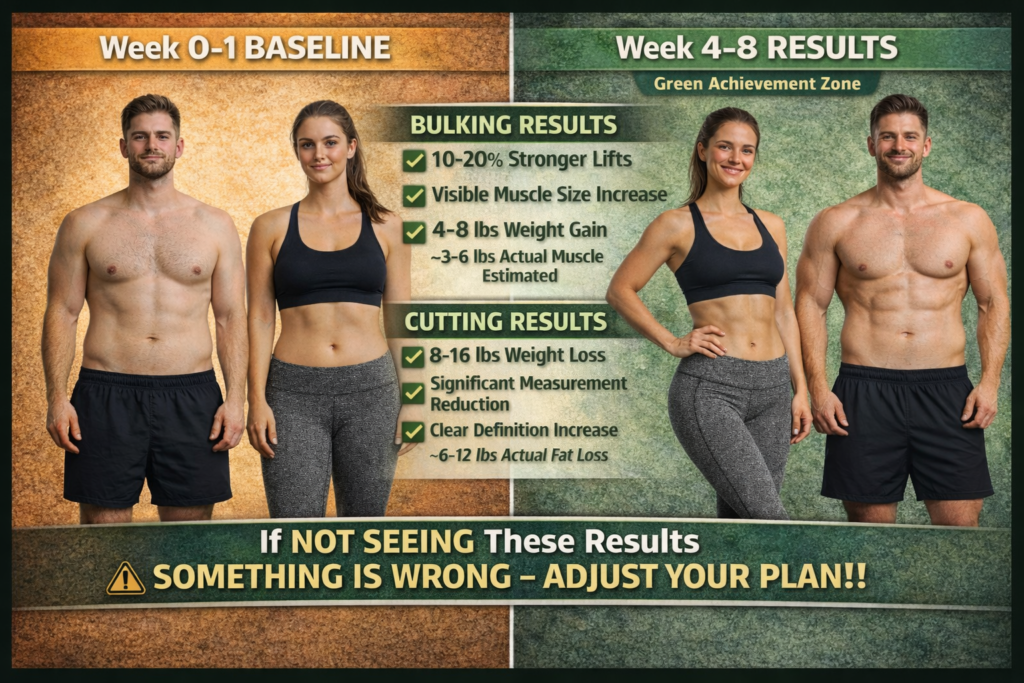
Weeks 4-8 confirm whether your plan works. Adjust intelligently if needed.
Weeks 8-12: Consolidation and Decision Point
What’s actually happening:
For bulking:
What you should notice:
- Continued but slower muscle gain
- Strength still increasing
- Some fat gain likely visible
- Weight gain of 8-16 pounds total from start
What’s actually happening:
- Muscle gain rate slowing (natural)
- Fat gain ratio increasing slightly
- Body adapting to chronic surplus
- Estimated 5-10 pounds muscle gain from baseline (some fat too)
Decision time:
- Assess muscle to fat gain ratio
- If gaining too much fat, consider maintenance or cut
- If still lean and progressing, can continue
- Plan next phase strategically
For cutting:
What you should notice:
- Continued fat loss but harder/slower
- Significant definition achieved
- Energy lower, hunger higher
- Weight loss of 12-24 pounds total from start
What’s actually happening:
- Metabolic adaptation making deficit harder
- Body defending against further fat loss
- Muscle preservation becoming challenging
- Estimated 10-20 pounds fat loss from baseline
Decision time:
- Assess current body fat percentage
- If very lean (visible abs, veins), consider maintenance or reverse
- If still have fat to lose and feeling okay, can continue
- Watch for signs of over-dieting
The critical truth about Weeks 8-12:
You’re a different person than Week 0:
- Visible transformation has occurred
- Metabolic state has shifted
- Habits are established
- Progress is real
But attention is needed:
For bulking:
- Monitor fat gain closely
- Assess if continuing surplus makes sense
- Plan transition to maintenance or cut
- Don’t let bulk become dirty bulk
For cutting:
- Watch for over-dieting signs (excessive fatigue, hunger, irritability, libido crash)
- Consider diet break or reverse diet
- Assess if further cutting sustainable
- Don’t push to unhealthy leanness
What you should do:
✅ Comprehensive assessment (photos, measurements, performance, how you feel)
✅ Plan next phase (continue, maintain, or reverse)
✅ Celebrate progress (acknowledge how far you’ve come)
✅ Set new realistic goals (next 12 weeks if continuing)
✅ Consider expert guidance (coach or nutritionist for next phase)
Weeks 8-12 are about consolidation and planning. Success builds on success.
Critical Factors That Affect Timeline
Why results vary between individuals.
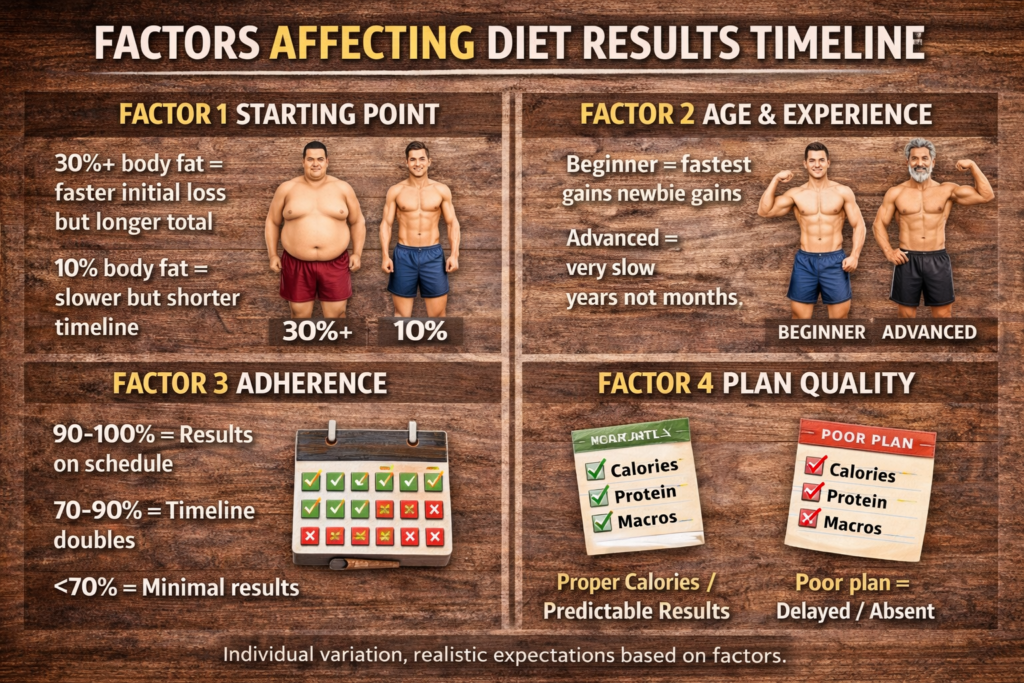
Factor 1: Starting Point Matters Enormously
Your beginning condition dramatically affects timeline:
For fat loss:
Starting very overweight (30%+ body fat):
- Initial weight loss faster (3-5 pounds weekly possible)
- Early visual changes dramatic
- BUT total time to lean physique much longer (6-12+ months)
- More total fat to lose
Starting moderately overweight (20-25% body fat):
- Moderate initial loss (1-2 pounds weekly)
- Steady visible progress
- Reasonable timeline to lean (3-6 months)
- Balanced approach works well
Starting slightly overweight (15-20% body fat):
- Slower initial loss (0.5-1 pound weekly)
- Subtle early changes
- Shorter total timeline (2-3 months)
- Easier to maintain results
For muscle gain:
Starting very lean/skinny (under 10% body fat, minimal muscle):
- Fast initial strength gains
- Visible muscle growth quickly
- BUT total transformation takes years
- Starting from scratch
Starting average (15-18% body fat, some muscle base):
- Moderate rate of progress
- Balanced muscle and strength gain
- Reasonable timeline expectations
- Good foundation to build on
Starting with muscle base but higher fat:
- Strength gains moderate
- Muscle size harder to see initially
- May need to cut first for visibility
- Recomposition possible
The reality: Someone with 80 pounds to lose needs 12+ months. Someone with 10 pounds to lose needs 2-3 months. Same effort, different timelines.
Factor 2: Age and Training Experience
These massively impact rate of change:
Training experience:
Beginner (0-1 years training):
- Fastest gains possible (“newbie gains”)
- Can build muscle AND lose fat simultaneously (recomp)
- Dramatic strength increases
- Most forgiving of mistakes
Intermediate (2-4 years consistent training):
- Slower but steady progress
- Harder to recomp (usually bulk or cut)
- Strength gains more gradual
- Must be more precise
Advanced (5+ years consistent training):
- Very slow progress
- Must be extremely precise
- Gains measured in years, not months
- Diminishing returns
Age:
Younger (teens to 20s):
- Faster recovery
- Higher hormone levels
- Better nutrient partitioning
- Faster results
Middle age (30s-40s):
- Slower recovery needed
- Slightly lower hormones
- Still excellent results possible
- Requires more precision
Older (50+):
- Recovery critical
- Hormones lower
- Results still achievable
- Slower timeline expected
Factor 3: Adherence and Consistency
This is the biggest variable you control:
90-100% adherence:
- Results match timeline above
- Predictable progress
- Optimal outcomes
- Minimal setbacks
70-90% adherence:
- Results delayed by 50%
- Progress inconsistent
- Still reach goals eventually
- Frustrating but workable
Below 70% adherence:
- Results minimal or nonexistent
- Constant restart cycles
- Never see real progress
- Wasting time
The math:
If you follow your diet 5 days per week but go off-plan 2 days:
- 71% adherence
- Timeline doubles (8 weeks becomes 16 weeks)
- Results possible but slow
Be honest about actual adherence when assessing timeline.
Factor 4: Plan Quality
Not all diets are created equal:
Well-designed plan:
- Appropriate calories for goal
- Adequate protein (0.8-1g per pound)
- Balanced macros
- Sustainable approach
- Results match timeline
Poor plan:
- Calories way off (too high or too low)
- Inadequate protein (<0.7g per pound)
- Extreme restrictions
- Unsustainable approach
- Results delayed or absent
No real plan:
- “Eating healthy” with no tracking
- Guessing portions and macros
- Inconsistent approach
- Results unlikely
If not seeing results by week 4-6, plan quality is likely the issue.
Common Mistakes That Delay Results
Avoid these critical errors.
Mistake 1: Confusing “Eating Healthy” With “Having a Diet Plan”
This is the most common mistake.
Eating healthy means:
- Choosing nutritious whole foods
- Avoiding junk and processed foods
- Generally good food quality
Having a diet plan means:
- Calculated calories for your specific goal
- Tracked macros (protein, carbs, fats)
- Measured portions
- Consistent intake daily
The problem:
You can eat perfectly healthy foods and:
- Still not lose weight (if calories too high)
- Still not gain muscle (if calories/protein too low)
- See zero body composition changes
Examples:
Trying to cut:
- Eating chicken, rice, vegetables (healthy)
- But consuming 2,800 calories when you need 2,200
- Result: No fat loss despite “eating clean”
Trying to bulk:
- Eating eggs, oatmeal, lean meats (healthy)
- But only consuming 2,400 calories when you need 3,200
- Result: No muscle gain despite “eating healthy”
The solution:
✅ Calculate your calories for your goal
✅ Set macros (especially protein)
✅ Track intake accurately
✅ Adjust based on results
Healthy food quality matters, but quantities determine body composition changes.
Mistake 2: Giving Up After “Messing Up”
This derails more progress than anything else.
The scenario:
Monday-Thursday: Perfect diet adherence
Friday night: Unplanned dinner with friends, eat off-plan
Wrong response: “I already ruined my week. Might as well eat whatever I want this weekend and start fresh Monday.”
Result: 3 days of overeating erases 4 days of good work
Right response: “That meal is over. Back to the plan for my next meal.”
Result: One meal off-plan has minimal impact
The math:
Scenario 1: Give up after one mistake
- 4 on-plan days
- 3 off-plan days
- 57% adherence
- Minimal progress
Scenario 2: Get back on track immediately
- 6 on-plan days
- 1 partial off-plan day
- 90% adherence
- Excellent progress
The truth:
Perfect adherence is impossible. Everyone messes up. Champions get back on track immediately, while failures use one mistake as excuse to quit.
Mistake 3: Unrealistic Timeline Expectations
This causes frustration and quitting.
Unrealistic expectations:
“I’ll lose 30 pounds in 6 weeks”
- Realistic: 6-12 pounds in 6 weeks
- Attempting faster = muscle loss, extreme hunger, unsustainable
“I’ll gain 20 pounds of muscle in 3 months”
- Realistic: 3-6 pounds muscle in 3 months (beginners might hit upper end)
- Anything faster includes significant fat gain
Where unrealistic expectations come from:
❌ Influencer transformation posts (often fake timelines, enhanced athletes, or angles/lighting tricks)
❌ Supplement marketing (showing years of results as if from 8-week program)
❌ Reality TV shows (extreme, unsustainable methods with medical supervision)
❌ Before/after photos with undisclosed timeframes
Realistic expectations:
For fat loss:
- 0.5-1% body weight per week sustainable
- 180-pound person: 1-2 pounds weekly
- 8-week realistic loss: 8-16 pounds
For muscle gain:
- Beginners: 1-2 pounds muscle monthly
- Intermediates: 0.5-1 pound muscle monthly
- Advanced: 0.25-0.5 pounds muscle monthly
- 12-week realistic gain: 3-6 pounds muscle (beginners)
Set realistic timelines to avoid frustration and maintain motivation.
Mistake 4: Comparing Yourself to Others
Everyone’s journey is different.
Why comparisons fail:
Different starting points:
- Someone starting at 25% body fat loses fat faster initially
- Someone starting with muscle base gains strength faster
- Can’t compare different baselines
Different genetics:
- Muscle-building potential varies 3-fold between individuals
- Fat loss rates vary significantly
- Recovery ability differs
- Hormones vary dramatically
Different adherence:
- Someone hitting 95% adherence progresses faster
- You might be at 75% adherence
- Comparing outcomes unfair
Different circumstances:
- Training experience
- Age
- Stress levels
- Sleep quality
- All affect results
The only valid comparison: You vs. your previous self.
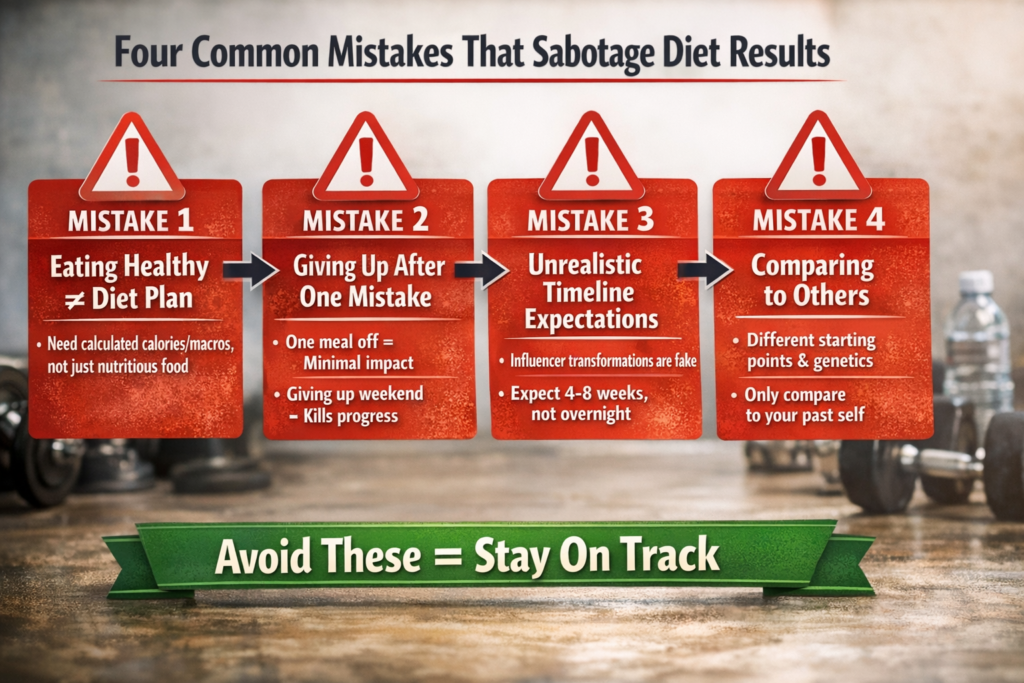
Compare Week 8 to Week 0 for YOU. Not your results to someone else’s.
The Bottom Line: Results Take 4-8 Weeks Minimum
After examining all the evidence:
The realistic timeline for diet results:
Week 1:
- Water weight changes only
- Metabolic adaptation beginning
- No real body composition changes
- Stay the course, be patient
Week 2:
- Continued adaptation
- Minimal real changes
- Early strength or hunger fluctuations
- Still too early for assessment
Weeks 2-4:
- Real changes starting
- Strength gains (bulking) or initial fat loss (cutting)
- Measurable but not dramatic
- Foundation being built
Weeks 4-8:
- Clear, undeniable progress
- Significant strength or visible fat loss
- Others may notice changes
- Results should be obvious
Weeks 8-12:
- Continued progress
- Slower rate than weeks 4-8
- Decision point for next phase
- Transformation visible
Critical factors affecting timeline:
- Starting point (more to lose/gain = longer total timeline)
- Age and experience (beginners faster, advanced slower)
- Adherence (90%+ hits timeline, below delays significantly)
- Plan quality (proper calories and macros essential)
Common mistakes that delay results:
- Confusing healthy eating with having a diet plan
- Giving up after mistakes instead of getting back on track immediately
- Unrealistic timeline expectations from fake social media transformations
- Comparing your journey to others with different circumstances
The proper mindset:
✅ First 2 weeks: Adaptation phase, not real results yet
✅ Weeks 2-4: Early real changes, stay patient
✅ Weeks 4-8: Proof of concept, clear results appearing
✅ Week 8+: Continued progress, plan next phase
✅ Compare yourself to your past self, not others
✅ Expect 6-12+ months for dramatic transformations, not 6-12 weeks
✅ Focus on consistency over perfection
✅ Celebrate small wins weekly
TRUST THE PROCESS. TRACK HONESTLY. STAY CONSISTENT. RESULTS WILL COME.
Ready to optimize your nutrition and training with a complete, science-based system that delivers predictable results without frustration or guesswork? Understanding the timeline is just the beginning. Get a comprehensive guide to calculating your exact calorie and macro needs, building a sustainable diet plan that works, training for maximum results, and tracking progress intelligently. Stop hoping for overnight transformations. Start following proven strategies that deliver real, lasting results.




Leave a Reply
You must be logged in to post a comment.