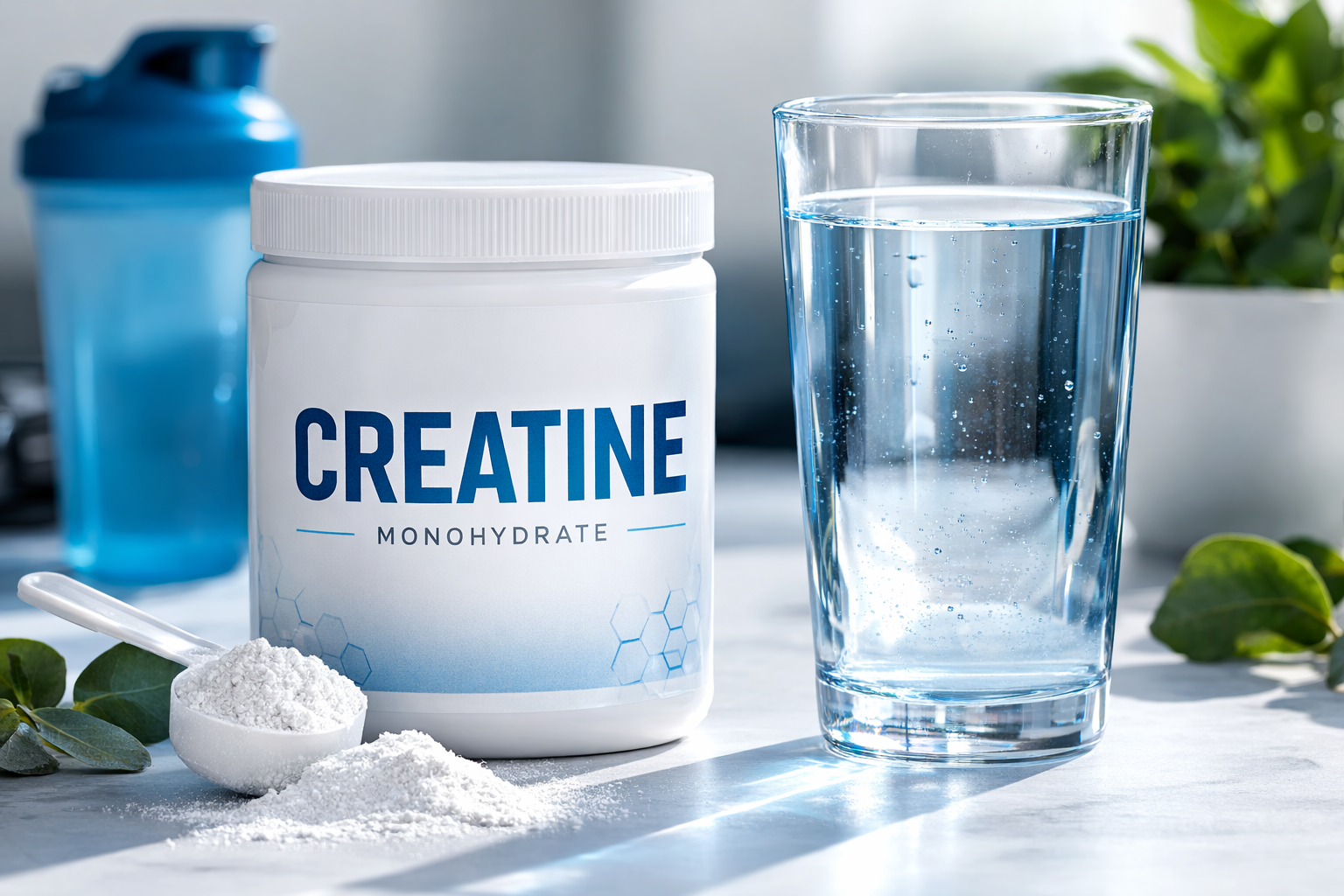
Taking creatine and wondering if you need to chug gallons of water? Most people are overthinking this. Here’s what actually matters.
You start taking creatine. Someone tells you “drink way more water or you’ll get dehydrated.”
You’re confused. Do you need an extra 2 liters daily? Do you need to mix creatine with a specific amount of water? What happens if you don’t drink enough?
You’ve heard:
- “Creatine dehydrates you”
- “You need double your normal water intake”
- “Mix creatine with at least 500ml of water”
- “You’ll get kidney stones if you don’t drink enough”
Most of this is wrong or exaggerated. The truth: If you’re already drinking adequate water (3-4 liters daily for active people), you don’t need to dramatically increase intake just because you’re taking creatine. Mix your creatine dose with enough water to dissolve it (300ml works), drink normally throughout the day, and you’re fine. Creatine pulls water INTO muscle cells (intracellular), not OUT of your body. This is different from dehydration.
In this comprehensive guide, I’ll explain how creatine actually works with water (the osmotic mechanism), reveal how much water you really need (the evidence-based amount), show you what happens if you don’t drink enough (the actual risks vs. myths), provide the optimal mixing protocol (how much water per dose), and address the water weight gain (how much to expect and why it’s not a problem).
Whether you’re new to creatine or trying to optimize your supplementation, understanding the water relationship is important.
Let’s separate creatine hydration facts from fiction.
TABLE OF CONTENTS
How Creatine Works and Why It Affects Water
Understanding the mechanism.
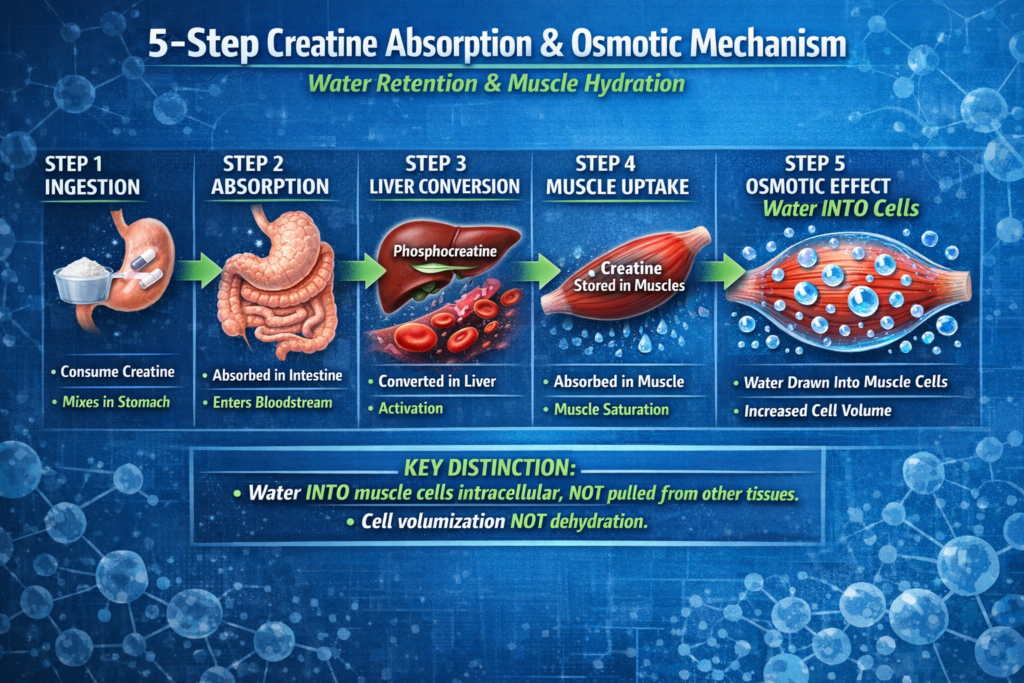
The Creatine Absorption Process
What happens when you take creatine:
Step 1: Ingestion
- Consume creatine monohydrate (powder or capsule)
- Mixes with water in stomach
- Oral intake
Step 2: Absorption
- Absorbed in small intestine
- Enters bloodstream
- Systemic delivery
Step 3: Liver conversion
- Travels to liver
- Converted to phosphocreatine (active form)
- Activation
Step 4: Muscle uptake
- Phosphocreatine released into blood
- Absorbed by muscle cells
- Stored in muscles
- Muscle saturation
Step 5: Utilization
- Used to regenerate ATP during exercise
- Provides quick energy for high-intensity work
- Energy production
The Osmotic Effect (Water Retention Mechanism)
What osmosis means:
- Movement of water across cell membranes
- From areas of low solute concentration to high
- Creatine in muscle cells creates osmotic pressure
- Water follows creatine
How it works with creatine:
Before creatine supplementation:
- Muscle cells contain baseline creatine
- Normal water balance in muscles
- Baseline state
After creatine supplementation:
- Muscle cells contain elevated creatine
- Higher solute concentration inside cells
- Water drawn into cells from bloodstream
- Muscle cells swell with water
- Intracellular water increase
The key distinction:
- Water goes INTO muscle cells (intracellular)
- NOT pulled from other body tissues
- NOT dehydration
- Cell volumization, not dehydration
The visual:
- Muscles appear fuller
- Body weight increases 1-3kg
- NOT fat or muscle tissue
- Water inside muscle cells
- Cosmetic and functional benefit
Why This Is Actually Beneficial
The advantages of intracellular water:
Benefit 1: Muscle fullness
- Muscles look bigger and fuller
- Better pumps during training
- Improved muscle definition
- Aesthetic benefit
Benefit 2: Cellular environment for protein synthesis
- Cell swelling signals anabolic processes
- May enhance protein synthesis
- Better muscle growth environment
- Anabolic signaling
Benefit 3: Improved performance
- More creatine phosphate available
- Better ATP regeneration
- Increased strength and power output
- Performance enhancement
Benefit 4: Nutrient delivery
- Increased cell volume may improve nutrient transport
- Better cellular function
- Metabolic optimization
The mechanism is NOT:
- Pulling water from vital organs
- Causing dehydration elsewhere
- Requiring massive water intake to compensate
- Misunderstood by most people
How Much Water to Drink With Creatine
The evidence-based recommendations.
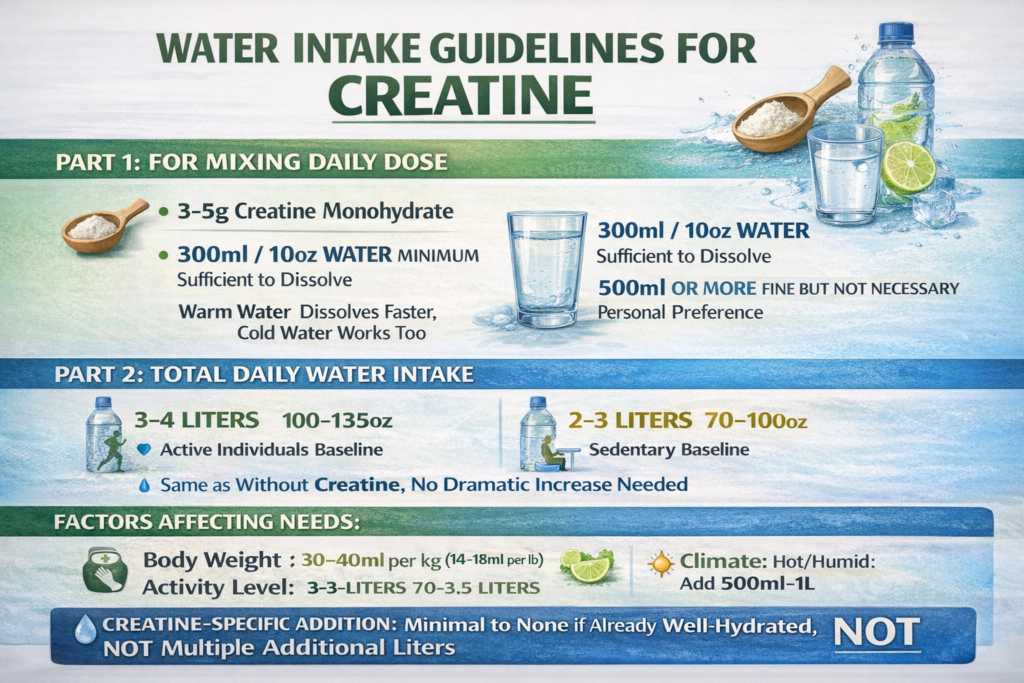
For Mixing Your Daily Dose
The mixing protocol:
- 3-5g creatine monohydrate
- 300ml (10 oz) water minimum
- Stir or shake until dissolved
- Standard mixing ratio
Why 300ml:
- Enough volume to fully dissolve creatine
- Comfortable to drink quickly
- Not excessive
- Practical amount
Can you use more water?
- Yes, 500ml or even 1 liter fine
- Doesn’t improve absorption
- Just personal preference
- Creatine dissolves in any reasonable amount of water
- More is okay but not necessary
Can you use less water?
- Minimum ~200ml (7 oz)
- Need enough to dissolve powder
- Less than 200ml may leave undissolved sediment
- Don’t go below minimum
Temperature matters:
- Warm water dissolves creatine faster
- Cold water works but takes longer stirring
- Temperature doesn’t affect absorption
- Preference only
What to mix with:
- Water (recommended, simple)
- Juice (works, adds calories and sugar)
- Protein shake (convenient, no issues)
- Coffee or tea (fine, caffeine doesn’t negate creatine)
- Pre-workout drink (common practice)
- Flexible options
For Total Daily Water Intake
The baseline recommendation (with or without creatine):
- 3-4 liters (100-135 oz) daily for active individuals
- 2-3 liters (70-100 oz) for sedentary individuals
- Standard hydration guidelines
Do you need MORE water specifically for creatine?
- If already drinking 3-4 liters: NO, maintain current intake
- If drinking <2 liters: YES, increase to baseline recommendations (but not BECAUSE of creatine, because you’re under-hydrated generally)
- Creatine doesn’t require extra water beyond normal needs
Factors affecting individual water needs (creatine or not):
Body weight:
- Heavier individuals need more water
- General guideline: 30-40ml per kg body weight
- 80kg person: 2.4-3.2 liters
- 100kg person: 3.0-4.0 liters
- Size-dependent
Activity level:
- Intense training: Upper end of range (3.5-4+ liters)
- Moderate training: Middle range (3-3.5 liters)
- Light activity: Lower end (2.5-3 liters)
- Activity-dependent
Climate:
- Hot/humid: More water loss through sweat
- Need additional 500ml-1 liter
- Cold/dry: Less additional needed
- Environment-dependent
Sweat rate:
- Heavy sweaters need more
- Can lose 1-2 liters per hour of intense training
- Replace fluid losses
- Individual variation
The creatine-specific addition:
- Minimal to none if already well-hydrated
- Perhaps extra 250-500ml if you want to be conservative
- But NOT multiple additional liters
- Modest increase at most
The practical approach:
- Already drinking 3-4 liters? Don’t change anything
- Drinking <2.5 liters? Increase to 3-4 liters (good for health anyway, not just creatine)
- Monitor urine color (see below)
- Simple guidelines
What Happens If You Don’t Drink Enough Water
The actual risks vs. the myths.
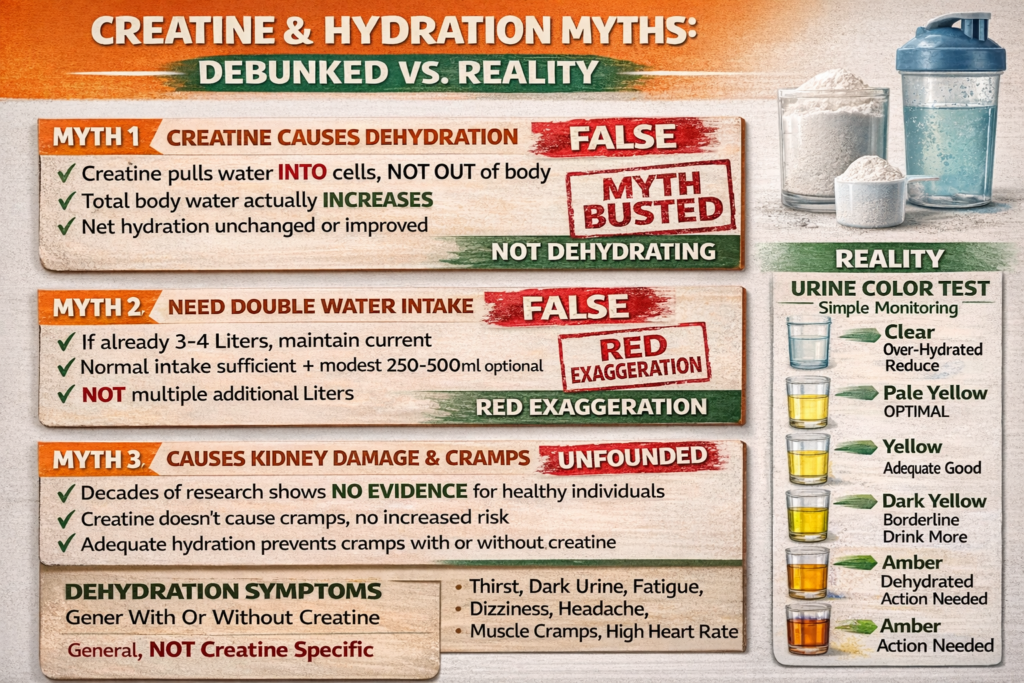
The Myths About Creatine and Dehydration
Myth 1: “Creatine causes dehydration”
- FALSE
- Creatine pulls water INTO cells, not OUT of body
- Does not reduce total body water
- Intracellular water increase
The truth:
- Total body water actually INCREASES with creatine
- Just redistributed (more in muscles)
- Net hydration status unchanged or slightly improved
- Not dehydrating
Myth 2: “You’ll get kidney stones or kidney damage”
- No evidence in healthy individuals
- Creatine studied extensively (decades of research)
- No kidney damage in healthy people with normal doses
- Safety established
The caveat:
- Pre-existing kidney disease: Consult doctor
- Normal kidney function: No concern
- Medical clearance if kidney issues
Myth 3: “You need to drink way more water to prevent cramps”
- Creatine doesn’t cause cramps
- Research shows no increased cramping risk
- Adequate hydration prevents cramps (with or without creatine)
- Cramping not creatine-related
The Reality: Under-Hydration Signs (Same With or Without Creatine)
Dehydration symptoms (creatine doesn’t change these):
Mild dehydration:
- Increased thirst
- Dry mouth
- Dark yellow urine
- Mild headache
- Reduced energy
- Early warning signs
Moderate dehydration:
- Very dark urine (amber colored)
- Dizziness when standing
- Fatigue
- Reduced exercise performance
- Dry skin
- Clear dehydration
Severe dehydration (medical emergency):
- No urination for 8+ hours
- Rapid heart rate
- Confusion
- Extreme weakness
- Seek medical attention
The urine color test (most practical):
- Clear to pale yellow: Well-hydrated (optimal)
- Lemonade yellow: Adequately hydrated (good)
- Apple juice yellow: Borderline (drink more)
- Dark amber: Dehydrated (drink water now)
- Visual hydration check
What happens with creatine specifically:
- Same dehydration symptoms if under-hydrated
- NOT unique creatine problems
- Just general dehydration (happens whether taking creatine or not)
- No creatine-specific issues
The Actual Risk (Very Minimal)
The theoretical concern:
- Creatine pulls water into muscles
- Theoretically less water available for other functions
- Could slightly increase dehydration risk IF already dehydrated
- Theoretical, not practical
The reality:
- Effect is minimal
- Only relevant if severely under-hydrated already
- Easily prevented by normal hydration practices
- Not a real-world problem
The research:
- Multiple studies on creatine and hydration status
- No increased dehydration risk with adequate baseline hydration
- No need for excessive water intake
- Science is clear
The bottom line:
- Drink adequate water for your body weight and activity level
- Creatine doesn’t require special hydration protocols
- Monitor urine color (simplest method)
- Basic hydration suffices
How Much Water Weight You Gain on Creatine
What to expect.
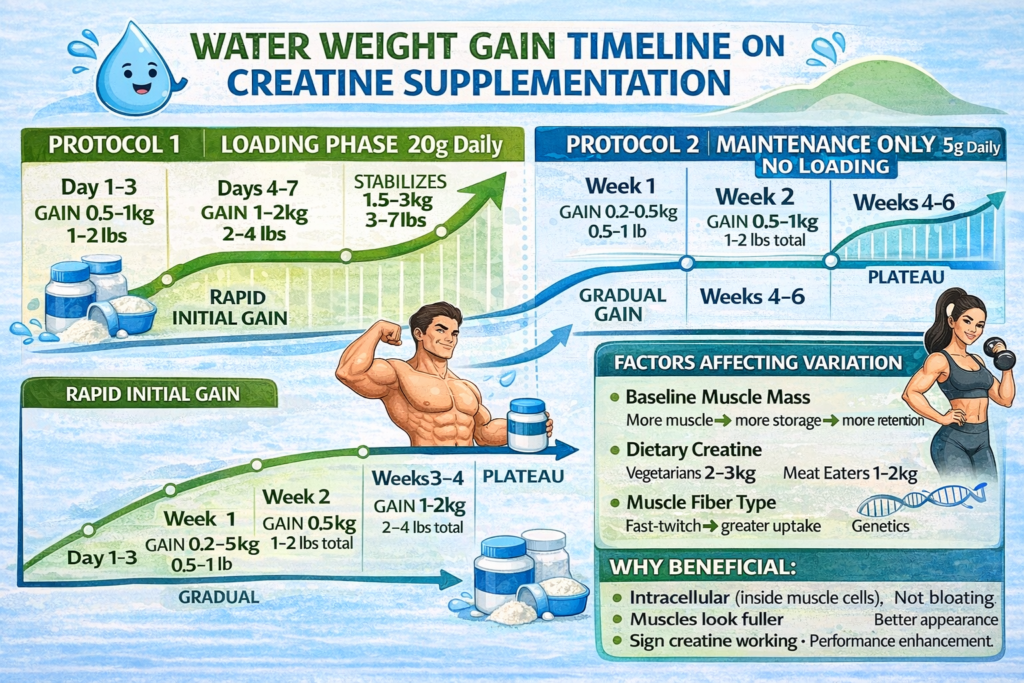
The Typical Water Weight Increase
The research findings:
Study (Journal of Athletic Training):
- Participants gained 0.5-3.5kg (1-8 lbs)
- Over 28 days of creatine supplementation
- Average increase: 1-2kg (2-4 lbs)
- Documented range
Individual variation factors:
Factor 1: Baseline muscle mass
- More muscle mass = more creatine storage capacity
- More storage = more water retention
- Larger individuals gain more weight
- Size-dependent
Factor 2: Dietary creatine intake
- Vegetarians/vegans (zero dietary creatine): Larger increase (2-3kg common)
- Meat eaters (some dietary creatine): Smaller increase (1-2kg common)
- Diet-dependent
Factor 3: Supplementation protocol
- Loading phase (20g daily): Rapid weight gain (1-2kg in first week)
- Maintenance only (5g daily): Gradual gain (1-2kg over 4 weeks)
- Protocol-dependent
Factor 4: Muscle fiber type
- More fast-twitch fibers: Greater creatine uptake
- Individual genetic variation
- Genetics play role
The Timeline of Water Weight Gain
Loading phase (if using):
- Day 1-3: 0.5-1kg (1-2 lbs)
- Day 4-7: 1-2kg (2-4 lbs) total
- Week 2-4: Stabilizes at 1.5-3kg (3-7 lbs)
- Rapid initial gain
Maintenance-only approach (no loading):
- Week 1: 0.2-0.5kg (0.5-1 lb)
- Week 2: 0.5-1kg (1-2 lbs) total
- Week 3-4: 1-2kg (2-4 lbs) total
- Plateau by week 4-6
- Gradual gain
After stopping creatine:
- Water weight lost within 2-4 weeks
- Returns to baseline
- Reversible effect
- Temporary retention
Why This Water Weight Is NOT a Problem
The benefits:
Benefit 1: Muscle fullness
- Muscles look bigger and fuller
- Better appearance
- Improved pumps
- Aesthetic advantage
Benefit 2: Intracellular (not subcutaneous)
- Water INSIDE muscle cells, not under skin
- Doesn’t cause bloating or soft appearance
- Actually improves muscle definition
- Good kind of water weight
Benefit 3: Performance enhancement
- Indicator that creatine is working
- Muscle saturation achieved
- Strength and power improvements correlate with water retention
- Functional benefit
Benefit 4: Anabolic signaling
- Cell swelling may enhance protein synthesis
- Better muscle growth environment
- Growth promotion
When water retention IS a problem:
- Weight class athletes (need to make weight)
- Physique competitors (days before show)
- Otherwise, NOT an issue
- Specific scenarios only
For most people:
- Water weight gain is GOOD sign
- Means creatine is working
- Don’t try to prevent it
- Embrace the weight gain
Practical Hydration Guidelines
Simple implementation.
The Daily Hydration Protocol
Morning:
- Wake up, drink 500ml (16 oz) water
- Rehydrate from overnight
- Start hydrated
With creatine dose:
- Mix 3-5g creatine with 300ml (10 oz) water
- Consume within 10 minutes
- Timing doesn’t matter (anytime works)
- Daily dose
Throughout day:
- Drink 250-500ml (8-16 oz) every 2-3 hours
- Total 3-4 liters by end of day
- Consistent intake
During training:
- Sip 500-1000ml (16-32 oz) during workout
- Replace sweat losses
- Training hydration
Before bed:
- Final 250ml (8 oz)
- Don’t overdo (will wake to urinate)
- Evening hydration
The simple tracking method:
- Fill 1-liter bottle 3-4 times daily
- Finish each bottle
- Easy visual tracking
- Practical monitoring
The Urine Color Monitoring
The scale:
Clear (no color):
- Over-hydrated (not harmful, just excessive)
- Peeing frequently
- Can reduce intake slightly
- Too much
Pale yellow (lemonade):
- Optimal hydration
- Target this
- Perfect
Yellow (moderate):
- Adequately hydrated
- Acceptable
- Good
Dark yellow (apple juice):
- Borderline dehydrated
- Drink more water
- Warning sign
Amber/brown:
- Dehydrated
- Drink water immediately
- Action needed
Frequency:
- Check color every time you urinate
- Aim for pale yellow most of the day
- Regular monitoring
Confounding factors:
- B vitamins turn urine bright yellow (ignore color that day)
- Some medications affect color
- First morning urine often darker (normal)
- Consider context
Common Hydration Questions
Addressing confusion.
“Can I drink too much water with creatine?”
The answer:
- Yes, you can over-hydrate (water intoxication)
- But very unlikely with reasonable intake (3-5 liters)
- Would need 7-10+ liters in short period
- Risk is low
Symptoms of over-hydration:
- Frequent urination (every 30-60 minutes)
- Clear urine constantly
- Nausea
- Headache (from electrolyte dilution)
- In extreme cases: Hyponatremia (dangerous)
- Rare but possible
The safe range:
- 3-5 liters daily for most active people
- Up to 6-7 liters if training intensely in heat
- Spread throughout day (not all at once)
- Reasonable limits
“Should I drink extra water on loading days?”
The answer:
- Not necessarily
- Loading phase (20g daily) doesn’t require 4x the water
- Maintain 3-4 liters as usual
- Perhaps add extra 500ml if you want
- Standard hydration suffices
The math:
- 20g creatine needs ~1.2 liters to mix (4 doses x 300ml)
- Still leaves 2-3 liters for rest of day
- Total 3.5-4.5 liters (adequate)
- Normal intake works
“Does creatine affect electrolyte balance?”
The answer:
- Minimal effect
- Sodium and potassium may shift slightly (more intracellular with water)
- Not clinically significant in healthy individuals
- No special electrolyte needs
When electrolytes matter:
- Very long training sessions (2+ hours)
- Heavy sweating
- Low-sodium diet
- Add electrolytes for performance (not specifically for creatine)
- Training-dependent, not creatine-dependent
“Can I take creatine with coffee or pre-workout?”
The answer:
- Yes, absolutely fine
- Caffeine doesn’t negate creatine effects (old myth)
- Mix creatine with coffee, pre-workout, or whatever
- No interaction
The fluid consideration:
- Coffee is diuretic (mild) but still counts toward hydration
- Pre-workout drinks count as fluid intake
- Include these in daily total
- Counts toward hydration
The Bottom Line: Normal Hydration Is Enough
After explaining everything:
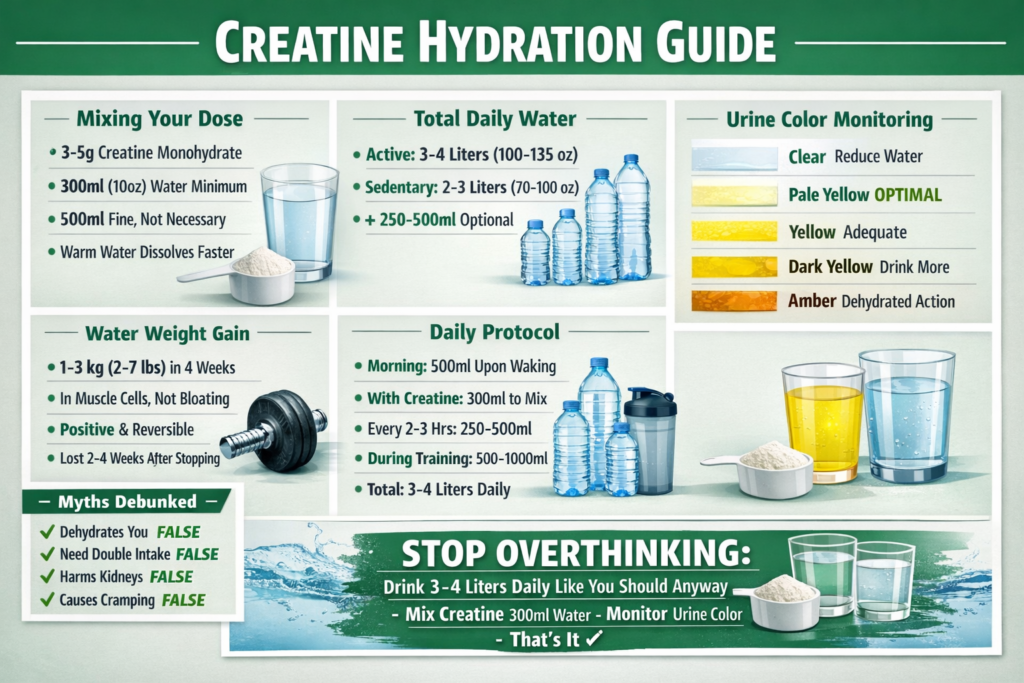
The truth about water and creatine:
✅ If already drinking 3-4 liters daily, don’t change anything (adequate hydration)
✅ Mix creatine with 300ml water, no need for excessive amounts (dissolves fine)
✅ Creatine pulls water INTO muscles, doesn’t dehydrate you (intracellular retention)
✅ Water weight gain of 1-3kg is normal and beneficial (sign it’s working)
✅ Monitor urine color for hydration status (pale yellow = optimal)
Key takeaways:
How creatine works with water:
- Absorbed in intestine, converted in liver to phosphocreatine
- Stored in muscle cells
- Exerts osmotic pressure (pulls water into cells)
- Intracellular water increase (inside muscle cells)
- NOT dehydration (total body water increases)
- Cell volumization mechanism
For mixing your dose:
- 3-5g creatine monohydrate
- 300ml (10 oz) water minimum
- 500ml or more is fine but not necessary
- Warm water dissolves faster
- Standard mixing protocol
For total daily water:
- 3-4 liters (100-135 oz) for active individuals
- 2-3 liters (70-100 oz) for sedentary
- Same as without creatine (no dramatic increase needed)
- Perhaps add 250-500ml if being conservative
- Normal hydration guidelines apply
Factors affecting individual needs:
- Body weight (30-40ml per kg guideline)
- Activity level (more training = more water)
- Climate (hot/humid = more needed)
- Sweat rate (individual variation)
- Personalize to your situation
Dehydration signs (same with or without creatine):
- Increased thirst, dry mouth
- Dark yellow urine (amber colored)
- Headache, fatigue
- Reduced exercise performance
- Dizziness
- General dehydration symptoms
Urine color test:
- Clear: Over-hydrated (reduce slightly)
- Pale yellow: Optimal (target this)
- Yellow: Adequate (good)
- Dark yellow: Borderline (drink more)
- Amber: Dehydrated (action needed)
- Visual monitoring tool
Water weight gain:
- 1-3kg (2-7 lbs) typical
- Occurs over 4 weeks (faster with loading)
- Inside muscle cells (not bloating)
- Beneficial (sign creatine working)
- Reversible (lost 2-4 weeks after stopping)
- Expected and good
Myths debunked:
- “Creatine dehydrates you” (FALSE, increases intracellular water)
- “Need double your water intake” (FALSE, normal intake sufficient)
- “Causes kidney damage” (FALSE in healthy individuals)
- “Causes cramping” (FALSE, no evidence)
- “Need special hydration protocol” (FALSE, standard guidelines work)
- Common misconceptions
Practical daily protocol:
- Morning: 500ml upon waking
- With creatine: 300ml to mix dose
- Throughout day: 250-500ml every 2-3 hours
- During training: 500-1000ml
- Total: 3-4 liters
- Simple routine
When to increase water:
- Training in heat (add 500ml-1L)
- Very long sessions (add 500ml)
- Heavy sweating (replace losses)
- NOT specifically because of creatine
- Training-dependent increases
Priority actions:
- Mix creatine with 300ml water daily (enough to dissolve)
- Drink 3-4 liters total daily (normal active person needs)
- Monitor urine color (aim for pale yellow)
- Don’t overthink it (normal hydration works)
- Embrace water weight gain (sign of efficacy)
- Simple implementation
STOP OVERTHINKING CREATINE HYDRATION. DRINK 3-4 LITERS DAILY LIKE YOU SHOULD ANYWAY. MIX CREATINE WITH 300ML WATER. MONITOR URINE COLOR. THAT’S IT.
Ready to optimize your entire creatine supplementation protocol with evidence-based dosing, timing strategies, and practical guidelines that maximize results? Understanding hydration is just one piece. Get comprehensive creatine guidance. Stop worrying about water. Start focusing on results.
REFERENCES
SECTION 1 — Creatine absorption and the osmotic mechanism
[1] Alfieri RR et al. — PMC/Journal of Physiology, 2006 Identified creatine as a compatible osmolyte in muscle cells; under hypertonic conditions, C2C12 muscle cells increase creatine transporter mRNA and transport activity; creatine is transported into muscle cells via a sodium-dependent transporter, drawing water in to maintain osmotic equilibrium; cell volumization is a fundamental physiological property of creatine, and this osmotic activity is conserved across cell types; creatine joins glycine, GABA, and betaine as biologically significant osmolytes https://pmc.ncbi.nlm.nih.gov/articles/PMC1890352/
[2] Lanhers C et al. — PMC/Journal of the International Society of Sports Nutrition, 2021 Comprehensive review addressing 8 common misconceptions about creatine; creatine is an osmotically active substance stored 95% in skeletal muscle; short-term evidence shows preferential increase in intracellular water; longer-term data show the ratio of skeletal muscle mass to intracellular water remains similar between creatine and placebo groups; the ISSN 2017 position stand found 3–5 g/day well-tolerated in over 500 peer-reviewed publications; no evidence of dehydration risk, cramping causation, kidney damage, or anabolic steroid effects https://pmc.ncbi.nlm.nih.gov/articles/PMC7871530/
SECTION 2 — Total body water increase and fluid distribution
[3] Powers ME et al. — PMC/Journal of Athletic Training, 2003 32 resistance-trained participants (16 men, 16 women); randomized, placebo-controlled; loading phase 25g/day for 7 days, maintenance 5g/day for 21 days; creatine group showed significant increases in muscle creatine concentration, body mass, and total body water (TBW); fluid distribution (intracellular vs. extracellular ratio) remained unchanged; the only clinically significant side effect was weight gain; no cramping, heat illness, or other adverse effects observed https://pmc.ncbi.nlm.nih.gov/articles/PMC155510/
SECTION 3 — Debunking the dehydration and cramping myth
[4] Greenhaff PL & Hultman E — PubMed/British Journal of Sports Medicine, 2008 Systematic review titled “Putting to rest the myth of creatine supplementation leading to muscle cramps and dehydration”; despite media-driven claims and a 2000 ACSM advisory, no published controlled study demonstrates increased cramping or dehydration from creatine; recent findings suggest creatine may maintain haematocrit, aid thermoregulation, and reduce exercising heart rate and sweat rate; creatine may also positively influence plasma volume during the onset of dehydration; little to no evidence exists that creatine in the heat presents additional risk https://pubmed.ncbi.nlm.nih.gov/18184753/
[5] Farshidfar F et al. — PMC/Frontiers in Nutrition, 2025 Short review of common safety concerns; claims that creatine causes dehydration or cramping are largely unsupported by controlled studies; ACSM 2000 advisory was based on weak evidence — primarily anecdotal reports; 4-month study (Greenwood et al.) found creatine supplementation may reduce the risk of cramping and muscle injury in football players training in hot, humid conditions; evidence consistently shows no negative impact on thermoregulation, body temperature, dehydration markers, or plasma volume https://pmc.ncbi.nlm.nih.gov/articles/PMC12702719/
[6] Buford TW et al. — PMC/Journal of the International Society of Sports Nutrition (ISSN Position Stand), 2007 ISSN position stand on creatine and exercise safety; the only clinically significant side effect documented in the research literature is weight gain; athletes supplementing with creatine monohydrate have no greater — and possibly lower — risk of cramping, dehydration, kidney or liver damage than non-supplementing athletes; fears generated by media and single case studies; no controlled study demonstrates harmful kidney effects in healthy individuals https://pmc.ncbi.nlm.nih.gov/articles/PMC2048496/
SECTION 4 — Water weight gain: what to expect
[7] Kutz MR & Gunter MJ — PubMed/Journal of Strength and Conditioning Research, 2003 17 active males; double-blind, placebo-controlled; 4 weeks of creatine supplementation; significant increases in total body weight (90.4 → 92.1 kg) and body water content; no significant changes in percent body fat or caloric intake; weight gain attributed to water retention; confirms creatine increases total body water without affecting fat mass https://pubmed.ncbi.nlm.nih.gov/14636103/



Leave a Reply
You must be logged in to post a comment.