
Struggling to put on weight no matter how much you eat? You’re not alone and you’re about to discover why your current approach isn’t working and exactly what to do instead.
I’ve heard the story a thousand times, from both men and women:
“I’ve been skinny my whole life. I eat tons of food. I lift weights regularly. I even take supplements. But nothing seems to work I just can’t gain weight!”
And here’s the thing: I believe them. They genuinely think they’re eating massive amounts of food.
But there’s a disconnect between what they think they’re eating and what’s actually happening.
In this comprehensive guide, I’m going to reveal the harsh truth about why you’re not gaining weight, then give you 10 proven strategies to finally pack on the pounds and build the physique you want.
Let’s get started.
TABLE OF CONTENTS
- Rule 1: Calculate How Many Calories You ACTUALLY Need
- Rule 2: Accept That It Will Be Difficult (And That's Normal)
- Rule 3: Eat More Frequently Throughout the Day
- Rule 4: Choose Calorie-Dense Foods
- The Best Calorie-Dense Foods for Weight Gain
- Rule 5: Prioritize Protein Intake
- Rule 6: Use Liquid Calories Strategically
- The Ultimate Weight Gain Shake Recipe
- Additional Shake Variations
- Rule 7: Lift Heavy Weights Consistently
- The Best Training Approach for Hardgainers
- Rule 8: Consistency Trumps Everything
- Rule 9: Track Your Progress Weekly
- Rule 10: Increase Calories When Progress Stalls
- The Bottom Line: You Can Gain Weight
The Truth About Why You Can’t Gain Weight
Before we dive into solutions, you need to understand the fundamental problem.
The calorie equation is simple and unbreakable:
Everything you eat and drink (except water) contains calories. Everything you do from breathing to exercising burns calories as energy.
- If calories consumed = calories burned: Your weight stays the same
- If calories consumed < calories burned: You lose weight
- If calories consumed > calories burned: You gain weight
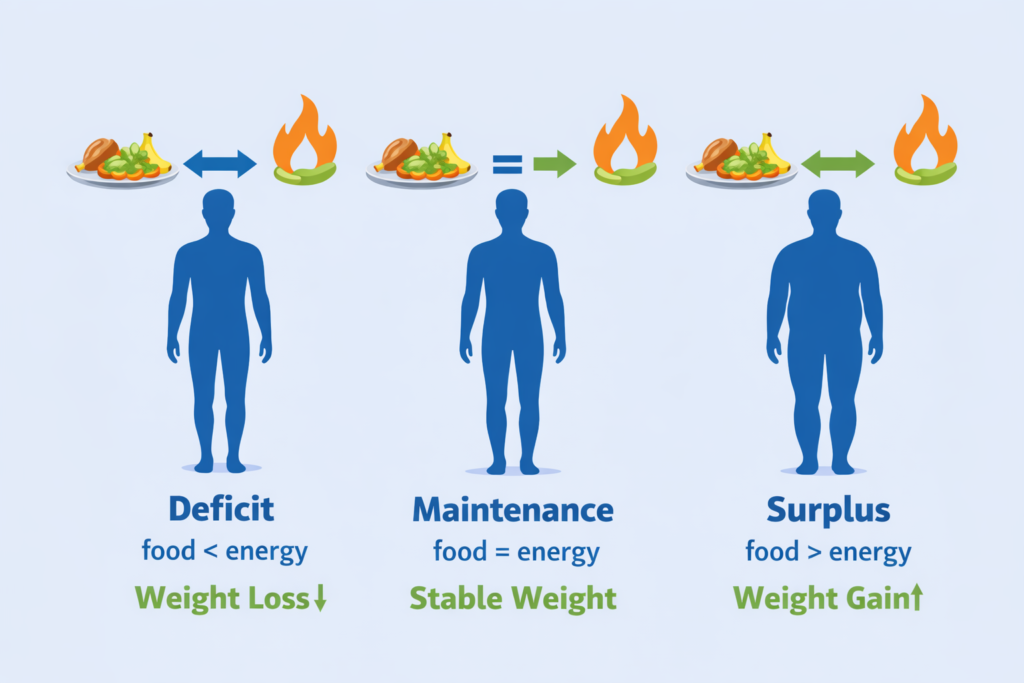
To gain weight, you MUST consume more calories than your body uses. Without this caloric surplus, nothing in this universe no supplement, no workout program, no magic trick will make you gain weight.
“But I already eat so much!”
Do you, though?
The “Eating a Lot” Illusion
Here’s the uncomfortable reality: you probably don’t eat as much as you think.
“Eating a lot” is a subjective, abstract concept especially for someone who’s been naturally thin their entire life and is typically surrounded by other naturally thin people with similar genetics.
You might eat more than everyone around you. You might feel stuffed after every meal. But none of this is concrete evidence that you’re creating a caloric surplus.
Why naturally thin people struggle to gain weight:
1. Efficient metabolism: Your body is optimized to burn calories efficiently, making it harder to store excess energy.
2. Underestimated appetite: Your hunger signals aren’t as strong as you think. You can go longer without eating and don’t experience the same food cravings as naturally heavier people.
3. Non-Exercise Activity Thermogenesis (NEAT): You probably move more throughout the day fidgeting, pacing, unconscious movements burning more calories without realizing it.
4. Adaptive thermogenesis: When you eat more, your body ramps up heat production and energy expenditure to compensate, making it harder to maintain a surplus.
5. Inaccurate tracking: You’re likely overestimating how much you actually eat. That “huge” meal might only be 600 calories, when you need 3,500+ daily.
All of this makes gaining weight more challenging but it doesn’t change the fundamental truth: you’re still not eating enough to create a consistent caloric surplus.
So what can you do about it?
10 Essential Rules for Gaining Weight Fast
Let’s turn knowledge into action with proven strategies that actually work.
Rule 1: Calculate How Many Calories You ACTUALLY Need
You can’t gain weight without a caloric surplus, but you can’t create a surplus based on guesswork and “feeling like you eat a lot.”
You need concrete numbers.
The only way to ensure you’re in a surplus is by:
- Calculating your daily calorie target
- Tracking what you actually consume
- Adjusting based on results
How to calculate your calorie needs:
Step 1: Estimate your Total Daily Energy Expenditure (TDEE)
Use this simple formula: Body weight (in pounds) × 16-18 = maintenance calories
- Less active individuals: multiply by 14-16
- Moderately active: multiply by 16-18
- Very active: multiply by 18-20
For example, a 150-pound person: 150 × 17 = 2,550 maintenance calories
Step 2: Add a surplus for weight gain
Add 300-500 calories to your maintenance number.
Using our example: 2,550 + 400 = 2,950 calories daily for weight gain
Step 3: Track your intake religiously
Download a calorie tracking app like:
- MyFitnessPal
- Cronometer
- Lose It!
- FatSecret
Log everything you eat and drink. Every snack, every meal, every beverage.
Why this matters: Most people wildly underestimate their calorie intake. What feels like “eating tons of food” is often 1,500-2,000 calories nowhere near enough for weight gain.
The calculator won’t be perfect, but it provides a far more accurate starting point than your instincts alone.
Rule 2: Accept That It Will Be Difficult (And That’s Normal)
Once you calculate your calorie target and start tracking, you’ll discover two harsh truths:
- You need to eat far more than you imagined
- It’s much harder than you expected
In other words, you’ll probably struggle to eat everything you need.
You might want to quit. You’ll definitely fail some days.
This is completely normal.
Changing eating habits is challenging for everyone, regardless of their goal. People trying to lose weight struggle with hunger; people trying to gain weight struggle with fullness.
The key mindset shift: Expect setbacks. Plan for difficult days. When you fail to hit your calories, don’t abandon the entire plan just get back on track the next day.
Remember: Building muscle and gaining weight is a marathon, not a sprint. Missing your calories one day doesn’t ruin your progress. Giving up entirely does.
The remaining rules will give you strategies to make this process easier.
Rule 3: Eat More Frequently Throughout the Day
Simple principle: Smaller meals are easier to consume than massive meals. They don’t leave you feeling bloated and uncomfortable.
Example scenario:
Let’s say you need 3,500 calories daily to gain weight.
Option A (difficult): 3 meals of 1,167 calories each Option B (easier): 5 meals of 700 calories each Option C (easiest): 6 meals of 583 calories each
Why this works: Your stomach capacity is limited. Trying to stuff 1,200 calories into one sitting is miserable. Spreading those calories across more frequent, smaller meals makes the total volume far more manageable.
Practical implementation:
- Breakfast: 600 calories
- Mid-morning snack: 400 calories
- Lunch: 800 calories
- Afternoon snack: 500 calories
- Dinner: 800 calories
- Before bed: 400 calories
Total: 3,500 calories without a single overwhelming meal.
Important caveat: If you find it easier to eat fewer, larger meals, that’s fine too. This is about finding what works for YOUR preferences and schedule.
Rule 4: Choose Calorie-Dense Foods
Not all foods are created equal when it comes to calories per volume.
The strategy: Eat foods that pack more calories into less physical food, so you can hit your calorie target without feeling constantly stuffed.
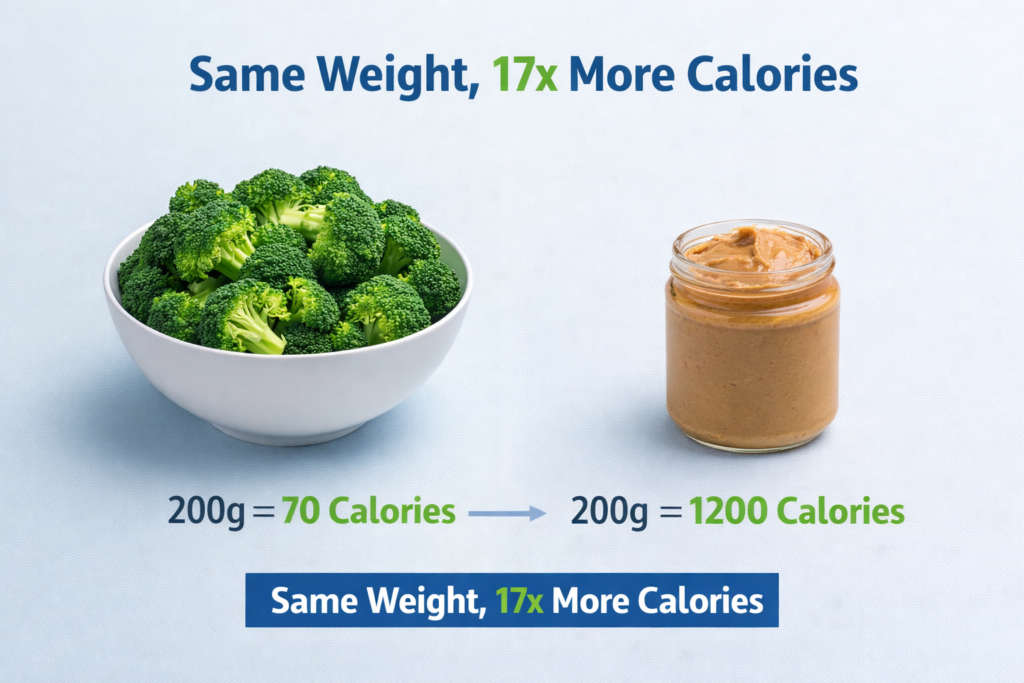
Comparison example:
- 200g broccoli = ~70 calories
- 200g peanut butter = ~1,200 calories
You can consume far more calories by eating less actual food volume if you choose calorie-dense options.
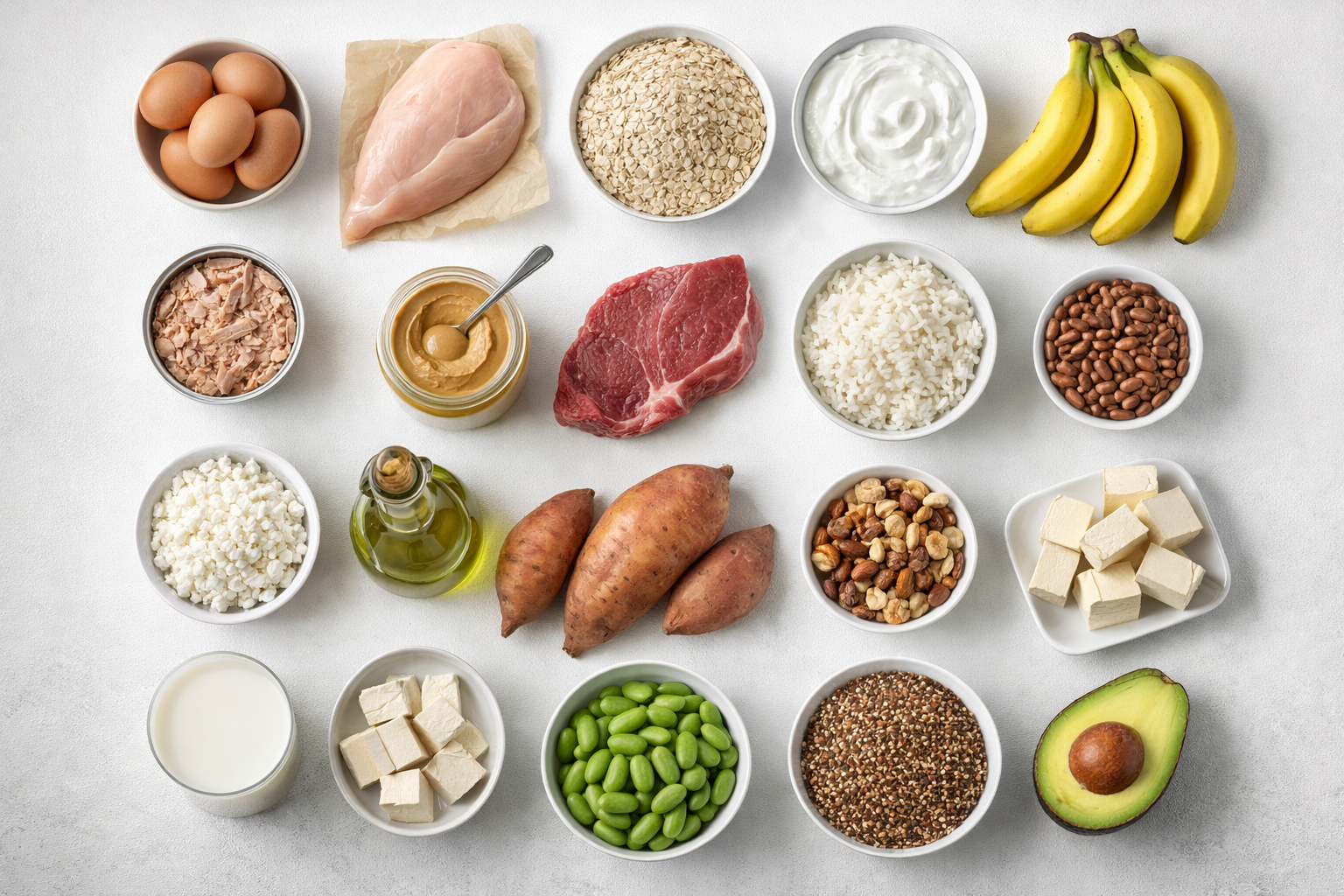
The Best Calorie-Dense Foods for Weight Gain
Nuts and nut butters:
- Peanut butter: 190 calories per 2 tablespoons
- Almonds: 160 calories per ounce (about 23 nuts)
- Cashews: 160 calories per ounce
- Mixed nuts: 170 calories per ounce
- Almond butter, walnut butter, etc.
Dried fruits:
- Raisins: 130 calories per ¼ cup
- Dates: 120 calories per 5 dates
- Dried apricots: 80 calories per ¼ cup
- Prunes, figs, cranberries
Dairy products:
- Whole milk: 150 calories per cup
- Full-fat Greek yogurt: 220 calories per cup
- Cheese: 110 calories per ounce
- Cottage cheese (full-fat): 220 calories per cup
- Heavy cream (add to coffee or shakes): 50 calories per tablespoon
Grains and starches:
- White rice: 200 calories per cooked cup
- Pasta: 220 calories per cooked cup
- Oats: 300 calories per dry cup
- Bread: 80-120 calories per slice
- Bagels: 250-350 calories each
- Granola: 600 calories per cup
Potatoes and starchy vegetables:
- Sweet potatoes: 180 calories per large potato
- White potatoes: 160 calories per medium potato
- Yams, plantains
Healthy fats:
- Extra virgin olive oil: 120 calories per tablespoon
- Coconut oil: 120 calories per tablespoon
- Avocado: 240 calories per medium avocado
- Avocado oil
Meats (especially fattier cuts):
- Salmon: 200 calories per 4 oz
- Chicken thighs (with skin): 250 calories per thigh
- Ground beef (80/20): 290 calories per 4 oz
- Ribeye steak: 310 calories per 4 oz
- Whole eggs: 70 calories per egg
Pro tip: You don’t need to eat “clean” 100% of the time. If you’re struggling to hit calories, including some less “perfect” foods is fine. Pizza, burgers, ice cream they all provide calories. Just ensure you’re getting adequate protein and micronutrients from whole foods too.
Rule 5: Prioritize Protein Intake
While total calories determine weight gain, protein determines whether that weight is muscle or just fat.
Your muscles need protein to:
- Recover from training
- Repair damaged muscle fibers
- Build new muscle tissue
- Maintain existing muscle mass
Optimal protein intake: 0.7-1.0 grams per pound of body weight daily
For a 150-pound person: 105-150 grams of protein daily
Why this range? Research consistently shows this amount maximizes muscle protein synthesis while supporting recovery. Going higher provides minimal additional benefit; going lower compromises muscle growth.
Include protein in every meal:
Breakfast options:
- Eggs (6-7g protein each)
- Greek yogurt (15-20g per cup)
- Cottage cheese (14g per ½ cup)
- Protein powder in oatmeal
Lunch and dinner proteins:
- Chicken breast (31g per 4 oz)
- Lean beef (28g per 4 oz)
- Fish (22-26g per 4 oz)
- Turkey (30g per 4 oz)
Snack proteins:
- Protein shakes (20-30g per scoop)
- Beef jerky (9g per ounce)
- String cheese (7g per stick)
- Tuna (20g per small can)
Plant-based options:
- Tofu (10g per ½ cup)
- Tempeh (15g per ½ cup)
- Lentils (18g per cooked cup)
- Chickpeas (15g per cooked cup)
- Edamame (17g per cooked cup)
Track your protein separately from total calories to ensure you’re hitting this crucial target daily.
Rule 6: Use Liquid Calories Strategically
Game-changer alert: Liquid calories are a hardgainer’s secret weapon.
Why liquids work better:
Faster digestion: Blending food breaks it down mechanically, essentially “pre-digesting” it. Your body processes it much faster than solid food.
Less satiation: Liquid calories don’t fill you up as much or as long as solid food, allowing you to consume more total calories throughout the day.
Convenience: You can drink a 1,000-calorie shake in 5 minutes. Try eating 1,000 calories of chicken and rice that quickly.
Timing advantage: You can drink a huge shake, then be hungry again in 60-90 minutes. The same calories from solid food might keep you full for 3-4 hours.
The Ultimate Weight Gain Shake Recipe
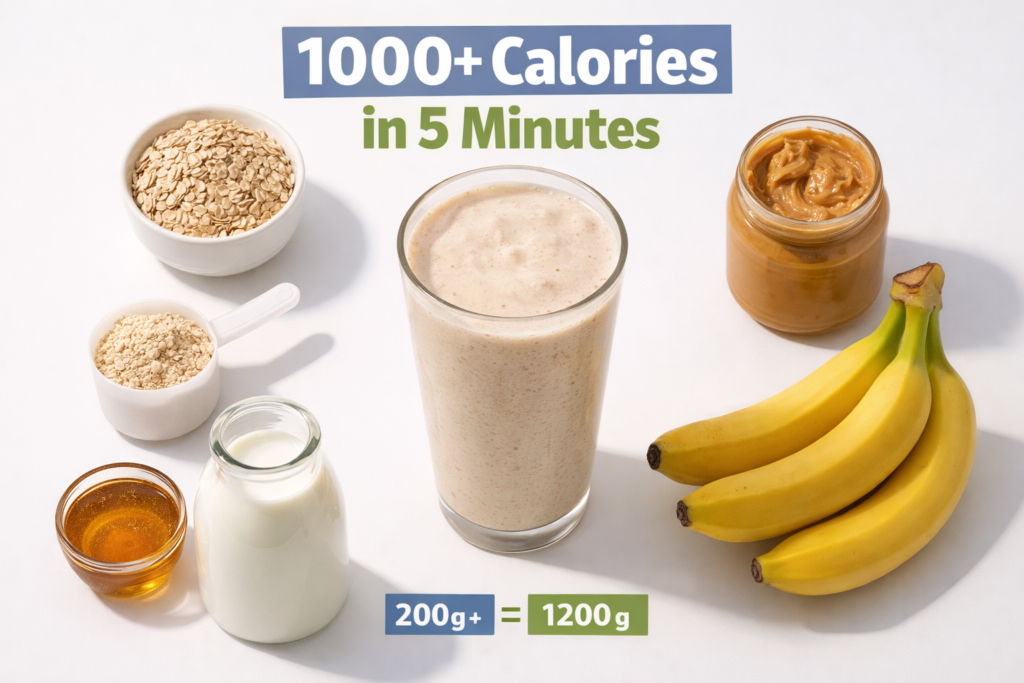
Here’s a simple recipe that delivers approximately 1,000 calories:
Ingredients:
- 1 cup (80g) rolled oats: 300 calories
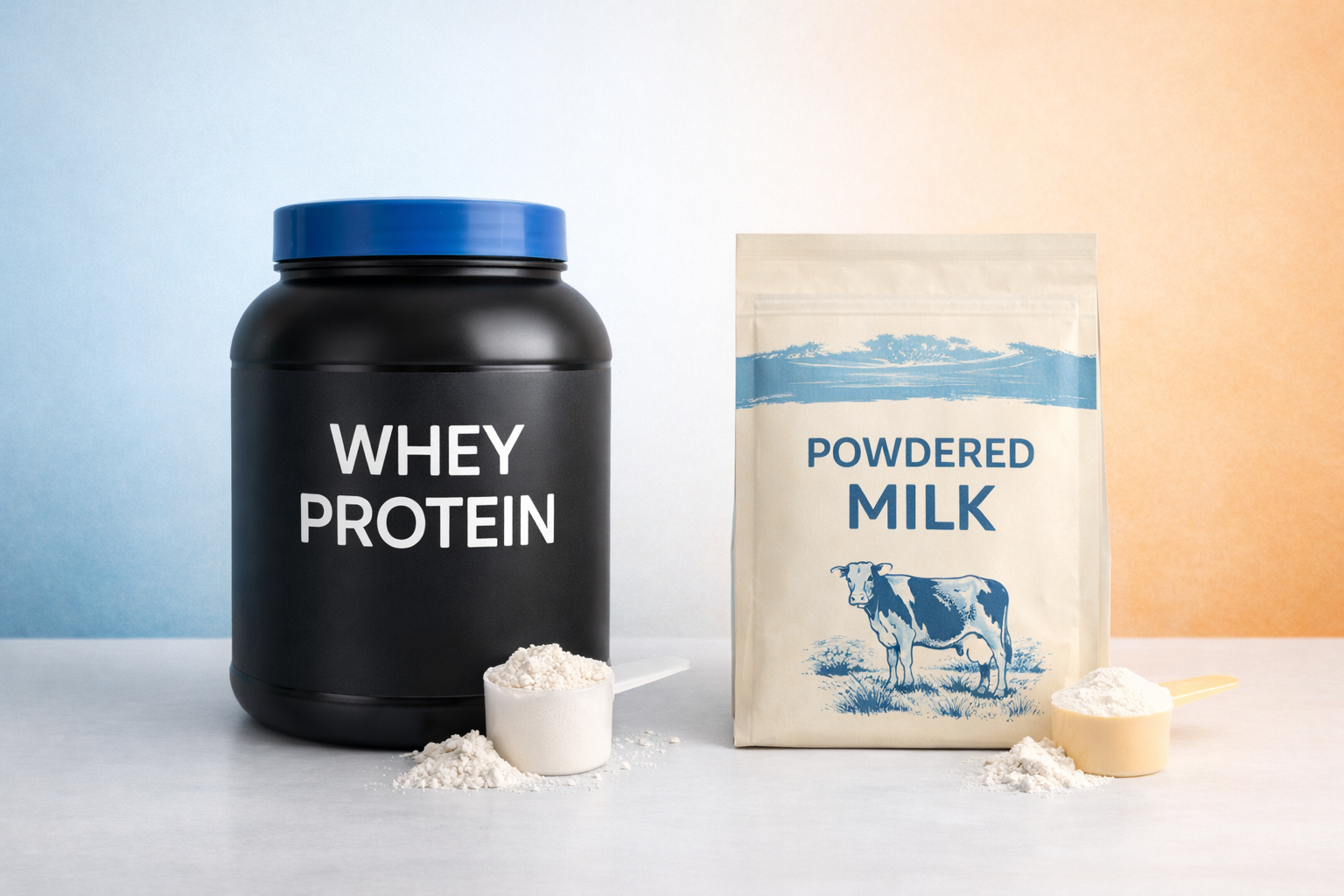
- 2 scoops whey protein powder: 240 calories
- 2 tablespoons peanut butter: 190 calories
- 1 large banana: 120 calories
- 1.5 cups whole milk: 225 calories
- 1 tablespoon honey: 60 calories
- Handful of ice
Instructions: Blend everything together until smooth
Macros (approximate):
- Calories: 1,135
- Protein: 60g
- Carbs: 140g
- Fat: 30g
Strategic use: Drink this for breakfast and you’ve already consumed roughly one-third of your daily calorie needs in 5 minutes.
Add two solid meals and a couple snacks throughout the rest of the day, and hitting 3,000+ calories becomes far more manageable.
Additional Shake Variations
Mass Gainer Alternative (1,200+ calories):
- 1.5 cups oats
- 2 scoops protein powder
- 3 tablespoons peanut butter
- 2 bananas
- 2 cups whole milk
- Handful of berries
Quick Morning Shake (700 calories):
- 1 cup oats
- 1 scoop protein
- 1 tablespoon peanut butter
- 1 cup milk
- 1 banana
Bedtime Shake for Recovery (600 calories):
- 2 scoops casein protein
- 1 tablespoon almond butter
- ½ cup oats
- 1 cup milk
- Cinnamon for flavor
Why homemade is better: Commercial mass gainers cost $50-80 per container and are filled with cheap maltodextrin and low-quality protein. Making your own is cheaper, healthier, and tastes better.
Rule 7: Lift Heavy Weights Consistently
Critical truth: If you just eat more calories without training, you’ll gain fat, not muscle.
Resistance training is essential because:
1. It provides the stimulus for muscle growth Your body has no reason to build new muscle unless you give it a reason. Heavy lifting signals your body: “We need to be stronger. Build more muscle to adapt.”
2. It improves nutrient partitioning When you train hard, your body preferentially shuttles incoming calories toward muscle recovery and growth rather than fat storage.
3. It increases your calorie needs More muscle mass = higher metabolic rate = you can eat even more without getting fat.
4. It ensures quality weight gain The combination of caloric surplus + progressive resistance training = muscle gain. Just surplus alone = fat gain.
The Best Training Approach for Hardgainers
Focus on compound movements:
- Squats
- Deadlifts
- Bench press
- Overhead press
- Barbell rows
- Pull-ups/chin-ups
Why compounds? They work multiple muscle groups simultaneously, allowing you to lift heavier weights and create a stronger growth stimulus.
Training frequency: 3-5 days per week
Ideal programs for beginners:
- Starting Strength
- StrongLifts 5×5
- Push/Pull/Legs split
- Upper/Lower split
Progressive overload is key: Consistently try to add weight to the bar, add reps, or increase volume over time. This progressive challenge forces continued adaptation.
Don’t waste time on isolation exercises and high-rep pump work until you’ve built a solid foundation of strength and mass with heavy compounds.
Rule 8: Consistency Trumps Everything
The brutal truth: Nothing in this article matters if you don’t apply it consistently, day after day, week after week.
You will face challenges:
- Days when you don’t feel like eating
- Weeks when motivation is low
- Times when progress stalls
- Moments when you want to quit
This is normal. Nobody stays 100% motivated all the time.
The difference between success and failure: Successful people push through anyway.
Practical consistency strategies:
1. Build eating into your routine: Set phone alarms for meal times. Pack meals in advance. Make it automatic, not optional.
2. Prepare in advance: Meal prep on Sundays for the week. Have ingredients ready for shakes. Remove decision-making from the process.
3. Track everything: Use your app religiously. Seeing the data keeps you accountable.
4. Find an accountability partner: Tell someone your goal. Check in weekly. External accountability increases follow-through.
5. Focus on the process, not perfection: You don’t need to hit your exact calorie target every single day. Aim for 80-90% adherence. That’s enough for excellent results.
Remember: Stopping and restarting repeatedly will derail your entire plan and make the process take far longer than necessary.
Rule 9: Track Your Progress Weekly
What gets measured gets managed.
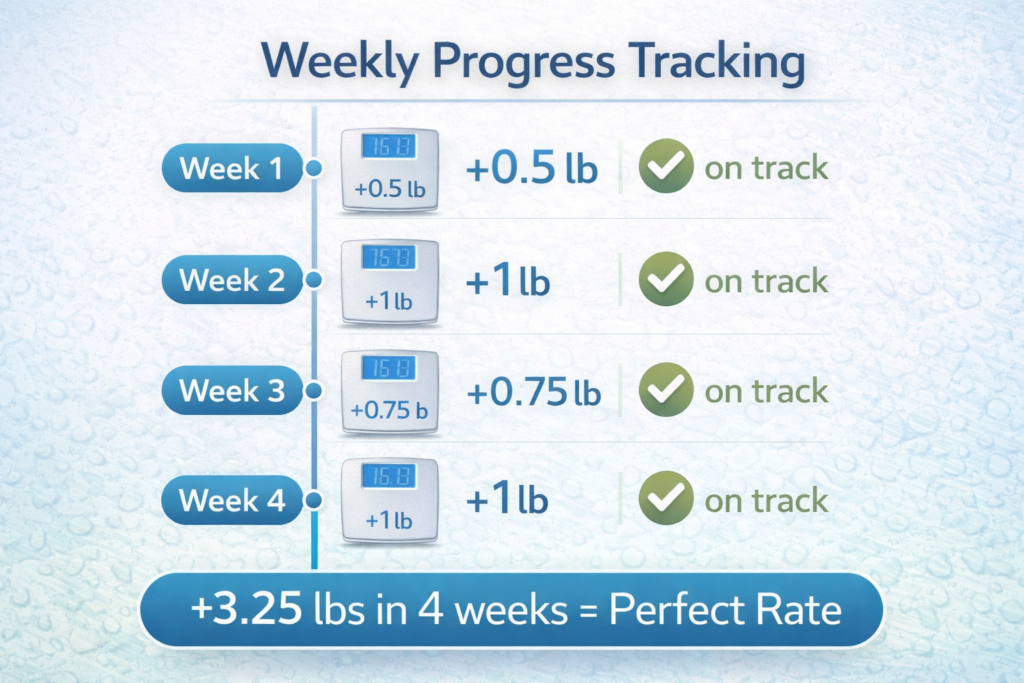
The weekly weigh-in protocol:
When: Weigh yourself once per week, same day, same time
Best timing: First thing in the morning, after using the bathroom, before eating or drinking anything, wearing minimal clothing
Why weekly, not daily? Your weight fluctuates significantly day-to-day based on:
- Stomach and intestinal contents
- Water retention (affected by sodium, carbs, stress, sleep)
- Glycogen storage
- Bowel movements
- Hormonal fluctuations
These daily fluctuations are meaningless noise. The weekly trend is what matters.
How to interpret results:
Gaining 0.5-1 pound per week: Perfect! This is the ideal rate for muscle gain with minimal fat accumulation.
Gaining 1.5-2+ pounds per week: Too fast. You’re likely gaining excessive fat. Reduce calories by 200-300.
Gaining 0-0.25 pounds per week: Too slow. You’re not in enough of a surplus. Add 200-300 calories.
No change or losing weight: Definitely not eating enough. Add 400-500 calories immediately.
Additional tracking methods:
- Progress photos: Take weekly photos from multiple angles (front, side, back) in the same lighting and location
- Body measurements: Measure arms, chest, waist, thighs monthly
- Strength progression: Track your lifts. Are you getting stronger? That’s muscle gain.
- How clothes fit: Are your shirts getting tighter in the shoulders and chest? Good sign.
Don’t rely on the mirror alone. When you see yourself every day, changes are imperceptible. Data doesn’t lie.
Rule 10: Increase Calories When Progress Stalls
Here’s what most people don’t realize: As you gain weight and muscle, your calorie needs increase.
Why your needs change:
- More body mass = higher metabolic rate
- More muscle tissue = more calories burned at rest
- Heavier training loads = more calories burned during workouts
- Metabolic adaptation = your body becomes more efficient
The practical problem: The 3,000 calories that worked initially might only maintain your new weight after a few months.
The solution: Periodically increase your calorie intake to maintain your rate of gain.
When to increase:
If your weight hasn’t increased for 2 consecutive weeks despite consistent eating and training, it’s time to add more calories.
How much to add: Increase by 200-500 calories
Example: You were eating 3,200 calories daily. Weight hasn’t budged for two weeks. Increase to 3,500-3,700 calories. Monitor for another 1-2 weeks and adjust again if needed.
This is a continuous process. As you get bigger, you’ll need to eat more. A 200-pound man needs significantly more calories than a 150-pound man, even if they’re the same height and activity level.
Don’t be afraid to eat more. Many hardgainers get stuck because they find a calorie level that works initially, then refuse to increase it when progress stops.
Common Mistakes That Sabotage Weight Gain
Let’s address the pitfalls that derail most hardgainers:
Mistake 1: Inconsistent Eating
The problem: Eating big on training days but barely anything on rest days. Nailing your calories during the week but completely dropping the ball on weekends.
The reality: Your body doesn’t care about your schedule. It needs consistent fuel to build muscle.
The fix: Hit your calorie target every single day, training or not. Plan weekend meals just as carefully as weekdays.
Mistake 2: Dirty Bulking to Extremes
The problem: “I need to gain weight, so I’ll eat nothing but pizza, burgers, ice cream, and junk food.”
The reality: While you don’t need to eat “clean” 100% of the time, going too far in the other direction causes:
- Excessive fat gain
- Poor nutrient intake
- Digestive issues
- Feeling like garbage
The fix: Follow the 80/20 rule 80% whole, nutritious foods; 20% whatever helps you hit calories.
Mistake 3: Neglecting Protein
The problem: Focusing only on total calories while eating mostly carbs and fats.
The reality: Without adequate protein, weight gain will be mostly fat, not muscle.
The fix: Track protein separately. Hit 0.7-1g per pound body weight daily, non-negotiable.
Mistake 4: Cardio Overload
The problem: Doing excessive cardio or conditioning work while trying to gain weight.
The reality: Cardio burns additional calories you then need to eat back. For hardgainers who already struggle to eat enough, adding cardio makes an already difficult task even harder.
The fix: Minimize cardio. Do just enough to maintain cardiovascular health (maybe 20-30 minutes, 2-3x per week), but don’t overdo it.
Mistake 5: Impatience and Unrealistic Expectations
The problem: Expecting to gain 20 pounds in a month like clickbait articles promise.
The reality: Natural muscle gain is slow. Expecting 0.5-1 pound per week (2-4 pounds per month) is realistic and sustainable.
The fix: Embrace the process. Commit to 6-12 months of consistent effort before judging results.
The Bottom Line: You Can Gain Weight
If you’re a hardgainer who’s struggled to put on weight despite “eating a lot,” the problem isn’t your genetics, your metabolism, or some mysterious condition.
The problem is simple: you’re not eating enough calories consistently enough for long enough.
The solution is equally simple (though not easy):
✅ Calculate your actual calorie needs
✅ Track what you eat religiously
✅ Hit your calorie target every single day
✅ Prioritize protein (0.7-1g per pound body weight)
✅ Use calorie-dense foods and liquid calories
✅ Eat more frequently throughout the day
✅ Lift heavy weights 3-5x per week
✅ Monitor your weight weekly and adjust calories as needed
✅ Stay consistent for months, not weeks
Will it be easy? No. You’ll feel uncomfortably full sometimes. You’ll have days you don’t want to eat another bite. You might question whether it’s worth it.
Will it work? Absolutely. I’ve never seen someone who genuinely followed this approach consistently for 3-6 months fail to gain weight.
The only question is: are you willing to do what it takes?
Stop making excuses. Stop blaming genetics. Stop saying you “eat a lot” without any data to back it up.
Start tracking. Start eating. Start training. Start building the body you want.
Your transformation starts now.
Ready to finally gain weight and build serious muscle? Stop spinning your wheels with guesswork and get a proven system that eliminates all the confusion around calories, macros, meal planning, and training. The right program can help you gain 15-25 pounds of quality muscle in your first year without turning into a fat mess. Your hardgainer days are over. It’s time to grow.

Leave a Reply
You must be logged in to post a comment.