
Waiting for motivation to strike before hitting the gym? Here’s why that’s killing your progress and what actually works instead.
You wake up Monday morning pumped. This is it. This is the week everything changes.
You meal prep like a champion. You crush your workout. You’re on fire.
Tuesday rolls around. Still feeling good.
Wednesday? The excitement starts fading.
By Friday, you’re ordering takeout and skipping the gym. Again.
Sound familiar?
You’re not alone. Losing motivation to train and diet is incredibly common. But here’s the uncomfortable truth most fitness influencers won’t tell you:
Lack of motivation isn’t your problem. Depending on motivation is your problem.
In this article, I’m going to completely flip your understanding of what it takes to stay consistent with training and nutrition. You’ll discover why motivation is actually sabotaging your success and learn the real system that separates people who achieve their goals from those who perpetually restart every Monday.
This might not be what you want to hear. But it’s what you need to understand.
Let’s get into it.
TABLE OF CONTENTS
The Motivation Trap: Why It’s Failing You
Most people approach body transformation with motivation as their primary (or only) driving factor.
That’s great, except for one massive problem:
Motivation is temporary.
It rises and falls throughout a single day. It comes and goes over weeks. It completely disappears and maybe, if you’re lucky, reappears months or years later.
Motivation can be at full strength on Monday and completely absent on Tuesday.
Yet somehow, we depend on this unreliable, fleeting feeling to drive one of the most important aspects of our lives.
See the problem?
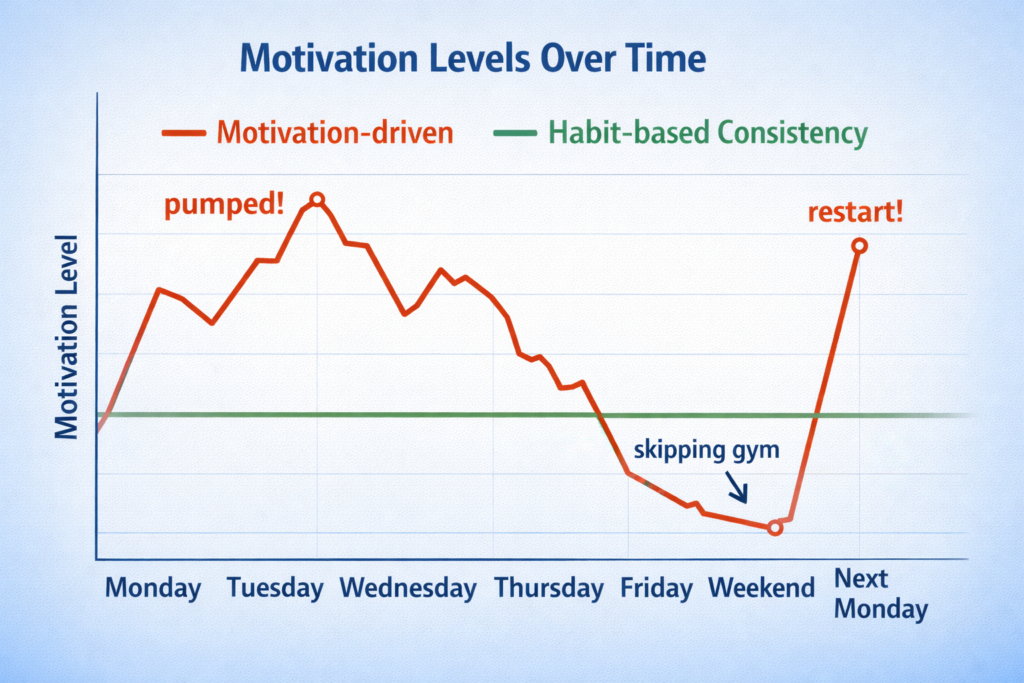
Relying on motivation to accomplish something dooms the plan from the start.
The Role Motivation Actually Plays
Don’t get me wrong. Motivation is essential for getting started.
Without that initial spark of motivation, you probably wouldn’t attempt to change your body until (or if) a health crisis presented a threat to your survival.
So yes, motivation is crucial for taking that first step in a healthy direction.
But depending on motivation to keep going? That’s a trap that will sabotage not just your fitness goals but your entire life.
There are hundreds, if not thousands, of situations where you need to do something you don’t want to do and can’t depend on inspiration or motivation.
This is the dividing line between people who achieve what they want and people who don’t.
So prepare yourself to read something that might not be what you expect.
The Uncomfortable Truth About Training and Dieting
Starting to understand that losing motivation to train and diet isn’t actually what’s sabotaging your results?
The real problem is your belief that motivation is something you need to have in order to train consistently, eat right, and do everything else required to achieve your goals.
Let me make this crystal clear.
Nobody feels happy and motivated every day about cutting calories to lose weight.
Nobody feels excited to wake up at 6 AM every morning to do fasted cardio when they desperately want another hour of sleep.
Nobody feels thrilled about force-feeding themselves when they’re not hungry because they need to hit their calorie target during a bulk.
Yet successful people do these things anyway. Not because they’re motivated, but because they’ve built different systems.
The Real Solution: Building Habits That Don’t Require Motivation
Okay, so motivation is unreliable and you need to do things even when you don’t feel like it.
Does that mean you need to develop unstoppable willpower?
Use anger as fuel like those ridiculous YouTube motivational videos suggest?
Follow fitness influencers on Instagram who will keep you on track with daily inspirational quotes?
Be born with perfect brain chemistry so you never feel lethargic or low energy?
No.
The secret, the cheat code, is creating the right habits.
The Toothbrush Example
Think about something simple like brushing your teeth.
This isn’t something you feel motivated or excited about doing. Yet you do it every single day without fail.
You brush your teeth on autopilot.
It doesn’t matter your mood or energy level. It doesn’t matter if you’re exhausted or extremely busy.
You just do it.
Seems unrelated to fitness? It’s not.
Training and dieting work exactly the same way.
Yes, it takes more time and effort to build these habits than building the toothbrushing habit. We’re comparing one small habit to two massive habits that encompass dozens of smaller habits.
But the concept is identical. We’re talking about frequent activities that are necessary not just for your health but directly (or indirectly for some) impact your appearance.
So if you can brush your teeth every night, guess what? You have what it takes to maintain your diet and training consistently.
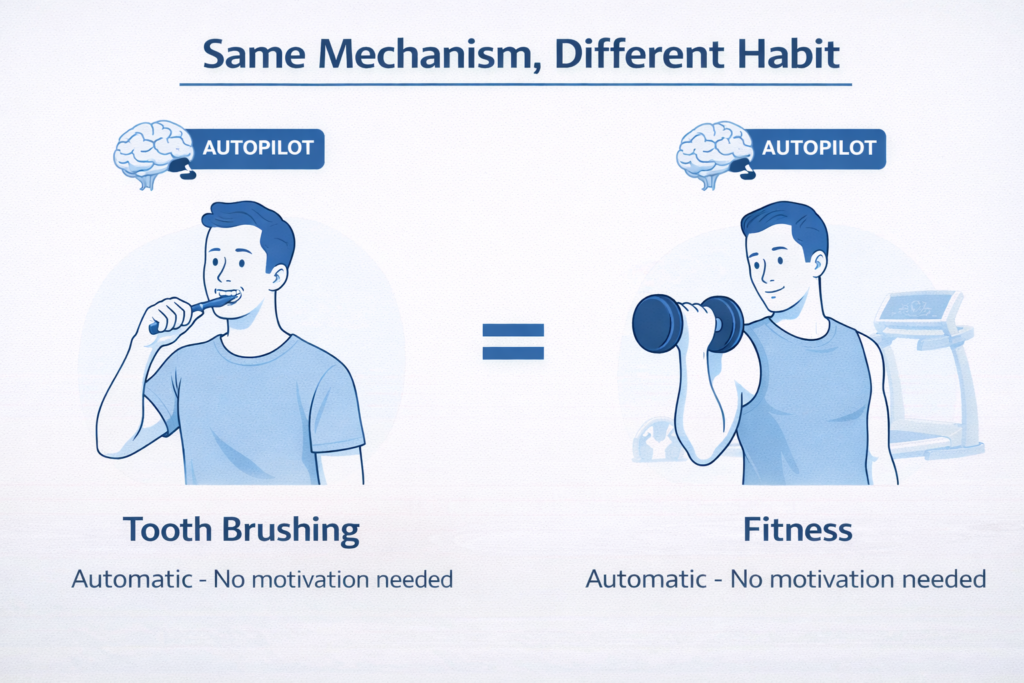
You just need to start approaching them the same way.
The Three-Step System for Building Unstoppable Habits
Here’s how to stop depending on motivation and start building the habits that actually get results.
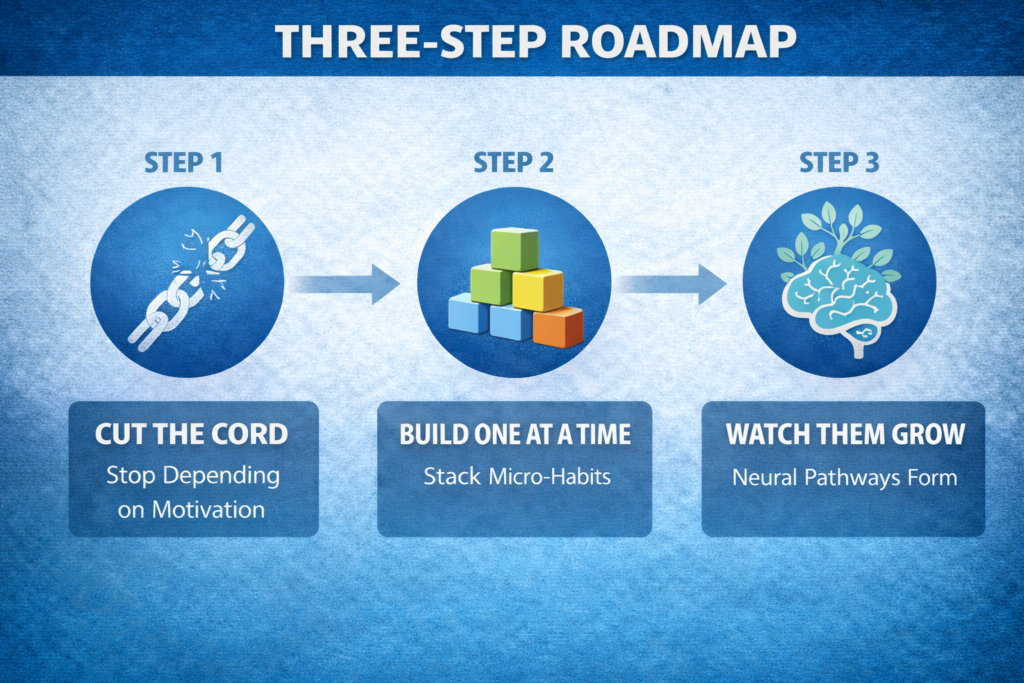
Step 1: Cut the Umbilical Cord With Motivation
You already know you can’t depend on motivation to get things done, because it won’t always (and probably won’t) be there when you need it most.
But that doesn’t mean you’ll automatically start doing what needs to be done.
Unfortunately, this step requires brutal honesty and self-criticism.
In other words, you need to finally understand that if you’re not doing what you need to do right now, it’s not because of lack of motivation.
It’s your fault.
Even when motivation appears, you might start something, but you’ll quit soon after because motivation will (it always does) disappear.
Therefore, start doing things without waiting for excitement or happiness. Separate emotion from rational action.
This is hard. This feels wrong. Your brain will resist.
Do it anyway.
Understanding the Motivation Cycle
Here’s what typically happens:
Monday: Motivation strikes. You’re pumped. You do everything perfectly.
Tuesday-Wednesday: Motivation lingers. You’re still mostly on track.
Thursday-Friday: Motivation fades. You start making excuses. “I’ll get back on track Monday.”
Weekend: Complete abandon. “I’ll start fresh next week.”
Next Monday: The cycle repeats. You’ve made zero actual progress.
This cycle can continue for months, years, even decades.
People spend their entire lives in this loop, always “starting Monday,” never actually building the body they want.
The solution? Accept that this is your fault, not motivation’s fault. You’re choosing to wait for a feeling instead of simply executing the actions required.
Step 2: Build Habits One at a Time
Start by addressing each new habit individually instead of trying to change 100 things at once. That rarely works.
Instead, choose one thing you can start doing tomorrow that will help you reach your goals.
Examples:
For training:
- “Maybe I can go to the gym one extra day per week”
- “Maybe I can at least commit to going one day” (if you’re currently training zero days)
- “Maybe I can add 10 minutes to my current workout”
For nutrition:
- “Maybe instead of ordering pizza, I can order something tasty but more aligned with my diet”
- “Maybe I can meal prep just Sunday’s meals this week”
- “Maybe I can eat one additional serving of vegetables daily”
For cardio:
- “Maybe I can at least walk, which is easy, instead of completely eliminating cardio from my routine”
- “Maybe I can take the stairs instead of the elevator”
- “Maybe I can park farther from the entrance”
Remember: It doesn’t need to be perfect or anywhere close. That only comes with time.
For now, just choose one thing and focus entirely on doing that single thing consistently for a few weeks.
The Power of Micro-Habits
Why start so small?
Two reasons:
1. Small changes are sustainable. Going from zero workouts to seven per week is overwhelming and doomed to fail. Going from zero to one is achievable.
2. Small wins build momentum. Each successful week increases your confidence and makes the next habit easier to add.
After successfully implementing the first habit for 2-4 weeks, repeat the process with a second thing while maintaining the first habit.
A few weeks later, add a third thing.
This approach allows you to gradually build a collection of smaller habits that eventually form the larger habits you need for success.
Notice this is the opposite of what most people do. They try to do EVERYTHING on day one when they’re feeling that sudden burst of motivation.
But inevitably, they can’t sustain it when that motivational feeling disappears shortly after.
This extremist attitude is precisely what prevents you from being one of those successful people.
Step 3: Watch Your Habits Take Root and Grow
You know what’s incredible about this approach of building smaller habits one at a time?
They take on a life of their own.
The moment you adopt a specific behavior, no matter how simple, that gets repeated consistently, it starts to literally change your brain structure. I’m not joking.
Our brain is an incredible adaptation machine.
Everything you do repeatedly, you become better at. Every day, your brain creates the neural connections necessary to perform that task using less energy (including your brain’s energy).
This is why when you start creating new habits, even minimal ones, they begin to develop their own life. They become increasingly automatic and easier to do.
At this point, you become far less likely to stop, quit, or deviate because the behavior doesn’t require as much energy as it would for someone who has never done it before.
Therefore, your chances of success increase dramatically. After achieving success, you can maintain what you’ve achieved much more easily.
You finally realize that motivation wasn’t necessary. But when it does eventually appear, it’s like a bonus on top of work you can already do independently.
The Neuroscience of Habit Formation
Let’s dive deeper into why this works so well.
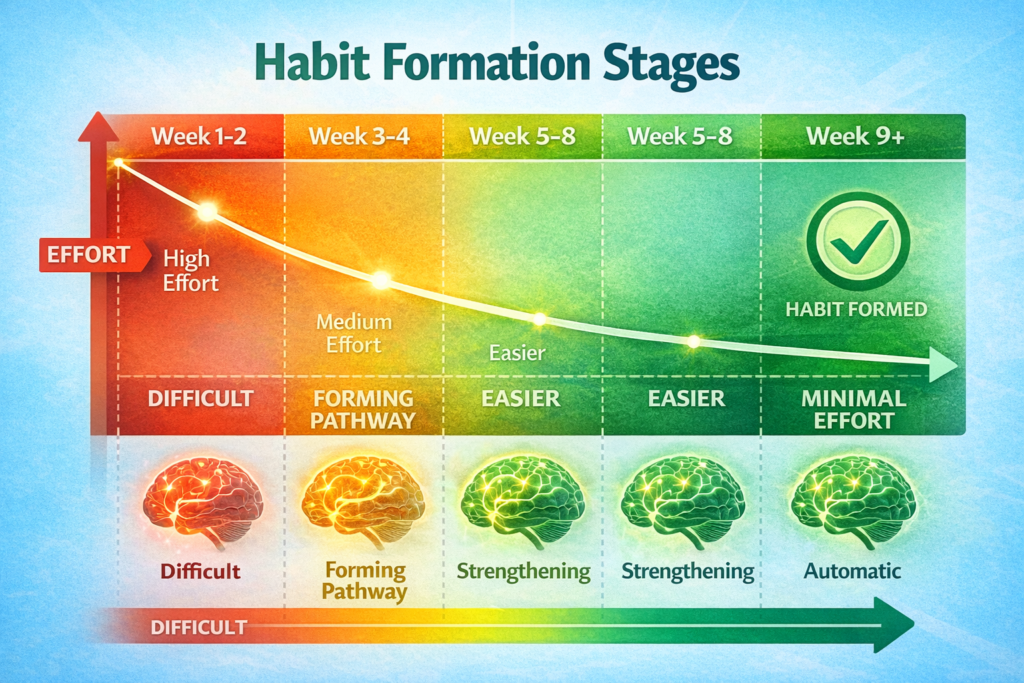
How Habits Form in the Brain
When you repeat a behavior consistently, your brain creates and strengthens neural pathways specific to that action.
The process:
Week 1-2: The behavior requires conscious effort and significant mental energy. You need to actively remind yourself and push through resistance.
Week 3-4: The neural pathway begins forming. The behavior requires less conscious thought but still needs attention.
Week 5-8: The pathway strengthens significantly. The behavior starts feeling more natural and requires less willpower.
Week 9+: The habit becomes automatic. You do it without thinking, like brushing your teeth.
This is called automaticity, and it’s why habits become easier over time, not harder.
The Basal Ganglia and Habit Loops
Your basal ganglia, a region deep in your brain, is responsible for pattern recognition and habit formation.
It creates what’s called a “habit loop”:
Cue: The trigger that initiates the behavior (alarm goes off, gym bag by door, meal prep container in fridge)
Routine: The actual behavior (going to gym, eating the meal)
Reward: The positive feeling that reinforces the behavior (sense of accomplishment, feeling energized)
As this loop repeats, the behavior becomes encoded in your basal ganglia and requires progressively less involvement from your prefrontal cortex (the decision-making part of your brain).
Result? The behavior happens automatically, without needing motivation or willpower.
Practical Examples: Building Your Fitness Habits
Let’s make this concrete with specific examples.
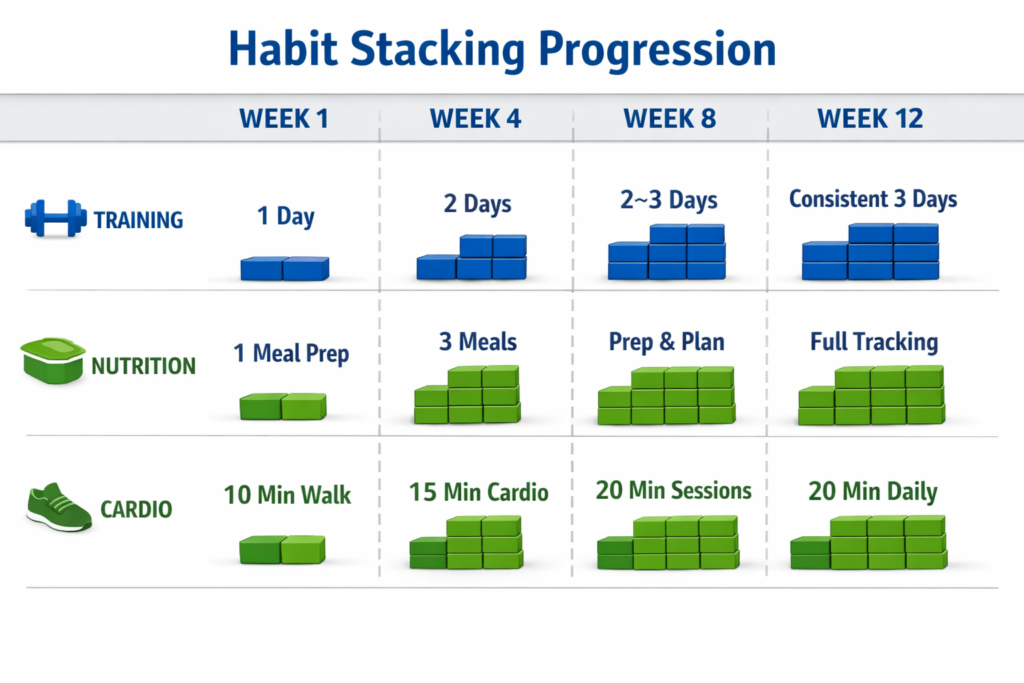
Building the Training Habit
Current state: You don’t train at all or train inconsistently.
Micro-habit approach:
Week 1-2: Commit to going to the gym one day per week, same day each week (e.g., every Wednesday at 6 PM). Do anything for 20 minutes. Literally anything.
Week 3-4: Continue Wednesday training. Add one more day (e.g., Saturday morning). 20-30 minutes each session.
Week 5-6: Continue both days. Increase duration to 40-45 minutes.
Week 7-8: Add a third day. Now training Monday, Wednesday, Saturday.
Week 9+: Continue three-day schedule. Slowly increase intensity as it becomes automatic.
Notice: You’re not going from zero to crushing five intense workouts weekly. You’re building gradually, allowing habits to form.
Building the Nutrition Habit
Current state: Eating is chaotic, mostly takeout and convenience foods.
Micro-habit approach:
Week 1-2: Commit to eating one home-cooked meal per day. Just one. Can be breakfast, lunch, or dinner. Keep it simple.
Week 3-4: Continue one home-cooked meal. Add one additional serving of vegetables to any meal daily.
Week 5-6: Increase to two home-cooked meals daily. Continue the vegetable habit.
Week 7-8: Start tracking protein intake for just one meal per day. Aim for 25-40g.
Week 9-10: Track protein for two meals. Continue other habits.
Week 11+: Gradually expand tracking and meal prep as previous habits solidify.
Building the Cardio Habit
Current state: No cardio, sedentary lifestyle.
Micro-habit approach:
Week 1-2: Take a 10-minute walk every day after dinner. No exceptions. Same time daily.
Week 3-4: Continue daily walks. Increase to 15 minutes.
Week 5-6: Increase to 20 minutes. Add one additional walk on weekend mornings.
Week 7-8: Continue current schedule. Slightly increase pace.
Week 9+: Add variety (hills, intervals) as the habit of daily movement becomes automatic.
Why This Works When Motivation Fails
Reason 1: Consistency Beats Intensity
Motivation-based approach: Intense effort when motivated, nothing when unmotivated. Net result: minimal progress.
Habit-based approach: Moderate consistent effort regardless of feelings. Net result: steady, compounding progress.
Example:
Person A (motivation-driven):
- Week 1: Trains 6 days, perfect diet
- Week 2: Trains 4 days, diet slipping
- Week 3: Trains 1 day, diet abandoned
- Week 4: Trains 0 days, “starting Monday”
Total: 11 training sessions in 4 weeks
Person B (habit-driven):
- Week 1: Trains 3 days, decent diet
- Week 2: Trains 3 days, decent diet
- Week 3: Trains 3 days, decent diet
- Week 4: Trains 3 days, decent diet
Total: 12 training sessions in 4 weeks, plus consistent nutrition
Person B makes more progress despite less “motivation” and intensity.
Reason 2: Removes Decision Fatigue
Every decision you make throughout the day depletes your mental energy.
When fitness requires constant decisions and willpower:
- “Should I go to the gym today?”
- “What should I eat?”
- “Do I have energy for this?”
You exhaust yourself before even starting.
When fitness is a habit:
- It’s Wednesday at 6 PM. I go to the gym. No decision required.
- It’s 12 PM. I eat my meal-prepped lunch. No decision required.
- The behavior is automatic. Energy is preserved.
Reason 3: Creates Identity Shift
Motivation-based approach: “I’m trying to be fit” (external, temporary)
Habit-based approach: “I’m someone who trains and eats well” (internal, permanent)
The identity shift is powerful.
When training and good nutrition become part of who you are, not something you’re trying to do, skipping becomes uncomfortable. You’re not motivated to train; you’re someone who trains. It’s different.
Reason 4: Compounds Over Time
Habits compound like interest.
Small daily actions seem insignificant in the moment but create massive results over months and years.
Example:
Training 3x per week consistently for one year = 156 workouts
Training sporadically based on motivation = maybe 40-60 workouts
The difference is enormous.
Common Obstacles and How to Overcome Them
Obstacle 1: “I Don’t Have Time”
The truth: You have time. You’re just not prioritizing it.
The solution: Start with micro-habits that fit your schedule. Can’t do 60-minute workouts? Do 20-minute ones. Can’t meal prep 21 meals weekly? Prep 5. Something is always better than nothing.
Remember: Lack of time is rarely the real issue. Lack of systems and habits is.
Obstacle 2: “I’m Too Tired”
The truth: You’re tired because of poor sleep, poor nutrition, lack of movement, and stress. Training and good nutrition actually increase energy over time.
The solution: Start so small it doesn’t require much energy. A 10-minute walk when exhausted is achievable. It won’t drain you; it will energize you.
The pattern: Once you experience how much better you feel after a workout (even a small one), the habit reinforces itself.
Obstacle 3: “I Keep Failing”
The truth: You’re trying to do too much too fast, then giving up entirely when you can’t maintain perfection.
The solution: Lower the bar. Make the habit so small it’s almost impossible to fail. Going to the gym and doing one set counts. Eating one healthy meal counts. You’re building the habit of showing up, not achieving perfection.
Reframe failure: Missing one day isn’t failure. Only quitting entirely is failure. Get back on track the next day.
Obstacle 4: “I Lost My Streak”
The truth: Streaks are useful but can become counterproductive if they create all-or-nothing thinking.
The solution: If you miss a day, immediately get back on track the next day. Don’t let one missed day become three, then a week, then a month.
The principle: Never miss twice. Missing once is life. Missing twice is the start of a new habit (the wrong one).
Advanced Habit Strategies
Once you’ve mastered the basics, these advanced techniques can accelerate progress.
Habit Stacking
What it is: Attaching a new habit to an existing one.
Examples:
- “After I brush my teeth in the morning, I’ll do 20 pushups”
- “After I pour my coffee, I’ll review my meal plan for the day”
- “After I park at the gym, I’ll put my phone in airplane mode”
Why it works: You’re using an established habit as the cue for a new one, making the new habit easier to remember and execute.
Implementation Intentions
What it is: Specific if-then plans for your habits.
Examples:
- “If it’s Wednesday at 6 PM, then I go to the gym, no matter what”
- “If I feel like skipping my meal prep, then I’ll prep just 3 meals instead of 7”
- “If I’m too tired for a full workout, then I’ll do 15 minutes instead of 60”
Why it works: Pre-deciding removes the need for willpower in the moment.
Environment Design
What it is: Structuring your environment to make good habits easy and bad habits hard.
Examples:
- Keep gym bag packed and by the door
- Meal prep containers visible in fridge
- Delete food delivery apps from phone
- Keep running shoes next to bed
- Pre-cut vegetables ready to eat
Why it works: You’re reducing friction for desired behaviors and increasing friction for undesired ones.
The Bottom Line: Stop Waiting, Start Building
Motivation is a terrible foundation for fitness success. It’s unreliable, temporary, and often absent when you need it most.
The real secret isn’t finding more motivation. It’s making motivation irrelevant.
Build habits so strong that:
- You train whether you feel like it or not
- You eat well whether you’re excited about it or not
- You show up whether you’re motivated or not
The system:
✅ Accept that motivation is unreliable and stop depending on it
✅ Start with one tiny habit you can do tomorrow
✅ Do that habit consistently for 2-4 weeks
✅ Add a second habit while maintaining the first
✅ Continue stacking habits gradually over months
✅ Watch as behaviors become automatic and effortless
✅ Realize motivation was never necessary
This isn’t sexy. It’s not exciting. It won’t get millions of views on social media.
But it works. It’s what every successful person actually does, even if they don’t explicitly articulate it this way.
Stop waiting for motivation to strike like lightning.
Start building habits that make motivation irrelevant.
Your future self, with the body you’ve always wanted, is counting on you to stop relying on feelings and start creating systems.
STOP WAITING FOR MOTIVATION. START BUILDING HABITS. BECOME UNSTOPPABLE.
Ready to build the body you want with a system that actually works? Stop depending on fleeting motivation and get a proven framework for creating unbreakable habits, optimizing your training, and transforming your nutrition. Motivation fades. Habits last forever. Build yours starting today.





Leave a Reply
You must be logged in to post a comment.