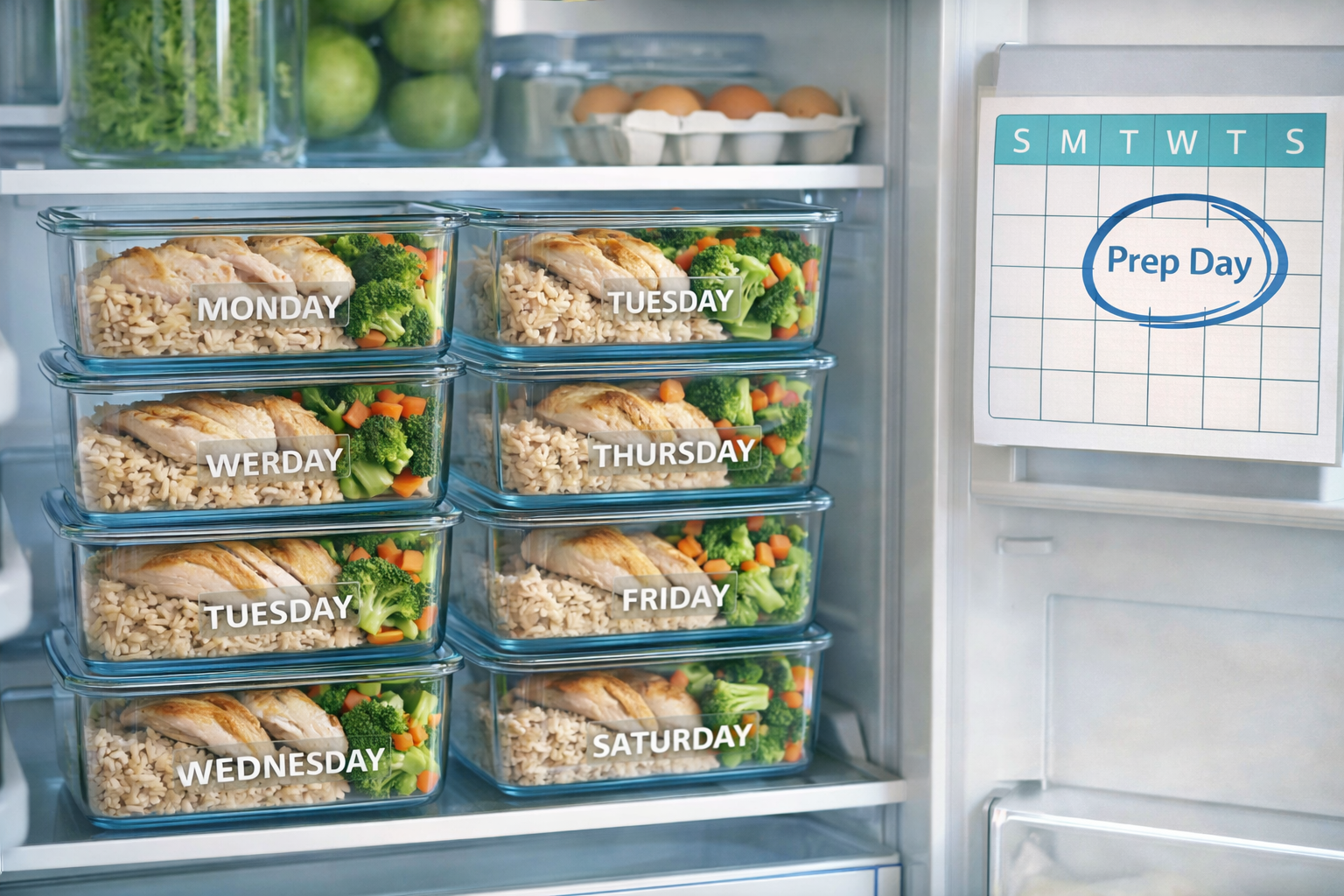
Want to stick to your diet consistently but tired of cooking every single day? Here’s the complete guide to meal prepping for bodybuilding success.
You know diet consistency is critical for results.
But here’s what actually happens:
Monday: Cook fresh meal, feel motivated
Tuesday: Scramble to make something, running late
Wednesday: No time to cook, order takeout (off plan)
Thursday: Too tired, eat whatever’s easy (off plan)
Friday: Give up, “I’ll start fresh Monday”
Your diet falls apart by midweek. Every. Single. Week.
Here’s the solution that changes everything: Meal prepping (preparing multiple meals in advance) eliminates daily cooking decisions, removes excuses for going off-plan, saves massive time throughout the week, and ensures diet adherence when life gets chaotic. The key is starting simple with just a few meals, not trying to prep your entire week at once.
In this comprehensive guide, I’ll explain exactly why meal prepping is the secret weapon of successful physique transformation, show you the step-by-step system for preparing a week’s meals (even if you’ve never done it), reveal which meals are worth prepping and which aren’t, provide the best storage and reheating strategies, and help you avoid the common mistakes that make meal prep feel overwhelming.
Whether you’re bulking, cutting, or maintaining, this article will transform your diet adherence.
Let’s master meal prep.
Why Meal Prep Instead of Cooking Daily?
The case for preparing meals in advance.
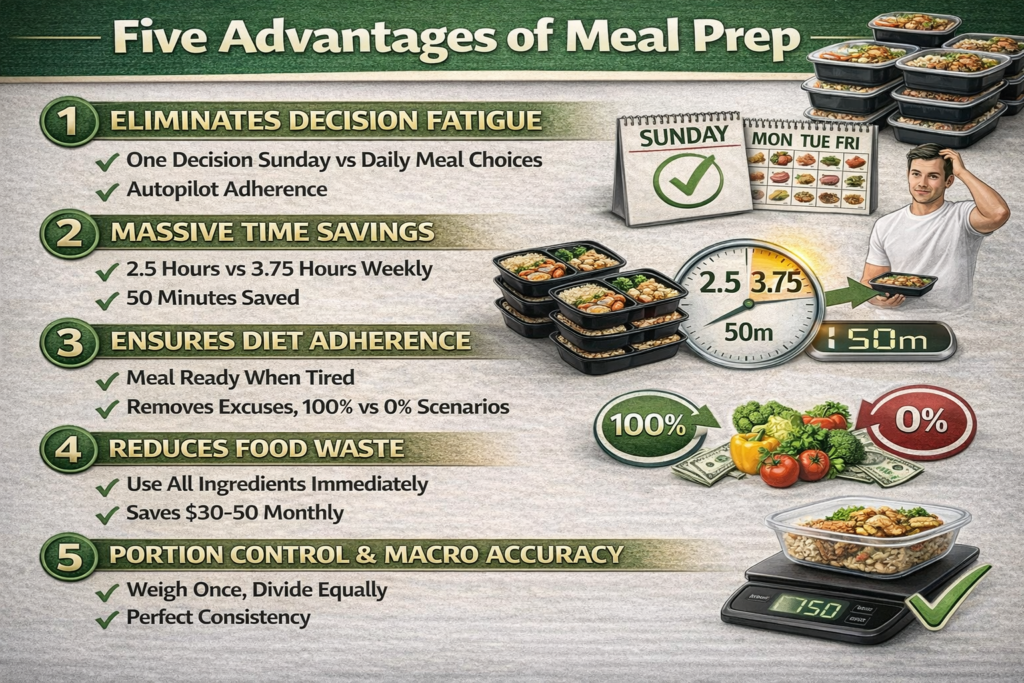
Advantage 1: Eliminates Daily Decision Fatigue
Every meal decision drains mental energy.
Without meal prep:
- Wake up: “What should I eat for breakfast?”
- Mid-morning: “What will I have for lunch?”
- Afternoon: “Should I prep dinner or grab something?”
- Evening: “Too tired to cook, what’s easy?”
- Result: Multiple decisions daily, each an opportunity to fail
With meal prep:
- Sunday: Make all decisions once
- Prepare everything in 2-3 hours
- Monday-Friday: Zero meal decisions
- Open fridge, grab container, eat
- Result: Automatic adherence
The psychology:
Decision fatigue is real:
- Each decision uses mental willpower
- By evening, willpower depleted
- Default to easiest option (usually unhealthy)
- Diet adherence suffers
Meal prep eliminates this:
- One decision session (prep day)
- Rest of week runs on autopilot
- No willpower needed (food is ready)
- Adherence becomes effortless
Advantage 2: Massive Time Savings
Cooking in batches is far more efficient.
Time comparison:
Cooking individual meals daily:
- Monday dinner: 45 minutes (prep, cook, cleanup)
- Tuesday dinner: 45 minutes
- Wednesday dinner: 45 minutes
- Thursday dinner: 45 minutes
- Friday dinner: 45 minutes
- Total: 3 hours 45 minutes
Meal prep approach:
- Sunday: 2.5 hours (prep 5 dinners at once)
- Monday-Friday: 5 minutes each (reheat only)
- Total: 2 hours 55 minutes
- Savings: 50 minutes weekly
Why batch cooking is faster:
Economy of scale:
- Chop vegetables once for all meals (not 5 times)
- Cook all chicken together (one oven session, not 5)
- Season and prepare everything simultaneously
- Clean kitchen once (not 5 separate times)
Practical benefits:
- 50 minutes weekly = 3+ hours monthly
- More time for training
- More time for recovery/sleep
- Less stress during busy weeknights
Advantage 3: Ensures Diet Adherence
This is the most important reason.
Common diet-breaking scenarios:
Scenario 1: Too tired to cook
- Get home from work exhausted
- Should make chicken and rice
- Too tired, order pizza instead
- Diet adherence: 0%
With meal prep:
- Get home exhausted
- Grab prepared container
- Microwave 3 minutes
- Diet adherence: 100%
Scenario 2: Running late in morning
- Should make breakfast
- No time, grab donuts at work
- Diet adherence: 0%
With meal prep:
- Grab prepared breakfast
- Eat in car or at work
- Diet adherence: 100%
Scenario 3: Lunch break at work
- Should eat healthy
- Colleagues going to restaurant
- Give in to social pressure
- Diet adherence: 0%
With meal prep:
- Have meal in work fridge
- Eat at desk in 15 minutes
- Save money, stay on track
- Diet adherence: 100%
The reality: Meal prep removes the friction between intention and execution.
Advantage 4: Reduces Food Waste
Meal prep actually saves money.
Without meal prep:
- Buy groceries with good intentions
- Some ingredients sit unused
- Vegetables go bad in fridge
- Meat expires before cooking
- Throw away wasted food and money
With meal prep:
- Use all ingredients immediately
- Nothing sits long enough to spoil
- Precise portions, minimal waste
- Everything gets cooked and eaten
The financial benefit:
Average food waste without meal prep:
- 20-30% of groceries thrown away
- $40-60 monthly wasted
With meal prep:
- <5% waste (mostly vegetable scraps)
- $5-10 monthly wasted
- Savings: $30-50 monthly
Advantage 5: Portion Control and Macro Accuracy
Hit your targets consistently.
Without meal prep:
- Eyeball portion sizes
- Guess at macros
- Some meals too large, some too small
- Weekly totals all over the place
- Inconsistent results
With meal prep:
- Weigh ingredients precisely once
- Calculate exact macros
- Divide into equal portions
- Every meal identical
- Perfectly consistent macros
Example:
Chicken and rice meal:
- Cook 1,500g chicken (375g protein)
- Cook 1,000g rice (750g carbs)
- Divide into 5 containers
- Each: 75g protein, 150g carbs
- Exact macros every time
This precision drives results.
How to Meal Prep: Step-by-Step System
The proven approach for beginners.
Step 1: Start Small (Critical for Success)
Don’t try to prep your entire week immediately.
The beginner mistake:
- Decide to meal prep
- Try to prepare 21 meals (7 days × 3 meals)
- Spend 6 hours cooking
- Get overwhelmed
- Never meal prep again
The smart approach:
Week 1: Prep ONE meal type for 3 days
- Choose your most problematic meal
- Usually lunch or dinner
- Make just 3 portions
- Test the process
- Learn without overwhelm
Example Week 1:
- Prep 3 lunches (Monday, Tuesday, Wednesday)
- Cook and eat normally for everything else
- Thursday: Prep 3 more lunches (Thursday, Friday, Saturday)
- Build confidence
Why start small:
- Learn the process without stress
- Identify what works for you
- Avoid burnout
- Build sustainable habit
- Success breeds success
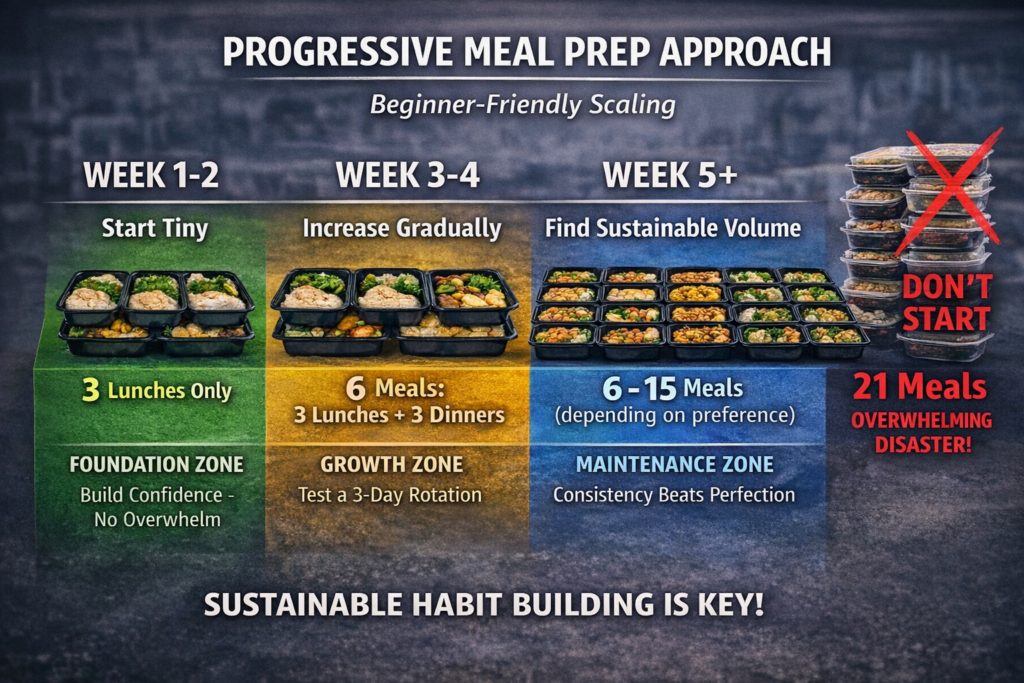
After 2-3 weeks of small preps, gradually increase volume.
Step 2: Choose the Right Meals to Prep
Not all meals are equally suitable for advance preparation.
Best meals to prep:
Lunch (highest priority):
- Usually eaten at work or school
- High temptation to eat out
- Most inconvenient to cook fresh
- Biggest diet-breaker
- Prep this first
Dinner (second priority):
- After long day, tired
- Cooking feels like chore
- Easy to order takeout
- Important for adherence
- Prep this second
Meals that DON’T need prepping:
Breakfast:
- Usually quick to make fresh (eggs, oatmeal, etc.)
- Many prefer fresh breakfast
- Often eaten at home with time
- Can be simple (protein shake + fruit)
- Usually skip prepping this
Snacks:
- Simple items (protein shake, fruit, nuts)
- No cooking required
- Portable individually
- Don’t benefit from batch prep
- Don’t need to prep
The strategic approach:
Beginners:
- Prep lunches only (3-5 for the week)
- Make everything else fresh/simple
- Master this first
Intermediate:
- Prep lunches AND dinners
- 6-10 total meals prepped
- Still make breakfasts fresh
- Sustainable long-term
Advanced (optional):
- Prep lunches, dinners, some breakfasts
- 12-15 meals prepped
- Only if you enjoy it
- Not necessary for success
Step 3: Use the 3-Day Rotation Strategy
Cook every 3 days, not once weekly.
Why 3-day cycles work better than 7-day:
Food safety:
- Most cooked meals last 3-4 days in refrigerator
- Day 5-7 meals taste worse and might spoil
- 3-day rotation keeps everything fresh
- No freezing/thawing needed
Variety:
- Cook Monday for Mon/Tue/Wed
- Cook Thursday for Thu/Fri/Sat
- Can have different meals each cycle
- Less boring than same meal 7 days
Flexibility:
- Easier to adjust to schedule changes
- If weekend plans change, hasn’t affected full week
- Smaller time commitment (90 minutes vs. 3 hours)
- More sustainable
The 3-day cycle schedule:
Sunday evening:
- Prep 3 lunches (Mon/Tue/Wed)
- Prep 3 dinners (Mon/Tue/Wed)
- 90-120 minutes total
- Meals stay fresh in fridge
Wednesday evening:
- Prep 3 lunches (Thu/Fri/Sat)
- Prep 3 dinners (Thu/Fri/Sat)
- 90-120 minutes total
- Fresh meals again
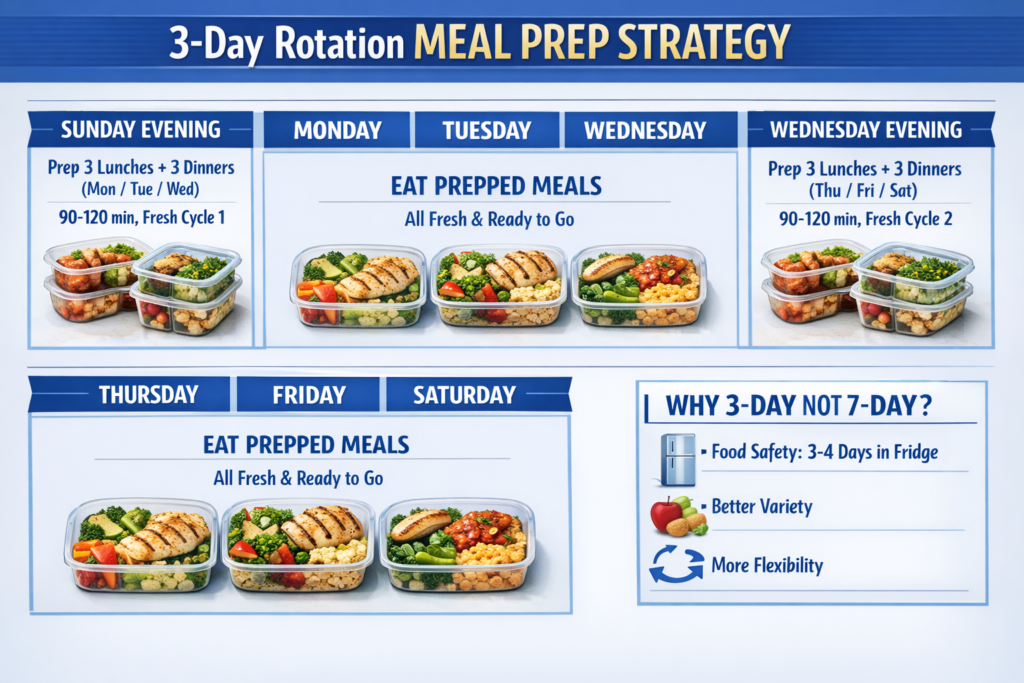
Total weekly time: 3-4 hours split across two sessions (much more manageable than one 5-6 hour session)
Step 4: Choose Meal Prep-Friendly Recipes
Some foods reheat better than others.
Best proteins for meal prep:
Excellent:
- Chicken breast (baked, grilled, or slow-cooked)
- Ground turkey or beef
- Pork tenderloin
- Baked fish (salmon, cod)
- Hard-boiled eggs
Avoid:
- Fried foods (get soggy)
- Delicate fish (falls apart)
- Rare steak (overcooks when reheated)
Best carbs for meal prep:
Excellent:
- White or brown rice
- Sweet potatoes
- Regular potatoes
- Whole grain pasta
- Quinoa
- Oats (for breakfast)
Avoid:
- Crispy foods (lose texture)
- Salads (get soggy)
Best vegetables for meal prep:
Excellent:
- Broccoli
- Green beans
- Carrots
- Cauliflower
- Bell peppers
- Zucchini
Avoid:
- Leafy salads (wilt)
- Cucumbers (get mushy)
Complete meal prep-friendly combinations:
Meal 1: Chicken, Rice, and Broccoli
- 6oz chicken breast: 45g protein
- 1.5 cups cooked rice: 60g carbs
- 1 cup broccoli: fiber and micronutrients
- Season with herbs, salt, pepper
Meal 2: Ground Turkey and Sweet Potato
- 6oz ground turkey: 40g protein
- 8oz sweet potato: 50g carbs
- Mixed vegetables
- Season with taco spices or Italian herbs
Meal 3: Salmon and Quinoa
- 6oz salmon: 40g protein, healthy fats
- 1 cup quinoa: 40g carbs
- Roasted vegetables
- Lemon and dill seasoning
Meal 4: Beef and Pasta
- 6oz lean ground beef: 42g protein
- 2oz dry pasta (6oz cooked): 60g carbs
- Tomato sauce
- Italian vegetables
These all reheat excellently and taste great on day 3.
Step 5: Batch Cook Efficiently
How to prepare multiple meals simultaneously.
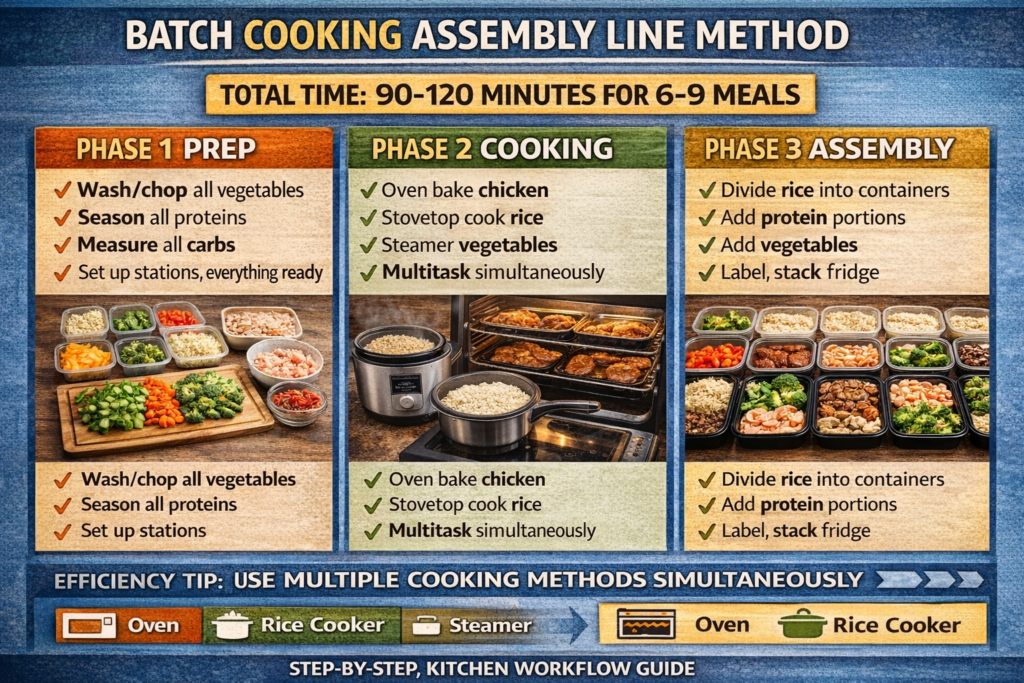
The assembly line method:
Prep phase (30-40 minutes):
- Wash and chop all vegetables at once
- Season all proteins together
- Measure all carbs (rice, pasta, etc.)
- Set up cooking stations
- Everything ready before cooking starts
Cooking phase (40-60 minutes):
- Start rice/pasta (longest cooking time)
- Put chicken in oven
- Steam vegetables
- Everything finishes around same time
- Multitask efficiently
Assembly phase (15-20 minutes):
- Divide rice equally into containers
- Add protein portions
- Add vegetables
- Label with macros if desired
- Stack in fridge
Total time: 90-120 minutes for 6-9 meals
Pro tips:
Use multiple cooking methods simultaneously:
- Oven: Bake chicken
- Stovetop: Cook rice
- Steamer: Steam vegetables
- All happening at once
Cook in largest batches possible:
- Use biggest pots and pans
- Fill entire oven with chicken
- Cook 3-4 cups dry rice at once
- More efficient than small batches
Season intelligently:
- Season half the chicken Italian style
- Season other half Mexican style
- Instant variety with minimal extra work
Step 6: Store in Proper Containers
Container choice matters for safety and convenience.
Best option: Glass containers with airtight lids
Why glass is superior:
Safety:
- No BPA or plastic chemicals
- Can go from freezer to microwave safely
- Won’t leach chemicals when heated
- Food-grade quality
Performance:
- Doesn’t absorb odors or stains
- Reheats food evenly
- Keeps food fresh longer
- Airtight seals prevent leaks
Durability:
- Last for years
- Won’t warp or crack easily
- Dishwasher safe
- Better long-term investment
Recommended size:
- 3-cup (24oz) containers for main meals
- 2-cup (16oz) for smaller meals
- Buy 6-12 containers to start
Alternative: BPA-free plastic containers
When plastic is acceptable:
- Budget-conscious (glass is expensive)
- Need lightweight (for carrying to work)
- Won’t be microwaving in container
Requirements:
- Must be BPA-free
- Microwave-safe
- Airtight seals
- Replace every 6-12 months
Organization tips:
Labeling:
- Masking tape + marker (cheap, removable)
- Write: “Chicken/Rice/Broccoli, 450 cal, 45P/50C/10F”
- Date prepared
- Easy to grab correct meal
Stacking:
- Stack in fridge by day (Monday on top, Tuesday below, etc.)
- Or by meal type (all lunches together, all dinners together)
- Whatever system works for you
Step 7: Reheat Properly (Yes, Microwave Is Fine)
Reheating safely and maintaining quality.
Microwave safety (dispelling myths):
The truth about microwaves:
✅ Completely safe for reheating food
✅ Don’t destroy nutrients more than other cooking methods
✅ Don’t make food “radioactive” or dangerous
✅ Heat food through electromagnetic waves that vibrate water molecules
✅ Recommended by food safety organizations
❌ Myth: Microwaves destroy nutrients
- Reality: All cooking methods reduce some nutrients. Microwave is actually better than many methods because shorter cooking time.
❌ Myth: Microwaves are unsafe
- Reality: Extensively tested, completely safe when used properly.
Proper microwave reheating:
Step 1: Remove meal from fridge 5-10 minutes before (reduces cold spots)
Step 2: Transfer to microwave-safe plate if using non-microwave container
Step 3: Add 1-2 tablespoons water (prevents drying)
Step 4: Cover with microwave-safe lid or damp paper towel (traps moisture)
Step 5: Heat on 70% power for 2-3 minutes
Step 6: Stir, check temperature
Step 7: Heat additional 1-2 minutes if needed
Step 8: Let stand 1 minute before eating
Tips for best results:
Prevent dryness:
- Sprinkle water on rice and chicken
- Cover while reheating
- Use lower power for longer time (more even heating)
Avoid overcooking:
- Don’t microwave on 100% power
- 70% power heats more evenly
- Better texture and taste
Texture preservation:
- Slightly undercook during meal prep
- Reheating finishes cooking perfectly
- Food doesn’t become mushy
Alternative reheating methods:
Oven (if you have time):
- 350°F for 15-20 minutes
- Better for maintaining crispy textures
- More even heating
- Longer time required
Stovetop:
- Add food to pan with small amount of water
- Cover and heat on medium
- Stir occasionally
- Good for pasta and rice dishes
Most convenient: Microwave. Most of the time, it’s the best choice.
Common Meal Prep Mistakes to Avoid
Don’t fall into these traps.
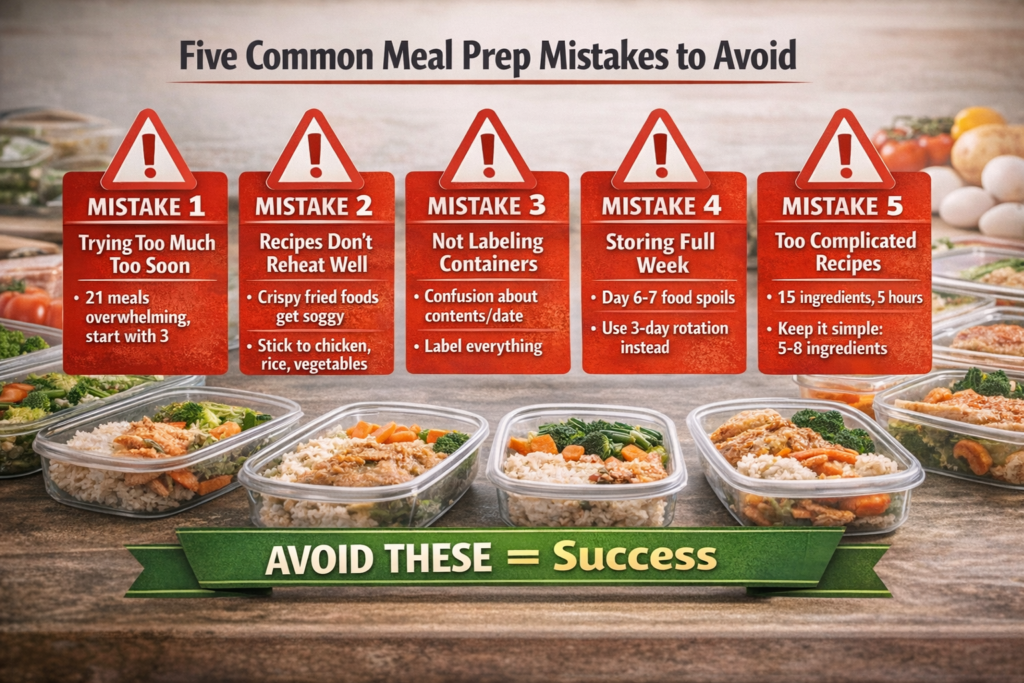
Mistake 1: Trying to Prep Too Much Too Soon
The overwhelm trap.
What happens:
- First time meal prepping
- Decide to prep 21 meals
- Spend 6 hours Sunday cooking
- Kitchen is disaster
- Exhausted and frustrated
- Never meal prep again
The fix:
✅ Start with 3 meals (one meal type, 3 days)
✅ Increase gradually (6 meals next week, 9 meals after that)
✅ Find sustainable rhythm (maybe 6-9 meals is your limit, and that’s fine)
✅ Meal prep should simplify life, not complicate it
Mistake 2: Choosing Recipes That Don’t Reheat Well
Food quality matters for adherence.
Bad choices:
- Crispy fried chicken (gets soggy)
- Leafy salads (wilt and become gross)
- Rare steak (overcooks when reheated)
- Delicate fish (falls apart)
Result: Meals taste bad, stop eating them, order takeout, diet fails
The fix:
✅ Stick to proven meal prep-friendly foods (chicken, rice, sturdy vegetables)
✅ Test new recipes in small batches first
✅ Choose foods that maintain or improve with time (stews, casseroles)
Mistake 3: Not Labeling Containers
Confusion kills efficiency.
What happens:
- Prep multiple meal types
- Forget which is which
- Grab wrong macro meal for your plan
- Or can’t remember what day it’s for
The fix:
✅ Label every container with contents and date
✅ Write macros if tracking precisely
✅ Use system (color-coded lids, numbered, etc.)
Mistake 4: Storing Everything the Full Week
Freshness matters.
What happens:
- Prep 7 days of meals Sunday
- By Friday-Saturday, food tastes bad or spoils
- Throw away meals or eat subpar food
- Waste money and effort
The fix:
✅ Use 3-day rotation (prep Sunday for Mon-Wed, Wednesday for Thu-Sat)
✅ Or prep 4-5 days maximum, freeze the rest
✅ Always prioritize fresh taste for adherence
Mistake 5: Making Meal Prep Too Complicated
Simplicity wins.
What happens:
- Choose complex recipes with 15 ingredients
- Requires advanced cooking skills
- Takes 5 hours
- Too exhausting to repeat
- Go back to not meal prepping
The fix:
✅ Simple recipes with 5-8 ingredients
✅ Basic cooking methods (bake, steam, boil)
✅ Focus on execution, not culinary perfection
✅ You’re making fuel, not competing on cooking shows
The Bottom Line: Start Small, Build Gradually, Stay Consistent
After examining all the evidence:
The truth about meal prep:
✅ Eliminates daily cooking decisions (removes friction and decision fatigue)
✅ Saves massive time (batch cooking is 40-50% faster than daily cooking)
✅ Ensures diet adherence (removes excuses when life gets busy)
✅ Reduces food waste (use all ingredients immediately)
✅ Improves macro accuracy (precise portions every time)
The beginner-friendly approach:
Week 1-2: Start tiny
- Prep just 3 lunches
- Master the basic process
- Build confidence
- Don’t overwhelm yourself
Week 3-4: Increase gradually
- Prep 6 meals (3 lunches + 3 dinners)
- Test the 3-day rotation
- Find your rhythm
- Still manageable
Week 5+: Find sustainable volume
- Maybe 6-9 meals per week is your sweet spot
- Or maybe 12-15 if you enjoy it
- Sustainable beats perfect
- Consistency is what matters
The 3-day rotation strategy:
Sunday evening: Prep 3-4 meals for Mon-Wed (90 minutes)
Wednesday evening: Prep 3-4 meals for Thu-Sat (90 minutes)
Total: 6-8 meals prepped, 3 hours weekly, always fresh food
Best meals to prep:
- Lunches (highest priority, biggest diet-breaker)
- Dinners (second priority, high convenience)
- Skip breakfast (usually quick to make fresh)
Best foods for meal prep:
- Proteins: Chicken, ground turkey/beef, salmon, eggs
- Carbs: Rice, sweet potato, pasta, quinoa
- Vegetables: Broccoli, green beans, carrots, peppers
Storage and reheating:
- Glass containers with airtight lids (best option)
- Microwave reheating is safe and effective
- Add water when reheating to prevent dryness
- Label everything with contents and date
Common mistakes to avoid:
- Trying to prep too much initially
- Choosing foods that don’t reheat well
- Not labeling containers
- Storing everything for full week (use 3-day rotation)
- Overcomplicating recipes
The key insight:
Meal prep isn’t about cooking like a professional chef. It’s about removing obstacles between you and diet adherence.
Simple meals that you’ll actually eat beat complex meals that sound impressive but you avoid eating.
START WITH 3 MEALS. USE 3-DAY ROTATION. KEEP IT SIMPLE. BUILD CONSISTENCY.
Ready to optimize your entire nutrition strategy with a complete system for meal planning, prep, and execution that ensures consistent results without spending your entire life in the kitchen? Meal prep is just one tool in effective nutrition management. Get a comprehensive guide to calculating your exact macro needs, choosing the right foods for your goals, planning sustainable meal schedules, and building habits that deliver long-term results. Stop struggling with daily food decisions. Start executing a proven nutrition system.

Leave a Reply
You must be logged in to post a comment.