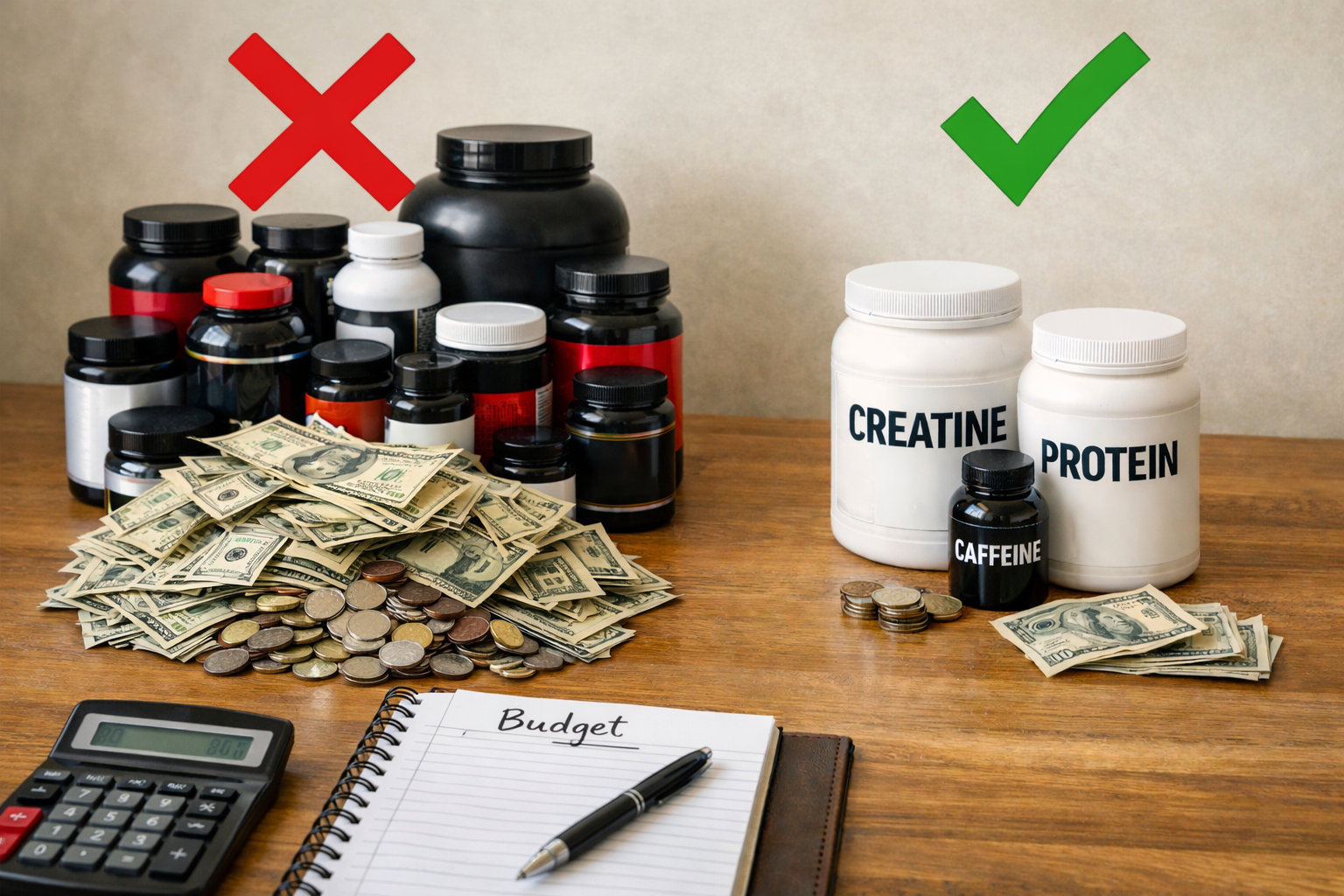
Spending hundreds monthly on supplements but barely seeing results? Here’s the truth about building muscle on a budget and which supplements actually matter.
You walk into a supplement store (or browse online) and feel overwhelmed.
Pre-workouts promising explosive energy. Mass gainers guaranteeing rapid muscle growth. BCAAs claiming to prevent muscle loss. Glutamine for recovery. Fancy creatine formulas. Testosterone boosters. Fat burners.
The salesperson says you need all of it. Your gym buddy takes 10+ supplements daily. Instagram influencers promote everything.
Your bank account is screaming. Your results aren’t matching the investment.
Here’s the uncomfortable truth most supplement companies don’t want you to know: You can build serious muscle spending $20-40 monthly on supplements instead of $200+. The key is understanding that 95% of supplements are unnecessary, whole food nutrition matters far more than any powder, and the few supplements worth buying are cheap and effective.
In this comprehensive guide, I’ll reveal whether supplements are actually necessary for muscle building, show you the exact priority system for spending limited supplement money wisely, identify which expensive supplements are complete wastes of money, provide specific budget-friendly alternatives that work just as well, and give you a complete supplement strategy for maximum results at minimum cost.
Whether you’re broke, budget-conscious, or just tired of wasting money, this article will transform your approach.
Let’s build muscle without going broke.
TABLE OF CONTENTS
Are Supplements Even Necessary for Muscle Building?
Before spending a single dollar, you need to understand this fundamental truth.
The Harsh Reality
You can build impressive muscle with ZERO supplements.
What actually builds muscle:
Priority 1: Progressive resistance training
- Lifting progressively heavier weights
- Increasing volume over time
- Proper form and technique
- Consistency (training 3-5x weekly for months/years)
Priority 2: Adequate protein intake
- 0.7-1g protein per pound of body weight
- From whole food sources (chicken, fish, eggs, beans, dairy)
- Distributed throughout the day
- Every single day without fail
Priority 3: Caloric surplus (for muscle gain)
- Eating 200-500 calories above maintenance
- Provides energy for muscle building
- Can be achieved with whole food
- No supplements required
Priority 4: Adequate sleep and recovery
- 7-9 hours nightly
- Consistent sleep schedule
- Manages stress
- Allows muscle repair and growth
Priority 5: Patience and consistency
- Months and years of dedication
- Not skipping workouts
- Not missing meals
- Trusting the process
Notice what’s NOT on this list: Supplements.
What Supplements Actually Do
Think of supplements like GPS navigation:
Whole food nutrition is the car and the road:
- Gets you to your destination
- Essential for the journey
- Works perfectly without GPS
Supplements are the GPS:
- Might help you arrive slightly faster
- Provides convenience
- Shows you shortcuts
- NOT necessary to reach destination
- Useless if you don’t have a car (proper nutrition and training)
The reality:
- Supplements provide maybe 5-10% additional benefit
- Proper training and nutrition provide the other 90-95%
- Most people neglect the 90-95% and overspend on the 5-10%
When Supplements Actually Help
Supplements are useful when:
Your diet genuinely falls short:
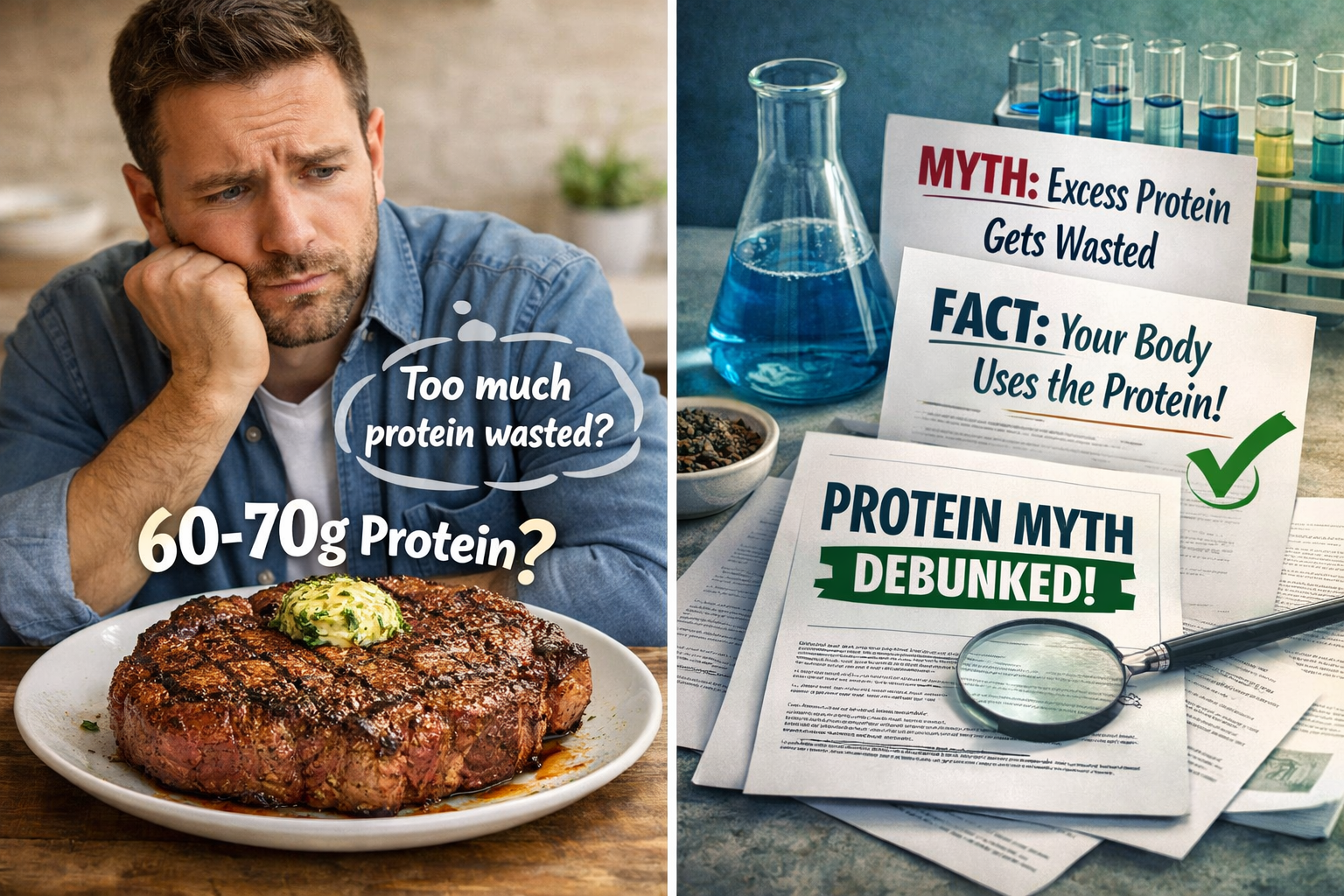
- Struggling to eat 150g+ protein daily from whole food
- Can’t consume enough calories for bulking
- Certain nutrients difficult to obtain (creatine)
- Hectic schedule prevents proper meals
Convenience matters:
- Post-workout and can’t eat immediately
- Traveling frequently
- No access to kitchen
- Time-constrained lifestyle
Specific performance needs:
- Caffeine for pre-workout energy
- Creatine for strength enhancement
- Protein powder when whole food insufficient
Budget allows:
- After covering whole food nutrition
- Not at expense of quality food
- Truly disposable income
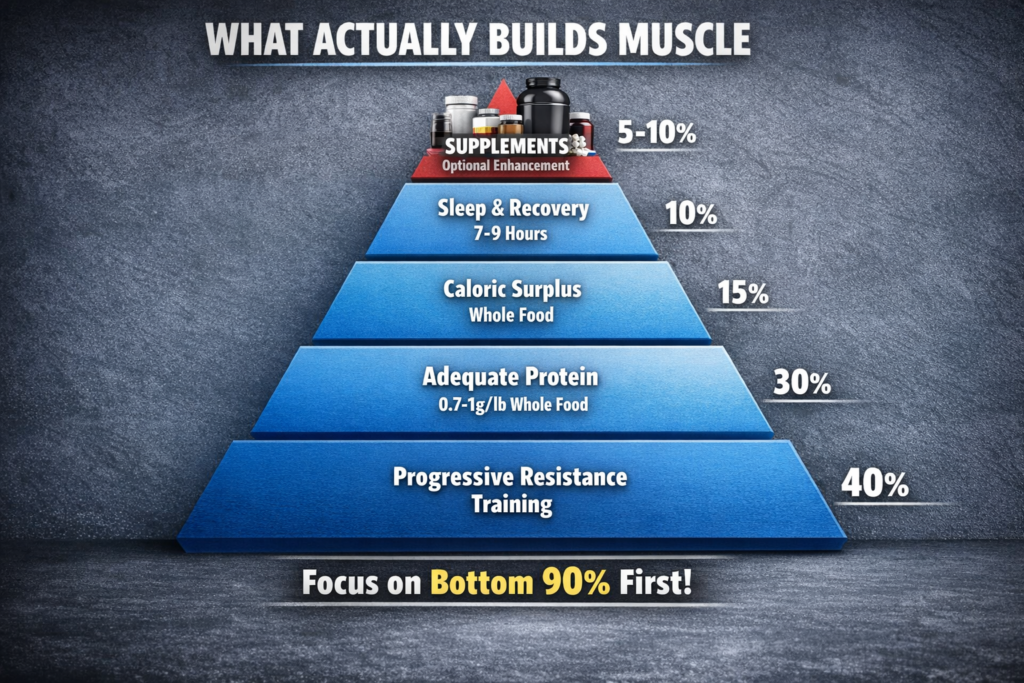
For 80% of people, supplements are optional conveniences, not necessities.
The Smart Supplement Budget Strategy
Here’s exactly how to prioritize your limited supplement budget.
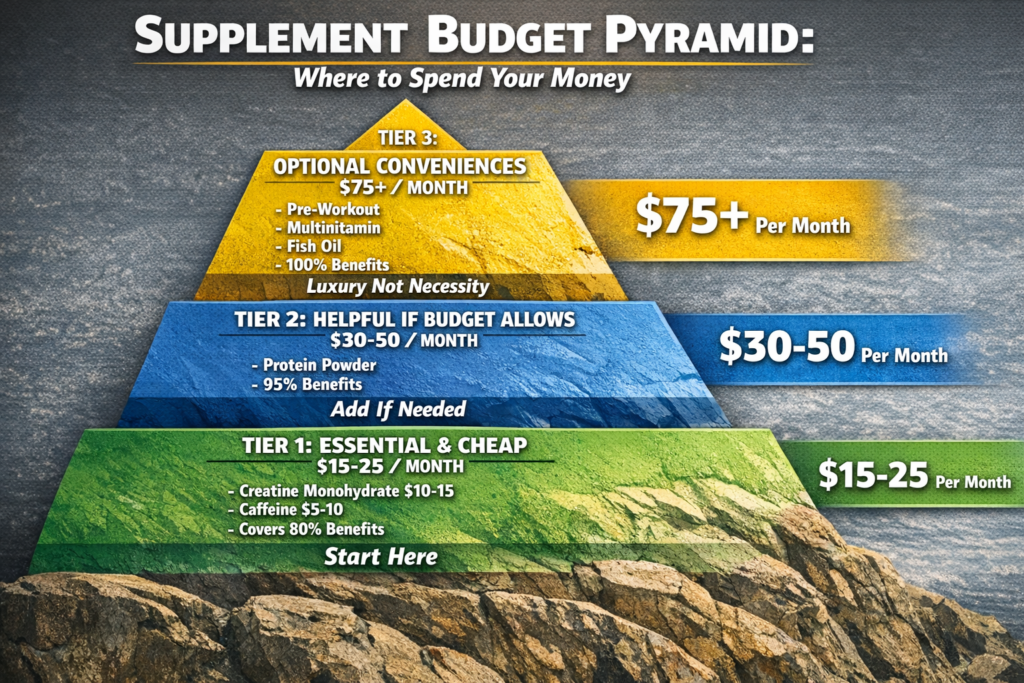
The Budget Pyramid: Where to Spend First
Tier 1: Essential and cheap ($15-25 monthly)
If you can only afford $20-25 monthly:
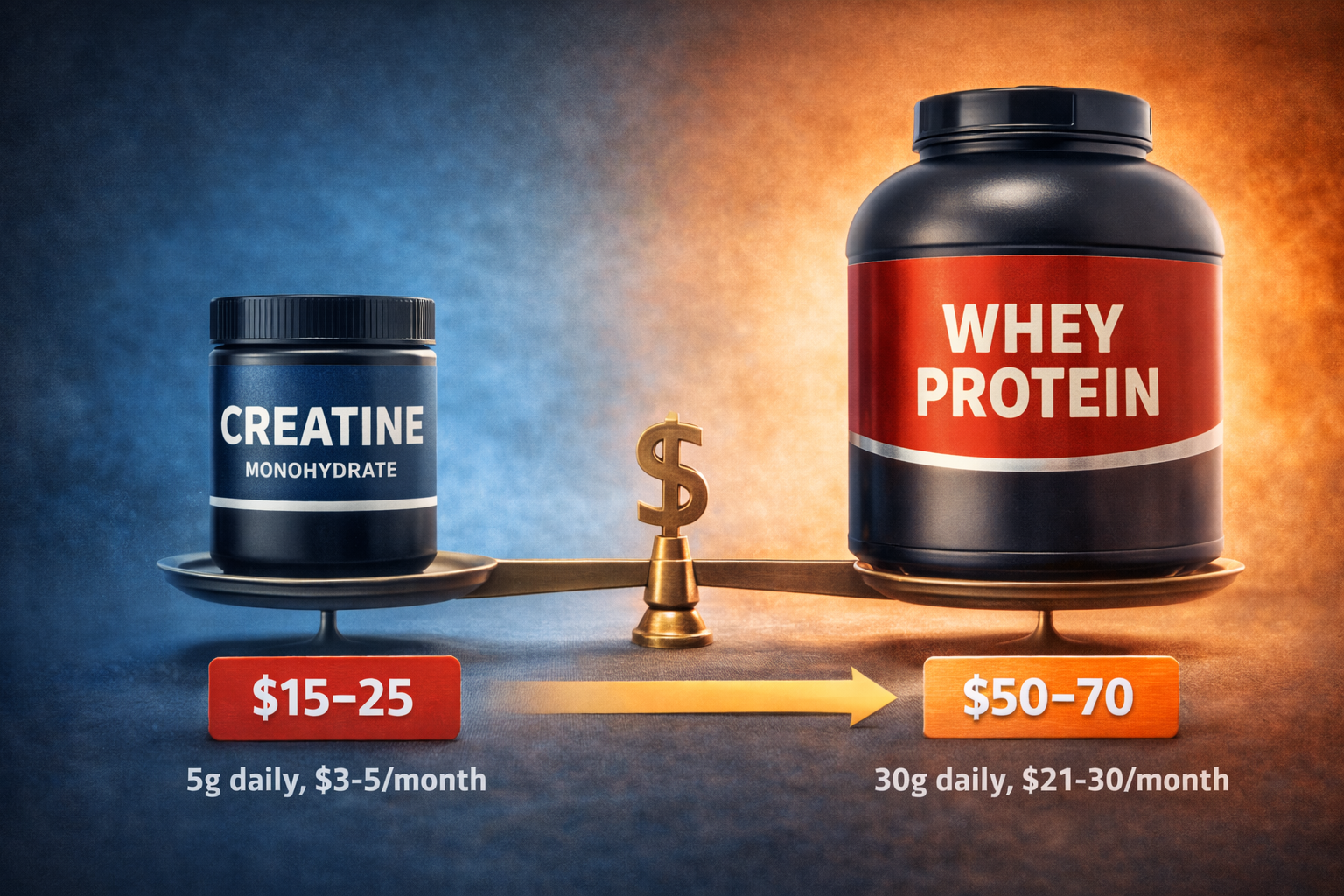
Creatine monohydrate: $10-15 monthly
- Most researched supplement
- Proven strength and muscle gains
- 5-15% performance improvement
- 5g daily, lasts 100-200 days per container
- No need for expensive forms
Caffeine (if needed): $5-10 monthly
- 200mg caffeine pills or coffee
- Proven performance enhancer
- Increases strength and endurance
- Much cheaper than pre-workouts
- Only if you respond well to caffeine
Total Tier 1 cost: $15-25 monthly
This covers 80% of supplement benefits for minimal cost.
Tier 2: Helpful if budget allows ($30-50 monthly)
If you have $50-75 total monthly budget:
Add protein powder: $20-40 monthly
- Only if struggling to hit protein targets from whole food
- Egg white protein (albumin) cheaper than whey
- Whey protein if you prefer and can afford
- Use to fill gaps, not replace food
Total Tier 1 + 2 cost: $45-75 monthly
This covers 95% of supplement benefits.
Tier 3: Optional conveniences ($75+ monthly)
Only if you have $100+ monthly budget AND tiers 1-2 covered:
Pre-workout (optional): $30-40 monthly
- Convenience over making your own
- Better flavors than DIY
- Not necessary (caffeine + creatine work fine)
Multivitamin (optional): $10-15 monthly
- Insurance against dietary gaps
- Whole food diet usually sufficient
- Low priority
Fish oil (optional): $15-20 monthly
- Omega-3s support health
- Can get from fatty fish instead
- Helpful but not essential
Total with Tier 3: $100+ monthly
The key: Most people should stop at Tier 1 or 2.
The Brutal Honesty About Supplement Budgets
If you’re spending $150-300 monthly on supplements:
You’re likely wasting 60-80% of that money on:
- Expensive pre-workout formulas (caffeine is the active ingredient)
- Fancy creatine forms (monohydrate works identically)
- BCAAs (worthless if eating adequate protein)
- Glutamine (your body makes plenty)
- Testosterone boosters (don’t work)
- Fat burners (caffeine and caloric deficit are all that matter)
- Mass gainers (real food is cheaper per calorie)
- Overpriced protein powder (when cheaper options work the same)
That $150-300 could instead buy:
- Quality whole food nutrition
- Better quality meat and produce
- Meal prep containers and equipment
- Gym membership upgrade
- Coaching or programming
Redirect supplement overspending to actual nutrition for better results.
Budget-Friendly Supplement Swaps That Work
Let’s examine specific ways to save money without sacrificing results.
Swap 1: Egg White Protein Instead of Whey
The expensive way:
- Whey protein isolate: $60-80 for 5 pounds
- 70 servings
- Cost per serving: $0.85-1.15
- Annual cost (if using daily): $310-420
The budget way:
- Egg white protein (albumin): $25-40 for 5 pounds
- 70 servings
- Cost per serving: $0.35-0.60
- Annual cost (if using daily): $128-220
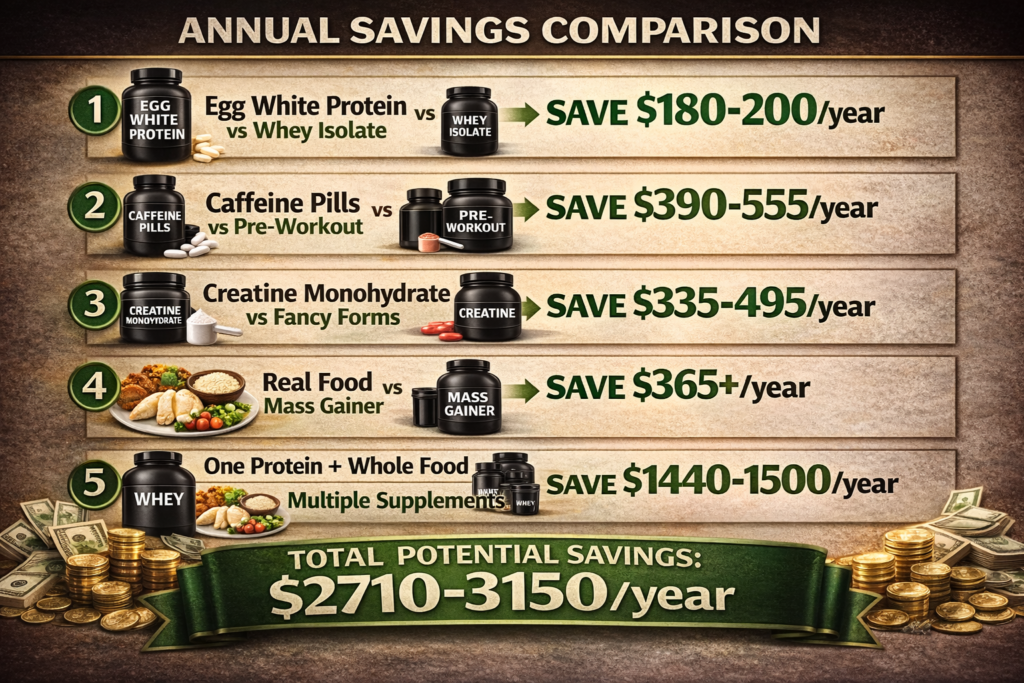
- Savings: $180-200 annually
What you get:
- Complete protein (all amino acids)
- Lactose-free (perfect for intolerant people)
- High biological value
- Effective for muscle building
What you sacrifice:
- Slightly slower absorption (doesn’t matter)
- Less fancy flavors (still works fine)
- Some people get gas (manageable)
Verdict: Egg white protein is the smart budget choice if you need supplemental protein.
Swap 2: Caffeine Pills Instead of Pre-Workout
The expensive way:
- Pre-workout supplement: $35-50
- 30 servings
- Cost per serving: $1.15-1.65
- Annual cost: $420-600
The budget way:
- 200mg caffeine pills: $8-12
- 100 pills
- Cost per serving: $0.08-0.12
- Annual cost: $30-45
- Savings: $390-555 annually
What you get:
- Same energy boost (caffeine is the active ingredient)
- Same performance benefits
- Same focus enhancement
- Proven ergogenic aid
What you sacrifice:
- Fancy flavors (doesn’t affect performance)
- Beta-alanine tingles (unnecessary anyway)
- Marketing hype (you don’t need it)
- Proprietary blends (usually junk)
Alternative: Black coffee (even cheaper, 5-10 cents per serving)
Verdict: Caffeine pills or coffee provide 80-90% of pre-workout benefits for 5-10% of the cost.
Swap 3: Generic Creatine Monohydrate Instead of Fancy Forms
The expensive way:
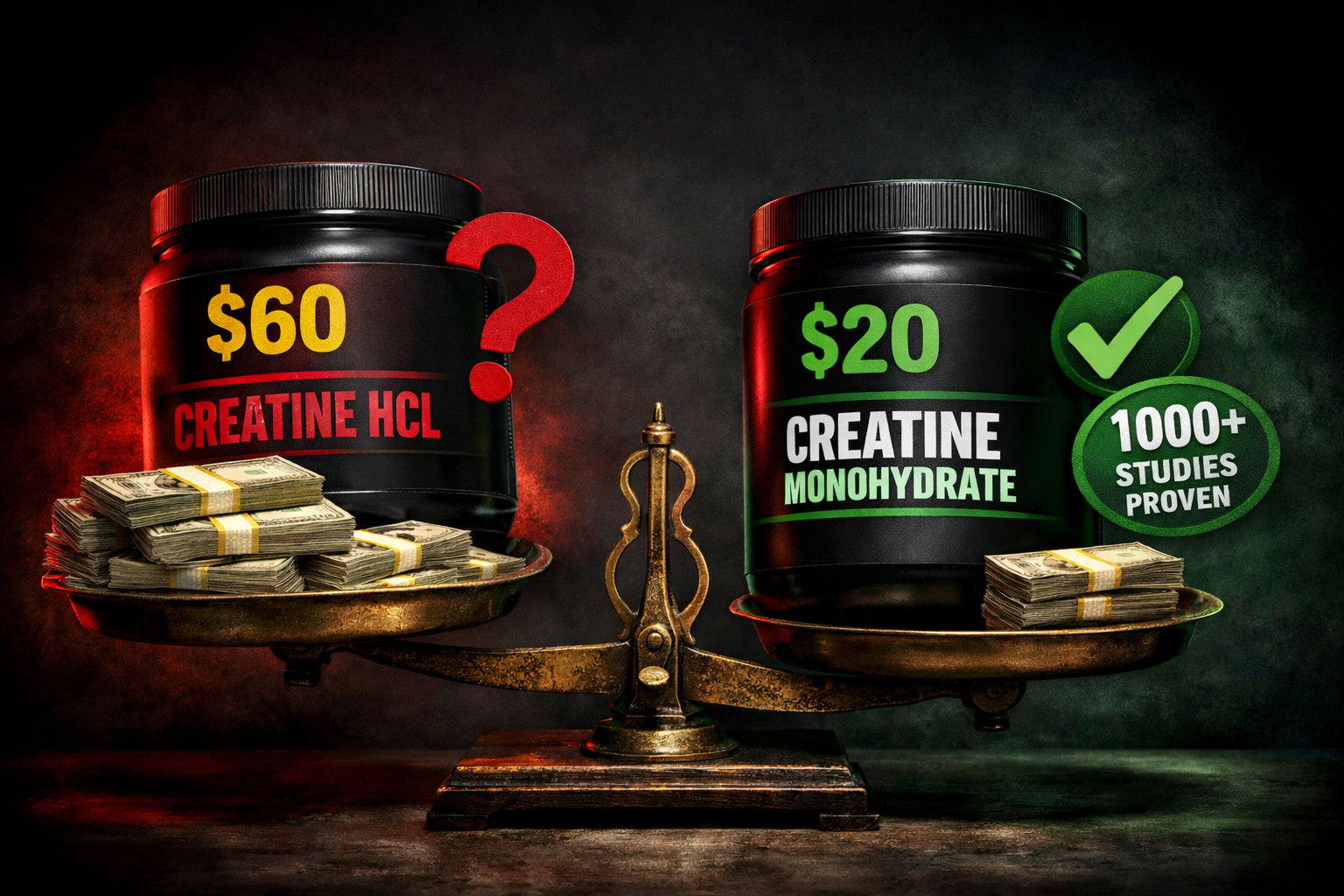
- Creatine HCL: $40-60
- 30-40 servings
- Cost per serving: $1.00-1.50
- Claims: Better absorption, no bloating, smaller dose needed
- Annual cost: $365-550
The budget way:
- Creatine monohydrate: $15-25
- 100-200 servings (500g-1kg)
- Cost per serving: $0.08-0.15
- Proven effectiveness, 30+ years research
- Annual cost: $30-55
- Savings: $335-495 annually
What you get:
- Same muscle-building benefits
- Same strength gains
- Same performance enhancement
- Identical results
What you sacrifice:
- Marketing hype (doesn’t build muscle)
- Fancy label (doesn’t matter)
- Placebo effect of “premium” product (results are the same)
Scientific reality: All forms of creatine work identically when equated for actual creatine content. Monohydrate is cheapest and most researched.
Verdict: Creatine monohydrate is the only form worth buying. Save $400+ annually.
Swap 4: Real Food Instead of Mass Gainers
The expensive way:
- Mass gainer: $50-80
- 16 servings
- 1,250 calories per serving
- Cost per 1,000 calories: $2.50-4.00
- Annual cost (if used daily): $910-1,460
The budget way:
- Homemade shake or whole food meal
- Recipe: 2 cups milk + 1 cup oats + 3 tbsp peanut butter + 2 scoops whey + banana
- 1,200 calories
- Cost per shake: $2.50-3.00
- Annual cost: $910-1,095
- Savings: $365+ annually
What you get:
- Real whole food nutrition
- Better micronutrients
- Actual fiber
- Higher quality ingredients
- Complete nutrition
What you sacrifice:
- Ultimate convenience (still pretty convenient)
- Pre-made formula (5 minutes to make your own)
Even better: Whole food meals
- Chicken, rice, vegetables, olive oil
- Better nutrition than any powder
- More satisfying
- Often cheaper per calorie
Verdict: Mass gainers are expensive convenience. Real food or homemade shakes provide better nutrition for less money.
Swap 5: Whole Food Protein Instead of Multiple Protein Supplements
The expensive way:
- Whey protein (post-workout): $60
- Casein protein (before bed): $50
- BCAAs (intra-workout): $30
- Total annual cost: $1,680
The budget way:
- Quality whey or egg white protein: $180-240 annually
- Whole food protein for other meals: Chicken, eggs, Greek yogurt, cottage cheese
- Savings: $1,440-1,500 annually
What you get:
- All the protein you need
- Better overall nutrition
- More satiety from whole food
- Identical muscle-building results
What you sacrifice:
- Having different protein powders for different times (unnecessary)
- BCAAs (worthless if eating adequate protein)
- Marketing-driven product diversity (doesn’t build more muscle)
Verdict: One good protein powder plus whole food is all you need. Multiple protein supplements are redundant and wasteful.
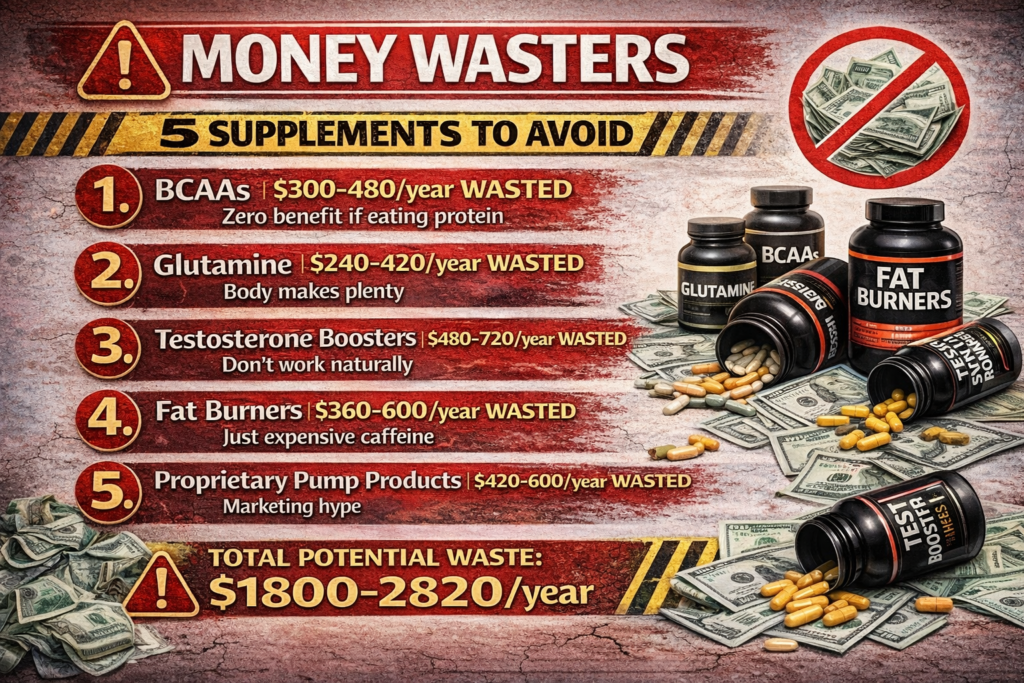
Supplements to Completely Avoid (Money Wasters)
These supplements are marketed heavily but provide minimal to no benefit.
Waste 1: BCAAs (Branch Chain Amino Acids)
The marketing claim:
- Prevents muscle breakdown
- Enhances recovery
- Builds more muscle
- Essential for training
The reality:
- If eating adequate protein (0.7-1g per pound), BCAAs provide ZERO additional benefit
- Any complete protein source contains BCAAs
- Whey protein is 25% BCAAs naturally
- You’re already getting plenty from food and protein powder
The cost:
- $25-40 monthly
- $300-480 annually
- For zero benefit if protein intake is adequate
When BCAAs might help: Only if training completely fasted (no food for 8+ hours before training) AND refusing to consume protein. Even then, protein powder is superior and cheaper.
Verdict: Complete waste of money for 95% of people. Use whole food or protein powder instead.
Waste 2: Glutamine
The marketing claim:
- Enhances recovery
- Supports immune function
- Reduces muscle soreness
- Improves gut health
The reality:
- Your body produces plenty of glutamine naturally
- Dietary glutamine from food is abundant
- Supplementation shows no benefit in healthy individuals
- Only beneficial for burn victims or severely immune-compromised people
The cost:
- $20-35 monthly
- $240-420 annually
- For benefits you’re already getting from your body and food
Verdict: Unnecessary for anyone eating a normal diet and training normally. Save your money.
Waste 3: Testosterone Boosters (For Natural Lifters)
The marketing claim:
- Naturally increase testosterone
- Build more muscle
- Enhance performance
- Boost recovery
The reality:
- Natural supplements cannot significantly increase testosterone in healthy men
- Even if they did slightly increase testosterone (which most don’t), it wouldn’t build more muscle
- The only thing that meaningfully increases testosterone is actual steroids (which is a different discussion entirely)
- Waste of money with zero proven benefits
The cost:
- $40-60 monthly
- $480-720 annually
- For no actual results
What actually optimizes natural testosterone:
- Adequate sleep (7-9 hours)
- Heavy compound lifting
- Healthy body fat percentage (not too low)
- Adequate dietary fat
- Stress management
- All free
Verdict: Complete scam. Save $500+ annually.
Waste 4: Fat Burners
The marketing claim:
- Burn fat faster
- Increase metabolism
- Lose weight effortlessly
- Get shredded quickly
The reality:
- The only effective ingredient in most fat burners is caffeine
- Caffeine increases energy expenditure by maybe 50-100 calories daily
- No supplement burns fat without a caloric deficit
- You can get the same caffeine from coffee for pennies
The cost:
- $30-50 monthly
- $360-600 annually
- For what coffee provides for $20 annually
What actually burns fat:
- Caloric deficit (eating less than you burn)
- Adequate protein (preserves muscle)
- Resistance training (maintains muscle during cut)
- Patience and consistency
- All free
Verdict: Expensive caffeine in fancy bottles. Buy coffee instead and save $340-580 annually.
Waste 5: Proprietary Blend “Pump” Products
The marketing claim:
- Insane muscle pumps
- Better nutrient delivery
- Enhanced muscle growth
- Superior to basic supplements
The reality:
- Usually contains citrulline or arginine (which are fine but cheap)
- Proprietary blends hide actual dosages (usually underdosed)
- Pumps feel good but don’t build muscle
- Overpriced for minimal benefit
The cost:
- $35-50 monthly
- $420-600 annually
What actually matters for muscle building:
- Progressive overload (lifting heavier over time)
- Adequate protein and calories
- Consistency
- Not how pumped you feel during one workout
Verdict: Pumps are fun but don’t build muscle. Skip these and save $400+ annually.
The Complete Budget Supplement Plan
Here’s exactly what to buy based on your budget.
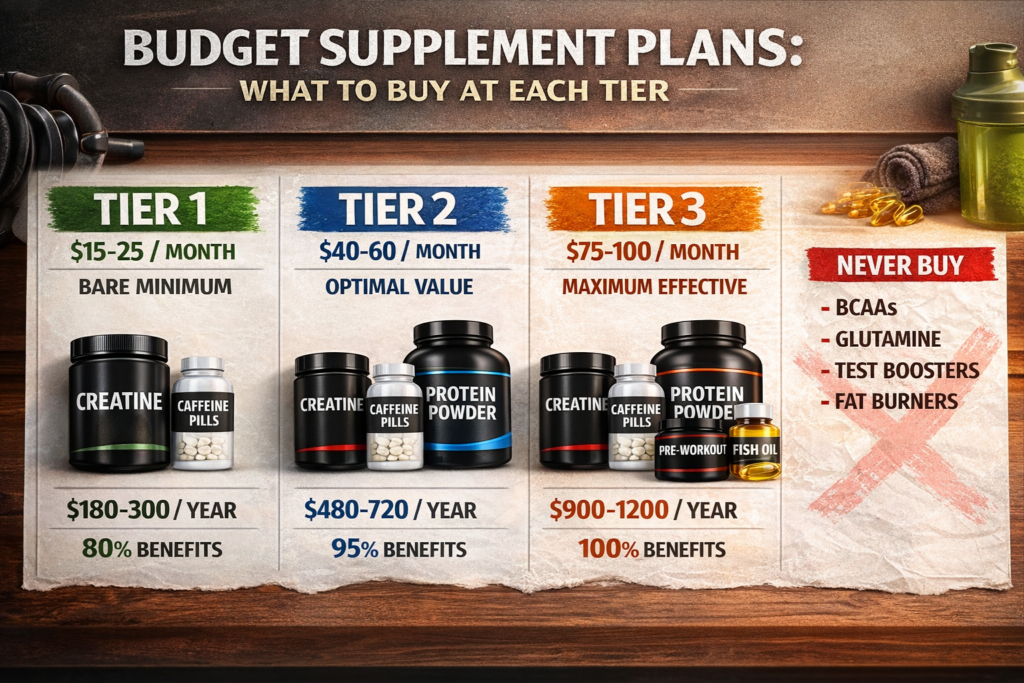
Budget Tier 1: $15-25 Monthly (Bare Minimum)
Total annual cost: $180-300
Buy:
- Creatine monohydrate: $10-15 monthly
- Caffeine (coffee or pills): $5-10 monthly
Why this works:
- Creatine provides 5-15% strength increase
- Caffeine enhances performance and focus
- These two supplements provide 80% of all supplement benefits
- Spend remaining money on whole food
Who this is for:
- Tight budget
- Students
- Anyone just starting out
- Anyone who values maximum value
Budget Tier 2: $40-60 Monthly (Optimal Value)
Total annual cost: $480-720
Buy:
- Creatine monohydrate: $10-15 monthly
- Caffeine: $5-10 monthly
- Egg white protein OR budget whey: $25-35 monthly
Why this works:
- All essential supplements covered
- Protein powder fills dietary gaps
- 95% of supplement benefits achieved
- Extremely cost-effective
Who this is for:
- Most people
- Anyone struggling to hit protein targets
- Optimal cost to benefit ratio
Budget Tier 3: $75-100 Monthly (Maximum Effective)
Total annual cost: $900-1,200
Buy:
- Creatine monohydrate: $10-15 monthly
- Pre-workout (or caffeine): $25-35 monthly
- Quality whey or egg white protein: $30-40 monthly
- Fish oil: $10-15 monthly
Why this works:
- Complete supplement coverage
- Pre-workout for convenience and taste
- Omega-3s for health
- Nothing redundant or wasteful
Who this is for:
- Comfortable budget
- Want convenience
- Enjoy pre-workout flavors
- All essentials covered, room for preferences
What NOT to Add Regardless of Budget
Even if you have unlimited money:
❌ BCAAs (if eating adequate protein) ❌ Glutamine ❌ Testosterone boosters ❌ Fat burners (unless you just want expensive caffeine) ❌ Fancy creatine forms ❌ Mass gainers (real food is better) ❌ Multiple protein powders ❌ Proprietary blend supplements ❌ Anything with “revolutionary formula”
These don’t improve results. Save the money or spend on better food.
The Bottom Line: Nutrition First, Supplements Second
After examining all the evidence:
The truth about supplement budgets:
✅ You can build serious muscle spending $20-40 monthly on creatine and caffeine
✅ Whole food nutrition matters 10x more than any supplement
✅ Most supplements are unnecessary marketing-driven wastes of money
✅ The expensive supplements aren’t better than cheap, proven basics
✅ Protein powder is optional (only if diet falls short)
The priority system:
Priority 1: Whole food nutrition
- Spend money on quality protein sources
- Chicken, fish, eggs, Greek yogurt, beans
- Carbs: rice, oats, potatoes, bread
- Fats: olive oil, nuts, avocado
- This is 90% of your results
Priority 2: Creatine monohydrate
- $10-15 monthly
- Proven 5-15% strength increase
- Most cost-effective supplement
Priority 3: Caffeine (if needed)
- $5-10 monthly for coffee or pills
- Performance enhancement
- Cheap and effective
Priority 4: Protein powder (if diet insufficient)
- Egg white protein: $25-35 monthly
- OR budget whey: $30-40 monthly
- Only if struggling to hit 0.7-1g per pound from food
Priority 5: Everything else is optional
- Pre-workout (convenience, not necessity)
- Fish oil (can get from diet)
- Multivitamin (insurance, not requirement)
What to never buy:
- BCAAs
- Glutamine
- Testosterone boosters
- Fat burners
- Fancy creatine
- Mass gainers
- Proprietary blends
The budget breakdown:
Minimum effective: $15-25 monthly
- Creatine + caffeine
- 80% of supplement benefits
- $180-300 annually
Optimal value: $40-60 monthly
- Creatine + caffeine + protein powder
- 95% of supplement benefits
- $480-720 annually
Maximum worthwhile: $75-100 monthly
- All the above + pre-workout + fish oil
- 100% of realistic supplement benefits
- $900-1,200 annually
Anything beyond $100 monthly is likely wasteful unless you have specific, proven needs.
PRIORITIZE FOOD. BUY BASICS. SKIP MARKETING HYPE. BUILD MUSCLE ON A BUDGET.
Ready to optimize your entire nutrition and training strategy for maximum muscle building without wasting money on unnecessary supplements? Budget-friendly supplementation is just one piece of building muscle intelligently. Get a complete guide to calculating your exact nutrition needs, building a whole food diet that works, training for maximum results, and using only the supplements that actually matter. Stop wasting money on marketing. Start building serious muscle on a smart budget.


Leave a Reply
You must be logged in to post a comment.