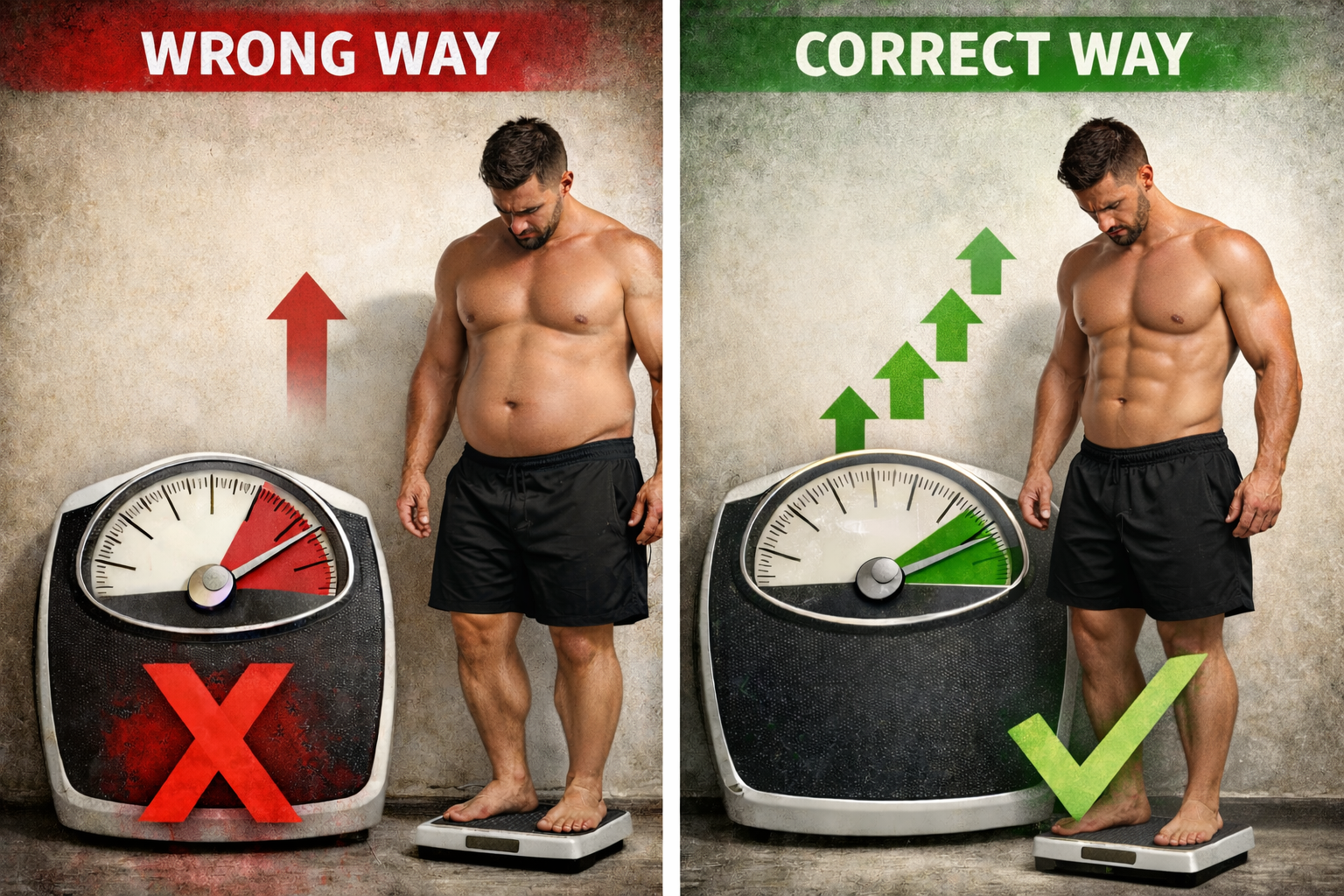
Successfully finished your cut and ready to build muscle? Here’s how to transition to bulking without immediately regaining all the fat you lost.
You did it. You lost the fat. You’re lean. You can finally see your abs.
Now you want to build muscle. Time to bulk.
So you start eating more. A lot more. You’re hungry after months of dieting, so you just eat.
Two weeks later:
Abs are gone. Face looks puffy. Waist is expanding rapidly.
What happened?
You jumped straight from cutting to aggressive bulking without a proper transition. Your metabolism was suppressed, hormones were down-regulated, and your body was primed to store fat rapidly.
You gained back in 2 weeks what took 8 weeks to lose.
Here’s the truth that will save your hard-earned results: You cannot go from cutting calories directly to bulking calories overnight without gaining excessive fat. Your metabolism has adapted to the deficit, and jumping immediately to a surplus creates the perfect storm for rapid fat regain. The correct approach is to first find your new maintenance calories, stabilize there, then add a controlled surplus.
In this comprehensive guide, I’ll explain exactly why jumping straight to bulking after cutting causes rapid fat gain, reveal the metabolic adaptations that occur during cutting and how they affect your transition, show you the step-by-step process for transitioning correctly, provide the exact calorie adjustment protocol, and help you avoid the common mistakes that ruin months of cutting work in just weeks.
Whether you just finished a cut or planning one, this article will protect your results.
Let’s transition intelligently.
TABLE OF CONTENTS
Why You Can’t Jump Straight From Cutting to Bulking
Understanding the problem prevents the mistake.
The Metabolic Adaptations From Cutting
Your body doesn’t function the same at the end of a cut as it did at the beginning.
What happens during a prolonged cut:
Hormonal down-regulation:
Leptin (fat regulation hormone):
- Decreases 40-50% during caloric deficit
- Signals body that energy is scarce
- Reduces metabolic rate
- Increases hunger
T3 (thyroid hormone):
- Decreases 10-25% during deficit
- Slows metabolic rate
- Reduces energy expenditure
- Body becomes more efficient
Testosterone (men):
- Can decrease 15-30% during prolonged cutting
- Reduces muscle-building capacity
- Lowers energy levels
- Affects recovery
Ghrelin (hunger hormone):
- Increases during deficit
- Creates stronger hunger signals
- Makes you want to eat everything
- Persists even after diet ends
Metabolic rate reduction:
Your body burns fewer calories:
- Basal metabolic rate decreases
- NEAT (non-exercise activity) decreases (you fidget less, move less)
- Exercise efficiency increases (burn fewer calories doing same workout)
- Adaptive thermogenesis occurs
Example:
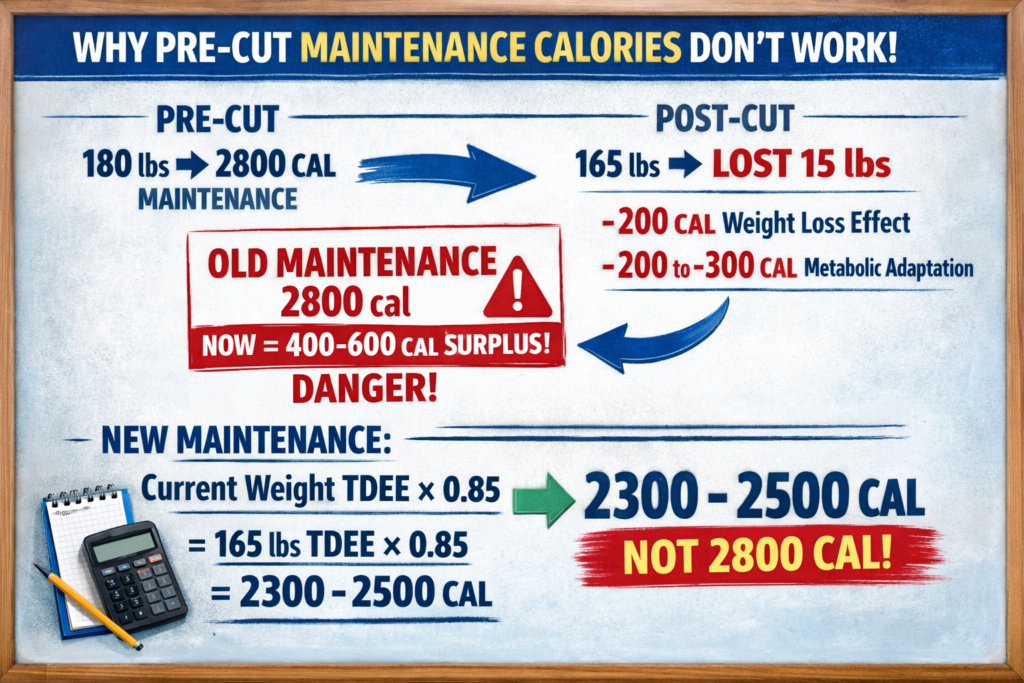
Before cutting (180 pounds):
- Maintenance calories: 2,800
After cutting (165 pounds):
- Expected maintenance (based on weight alone): 2,600
- Actual maintenance (with metabolic adaptation): 2,300-2,400
- Difference: 200-300 calories lower than expected
This is why simply eating your “old” maintenance calories causes rapid fat gain.
What Happens When You Jump to Bulking Immediately
The perfect storm for fat regain:
Scenario: Jumping from deficit to surplus
End of cut:
- Eating 2,000 calories daily
- Maintaining 165 pounds
- Metabolically adapted (suppressed hormones, reduced expenditure)
Day 1 of “bulk”:
- Jump to 3,000 calories (old maintenance + surplus)
- Body is primed to store energy
- Hormones still suppressed
What happens:
Week 1:
- Gain 4-6 pounds rapidly
- Think: “Some is water weight, some is muscle”
- Actually: 2-3 pounds water/glycogen, 1-2 pounds fat, minimal muscle
Week 2:
- Gain another 3-4 pounds
- Getting concerned but committed to bulk
- Mostly fat gain now
Week 4:
- Gained 10-15 pounds total
- Abs completely gone
- Face puffy
- Waist expanded 2-3 inches
- Lost the physique you worked months to build
Why this happens:
Suppressed metabolism:
- Body still in “conservation mode”
- Not burning calories efficiently
- Storing excess readily
Hormone imbalance:
- Low leptin means poor nutrient partitioning
- Low T3 means low metabolic rate
- High ghrelin means excessive hunger
- Combination promotes fat storage
Psychological factors:
- Hunger is extreme after months of deficit
- Hard to control portions
- “I’m bulking” becomes excuse to overeat
- Lose all restraint
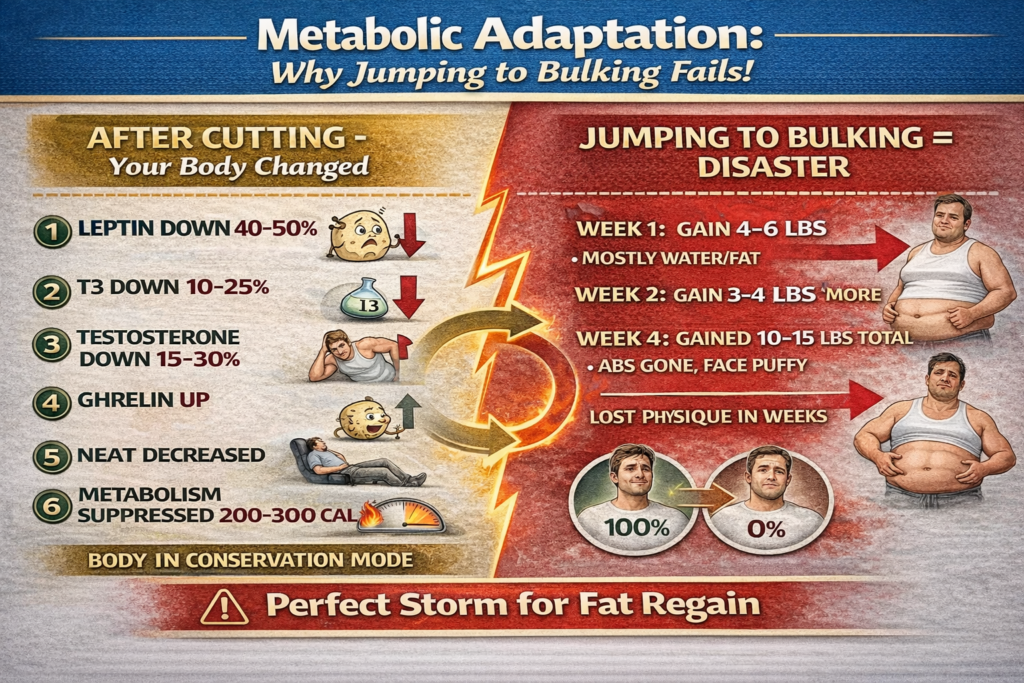
The result: Gain back in weeks what took months to lose.
The Correct Transition Process: Step-by-Step
How to protect your results while preparing to build muscle.
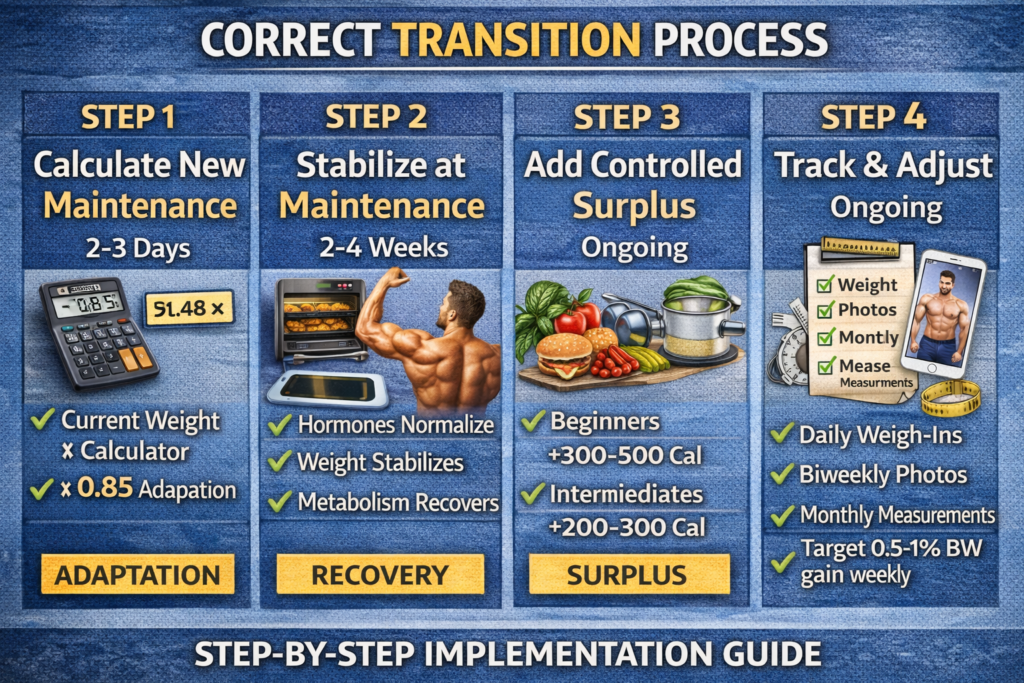
Step 1: Calculate Your New Maintenance Calories
This is the foundation of successful transition.
The critical mistake people make:
“I maintained at 2,800 calories before my cut. I’ll just go back to that.”
Why this is wrong:
You weigh less now:
- Lost 15-20 pounds during cut
- Smaller body = fewer calories needed
- Weight-based calorie reduction
Your metabolism adapted:
- Hormonal down-regulation
- Reduced NEAT
- Adaptive thermogenesis
- Additional 200-300 calorie reduction
Total reduction: 400-600 calories lower than pre-cut maintenance
How to calculate new maintenance:
Method 1: Use a calculator with current weight
Online TDEE calculator:
- Input current weight (post-cut)
- Use moderate activity level
- Result is estimated maintenance
- Reduce by 10-15% to account for metabolic adaptation
Example:
- Calculator says: 2,500 calories
- Reduce by 15%: 2,500 × 0.85 = 2,125 calories
- Start here
Method 2: Track and adjust (more accurate)
Week 1:
- Estimate maintenance (method 1)
- Eat that amount daily
- Track weight daily
Week 2:
- If weight dropping: Add 100-150 calories
- If weight stable: Perfect, you found maintenance
- If weight increasing: Reduce 50-100 calories
Week 3:
- Continue adjusting
- Find the calorie level where weight stabilizes
- This is your true current maintenance
Expected new maintenance:
If you were:
- Pre-cut weight: 180 pounds, maintaining at 2,800 calories
- Post-cut weight: 165 pounds
New maintenance will be:
- Approximately 2,300-2,500 calories
- Not the 2,800 you maintained at before
Step 2: Eat at Maintenance for 2-4 Weeks
Don’t skip this phase. It’s critical.
What happens during maintenance phase:
Metabolic restoration:
Hormones normalize:
- Leptin begins recovering (takes 2-4 weeks)
- T3 starts increasing (takes 1-2 weeks)
- Testosterone recovers (takes 2-4 weeks)
- Ghrelin decreases gradually
Energy expenditure increases:
- NEAT increases (you move more spontaneously)
- Metabolic rate rises
- Body exits “starvation mode”
- Thermogenesis normalizes
Psychological recovery:
- Hunger decreases to manageable levels
- Energy levels improve
- Training quality increases
- Mental clarity returns
Weight changes during maintenance:
Week 1-2:
- Gain 2-4 pounds rapidly
- This is water weight and glycogen
- Muscles refilling with carbs
- Not fat gain
- Don’t panic
Week 3-4:
- Weight stabilizes
- Minimal fluctuation
- True maintenance achieved
- Ready for bulking
Why this phase matters:
Skipping maintenance = rapid fat gain:
- Metabolism still suppressed
- Hormones still down
- Jumping to surplus catastrophic
Spending 2-4 weeks at maintenance:
- Allows full recovery
- Normalizes hormones
- Increases metabolic rate
- Prepares body for surplus
Think of it as investment:
- Spend 2-4 weeks now
- Bulk cleaner for next 12-16 weeks
- Gain more muscle, less fat
- Protect your cut results
What to do during maintenance phase:
✅ Eat same calories daily (new maintenance)
✅ Keep protein high (0.8-1g per pound)
✅ Train hard (maintain or increase volume)
✅ Track weight daily (should stabilize)
✅ Enjoy having more energy
✅ Let body normalize
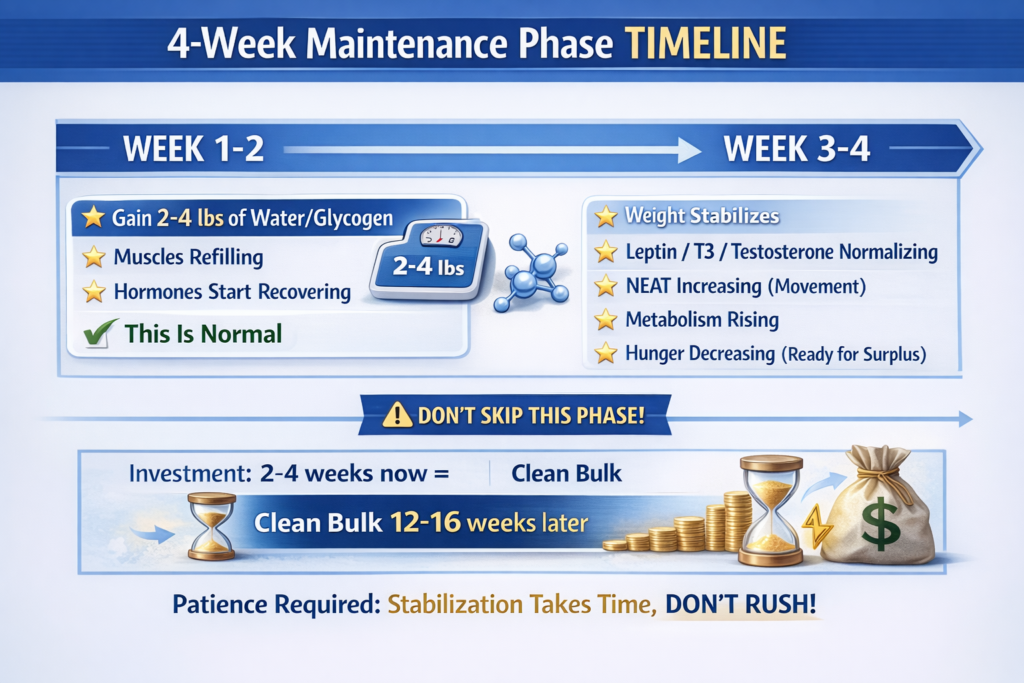
Don’t rush this. Patience here prevents fat gain later.
Step 3: Gradually Increase to Bulking Calories
Add a controlled surplus after maintenance is established.
The right surplus for your experience level:
Beginners (0-2 years training):
- Surplus: 300-500 calories above maintenance
- Can build muscle faster
- More forgiving of larger surplus
- Higher end of range appropriate
Intermediates (2-4 years training):
- Surplus: 200-300 calories above maintenance
- Slower muscle-building rate
- Need precision
- Middle range optimal
Advanced (5+ years training):
- Surplus: 100-200 calories above maintenance
- Very slow muscle building
- Larger surplus just adds fat
- Minimal surplus needed
How to add the surplus:
Option 1: Immediate increase (recommended for most)
From maintenance to surplus:
- Currently eating 2,400 calories (maintenance)
- Want 300 calorie surplus
- Immediately eat 2,700 calories
- Monitor weight gain
Why this works:
- You’ve already spent 2-4 weeks at maintenance
- Hormones normalized
- Can handle surplus
- Simple and effective
Option 2: Gradual increase (very conservative)
Add calories weekly:
- Week 1: Maintenance (2,400)
- Week 2: Add 100 calories (2,500)
- Week 3: Add 100 calories (2,600)
- Week 4: Add 100 calories (2,700)
- Week 5: At target surplus
Why this works:
- Very cautious approach
- Minimizes fat gain
- More time consuming
- Not necessary if you did maintenance phase
For most people: Option 1 after proper maintenance phase.
Step 4: Monitor and Adjust Based on Results
Track progress and make intelligent adjustments.
What to track:
Daily weigh-ins:
- Same time each morning
- After bathroom, before eating
- Track 7-day average
- Focus on trend, not daily fluctuations
Weekly measurements:
- Waist (at belly button)
- Chest
- Arms
- Thighs
- Track changes
Bi-weekly photos:
- Same lighting, same pose
- Front, side, back
- Compare to assess body composition
- Most accurate visual feedback
Training performance:
- Are weights increasing?
- Is volume progressing?
- Recovery adequate?
- Performance indicator of proper surplus
What to look for:
Optimal bulk progress:
- Weight gain: 0.5-1% body weight weekly
- For 165-pound person: 0.8-1.6 pounds weekly
- Strength increasing consistently
- Waist increasing slowly (0.25 inch monthly acceptable)
If gaining too slowly (<0.5% weekly):
- Add 100-150 calories
- Wait 2 weeks
- Reassess
- Repeat if needed
If gaining too fast (>1.5% weekly):
- Reduce 100-150 calories
- Wait 2 weeks
- Reassess
- Find sweet spot
Red flags (gaining too much fat):
- Waist increasing >0.5 inches monthly
- Visible fat gain in photos
- Abs disappearing rapidly
- Weight gain much faster than strength gain
Action if red flags appear:
- Reduce surplus immediately
- Possibly return to maintenance briefly
- Reassess approach
- Adjust accordingly
Common Transition Mistakes to Avoid
Don’t sabotage your cut results.
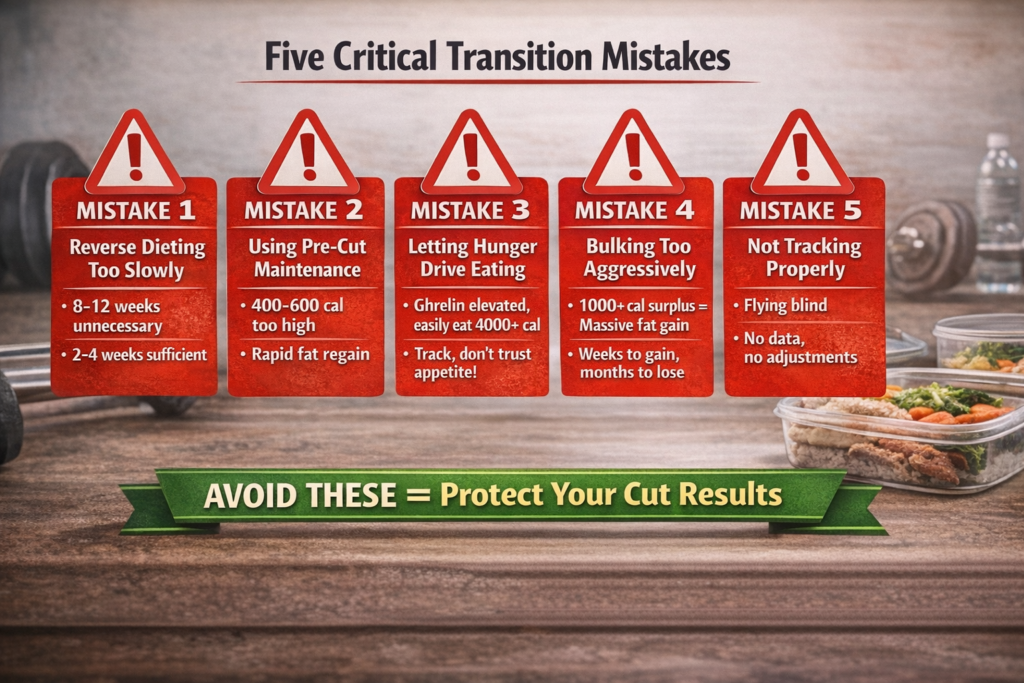
Mistake 1: Reverse Dieting Too Slowly
Some coaches recommend extremely slow reverse diet.
The approach:
- Add 50-100 calories weekly
- Take 8-12 weeks to reach maintenance
- Eventually reach surplus
The problems:
Unnecessarily prolonged deficit:
- Spending months in semi-deficit
- Suppressed hormones continue
- Suboptimal muscle building for extended period
- Lost opportunity
Psychological difficulty:
- Months more of restriction
- Frustration builds
- Harder to adhere
- Mental fatigue
Minimal benefit over faster approach:
- Fat gain prevention marginal
- Not worth extended timeline
- Better to reach maintenance in 2-4 weeks
The better approach:
- Jump to estimated new maintenance immediately
- Spend 2-4 weeks there
- Then add surplus
- Total time: 3-6 weeks vs. 12-16 weeks
Mistake 2: Using Pre-Cut Maintenance Calories
Thinking your maintenance is the same as before.
The mistake:
“I maintained at 2,800 before my cut. I’ll go back to 2,800.”
Why it fails:
- You weigh 15-20 pounds less
- Metabolism adapted during cut
- Actual maintenance 400-600 calories lower
- Eating 2,800 is actually a 400-600 calorie surplus
- Rapid fat gain occurs
The fix:
✅ Calculate new maintenance based on current weight
✅ Account for metabolic adaptation (reduce 10-15%)
✅ Start conservative
✅ Adjust based on results
Mistake 3: Letting Hunger Drive Eating
Relying on appetite after months of restriction.
What happens:
Post-cut hunger is extreme:
- Ghrelin elevated
- Leptin suppressed
- Psychological deprivation
- “I deserve to eat” mentality
If eating ad libitum (to appetite):
- Easily consume 4,000+ calories
- Massive surplus (1,500+ over maintenance)
- Rapid fat gain
- Destroy cut results
The fix:
✅ Continue tracking calories
✅ Don’t trust hunger signals immediately
✅ Follow the plan (maintenance, then controlled surplus)
✅ Hunger will normalize in 2-4 weeks
Mistake 4: Bulking Too Aggressively
“I’m lean now, I can eat a lot!”
The mentality:
- Finished cut, very lean
- Think you can bulk hard
- Eat 1,000+ calorie surplus
- “I’ll just cut again later”
Why this fails:
Getting fat is easy, getting lean is hard:
- Gaining fat back takes weeks
- Losing it again takes months
- You just spent 8-16 weeks cutting
- Why immediately need to cut again?
Excessive surplus doesn’t build more muscle:
- Muscle-building rate is limited
- Body can only build ~0.5-2 pounds muscle monthly (depending on experience)
- Extra calories beyond what’s needed just become fat
- No benefit to massive surplus
The fix:
✅ Controlled surplus (200-400 calories)
✅ Slow, steady muscle gain
✅ Minimize fat gain
✅ Bulk longer without needing to cut
✅ Better long-term progress
Mistake 5: Not Tracking Properly
“I’ll just eat healthy and lift heavy.”
The problem:
Without tracking:
- No idea actual calorie intake
- Could be in deficit still
- Could be in massive surplus
- Guessing leads to failure
The fix:
✅ Track calories and macros
✅ Weigh daily
✅ Take photos
✅ Monitor measurements
✅ Make data-driven adjustments
At least for the first 4-8 weeks of transition and bulk.
The Bottom Line: Transition Smart, Protect Your Results
After examining all the evidence:
Why you can’t jump straight to bulking:
❌ Metabolic adaptation during cut (hormones suppressed, expenditure reduced)
❌ New maintenance is 400-600 calories lower than pre-cut (weight loss + adaptation)
❌ Jumping to old calories creates massive surplus (rapid fat regain)
❌ Hunger is extreme post-cut (ghrelin high, leptin low)
❌ Body primed to store fat (survival mechanism from deficit)
The correct transition process:
Step 1: Calculate new maintenance (2-3 days)
- Use current weight in calculator
- Reduce by 10-15% for metabolic adaptation
- Start eating this amount
Step 2: Stabilize at maintenance (2-4 weeks)
- Eat new maintenance calories daily
- Gain 2-4 pounds (water/glycogen, not fat)
- Weight stabilizes
- Hormones normalize
- Metabolism recovers
Step 3: Add controlled surplus (ongoing)
- Beginners: +300-500 calories
- Intermediates: +200-300 calories
- Advanced: +100-200 calories
- Monitor and adjust based on results
Step 4: Track and adjust (ongoing)
- Daily weigh-ins (track 7-day average)
- Bi-weekly photos
- Monthly measurements
- Adjust if gaining too fast or too slow
Target rate of gain:
- 0.5-1% body weight weekly
- For 165-pound person: 0.8-1.6 pounds per week
- Strength increasing consistently
- Minimal fat gain
Common mistakes to avoid:
- Reverse dieting too slowly (months in semi-deficit)
- Using pre-cut maintenance calories (too high)
- Letting hunger drive intake (eat way too much)
- Bulking too aggressively (rapid fat regain)
- Not tracking properly (flying blind)
The realistic timeline:
Weeks 1-2: Find new maintenance, begin eating at it
Weeks 3-4: Weight stabilizes, hormones normalizing
Week 5: Add controlled surplus, begin proper bulk
Weeks 6-20: Continue controlled bulk, monitor progress
Total transition: 4-6 weeks before proper bulking begins
The mindset shift:
You spent 8-16 weeks getting lean. Don’t ruin it in 2 weeks of impatience.
Invest 4 weeks transitioning correctly. Then bulk cleanly for 16-20 weeks.
Better to:
- Spend 4 weeks transitioning properly
- Bulk for 20 weeks gaining 10-15 pounds (8-12 pounds muscle, 2-3 pounds fat)
- Stay relatively lean
- Repeat cycle
Than to:
- Jump straight to bulking
- Bulk for 12 weeks gaining 20 pounds (5-8 pounds muscle, 12-15 pounds fat)
- Get fat quickly
- Need another long cut
TRANSITION GRADUALLY. FIND MAINTENANCE. ADD CONTROLLED SURPLUS. PROTECT YOUR RESULTS.
Ready to optimize every phase of your training and nutrition with a complete system for cutting, bulking, and transitioning that delivers maximum muscle gain with minimal fat accumulation? The transition from cutting to bulking is just one critical phase. Get a comprehensive guide to calculating your exact calorie needs for each phase, programming your training optimally, timing your nutrition perfectly, and building the physique you want without wasting time on ineffective approaches. Stop yo-yoing between fat and lean. Start following a systematic approach that delivers consistent, long-term progress.






Leave a Reply
You must be logged in to post a comment.