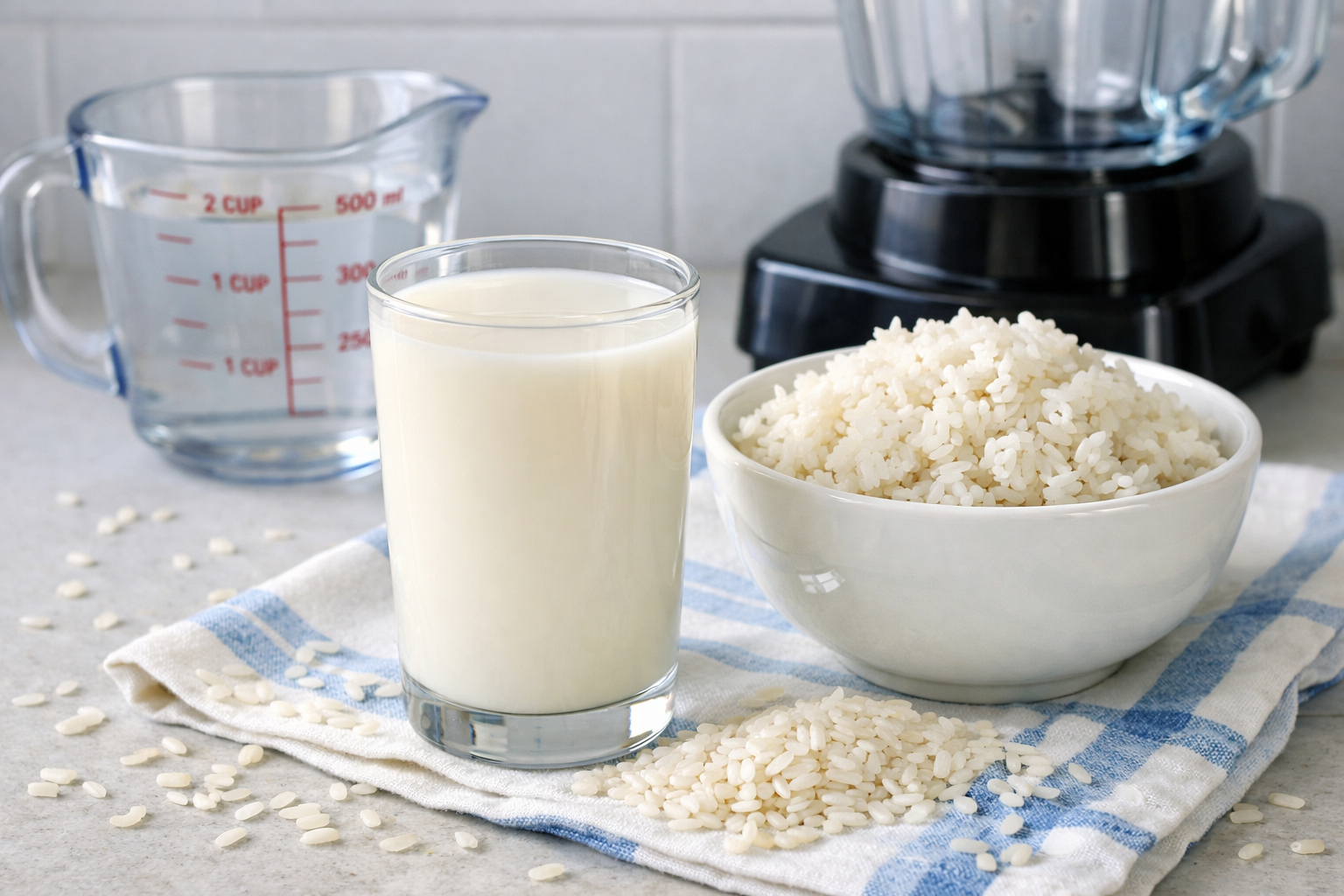
Struggling to eat enough calories for bulking? Here’s a dirt-cheap, allergen-free liquid carbohydrate solution most people overlook.
You’re trying to bulk. You need 3,500+ calories daily to build muscle.
But you’re full. All. The. Time.
You’ve eaten chicken and rice until you can’t stand looking at another plate. Your stomach feels stuffed, yet you’re still 500-800 calories short of your target.
Eating more solid food feels impossible.
Meanwhile, commercial mass gainers cost $50-80 per bag and are filled with cheap sugars and artificial ingredients.
There has to be a better way.
Here’s the solution hiding in plain sight: Homemade rice milk provides 640 calories and 140g carbs from just cooked rice and water, costs pennies per serving, contains zero allergens or controversial ingredients, and makes consuming bulking calories dramatically easier. It’s the ultimate budget-friendly liquid carbohydrate source for hardgainers.
In this comprehensive guide, I’ll explain exactly what rice milk is and why it works for muscle building, reveal the specific benefits that make it superior to store-bought alternatives, show you the simple recipe to make it at home in 10 minutes, provide practical ways to incorporate it into your muscle-building diet, and help you avoid the common mistakes that reduce effectiveness.
Whether you’re a hardgainer struggling to eat enough or just looking for affordable bulking strategies, this article will change your nutrition game.
Let’s unlock this powerful tool.
TABLE OF CONTENTS
What Is Rice Milk and Why It Matters for Muscle Building
Understanding the basics before making it.
The Simple Definition
Rice milk is a plant-based beverage made by blending cooked rice with water.
What it contains:
- Cooked white or brown rice
- Water
- Optional: Flavorings (vanilla, cocoa)
- That’s it
What it doesn’t contain:
- No dairy (lactose-free)
- No soy (allergen-free)
- No nuts (safe for nut allergies)
- No additives (when homemade)
- No processing chemicals
Nutritional profile (500g cooked rice version):
- Calories: 640
- Carbohydrates: 140g
- Protein: 12g
- Fat: 1g
- Pure liquid carbohydrate source
Why Rice Milk for Muscle Building?
It solves a specific bulking problem.
The hardgainer struggle:
Scenario most hardgainers face:
- Need 3,500-4,000 calories daily for muscle gain
- Can comfortably eat 2,800-3,200 from solid food
- Shortfall: 500-800 calories daily
- Trying to eat more solid food = uncomfortable fullness
Traditional solutions and their problems:
Mass gainer supplements:
- Cost: $50-80 per container
- 16-24 servings
- $2.50-4.00 per serving
- Often filled with maltodextrin (cheap corn syrup)
- Artificial sweeteners and flavors
- Expensive long-term
Just eating more food:
- Physically uncomfortable
- Digestive distress
- Reduced appetite for hours
- Unsustainable approach
- Training quality suffers
Rice milk solution:
Provides liquid calories:
- 640 calories from simple recipe
- Easier to consume than solid food
- Doesn’t fill you up excessively
- Room temperature or cold, your choice
Extremely affordable:
- 500g cooked rice = ~$0.30-0.50
- Water = free
- Total cost: $0.30-0.50 per 640 calories
- Mass gainer equivalent would cost $2.50-4.00
- Savings: $2.00-3.50 per serving
Clean ingredients:
- Just rice and water
- No processing
- No additives
- Know exactly what you’re consuming
The strategic advantage:
Rice milk doesn’t replace protein supplementation (whey protein still useful). Instead, it addresses the other common bulking problem: getting enough total calories without feeling stuffed or spending a fortune.
Why Most People Don’t Know About This
Rice milk exists, but homemade rice milk for bulking is underutilized.
Store-bought rice milk:
- Marketed as dairy alternative
- Heavily diluted (30-50 calories per cup)
- Often has added sugar
- Expensive ($3-5 per container)
- Not the same as homemade concentrated version
Homemade concentrated rice milk:
- Made specifically for calorie density
- 640 calories per batch (vs. 30-50 in store versions)
- Costs pennies
- This is what builds muscle
Most bodybuilders don’t discuss it because:
- They use expensive mass gainers (sponsored)
- They can eat enormous amounts of food (genetic advantage)
- They don’t share budget strategies
- It’s too simple (not sexy marketing)
But for the average hardgainer on a budget, this is game-changing.
Benefits of Homemade Rice Milk for Bulking
Why this approach is superior to alternatives.
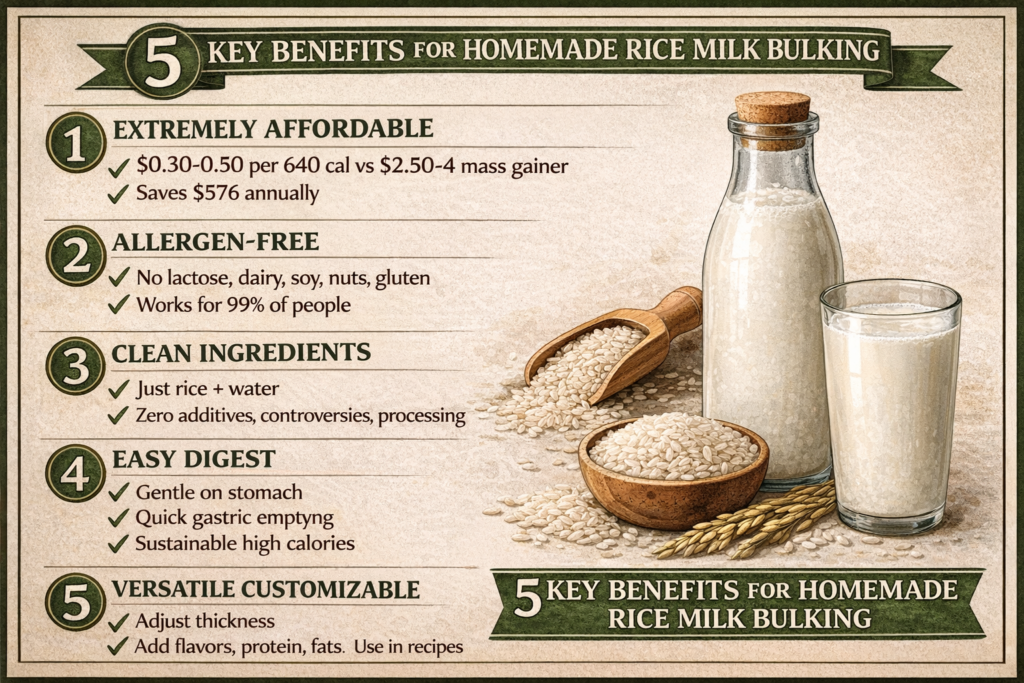
Benefit 1: Extremely Affordable
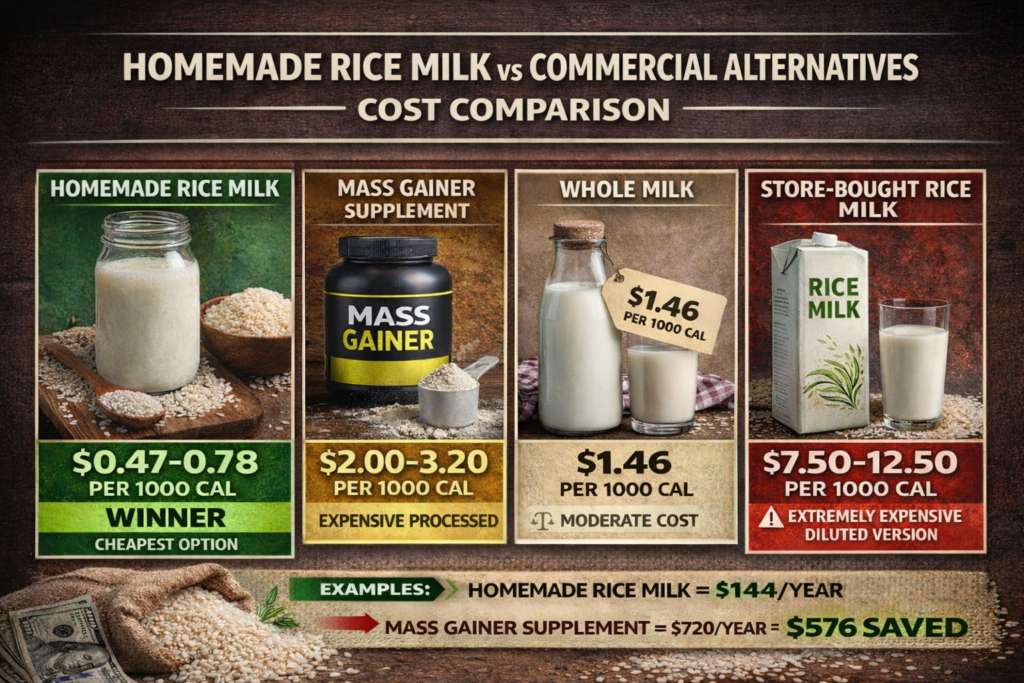
The cost comparison is shocking.
Rice milk (homemade):
- 500g cooked rice (from ~200g dry rice)
- 200g dry rice costs: $0.30-0.50
- 500ml water: Free
- Total cost: $0.30-0.50 for 640 calories
- Cost per 1,000 calories: $0.47-0.78
Mass gainer supplement:
- Typical serving: 1,250 calories
- Cost per serving: $2.50-4.00
- Cost per 1,000 calories: $2.00-3.20
Whole milk:
- 1 gallon whole milk: ~$3.50
- Provides: 2,400 calories
- Cost per 1,000 calories: $1.46
Commercial rice milk:
- Store-bought carton: $3-5
- Provides: 240-400 total calories
- Cost per 1,000 calories: $7.50-12.50
The winner: Homemade rice milk at $0.47-0.78 per 1,000 calories
Annual savings example:
If using 640 calories from rice milk daily for bulking:
Homemade rice milk:
- Daily cost: $0.40
- Monthly: $12
- Annual: $144
Mass gainer supplement:
- Daily cost: $2.00 (for similar calories)
- Monthly: $60
- Annual: $720
Savings: $576 per year
That’s enough to buy:
- 100+ pounds of chicken breast
- A year’s supply of creatine
- Quality training shoes
- Gym membership for several months
Benefit 2: Allergen-Free and Universally Tolerable
Works for almost everyone.
Common food intolerances and allergies:
Lactose intolerance (affects 65-70% of adults globally):
- Cannot use dairy milk
- Cannot use whey protein (some)
- Mass gainers often contain dairy
- Rice milk: Zero lactose
Dairy allergy:
- Different from intolerance (immune response)
- All dairy products problematic
- Rice milk: Completely dairy-free
Soy allergy/sensitivity:
- Soy milk not an option
- Many mass gainers contain soy
- Some avoid soy for hormone concerns
- Rice milk: Zero soy
Nut allergies:
- Almond milk, cashew milk dangerous
- Peanut butter (common bulking food) off-limits
- Rice milk: Nut-free
Gluten intolerance:
- Oat milk may be problematic
- Some mass gainers contain gluten
- Rice milk: Naturally gluten-free
Rice allergy:
- Extremely rare (affects <0.1% of population)
- Rice is one of least allergenic foods
- Used in hypoallergenic formulas
- Almost everyone can tolerate rice
The practical advantage:
If you have any food sensitivities, rice milk is likely safe. You can bulk without digestive distress or allergic reactions.
Benefit 3: Free From Controversial Ingredients
Clean, transparent nutrition.
Problems with other options:
Conventional dairy milk:
- Hormone concerns (rBGH/rBST in some countries)
- Antibiotic residues (from treated cows)
- Quality varies by source
- Adulteration scandals (watered down, added ingredients)
Soy products:
- Phytoestrogen concerns (ongoing debate)
- GMO soybeans (unless organic)
- Conflicting research on hormonal effects
- Some people prefer to avoid
Mass gainers:
- Maltodextrin (processed corn syrup)
- Artificial sweeteners
- Artificial colors and flavors
- Proprietary blends (hidden ingredients)
- Heavy metals (some brands)
Homemade rice milk:
- Ingredient 1: Rice
- Ingredient 2: Water
- Optional Ingredient 3: Natural flavoring
- Complete transparency
- Zero controversies
- You control everything
Additional purity benefits:
Impossible to adulterate:
- You buy rice directly
- You cook it yourself
- You blend it yourself
- No middleman adding fillers
No processing chemicals:
- Commercial products often have stabilizers, emulsifiers, preservatives
- Homemade has none
- Fresh is better
Benefit 4: Easy to Digest
Gentle on the stomach, especially important when bulking.
Why digestion matters when eating a lot:
Bulking requires high food volume:
- 3,500-4,000+ calories daily
- 5-6 meals
- Large portions
- Constant eating
Digestive stress is common:
- Bloating
- Gas
- Discomfort
- Constipation
- Reduced appetite
Rice is extremely digestible:
Why rice digests easily:
- Low fiber (white rice especially)
- Gentle on stomach
- Rarely causes bloating
- Quick gastric emptying
- Minimal digestive stress
When blended into liquid:
- Even easier than eating rice
- Pre-broken down mechanically
- Faster absorption
- Less work for digestive system
Practical benefit:
- Drink rice milk shake
- Stomach feels fine
- Appetite returns quickly
- Can eat next meal on schedule
- Sustainable high-calorie intake
Compare to:
- Eating massive solid meals (uncomfortable for hours)
- Dairy for lactose intolerant (bloating, gas, diarrhea)
- High-fiber foods in excess (bloating, fullness)
Benefit 5: Versatile and Customizable
Adapt to your exact needs and preferences.
Base recipe flexibility:
Adjust thickness:
- More water: Thinner, easier to drink
- Less water: Thicker, milkshake-like
- Your preference matters
Flavor options:
- Plain: Neutral (mix with anything)
- Vanilla extract: Sweet, dessert-like
- Cocoa powder: Chocolate version
- Cinnamon: Warm, comforting
- Coffee: Caffeinated version
Nutritional modifications:
Add protein:
- Blend with whey protein
- Add peanut butter (protein + fats)
- Mix in Greek yogurt
- Complete meal in liquid form
Add healthy fats:
- Peanut butter (2 tbsp = 190 cal)
- Almond butter
- MCT oil
- Coconut oil (if you like the taste)
Increase calories further:
- Use more rice
- Add honey
- Include banana
- Stack with other ingredients
Usage flexibility:
Standalone:
- Quick carb source
- Post-workout carbs
- Between-meal calories
In recipes:
- Oatmeal base (instead of water)
- Protein shake liquid
- Smoothies
- Pancake batter
- Baking recipes
How to Make Rice Milk at Home (Simple Recipe)
The 10-minute process that saves you hundreds of dollars.
The Basic Recipe
Ingredients:
- 500g cooked white rice (from ~200g dry rice)
- 500ml water
- Optional: Vanilla extract, cocoa powder, or cinnamon for flavor
Equipment needed:
- Pot (to cook rice)
- Blender
- Storage container
- That’s it
Step-by-Step Instructions
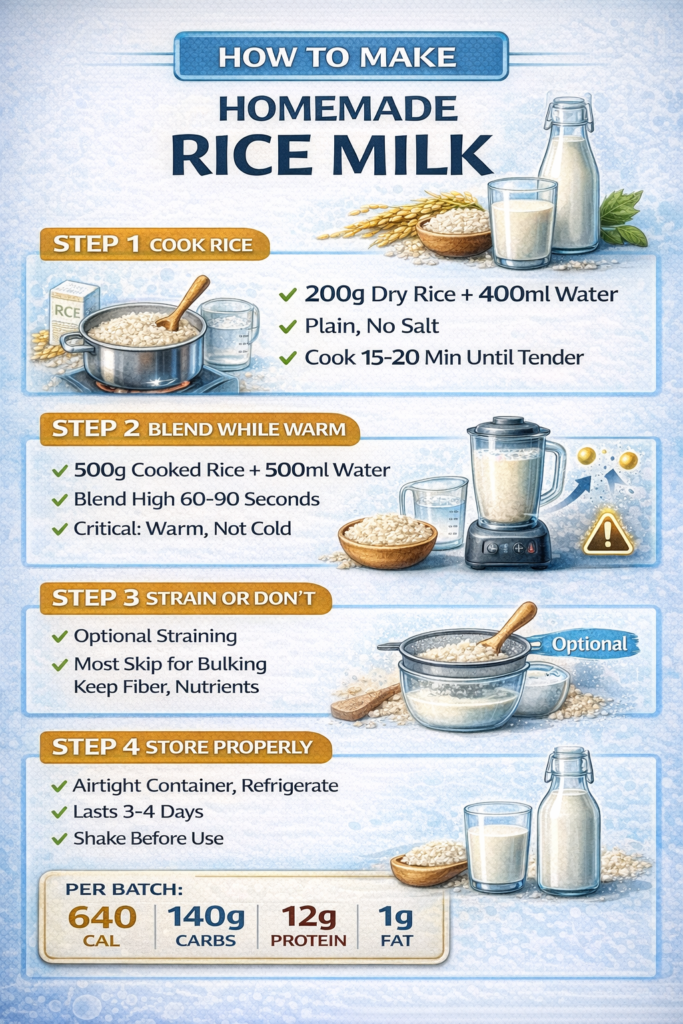
Step 1: Cook the rice properly
Important details:
- Use plain white rice (no salt, no oil, no seasoning)
- Cook until fully tender
- Drain excess water if needed
- Why plain: Neutral flavor makes it versatile for any use
Cooking method:
- 200g dry rice
- 400-500ml water
- Bring to boil
- Reduce heat, simmer 15-20 minutes
- Remove from heat when tender
Step 2: Blend while still warm (critical tip)
Why blend while warm:
- Rice is softer and breaks down easier
- Creates smoother consistency
- Blends much faster
- Cold rice is harder to blend smoothly
Blending process:
- Add 500g cooked rice to blender
- Add 500ml water
- Blend on high for 60-90 seconds
- Check consistency
- Blend additional 30 seconds if needed
Expected result:
- Smooth, milky liquid
- Some small rice particles normal
- Consistency like thin milkshake
Step 3: Strain or don’t (your choice)
Option A: Strain with fine mesh
- Pour through strainer
- Removes solid particles
- Smoother texture
- Lose some fiber and nutrients
Option B: Don’t strain (recommended)
- Keep everything
- More fiber
- More nutrients
- Thicker texture
- Better for bulking (more calories)
Most people skip straining for bulking purposes.
Step 4: Store properly
Storage guidelines:
- Pour into airtight container
- Refrigerate immediately
- Lasts 3-4 days refrigerated
- Shake well before each use (separates naturally)
Don’t make huge batches:
- Make 2-3 day supply
- Keeps fresher
- Better taste
- Food safety
Nutritional Information
Per full batch (500g rice + 500ml water):
- Calories: 640
- Carbohydrates: 140g
- Protein: 12g
- Fat: 1g
- Fiber: 1-2g
Per cup (240ml serving, approximately):
- Calories: ~155
- Carbohydrates: ~34g
- Protein: ~3g
- Fat: ~0.25g
Recipe Variations and Upgrades
Chocolate rice milk:
- Base recipe
- Add 2 tbsp unsweetened cocoa powder
- Optional: Stevia or honey for sweetness
- Blend together
High-protein version:
- Base recipe
- Add 1-2 scoops whey protein
- Blend together
- Now has 36-60g protein
Calorie-bomb version:
- Base recipe
- Add 4 tbsp peanut butter (380 calories)
- Add 2 scoops whey protein (240 calories)
- Add 1 banana (105 calories)
- Total: ~1,365 calories in one shake
Coffee-flavored:
- Base recipe
- Add 1 cup cold brew coffee
- Caffeinated carb source
Common Mistakes to Avoid
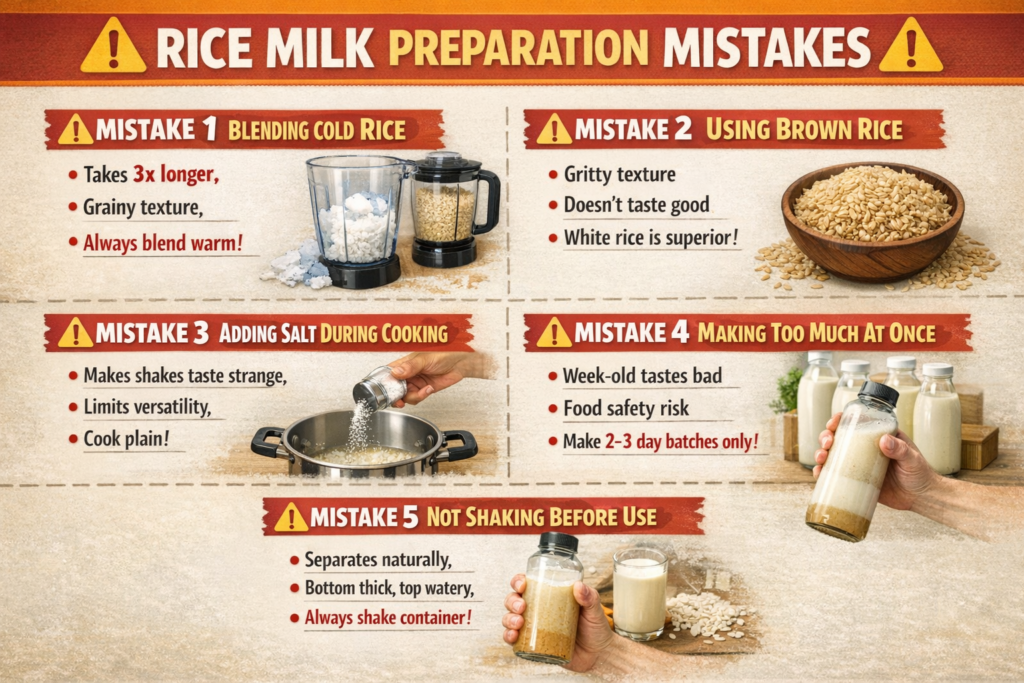
Mistake 1: Blending cold rice
- Much harder to blend smooth
- Takes 3x longer
- Results in grainier texture
- Always blend warm
Mistake 2: Using brown rice
- Works, but creates gritty texture
- Doesn’t taste as good
- Minimal nutritional advantage
- White rice superior for this purpose
Mistake 3: Adding salt during cooking
- Makes final product taste strange in shakes
- Limits versatility
- Cook plain, season later if needed
Mistake 4: Making too much at once
- Week-old rice milk tastes bad
- Food safety concerns
- Make 2-3 day batches maximum
Mistake 5: Not shaking before use
- Rice milk separates naturally
- Bottom thick, top watery
- Always shake container before pouring
How to Use Rice Milk in Your Muscle-Building Diet
Strategic incorporation for maximum benefit.
Best Times to Use Rice Milk
Timing 1: Post-Workout (Most Common)
Why it works:
- Need carbs for glycogen replenishment
- Liquid easier to consume than solid food post-training
- Fast-digesting carbs beneficial
- Convenient with protein shake
How to use:
- 1-2 cups rice milk (300-600 calories)
- 1-2 scoops whey protein (240-480 calories)
- Optional banana
- Complete post-workout nutrition in liquid form
Example post-workout shake:
- 2 cups rice milk (310 cal, 68g carbs)
- 2 scoops whey (240 cal, 48g protein)
- 1 banana (105 cal, 27g carbs)
- Total: 655 calories, 48g protein, 95g carbs
Timing 2: Between Meals (Strategic Calories)
Why it works:
- Need extra calories but not hungry enough for meal
- Liquid doesn’t fill you up like food
- Maintains calorie intake
- Prevents long fasting periods
How to use:
- Mid-morning or mid-afternoon
- 1-2 cups plain or with protein
- Doesn’t interfere with next meal appetite
Timing 3: Before Bed (Optional)
Why it might work:
- Prevents overnight fasting
- Carbs can aid sleep (some people)
- Easy calories when too full for food
Considerations:
- Some people sleep worse with carbs before bed
- Experiment to see how you respond
- Not necessary for most people
Timing 4: First Thing Morning (Specific Use Case)
Why some use this:
- Not hungry for solid breakfast
- Need calories to break fast
- Training early, need pre-workout carbs
How to use:
- 1 cup rice milk + protein powder
- 30-60 minutes before morning training
- Or as quick breakfast replacement
Practical Meal Examples
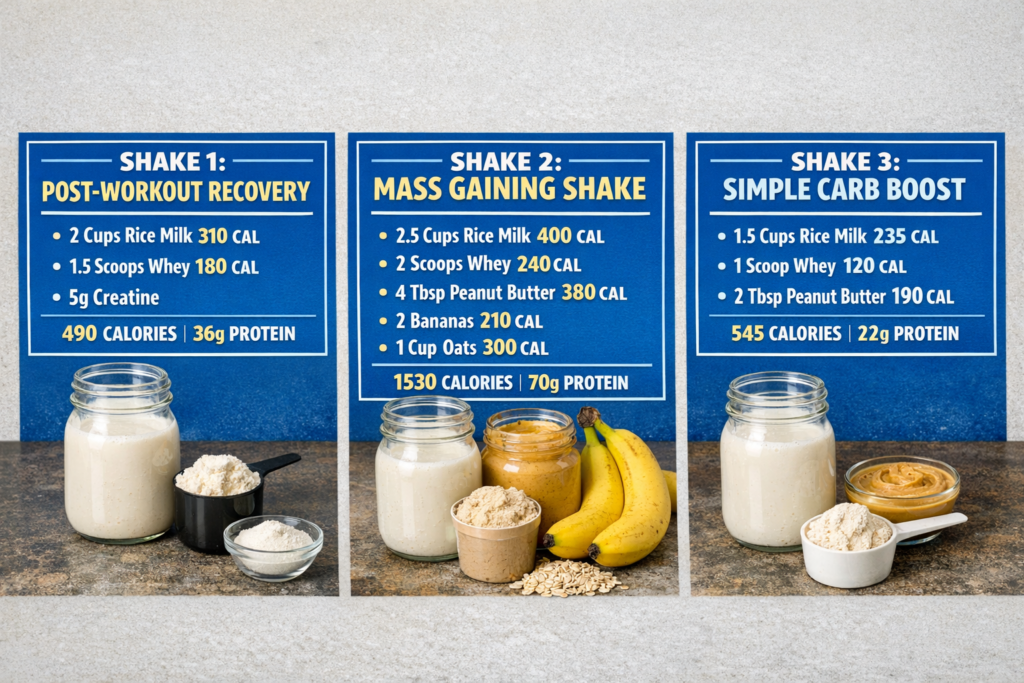
Mass Gaining Shake (1,200+ calories):
- 2.5 cups homemade rice milk (400 cal)
- 2 scoops whey protein (240 cal)
- 4 tbsp peanut butter (380 cal)
- 2 bananas (210 cal)
- 1 cup oats (300 cal)
- Total: 1,530 calories, 70g protein
Post-Workout Recovery Shake:
- 2 cups rice milk (310 cal, 68g carbs)
- 1.5 scoops whey (180 cal, 36g protein)
- 5g creatine
- Total: 490 calories, perfect post-workout
Bulking Breakfast Shake:
- 1.5 cups rice milk (235 cal)
- 1 scoop whey (120 cal)
- 1/2 cup oats (150 cal)
- 2 tbsp peanut butter (190 cal)
- Total: 695 calories, easy to drink
Simple Carb Addition:
- Any protein shake recipe
- Use rice milk instead of water or regular milk
- Instant 150-300 additional calories
- More carbs for glycogen
How Much to Use Daily
Depends on your total calorie needs and current intake.
Scenario 1: Small shortfall (200-400 calories)
- Use 1-2 cups daily
- One serving post-workout
- Fills gap perfectly
Scenario 2: Moderate shortfall (400-800 calories)
- Use 2-4 cups daily
- Post-workout shake
- Mid-afternoon shake
- Major calorie boost
Scenario 3: Large shortfall (800+ calories)
- Use 3-5 cups daily
- Multiple shakes throughout day
- Or one massive shake
- Extreme hardgainer solution
General recommendation:
- Start with 1-2 cups daily
- Assess weight gain after 2 weeks
- Increase if gaining too slowly
- Decrease if gaining too fast
- Target: 0.5-1% body weight gain weekly
Foods to Pair With Rice Milk
Rice milk is pure carbs. Add other macros.
Protein sources:
- Whey protein powder (convenient)
- Greek yogurt (if not dairy intolerant)
- Protein-rich solid meals
- Ensure 0.8-1g protein per pound daily
Healthy fats:
- Peanut butter (calorie-dense)
- Almond butter
- Nuts
- Avocado (in smoothies, yes really)
- MCT oil
Additional carbs (if needed):
- Oats (slow-release)
- Banana (fast-release)
- Honey (sweet, fast carbs)
Micronutrients:
- Spinach in shakes (can’t taste it)
- Berries
- Multivitamin separately
- Whole food meals
Frequently Asked Questions
Common concerns answered.
Is rice milk healthy?
For bulking: Yes, very effective.
Nutritional profile:
- High carbs (needed for muscle gain)
- Low fat (allows customization)
- Low protein (add protein separately)
- Easily digestible
What it’s NOT:
- Not a complete meal replacement alone
- Not high in micronutrients
- Not a protein source
What it IS:
- Excellent carbohydrate source
- Affordable calorie addition
- Digestible liquid nutrition
- Tool for specific purpose (bulking)
For cutting: Less useful.
- Too calorie-dense
- Better options for fat loss
- Save for bulking phases
Can rice milk replace regular milk?
Depends on context.
For bulking calories: Yes
- Provides more carbs
- Cheaper
- Allergen-free
- Works great
For complete nutrition: No
- Lacks calcium (regular milk has 300mg per cup)
- Lacks vitamin D (fortified milk has this)
- Lower protein (regular milk has 8g per cup)
- Get these nutrients elsewhere
The smart approach:
- Use rice milk for carb calories
- Get calcium from other sources (leafy greens, fortified foods)
- Get vitamin D from sun, supplements, or fortified foods
- Get protein from meat, eggs, whey, etc.
Does rice milk contain gluten?
No, rice is naturally gluten-free.
- Safe for celiac disease
- Safe for gluten sensitivity
- Rice is one of safest grains
- Completely gluten-free
Caveat: If buying store-bought, check label for cross-contamination warnings if severely celiac.
How long does homemade rice milk last?
Refrigerated: 3-4 days maximum
Signs it’s gone bad:
- Sour smell
- Unusual separation
- Slimy texture
- Off taste
Storage tips:
- Airtight container
- Refrigerate immediately after making
- Shake before each use
- Make small batches (2-3 days worth)
Don’t freeze:
- Texture changes significantly
- Not recommended
- Make fresh instead
Is rice milk good for weight loss?
Generally no, not ideal for cutting.
Why it’s not great for fat loss:
- Very calorie-dense (opposite of what you want)
- High carbs without satiety
- Liquid calories less filling
- Easy to overconsume
For cutting, better options:
- Water
- Black coffee
- Unsweetened almond milk (30 cal per cup vs. 155)
- Tea
Exception: If doing high-volume training and need carbs while cutting, small amounts might work. But generally, save rice milk for bulking.
Can I use brown rice instead of white?
Yes, but white is better.
Brown rice version:
- More fiber (good)
- Slightly more micronutrients (good)
- Grittier, less pleasant texture (bad)
- Doesn’t taste as good (bad)
- Harder to blend smooth (bad)
White rice version:
- Smooth texture
- Better taste
- Easier to blend
- Nearly identical macro benefits for bulking
Recommendation: Use white rice for best results.
Is store-bought rice milk the same?
No, completely different.
Store-bought:
- Heavily diluted (30-50 cal per cup)
- Often has added sugar
- Contains stabilizers, preservatives
- Expensive ($3-5 per container)
- Not useful for bulking
Homemade concentrated:
- 155 calories per cup (3-5x more concentrated)
- No additives
- Pure rice and water
- Costs $0.10-0.15 per cup
- Perfect for bulking
Don’t confuse the two. Only homemade version works for muscle building.
The Bottom Line: The Ultimate Budget Bulking Tool
After examining all aspects:
The truth about rice milk for muscle building:
✅ Provides 640 calories from $0.30-0.50 of ingredients (vs. $2.50-4 for mass gainer)
✅ Made in 10 minutes (cook rice, blend with water, done)
✅ Allergen-free (no dairy, soy, nuts, gluten)
✅ Zero controversial ingredients (just rice and water)
✅ Easy to digest (gentle on stomach, sustainable for daily use)
✅ Extremely versatile (drink plain, mix with protein, use in recipes)
When rice milk makes sense:
Perfect for:
- Hardgainers struggling to eat enough calories
- People with lactose intolerance or dairy allergies
- Budget-conscious bulkers
- Anyone wanting clean, simple liquid carbs
- Those who can’t tolerate mass gainers
Not ideal for:
- Cutting (too calorie-dense)
- People who can easily eat enough solid food
- Those seeking complete meal replacement (need to add protein/fats)
How to use effectively:
The simple protocol:
- Make batch every 2-3 days (500g rice + 500ml water)
- Store in fridge
- Use 1-3 cups daily based on calorie needs
- Combine with protein powder post-workout
- Track weight gain (target 0.5-1% weekly)
- Adjust amount based on results
Sample daily usage for 180-pound hardgainer:
- Breakfast: Solid food (eggs, oats)
- Post-workout: 2 cups rice milk + 2 scoops whey (550 cal)
- Lunch: Solid food (chicken, rice, vegetables)
- Snack: 1 cup rice milk + protein (275 cal)
- Dinner: Solid food
- Added 825 liquid calories easily
The cost reality:
Annual comparison (using 640 cal daily for 9-month bulk):
Homemade rice milk: $108
Mass gainer: $540
Savings: $432 annually
That’s enough to buy:
- Year’s supply of creatine ($60)
- 50 pounds of chicken ($150)
- New training shoes ($100)
- And still have money left over
MAKE RICE MILK. ADD LIQUID CALORIES. BULK ON A BUDGET. BUILD MUSCLE.
Ready to build a complete, customized bulking plan that maximizes muscle gain while minimizing cost, without relying on expensive supplements or forcing down food when you’re stuffed? Rice milk is one tool in effective bulking nutrition. Get a comprehensive guide to calculating your exact calorie and macro needs, building affordable meal plans that actually work, timing your nutrition for maximum muscle growth, and using budget strategies that deliver serious results. Stop wasting money on overpriced mass gainers. Start bulking intelligently with proven, affordable strategies.


Leave a Reply
You must be logged in to post a comment.