
Skipping breakfast to burn fat? Here’s the science-backed truth about the 16/8 intermittent fasting protocol and how to use it effectively for cutting without losing muscle.
The idea of not eating for 16 hours straight probably sounds crazy to you.
You’ve heard all the warnings:
- “You need to eat every 2-3 hours to keep your metabolism running”
- “Skipping meals will put your body in starvation mode”
- “You’ll lose all your muscle if you don’t eat constantly”
- “Breakfast is the most important meal of the day”
Yet intermittent fasting has exploded in popularity, with millions of people using it successfully to lose fat, simplify their nutrition, and improve their health.
So what’s the truth?
Here’s the reality: Intermittent fasting (specifically the 16/8 protocol) is one of the most effective and sustainable approaches for fat loss, not because of metabolic magic, but because it makes adherence dramatically easier.
In this comprehensive guide, I’ll explain exactly what 16/8 intermittent fasting is, reveal what the science actually says (spoiler: it’s not magic), show you step-by-step how to implement it correctly, explain how to train while fasting, and help you avoid the common mistakes that sabotage results.
This isn’t about selling you a miracle cure. It’s about giving you a practical tool that makes fat loss easier.
Let’s get into it.
TABLE OF CONTENTS
- Mistake 1: Overeating During the Eating Window
- Mistake 2: Breaking the Fast With Junk Food
- Mistake 3: Not Drinking Enough Water
- Mistake 4: Quitting Too Soon
- Mistake 5: Inconsistent Eating Windows
- Mistake 6: Using Intermittent Fasting as an Excuse for Poor Nutrition
- Mistake 7: Consuming "Calorie-Free" Foods That Break the Fast
- Important Reminders: Key Principles for Success
- The Bottom Line: Intermittent Fasting Is About Adherence
What Is 16/8 Intermittent Fasting?
Let’s start with the basics before diving into how to use it.
The Simple Definition
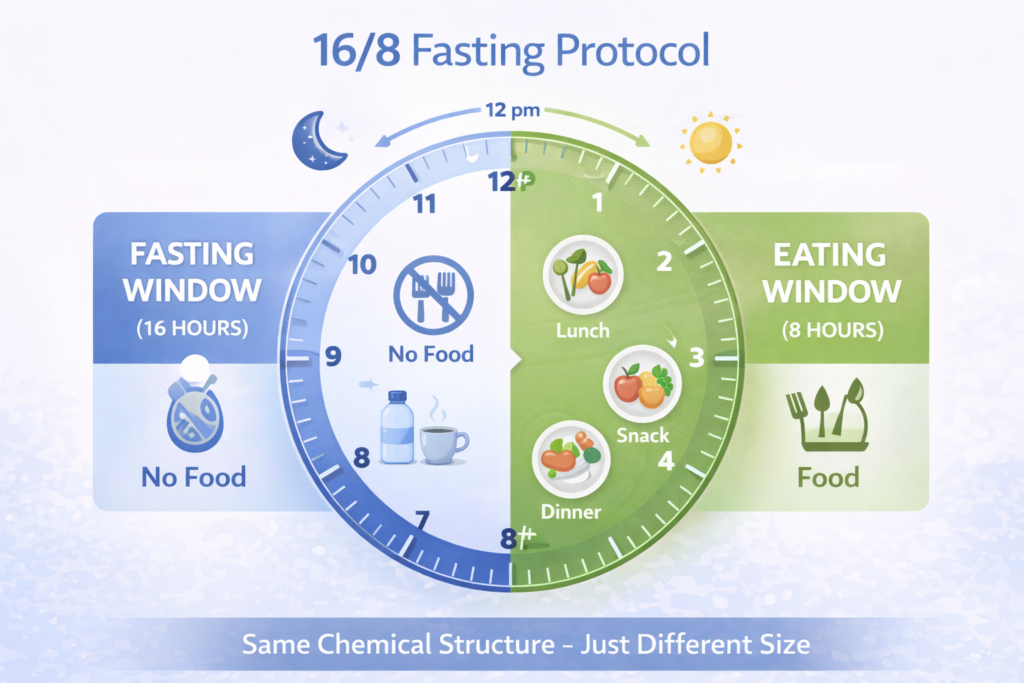
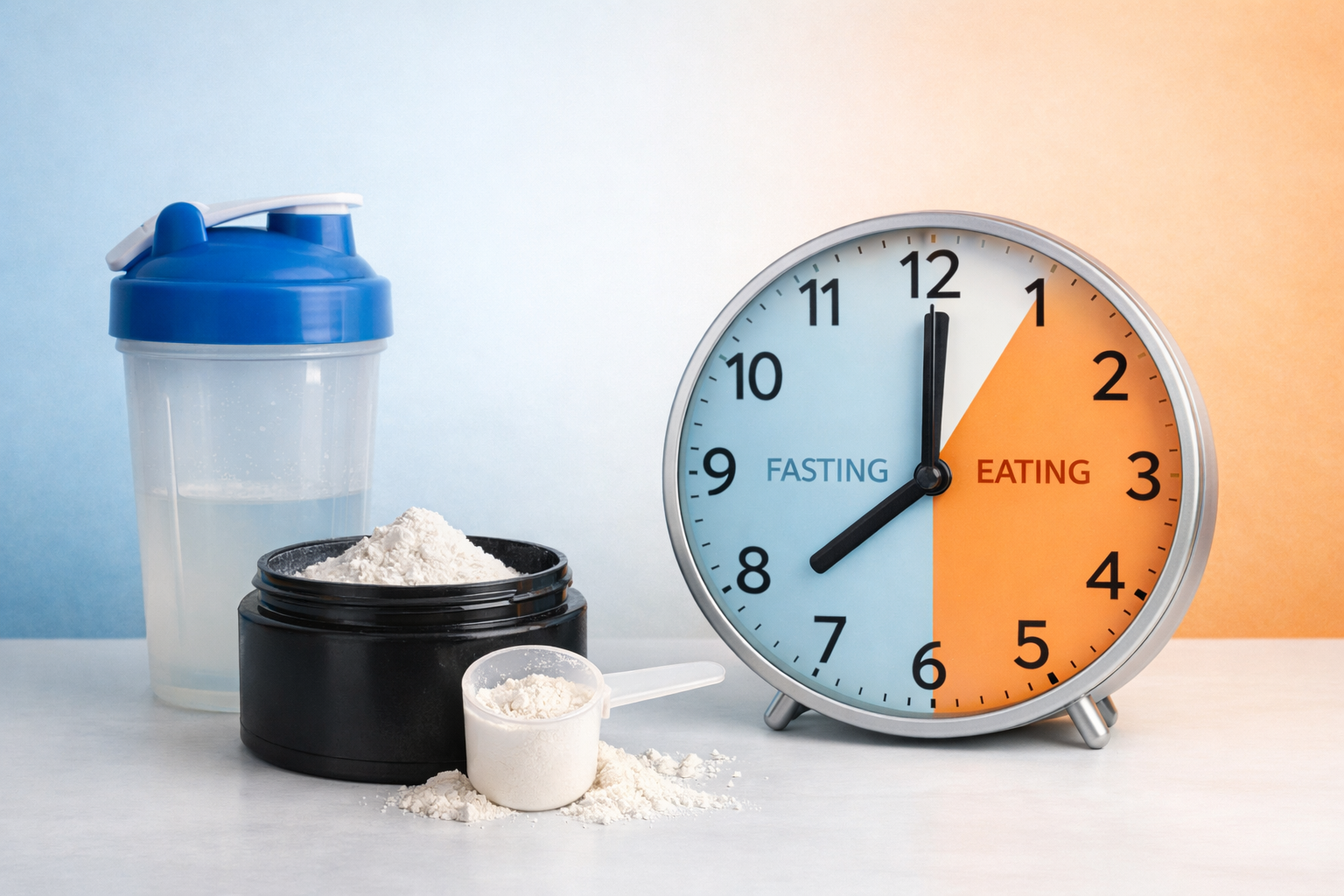
16/8 intermittent fasting means:
- Fasting for 16 hours
- Eating all your daily food within an 8-hour window
That’s it. The concept is remarkably simple.
A Practical Example
Most common schedule:
- Eating window: 12:00 PM to 8:00 PM
- Fasting window: 8:00 PM to 12:00 PM the next day
What this looks like in practice:
- Wake up at 7:00 AM, drink coffee or water (no calories)
- Continue fasting through the morning
- First meal at 12:00 PM (lunch)
- Second meal around 3:00-4:00 PM (afternoon)
- Third meal around 7:00-8:00 PM (dinner)
- Stop eating at 8:00 PM
- Fast until 12:00 PM the next day
The eating window can be adjusted to fit your schedule:
- 1:00 PM to 9:00 PM
- 10:00 AM to 6:00 PM
- 2:00 PM to 10:00 PM
The timing doesn’t matter. What matters is maintaining the 16-hour fast and 8-hour eating window consistently.
What Intermittent Fasting Is NOT
Intermittent fasting is not:
❌ Starvation or severe calorie restriction
❌ A specific diet telling you what to eat
❌ A way to eat unlimited calories and still lose fat
❌ A replacement for proper nutrition
❌ Magic that burns fat without a calorie deficit
Intermittent fasting is simply: A schedule for when you eat, not what you eat.
The Truth About Intermittent Fasting and Fat Loss
Before you get overly excited or dismissive, you need to understand what intermittent fasting actually does (and doesn’t do).
What the Science Actually Shows
A comprehensive review of over 40 studies on intermittent fasting concluded:
When calorie intake is equalized, intermittent fasting provides numerous psychological and physiological benefits for fat loss, but does NOT provide additional fat loss compared to traditional dieting approaches.
Let me translate: Intermittent fasting doesn’t magically burn more fat by itself.
You still need to create a caloric deficit (consume fewer calories than your body burns) for fat to be used as energy.
The 16/8 protocol doesn’t change the laws of thermodynamics.
So Why Bother With Intermittent Fasting?
Here’s where it gets interesting:
While intermittent fasting doesn’t directly burn extra fat, it can dramatically accelerate and facilitate the entire fat loss process, helping you reach your goal much faster.
How? By making adherence to your diet significantly easier.
This is the real power of intermittent fasting. Not metabolic magic, but psychological and practical advantages that help you actually stick to your diet.
The Real Benefits of 16/8 Intermittent Fasting
Let’s examine the actual advantages that make this protocol so effective.
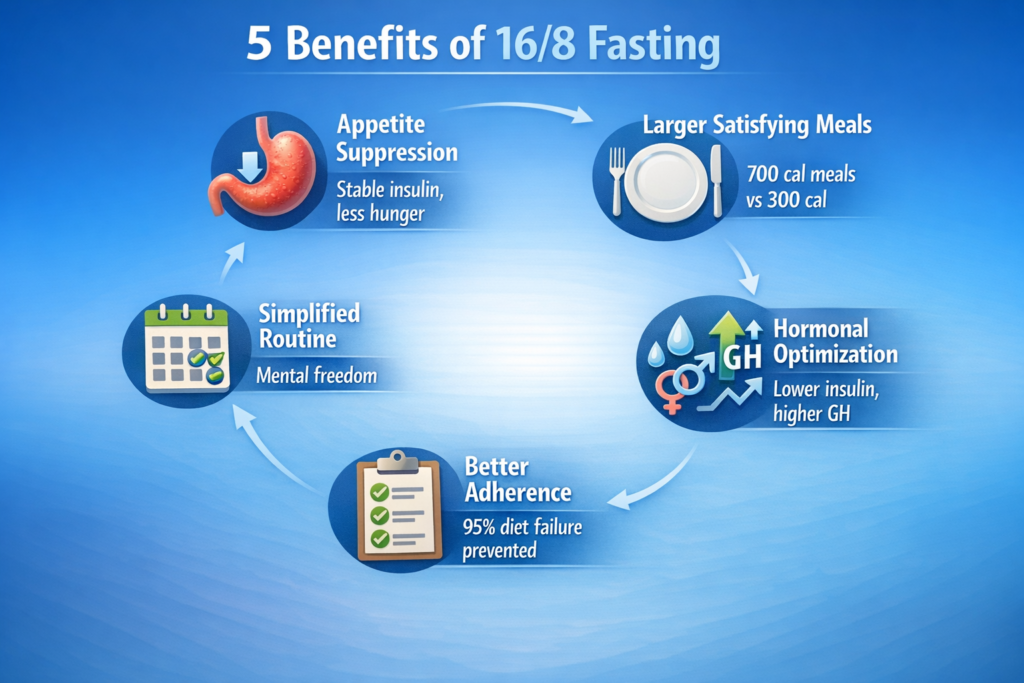
Benefit 1: Powerful Appetite Suppression
This is intermittent fasting’s biggest advantage.
When you fast for an extended period, insulin levels stabilize.
Lower, stable insulin means:
- Reduced food cravings
- Less hunger between meals
- Elimination of blood sugar rollercoaster
- Better appetite control throughout the day
The science: Studies show that after an adaptation period (2-3 weeks), people report significantly reduced hunger during fasting windows compared to when they ate breakfast.
Practical impact: If you’re not hungry for most of the day, staying in a caloric deficit becomes dramatically easier.
Benefit 2: Larger, More Satisfying Meals
When you compress all your daily calories into an 8-hour window instead of 12-16 hours, your individual meals become substantially larger.
Example comparison:
Traditional eating (3 meals + snacks across 14 hours):
- Breakfast: 400 calories
- Mid-morning snack: 150 calories
- Lunch: 500 calories
- Afternoon snack: 150 calories
- Dinner: 600 calories
- Evening snack: 200 calories
- Total: 2,000 calories
16/8 intermittent fasting (3 meals in 8 hours):
- First meal (12 PM): 700 calories
- Second meal (4 PM): 650 calories
- Third meal (8 PM): 650 calories
- Total: 2,000 calories
Same total calories, but the 16/8 approach provides larger, more satisfying meals that make you feel full despite eating the same amount.
Psychological advantage: It’s easier to feel satisfied with three 600-700 calorie meals than six 300-350 calorie meals or snacks.
Benefit 3: Simplified Daily Routine
Intermittent fasting dramatically simplifies your relationship with food.
What you eliminate:
- Constant meal planning and prep throughout the day
- Worrying about eating every 2-3 hours
- Anxiety about missing a meal and “losing gains”
- Packing multiple meals for work or travel
- Interrupting your day for frequent eating
What you gain:
- Mental freedom during fasting hours
- Ability to focus on work and other priorities
- Simplified grocery shopping and meal prep
- Less time spent thinking about food
- Greater flexibility in your daily schedule
Practical impact: During your fasting window, you simply don’t eat. You don’t have to plan, prepare, or think about food. You can focus entirely on being productive.
Benefit 4: Improved Dietary Adherence
This is the ultimate benefit that makes everything else matter:
All the advantages above combine to create one powerful outcome: you’re far more likely to stick to your diet long-term.
The statistics on diet failure are brutal:
- Most people quit diets within 2-4 weeks
- Over 95% of dieters regain lost weight
- Hunger and restriction are the primary reasons for failure
Intermittent fasting addresses these failure points:
- Reduces hunger (easier to stick with it)
- Allows larger meals (feels less restrictive)
- Simplifies execution (fewer obstacles to consistency)
The result: Higher success rates and sustainable fat loss.
Benefit 5: Potential Hormonal Optimization
While less important than adherence benefits, there are some hormonal changes during fasting:
Lower insulin levels:
- Insulin is a storage hormone
- Lower levels facilitate fat mobilization
- Reduced insulin resistance over time
Increased growth hormone (GH):
- GH levels can increase during fasting
- May help preserve muscle mass during caloric deficit
- Supports fat oxidation
Enhanced norepinephrine:
- Increases during fasting
- Stimulates fat breakdown
- Supports metabolism
Important context: While these hormonal changes are real, their practical impact on fat loss is minimal compared to simply maintaining a caloric deficit consistently.
Don’t fast for hormonal optimization. Fast because it makes diet adherence easier.
The 16/8 Protocol: Step-by-Step Implementation
Now let’s get practical about how to actually do this.
Step 1: Choose Your Eating Window
Pick an 8-hour window that fits your lifestyle and schedule.
Common options:
12 PM to 8 PM (most popular):
- Skip breakfast
- Eat lunch, afternoon meal, dinner
- Good for people who aren’t hungry in the morning
- Allows social dinner with family/friends
1 PM to 9 PM:
- Later eating window
- Good for night owls
- Accommodates late dinners
10 AM to 6 PM:
- Earlier window
- Includes late breakfast
- Good for early risers who get hungry sooner
- Allows earlier last meal
2 PM to 10 PM:
- Very late window
- For people who prefer late eating
- Can make social evenings easier
Key principle: Choose a window you can maintain consistently. The specific hours don’t matter for results.
Step 2: Understand What Breaks Your Fast
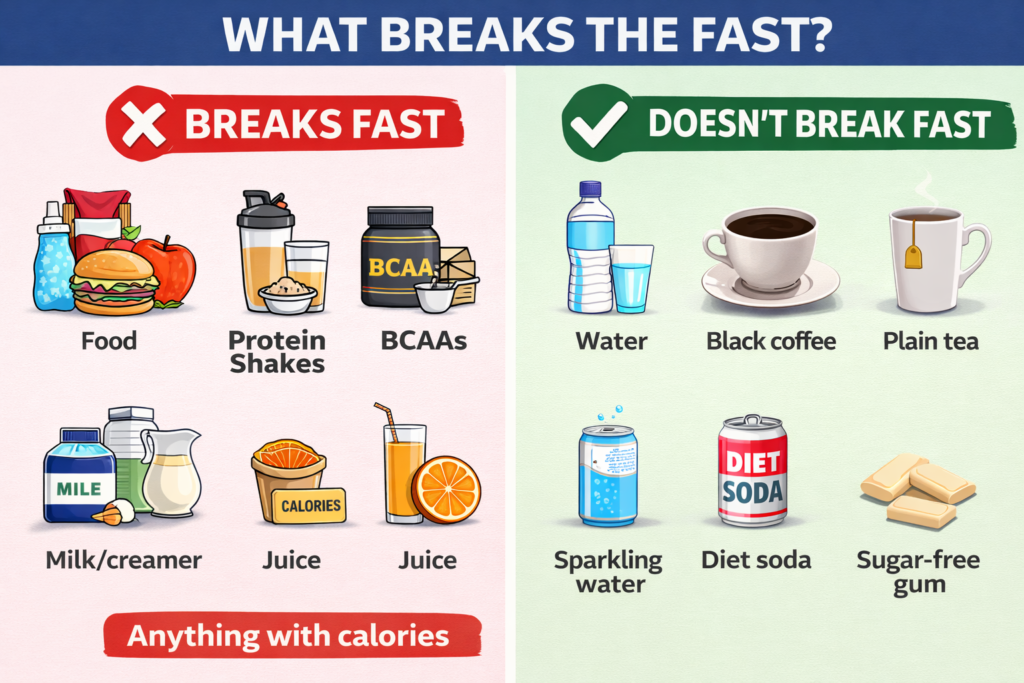
During the 16-hour fasting window, you MUST NOT consume anything with calories.
What breaks your fast (AVOID during fasting):
❌ Any food whatsoever
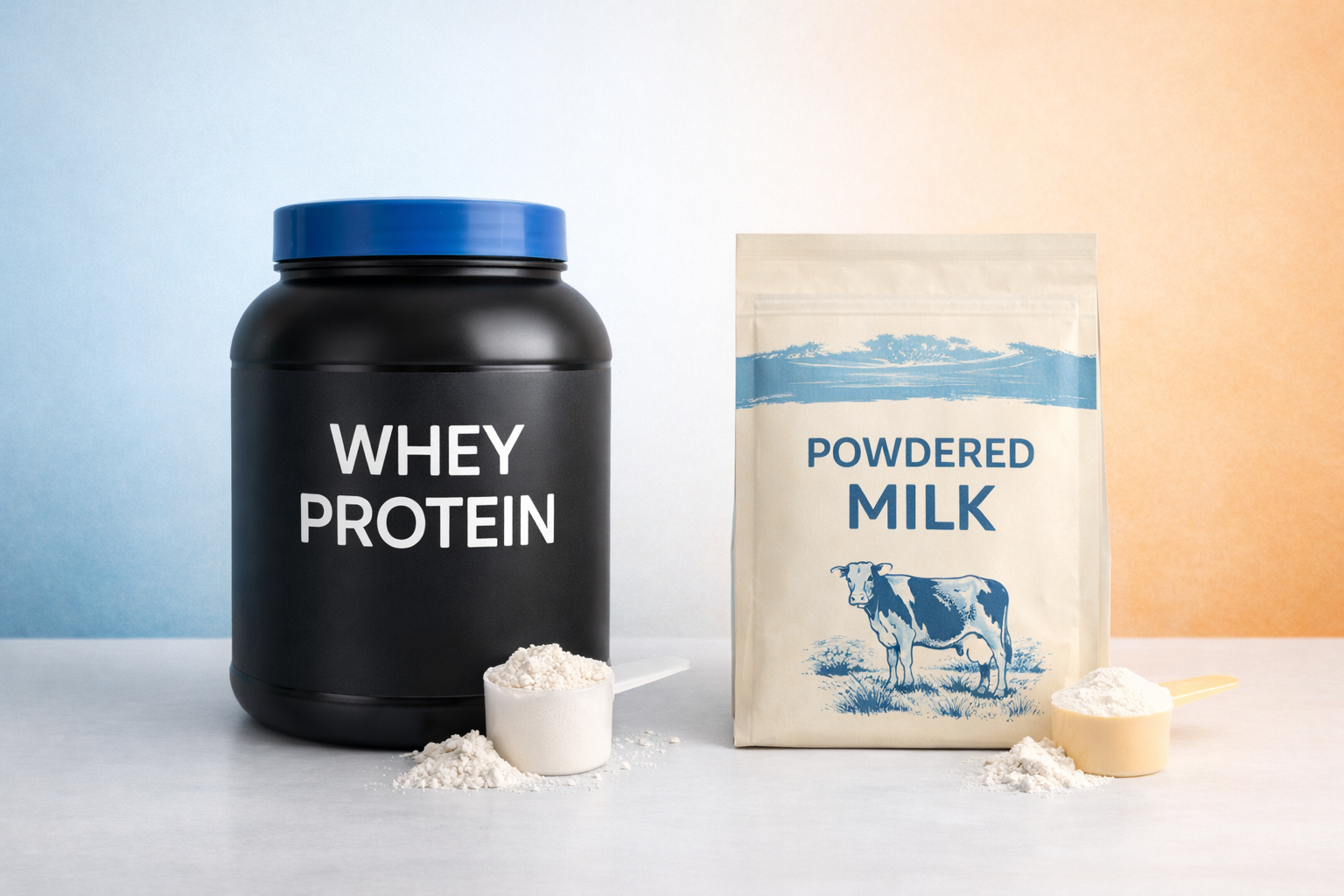
❌ Protein shakes or whey protein
❌ BCAAs (branched-chain amino acids)
❌ Glutamine or other amino acids
❌ Milk or creamer in coffee
❌ Juice or sugary drinks
❌ Anything with calories on the nutrition label
Why amino acids break the fast: BCAAs, glutamine, and other amino acids can rapidly convert to glucose when consumed in a fasted state, spiking insulin and breaking your fast.
What does NOT break your fast (ALLOWED during fasting):
✅ Water (as much as you want)
✅ Black coffee (no sugar, milk, or creamer)
✅ Plain tea (green tea, black tea, herbal tea)
✅ Sparkling water
✅ Diet soda or zero-calorie drinks (with artificial sweeteners)
✅ Sugar-free gum (minimal calories)
Step 3: Optimize Your Fasting Window
Use these strategies to make fasting easier:
Drink plenty of water:
- Water is a natural appetite suppressant
- Helps you feel full
- Prevents dehydration-induced hunger signals
- Target: 8-10 glasses throughout the day
Use black coffee strategically:
- Coffee contains caffeine (thermogenic effect)
- Suppresses appetite effectively
- Provides energy and mental clarity
- Timing: Have a cup when hunger strikes during fasting
Try green tea:
- Contains caffeine and catechins (mild fat-burning properties)
- Appetite suppression
- Antioxidant benefits
- Can alternate with coffee for variety
Stay busy and productive:
- Don’t sit around thinking about food
- Fill fasting hours with work, hobbies, errands
- Mental engagement reduces hunger awareness
- Use the extra time productively
Step 4: Plan Your Eating Window
What to eat during your 8-hour window:
Follow the 80/20 rule for sustainability:
80% of calories: Whole, minimally processed foods
- Lean proteins (chicken, fish, lean beef, eggs)
- Vegetables (unlimited quantities)
- Complex carbs (rice, potatoes, oats, whole grains)
- Healthy fats (avocado, nuts, olive oil)
- Fruits (in moderation)
20% of calories: Whatever you want
- Treats, desserts, processed foods
- “Cheat” foods you enjoy
- Social eating flexibility
This flexibility makes the diet sustainable long-term.
Meal structure example (12 PM to 8 PM window):
Meal 1 (12 PM): 30-40% of daily calories
- Protein source (chicken, fish, lean meat)
- Carbs (rice, potatoes, pasta)
- Vegetables
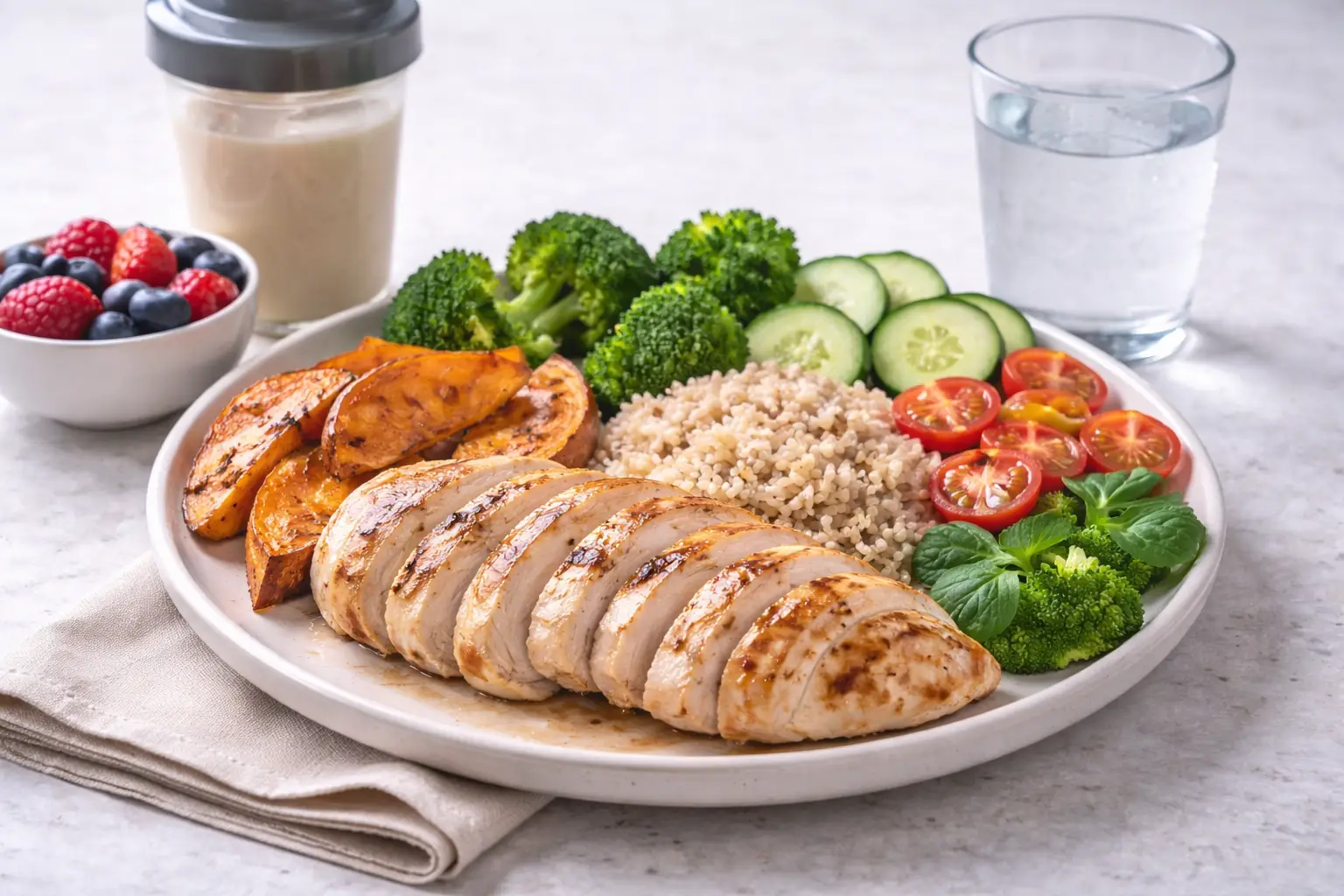
- Example: Grilled chicken breast, brown rice, broccoli
Meal 2 (4 PM): 25-35% of daily calories
- Similar macronutrient balance
- Can be larger or smaller based on training schedule
- Example: Ground turkey, sweet potato, green beans
Meal 3 (7:30-8 PM): 30-35% of daily calories
- Final meal before fast
- Slightly higher in protein and fats (longer satiety)
- Example: Salmon, quinoa, asparagus, mixed nuts
Step 5: Set Your Calorie and Macronutrient Targets
Intermittent fasting doesn’t eliminate the need for proper nutrition planning.
For fat loss, you need:
Calorie deficit:
- Calculate maintenance calories (bodyweight × 14-16)
- Subtract 300-500 calories for fat loss
- Track food to ensure you’re in deficit
Adequate protein:
- 0.8-1.0g per pound of body weight
- Preserves muscle during fat loss
- Increases satiety
Example for a 180-pound person cutting:
- Maintenance: 180 × 15 = 2,700 calories
- Cutting: 2,200-2,400 calories daily
- Protein: 144-180g daily
- Fill remaining calories with carbs and fats based on preference
Track your food: Use MyFitnessPal, Cronometer, or similar apps to ensure you’re hitting targets.
The Adaptation Period: What to Expect
Your body needs time to adapt to intermittent fasting. Here’s what’s normal.
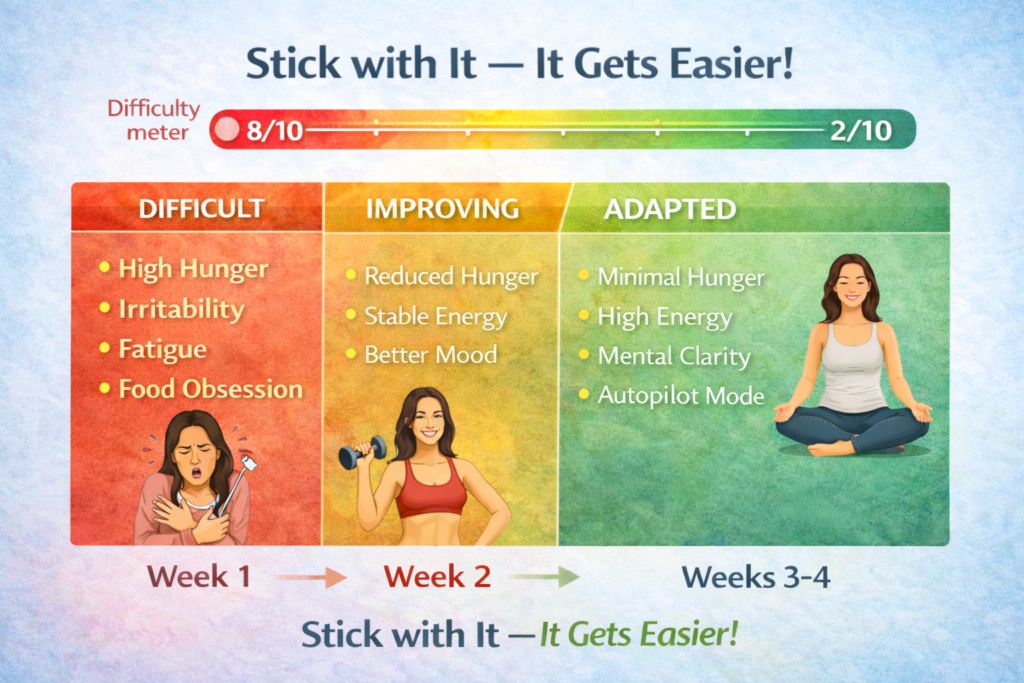
Week 1: The Hardest Phase
Common experiences:
Hunger: Significant hunger in the morning, especially if you’re used to eating breakfast.
Irritability: Some moodiness and crankiness (the “hangry” effect).
Fatigue: Slightly lower energy, particularly in the morning.
Headaches: Possible mild headaches (often from dehydration or caffeine withdrawal).
Food obsession: Constantly thinking about food and when you can eat.
What to do:
- Stay hydrated (many “hunger” signals are actually thirst)
- Use black coffee or tea to manage hunger
- Stay busy and productive
- Remember this is temporary
- Consider starting with 14-hour fasts if 16 is too difficult
Week 2: Getting Easier
What changes:
Reduced hunger: Morning hunger decreases noticeably.
Stable energy: Energy levels stabilize and improve.
Mental clarity: Many people report improved focus during fasting.
Less irritability: Mood stabilizes as the body adapts.
What to do:
- Continue consistent schedule
- Notice improvements and acknowledge progress
- Fine-tune eating window if needed
Week 3-4: Fully Adapted
What you’ll experience:
Minimal hunger: Little to no hunger during fasting window.
High energy: Often higher energy in fasted state than when eating breakfast.
Mental sharpness: Enhanced focus and productivity during fasting hours.
Autopilot: Fasting becomes second nature, requiring minimal willpower.
Hormonal adaptation: Your body stops releasing hunger hormones (ghrelin) during fasting hours.
The key: Give yourself the full 2-4 weeks to adapt. Most people quit during week 1 before experiencing the benefits.
Training While Doing 16/8 Intermittent Fasting
How you schedule training matters significantly for results.
The Optimal Approach: Train Within Your Eating Window
While training fasted has some theoretical fat-burning benefits, training in a fed state is far superior for:
- Performance and strength
- Muscle preservation
- Training intensity
- Recovery
Best strategy: Schedule training so you can have a pre-workout and post-workout meal within your eating window.
Training Schedule Examples
Example 1: Morning Training (11 AM workout)
Eating window: 9 AM to 5 PM
- 9:00 AM: Pre-workout meal (protein + carbs)
- 11:00 AM-12:00 PM: Training session
- 12:00-12:30 PM: Post-workout meal (protein + carbs)
- 3:00 PM: Second meal
- 5:00 PM: Final meal before fast
- Fast from 5 PM to 9 AM next day
Example 2: Afternoon Training (3 PM workout)
Eating window: 12 PM to 8 PM
- 12:00 PM: First meal
- 2:00 PM: Pre-workout meal/snack
- 3:00-4:00 PM: Training session
- 4:30 PM: Post-workout meal
- 7:30 PM: Final meal before fast
- Fast from 8 PM to 12 PM next day
Example 3: Evening Training (6 PM workout)
Eating window: 12 PM to 8 PM
- 12:00 PM: First meal
- 4:00 PM: Pre-workout meal
- 6:00-7:00 PM: Training session
- 7:30 PM: Post-workout meal (final meal)
- Fast from 8 PM to 12 PM next day
Key principle: Adjust your eating window to accommodate training with proper nutrition before and after.
What If You Must Train Fasted?
If your schedule absolutely requires fasted training:
Strategies to minimize muscle loss:
Use BCAAs or EAAs: While these technically break your fast, they provide amino acids to prevent muscle breakdown during training. Take 10g before fasted training.
Train with lower volume: Reduce sets and exercises slightly to avoid excessive muscle damage without fuel.
Eat immediately after: Break your fast with a protein-rich meal right after training.
Prioritize strength over hypertrophy: Focus on heavy, lower-rep work rather than high-volume bodybuilding training.
Monitor performance: If strength drops significantly, you need to adjust your window to allow pre-workout nutrition.
Reality check: Fasted training is suboptimal. Only do it if schedule absolutely requires it.
Common Mistakes That Sabotage Results
Avoid these errors that prevent intermittent fasting from working.
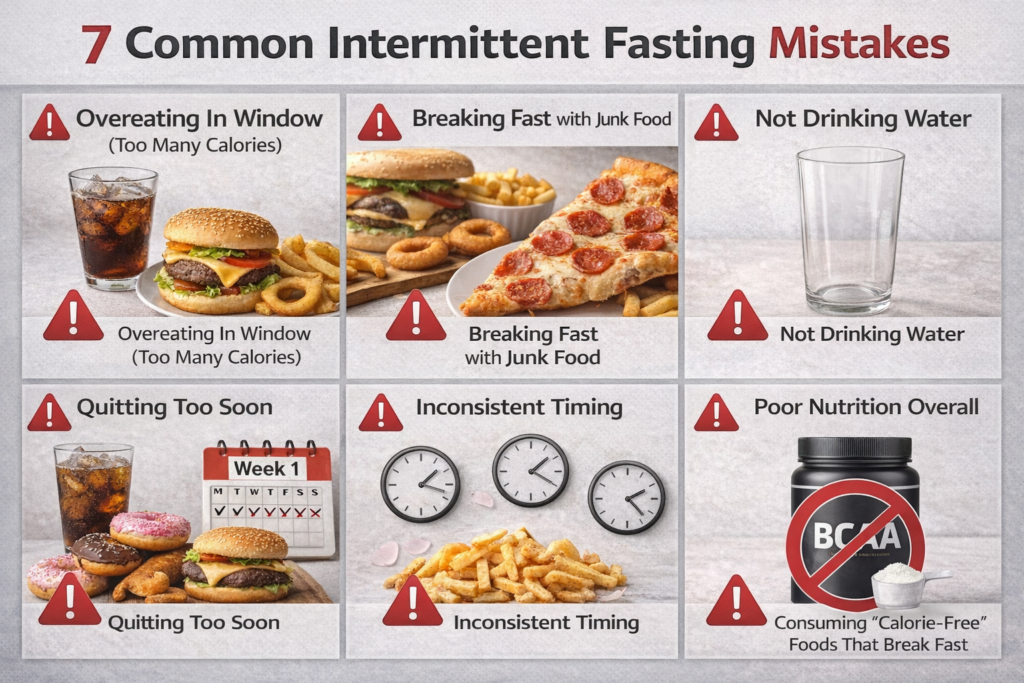
Mistake 1: Overeating During the Eating Window
The problem: “I can eat whatever I want as long as it’s in my window!”
The reality: You still need a caloric deficit to lose fat. Intermittent fasting doesn’t change this.
What happens: People compress 3,000+ calories into 8 hours and wonder why they’re not losing fat.
The solution: Track your food. Ensure you’re in a caloric deficit despite the eating window.
Mistake 2: Breaking the Fast With Junk Food
The problem: First meal is pizza, burgers, or other highly processed, calorie-dense food.
The reality: While you can fit treats into your macros, breaking your fast with junk makes it nearly impossible to stay in a deficit.
What happens: The first meal uses most of your daily calories, leaving little room for the rest of the day.
The solution: Break your fast with a balanced meal: protein, vegetables, moderate carbs, healthy fats.
Mistake 3: Not Drinking Enough Water
The problem: Dehydration is often mistaken for hunger.
What happens: Increased perceived hunger during fasting, making it harder to stick with the protocol.
The solution: Drink 8-10 glasses of water throughout the day, especially during fasting hours.
Mistake 4: Quitting Too Soon
The problem: Giving up during week 1 when hunger and discomfort are highest.
What happens: You never adapt, never experience the benefits, and conclude “intermittent fasting doesn’t work for me.”
The solution: Commit to 3-4 weeks minimum. If truly struggling, start with 14-hour fasts and gradually increase to 16.
Mistake 5: Inconsistent Eating Windows
The problem: Eating window varies drastically day to day (12-8 PM Monday, 2-10 PM Tuesday, 10 AM-6 PM Wednesday).
What happens: Your body never adapts. Hunger hormones don’t regulate. Feels difficult indefinitely.
The solution: Keep the same eating window 6-7 days per week. Consistency allows adaptation.
Mistake 6: Using Intermittent Fasting as an Excuse for Poor Nutrition
The problem: “As long as I fast 16 hours, I can eat garbage.”
The reality: Intermittent fasting doesn’t make poor food choices healthy.
What happens: Poor body composition, low energy, compromised health despite weight loss.
The solution: Follow the 80/20 rule. Prioritize whole foods. Treat intermittent fasting as a meal timing strategy, not a free pass for junk food.
Mistake 7: Consuming “Calorie-Free” Foods That Break the Fast
The problem: Thinking BCAAs, bone broth, or bulletproof coffee are “fasting-friendly.”
The reality: Anything with calories breaks your fast and stops the benefits.
The solution: Stick to water, black coffee, plain tea, and truly zero-calorie beverages during fasting.
Who Should (and Shouldn’t) Use 16/8 Intermittent Fasting
Intermittent fasting isn’t for everyone. Here’s who benefits most and who should avoid it.
16/8 Works Great For:
✅ People who aren’t hungry in the morning: If you naturally don’t want breakfast, this is perfect.
✅ Busy professionals: Simplifies daily routine and frees up time.
✅ People who struggle with constant snacking: Eliminates grazing throughout the day.
✅ Those who prefer larger meals: Allows more satisfying portions.
✅ People seeking simplicity: Fewer decisions about when to eat.
✅ Athletes in a cutting phase: Helps maintain muscle while losing fat.
✅ Anyone who has tried traditional dieting and struggled with adherence: The psychological benefits often make it easier to stick with.
16/8 May Not Work For:
❌ People with history of eating disorders: Fasting can trigger unhealthy restriction patterns.
❌ Pregnant or breastfeeding women: Need consistent nutrition for baby’s development.
❌ People with diabetes or blood sugar disorders: Should consult doctor before attempting.
❌ Those with hypoglycemia: Extended fasting can cause dangerous blood sugar drops.
❌ People who love breakfast: If morning meals are important to you, don’t force fasting.
❌ Those who train intensely in the early morning: Difficult to get proper pre-workout nutrition.
❌ Anyone with hormonal imbalances (especially women): Some women experience hormonal disruption from fasting.
Important: If you have any medical conditions, consult your doctor before starting intermittent fasting.
Important Reminders: Key Principles for Success
Keep these critical points in mind:
✅ Intermittent fasting is a tool, not magic: You still need a caloric deficit to lose fat.
✅ Adaptation takes time: Give it 2-4 weeks before judging whether it works for you.
✅ Start smaller if needed: Begin with 14-hour fasts and gradually increase to 16 hours.
✅ Nothing caloric during fasting: No BCAAs, no amino acids, no “keto coffee” with butter.
✅ Stay productive during fasting: Don’t sit idle thinking about food. Stay engaged with work and activities.
✅ Maintain consistent timing: Use the same fasting and eating windows daily for fastest adaptation.
✅ Consult a doctor if you have blood sugar issues: Hypoglycemia, hyperglycemia, or diabetes require medical guidance.
✅ 16/8 is optimal for body composition: Other fasting protocols (20/4, alternate day, 24-hour) exist but 16/8 provides the best balance for muscle preservation and fat loss.
The Bottom Line: Intermittent Fasting Is About Adherence
After examining all the science and practical applications, here’s what matters:
Intermittent fasting doesn’t burn fat magically. It makes adhering to a caloric deficit dramatically easier through:
- Appetite suppression
- Larger, more satisfying meals
- Simplified daily routine
- Mental freedom from constant food focus
- Sustainable long-term structure
The 16/8 protocol works because:
✅ You can stick with it long-term
✅ You feel satisfied despite eating less
✅ It fits naturally into most lifestyles
✅ The adaptation period is manageable
✅ Results are sustainable
What actually determines success:
- Maintaining a caloric deficit consistently
- Adequate protein intake (0.8-1.0g per pound)
- Proper training with progressive overload
- Patience and consistency over months
Intermittent fasting is simply a tool that makes achieving these fundamentals easier.
If you struggle with traditional dieting:
- Constant hunger throughout the day
- Difficulty controlling portions
- Snacking derails your progress
- Small meals leave you unsatisfied
Then 16/8 intermittent fasting might be the solution you’ve been looking for.
Give it 3-4 weeks of consistent implementation. Adjust your eating window to fit your schedule. Stay in a caloric deficit. Train properly.
The results will follow.
SKIP THE BREAKFAST. SIMPLIFY YOUR DIET. FINALLY LOSE THE FAT.
Ready to master fat loss with a complete, science-based approach that actually works long-term? Intermittent fasting is just one tool. Get a proven system that combines optimal nutrition timing, strategic training, sustainable deficit creation, and psychological strategies for adherence. Stop jumping between diets. Start building a body transformation that lasts.

Leave a Reply
You must be logged in to post a comment.