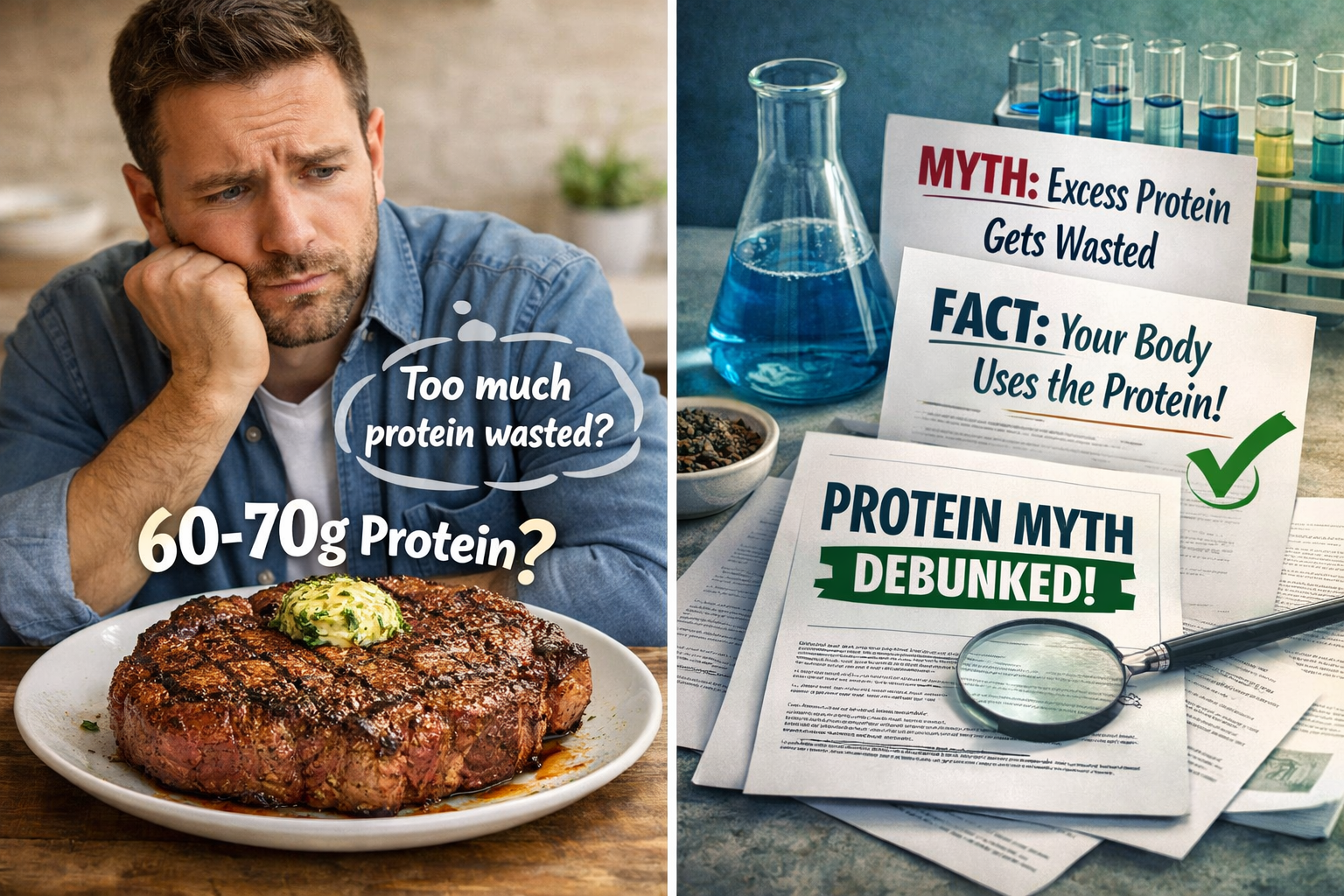
Worried about eating more than 30g protein per meal because you’ve heard your body can’t absorb it? Here’s what the science actually says.
You’re at dinner. You’ve got a large steak in front of you.
It contains 60-70g of protein.
But you’ve heard the rule: “Your body can only absorb 20-30g of protein per meal. Anything more is wasted or turned into fat.”
So what do you do?
Save half the steak for later? Force yourself to eat smaller, more frequent meals? Feel anxious that you’re “wasting” protein and money?
The confusion is understandable. This myth is everywhere.
Here’s the truth that will end the anxiety: There is no fixed protein absorption limit per meal. Your body adapts digestion speed to absorb virtually all protein consumed, whether that’s 20g, 50g, or 100g. The “30g limit” myth comes from misunderstood research about muscle protein synthesis, not actual protein absorption or utilization. Total daily protein intake matters far more than per-meal amounts.
In this comprehensive guide, I’ll explain exactly where the “30g limit” myth originated and why it’s misleading, reveal what actually happens when you eat large amounts of protein, show you the real science on protein absorption and muscle building, provide practical guidelines for optimal protein distribution, and help you stop worrying about arbitrary limits and focus on what matters.
Whether you’re trying to build muscle, lose fat, or just eat properly, this article will clarify one of fitness nutrition’s most persistent myths.
Let’s separate fact from fiction.
TABLE OF CONTENTS
Where the “30g Protein Limit” Myth Comes From
Understanding the origin reveals why it’s misleading.
The Misunderstood Research
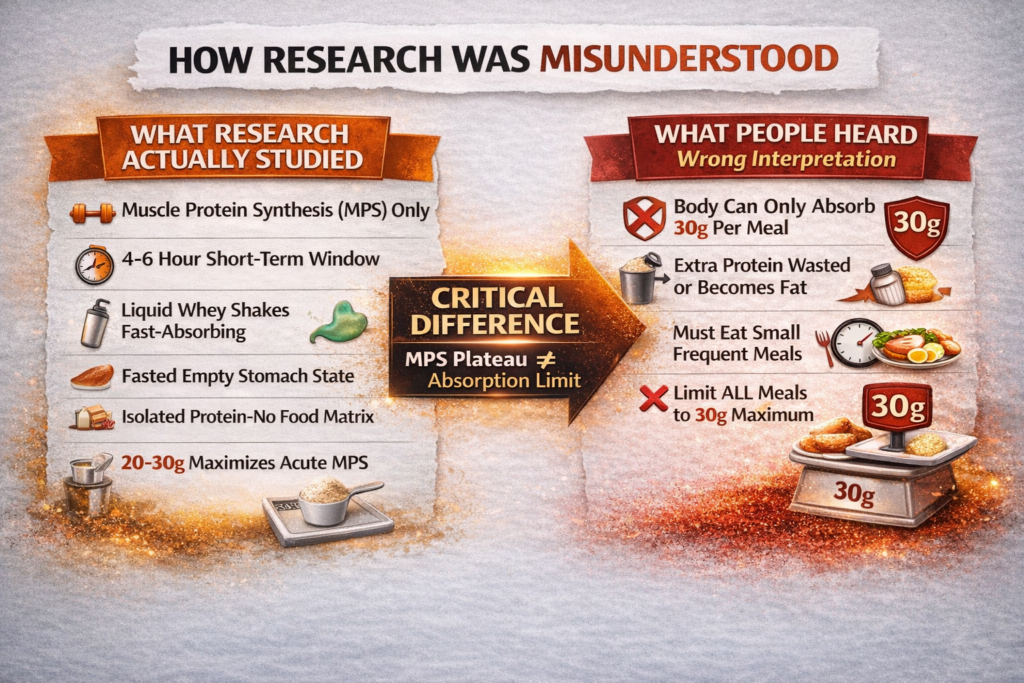
The myth stems from studies on muscle protein synthesis (MPS), not absorption.
What the research actually studied:
Study design (typical):
- Give subjects liquid protein shake
- On empty stomach
- Fast-absorbing protein (whey)
- Measure muscle protein synthesis for 4-6 hours
- Compare different protein doses
What researchers found:
Key findings:
- 20-30g protein maximizes MPS in a single sitting
- Consuming 40g or 60g doesn’t increase MPS further
- Plateau effect around 20-30g for MPS
Example study:
- 20g whey protein: MPS increases X amount
- 40g whey protein: MPS increases same X amount (no additional benefit)
- Conclusion of study: More than 20-40g doesn’t further stimulate MPS
How this got twisted into the myth:
What people heard: “Your body can only use 20-30g protein per meal”
What the study actually said: “20-30g protein maximizes muscle protein synthesis in the 4-6 hours after consuming a fast-digesting protein shake on an empty stomach”
Critical differences:
The studies measured:
- Muscle protein synthesis only (not total protein utilization)
- Short-term response (4-6 hours)
- Liquid protein shakes (fast absorption)
- Fasted state (empty stomach)
- Isolated protein (no food matrix)
Real life involves:
- Total protein utilization (many functions beyond MPS)
- 24-hour timeframe (full day matters)
- Mixed meals (slower absorption)
- Fed state (food in stomach)
- Complete meals (protein + fats + carbs + fiber)
What the Research Actually Tells Us
The studies are valuable but have limited application.
What we learned:
✅ 20-30g protein per meal effectively stimulates MPS
✅ More than 40g in a single dose doesn’t further increase MPS acutely
✅ Spreading protein throughout day is beneficial
✅ Regular protein intake supports muscle maintenance and growth
What we did NOT learn:
❌ That your body can’t absorb more than 30g
❌ That extra protein is wasted
❌ That you must limit protein per meal to 30g
❌ That consuming 50g+ in one meal is problematic
The key distinction:
Maximizing acute muscle protein synthesis ≠ Total protein absorption and utilization
Your body uses protein for hundreds of functions beyond building muscle in the immediate post-meal period.
How Protein Absorption Actually Works
The biological reality is far more sophisticated than the myth suggests.
The Digestion and Absorption Process
Your body is remarkably efficient at extracting nutrients.
Step-by-step protein absorption:
Step 1: Stomach (1-4 hours)
- Protein broken down by pepsin and stomach acid
- Mechanical churning continues breakdown
- Time varies based on meal composition
- Protein doesn’t “pass through” quickly
Step 2: Small intestine (3-6 hours)
- Pancreatic enzymes break protein into amino acids
- Amino acids absorbed through intestinal wall
- Enters bloodstream gradually
- Not all at once
Step 3: Bloodstream transport
- Amino acids circulate to organs and muscles
- Used for various functions
- Muscle protein synthesis is one use
- Many other critical functions
Step 4: Utilization
- Building and repairing tissues
- Enzyme and hormone production
- Immune function
- Energy (when needed)
- Storage as amino acids (yes, this happens)
Critical point: The process is slow and adaptive, not fixed and limited.
The Body’s Adaptive Mechanisms
Your digestive system adjusts to protein intake.
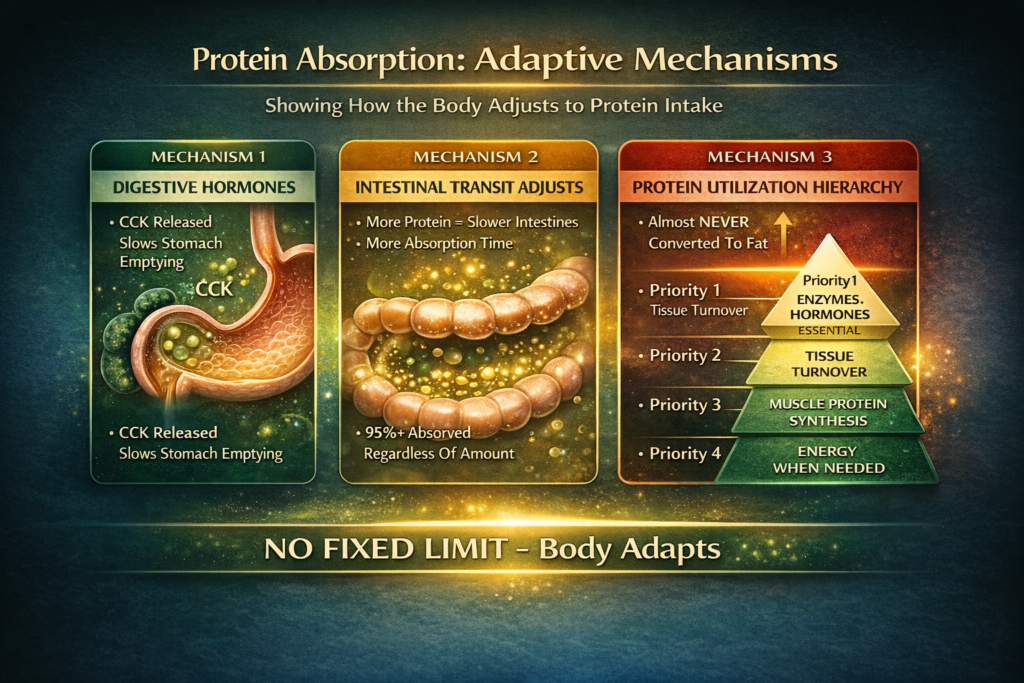
Adaptation 1: Digestive hormones regulate speed
Cholecystokinin (CCK):
- Released when protein detected
- Slows stomach emptying
- Reduces intestinal contractions
- Result: Protein digests slower, allowing complete absorption
Example:
- Eat 20g protein: Digests in 2-3 hours
- Eat 60g protein: CCK released, digests in 4-6 hours
- All protein gets absorbed, just takes longer
Adaptation 2: Intestinal transit time adjusts
With more protein:
- Intestines slow down
- More time for absorption
- Essentially nothing “passes through” unabsorbed
- Fecal protein content is minimal regardless of intake
Research evidence:
- Studies feeding people 100g+ protein in single meal
- Fecal analysis shows 95%+ protein absorbed
- The body adapts and absorbs it all
Adaptation 3: Protein type affects absorption speed
Fast-digesting proteins:
- Whey protein: 1-2 hours
- Egg whites: 1.5-2.5 hours
- Fish: 2-3 hours
Medium-digesting proteins:
- Chicken: 2-4 hours
- Beef: 3-4 hours
- Pork: 3-4 hours
Slow-digesting proteins:
- Casein: 6-8 hours
- Whole eggs: 3-4 hours
- Cheese: 4-5 hours
Practical implication:
- Large steak taking 6-8 hours to fully digest
- Amino acids released gradually throughout
- No “30g limit” being challenged at any moment
- Steady stream of amino acids for hours
What Happens to “Excess” Protein
Your body doesn’t waste protein or immediately turn it into fat.
Protein utilization hierarchy:
Priority 1: Essential functions (always happens first)
- Enzyme production
- Hormone synthesis
- Antibody creation
- Cell repair and maintenance
- Neurotransmitter production
- These require protein constantly
Priority 2: Tissue turnover
- Skin cell replacement
- Hair and nail growth
- Organ tissue maintenance
- Blood cell production
- Ongoing 24/7, not just post-workout
Priority 3: Muscle protein synthesis
- Building new muscle tissue
- Repairing damaged fibers
- Adaptation to training
- Important but not sole use of protein
Priority 4: Oxidation for energy (when needed)
- Amino acids can be used for energy
- Happens when carbs/fats insufficient
- Not ideal but possible
- Not the same as “turning into fat”
Priority 5: Conversion to glucose (gluconeogenesis)
- In absence of adequate carbs
- Amino acids converted to glucose
- Supports blood sugar
- Energetically expensive, rarely happens with adequate diet
What almost never happens:
Direct conversion to fat (de novo lipogenesis from protein):
- Extremely rare
- Energetically inefficient
- Only in massive caloric surplus
- Body prioritizes carb-to-fat conversion instead
- Protein is the last macronutrient converted to fat
The reality:
Eating 60g protein in one meal doesn’t mean 30g gets “wasted” or “turned to fat.” Instead:
- Digestion slows down
- Amino acids released over 6-8 hours
- Used for hundreds of functions
- All gets utilized efficiently
The Real Science on Protein and Muscle Building
What actually matters for muscle growth.
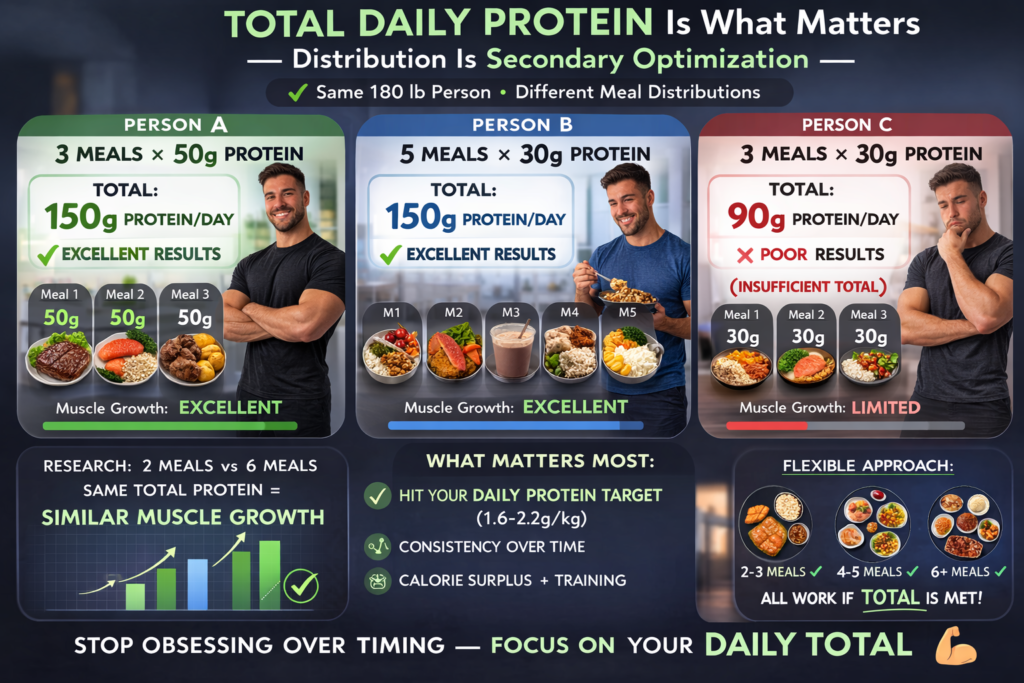
Total Daily Protein Intake Is What Matters
The research is clear on this point.
Study after study shows:
Finding 1: Total daily protein drives muscle growth
- Studies comparing different protein distributions
- Same total daily protein, different meal frequencies
- Results: Total protein matters most, distribution matters less
- Example: 160g protein in 3 meals vs. 160g in 6 meals = similar muscle growth
Finding 2: Wide range of effective protein distributions
- Some people build muscle eating 2-3 meals daily
- Others eat 5-6 meals daily
- Both approaches work if total protein adequate
- Flexibility in meal frequency, rigidity not required
Finding 3: Minimum effective daily protein intake
- 1.6g per kg body weight (0.7g per pound) minimum for muscle building
- More may be better (up to 2.2g per kg / 1g per pound)
- Going higher doesn’t harm, but provides diminishing returns
- Hit your daily total, method is flexible
Practical example:
Person A (180 pounds):
- Eats 3 meals daily
- 50g protein per meal
- Total: 150g daily
- Gets excellent results
Person B (180 pounds):
- Eats 5 meals daily
- 30g protein per meal
- Total: 150g daily
- Also gets excellent results
The difference in results between A and B: Negligible
What would cause poor results:
- Person C: 3 meals, 30g each, total 90g daily (insufficient total)
Protein Distribution Still Matters (But It’s Not Rigid)
While total is most important, smart distribution helps.
Research-supported distribution guidelines:
Spacing protein intake throughout day:
- Studies suggest 3-5 hour intervals optimal
- Keeps muscle protein synthesis elevated
- Prevents long fasting periods
- But missing this occasionally won’t ruin progress
Each meal containing 20-40g protein:
- Reliably stimulates muscle protein synthesis
- Provides steady amino acid availability
- Practical and sustainable
- But eating 50-60g in one meal is also fine
Why reasonable distribution helps:
Benefit 1: Maintains elevated muscle protein synthesis
- Protein every 3-5 hours keeps MPS stimulated
- Better than one huge meal then nothing for 12 hours
- Optimization, not requirement
Benefit 2: Appetite and satiety management
- Protein throughout day keeps you satisfied
- Prevents extreme hunger
- Supports diet adherence
- Practical benefit more than physiological
Benefit 3: Digestive comfort
- Spreading intake easier on stomach
- Large protein loads can cause bloating (individual variation)
- More sustainable long-term
But here’s the key: These are optimizations, not strict requirements.
Real-world flexibility:
Scenario 1: Intermittent fasting (2 large meals)
- Breakfast: 70g protein
- Dinner: 70g protein
- Total: 140g protein
- Research shows this works fine for muscle building
Scenario 2: One large meal (OMAD)
- Single meal: 150g protein
- Total: 150g protein
- Also works, though not “optimal”
- Studies show muscle maintenance possible
Scenario 3: Warrior diet (small meals + one large)
- Small meals: 20g protein each
- Large dinner: 80g protein
- Total: 140g protein
- Also effective
The pattern: Total daily protein is the priority. Distribution is a secondary optimization that provides benefits but isn’t make-or-break.
Practical Guidelines for Protein Intake
How to apply this information intelligently.
Stop Worrying About Per-Meal Limits
Free yourself from arbitrary restrictions.
What you can stop doing:
❌ Refusing to eat a large steak because “it’s too much protein”
❌ Forcing yourself to eat 6 small meals to “maximize absorption”
❌ Stressing about eating 50g protein post-workout
❌ Throwing away food because you hit “30g this meal”
❌ Carrying Tupperware everywhere to eat every 3 hours
What you should focus on:
✅ Hitting your total daily protein target (0.7-1g per pound)
✅ Spreading protein reasonably throughout day (3-5 meals works great)
✅ Eating when it’s convenient and sustainable
✅ Choosing high-quality protein sources
✅ Consistency over weeks, months, and years
Calculate Your Daily Protein Target
Start with total daily needs, not per-meal amounts.
Step 1: Determine your body weight
- Use pounds or convert kg to pounds
- Example: 180 pounds
Step 2: Calculate protein target
For muscle building:
- Multiply by 0.8-1.0
- Example: 180 × 0.8 = 144g minimum
- Example: 180 × 1.0 = 180g optimal
- Target range: 144-180g daily
For fat loss (preserving muscle):
- Multiply by 1.0-1.2
- Example: 180 × 1.0 = 180g minimum
- Example: 180 × 1.2 = 216g optimal
- Target range: 180-216g daily
Step 3: Distribute across your preferred meal frequency
3 meals daily:
- 180g total ÷ 3 meals = 60g per meal
- Perfectly fine despite being “over 30g”
4 meals daily:
- 180g total ÷ 4 meals = 45g per meal
- Also perfectly fine
5 meals daily:
- 180g total ÷ 5 meals = 36g per meal
- Works great too
2 meals daily (intermittent fasting):
- 180g total ÷ 2 meals = 90g per meal
- Still effective despite large amounts per meal
Choose meal frequency based on:
- Your schedule and lifestyle
- Appetite and hunger patterns
- Training times
- Personal preference
- NOT arbitrary protein limits
Smart Protein Distribution Strategies
Optimize within flexible framework.
Strategy 1: Bookend your day with protein
Morning:
- Breakfast with 30-50g protein
- Breaks overnight fast
- Stimulates MPS for day
- Supports satiety
Evening:
- Dinner with 40-60g protein
- Supports overnight recovery
- Slow-digesting sources ideal (casein, whole foods)
- Prevents overnight muscle breakdown
Benefits:
- Covers long fasting periods (sleep)
- Simple to remember
- Very effective
- Flexible middle meals
Strategy 2: Prioritize protein around training
Pre-workout (1-3 hours before):
- 30-40g protein
- Provides amino acids during training
- Supports performance
- Combined with carbs for energy
Post-workout (within 2-3 hours after):
- 30-50g protein
- Supports recovery
- Maximizes MPS when elevated
- Combined with carbs for glycogen
Benefits:
- Leverages training-induced MPS elevation
- Supports recovery directly
- Practical and effective
Strategy 3: Eat protein when you’re actually hungry
Novel concept: Listen to your body
- Hunger is a signal
- Protein is satiating
- Natural regulation often works
- Less stress, better adherence
Example:
- Naturally hungry for breakfast: Eat 40g protein
- Not very hungry at lunch: Eat 25g protein
- Hungry for dinner: Eat 60g protein
- Late snack if hungry: 20g protein
- Total: 145g (on target)
High-Protein Meal Examples
Real meals with “too much” protein that work perfectly.
Large dinner (70g protein):
- 10oz steak (70g protein)
- Baked potato
- Vegetables
- Total: 70g protein in one meal
- Result: Completely fine, all gets used
Post-workout feast (85g protein):
- 8oz chicken breast (60g)
- 1 cup Greek yogurt (20g)
- Rice and vegetables
- Total: 85g protein
- Result: Excellent for recovery
Intermittent fasting dinner (90g protein):
- 8oz salmon (50g)
- 4 whole eggs (24g)
- Quinoa and spinach
- Total: 90g protein in one meal
- Result: Supports muscle building despite single large dose
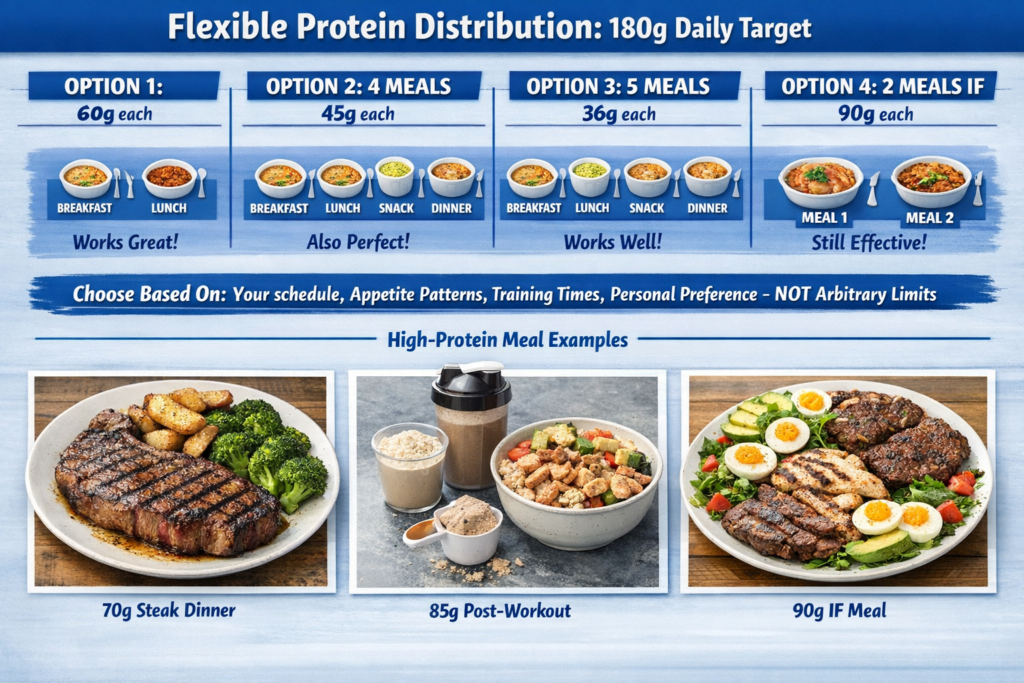
The point: These aren’t “wasting” protein. Your body adapts digestion and uses it all.
Common Questions and Concerns
Addressing specific worries.
“If I eat 60g protein, does my body only use 30g?”
No. Your body uses all of it, just not all for acute muscle protein synthesis.
What happens to 60g protein meal:
- Digests over 4-6 hours
- Amino acids absorbed gradually
- Used for:
- Muscle protein synthesis (some)
- Enzyme production (some)
- Hormone synthesis (some)
- Tissue repair (some)
- Immune function (some)
- Many other functions
- None gets “wasted”
“Will extra protein turn into fat?”
Very unlikely unless in massive caloric surplus.
The reality:
- Protein is the least likely macronutrient to convert to fat
- Requires energetically expensive process
- Your body prefers using excess carbs for fat storage
- Would need to be in significant caloric surplus
- Eating protein alone doesn’t cause fat gain
What actually causes fat gain:
- Total caloric surplus (eating more than you burn)
- Excess comes from any macronutrient
- Usually excess carbs and fats, not protein
“Should I limit protein to 30g per meal anyway?”
Only if it fits your lifestyle better. Not because of absorption limits.
Reasons to eat smaller, more frequent protein doses:
- Preference for frequent eating
- Better appetite control
- Digestive comfort
- Keeps MPS elevated (optimization)
Reasons to eat larger, less frequent protein doses:
- Intermittent fasting preference
- Busy schedule (fewer meals easier)
- Larger meals more satisfying
- Simplicity
Both approaches work. Choose based on lifestyle, not fear of “wasting” protein.
“Does protein type affect the ‘limit’?”
There is no limit, but protein type does affect digestion speed.
Fast proteins (whey, egg whites):
- Digest quickly
- Amino acids spike faster
- Might reach MPS plateau quicker
- Still all gets absorbed and used
Slow proteins (casein, whole food meals):
- Digest slowly
- Amino acids released gradually
- Sustained MPS over longer period
- All gets absorbed and used
Mixed meals (protein + carbs + fats + fiber):
- Slowest digestion
- Most gradual amino acid release
- Most “real world” scenario
- Definitely all gets absorbed
Practical implication:
A 60g protein whey shake on empty stomach digests faster than a 60g protein steak with vegetables and potato. But both provide full protein utilization over time.
The Bottom Line: Forget Per-Meal Limits, Focus on Daily Total
After examining all the evidence:
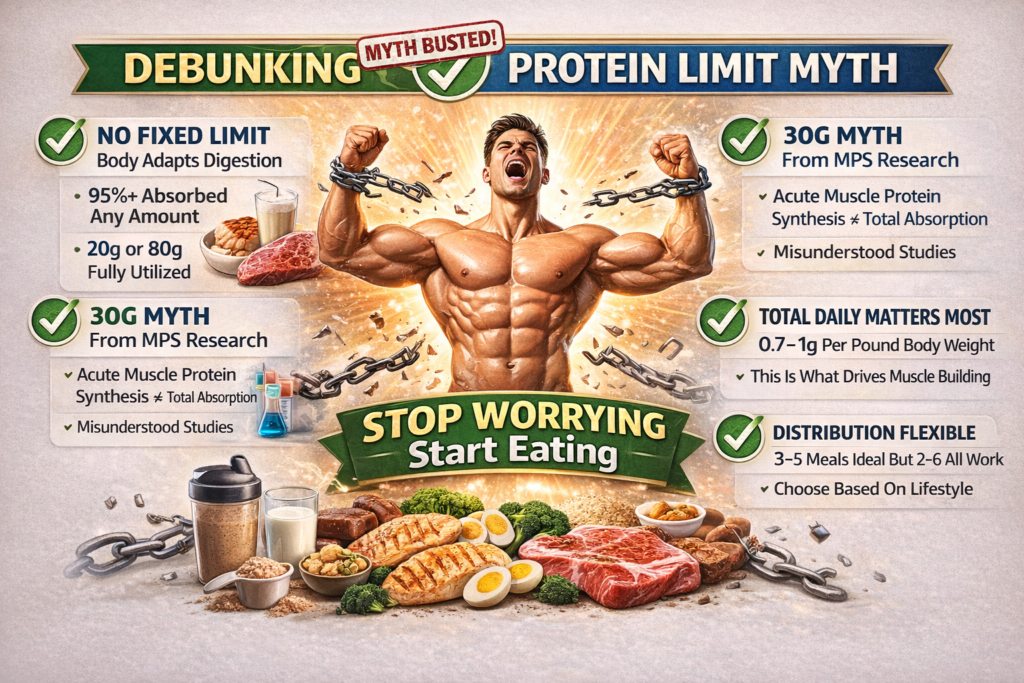
The truth about protein absorption limits:
✅ No fixed protein absorption limit per meal exists (body adapts digestion speed)
✅ The “30g limit” myth comes from misunderstood research (MPS studies, not absorption)
✅ Your body absorbs and uses virtually all protein consumed (95%+ absorption regardless of amount)
✅ Total daily protein intake matters most (0.7-1g per pound body weight minimum)
✅ Distribution throughout day is beneficial but flexible (3-5 meals ideal, but 2-6 meals all work)
What the research actually shows:
About muscle protein synthesis:
- 20-40g protein per meal maximizes acute MPS
- More doesn’t increase MPS further in that 4-6 hour window
- But this doesn’t mean excess is wasted
About total protein absorption:
- Body adapts digestion speed via hormones (CCK)
- Intestinal transit time adjusts to protein load
- 95%+ protein absorbed regardless of meal size
- Eating 20g or 80g both result in full absorption
About protein utilization:
- Protein used for hundreds of functions
- Muscle building is one use among many
- Excess rarely converted to fat
- All protein gets utilized effectively
Practical recommendations:
Priority 1: Hit your daily protein target
- Muscle building: 0.8-1g per pound (1.6-2.2g per kg)
- Fat loss: 1-1.2g per pound (2.2-2.6g per kg)
- This matters more than anything else
Priority 2: Distribute reasonably throughout day
- 3-5 meals with protein works great
- 20-50g protein per meal ideal range
- But don’t stress if one meal has 60-80g
Priority 3: Eat high-quality protein sources
- Complete amino acid profiles
- Animal proteins (meat, fish, eggs, dairy)
- Plant proteins (soy, quinoa, legumes + grains)
- Variety is beneficial
Priority 4: Time protein around training (optional optimization)
- 30-40g pre-workout (1-3 hours before)
- 30-50g post-workout (within 2-3 hours)
- Helpful but not critical if daily total adequate
What you can stop worrying about:
❌ Limiting each meal to exactly 30g protein
❌ Eating 6-8 small meals to “maximize absorption”
❌ Stressing about eating a large steak
❌ Forcing protein into rigid meal schedules
❌ Thinking extra protein is “wasted”
What you should focus on:
✅ Consistent daily protein intake (every single day)
✅ Quality protein sources
✅ Meal timing that fits your lifestyle
✅ Training hard with progressive overload
✅ Patience and long-term consistency
FOCUS ON TOTAL DAILY PROTEIN. DISTRIBUTE REASONABLY. STOP STRESSING ABOUT ARBITRARY PER-MEAL LIMITS.
Ready to optimize your complete nutrition strategy with science-based protein intake guidelines, meal planning, and a system that delivers maximum muscle building without arbitrary restrictions or unnecessary complications? Understanding protein absorption is just one piece of effective nutrition. Get a comprehensive guide to calculating your exact macro needs, building sustainable meal plans, timing your nutrition optimally, and achieving your physique goals with proven strategies. Stop worrying about protein myths. Start following evidence-based nutrition that actually works.
REFERENCES
SECTION 1 — Where the “30g Protein Limit” Myth Comes From (MPS Studies)
[1] Moore DR et al. — American Journal of Clinical Nutrition, 2009 Ingested protein dose response of muscle and albumin protein synthesis after resistance exercise in young men https://pubmed.ncbi.nlm.nih.gov/19056590/
[2] Macnaughton LS et al. — Physiological Reports, 2016 The response of muscle protein synthesis following whole-body resistance exercise is greater following 40g than 20g of ingested whey protein https://pmc.ncbi.nlm.nih.gov/articles/PMC4985555/
SECTION 2 — How Protein Absorption Actually Works (CCK / Adaptive Digestion)
[3] Liddle RA et al. — Frontiers in Endocrinology, 2021 Roles of Cholecystokinin in the Nutritional Continuum — CCK slows gastric emptying to “titrate the rate of nutrient delivery to allow optimal digestion and absorption” https://www.frontiersin.org/journals/endocrinology/articles/10.3389/fendo.2021.684656/full
SECTION 3 — 95%+ Protein Absorbed Regardless of Meal Size
[4] ScienceDirect — Digestible Protein (Gaudichon et al., 2002 consolidated) “Digestion and absorption of ingested proteins is remarkably complete, with only a small fraction (3–5%) of ingested protein nitrogen excreted in stools” — milk protein ileal digestibility ~95% in humans https://www.sciencedirect.com/topics/food-science/digestible-protein
SECTION 4 — No Upper Limit for the Anabolic Response (Key Study)
[5] Trommelen J, van Loon LJC et al. — Cell Reports Medicine, 2023 The anabolic response to protein ingestion during recovery from exercise has no upper limit in magnitude and duration in vivo in humans — 100g protein produced a greater and more prolonged (>12h) anabolic response vs. 25g; “the magnitude and duration of the anabolic response to protein ingestion is not restricted and has previously been underestimated” https://pubmed.ncbi.nlm.nih.gov/38118410/ PMC: https://pmc.ncbi.nlm.nih.gov/articles/PMC10772463/
SECTION 5 — Slow Proteins and Mixed Meals Extend the Absorption Window
[6] Schoenfeld BJ, Aragon AA — Journal of the International Society of Sports Nutrition, 2018 How much protein can the body use in a single meal for muscle-building? Implications for daily protein distribution — slower-acting proteins consumed with other macronutrients delay absorption and extend anabolic utilization beyond the 4-6h window https://pubmed.ncbi.nlm.nih.gov/29497353/ PMC: https://pmc.ncbi.nlm.nih.gov/articles/PMC5828430/
SECTION 6 — Total Daily Protein Matters More Than Per-Meal Distribution
[7] Morton RW, Schoenfeld BJ, Phillips SM et al. — British Journal of Sports Medicine, 2018 A systematic review, meta-analysis and meta-regression of the effect of protein supplementation on resistance training-induced gains in muscle mass and strength in healthy adults — 49 studies, 1863 participants; total daily protein identified as primary driver of muscle and strength gains, break point at 1.62g/kg/day https://pubmed.ncbi.nlm.nih.gov/28698222/
[8] Hudson JL, Paddon-Jones D, Campbell WW — Nutrients (MDPI), 2020 Protein Distribution and Muscle-Related Outcomes: Does the Evidence Support the Concept? — for adults consuming 0.8–1.3g/kg/day, “the preponderance of evidence supports that consuming at least one meal with sufficient protein to maximally stimulate MPS, independent of daily distribution, is helpful to promote skeletal muscle health” https://pmc.ncbi.nlm.nih.gov/articles/PMC7285146/


Leave a Reply
You must be logged in to post a comment.