
What happens when you eliminate social media, entertainment, junk food, and all distractions for 30 days? Everything changes.
You’re constantly distracted. Scrolling, watching, consuming. Your life is reactive, not intentional.
You know you’re wasting time. But you can’t stop. The pull is too strong. You feel out of control.
You’ve tried to “cut back” on distractions:
- Delete apps (reinstall them the next day)
- “Use phone less” (check it 100+ times anyway)
- “Be more productive” (scroll for 4 hours)
- “Focus more” (can’t focus for 10 minutes)
Nothing works. Because you’re trying to moderate addiction. You can’t moderate addiction. You can only eliminate it. That’s what Monk Mode is.
Here’s what Monk Mode actually means: 30 days of complete elimination of all distractions and dopamine-hijacking behaviors. No social media. No entertainment. No junk food. No casual internet browsing. No dating apps. No video games. Just work, training, reading, and recovery. The first week is hell. Week 2-3 you start emerging. By week 4, you’re a different person. Your focus returns. Your energy skyrockets. Your confidence rebuilds. Your goals become achievable. This isn’t theory this is documented transformation that thousands have experienced.
In this comprehensive guide, I’ll explain what Monk Mode actually is (the complete protocol), reveal what happens each week (the physical and mental changes), show you the exact 30-day structure (what to eliminate and what to do instead), provide troubleshooting for when it gets difficult (it will), and explain how to transition back without relapsing (the exit strategy).
Whether you’re stuck in mediocrity, addicted to distractions, or just want to see what you’re capable of, Monk Mode is the reset button.
Let’s experience 30 days of zero distractions and total focus.
TABLE OF CONTENTS
What Is Monk Mode?
Understanding the modern ascetic practice.
The Origin and Philosophy
Where it came from:
- Internet self-improvement communities (Reddit, forums)
- Inspired by actual monk practices (asceticism, focused practice)
- Modern adaptation for digital age
- Popularized by productivity communities
- Digital-age monasticism
The core philosophy:
- Elimination, not moderation
- All or nothing for defined period
- Temporary extreme to create permanent change
- Total environmental control
- Radical intervention
What it’s NOT:
- Not permanent lifestyle (though some extend it)
- Not religious practice (secular approach)
- Not punishment or deprivation mindset
- Not about suffering (about clarity)
- Temporary focused period
What it IS:
- Intentional removal of all distractions
- Hyper-focus on specific goals
- Complete control of inputs and environment
- Dopamine reset and habit breaking
- Intensive self-development sprint
The Standard Monk Mode Protocol
Duration:
- Minimum: 30 days
- Standard: 30-90 days
- Extended: 6-12 months
- 30 days sufficient for transformation
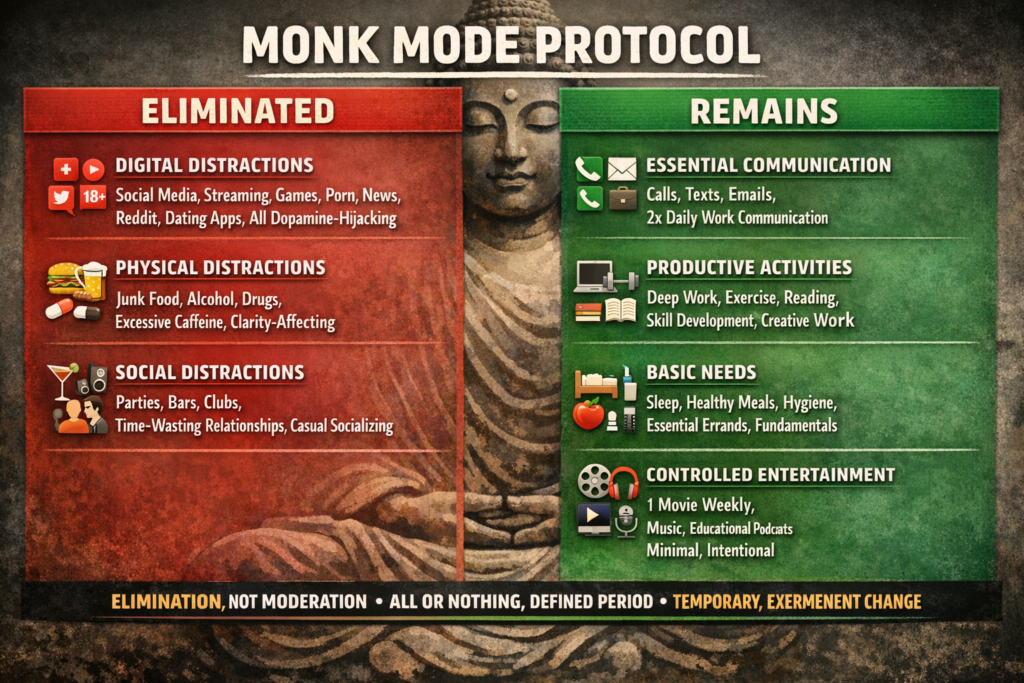
What gets eliminated (The Non-Negotiables):
Digital distractions:
- Social media (all platforms)
- Entertainment streaming (Netflix, YouTube browsing, etc.)
- Video games
- Porn and sexual content
- News websites (no doomscrolling)
- Reddit, forums (mindless browsing)
- Dating apps
- All dopamine-hijacking digital content
Physical distractions:
- Junk food and processed food
- Alcohol
- Recreational drugs
- Excessive caffeine (>200mg daily)
- Anything affecting mental clarity
Social distractions:
- Casual socializing (parties, bars, clubs)
- Excessive social obligations
- Time-wasting relationships
- Non-essential social activities
What remains (The Allowed):
Essential communication:
- Phone calls (actual conversations)
- Text messages (essential only)
- Email (checked 1-2x daily, scheduled)
- Work communication
- Functional communication only
Productive activities:
- Deep work on goals/projects
- Exercise and training
- Reading (books, educational content)
- Skill development
- Creative work
- Value-creating activities
Basic needs:
- Sleep (prioritized)
- Healthy meals
- Personal hygiene
- Essential errands
- Fundamentals
Controlled entertainment:
- One movie per week (chosen in advance)
- Music (as background, not primary activity)
- Podcasts (educational, during commute)
- Minimal, intentional only
The Core Pillars of Monk Mode
Pillar 1: Elimination
- Remove all distractions from environment
- Delete apps, cancel subscriptions
- Create friction for bad habits
- Temptation removal
Pillar 2: Singular focus
- One to three primary goals only
- All energy directed toward these
- No scattered attention
- Concentrated effort
Pillar 3: Environmental control
- Design space for success
- Remove triggers
- Add success cues
- Behavioral architecture
Pillar 4: Routine and structure
- Same wake/sleep times
- Scheduled deep work blocks
- Consistent daily rhythm
- Systematic execution
Pillar 5: Self-reliance
- Solve own problems
- Reduce dependence on external validation
- Build internal locus of control
- Independence building
Week-by-Week Breakdown (What Actually Happens)
The documented transformation timeline.
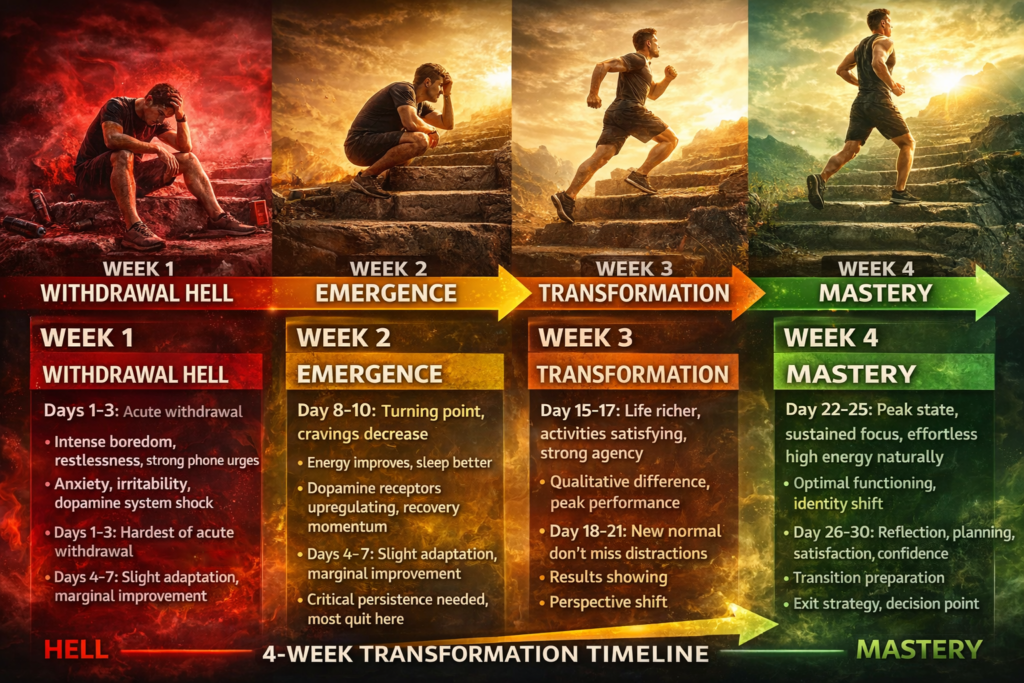
Week 1: The Withdrawal Hell
Days 1-3: The hardest days
What you feel:
- Intense boredom (nothing stimulating)
- Restlessness (physical discomfort)
- Strong urges to check phone (phantom notifications)
- Anxiety (disconnection from world)
- Time feels extremely slow
- Irritability
- Acute withdrawal
What’s happening neurologically:
- Dopamine system in shock
- Accustomed to constant stimulation
- Baseline dopamine crashed
- Brain screaming for hits
- Chemical withdrawal
Common thoughts:
- “This is stupid”
- “One check won’t hurt”
- “I’m missing out on everything”
- “Maybe I don’t need this”
- Rationalization attempts
Coping strategies:
Physical activity:
- When urge hits, do 20 pushups
- Go for walk
- Release restless energy
- Channel discomfort
Replace habit:
- Reach for book instead of phone
- Have immediate alternative ready
- Behavior substitution
Acknowledge without acting:
- “I want to check phone AND I won’t”
- Notice urge, don’t act
- Urge surfing
Days 4-7: Slight adaptation
What you feel:
- Urges still strong but less intense
- Boredom decreasing marginally
- Time still slow
- Mild improvement in sleep
- Occasional moments of clarity
- Beginning adjustment
What’s happening:
- Brain beginning to adapt
- Dopamine receptors starting to upregulate
- Breaking behavioral patterns
- Initial recovery
Productivity:
- Focus still poor (can manage 20-30 min blocks)
- Easily distracted by internal thoughts
- But more than week before
- Marginal improvement
The danger:
- Week 1 is when most people quit
- “This isn’t working”
- Give up before transformation begins
- Critical persistence needed
Week 2: The Emergence
Days 8-10: The turning point
What you feel:
- Noticeable decrease in cravings
- Boredom becoming manageable
- Occasional genuine enjoyment of reading
- Energy starting to improve
- Sleep quality markedly better
- Emergence from fog
What’s happening:
- Dopamine receptors upregulating significantly
- Natural rewards starting to feel rewarding
- Neural adaptation accelerating
- Recovery momentum
Productivity:
- Focus improving (45-60 min blocks possible)
- Deep work becoming accessible
- Creative thoughts appearing
- Real progress
Days 11-14: Momentum building
What you feel:
- Cravings minimal (manageable impulses only)
- Actually enjoying simple activities
- Conversations more engaging
- Increased confidence
- Sense of control returning
- Positive state emerging
Physical changes:
- More energy throughout day
- Better sleep (7-8 hours feeling restorative)
- Improved skin (from diet and sleep)
- Less bloating (from clean eating)
- Visible improvements
Mental changes:
- Mind clearer
- Less anxiety
- More present in moment
- Self-awareness increasing
- Cognitive improvement
Week 3: The Transformation
Days 15-17: The shift
What you feel:
- Life feels richer and more vivid
- Activities genuinely satisfying
- Time feels normal paced
- Strong sense of agency
- Confidence growing
- Qualitative difference
Productivity:
- 90-minute deep work sessions achievable
- Flow states accessible
- Creative problem-solving returning
- Actual progress on goals visible
- Peak performance emerging
Social:
- In-person conversations deeply satisfying
- Less need for external validation
- Comfortable with solitude
- Social quality over quantity
Days 18-21: The new normal
What you feel:
- Monk Mode becoming default
- Don’t miss distractions
- Phone not interesting anymore
- Books genuinely enjoyable
- Exercise satisfying
- New baseline
The realization:
- “I don’t need that stuff”
- “I was wasting so much time”
- “Why did I ever live that way?”
- Perspective shift
Results showing:
- Weight loss visible (if that was goal)
- Project progress significant
- Skill improvement measurable
- Tangible outcomes
Week 4: The Mastery
Days 22-25: Peak state
What you feel:
- Operating at different level
- Sustained focus effortless
- High energy naturally
- Clear purpose and direction
- Inner peace
- Optimal functioning
Capabilities:
- 3-4 hours deep work daily (total)
- Multiple 90-minute blocks
- Complex tasks manageable
- Maximum productivity
Identity shift:
- “I’m someone who focuses deeply”
- “I’m someone who doesn’t need entertainment”
- “I’m disciplined”
- Self-concept transformation
Days 26-30: Reflection and planning
What you feel:
- Satisfaction with progress
- Confidence in capabilities
- Slight anxiety about ending
- Desire to maintain gains
- Transition preparation
The assessment:
- Review goals (progress made)
- Evaluate what worked
- Plan post-Monk Mode strategy
- Strategic planning
The decision point:
- Extend Monk Mode?
- Return with boundaries?
- What to reintroduce?
- Exit strategy
The Exact 30-Day Structure
Day-by-day implementation guide.
Daily Schedule Template
5:30 AM – Wake (no snooze)
- Immediate: Drink water
- Morning routine (no phone)
- Consistent wake time
5:45 AM – Morning practice
- 15-20 minutes: Meditation or journaling
- Review daily goals
- Visualization
- Mental preparation
6:00 AM – Exercise
- 45-60 minutes: Training session
- No music/podcast (sometimes)
- Full focus on movement
- Physical training
7:00 AM – Breakfast and reading
- Nutrient-dense meal
- 30 minutes reading (book)
- No phone/screens
- Fuel and learning
8:00 AM – Deep work block 1
- 90 minutes: Primary goal work
- Phone in other room
- Website blockers on
- Peak productivity window
9:30 AM – Break
- 15 minutes: Walk outside
- Stretch
- Water
- Recovery
9:45 AM – Deep work block 2
- 90 minutes: Continued focused work
- Second peak window
11:15 AM – Admin/shallow work
- Email (first check of day)
- Messages
- Scheduling
- Communication batch
12:00 PM – Lunch and reading
- Healthy meal
- 30 minutes reading
- Midday break
1:00 PM – Deep work block 3
- 90 minutes: Secondary goal or continued primary
- Afternoon productivity
2:30 PM – Break and walk
- 20-30 minute walk outside
- No phone
- Mental processing
- Physical movement
3:00 PM – Skill development or creative work
- 60-90 minutes
- Learning new skill
- Creative project
- Growth activities
5:00 PM – Exercise (optional second session)
- Light activity, stretching, yoga
- OR additional skill practice
- Optional training
6:00 PM – Dinner prep and meal
- Cook (no screens)
- Eat mindfully
- Clean up
- Evening nutrition
7:00 PM – Reading or creative hobby
- 60-90 minutes
- Books, writing, music practice
- Evening enrichment
8:30 PM – Tomorrow preparation
- Plan next day
- Prepare gym clothes, meals
- Review progress
- Evening routine
9:00 PM – Wind down
- Dim lights
- Light reading
- Stretching
- Sleep preparation
10:00 PM – Sleep
- Consistent bedtime
- Dark, cool room
- Recovery
The Three Primary Goals
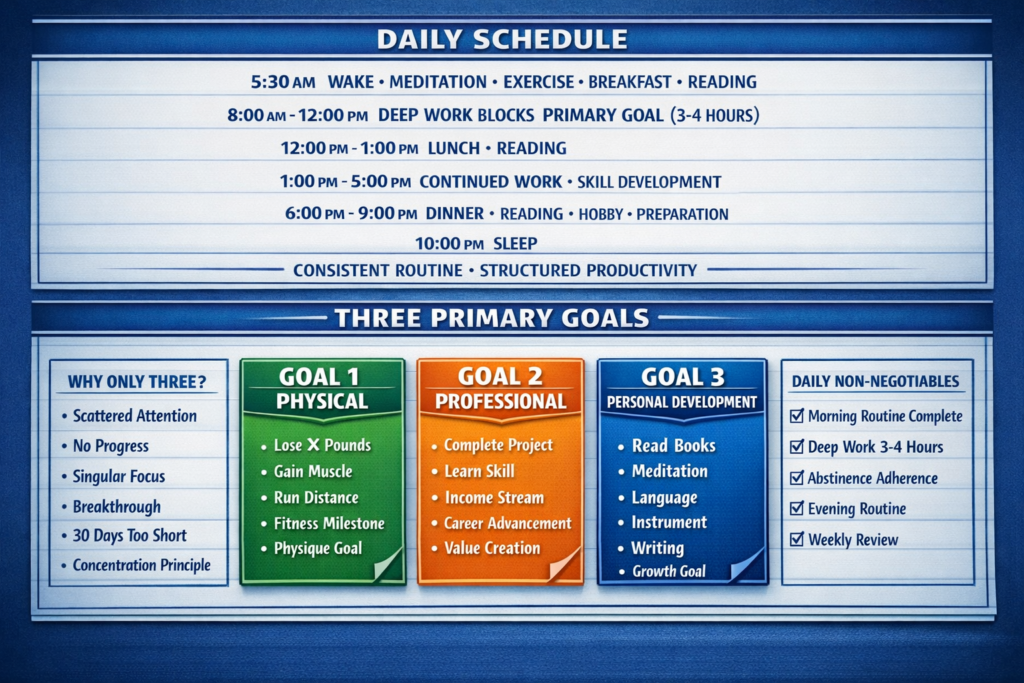
Why only three:
- Scattered attention = no progress
- Singular focus = breakthrough results
- 30 days too short for many goals
- Concentration principle
How to choose:
Goal 1: Physical
- Lose X pounds fat
- Gain X pounds muscle
- Run X distance/time
- Learn specific sport skill
- Physique or fitness goal
Goal 2: Professional/Financial
- Complete specific project
- Learn specific skill
- Build side income stream
- Career advancement
- Value creation goal
Goal 3: Personal development
- Read X books
- Learn instrument/language
- Write X words
- Meditation streak
- Growth goal
The commitment:
- Write goals daily
- Review progress weekly
- All actions aligned to goals
- Total focus
Example goal sets:
Example 1:
- Lose 10 pounds (exercise 6x/week, strict diet)
- Finish business website (3 hours daily coding)
- Read 8 books (1 hour daily)
Example 2:
- Gain 5 pounds muscle (progressive overload program)
- Complete online course certification (2 hours daily study)
- 30-day meditation streak (20 min daily)
The Essential Habits Checklist
Daily non-negotiables:
Morning:
- [ ] Wake 5:30 AM (no snooze)
- [ ] Meditation 15 min
- [ ] Exercise 60 min
- [ ] Healthy breakfast
- [ ] Reading 30 min
- Morning routine completion
Work:
- [ ] Deep work 3-4 hours (total)
- [ ] Email checked 2x only
- [ ] Phone in other room during work
- [ ] Progress on primary goal
- Productivity standards
Evening:
- [ ] Healthy dinner (home cooked)
- [ ] Reading 60 min
- [ ] Tomorrow prepared
- [ ] In bed by 10 PM
- Evening routine completion
Abstinence:
- [ ] Zero social media
- [ ] Zero entertainment streaming
- [ ] Zero junk food
- [ ] Zero alcohol
- [ ] Zero casual internet
- Elimination adherence
Weekly review:
- Every Sunday: Assess week
- What worked well?
- What needs adjustment?
- Plan next week
- Continuous improvement
Common Challenges and How to Overcome Them
Troubleshooting the difficult moments.
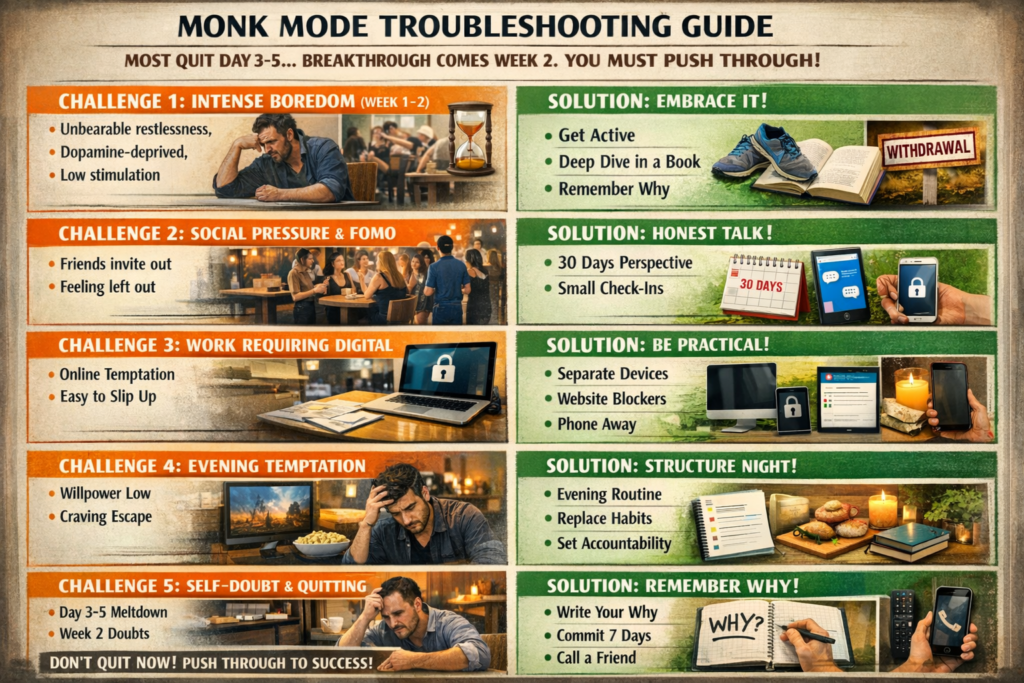
Challenge 1: Intense Boredom (Week 1-2)
What it feels like:
- Unbearable restlessness
- Time crawling
- Nothing feels interesting
- Strong urge to break rules
- Acute discomfort
Why it happens:
- Dopamine-deprived state
- Unaccustomed to low stimulation
- Brain seeking familiar hits
- Withdrawal symptom
Solutions:
Embrace it:
- Boredom is sign of healing
- Sit with discomfort
- Doesn’t require action
- Will pass
- Acceptance
Physical activity:
- When unbearable, exercise
- Walk, run, lift, stretch
- Releases endorphins
- Natural dopamine
Deep dive into book:
- Force 30 minutes reading
- Usually becomes engrossed after 10 min
- Time passes
- Immersion
Remember why:
- Review goals
- Remember the vision
- Pain is temporary
- Purpose reconnection
Challenge 2: Social Pressure and FOMO
What it looks like:
- Friends invite to events
- Feel left out
- Pressure to “just this once”
- Fear of missing important things
- Social conflict
Why it’s challenging:
- Social animals
- Validation from others
- Fear of disconnection
- Biological drive
Solutions:
Honest communication:
- Tell close friends about Monk Mode
- Explain it’s temporary
- Ask for support
- Transparency
Perspective:
- 30 days is 0.08% of your life
- Not missing anything important
- True friends will understand
- Rational framing
Compromise:
- Can see friends (coffee, walk, workout)
- Just not parties, bars, distracting environments
- Quality > quantity
- Selective socializing
Alternative connection:
- Phone calls instead of texting
- One-on-one meetups instead of groups
- Meaningful conversations
- Depth over breadth
Challenge 3: Work Requiring Digital Tools
The conflict:
- Need computer for work
- Temptation always present
- Easy to “just check something”
- Slippery slope
- Access problem
Solutions:
Separate devices:
- Work computer: No social media, entertainment sites
- Personal device: Locked away during work
- Physical separation
Website blockers:
- Freedom, Cold Turkey (apps)
- Block all distraction sites
- Scheduled blocks during work hours
- Forced restriction
Separate browser profiles:
- Work profile: Only work sites
- Personal profile: Blocked during work
- Psychological separation
Phone completely away:
- Other room
- Car
- Locker
- Not just “silent” (must be inaccessible)
- Physical distance
Challenge 4: Evening Temptation
What happens:
- Willpower depleted by evening
- Strong urge to “relax” with entertainment
- Rationalizations emerge
- Most vulnerable time
- Peak risk period
Why it’s hardest:
- Ego depletion (willpower drained)
- Associated habit (evening = Netflix)
- Less structure than workday
- Perfect storm
Solutions:
Structured evening routine:
- Planned activities (reading, hobby, preparation)
- No “free time” (always occupied)
- Early bedtime (9:30-10 PM)
- Eliminate temptation window
Environmental control:
- TV unplugged
- Streaming apps deleted
- Laptop put away
- Remove access
Replacement ritual:
- Instead of Netflix: Reading + tea
- Instead of scrolling: Journaling + stretching
- Instead of gaming: Music practice
- Positive substitution
Accountability:
- Text friend/partner: “Evening routine starting”
- Commit publicly
- Social pressure helps
- External support
Challenge 5: Self-Doubt and Quitting Thoughts
When it emerges:
- Usually Day 3-5 (peak withdrawal)
- Also possible Week 2 (before breakthrough)
- Rationalization creeps in
- Critical moments
The thoughts:
- “This is too extreme”
- “Moderation is better”
- “I can control it”
- “One break won’t hurt”
- “Maybe I don’t need this”
- Addiction speaking
The truth:
- Moderation hasn’t worked (that’s why you’re here)
- Can’t moderate addiction
- One break WILL hurt (resets progress)
- You DO need this (or wouldn’t have started)
- Reality check
Solutions:
Write down why you started:
- Read daily
- Especially when doubting
- Original motivation
- Anchor to purpose
Commit for 7 days minimum:
- “I’ll reassess after 7 days”
- Usually breakthrough by then
- Avoid quitting in withdrawal
- Minimum commitment
Phone a friend:
- Tell someone who supports you
- Talk through doubt
- External perspective
- Support system
Remember it’s temporary:
- Only 30 days
- Not forever
- Can return to moderation after (if desired)
- Time-limited
How to Exit Monk Mode Without Relapsing
The critical transition period.
Days 28-30: The Exit Strategy Planning
What to decide:
What to reintroduce:
- Which (if any) distractions to bring back
- With what boundaries
- Scheduled how
- Selective reintegration
What to eliminate permanently:
- Which behaviors were clearly harmful
- No value added
- Better without
- Permanent elimination
What boundaries to maintain:
- Even for reintroduced activities
- Time limits
- Scheduled usage
- Device-free zones
- Controlled usage
The three paths:
Path 1: Extended Monk Mode
- Continue 30 more days (60 total)
- Or 90 days
- Or indefinitely
- Full commitment
Path 2: Monk Mode Lite
- Reintroduce some activities with strict boundaries
- Social media: 30 min daily scheduled
- Entertainment: 1-2 movies weekly
- Maintain high focus
- Sustainable middle ground
Path 3: Strategic Reintegration
- Gradually reintroduce over 2 weeks
- Monitor effects on focus/productivity
- Quick to eliminate if harmful
- Experimental approach
Most recommended: Path 2 (Monk Mode Lite)
The Monk Mode Lite Protocol
What this looks like:
Permanently eliminated:
- Infinite scroll (TikTok, Instagram Reels, Twitter feed)
- Video games (if were problematic)
- Porn
- Junk food (90% of time)
- Worst offenders gone
Bounded reintroduction:
Social media:
- 30 minutes daily maximum
- Desktop only (not phone)
- Scheduled time (not scattered)
- No browsing, specific purpose
- Controlled access
Entertainment:
- 1-2 movies/shows weekly
- Chosen in advance (no browsing)
- With others when possible (social)
- No autoplay
- Intentional watching
News:
- 15-20 minutes daily
- Scheduled time
- No throughout-day checking
- Information batching
Maintained permanently:
Morning routine:
- No phone first 2 hours
- Exercise, reading, breakfast
- Sacred morning
Deep work:
- 3-4 hours daily (not necessarily continuous)
- Phone in other room
- Website blockers
- Focus periods
Evening routine:
- No screens 1-2 hours before bed
- Reading
- Preparation
- 10 PM bedtime
- Sleep hygiene
Device-free zones:
- Bedroom
- Dining table
- Bathroom
- Protected spaces
Why this works:
- Maintains most benefits
- Sustainable long-term
- Allows some flexibility
- Boundaries prevent relapse
- Balance achieved
The First Week After: High Risk Period
What to watch for:
- Boundaries slowly eroding
- “Just this once” becoming regular
- Time limits extending
- Old patterns returning
- Creeping relapse
Prevention strategies:
Daily check-in:
- Did I maintain boundaries today?
- Any slips?
- Course correct immediately
- Accountability
Weekly review:
- How much time on reintroduced activities?
- Is it affecting focus/productivity?
- Tighten boundaries if needed
- Monitoring
Support system:
- Tell someone your boundaries
- Check in with them weekly
- Accountability partner
- External support
Relapse response:
- If boundaries broken significantly
- Immediate 7-day strict Monk Mode reset
- Don’t spiral
- Quick correction
The Long-Term Benefits (Beyond 30 Days)
What changes permanently.
Cognitive Benefits
Sustained attention:
- Can focus 90+ minutes easily
- Deep work daily habit
- Distraction resistance high
- Attention restored
Mental clarity:
- Thoughts organized
- Decision-making faster
- Less brain fog
- Cognitive enhancement
Creativity:
- Ideas emerge naturally
- Problem-solving improved
- Boredom breeds creativity
- Creative renaissance
Memory:
- Better retention
- Information processing improved
- Learning capacity increased
- Cognitive capacity
Emotional Benefits
Confidence:
- Proof of self-control
- Trust in abilities
- Can achieve difficult things
- Self-efficacy
Emotional stability:
- Less reactive
- Mood more stable
- Anxiety reduced
- Emotional regulation
Life satisfaction:
- Present in moments
- Appreciate simple things
- Less comparison
- Contentment
Purpose and direction:
- Clear on values
- Know what matters
- Aligned actions
- Meaning
Relationship Benefits
Deeper connections:
- Present in conversations
- Active listening
- Quality over quantity
- Relational depth
Less need for validation:
- Internal locus of control
- Not seeking approval
- Comfortable alone
- Independence
Selective socializing:
- Choose relationships intentionally
- Less time-wasting social
- Meaningful connections
- Quality relationships
Physical Benefits
Body composition:
- Visible fat loss or muscle gain
- Depends on training and diet
- Consistent progress
- Physique improvement
Energy levels:
- Higher baseline energy
- No afternoon crashes
- Sustained throughout day
- Vitality
Sleep quality:
- Fall asleep easily
- Deep restful sleep
- Wake refreshed
- Recovery optimization
Overall health:
- Better digestion (clean diet)
- Clearer skin
- Improved biomarkers
- Health improvement
Professional Benefits
Productivity:
- 2-3x more output
- Same time, better focus
- Compound over time
- Performance increase
Skill development:
- Focused practice
- Rapid improvement
- Noticeable competence gain
- Capability building
Career advancement:
- Higher quality work
- More projects completed
- Noticed by superiors
- Professional growth
Financial:
- Side business progress
- Promotions
- Less spending (no impulse buying)
- Economic benefit
The Bottom Line: 30 Days That Change Everything
After explaining everything:
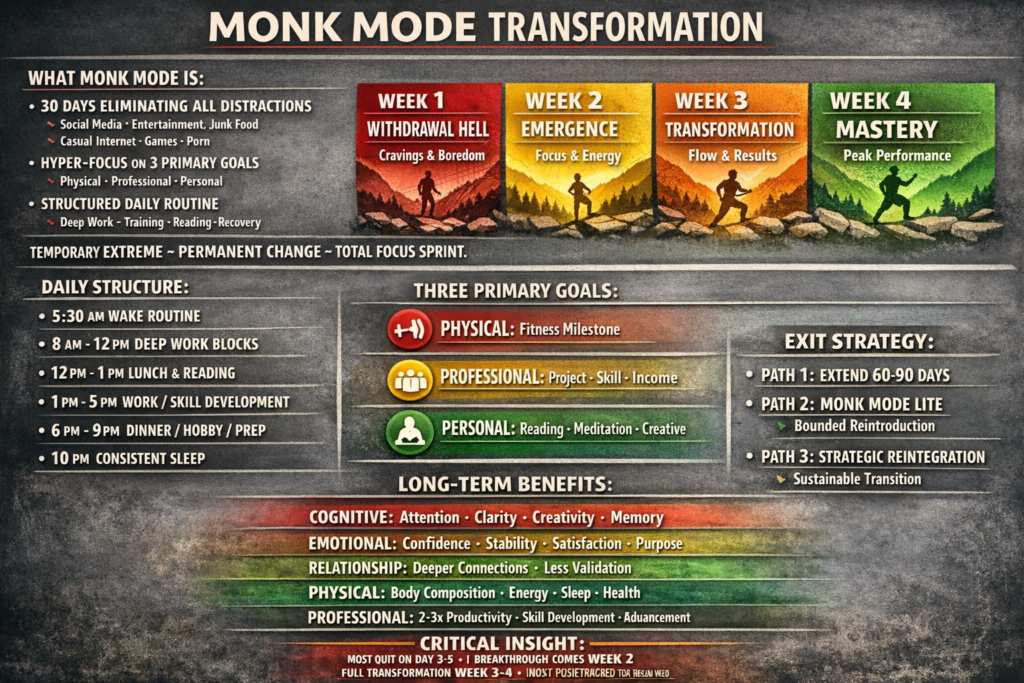
The truth about Monk Mode:
✅ 30 days of zero distractions creates permanent transformation (if done correctly)
✅ Week 1 is hell, but breakthrough comes Week 2-3 (must persist through withdrawal)
✅ Your focus, energy, and confidence will skyrocket (documented benefits)
✅ You’ll see what you’re actually capable of (hidden potential revealed)
✅ Boundaries must remain after or you’ll relapse (exit strategy critical)
Key takeaways:
What Monk Mode is:
- 30 days eliminating ALL distractions (social media, entertainment, junk food, casual internet, games, porn)
- Hyper-focus on 3 primary goals (physical, professional, personal)
- Structured daily routine (deep work, training, reading, recovery)
- Temporary extreme for permanent change
- Total focus sprint
What gets eliminated:
- Digital: Social media, streaming, games, porn, news, Reddit, dating apps
- Physical: Junk food, alcohol, drugs
- Social: Parties, bars, time-wasting relationships
- All dopamine hijackers
What remains:
- Essential communication (calls, texts, email 2x daily)
- Productive work (deep work, training, reading, skill development)
- Basic needs (sleep, meals, hygiene)
- Controlled entertainment (1 movie weekly, music, educational podcasts)
- Value-creating only
Week-by-week transformation:
- Week 1: Withdrawal hell (intense boredom, cravings, anxiety)
- Week 2: Emergence (cravings decrease, focus improving, energy rising)
- Week 3: Transformation (flow states, clarity, confidence, results visible)
- Week 4: Mastery (peak performance, identity shift, planning exit)
- Documented progression
Daily structure:
- 5:30 AM wake, meditation, exercise, breakfast, reading
- 8:00 AM-12:00 PM: Deep work blocks (primary goal)
- 12:00-1:00 PM: Lunch and reading
- 1:00-5:00 PM: Continued work, skill development
- 6:00-9:00 PM: Dinner, reading, hobby, preparation
- 10:00 PM: Sleep
- Consistent routine
The three goals:
- Physical (lose fat, gain muscle, fitness milestone)
- Professional (complete project, learn skill, income)
- Personal development (read books, meditation, creative)
- Concentrated focus
Common challenges:
- Intense boredom (embrace, will pass)
- Social pressure (communicate honestly, temporary)
- Work requiring digital (separate devices, blockers)
- Evening temptation (structured routine, environmental control)
- Self-doubt (remember why started, minimum 7 days)
- Obstacles and solutions
Exit strategy (Day 30+):
- Path 1: Extended Monk Mode (60-90 days)
- Path 2: Monk Mode Lite (bounded reintroduction, recommended)
- Path 3: Strategic reintegration (experimental)
- Sustainable transition
Monk Mode Lite (recommended):
- Permanently eliminate: Infinite scroll, games (if problematic), porn, junk food
- Bounded: Social media 30 min daily desktop only, entertainment 1-2x weekly, news 20 min daily
- Maintain: Morning routine, deep work 3-4 hours, evening routine, device-free zones
- Sustainable long-term
Long-term benefits:
- Cognitive: Sustained attention, mental clarity, creativity, memory
- Emotional: Confidence, stability, satisfaction, purpose
- Relationship: Deeper connections, less validation-seeking
- Physical: Better body composition, energy, sleep, health
- Professional: 2-3x productivity, skill development, advancement, financial
- Comprehensive transformation
Priority actions:
- Choose start date (Monday ideal)
- Delete all social media apps right now
- Write down 3 primary goals
- Plan daily structure
- Tell accountability partner
- Commit to minimum 7 days (reassess then)
- Start preparation now
The commitment:
- Most people quit Day 3-5 (peak withdrawal)
- Breakthrough comes Week 2
- Full transformation Week 3-4
- Must push through hell to reach heaven
- Persistence required
STOP SCROLLING. START LIVING. 30 DAYS MONK MODE. ELIMINATE ALL DISTRACTIONS. DISCOVER WHAT YOU’RE ACTUALLY CAPABLE OF.
Ready to build a complete Monk Mode system with day-by-day protocols, accountability structures, environment design strategies, goal-setting frameworks, and exit planning that guarantees successful completion and permanent transformation? Understanding Monk Mode is just the beginning. Get a comprehensive guide to preparing, executing, and transitioning from Monk Mode successfully, maintaining boundaries permanently, and achieving breakthrough results in 30 days. Stop being distracted. Start executing your potential.
REFERENCES
SECTION 1 — Dopamine hijacking: how social media exploits the reward system
[1] Turel O et al. — PMC/Brain and Behavior, 2025 Review of social media algorithms and neurophysiological addiction mechanisms; frequent social media engagement alters dopamine pathways analogous to substance addiction; AI-driven algorithms maximize screen time by continuously deepening activation of the brain’s reward centers; the overactivation of the dopamine system creates a cyclical “desire-reward-desire” loop that increases susceptibility to addictive behaviors; prolonged overstimulation results in reduced reward sensitivity (a hallmark of addiction), meaning ordinary activities feel less rewarding; directly supports the article’s claim that social media constitutes dopamine hijacking that cannot be moderated — only eliminated — to reset the system https://pmc.ncbi.nlm.nih.gov/articles/PMC11804976/
[2] Andreassen CS et al. — PMC/Frontiers in Psychiatry, 2023 Narrative review of neurobiological risk factors for problematic social media use; Internet addiction shares core features with chemical and behavioral addictions including impaired dopamine metabolism, structural brain changes in prefrontal and orbitofrontal cortices, impaired inhibitory control, and reduced dopamine receptor availability in the striatum; dopamine secretion increases while receptor availability decreases — the mechanism underlying reduced baseline reward capacity; meta-analysis of 40 neurophysiological studies confirms significant violations of inhibitory control, decision-making, and working memory across addictive internet behaviors; provides the neurobiological basis for Week 1 withdrawal symptoms described in the article https://pmc.ncbi.nlm.nih.gov/articles/PMC10251362/
SECTION 2 — Social media abstinence improves mental health
[3] Lambert J et al. — PubMed/Cyberpsychology, Behavior, and Social Networking, 2022 Randomized controlled trial in which participants asked to stop social media use for 1 week showed significant between-group improvements in wellbeing (mean difference +4.9), depression (−2.2), and anxiety (−1.7) compared to controls; intervention effects on depression and anxiety were partially mediated specifically by reductions in Twitter and TikTok use; first large RCT to demonstrate that even 1 week of complete abstinence produces measurable mental health improvements; supports the article’s claim that detachment from platforms produces rapid psychological benefits, beginning in Week 2 of the Monk Mode timeline https://pubmed.ncbi.nlm.nih.gov/35512731/
[4] Mazza S et al. — PMC/JAMA Network Open, 2025 Prospective cohort study of 373 young adults (mean age 21); 1-week social media detox intervention significantly reduced anxiety by 16.1% (Cohen d=−0.44), depression by 24.8% (Cohen d=−0.37), and insomnia by 14.5% (Cohen d=−0.44); participants also showed improved momentary mental health states; used objective smartphone-based digital phenotyping alongside validated self-reports; the reduction in symptoms aligns with the Monk Mode Week 1–2 timeline in the article and provides clinical scale effect sizes for the benefits of a defined abstinence period https://pmc.ncbi.nlm.nih.gov/articles/PMC11846175/
SECTION 3 — The cost of distraction and task interruption on focus
[5] Mark G et al. — UCI/CHI Conference Proceedings, 2008 Field study and laboratory experiment on interrupted work in real office environments; interrupted workers compensated by increasing work pace, but at the cost of significantly higher stress, frustration, and effort; work requires additional cognitive reorganization after each interruption; participants took an average of 23 minutes and 15 seconds to fully return to their original task after an interruption; foundational research establishing the quantifiable productivity cost of constant connectivity; directly supports the article’s framing that eliminating all distractions — not moderation — is necessary for deep work recovery https://ics.uci.edu/~gmark/chi08-mark.pdf
[6] Leroy S — Organizational Behavior and Human Decision Processes, 2009 Two-study experimental investigation defining and measuring “attention residue” — the persistence of cognitive activity about a prior task even after switching to a new one; task-switching results in incomplete attentional transfer: the brain maintains partial focus on the prior task, consuming working memory resources needed for the current one; participants who switched tasks before completing the first showed significantly lower performance on subsequent tasks; unfinished tasks and interruptions produce the strongest residue; directly explains the article’s description of fractured focus in modern life and the neurological rationale for eliminating all digital interruptions during Monk Mode https://www.sciencedirect.com/science/article/abs/pii/S0749597809000399
SECTION 4 — Habit strength and self-control systems
[7] Galla BM & Duckworth AL — PubMed/Journal of Personality and Social Psychology, 2015 Eight studies demonstrating that people with strong self-control rely less on willpower and more on consistent habits and structured routines to avoid temptation; high self-control individuals succeeded not by resisting urges in the moment but by reducing exposure to temptation through environmental structuring; habit automaticity mediates the relationship between trait self-control and positive behavioral outcomes; directly supports the Monk Mode protocol’s emphasis on environmental design, daily routine, and total elimination over willpower-based moderation — the central premise that “you can’t moderate addiction” https://pubmed.ncbi.nlm.nih.gov/25643222/








Leave a Reply
You must be logged in to post a comment.