
Training hard but not seeing results? Here’s the uncomfortable reality nobody wants to hear.
You’re crushing your workouts. Hitting the gym five days a week. Following a program designed by experts. Pushing yourself to the limit every single session.
Yet your body looks basically the same as it did six months ago.
Sound familiar?
Here’s the harsh truth that most people don’t want to acknowledge:
Almost every problem with your bodybuilding or fitness results is a diet problem, not a training problem.
You can’t out-train a bad diet. Not if your goal is actually changing your body.
In this article, I’m going to explain why diet matters far more than training for body transformation, why most people refuse to accept this reality, and what you need to do about it starting today.
This isn’t what you want to hear. But it’s what you need to understand.
Let’s get brutally honest.
TABLE OF CONTENTS
Training Is the Car. Diet Is the Steering Wheel.
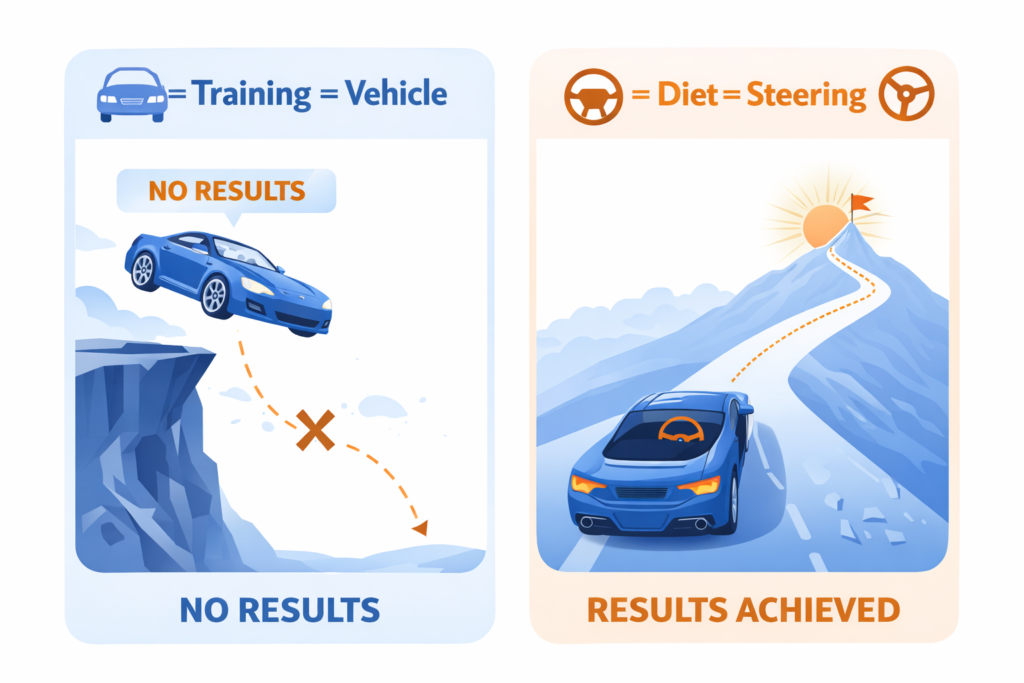
Think of training as a vehicle and diet as the steering wheel that controls where that vehicle goes.
A muscle-building training program won’t take you anywhere if you don’t direct the growth by following an appropriate muscle-building diet.
You can do the perfect hypertrophy program with ideal volume, frequency, and progressive overload. But if you’re not eating enough calories and protein, you won’t build muscle. The training stimulus is there, but the raw materials for growth are absent.
A fat loss training program will fail you if combined with an incompatible eating plan, unless you were completely sedentary before starting. And even then, you’ll hit a wall quickly if you don’t take control of your diet.
You might burn a few hundred extra calories from exercise, but if you’re still eating in a surplus, you won’t lose fat. The math doesn’t work.
And if you’re not following any structured diet or lack basic nutritional knowledge?
Then it’s like you’re driving a car with nobody at the wheel. You might be moving, but you have no control over the direction. You’ll crash eventually.
“Thanks, Captain Obvious. Everyone Already Knows This”
Do they really?
If everyone truly understood and accepted this, why do so few people prioritize nutrition?
Why do forums overflow with questions about the perfect training split, the ideal rep range, the best exercise for bicep peaks, while basic nutritional principles remain ignored?
Here’s why people avoid the diet conversation:
Training Is Easier (Psychologically)
Training, even brutal workouts that make you nauseous, can be satisfying. There’s immediate feedback. You feel the pump. You hit a new PR. You get the endorphin rush afterward.
Training feels productive. You can see and feel yourself working hard. The effort is visible and measurable.
Diet is the opposite.
Not eating something you really want provides no immediate satisfaction. Force-feeding yourself when you’re not hungry to hit calorie targets feels miserable. Meal prepping on Sunday instead of relaxing feels like a chore.
Diet goes against our instincts. Our biology is wired to seek pleasure from food and avoid restriction. Fighting this is psychologically draining in ways that physical training isn’t.
Diet Requires Constant Decisions
You train for maybe 60-90 minutes per day, 3-6 days per week. That’s perhaps 6-9 hours weekly of training-related decisions and effort.
You make food decisions every single day, multiple times per day, for your entire life.
Breakfast. Mid-morning snack. Lunch. Afternoon snack. Dinner. Evening snack. Weekend meals. Social events. Restaurants. Travel. Holidays.
Every single one is a decision point. Every one is an opportunity to derail your progress.
The mental load is exhausting. So most people simply… ignore it.
The Elephant in the Room Everyone Pretends Doesn’t Exist
So the majority of people ignore the elephant sitting in the room: their diet is the problem.
Or at least they try everything else first:
They try different training programs:
- “Maybe I need more volume”
- “Maybe I should try German Volume Training”
- “Maybe I need to train twice per day”
They try different supplements:
- “Maybe this pre-workout will help”
- “Maybe I need BCAAs”
- “Maybe this fat burner is the answer”
They try advanced methods:
- “Maybe I need to do fasted cardio”
- “Maybe I need to add drop sets and supersets”
- “Maybe I need blood flow restriction training”
All while the basics remain broken.
Their protein intake is inconsistent. They have no idea how many calories they eat daily. They’re either massively overeating or severely undereating depending on mood and circumstances.
And they continue getting no results.
The sad part? Many of these people work incredibly hard in the gym. They’re dedicated, consistent with training, and genuinely trying. But they’re steering the car in the wrong direction (or not steering at all).
The “Magic” of Diet
Here’s what happens as soon as someone finally accepts that they need a structured eating plan:
Magic starts to happen.
Just by changing a few foods consistently, eating a few hundred calories more or less than before, boom. Abracadabra. The body starts changing and results start appearing.
And this happens without changing their training at all, assuming “training” means doing the bare minimum that’s humanly effective.
Let me give you real examples:
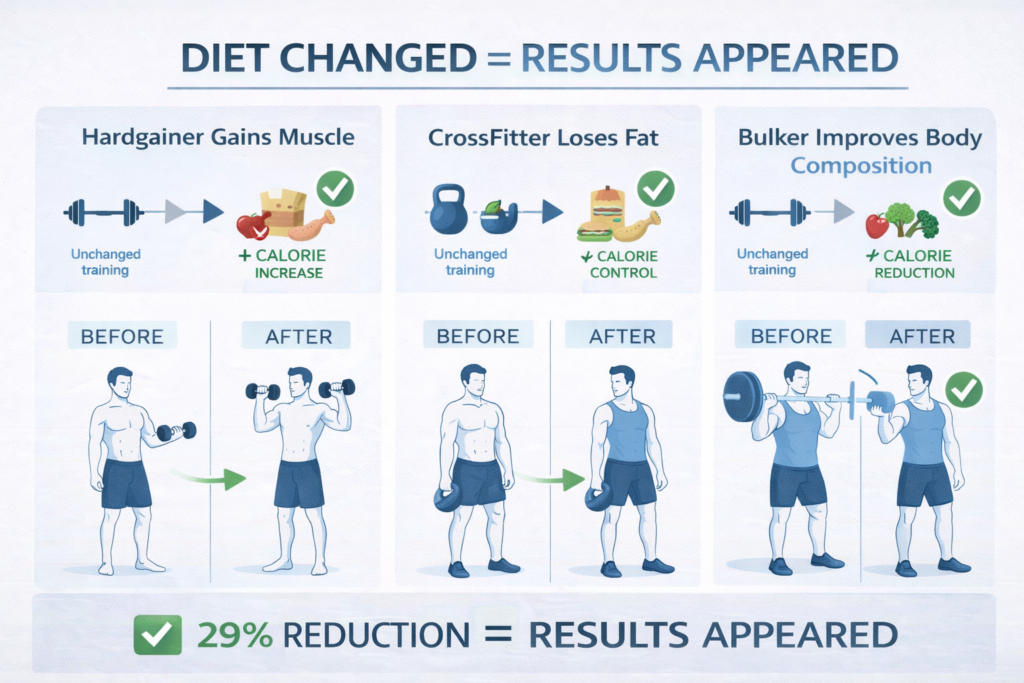
Example 1: The Hardgainer Who Can’t Build Muscle
Training: Following a solid 4-day upper/lower split. Progressive overload. Good form. Consistent for 8 months.
Results: Virtually no muscle gain. Maybe 2-3 pounds in 8 months.
Diet audit reveals: Eating approximately 2,200 calories daily. Protein intake around 80-100g daily. Body weight: 165 pounds.
The fix: Increase to 2,800 calories daily. Increase protein to 140g daily (0.85g per pound body weight).
Results after 3 months: Gained 8 pounds, mostly muscle. Lifts increased significantly.
What changed? Only the diet. Training remained identical.
Example 2: The Person Who Can’t Lose Fat
Training: CrossFit 5 days per week. Extremely intense workouts. Burning 400-500 calories per session.
Results: Zero fat loss over 6 months. Actually gained 5 pounds.
Diet audit reveals: “Eating healthy” but not tracking anything. Consuming approximately 2,500-2,800 calories daily through “healthy” foods like nuts, avocados, olive oil, granola, smoothies.
The fix: Track everything. Reduce to 2,000 calories daily. Still eating mostly the same foods, just controlled portions.
Results after 3 months: Lost 15 pounds of fat while maintaining muscle and performance.
What changed? Only the diet. Training remained the same intense CrossFit.
Example 3: The “Hardgainer” Who’s Actually Overeating
Training: 3-day full body program. Solid compound movements. Progressive overload.
Results: Gaining weight steadily but it’s all going to the midsection. Getting “bulky” but not muscular.
Diet audit reveals: “Bulking hard” at 3,500+ calories daily. Body weight: 155 pounds. Only needs about 2,400 to gain optimally.
The fix: Reduce to 2,600 calories daily. Increase protein percentage. Reduce junk food justified as “bulking calories.”
Results after 3 months: Still gaining weight (muscle) but losing fat simultaneously. Body composition dramatically improved.
What changed? Only the diet. Training remained identical.
The Pattern
Notice the pattern? In every case:
Training was already adequate. It didn’t need to be changed, optimized, or made more complex.
Diet was the limiting factor. Once fixed, results appeared almost immediately.
This isn’t coincidence. This is how body transformation actually works.
Why Most People Still Won’t Accept This
Even after reading this far, many people will continue prioritizing training over diet. Here’s why:
Reason 1: Diet Is Emotional
Food isn’t just fuel. It’s:
Comfort: We eat when stressed, sad, anxious, or bored.
Celebration: Birthday cake, holiday feasts, going out for dinner to celebrate achievements.
Social: Meeting friends for drinks, family dinners, office pizza parties.
Identity: “I’m a foodie,” “I love trying new restaurants,” “Cooking is my passion.”
Changing your diet means confronting all of this. It means sometimes saying no to social events, declining Grandma’s famous dessert, or eating differently than your friends.
This is psychologically harder than adding another set of squats.
Reason 2: Diet Requires Knowledge
You can learn to train effectively in a few weeks:
- Push, pull, legs
- Progressive overload
- 3-5 sets of 6-12 reps for most exercises
- Compound movements priority
Done. You know enough to get strong and build muscle.
Diet is more complex:
- How many calories do you need?
- How much protein, carbs, and fat?
- Which foods provide which nutrients?
- How do you track accurately?
- How do you adjust based on results?
- How do you handle social situations?
- How do you make it sustainable long-term?
This takes time to learn and master. Most people don’t want to invest that time and effort.
Reason 3: Diet Results Take Longer to Appear
Training provides immediate feedback:
- You feel sore (good training stimulus)
- You get a pump (satisfying)
- Your lifts go up (measurable progress)
- You feel accomplished after each session
Diet changes take 2-4 weeks to show visible results.
The first week or two, you see nothing. Your body looks the same. The scale might fluctuate randomly due to water retention.
Most people give up during this “no results” phase, assuming the diet isn’t working, when in reality they just haven’t given it enough time.
Reason 4: Diet Lacks the “Grind” Appeal
There’s something romantically appealing about brutal workouts:
The Instagram posts of sweaty gym selfies. The quotes about “no pain, no gain.” The image of someone pushing through that last rep, veins popping, face grimacing.
This is sexy. This is inspiring. This is shareable content.
Meal prepping chicken and broccoli on Sunday afternoon? Not sexy. Not inspiring. Nobody’s making motivational videos about weighing your rice portions.
But guess which one actually determines your results?
The Hierarchy of Importance for Body Transformation
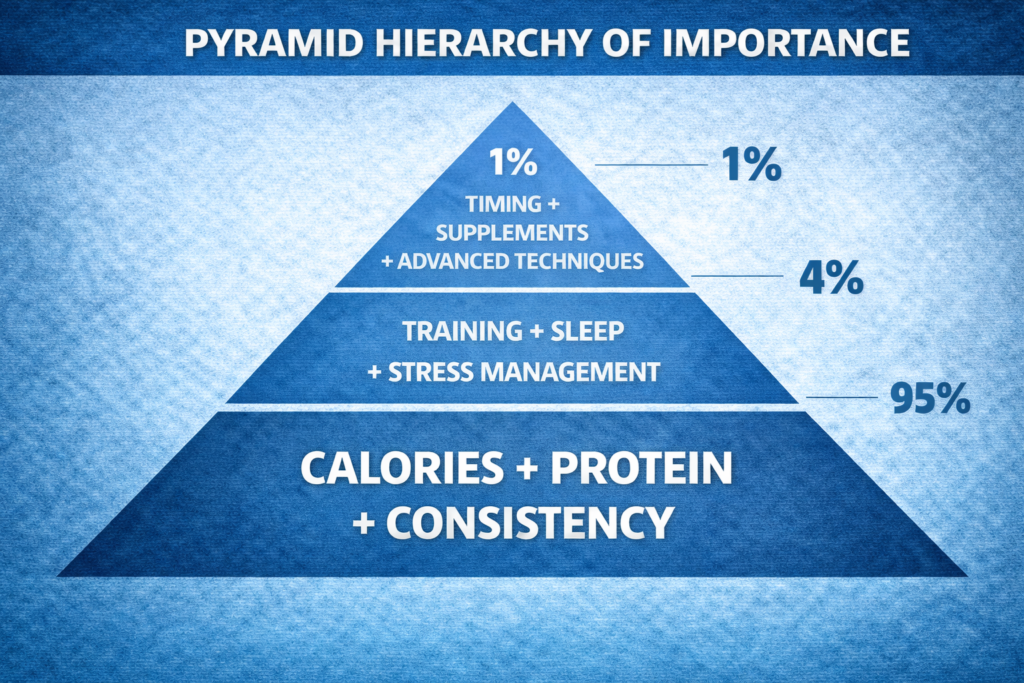
Let’s be completely clear about what matters and in what order:
Tier 1: Non-Negotiable Fundamentals (95% of Results)
1. Total daily calorie intake
This determines whether you gain, lose, or maintain weight. Everything else is secondary to getting this right.
2. Daily protein intake
This determines whether weight changes are muscle or fat. Aim for 0.7-1.0g per pound of body weight.
3. Consistency over time
Doing the above two things consistently for months and years. Not perfectly, but consistently (80-90% adherence).
Get these three right and you’ll transform your body. Everything else is details and optimization.
Tier 2: Important but Secondary (4% of Results)
4. Training with progressive overload
Necessary to build muscle and strength, but diet determines whether your body has the resources to actually build that muscle.
5. Adequate sleep
Crucial for recovery and hormonal health, but can’t compensate for poor nutrition.
6. Stress management
Helps with adherence and hormone optimization, but won’t override caloric imbalance.
Tier 3: Optimization and Fine-Tuning (1% of Results)
7. Macronutrient timing
Post-workout nutrition, meal frequency, etc. Nice to optimize once everything else is dialed in.
8. Supplements
Creatine, caffeine, maybe a few others. Helpful but minimal impact compared to diet fundamentals.
9. Advanced training techniques
Drop sets, supersets, rest-pause, periodization. Useful for advanced lifters with everything else mastered.
Most people obsess over Tier 3 while ignoring Tier 1.
They argue about whether post-workout protein should be consumed within 30 or 60 minutes while having no idea if they’re eating 1,800 or 2,800 calories daily.
They buy expensive supplements while eating out for 70% of meals with zero tracking.
They debate optimal training splits while their protein intake varies from 60g to 180g daily depending on convenience.
This is like polishing the hubcaps on a car with a broken engine.
What You Actually Need to Do
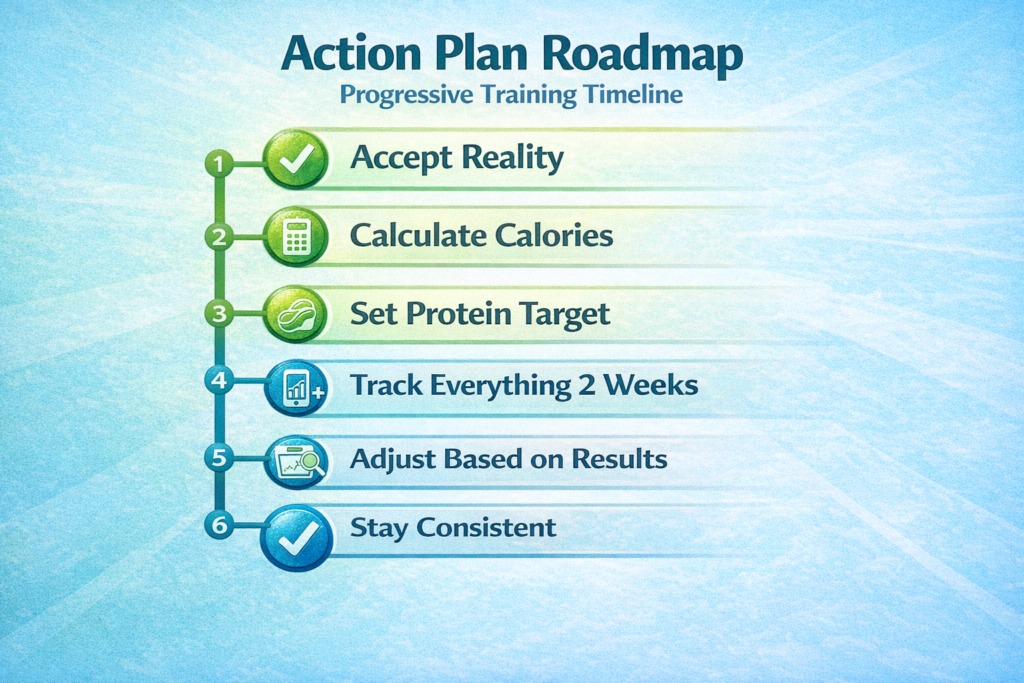
Enough theory. Here’s the practical action plan:
Step 1: Accept Reality
Your diet is almost certainly the problem. Not your genetics, not your training program, not your supplements.
If you’re not making progress, you’re either:
- Not eating enough (if trying to build muscle)
- Eating too much (if trying to lose fat)
- Not eating consistent enough protein (both scenarios)
Accept this. Own it. Stop looking for other explanations.
Step 2: Calculate Your Calorie Target
Use an online calculator or this simple formula:
For maintenance: Body weight (lbs) × 14-16
For muscle gain: Add 300-500 calories to maintenance
For fat loss: Subtract 300-500 calories from maintenance
Example: 180-pound person
- Maintenance: 180 × 15 = 2,700 calories
- Muscle gain: 3,000-3,200 calories
- Fat loss: 2,200-2,400 calories
Step 3: Set Your Protein Target
Simple rule: 0.7-1.0 grams per pound of body weight
Example: 180-pound person
- Minimum: 126g protein daily
- Optimal: 144-180g protein daily
Step 4: Track Everything for 2 Weeks
Download MyFitnessPal, Cronometer, or similar app.
Log every single thing you eat and drink for 14 days.
Weigh food when possible. Be honest and accurate.
This reveals the truth. You’ll likely discover you’re eating far more or far less than you thought.
Step 5: Adjust Based on Results
Weigh yourself weekly (same day, same time, after bathroom, before eating).
After 2-3 weeks:
If trying to build muscle:
- Gaining 0.5-1 lb weekly: Perfect, continue
- Gaining less: Increase calories by 200
- Gaining 2+ lbs weekly: Reduce calories by 100-200 (gaining too much fat)
If trying to lose fat:
- Losing 0.5-1 lb weekly: Perfect, continue
- Losing less: Reduce calories by 200
- Losing 2+ lbs weekly: Increase calories by 100-200 (losing too quickly, likely losing muscle)
Step 6: Stay Consistent
This is where most people fail.
They do great for 2 weeks, then:
- Weekend binge derails progress
- Social event leads to overeating
- Stressful week leads to abandoning tracking
- “I’ll start again Monday”
80-90% consistency over months beats 100% perfection for 2 weeks followed by complete abandonment.
Common Objections (And Why They’re Wrong)
“But I Need to Find the Perfect Training Program First”
No, you don’t. Any competent program with progressive overload works if your diet supports it.
Stop program hopping. Pick one, stick with it for 6 months, fix your diet, and watch the results.
“But I’m Already Eating Healthy”
“Healthy” and “appropriate for your goals” are different things.
You can eat incredibly healthy whole foods and still be in the wrong caloric balance for your goals.
Nuts, avocados, olive oil, whole grains, and fruit are all “healthy.” They’re also calorie-dense. Easy to overeat.
Healthy doesn’t automatically mean right for fat loss or muscle gain.
“But I Don’t Want to Track Forever”
You don’t have to. But you need to track initially to learn:
- What portions actually look like
- How many calories are in different foods
- How much you’re actually eating vs. what you think
After 2-3 months of tracking, most people develop enough intuition to maintain without tracking every meal.
But you need the education period first.
“But Counting Calories Is Obsessive and Unhealthy”
No more obsessive than checking your bank account to manage finances.
Would you rather be:
- “Obsessive” about tracking for 12 weeks and achieve your goals
- “Relaxed and intuitive” for 2 years making zero progress
Choose your hard.
“But I Just Need to Train Harder”
If you’re already training consistently 3-5x per week with progressive overload, training harder won’t fix a diet problem.
More training without adequate nutrition leads to:
- Overtraining and injury
- Muscle loss (if undereating)
- Spinning your wheels (if overeating while trying to lose fat)
Training harder is never the solution to a diet problem.
The Uncomfortable Truth Nobody Wants to Accept
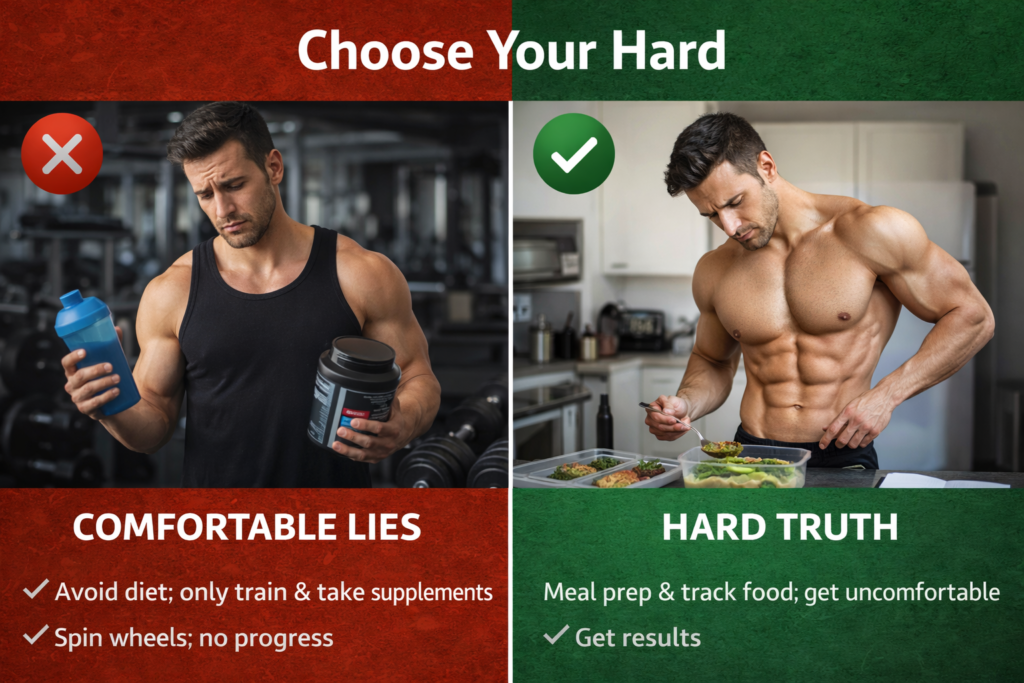
Getting the body you want requires doing things you don’t want to do.
You’ll have to:
- Track your food (at least initially)
- Eat when you’re not hungry (muscle gain)
- Stay hungry sometimes (fat loss)
- Say no to social food events occasionally
- Meal prep when you’d rather relax
- Make different choices than your friends and family
- Invest time learning nutrition basics
- Be consistent for months and years, not days and weeks
This is hard. This is uncomfortable. This is not fun.
Training is easier. Supplements are easier. Trying new programs is easier.
That’s exactly why most people avoid fixing their diet.
But here’s what else is true:
The effort is worth it. Actually, it’s probably the most important aspect when your goal is body transformation.
You can spend years spinning your wheels, trying every training program and supplement under the sun, making zero progress.
Or you can spend 3 months getting your diet dialed in and finally start seeing the results you’ve been chasing.
Which sounds better?
The Bottom Line: Stop Lying to Yourself
If you’re training consistently and not seeing results, your diet is the problem.
Not maybe. Not possibly. It IS the problem.
Stop looking for other explanations:
- Your genetics are fine
- Your training program is probably adequate
- Your supplements don’t matter
- Your metabolism isn’t broken
Your diet is broken. Fix it.
The process:
✅ Accept that diet is the issue
✅ Calculate your calorie and protein targets
✅ Track your food intake accurately
✅ Adjust based on weekly weigh-ins
✅ Stay consistent for at least 12 weeks
✅ Watch your body finally transform
This isn’t complicated. But it is hard.
The question is: are you finally ready to do the hard thing that actually works?
Or will you continue doing the easier thing that keeps you stuck?
Your choice. Your results.
STOP AVOIDING THE TRUTH. FIX YOUR DIET. TRANSFORM YOUR BODY.
Ready to finally get your diet dialed in and see the results you’ve been chasing? Stop wasting time on training programs and supplements while ignoring the one thing that actually determines your success. Get a complete, proven nutrition system that shows you exactly what to eat, how much, and when. No more guessing. No more spinning your wheels. Just results. Your transformation starts with your diet.




Leave a Reply
You must be logged in to post a comment.