
Training harder but getting weaker? Sore all the time? Can’t sleep despite exhaustion? You’re not undertrained. You’re overtrained.
You’re at the gym 6 days a week. You’re pushing every set to failure. You’re adding extra cardio.
You’re doing everything “right” but your body is falling apart. You’re getting smaller, not bigger. Weaker, not stronger.
You think the solution is more:
- More training days
- More sets per workout
- More intensity techniques
- More cardio for fat loss
But you’re destroying yourself. Every workout is digging a deeper hole. You’re not building muscle. You’re systematically breaking down your body.
Here’s what’s actually happening: Overtraining syndrome is chronic stress overload. Your body can’t recover from the training volume you’re imposing. Cortisol stays elevated 24/7, testosterone crashes, your immune system fails, sleep becomes impossible, and muscle tissue breaks down faster than it can rebuild. This isn’t about being “tough” or “dedicated.” This is pathological. You’re clinically overtrained, and if you don’t stop, you’ll need months to recover.
In this comprehensive guide, I’ll explain the difference between overreaching (temporary) and overtraining (pathological), reveal the 7 definitive signs you’re overtrained (most people have 4+), show you how overtraining actually destroys muscle tissue (the mechanism), provide the complete recovery protocol (rest alone isn’t enough), and explain the optimal training volume for muscle growth (less than you think).
Whether you’re a dedicated lifter, athlete, or fitness enthusiast, understanding overtraining could save months of lost progress.
Let’s identify if you’re overtrained and fix it before permanent damage occurs.
TABLE OF CONTENTS
- Sign 1: Persistent Decline in Performance
- Sign 2: Chronic Muscle Soreness That Never Goes Away
- Sign 3: Sleep Disturbances Despite Exhaustion
- Sign 4: Resting Heart Rate Elevated 10+ BPM
- Sign 5: Getting Sick Constantly
- Sign 6: Complete Loss of Motivation and Enjoyment
- Sign 7: Fat Gain Despite Training and Dieting
- The Bottom Line: Less Training, More Gains
What Is Overtraining Syndrome?
Understanding the difference between hard training and pathological stress.
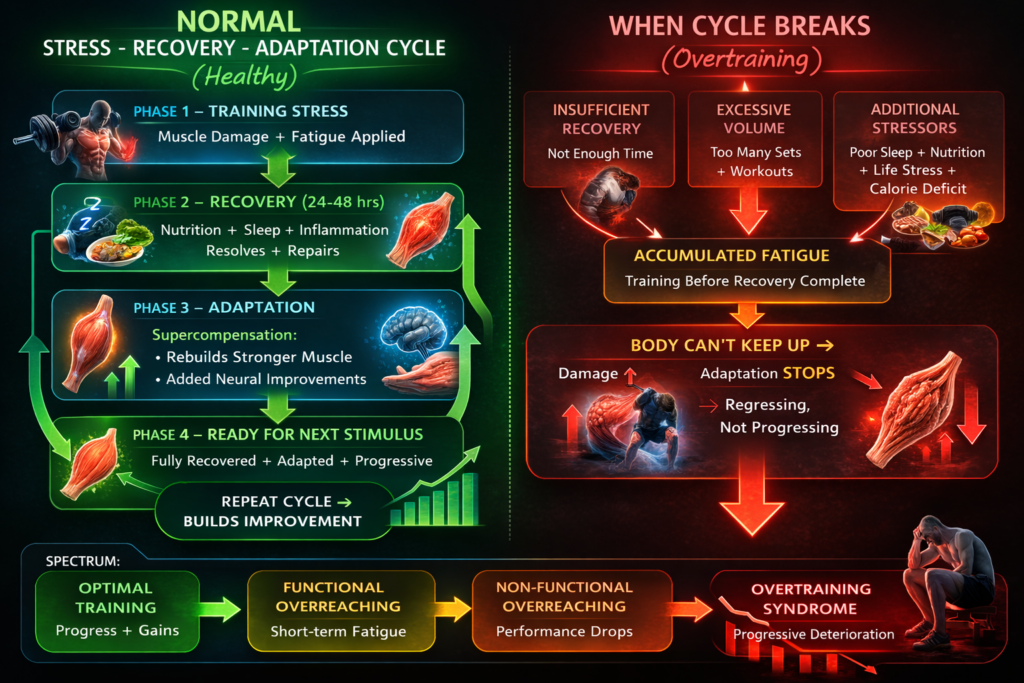
The Stress-Recovery-Adaptation Cycle
Normal training response:
Phase 1: Training stress
- Workout creates muscle damage
- Energy stores depleted
- Nervous system fatigued
- Acute stress applied
Phase 2: Recovery
- 24-48 hours rest
- Adequate nutrition
- Quality sleep
- Inflammation resolves
- Body repairs damage
Phase 3: Adaptation (supercompensation)
- Body rebuilds stronger than before
- Muscle tissue added
- Neural efficiency improved
- Energy systems enhanced
- Positive adaptation
Phase 4: Ready for next stimulus
- Fully recovered
- Adapted from previous workout
- Ready for progressive overload
- Growth achieved
The cycle:
- Stress → Recovery → Adaptation → Repeat
- Each cycle builds on previous
- Progressive improvement
- This is how muscle growth works
When The Cycle Breaks: Overtraining
What goes wrong:
Insufficient recovery:
- Not enough time between sessions
- Training again before recovery complete
- Accumulated fatigue builds
- Never fully recovering
Excessive training volume:
- Too many sets per workout
- Too many workouts per week
- Too much intensity
- Exceeds recovery capacity
Additional stressors:
- Poor sleep
- Inadequate nutrition
- Life stress (work, relationships)
- Calorie deficit too aggressive
- Cumulative stress overload
The result:
- Body can’t keep up with damage
- Adaptation stops occurring
- Begin regressing instead of progressing
- Pathological state
Overreaching vs. Overtraining
Functional overreaching (good):
- Temporary period of excessive training
- Planned and brief (1-2 weeks)
- Performance temporarily decreases
- Full recovery within 1-2 weeks with rest
- Followed by supercompensation
- Strategic training tool
Non-functional overreaching (bad):
- Excessive training without adequate recovery
- Performance decreases significantly
- Takes 2-4 weeks to recover
- No supercompensation benefit
- Mistake, not strategy
Overtraining syndrome (pathological):
- Chronic state of excessive training stress
- Performance severely impaired
- Takes months to fully recover
- Hormonal dysfunction
- Immune suppression
- Psychological symptoms
- Medical condition
The spectrum:
- Optimal training → Functional overreaching → Non-functional overreaching → Overtraining syndrome
- Progressive deterioration
The critical distinction:
- Overreaching: Recovers in 1-4 weeks
- Overtraining: Requires months of recovery
- Severity and duration differ dramatically
The 7 Definitive Signs of Overtraining
How to know if you’ve crossed the line.
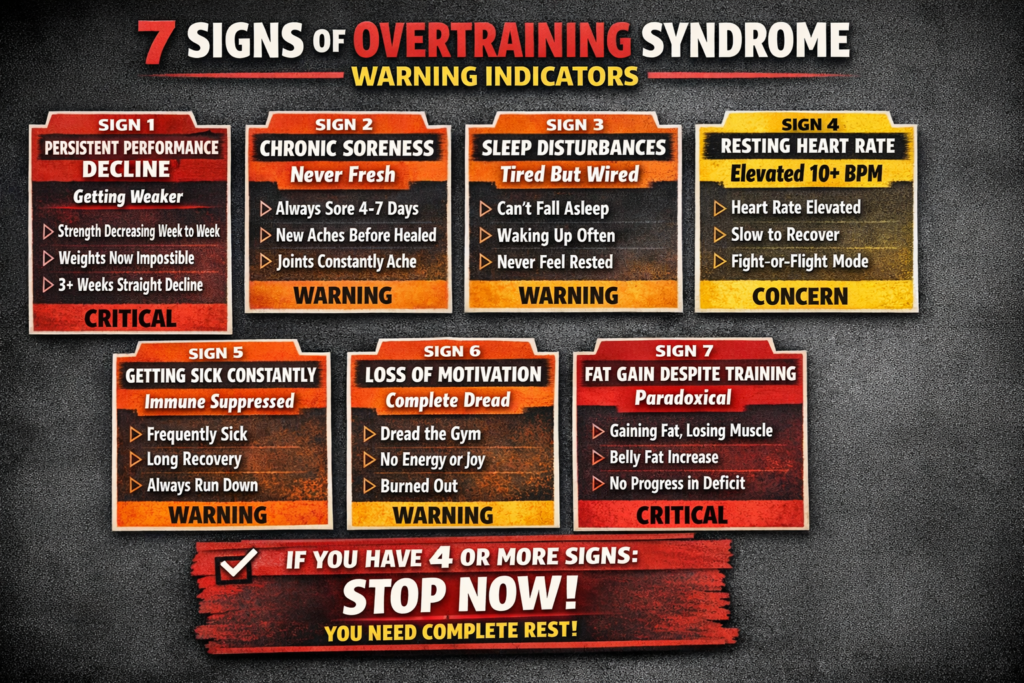
Sign 1: Persistent Decline in Performance
What it looks like:
- Strength decreasing week to week
- Can’t hit weights you could do easily before
- Reps decreasing on same weight
- Workouts feel impossibly hard
- Getting weaker consistently
Why it matters:
- Normal training: Progressive improvement
- Overtraining: Progressive decline
- Most obvious and objective sign
- Performance should increase, not decrease
The pattern:
- Week 1: Bench press 225×10
- Week 2: 225×9 (slightly off)
- Week 3: 225×7 (concerning)
- Week 4: 225×6 (definitely overtrained)
- Consistent downward trend
What it’s NOT:
- Single bad workout (everyone has these)
- One week plateau (normal)
- Expected during intense cut
- Must be persistent decline
The test:
- Track weights and reps
- If declining 3+ weeks straight
- And not cutting calories aggressively
- Likely overtrained
- Objective measurement
Sign 2: Chronic Muscle Soreness That Never Goes Away
What it looks like:
- Always sore, even days after workout
- Soreness lasts 4-7 days (normal is 24-72 hours)
- New soreness before previous soreness resolves
- Joints ache constantly
- Never feel fresh
Why it matters:
- Soreness indicates muscle damage
- Should resolve within 72 hours
- Persistent soreness = incomplete recovery
- Training on damaged tissue = more damage
- Damage accumulating
The mechanism:
- Workout causes micro-tears
- Inflammation repairs damage
- Should be resolved in 2-3 days
- If not, body can’t keep up with repair
- Overwhelmed recovery
Normal pattern:
- Monday: Train chest
- Tuesday-Wednesday: Sore
- Thursday: Recovered
- Clear resolution
Overtraining pattern:
- Monday: Train chest
- Tuesday-Saturday: Still sore
- Monday: Train chest again (still sore from last week)
- Accumulating damage
Sign 3: Sleep Disturbances Despite Exhaustion
What it looks like:
- Physically exhausted but can’t fall asleep
- Waking multiple times per night
- Waking too early (4-5 AM, can’t go back)
- Never feel rested
- Tired but wired
Why it happens:
- Chronically elevated cortisol
- Cortisol should be low at night (allows sleep)
- Overtraining keeps cortisol elevated 24/7
- High cortisol = poor sleep
- HPA axis dysregulation
The pattern:
- Exhausted all day
- Hit bed at 10 PM
- Lie awake until midnight
- Wake at 3 AM, 5 AM
- Alarm at 7 AM, still exhausted
- Exhaustion without rest
Why it matters:
- Sleep is when recovery occurs
- No sleep = no recovery
- Creates vicious cycle
- Overtraining worsens sleep, poor sleep worsens overtraining
- Self-perpetuating problem
Sign 4: Resting Heart Rate Elevated 10+ BPM
What it looks like:
- Normal resting heart rate: 60 BPM
- Now: 70-75 BPM
- Consistently elevated
- Takes forever to drop after exercise
- Elevated sympathetic activity
Why it happens:
- Overtraining = chronic stress
- Sympathetic nervous system overactive
- Heart rate stays elevated
- Body in constant “fight or flight”
- Autonomic dysfunction
How to measure:
- Check heart rate upon waking (before getting up)
- Same time each day
- Track trend over weeks
- Increase of 10+ BPM above normal = warning sign
- Simple objective marker
The research:
- Elite athletes monitor resting heart rate
- Indicator of recovery status
- Increase = inadequate recovery
- Validated marker
Sign 5: Getting Sick Constantly
What it looks like:
- Catching every cold
- Illnesses last longer
- Chronic low-grade sickness
- Sore throat, congestion that won’t resolve
- Immune suppression
Why it happens:
- Exercise is stress
- Moderate exercise boosts immunity
- Excessive exercise suppresses immunity
- Chronic cortisol elevation impairs immune function
- U-shaped curve
The mechanism:
- Cortisol anti-inflammatory (suppresses immune response)
- Chronically high cortisol = chronically suppressed immunity
- Pathogens take advantage
- Immunosuppression
The pattern:
- Before overtraining: Rarely sick
- During overtraining: Sick monthly
- After recovery: Healthy again
- Clear correlation
Sign 6: Complete Loss of Motivation and Enjoyment
What it looks like:
- Used to love training
- Now dread going to gym
- Workouts feel like torture
- No enjoyment or satisfaction
- Consider quitting
- Psychological burnout
Why it happens:
- Central nervous system fatigue
- Neurotransmitter depletion (dopamine, serotonin)
- Chronic stress affects mood
- Body signaling “we need rest”
- Mental exhaustion
The experience:
- Alarm goes off for gym
- Feel dread instead of excitement
- Drag yourself there
- Every set is misery
- Leave feeling worse
- No positive feelings
Why it matters:
- Training should be challenging but rewarding
- Complete loss of enjoyment = red flag
- Psychological symptoms as important as physical
- Mental health indicator
Sign 7: Fat Gain Despite Training and Dieting
What it looks like:
- Training hard
- Eating in deficit
- Still gaining fat (especially belly)
- Losing muscle simultaneously
- Looking worse despite effort
- Paradoxical fat gain
Why it happens:
- Chronically elevated cortisol
- Cortisol promotes fat storage (especially visceral)
- Cortisol breaks down muscle
- Metabolic rate crashes
- Hormonal nightmare
The mechanism:
- Cortisol increases blood glucose
- Promotes insulin resistance
- Favors fat storage
- Simultaneously breaks down muscle for energy
- Worst body composition scenario
The frustration:
- Doing “everything right”
- Cardio, weights, low calories
- Body composition getting worse
- Doesn’t make sense
- Biology broken
The solution:
- More training makes it worse
- Need to reduce stress (rest)
- Counterintuitive fix
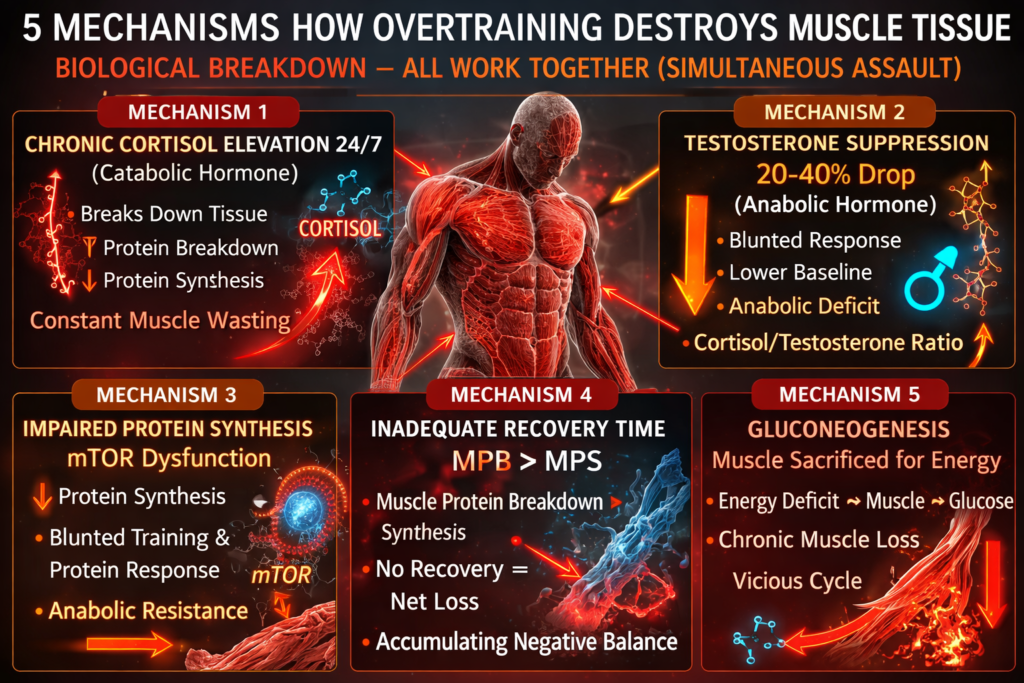
How Overtraining Destroys Muscle Tissue
The biological mechanisms of muscle loss.
Mechanism 1: Chronic Cortisol Elevation
What cortisol does:
- Catabolic hormone (breaks down tissue)
- Increases protein breakdown
- Decreases protein synthesis
- Mobilizes amino acids from muscle
- Muscle breakdown hormone
Normal cortisol pattern:
- Spikes during workout (good, mobilizes energy)
- Drops after workout
- Low evening and night
- Acute elevation, then recovery
Overtraining cortisol pattern:
- Elevated during workout (expected)
- Stays elevated after workout
- Elevated evening and night
- Elevated 24/7
- Chronic elevation
The effect:
- Constant muscle breakdown
- Protein synthesis impaired
- Net muscle loss
- Despite training
- Muscle wasting
The research:
- Chronically elevated cortisol
- Associated with muscle atrophy
- Similar to Cushing’s syndrome
- Well-documented
Mechanism 2: Testosterone Suppression
What testosterone does:
- Anabolic hormone (builds tissue)
- Increases protein synthesis
- Promotes muscle growth
- Opposes cortisol
- Muscle building hormone
Normal testosterone:
- Rises acutely during training
- Returns to healthy baseline
- Adequate for recovery and growth
- Anabolic environment
Overtrained testosterone:
- Blunted response to training
- Lower baseline levels
- Can drop 20-40%
- Anabolic deficit
The cortisol-testosterone ratio:
- Healthy: High testosterone, controlled cortisol spikes
- Overtrained: Low testosterone, chronically high cortisol
- Ratio determines anabolic vs. catabolic state
- Massively shifted toward catabolism
Mechanism 3: Impaired Protein Synthesis Signaling
The mTOR pathway:
- Master regulator of protein synthesis
- Stimulated by training and nutrition
- Builds new muscle tissue
- Growth signal
Normal function:
- Training activates mTOR
- Amino acids enhance activation
- Protein synthesis increases
- Muscle builds
- Growth occurs
Overtrained dysfunction:
- Chronic stress impairs mTOR activation
- Blunted response to training
- Blunted response to protein
- Protein synthesis reduced
- Growth impaired
The mechanism:
- Inflammation from overtraining
- Inflammatory signals interfere with mTOR
- Anabolic resistance develops
- Can’t use nutrients properly
Mechanism 4: Inadequate Recovery Time
The simple math:
- Muscle protein breakdown (MPB) occurs during training
- Muscle protein synthesis (MPS) occurs during recovery
- Net growth = MPS > MPB
- Recovery is when growth happens
Normal training:
- Workout: MPB increases
- Recovery: MPS increases more
- Net gain over 48-72 hours
- Positive balance
Overtraining:
- Workout: MPB increases
- No recovery time: MPS can’t catch up
- Next workout: More MPB before MPS occurred
- Net loss accumulating
- Negative balance
The requirement:
- Need 48-72 hours between sessions per muscle group
- Overtraining = training same muscles every day or too frequently
- No time for MPS to exceed MPB
- Insufficient recovery time
Mechanism 5: Energy Deficit and Gluconeogenesis
What happens:
- Excessive training creates massive energy deficit
- Body needs glucose for brain and vital functions
- Insufficient carbs/calories
- Breaks down muscle for glucose
- Muscle sacrificed for energy
Gluconeogenesis:
- Process of making glucose from protein
- Occurs when glucose stores depleted
- Amino acids from muscle converted to glucose
- Muscle becomes fuel
The overtrained scenario:
- Training volume massive (high energy demand)
- Insufficient nutrition (trying to stay lean)
- Glycogen constantly depleted
- Body raids muscle tissue constantly
- Chronic muscle loss
The vicious cycle:
- Lose muscle → metabolic rate drops
- Metabolic rate drops → need fewer calories
- Eat fewer calories → more muscle loss
- Downward spiral
The Hormonal Cascade of Overtraining
How chronic stress destroys your endocrine system.
The HPA Axis Dysregulation
Normal HPA axis:
- Hypothalamus → Pituitary → Adrenal glands
- Stress response system
- Feedback loop maintains balance
- Self-regulating
Overtrained HPA axis:
- Chronic stress
- Feedback loop breaks
- System dysregulated
- Cortisol chronically elevated or erratic
- Lost regulation
The consequences:
- Cortisol dominance (muscle breakdown)
- Aldosterone disruption (water retention)
- Sex hormone suppression (testosterone, estrogen)
- Thyroid suppression (metabolic slowdown)
- Systemic hormonal chaos
Testosterone Suppression Mechanisms
Direct suppression:
- Chronic stress suppresses GnRH (from hypothalamus)
- Less GnRH = less LH and FSH (from pituitary)
- Less LH = less testosterone production (testes)
- Reproductive axis shutdown
Why this happens:
- Evolutionary perspective
- Stress = danger = not time to reproduce
- Body prioritizes survival over reproduction
- Biological survival mechanism
The degree:
- Can drop 20-40% from baseline
- Functionally low even if “technically normal”
- Takes months to fully restore
- Significant suppression
Thyroid Suppression
The mechanism:
- Chronic stress suppresses TSH
- Less TSH = less T4 and T3 production
- Increased conversion T4 → reverse T3 (inactive)
- Metabolic slowdown
The effects:
- Lower metabolic rate
- Easier fat gain
- Fatigue and lethargy
- Cold intolerance
- Hypothyroid symptoms
The irony:
- Training more to lose fat
- Overtraining suppresses thyroid
- Thyroid suppression makes fat loss harder
- Counterproductive
Growth Hormone Disruption
Normal GH:
- Released during deep sleep
- Promotes recovery and growth
- Anabolic hormone
- Recovery hormone
Overtrained GH:
- Sleep disrupted (can’t reach deep sleep)
- GH release impaired
- Less recovery
- More breakdown
- Impaired recovery
The Complete Recovery Protocol
How to fix overtraining syndrome.
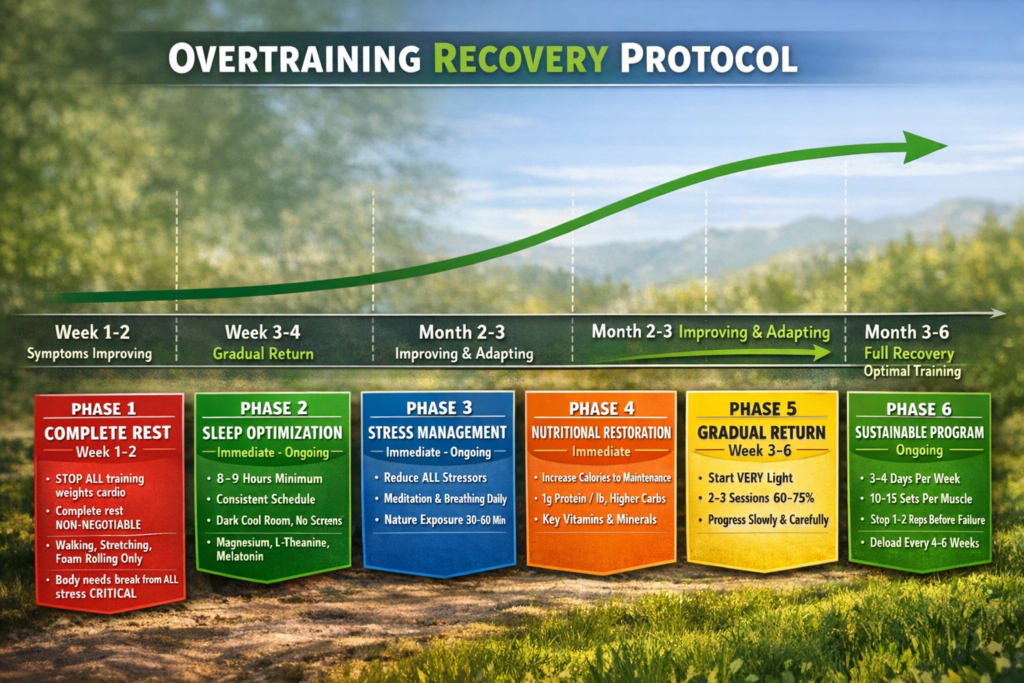
Phase 1: Complete Training Cessation (Week 1-2)
What to do:
- STOP all training
- No weights
- No cardio
- No “active recovery” workouts
- Complete rest
Why this is necessary:
- Body needs break from ALL training stress
- Even light training prevents recovery
- Must allow HPA axis to reset
- Non-negotiable
What you CAN do:
- Walking (light, 20-30 minutes)
- Stretching (gentle)
- Foam rolling
- True recovery activities only
The mental challenge:
- Fear of losing gains
- Guilt about not training
- Restlessness
- Psychological difficulty
The reality:
- Not training 1-2 weeks won’t cause significant atrophy
- Continuing to train delays recovery by months
- Short-term rest prevents long-term disaster
- Strategic deload
Phase 2: Sleep Optimization (Immediate and Ongoing)
Why it’s critical:
- Sleep is when recovery occurs
- Overtraining disrupts sleep
- Must fix aggressively
- Foundation of recovery
The protocol:
Sleep hygiene:
- 8-9 hours minimum (more than normal)
- Consistent schedule (same bedtime/wake)
- Dark room (blackout curtains)
- Cool temperature (65-68°F)
- No screens 2 hours before bed
- Optimize environment
If sleep still difficult:
- Magnesium glycinate (400-600mg before bed)
- L-theanine (200-400mg)
- Melatonin (0.5-3mg)
- Valerian root
- Supplemental support
If severely disrupted:
- Consider sleep study (rule out apnea)
- May need temporary sleep medication
- Under doctor supervision
- Medical intervention if needed
Timeline:
- Week 1-2: Sleep beginning to improve
- Week 3-4: Sleep normalizing
- Month 2-3: Sleep fully restored
- Progressive recovery
Phase 3: Stress Management (Immediate and Ongoing)
Why it matters:
- Overtraining IS chronic stress
- Must reduce ALL stressors
- Not just training stress
- Holistic approach
What to address:
Work stress:
- Set boundaries
- Take vacation if possible
- Delegate tasks
- Reduce where possible
Relationship stress:
- Address conflicts
- Seek therapy if needed
- Social support
- Manage interpersonal stress
Financial stress:
- Budget review
- Reduce unnecessary expenses
- Seek financial counseling
- Address root causes
Active stress reduction:
Daily meditation:
- 20 minutes daily (minimum)
- Reduces cortisol significantly
- Non-negotiable practice
- Evidence-based intervention
Deep breathing:
- 10 minutes, 2-3x daily
- Box breathing (4-4-4-4)
- Activates parasympathetic
- Nervous system reset
Nature exposure:
- 30-60 minutes daily
- Outdoor walking
- Reduces cortisol
- Natural stress relief
Phase 4: Nutritional Restoration (Immediate)
Why nutrition matters:
- Body needs resources to recover
- Likely been in deficit
- Must provide building blocks
- Fuel recovery
Calorie intake:
- Increase to maintenance or slight surplus
- Stop dieting completely
- Body needs energy to heal
- End the deficit
Protein:
- 1.0g per pound body weight
- Provides amino acids for repair
- Supports muscle retention
- Building blocks
Carbohydrates:
- Increase substantially
- Replenish glycogen stores
- Support cortisol regulation
- 2-3g per pound body weight
- Energy restoration
Fats:
- 25-30% of calories
- Supports hormone production
- Anti-inflammatory fats (omega-3)
- Hormonal support
Micronutrients:
- Multivitamin
- Vitamin D (if deficient)
- Magnesium
- Zinc
- Nutritional insurance
Phase 5: Gradual Return to Training (Week 3-6)
The approach:
- Slow, progressive return
- Start extremely light
- Less than you think necessary
- Cautious reintroduction
Week 3-4: Initial return
- 2-3 sessions per week (full body)
- 2-3 exercises per session
- 2-3 sets per exercise
- 60-70% previous working weights
- Stop 2-3 reps short of failure
- Extremely conservative
Week 5-6: Gradual progression
- 3 sessions per week
- 3-4 exercises per session
- 3 sets per exercise
- 70-75% previous working weights
- Stop 1-2 reps short of failure
- Progressive but cautious
Week 7-8: Continued progression
- 3-4 sessions per week
- 4-5 exercises per session
- 3-4 sets per exercise
- 75-80% previous working weights
- Approaching normal volume
Important:
- If symptoms return at any point (sleep issues, declining performance)
- Reduce volume immediately
- Take another week off
- Listen to body
Phase 6: Sustainable Training Program (Ongoing)
Design principles:
- Less volume than before overtraining
- More recovery time
- Sustainable long-term
- Prevent recurrence
The program:
Frequency:
- 3-4 days per week (not 6)
- Full rest days between sessions
- Adequate recovery
Volume per session:
- 10-15 sets per muscle per week (not 20+)
- 3-4 exercises per muscle
- 3-4 sets per exercise
- Moderate volume
Intensity:
- Stop 1-2 reps short of failure most sets
- Failure only on last set occasionally
- Controlled intensity
Progression:
- Add weight slowly (2.5-5lbs per week)
- Don’t rush progress
- Gradual > aggressive
- Patience
Deload weeks:
- Every 4-6 weeks
- Reduce volume 50%
- Maintain weights
- Scheduled recovery
Optimal Training Volume for Muscle Growth
The science of how much is enough.
The Dose-Response Relationship
The curve:
- Zero sets: Zero growth
- 1-10 sets per week: Significant growth
- 10-20 sets per week: Optimal growth
- 20-30 sets per week: Marginal additional growth
- 30+ sets per week: No additional growth, increased injury risk
- Diminishing returns after 10-20 sets
The research:
- Meta-analyses show optimal volume
- 10-20 sets per muscle group per week
- More is not always better
- Evidence-based recommendation
Individual variation:
- Some respond to lower volume
- Some tolerate higher volume
- Most in 10-20 set range
- Find your personal optimal
The Recovery Equation
The formula:
- Stimulus (training) + Recovery = Adaptation
- Too much stimulus + insufficient recovery = Overtraining
- Moderate stimulus + adequate recovery = Optimal growth
- Balance is key
The variables:
Training stress:
- Volume (sets, reps)
- Intensity (weight, effort)
- Frequency (sessions per week)
- Controllable factors
Recovery capacity:
- Sleep quality and duration
- Nutrition adequacy
- Life stress
- Age and training experience
- Genetics
- Individual factors
The practical application:
- High stress life = need lower training volume
- Excellent sleep and nutrition = can handle more volume
- Adjust training to recovery capacity
- Individualized approach
Minimum Effective Dose
The concept:
- What’s the LEAST training needed for growth?
- More efficient approach
- Allows better recovery
- Minimalist philosophy
The research:
- Beginners: 3-5 sets per muscle per week sufficient
- Intermediates: 5-10 sets per week sufficient
- Advanced: 10-15 sets per week sufficient
- Less than most people do
The benefits:
- Better recovery
- Lower injury risk
- More sustainable
- Life outside gym
- Quality over quantity
The mindset shift:
- From “more is better”
- To “what’s sufficient”
- Ego adjustment required
- Smarter training
How to Prevent Overtraining
Sustainable training practices.
Strategy 1: Track Your Training Volume
What to track:
- Sets per muscle group per week
- Total sets per week
- Training frequency
- Quantify workload
The benefit:
- See patterns
- Identify when volume creeping up
- Make adjustments before overtrained
- Objective monitoring
The tool:
- Training journal or app
- Weekly volume calculation
- Review monthly
- Data-driven decisions
Strategy 2: Monitor Recovery Markers
What to track:
Objective markers:
- Resting heart rate (daily, upon waking)
- Body weight (daily, same time)
- Performance metrics (weights, reps)
- Sleep quality (duration, subjective rating)
- Measurable data
Subjective markers:
- Energy levels (1-10 scale)
- Motivation (1-10 scale)
- Soreness levels
- Mood
- Self-assessment
Warning signs:
- Resting heart rate up 10+ BPM
- Performance declining 2+ weeks
- Sleep quality dropping
- Energy consistently low
- Early detection
The action:
- If 2+ markers declining
- Take immediate deload week
- Prevent progression to overtraining
- Proactive approach
Strategy 3: Schedule Deload Weeks
What they are:
- Planned reduction in training volume
- Every 4-6 weeks
- Allows accumulated fatigue to dissipate
- Preventive recovery
The protocol:
- Reduce volume 50% (half the sets)
- Maintain intensity (same weights)
- Or reduce both volume and intensity
- Strategic break
The benefits:
- Prevents accumulated fatigue
- Maintains adaptations
- Psychological break
- Comes back stronger
- Scheduled recovery
The resistance:
- Feels like “wasted week”
- Fear of losing gains
- Ego wants to push
- Mental barrier
The reality:
- No atrophy in one week
- Often come back stronger (supercompensation)
- Long-term progress faster
- Strategic investment
Strategy 4: Prioritize Sleep and Nutrition
Sleep non-negotiables:
- 7-9 hours nightly (minimum 7)
- Consistent schedule
- Quality environment
- Foundation of recovery
Nutrition non-negotiables:
- Adequate calories (at least maintenance)
- High protein (1g+ per pound)
- Sufficient carbs for training
- Micronutrient complete
- Fuel recovery
The principle:
- Can’t out-train poor recovery
- Sleep and nutrition determine recovery capacity
- Training must match recovery capacity
- Recovery limits training
Strategy 5: Manage Life Stress
The reality:
- Total stress = training stress + life stress
- High life stress = must reduce training stress
- Can’t max out both
- Cumulative stress
High stress periods:
- Work deadlines
- Relationship issues
- Financial problems
- Family obligations
- Life events
The adjustment:
- During high stress: Reduce training volume 20-30%
- Maintain intensity, reduce volume
- More rest days
- Adapt training to life
The mindset:
- Training is stressor, not stress relief
- If life already stressful, training adds to burden
- Must account for total stress load
- Holistic perspective
The Bottom Line: Less Training, More Gains
After explaining everything:
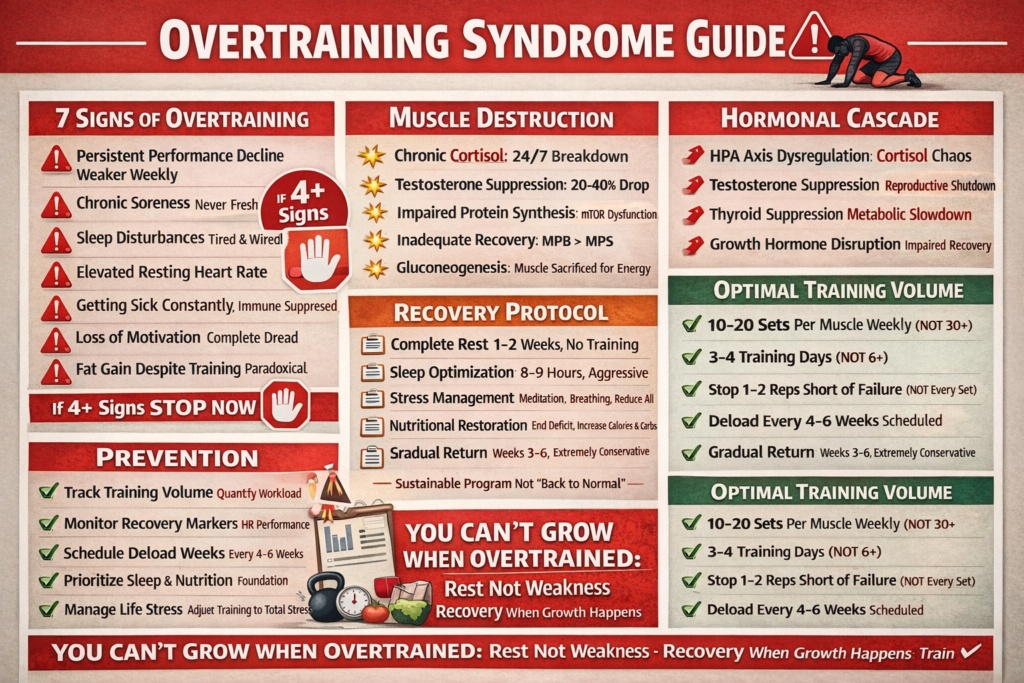
The truth about overtraining:
✅ Overtraining destroys muscle faster than anything else (chronic catabolism)
✅ Most dedicated lifters have some degree of overreaching (pushing too hard)
✅ Recovery is when muscle growth actually happens (training is stimulus, not growth)
✅ Optimal volume is less than most people think (10-20 sets per muscle per week)
✅ Takes months to fully recover from overtraining syndrome (not just one week off)
Key takeaways:
The 7 signs of overtraining:
- Persistent decline in performance (getting weaker week after week)
- Chronic muscle soreness (never feel fresh)
- Sleep disturbances despite exhaustion (tired but wired)
- Elevated resting heart rate (+10 BPM above normal)
- Getting sick constantly (immune suppression)
- Complete loss of motivation (dread training)
- Fat gain despite training and dieting (cortisol dominance)
- Check yourself honestly
How overtraining destroys muscle:
- Chronic cortisol elevation (24/7 muscle breakdown)
- Testosterone suppression (20-40% drop)
- Impaired protein synthesis signaling (mTOR dysfunction)
- Inadequate recovery time (MPB > MPS)
- Gluconeogenesis (muscle sacrificed for energy)
- Multiple mechanisms
The hormonal cascade:
- HPA axis dysregulation (cortisol chaos)
- Testosterone suppression (reproductive axis shutdown)
- Thyroid suppression (metabolic slowdown)
- Growth hormone disruption (impaired recovery)
- Systemic endocrine failure
The recovery protocol:
- Complete rest (1-2 weeks, no training at all)
- Sleep optimization (8-9 hours, aggressive intervention)
- Stress management (meditation, breathing, reduce all stressors)
- Nutritional restoration (end deficit, increase calories and carbs)
- Gradual return (weeks 3-6, extremely conservative progression)
- Sustainable program (lower volume than before)
- Complete approach required
Optimal training volume:
- 10-20 sets per muscle per week (not 30+)
- 3-4 training days per week (not 6)
- Stop 1-2 reps short of failure (not every set to failure)
- Deload every 4-6 weeks (scheduled recovery)
- Less is more
Prevention strategies:
- Track training volume (quantify workload)
- Monitor recovery markers (resting HR, performance, sleep, energy)
- Schedule deload weeks (every 4-6 weeks)
- Prioritize sleep and nutrition (foundation of recovery)
- Manage life stress (adjust training to total stress load)
- Proactive management
The mindset shift:
- From “more is better” to “what’s sufficient”
- From “training harder” to “recovering smarter”
- From “no days off” to “strategic rest”
- From “pushing through” to “listening to body”
- Smarter training
Recovery timeline:
- Week 1-2: Complete rest, symptoms begin improving
- Week 3-4: Gradual return, conservative volume
- Month 2-3: Approaching normal training, sleep and hormones improving
- Month 3-6: Full recovery, back to optimal training
- Patience required
Warning signs to stop immediately:
- Performance declining 3+ weeks straight
- Sleep getting progressively worse
- Multiple signs of overtraining present
- Don’t wait until complete breakdown
The hard truth:
- If you have 4+ signs of overtraining, you need to stop now
- One more week of training delays recovery by weeks or months
- Your body is screaming for rest
- Listen before permanent damage occurs
- Act now
YOU CAN’T GROW WHEN YOU’RE OVERTRAINED. REST IS NOT WEAKNESS. RECOVERY IS WHEN MUSCLE GROWTH HAPPENS. TRAIN LESS, RECOVER MORE, GROW BIGGER.
Ready to build a complete training and recovery system with optimal volume programming, objective recovery monitoring, strategic deload scheduling, and lifestyle management that maximizes muscle growth while preventing overtraining forever? Understanding overtraining is just the beginning. Get a comprehensive guide to designing sustainable training programs, tracking recovery markers accurately, implementing evidence-based volume recommendations, and achieving consistent progress without burning out. Stop training yourself into the ground. Start training intelligently for long-term success.
REFERENCES
SECTION 1 — Definition and diagnostic framework
[1] Cadegiani FA & Kater CE — PMC/BMC Sports Science, Medicine and Rehabilitation, 2017 Systematic review of hormonal aspects of OTS across 38 studies; overtraining syndrome, functional overreaching (FOR), and non-functional overreaching (NFOR) defined as conditions of decreased performance and fatigue arising from an imbalance between training stress and recovery; OTS characterized by long-term (months or indefinitely) performance decrement, psychological symptoms, and immune, hormonal, metabolic, and neurological dysfunction; distinguishes the overreaching spectrum from true OTS by severity and recovery timeline https://pmc.ncbi.nlm.nih.gov/articles/PMC5541747/
[2] Kreher JB & Schwartz JB — PMC/Sports Health, 2016 Review of OTS diagnosis and prevention; OTS defined as maladapted physiology in the setting of excessive exercise without adequate rest; symptoms are multisystem — hormonal, immunologic, neurologic, and psychologic; OTS causes performance decrements lasting over 2-3 months combined with mood disturbances; distinguishes functional overreaching (recovers in 1-2 weeks with supercompensation), non-functional overreaching (2-4 weeks, no supercompensation), and OTS (months); no validated diagnostic test currently available https://pmc.ncbi.nlm.nih.gov/articles/PMC5019445/
SECTION 2 — HPA axis dysregulation and hormonal cascade
[3] Urhausen A, Gabriel H, Kindermann W — PubMed/Sports Medicine, 1995 Review of blood hormones as markers of training stress and overtraining; testosterone/cortisol ratio used as indicator of anabolic/catabolic balance; ratio decreases with exercise intensity and duration and during periods of intense training; in overtraining syndrome, blunted maximal secretion of pituitary hormones (cortisol, GH, ACTH) observed after standardized exhaustive exercise; testosterone and cortisol act as competitive agonists at muscle cell receptor level; disturbed autonomic regulation a key feature of OTS https://pubmed.ncbi.nlm.nih.gov/8584849/
[4] Mondal S et al. — PMC/Indian Journal of Endocrinology and Metabolism, 2025 Review of testosterone:cortisol ratio (TCR) in sports endocrinology; testosterone promotes muscle protein synthesis via mTOR pathway; cortisol activates the ubiquitin-proteasome system causing proteolysis and inhibits mTOR; chronically elevated cortisol suppresses testosterone synthesis via GnRH/LH axis; a decline of ≥30% in TCR considered indicator of insufficient recovery; TCR reduced in 50% of studies examining NFOR/FOR athletes; serial monitoring recommended over single absolute values https://pmc.ncbi.nlm.nih.gov/articles/PMC12604835/
SECTION 3 — Cortisol and muscle catabolism mechanism
[5] Thau L, Gandhi J, Bhimji SS — NCBI StatPearls, 2025 Physiology of cortisol; cortisol induces catabolism in skeletal muscle by stimulating proteolysis via the ubiquitin-proteasome system through upregulation of atrogin-1 and MuRF1; FOXO gene overexpression accelerates muscle fiber atrophy; amino acids released serve as hepatic gluconeogenesis substrates during stress; cortisol further suppresses anabolic pathways by inhibiting mTOR signaling and reducing IGF-1 activity, causing sustained decrease in protein synthesis; chronic hypercortisolism produces muscle wasting similar to Cushing’s syndrome https://www.ncbi.nlm.nih.gov/books/NBK538239/
SECTION 4 — Immune suppression in overtraining
[6] Mackinnon LT — PubMed/Medicine & Science in Sports & Exercise, 2000 Review of chronic exercise training effects on immune function; intense training suppresses neutrophil function, serum and mucosal immunoglobulin levels, and plasma glutamine; incidence of upper respiratory tract infections (URTIs) increases during periods of heavy training; a J-curve or U-shaped relationship between exercise and immunity — moderate exercise enhances immunity, excessive exercise suppresses it; prevention strategies include avoiding overtraining and ensuring adequate rest, recovery, and nutrition https://pubmed.ncbi.nlm.nih.gov/10910293/
[7] Lakier Smith L — PubMed/Sports Medicine, 2003 Review of altered immunity in overtraining; OTS associated with suppressed immune function and increased URTI incidence; chronically elevated cortisol and catecholamines suppress cell-mediated immunity (Th1) while upregulating humoral immunity (Th2); net effect renders athletes more susceptible to infection; increased illness associated with OTS reflects altered focus of immune function rather than outright immunosuppression https://pubmed.ncbi.nlm.nih.gov/12696983/
SECTION 5 — Optimal training volume for muscle growth
[8] Schoenfeld BJ, Ogborn D, Krieger JW — PubMed/Journal of Sports Sciences, 2017 Systematic review and meta-analysis; 34 treatment groups from 15 studies; significant dose-response relationship between weekly resistance training volume and muscle hypertrophy (p=0.002); each additional set associated with 0.37% increase in muscle gain; groups performing 10+ sets per week experienced significantly greater hypertrophy than those performing fewer than 5 sets; first large-scale meta-analysis to demonstrate the volume-hypertrophy dose-response relationship https://pubmed.ncbi.nlm.nih.gov/27433992/
[9] Baz-Valle E et al. — PMC/Journal of Strength and Conditioning Research, 2022 Systematic review with meta-analysis; 12-20 weekly sets per muscle group identified as an optimum standard recommendation for muscle hypertrophy in trained men; no significant difference between moderate (12-20 sets/week) and high volume (>20 sets/week) for quadriceps and biceps hypertrophy; diminishing returns observed above 20 sets/week; dose-response trend confirmed with favorable results at 12-20 sets per muscle group https://pmc.ncbi.nlm.nih.gov/articles/PMC8884877/




Leave a Reply
You must be logged in to post a comment.