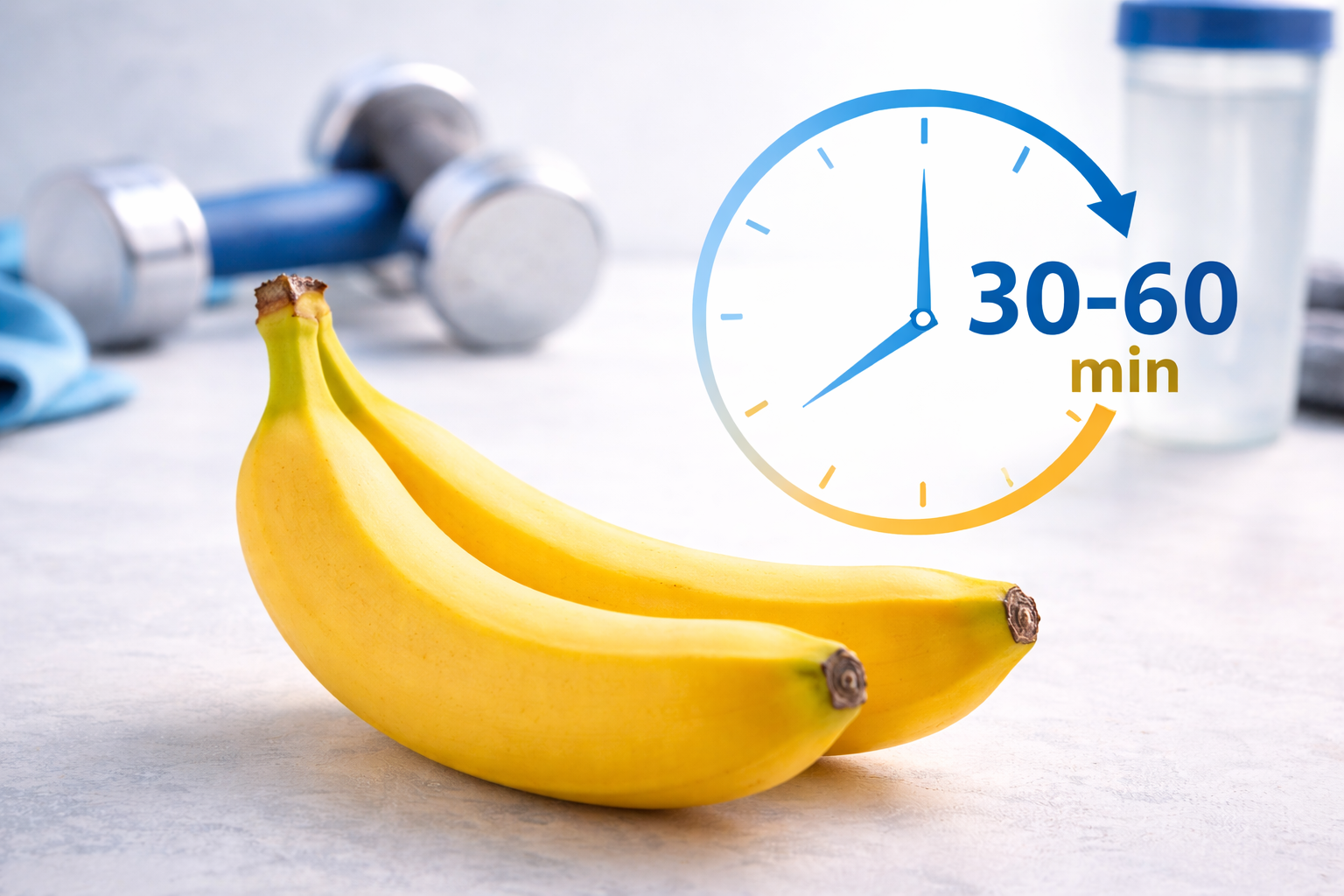
Wondering if bananas make a good pre-workout snack? Here’s the science-backed truth about timing, portions, and effectiveness.
You’re heading to the gym. You need a quick pre-workout snack.
You grab a banana. But is this actually a good choice?
You’ve heard mixed opinions:
- “Bananas are perfect pre-workout fuel”
- “Too much sugar, you’ll crash”
- “Not enough protein”
- “The potassium prevents cramps”
So which is it? Does science support eating bananas before training?
Here’s the evidence-based answer: Yes, bananas are an excellent pre-workout food when eaten 30-60 minutes before training. One medium banana provides 25g of fast-digesting carbohydrates for immediate energy, 422mg of potassium to prevent cramping and support muscle contractions, and natural sugars that provide quick fuel without digestive discomfort. They’re portable, affordable, and scientifically proven to enhance performance.
In this comprehensive guide, I’ll explain exactly why bananas work so well pre-workout (backed by research), reveal the optimal timing for eating bananas before different types of training, show you the ideal portion sizes for various goals and body weights, provide creative ways to combine bananas with protein for complete pre-workout nutrition, and help you understand when bananas work best versus when alternatives might be better.
Whether you’re training for strength, endurance, or muscle building, this article will optimize your pre-workout nutrition.
Let’s fuel your workouts intelligently.
TABLE OF CONTENTS
Is Banana a Good Pre-Workout Food?
The direct answer with scientific backing.
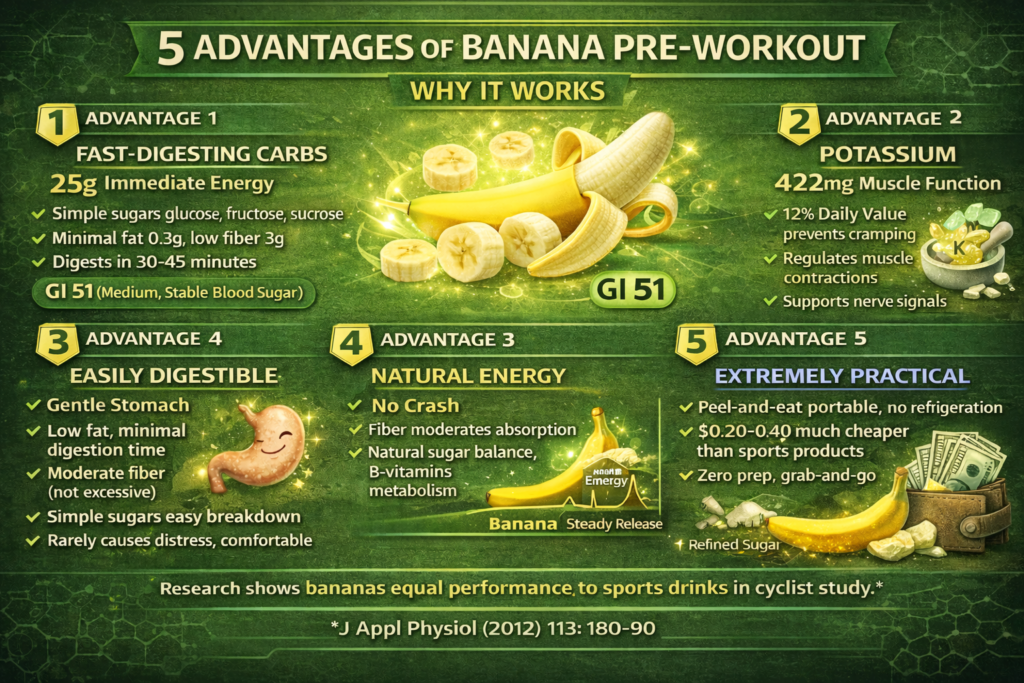
Why Bananas Excel Pre-Workout
Bananas provide specific advantages supported by research.
Advantage 1: Fast-digesting carbohydrates for immediate energy
Carbohydrate composition:
- 25g carbs per medium banana
- Primarily simple sugars (glucose, fructose, sucrose)
- Minimal fat (0.3g)
- Low fiber (3g)
- Digests in 30-45 minutes
Glycemic index: 51 (medium)
- Not too high (won’t cause crash)
- Not too low (provides energy quickly)
- Perfect middle ground
- Stable blood sugar during workout
What the research shows:
Study on bananas vs. sports drinks:
- Cyclists performed equally well with bananas or sports drinks
- Bananas provided same performance benefits
- Added benefit: Whole food nutrients
- Conclusion: Bananas as effective as engineered sports nutrition
Advantage 2: Potassium for muscle function
Potassium content: 422mg per medium banana (12% DV)
Why potassium matters for training:
- Regulates muscle contractions
- Prevents cramping
- Supports nerve signals
- Maintains electrolyte balance
During exercise:
- Potassium lost through sweat
- Muscle contractions require potassium
- Pre-workout banana provides buffer
- Reduces cramping risk
Research evidence:
- Low potassium associated with muscle cramps
- Adequate potassium supports performance
- Athletes benefit from potassium-rich foods
- Bananas naturally provide what sports drinks add artificially
Advantage 3: Easily digestible
Why digestion matters pre-workout:
Heavy foods cause problems:
- Blood diverted to digestion
- Feeling sluggish
- Nausea during training
- Reduced performance
Bananas are gentle:
- Low fat (0.3g, minimal digestion time)
- Moderate fiber (3g, not excessive)
- Simple sugars (easy to break down)
- Rarely causes digestive distress
Advantage 4: Natural energy without crash
Unlike pure sugar or candy:
Simple sugar alone:
- Rapid spike
- Insulin surge
- Quick crash
- Energy rollercoaster
Banana (natural package):
- Fiber moderates absorption
- Natural sugar balance
- B-vitamins support energy metabolism
- Steady energy release
- No crash mid-workout
Advantage 5: Extremely practical
Convenience factors:
Pre-packaged by nature:
- Peel-and-eat convenience
- No container needed
- No refrigeration required
- Portable anywhere
Affordable:
- $0.20-0.40 per banana
- Much cheaper than sports nutrition products
- Available everywhere
- Budget-friendly
No preparation:
- Zero cooking
- Zero mixing
- Zero cleanup
- Grab and go
When Banana Might Not Be Ideal
Specific scenarios where alternatives work better.
Scenario 1: Very long endurance training (2+ hours)
The limitation:
- Single banana only provides 25g carbs
- 2+ hour training requires 30-60g carbs per hour
- Need sustained fuel
- Banana alone insufficient
Better option:
- Banana + other carb sources
- Sports drinks during training
- Carb-loading meal beforehand
- Multiple fuel sources
Scenario 2: Training immediately (less than 20 minutes)
The issue:
- Banana takes 30-45 minutes to digest
- Won’t provide energy if training too soon
- May cause stomach discomfort
Better option:
- Liquid carbs (juice, sports drink)
- Already ate proper meal 2-3 hours ago
- Or train fasted (if short session)
Scenario 3: You dislike bananas
Simple reality:
- Adherence matters more than “perfect” food
- If you hate bananas, don’t force them
- Many alternatives provide similar benefits
- Choose foods you’ll actually eat
For 90% of people doing standard 45-90 minute training sessions, bananas are excellent.
Optimal Timing: When to Eat Banana Before Training
Precision timing for maximum benefit.
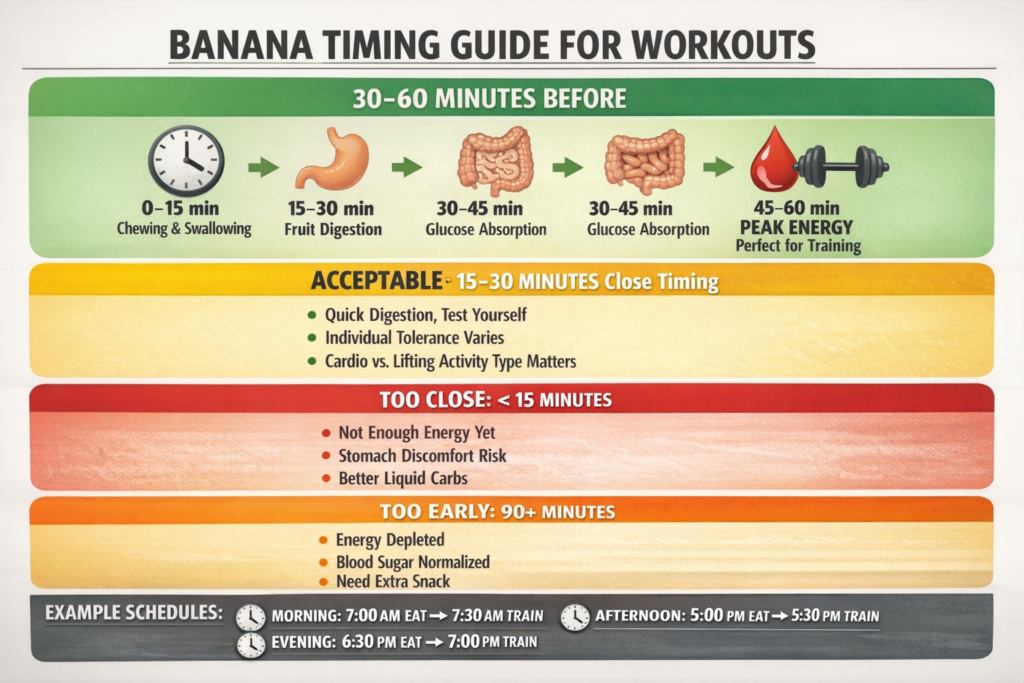
The 30-60 Minute Window (Ideal)
Why this timing works perfectly:
Digestion timeline:
- 0-15 min: Chewing and swallowing, stomach processing begins
- 15-30 min: Stomach breaks down fruit
- 30-45 min: Moves to small intestine, glucose absorption starts
- 45-60 min: Peak glucose availability in bloodstream
- Perfect for training start
Example schedules:
Morning training:
- 7:00 AM: Eat banana
- 7:30-7:45 AM: Begin training
- Energy peaks during workout
Afternoon training:
- 5:00 PM: Eat banana
- 5:30-5:45 PM: Begin training
- Optimal fuel timing
Evening training:
- 6:30 PM: Eat banana
- 7:00 PM: Begin training
- Ready to perform
What happens when timing is right:
- Feel energized at workout start
- Sustained energy entire session
- No stomach discomfort
- No hunger during training
- Optimal performance
Can You Eat Closer? (15-30 Minutes Before)
Possible for some people.
Considerations:
Lighter digestion:
- Bananas digest quickly
- Some people tolerate 20-30 min timing
- Individual variation exists
- Test to see your tolerance
Activity type matters:
- Cardio: Often tolerate closer timing
- Heavy lifting: May want more time
- HIIT: Might cause discomfort if too close
- Low-intensity: Closer timing usually fine
If eating 15-30 minutes before:
- Eat only one banana (don’t overdo)
- Chew thoroughly
- Drink water with it
- Monitor how you feel
What If You Eat Too Early? (90+ Minutes Before)
Potential issue:
Energy depleted before training:
- Glucose from banana already used
- Blood sugar normalized
- Energy boost gone
- Feeling hungry again
Solutions:
If banana was 90+ minutes ago:
- Add small additional snack 30 min before training
- Handful of rice cakes
- Sports drink
- Another small banana
- Maintains energy
Or plan better:
- Eat larger meal 2-3 hours before
- Banana 30-60 min before
- Proper fueling strategy
- Both short and long-term energy
Ideal Portion: How Many Bananas?
Right-sizing for your needs.
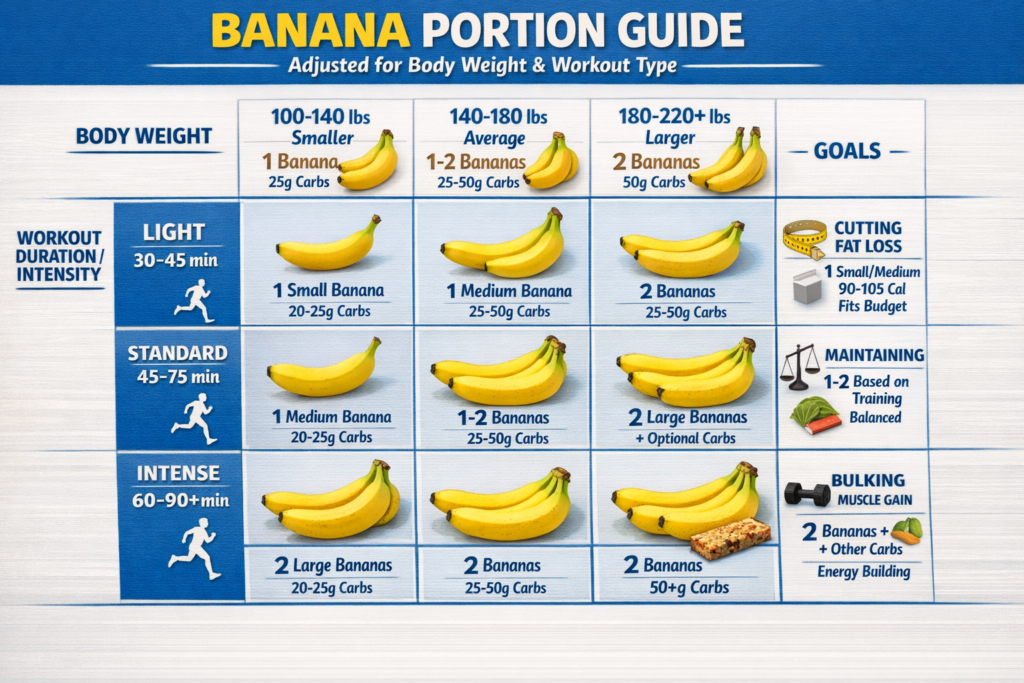
General Guideline: 1-2 Medium Bananas
One medium banana provides:
- Calories: 105
- Carbohydrates: 27g
- Sugars: 14g
- Fiber: 3g
- Potassium: 422mg
- Sufficient for most 45-75 minute workouts
Two medium bananas provide:
- Calories: 210
- Carbohydrates: 54g
- Sugars: 28g
- Fiber: 6g
- Potassium: 844mg
- Better for longer or more intense sessions
Adjusting for Body Weight
Customize based on your size.
Smaller individuals (100-140 pounds):
- 1 banana sufficient
- Provides adequate carbs
- Prevents overeating
- Comfortable digestion
Average individuals (140-180 pounds):
- 1-2 bananas depending on workout
- Standard recommendation
- Adjust based on intensity
- Most common approach
Larger individuals (180-220+ pounds):
- 2 bananas
- Or 1 banana + additional carb source
- Larger body needs more fuel
- Scale appropriately
Adjusting for Workout Type
Match fuel to demands.
Light workout (30-45 minutes, moderate intensity):
- 1 small/medium banana
- Lower energy demands
- Don’t need excessive carbs
- 20-25g carbs sufficient
Standard workout (45-75 minutes, moderate to high intensity):
- 1-2 medium bananas
- Most common scenario
- 25-50g carbs
- Ideal for most training
Intense workout (60-90+ minutes, high intensity):
- 2 large bananas
- Or 1-2 bananas + other carb source
- Higher fuel needs
- May need intra-workout carbs too
Very long training (90+ minutes):
- 1-2 bananas pre-workout
- Additional carbs during workout
- Sports drinks or gels
- Sustained fueling strategy
Adjusting for Goals
Different objectives require different approaches.
Cutting (fat loss):
- 1 small/medium banana
- Provides energy without excessive calories
- 90-105 calories manageable
- Fits calorie budget
Maintaining:
- 1-2 medium bananas based on training
- Standard approach
- Balanced fueling
- Sustainable
Bulking (muscle gain):
- 2 bananas + possibly other carbs
- Need energy for intense training
- Higher calorie needs
- Support muscle building
Benefits of Eating Banana Before Workout
Beyond just the carbohydrates.
Benefit 1: Proven Performance Enhancement
Research-backed effectiveness.
Study: Bananas vs. sports drinks in cyclists:
- 14 trained cyclists
- 75km time trial
- Group A: Bananas
- Group B: Sports drink (6% carbohydrate)
- Results: Equal performance
Implications:
- Whole food as effective as engineered product
- Added benefit: Nutrients, fiber, antioxidants
- More affordable
- Science validates banana pre-workout use
Benefit 2: Electrolyte Support
Beyond potassium.
Complete electrolyte profile:
- Potassium: 422mg (muscle function)
- Magnesium: 32mg (muscle relaxation, energy)
- Sodium: 1mg (minimal, but present)
- Natural electrolyte balance
Why this matters:
- Sweating depletes electrolytes
- Muscle cramping more likely when deficient
- Pre-workout electrolytes provide buffer
- Support optimal muscle function
Comparison to sports drinks:
- Sports drinks: Added electrolytes artificially
- Bananas: Natural electrolytes plus nutrients
- Both effective
- Banana more cost-effective
Benefit 3: Antioxidant Protection
Reducing exercise-induced oxidative stress.
Antioxidant content:
- Dopamine (yes, the neurotransmitter, also antioxidant)
- Catechins
- Vitamin C
- Combats free radicals from intense exercise
Research findings:
- Exercise creates oxidative stress
- Antioxidants support recovery
- Whole foods provide diverse antioxidants
- Bananas contribute to antioxidant defense
Benefit 4: Mental Performance
Carbs fuel brain and muscles.
Glucose for cognitive function:
- Brain uses 20% of body’s glucose
- Training requires focus and coordination
- Carbs support mental clarity
- Better mind-muscle connection
B-vitamins:
- B6: 0.4mg per banana (22% DV)
- Supports neurotransmitter production
- Energy metabolism
- Enhanced mental function during training
Benefit 5: Digestive Comfort
Gentle on stomach.
Why bananas work:
- Low fat (won’t slow digestion)
- Moderate fiber (not excessive)
- Natural sugars (easy to process)
- Rarely causes bloating or discomfort
Comparison to other pre-workout foods:
Heavy protein shake:
- Can sit heavy
- Some experience bloating
- May cause discomfort
Fiber-rich foods:
- Can cause gas
- Bloating
- Uncomfortable during training
Bananas:
- Light and easy
- Comfortable digestion
- Rare complaints
Ways to Consume Banana Pre-Workout
Variety in preparation and combination.
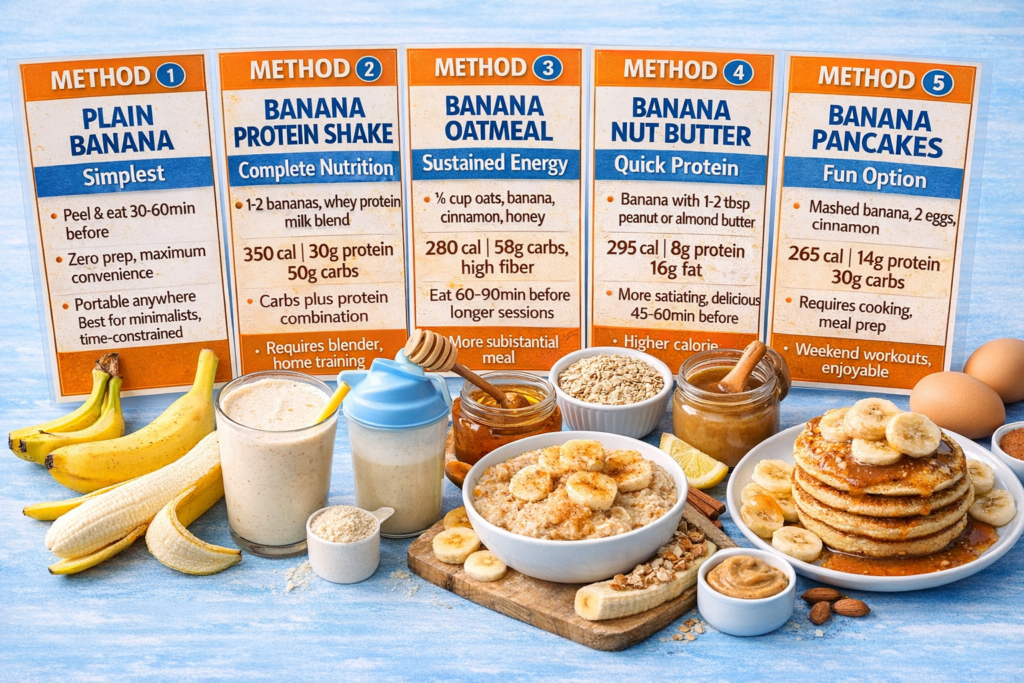
Method 1: Plain Banana (Simplest)
The classic approach.
How to:
- Peel banana
- Eat 30-60 minutes before training
- That’s it
Pros:
- Zero preparation
- Maximum convenience
- Portable anywhere
- No cleanup
Cons:
- No protein (add separately if needed)
- Can get boring
- Limited variety
Best for:
- Minimalists
- Time-constrained
- On-the-go nutrition
- Budget-conscious
Method 2: Banana Protein Shake
Combining carbs and protein.
Recipe:
- 1-2 bananas
- 1 scoop whey protein (or plant protein)
- 1 cup milk (dairy or plant-based)
- Ice cubes
- Blend 30 seconds
Macros:
- Calories: ~350
- Protein: ~30g
- Carbs: ~50g
- Fat: ~5g
Pros:
- Complete pre-workout nutrition
- Protein + carbs combination
- Tastes great
- Easy to consume
Cons:
- Requires blender
- Less portable
- More cleanup
Best for:
- Home training
- Complete nutrition seekers
- Protein intake prioritizers
Method 3: Banana with Oatmeal
Sustained energy combination.
Recipe:
- 1/2 cup oats
- 1 banana (sliced)
- Cinnamon
- Optional: Honey drizzle
Macros:
- Calories: ~280
- Protein: ~8g
- Carbs: ~58g
- Fiber: ~9g
Timing: Eat 60-90 minutes before training (takes longer to digest)
Pros:
- Sustained energy
- Very filling
- Nutrient-dense
- Budget-friendly
Cons:
- Requires more digestion time
- Not as portable
- Needs preparation
Best for:
- Longer training sessions
- Morning workouts (as breakfast)
- Those needing more substantial meal
Method 4: Banana Pancakes
Fun pre-workout option.
Simple recipe:
- 1 ripe banana (mashed)
- 2 eggs
- Cinnamon
- Mix and cook like pancakes
Macros (entire recipe):
- Calories: ~265
- Protein: ~14g
- Carbs: ~30g
- Fat: ~10g
Timing: 60-90 minutes before training
Pros:
- Tasty and satisfying
- Combines protein and carbs
- Can meal prep
- Enjoyable
Cons:
- Requires cooking
- Takes time
- Not immediate convenience
Best for:
- Weekend workouts
- Those who enjoy cooking
- Meal prep enthusiasts
Method 5: Banana with Nut Butter
Quick protein addition.
How to:
- 1 banana
- 1-2 tbsp peanut or almond butter
- Slice banana, spread butter, eat
Macros:
- Calories: ~295
- Protein: ~8g
- Carbs: ~35g
- Fat: ~16g
Timing: 45-60 minutes before (fat slows digestion slightly)
Pros:
- Adds protein and healthy fats
- More satiating
- Delicious
- Quick to make
Cons:
- Higher calorie
- Fat content may slow digestion for some
- Not ideal right before training
Best for:
- Those needing more calories
- Longer time before training
- Hunger management
Can You Eat Banana After Workout Too?
Yes, and here’s why it works.
Post-Workout Benefits
Why banana works post-workout:
Glycogen replenishment:
- Depleted muscle glycogen after training
- Fast carbs in banana quickly restore
- 25g carbs starts recovery process
- Insulin spike aids nutrient uptake
Quick nutrition:
- No preparation needed
- Immediate consumption possible
- Convenient at gym
- Portable from gym bag
Research support:
- Post-workout carbs support recovery
- Fast-digesting carbs beneficial
- Insulin spike aids protein synthesis
- Bananas provide these benefits
The Protein Problem
Banana alone insufficient post-workout.
What’s missing:
- Banana: 1.3g protein (negligible)
- Post-workout needs: 20-40g protein
- Massive gap
The solution: Combine with protein
Option 1: Banana + protein shake
- 1-2 bananas
- 1-2 scoops whey protein
- Water or milk
- Complete post-workout nutrition
Option 2: Banana + Greek yogurt
- 1 banana
- 1 cup Greek yogurt (20g protein)
- Mix together
- Balanced recovery meal
Option 3: Banana + protein bar
- 1 banana (carbs)
- 1 protein bar (20g+ protein)
- Portable combination
- Convenient complete nutrition
Pre or Post-Workout: Which Is Better?
Both work, choose based on needs.
Eat banana PRE-workout if:
- Need training energy
- Training in 30-60 minutes
- Want performance boost
- Preventing mid-workout fatigue
Eat banana POST-workout if:
- Already have pre-workout fuel
- Need quick recovery carbs
- Convenient portable option
- Combined with protein source
Eat BOTH if:
- Intense training depletes energy
- Bulking with high carb needs
- Training duration 90+ minutes
- Budget and appetite allow
Most people: Choose one or the other based on when you need fuel most.
The Bottom Line: Bananas Are Excellent Pre-Workout
After examining all the evidence:
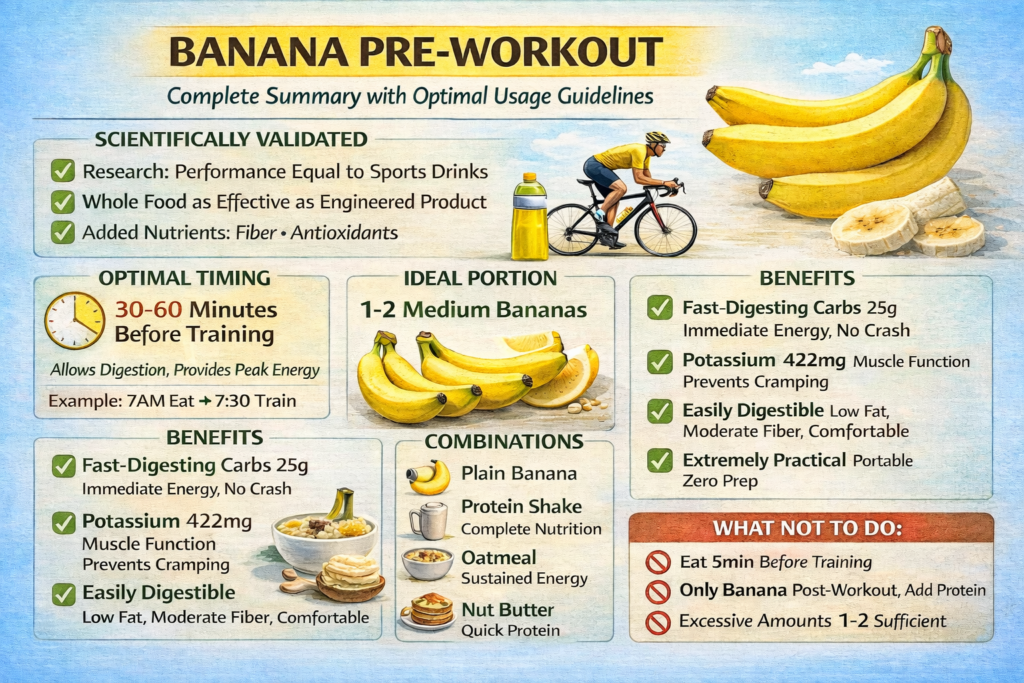
The truth about bananas pre-workout:
✅ Scientifically validated (research shows equal performance to sports drinks)
✅ Optimal timing: 30-60 minutes before training (allows digestion, provides peak energy)
✅ Ideal portion: 1-2 medium bananas (25-50g carbs for most workouts)
✅ Fast-digesting carbs (provides immediate energy without crash)
✅ Rich in potassium (422mg supports muscle function, prevents cramping)
✅ Easily digestible (low fat, moderate fiber, rarely causes discomfort)
✅ Extremely practical (portable, affordable, no prep required)
How to use bananas optimally:
Basic approach:
- Eat 1-2 bananas
- 30-60 minutes before training
- Plain or combined with protein
- Hydrate with 16-24oz water
Enhanced combinations:
Pre-workout shake:
- 1-2 bananas
- 1 scoop protein powder
- 1 cup milk
- Blend and drink 45-60 min before
Quick snack:
- 1 banana
- 1-2 tbsp nut butter
- Eat 45-60 min before
Substantial meal:
- Banana oatmeal
- With cinnamon and honey
- Eat 60-90 min before
When bananas work best:
- Standard 45-90 minute workouts
- Any training intensity
- When you have 30-60 min before session
- Budget-conscious nutrition
When to consider alternatives:
- Training in <20 minutes (use liquid carbs)
- Very long endurance events (need more fuel)
- You dislike bananas (choose foods you enjoy)
Pre and post-workout:
- Pre: Energy for performance
- Post: Glycogen replenishment (combine with protein)
- Both: If training demands high
- Choose based on needs
What NOT to do:
❌ Eat banana 5 minutes before training
❌ Eat only banana post-workout (add protein)
❌ Eat excessive amounts (1-2 sufficient)
❌ Force bananas if you dislike them
BANANAS = PROVEN PRE-WORKOUT FUEL. EAT 30-60 MIN BEFORE. 1-2 BANANAS. TRAIN STRONG.
Ready to optimize your complete pre and post-workout nutrition strategy with science-based timing, portion guidelines, and food combinations that maximize performance and recovery without expensive supplements or complicated meal planning? Banana timing is just one piece of effective workout nutrition. Get a comprehensive guide to calculating your exact pre-workout carb needs, building complete meals that fuel performance, timing all nutrients optimally, and achieving maximum results from every training session. Stop guessing about workout nutrition. Start following proven strategies that deliver results.
REFERENCES
SECTION 1 — Bananas vs. sports drinks: performance validation
[1] Nieman DC et al. — PMC/PLOS ONE, 2012 14 trained cyclists; randomized crossover; 75km time trial; bananas vs. 6% carbohydrate sport drink (0.2g/kg every 15 min); blood glucose and performance did not differ between conditions (2.41 vs. 2.36h, p=0.258); bananas produced higher antioxidant capacity (FRAP) and elevated serum dopamine; inflammation and oxidative stress comparable between conditions; banana polyphenolics (dopamine, catechin) may have contributed to additional antioxidant benefit over the sports drink https://pmc.ncbi.nlm.nih.gov/articles/PMC3355124/
[2] Nieman DC et al. — PMC/PLOS ONE, 2018 20 cyclists; randomized crossover; four 75km time trials comparing Cavendish banana, mini-yellow banana, 6% sugar beverage, and water; all carbohydrate conditions (banana and sugar) significantly attenuated metabolic perturbation vs. water (p<0.01); banana ingestion additionally decreased COX-2 mRNA expression in monocytes — similar mechanism to ibuprofen — suggesting anti-inflammatory advantage over sugar beverage alone; banana carbohydrates provide equivalent fuel support to sports drinks while offering additional recovery benefits https://pmc.ncbi.nlm.nih.gov/articles/PMC5864065/
SECTION 2 — Pre-workout carbohydrate timing: the 30-60 minute window
[3] Kerksick CM et al. — PMC/Journal of the International Society of Sports Nutrition (ISSN Position Stand), 2017 ISSN nutrient timing position stand; carbohydrate ingestion 30–120 min before exercise improves performance; pre-exercise carbohydrate not impaired by moderate-GI foods like banana (GI ~51); performance increases of 7–20% reported across multiple studies providing carbohydrate ≥60 min before exercise; carbohydrate 30 min before exercise led to greater increases in exercise capacity vs. placebo https://pmc.ncbi.nlm.nih.gov/articles/PMC5596471/
[4] Ormsbee MJ et al. — PMC/Nutrients, 2014 Review of pre-exercise nutrition; carbohydrate feeding within 60 min of exercise does not impair and often improves performance; low-to-moderate GI foods (such as banana) produce favorable blood glucose response without the rebound hypoglycemia risk of high-GI sources; gastric emptying and digestion of simple carbohydrates completed within 30–45 min; advice to avoid carbohydrate in the hour before exercise is unsupported by evidence https://pmc.ncbi.nlm.nih.gov/articles/PMC4042570/
SECTION 3 — Potassium and muscle function during exercise
[5] Allen DG, Lamb GD, Westerblad H — Journal of Applied Physiology, 2008 Comprehensive review of potassium dynamics during fatiguing exercise; marked perturbations in intracellular and extracellular K⁺ occur during intense exercise; K⁺ gradients across muscle membranes are prerequisites for action potential generation and tension development; K⁺ shifts contribute to both early potentiation and later fatigue of contractile force; Na⁺-K⁺-ATPase pump activity critical for maintaining ionic gradients during sustained exercise https://journals.physiology.org/doi/full/10.1152/japplphysiol.01037.2007
[6] Schwellnus MP — PMC/Clinical Journal of Sport Medicine, 2021 Evidence-based review of exercise-associated muscle cramps (EAMCs); serum electrolyte theory: decreases in sodium, potassium, magnesium, and chloride through sweating proposed as causative factors; electrolyte-containing beverages delayed onset of cramping vs. plain water; potassium losses through sweat average 120–160 mg/L; pre-exercise electrolyte loading via potassium-rich foods (e.g., banana: 422mg/medium unit) provides buffer against electrolyte depletion during training https://pmc.ncbi.nlm.nih.gov/articles/PMC8775277/
SECTION 4 — Banana antioxidant profile
[7] Kanazawa K & Sakakibara H — Journal of Agricultural and Food Chemistry, 2000 Identified dopamine as the primary water-soluble antioxidant in Cavendish banana (Musa cavendishii); dopamine antioxidant potency greater than glutathione, luteolin, quercetin, and catechin; comparable to gallocatechin gallate and ascorbic acid (strongest known antioxidants); dopamine content in pulp 2.5–10 mg per 100g in ripe, ready-to-eat bananas; banana classified as one of the antioxidative foods; catechins also present as additional polyphenolic antioxidants https://pubmed.ncbi.nlm.nih.gov/10725161/
SECTION 5 — Post-workout carbohydrate timing and glycogen replenishment
[8] Arent SM et al. — PMC/Journal of the International Society of Sports Nutrition, 2020 Nutrient timing systematic review; post-exercise carbohydrate + protein supplementation significantly expedites muscle recovery, glycogen restoration, and reduces fatigue vs. delayed supplementation; 30-min post-exercise window remains optimal for glycogen replenishment; fast-digesting carbohydrates (such as banana) initiate glycogen resynthesis rapidly after training; 1.0–1.5g carbohydrate/kg within 30 min recommended for rapid glycogen restoration https://pmc.ncbi.nlm.nih.gov/articles/PMC12061868/

Leave a Reply
You must be logged in to post a comment.