Thinking about taking mass gainer daily to maximize muscle growth? Here’s the truth about whether daily use is necessary, beneficial, or potentially problematic.
You just bought your first tub of mass gainer.
The label says one serving provides 1,250 calories. You’re excited to finally start gaining weight and building muscle.
Then the questions hit:
- Do I need to take this every single day?
- What if I miss a day?
- Is daily use required for results?
- Could taking it every day cause problems?
The supplement companies don’t make this clear, and online advice is contradictory.
Here’s the honest truth: You can take mass gainer every day, but it’s NOT strictly necessary. Daily use depends entirely on whether you can eat enough calories from whole food. If you consistently fall short of your caloric needs despite eating regular meals, daily mass gainer use makes sense. If you can hit your targets with food on most days, you only need mass gainer occasionally.
In this comprehensive guide, I’ll explain what mass gainers actually do and when they’re useful, reveal whether daily use is necessary for muscle growth, examine the potential risks of taking mass gainer every day, show you the optimal timing and frequency for mass gainer use, and provide a practical system for using mass gainers effectively without wasting money or gaining excessive fat.
Whether you’re a hardgainer struggling to bulk or someone reconsidering their supplement strategy, this article will give you clarity.
Let’s separate necessity from marketing.
TABLE OF CONTENTS
What Mass Gainers Actually Do (The Real Function)
Before discussing daily use, you need to understand what mass gainers are designed to accomplish.
The Primary Purpose
Mass gainers exist to solve one specific problem: helping people consume enough calories to create a caloric surplus.
That’s it. That’s the entire purpose.
What a mass gainer provides:
- High calorie density (400-1,250 calories per serving)
- Combination of macronutrients (protein, carbs, sometimes fats)
- Liquid form (easier to consume than equivalent solid food)
- Convenience (quick to prepare and drink)
What a mass gainer does NOT do:
- Build muscle directly (training and protein do this)
- Work without adequate training stimulus
- Eliminate the need for whole food nutrition
- Provide magic muscle-building compounds
Why Caloric Surplus Matters for Muscle Growth
Understanding this is critical:
To build muscle, your body needs:
1. Training stimulus
- Progressive resistance training
- Mechanical tension on muscles
- Signals body to adapt by building muscle
2. Adequate protein
- 0.7-1g per pound of body weight
- Provides amino acids (building blocks) for muscle tissue
- Supports muscle protein synthesis
3. Caloric surplus
- Consuming more calories than you burn
- Provides energy for muscle-building processes
- Typically 200-500 calories above maintenance
Without all three, muscle growth won’t occur optimally.
Mass gainers specifically address requirement #3 (caloric surplus) for people who struggle to achieve it through whole food alone.
The Practical Reality
Most people overestimate how much they eat.
Common scenario:
Person: “I eat so much but can’t gain weight. I need a mass gainer.”
Reality: They’re actually eating 2,400 calories daily while thinking it’s 3,500 calories.
Solution: Not a mass gainer. Track food accurately and eat more whole food.
Less common but legitimate scenario:
Person: “I tracked my intake for 2 weeks. I need 3,800 calories to bulk but can only eat 3,000 from whole food comfortably.”
Reality: Genuine caloric shortfall of 800 calories despite maximum effort with whole food.
Solution: Mass gainer makes sense to fill this specific gap.
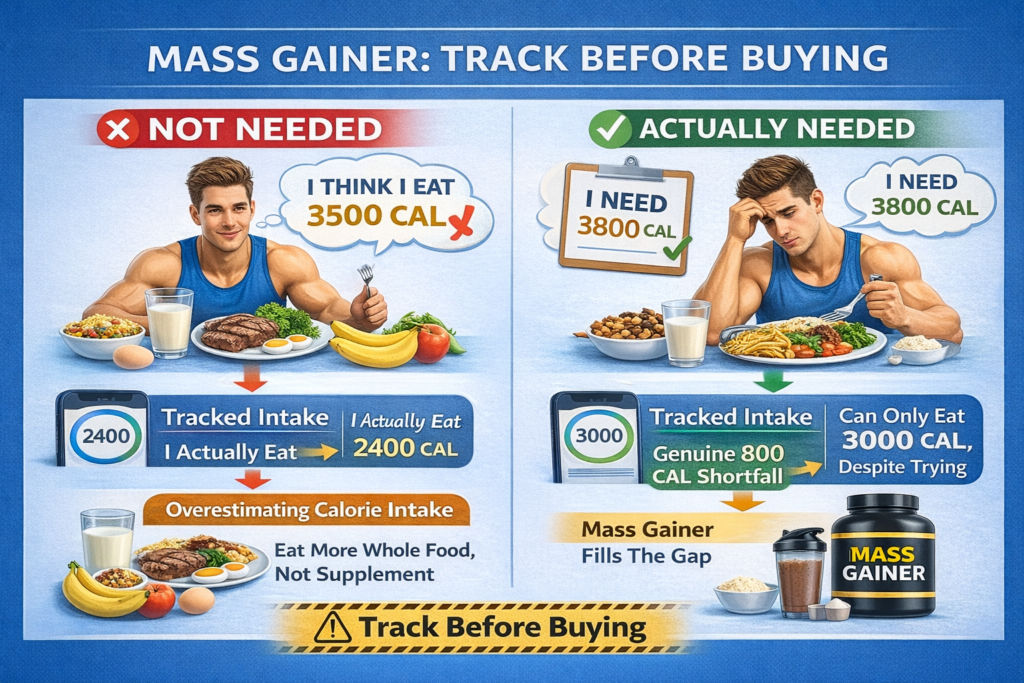
Mass gainers are tools for the second scenario, not the first.
Do You NEED to Take Mass Gainer Every Day?
The short answer: No, it’s not strictly required.
When Daily Use Makes Sense
You should consider taking mass gainer every day if:
Scenario 1: Consistent daily caloric shortfall
Your situation:
- Need 3,600 calories daily for bulking
- Consistently eat only 2,800-3,000 from whole food
- Gap of 600-800 calories every single day
- Tried increasing meal frequency and calorie-dense foods
- Appetite or schedule prevents eating more solid food
Solution: Daily mass gainer use (600-800 calorie shake) fills the consistent gap.
Why daily? The shortfall exists every day, so the solution needs to be daily.
Scenario 2: Extremely high caloric needs
Your situation:
- Athlete burning 4,500+ calories daily
- Need 5,500 calories for muscle gain
- Impossible to eat this much solid food sustainably
- Require liquid calories to meet demands
Solution: Daily mass gainer (possibly multiple servings) as part of nutrition strategy.
Why daily? Extreme caloric needs don’t fluctuate much day to day.
Scenario 3: Very small appetite consistently
Your situation:
- Hardgainer with naturally small appetite
- Force-feeding solid food causes nausea
- Liquid calories much easier to consume
- Can’t comfortably eat enough solid food any day
Solution: Daily mass gainer provides necessary calories without digestive distress.
Why daily? Appetite limitation is consistent, not occasional.
When Daily Use Is NOT Necessary
You don’t need mass gainer every day if:
Scenario 1: You can hit calorie targets with whole food most days
Your situation:
- Need 3,400 calories for bulking
- Can eat 3,400+ calories from whole food 5-6 days weekly
- Some busy days make it harder
- Overall weekly average is sufficient
Solution: Use mass gainer only on days when whole food falls short.
Why not daily? You’re already succeeding most days. Don’t fix what isn’t broken.
Scenario 2: Your schedule varies significantly
Your situation:
- Some days have time for meal prep and eating
- Other days are extremely busy
- Caloric needs are met on less busy days
- Need help only on chaotic days
Solution: Strategic mass gainer use on busy days only.
Why not daily? Caloric needs are already met on many days.
Scenario 3: You’re using mass gainer as insurance, not necessity
Your situation:
- Generally eat enough whole food
- Use mass gainer “just to be safe”
- Not tracking actual intake
- Might not actually need extra calories
Solution: Track intake for 2 weeks. Likely don’t need mass gainer at all, or only occasionally.
Why not daily? You might not have a real caloric deficit.
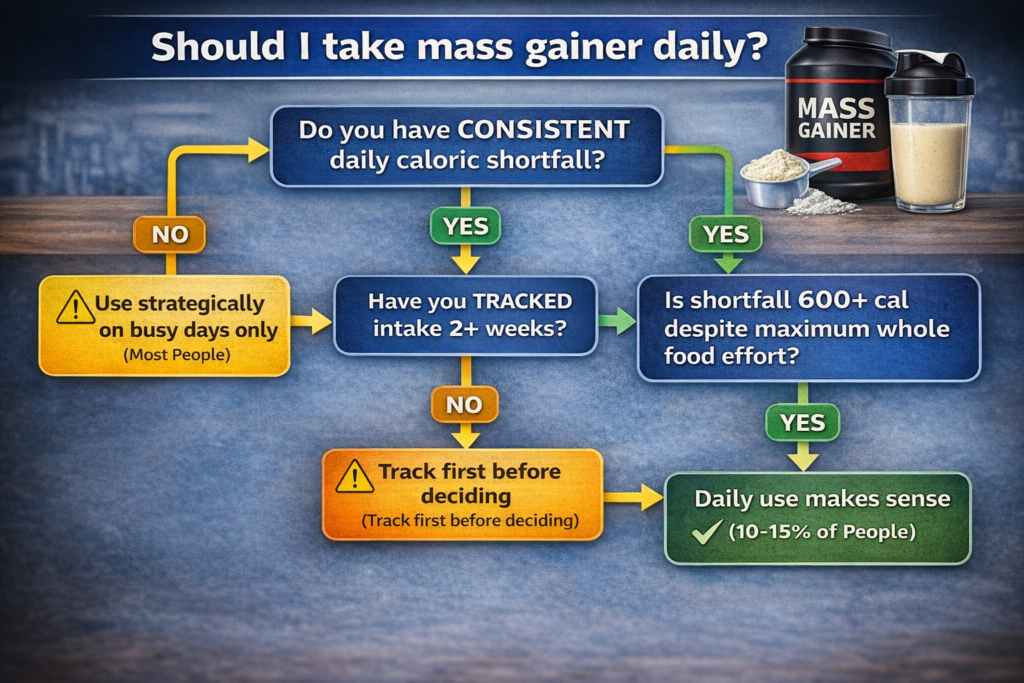
The Key Question to Ask Yourself
“Am I consistently falling short of my caloric target despite maximum effort with whole food?”
If yes: Daily mass gainer use makes sense.
If no: Daily use is unnecessary and potentially wasteful or problematic.
If unsure: Track your intake for 2 weeks before deciding.
Potential Risks of Taking Mass Gainer Every Day
While mass gainers can be useful, daily use carries some risks you need to understand.
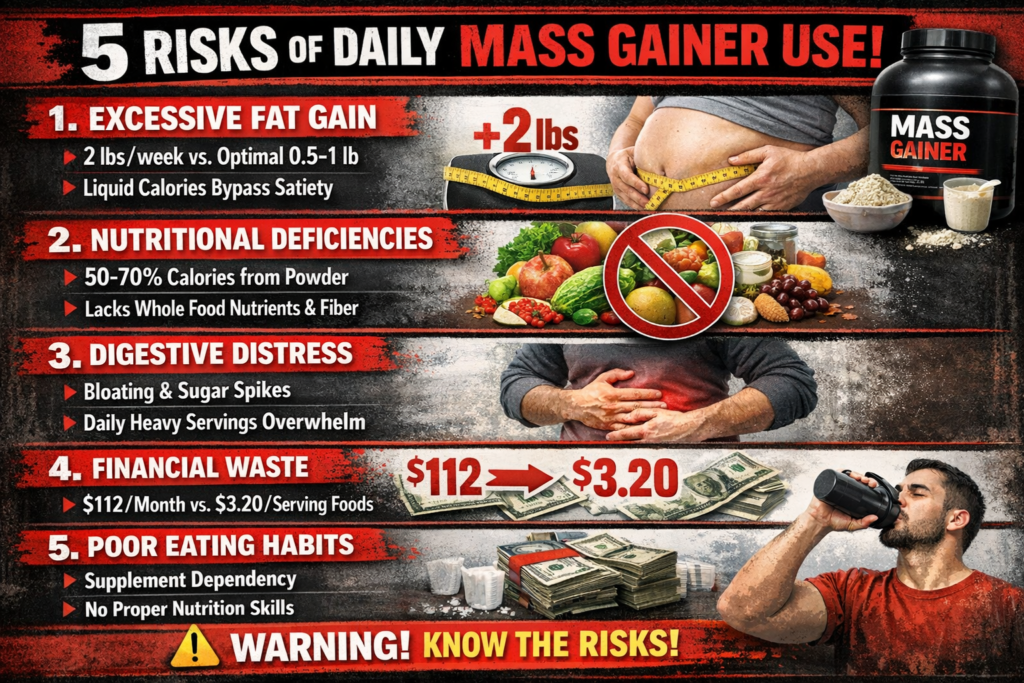
Risk 1: Excessive Fat Gain
This is the most common problem with daily mass gainer use.
How it happens:
The calorie miscalculation:
- Mass gainer shake: 1,000 calories
- Regular meals: 2,800 calories
- Total: 3,800 calories
- But you only need 3,400 calories
- Daily surplus: 400 calories (should be 200-300)
The result:
- Gaining 1.5-2 pounds per week instead of 0.5-1 pound
- Excessive fat accumulation
- Need to cut for longer after bulk
- Suboptimal muscle to fat ratio
Why this happens with daily mass gainer:
- Liquid calories don’t trigger satiety like solid food
- Easy to consume without feeling full
- People forget to account for all calories
- “More is better” mentality leads to overconsumption
Prevention:
- Track total daily calories including mass gainer
- Monitor weekly weight gain (should be 0.5-1 pound weekly)
- Adjust if gaining too fast
- Use smallest effective dose
Risk 2: Nutritional Deficiencies from Whole Food Displacement
Mass gainers can’t replace whole food nutrition.
The problem:
Scenario: Taking 2 servings of mass gainer daily
- Mass gainer calories: 2,000-2,500
- Regular food calories: 1,500-2,000
- Total: 3,500-4,500 calories
What’s wrong:
- 50-70% of calories from processed powder
- Minimal fiber from mass gainer
- Limited micronutrient diversity
- Missing phytonutrients and antioxidants from whole foods
- Poor gut microbiome support
Health consequences:
- Digestive issues (lack of fiber)
- Micronutrient deficiencies over time
- Poor immune function
- Suboptimal health markers
- Training and recovery suffer
Prevention:
- Maximum 30-40% of daily calories from mass gainer
- Prioritize whole food for majority of nutrition
- Eat vegetables, fruits, quality proteins, whole grains
- Use mass gainer to supplement, not replace
Risk 3: Digestive Distress
Daily consumption of large mass gainer servings often causes digestive issues.
Common problems:
Bloating:
- Large liquid volume distends stomach
- High carb content ferments in gut
- Gas production increases
Blood sugar instability:
- Many mass gainers use simple sugars (maltodextrin, dextrose)
- Rapid blood sugar spike
- Insulin surge
- Subsequent crash and fatigue
- Daily roller coaster affects energy levels
Diarrhea or constipation:
- Lack of fiber (if using cheap mass gainer)
- Excessive simple carbs
- Digestive system overwhelmed
- Issues compound with daily use
Nausea:
- Overly sweet taste becomes sickening
- Large serving size difficult to tolerate
- Worse when consuming same flavor daily
Prevention:
- Choose quality mass gainer (complex carbs, not just sugar)
- Split serving into smaller doses throughout day
- Consume slowly over 20-30 minutes
- Rotate flavors to prevent taste fatigue
- Stay well hydrated
Risk 4: Financial Waste
Daily mass gainer use gets expensive quickly.
The math:
Quality mass gainer:
- Price: $60 for 12-pound bag
- Servings: 16 (at full serving size)
- Cost per serving: $3.75
- Monthly cost (daily use): $112.50
Annual cost: $1,350
Compare to whole food alternatives:
Homemade mass gainer shake:
- 2 cups whole milk: $0.60 (300 cal)
- 1 cup oats: $0.30 (300 cal)
- 2 scoops whey protein: $1.50 (240 cal)
- 3 tablespoons peanut butter: $0.60 (285 cal)
- 1 banana: $0.20 (105 cal)
- Total: $3.20 for 1,230 calories
Or whole food meal:
- 2 cups cooked rice: $0.40 (400 cal)
- 8oz chicken breast: $2.00 (400 cal)
- 2 tablespoons olive oil: $0.30 (240 cal)
- Vegetables: $0.50 (40 cal)
- Total: $3.20 for 1,080 calories
The verdict: Mass gainer provides convenience but not cost efficiency.
If budget is limited, daily mass gainer use might not be sustainable long-term.
Risk 5: Developing Poor Eating Habits
Relying on mass gainers daily can prevent developing proper nutrition skills.
The long-term problem:
Short-term (bulking phase):
- Use mass gainer daily
- Successfully gain weight
- Achieve muscle-building goals
Long-term (after bulking):
- Never learned to eat adequate whole food
- Dependent on supplements for nutrition
- Struggle when mass gainer isn’t available
- Can’t maintain muscle without supplements
- Poor meal planning and preparation skills
Better approach:
- Learn to eat properly first
- Use mass gainer as temporary tool
- Gradually reduce dependency
- Build sustainable eating habits
Best Timing for Daily Mass Gainer Use
If you’ve determined daily use is necessary, timing matters for optimal results.
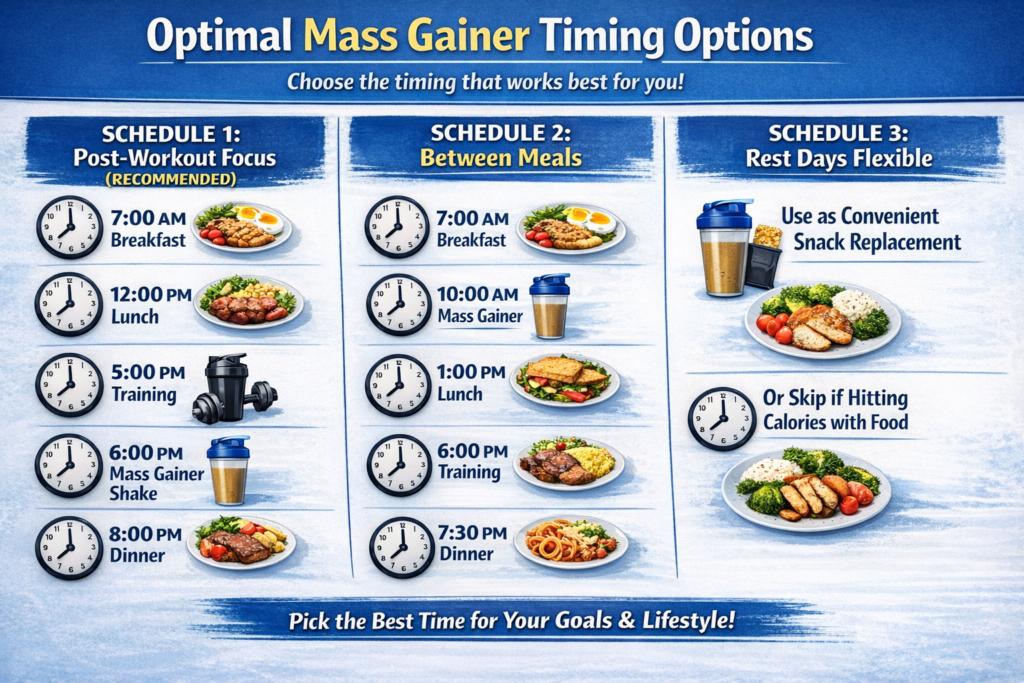
Option 1: Post-Workout (Most Recommended)
Why this timing is ideal:
Physiological benefits:
- Muscles are primed for nutrient absorption post-training
- Glycogen stores depleted and need replenishment
- Muscle protein synthesis elevated for hours after training
- Body efficiently uses both protein and carbs
Practical benefits:
- Training often suppresses appetite temporarily
- Liquid nutrition easier to consume when not hungry
- Convenient at gym or on way home
- Doesn’t interfere with regular meals
Optimal post-workout approach:
- Consume mass gainer within 60-90 minutes post-training
- Provides both protein for recovery and carbs for glycogen
- Allows for regular whole food meals at other times
Example daily schedule:
- 7 AM: Breakfast (whole food)
- 12 PM: Lunch (whole food)
- 5 PM: Training
- 6 PM: Mass gainer shake (800-1,000 calories)
- 8 PM: Dinner (whole food)
Option 2: Between Meals
Why this works:
Fills caloric gaps:
- Prevents long periods without calories
- Maintains steady nutrient intake
- Doesn’t replace any main meals
Timing strategies:
Mid-morning (10-11 AM):
- Between breakfast and lunch
- Provides energy through morning
- Doesn’t interfere with lunch appetite
Mid-afternoon (3-4 PM):
- Between lunch and dinner
- Prevents energy crash
- Bridges long afternoon gap
Example daily schedule:
- 7 AM: Breakfast (whole food)
- 10 AM: Mass gainer shake
- 1 PM: Lunch (whole food)
- 6 PM: Training
- 7:30 PM: Dinner (whole food)
Option 3: Non-Training Days
Adjust approach on rest days:
Why different timing:
- No post-workout window to leverage
- Appetite might be higher (not suppressed by training)
- More time for whole food meals
Best approach for rest days:
- Use mass gainer as convenient snack replacement
- Between any two meals where gap is long
- Or skip mass gainer if you can hit calories with whole food
Flexibility is key on rest days.
Timing to Avoid
Don’t use mass gainer:
First thing in the morning (for most people):
- Better to eat protein-rich whole food breakfast
- Mass gainer might suppress appetite for hours
- Prevents eating adequate whole food at other meals
Exception: If you train very early and need quick calories.
Immediately before bed:
- Large carb intake before sleep can affect sleep quality
- Not ideal for blood sugar stability
- Better to use casein protein if you want pre-sleep protein
Exception: If you still need 500-800 calories at end of day to hit target.
Right before training:
- Large liquid meal can cause stomach discomfort during training
- Blood sugar spike and crash during workout
- Reduced performance
Use 90-120 minutes before training if pre-workout timing desired.
How Many Times Per Day Should You Take Mass Gainer?
Frequency matters as much as total daily intake.
Recommended Frequency: 1-2 Times Daily Maximum
Most effective approaches:
Once daily (most common and recommended):
- Post-workout or as snack replacement
- Provides 600-1,000 calories
- Fills specific daily gap
- Remaining calories from whole food
Why once is usually sufficient:
- Average caloric shortfall is 500-800 calories
- One serving covers this gap
- Prevents over-reliance on supplements
- Maintains whole food as dietary foundation
Twice daily (for extreme needs only):
- Morning + post-workout
- Post-workout + before bed
- Two between-meal servings
When twice makes sense:
- Caloric needs exceed 4,500 daily
- Shortfall is 1,200-1,500 calories
- Elite athletes or very large individuals bulking
- Confirmed through tracking, not guessing
Why More Than Twice Is Problematic
Three or more servings daily creates serious issues:
Nutritional displacement:
- Mass gainer provides 1,800-3,000+ calories
- Only 1,500-2,000 calories from whole food
- 60-70% of diet is processed powder
- Severe micronutrient and fiber deficiency
Digestive overwhelm:
- Constant liquid nutrition
- Digestive system never processes solid food properly
- Chronic bloating and discomfort
- Poor gut health
Unsustainable:
- Expensive ($5-10+ daily on supplements)
- Mentally exhausting
- Not teaching proper eating habits
- Fails when supplements aren’t available
If you think you need 3+ servings daily:
- You’re miscalculating caloric needs
- Or not trying hard enough with whole food
- Or need professional nutrition guidance
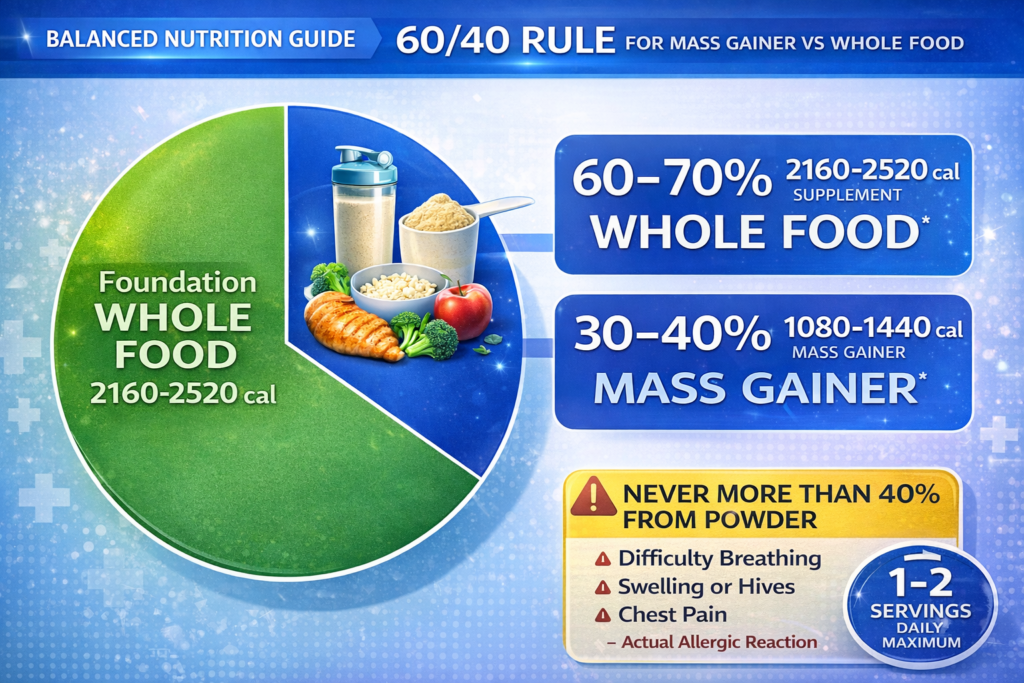
The 60/40 Rule
A good guideline for supplement vs. whole food ratio:
Optimal balance:
- 60-70% of daily calories from whole food
- 30-40% from mass gainer (maximum)
Example for 3,600 calorie daily target:
- Whole food: 2,160-2,520 calories (60-70%)
- Mass gainer: 1,080-1,440 calories (30-40%)
- This allows 1-2 servings of mass gainer
Why this ratio works:
- Ensures adequate whole food nutrition
- Prevents supplement dependency
- Provides convenience where needed
- Maintains long-term sustainability
Essential Tips for Daily Mass Gainer Use
If you’re taking mass gainer every day, follow these guidelines.
Tip 1: Choose a Quality Brand
This is critical for daily use.
What to look for:
Quality protein sources:
- Whey protein concentrate or isolate
- Micellar casein
- Milk protein isolate
- Avoid products listing only “protein blend” (hiding soy)
Complex carbohydrate sources:
- Oat flour
- Sweet potato powder
- Quinoa
- Brown rice flour
- Avoid products with maltodextrin as primary carb source
Reasonable macro ratio:
- At least 20-25% of calories from protein
- Complex carbs, not just simple sugars
- Some healthy fats included
Minimal additives:
- Short, recognizable ingredient list
- No excessive artificial ingredients
- Third-party testing if available
Why this matters for daily use:
- You’re consuming this product every single day
- Poor quality compounds over time
- Health effects accumulate
- Worth paying premium for quality
Tip 2: Start With One Serving Daily
Don’t immediately jump to maximum dose.
The smart progression:
Week 1-2: One serving daily
- Monitor weight change
- Track how you feel
- Assess digestive tolerance
- Evaluate energy levels
Week 3-4: Assess and adjust
- Gaining 0.5-1 pound weekly? Perfect, continue.
- Not gaining weight? Increase to 1.5 servings or add second serving.
- Gaining too fast (2+ pounds weekly)? Reduce to half serving or every other day.
Why start conservatively:
- Easy to add more calories, hard to lose excess fat
- Allows digestive system to adapt
- Prevents waste if full serving unnecessary
- Lets you find minimum effective dose
Tip 3: Whole Food Must Be Your Foundation
This cannot be stressed enough.
The non-negotiable principle:
Your diet should be:
- 60-70% whole foods (minimum)
- 30-40% mass gainer (maximum)
Essential whole foods to include daily:
- Quality protein sources (chicken, fish, eggs, beef)
- Complex carbs (rice, oats, potatoes, whole grains)
- Healthy fats (olive oil, nuts, avocado, fatty fish)
- Vegetables (fiber, vitamins, minerals, phytonutrients)
- Fruits (vitamins, antioxidants, fiber)
Why this matters:
- Micronutrients support health and performance
- Fiber essential for digestion
- Whole foods more satiating (prevents overeating later)
- Phytonutrients and antioxidants support recovery
- Gut microbiome requires whole food diversity
If mass gainer becomes more than 40% of your diet, you’re doing it wrong.
Tip 4: Combine With Consistent Training
Mass gainers don’t work without proper training.
The harsh reality:
Mass gainer + no training = fat gain
- Extra calories stored as fat
- No muscle-building stimulus
- You just get fatter
Mass gainer + inconsistent training = mostly fat gain
- Occasional workouts insufficient for muscle growth
- Surplus calories still stored
- Poor muscle to fat ratio
Mass gainer + consistent progressive training = muscle gain
- Training provides stimulus for muscle growth
- Surplus calories support muscle building
- Progressive overload ensures continued adaptation
Minimum training requirements:
- 3-5 resistance training sessions weekly
- Progressive overload (increasing weight/reps over time)
- Adequate volume (10-20 sets per muscle group weekly)
- Proper recovery between sessions
Without this training foundation, daily mass gainer use is pointless and counterproductive.
Tip 5: Track Your Progress
Daily mass gainer use requires monitoring.
What to track:
Weekly weigh-ins:
- Same day, same time (e.g., Monday morning, fasted)
- Track weekly average, not daily fluctuations
- Target: 0.5-1 pound gain weekly
Body composition:
- Monthly progress photos
- Waist measurements weekly
- Visual assessment of fat gain
- Adjust if gaining too much fat
Performance:
- Strength increases in gym
- Progressive overload happening?
- Recovery adequate?
- Energy levels good?
Digestive health:
- Bloating or discomfort?
- Bowel movements regular?
- Any issues needing attention?
Adjust based on feedback:
- Gaining too fast? Reduce mass gainer frequency or serving size.
- Not gaining? Increase dose or add second serving.
- Digestive issues? Try different product or split servings.
- Getting too fat? Reduce surplus, possibly eliminate mass gainer.
The Bottom Line: Daily Use Depends on Your Specific Needs
After examining all the evidence:
You should take mass gainer every day if:
✅ You have a consistent daily caloric shortfall (600-800+ calories)
✅ You’ve tried maximizing whole food intake and still fall short
✅ You’ve tracked intake for 2+ weeks confirming the gap
✅ You’re training consistently with progressive overload
✅ You’re choosing a quality product with good ingredients
✅ You’re monitoring progress and adjusting as needed
You don’t need mass gainer every day if:
❌ You can hit calorie targets with whole food most days
❌ Your schedule varies (some days you can eat enough)
❌ You haven’t actually tracked your intake to confirm a deficit
❌ You’re using it “just to be safe” without real need
❌ Budget is tight (whole food is more cost-effective)
❌ You’re not training consistently
The smart approach for most people:
Step 1: Track food intake for 2 weeks
- Use MyFitnessPal or similar
- Weigh and measure everything
- Calculate average daily calories
- Determine if real deficit exists
Step 2: Maximize whole food first
- Increase meal frequency (5-6 meals vs. 3)
- Add calorie-dense foods (nut butter, olive oil, rice, etc.)
- Try liquid whole food calories (smoothies with real ingredients)
- Give this 2 weeks of honest effort
Step 3: Only then consider mass gainer
- If still falling 500-800 calories short daily
- Start with one serving daily
- Monitor progress weekly
- Adjust based on results
This approach ensures:
- You actually need the supplement
- You’re not wasting money
- You develop proper eating habits
- You use mass gainer as tool, not crutch
TRACK YOUR INTAKE. MAXIMIZE WHOLE FOOD. USE MASS GAINER STRATEGICALLY.
Ready to optimize your entire bulking strategy with a science-based approach that maximizes muscle growth while minimizing fat gain? Daily mass gainer use is just one decision in a complete nutrition plan. Get a comprehensive guide to calculating your exact caloric needs, building a whole food bulking diet, training for maximum muscle growth, and using supplements only when truly beneficial. Stop guessing about daily mass gainer use. Start following a proven system that delivers results.


Leave a Reply
You must be logged in to post a comment.