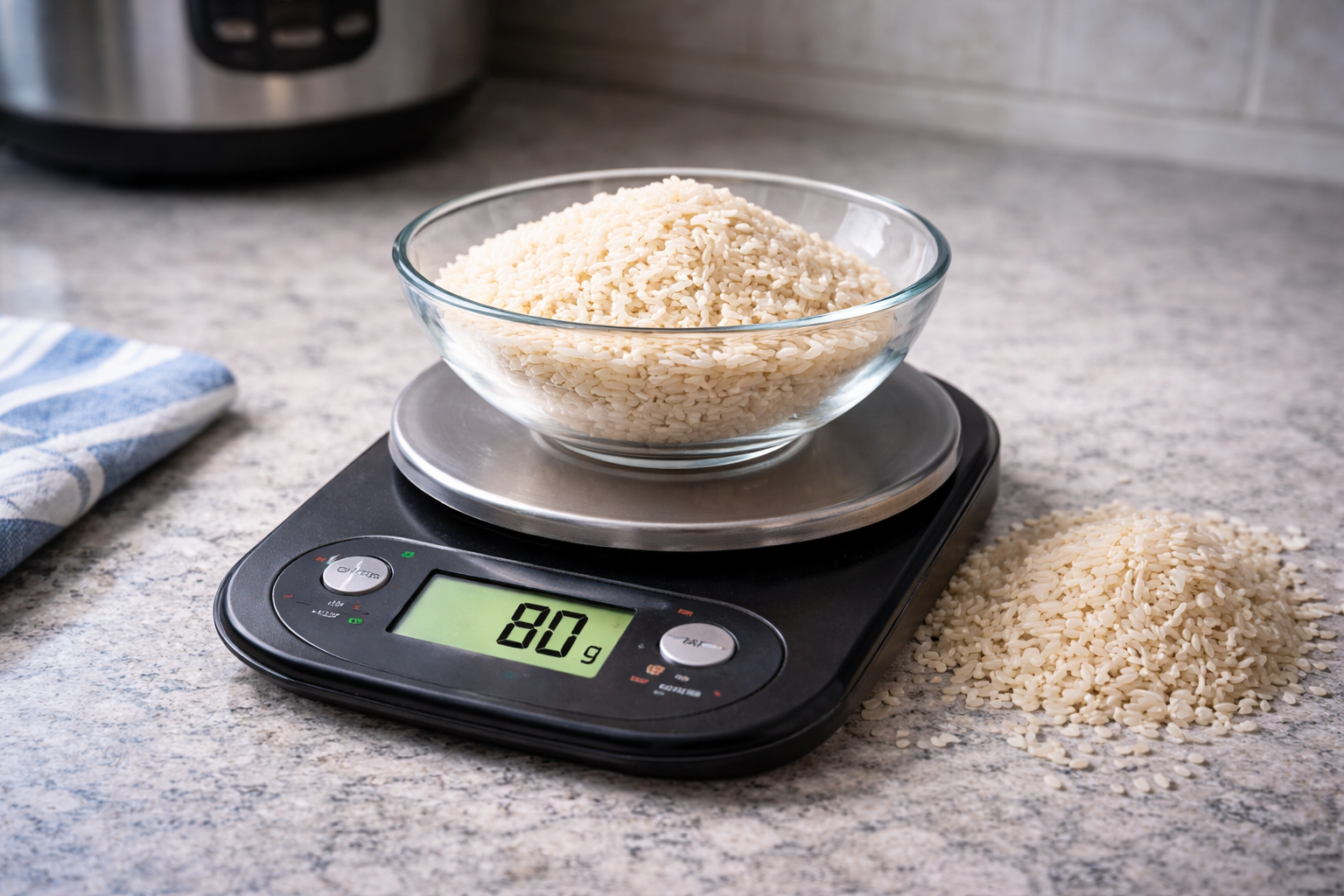
Tracking your rice intake but confused about whether to weigh it raw or cooked? Here’s why getting this wrong can completely sabotage your diet results.
You’re diligently tracking your macros. Weighing your food. Logging everything in MyFitnessPal.
Then you get to your rice.
Do you weigh it before or after cooking?
You check the nutrition label. It says “per 100g.” But 100g of what? Raw rice? Cooked rice?
You ask online. Some people say raw. Others say cooked. Some claim it doesn’t matter.
Here’s the truth that will save your diet: You should ALWAYS weigh rice raw (before cooking). Weighing cooked rice creates massive inconsistencies that can throw off your entire diet by hundreds of calories daily.
In this comprehensive guide, I’ll explain exactly why weighing rice raw is critical for accurate tracking, show you the massive calorie differences between raw and cooked measurements, reveal why “raw to cooked conversion formulas” don’t work, explain how this applies to different rice types, and give you a foolproof system for tracking rice in your diet.
Whether you’re cutting, bulking, or maintaining, getting this right is essential for hitting your targets and getting results.
Let’s end the confusion.
TABLE OF CONTENTS
- "But I eat at restaurants. How do I track rice there?"
- "I meal prep and portion cooked rice into containers. Now what?"
- "The app I use has entries for cooked rice. Can I use those?"
- "I cook rice in a rice cooker. Does the same rule apply?"
- "What if I'm eating leftovers and don't know how much raw rice was used?"
- The Bottom Line: Always Weigh Rice Raw
Why Weighing Rice Raw vs Cooked Matters So Much
Before diving into the how, you need to understand why this matters for your results.
The Fundamental Problem: Water Absorption
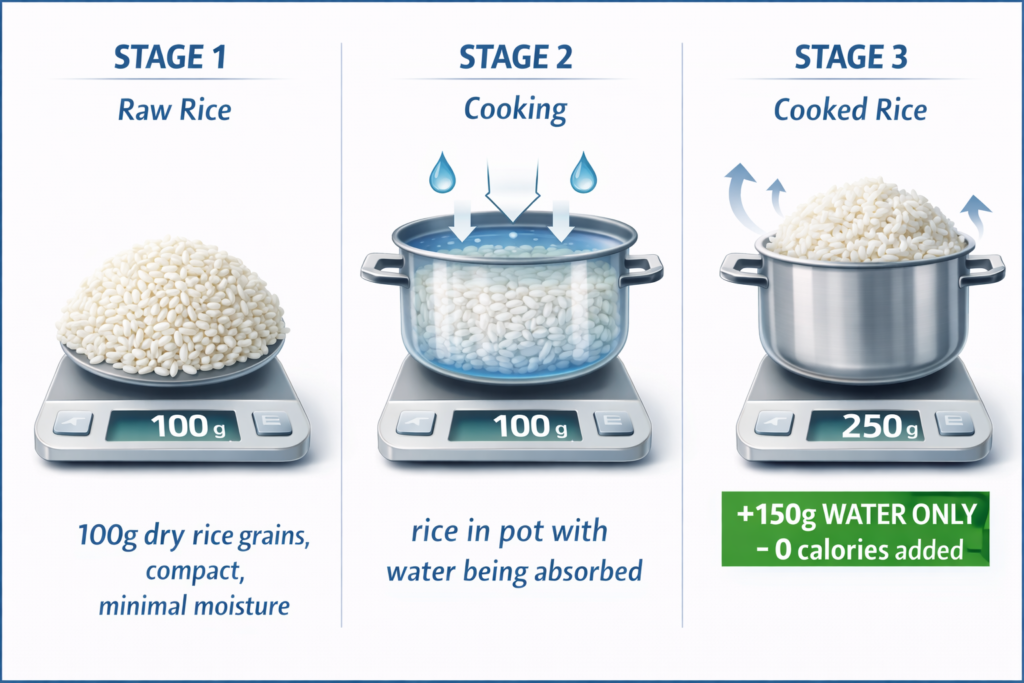
Rice absorbs water during cooking.
This isn’t a minor detail. It’s the entire reason this topic matters.
What happens when you cook rice:
Raw rice starts with:
- Dried grains
- Minimal water content
- Compact, dense structure
- Predictable weight
During cooking:
- Rice absorbs water from the cooking liquid
- Grains expand 2-3x in size
- Weight increases 2-3x
- Volume increases significantly
The result:
- 100g raw rice becomes 200-300g cooked rice
- The weight change is entirely from water
- Zero calories added (water has no calories)
- Same nutrition, completely different weight
This creates a massive problem for tracking.
The Impact on Your Calorie Tracking
Let’s see how this affects your actual numbers.
Scenario: You want to eat 100g of rice
If you weigh it raw (correct method):
- 100g raw white rice = 130 calories, 28g carbs
- You cook it, it becomes ~250g cooked
- You eat all of it = 130 calories consumed
- Your tracking is accurate
If you weigh it cooked (incorrect method):
- You cook rice, scoop 100g cooked rice
- 100g cooked rice = approximately 40-50g raw rice equivalent
- Actual calories = 52-65 calories (not the 130 you think)
- Your tracking shows 130 but you only ate 52-65
- You’re off by 65-78 calories just from this one measurement
Or worse, the opposite mistake:
If your diet calls for “100g rice” and you measure cooked:
- You think “100g cooked rice = 130 calories” (looking at raw nutrition label)
- Actually, 100g cooked rice ≈ 50g raw = 65 calories
- You log 130 calories but only consumed 65
- You’re undereating by 65 calories and don’t know it
The Compounding Effect Over a Full Day
Let’s look at a typical day eating rice 2-3 times:
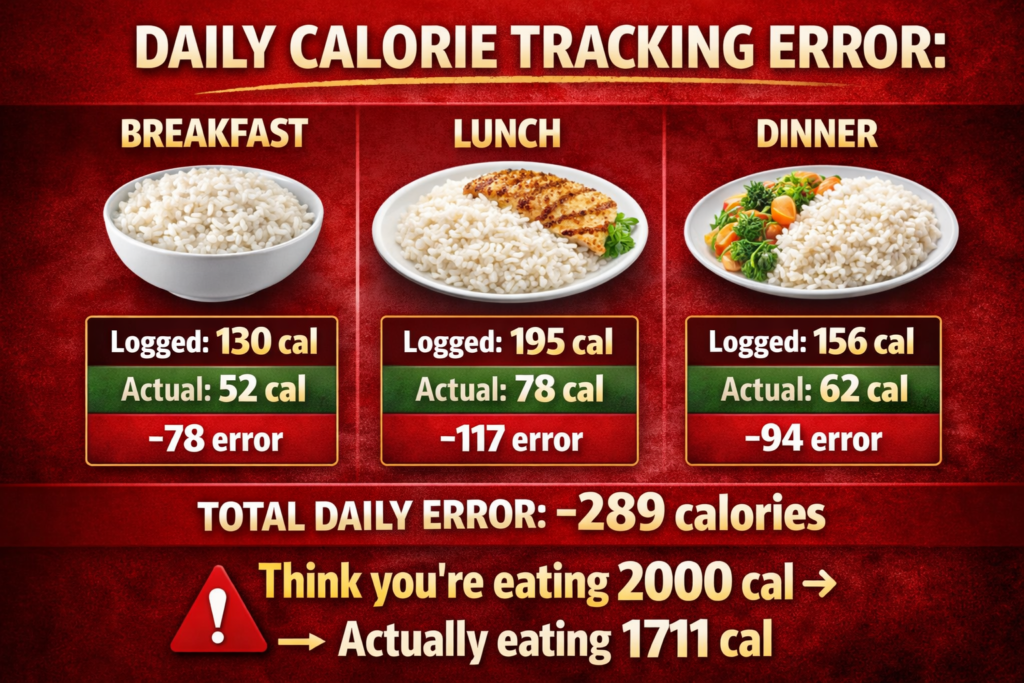
Breakfast: Rice bowl logged as 100g (cooked, but using raw nutrition data)
- Logged: 130 calories
- Actual: 52 calories
- Error: -78 calories
Lunch: Rice with chicken logged as 150g (cooked, but using raw nutrition data)
- Logged: 195 calories
- Actual: 78 calories
- Error: -117 calories
Dinner: Rice with vegetables logged as 120g (cooked, but using raw nutrition data)
- Logged: 156 calories
- Actual: 62 calories
- Error: -94 calories
Daily total error: -289 calories
If you’re on a 2,000 calorie diet:
- You think you’re eating 2,000 calories
- You’re actually eating 1,711 calories
- You’re in a much larger deficit than planned
If you’re bulking on 3,500 calories:
- You think you’re eating 3,500 calories
- You’re actually eating 3,211 calories
- You’re not in the surplus you need for muscle growth
This error accumulates daily, completely sabotaging your diet plan.
Why Cooking Method Creates Inconsistency
Here’s the even bigger problem: water absorption varies.
Factors affecting how much water rice absorbs:
1. Cooking method:
- Boiling (lots of water): More absorption
- Steaming: Moderate absorption
- Rice cooker: Varies by model and settings
- Absorption method (exact water ratio): More consistent but still varies
2. Water amount used:
- 2:1 water to rice ratio: More absorption
- 1.5:1 ratio: Less absorption
- 1:1 ratio: Minimal absorption
- “Lots of water, then drain”: Maximum absorption
3. Cooking time:
- Shorter cooking: Less water absorbed
- Longer cooking: More water absorbed
- Overcooked rice: Even more water
4. Rice variety:
- White rice: Absorbs more water
- Brown rice: Absorbs less water
- Parboiled rice: Absorbs less water
- Basmati: Different absorption than jasmine
- Each variety behaves differently
5. Individual preference:
- Some people like drier rice (less water)
- Some prefer softer, wetter rice (more water)
- Your preference affects absorption
The practical problem:
If you weigh cooked rice, you have no idea:
- How much actual rice you’re eating
- How much is water
- Whether today’s rice absorbed the same water as yesterday’s
- If your tracking is accurate
100g of your cooked rice today might equal 40g raw rice.
100g of your cooked rice tomorrow might equal 50g raw rice.
Same weight, 25% difference in actual calories.
This inconsistency makes tracking meaningless.
The Only Reliable Solution: Always Weigh Rice Raw
The solution is simple: weigh rice before cooking.
Why Raw Weight Is Always Accurate
Raw rice is standardized:
Consistency factors:
- Moisture content is standardized (typically 12-14% for dried rice)
- Weight doesn’t vary between preparations
- 100g raw rice today = 100g raw rice tomorrow
- Nutrition labels are based on raw weight
- Zero variables from cooking method
Reliability:
- You know exactly how many calories you’re consuming
- You know exactly how many carbs you’re consuming
- Your tracking is consistent day to day
- You can accurately adjust your diet based on results
Simplicity:
- One measurement, one time
- No guessing about water content
- No conversion calculations needed
- No wondering if your tracking is accurate
How to Implement Raw Rice Weighing
The practical system that works:
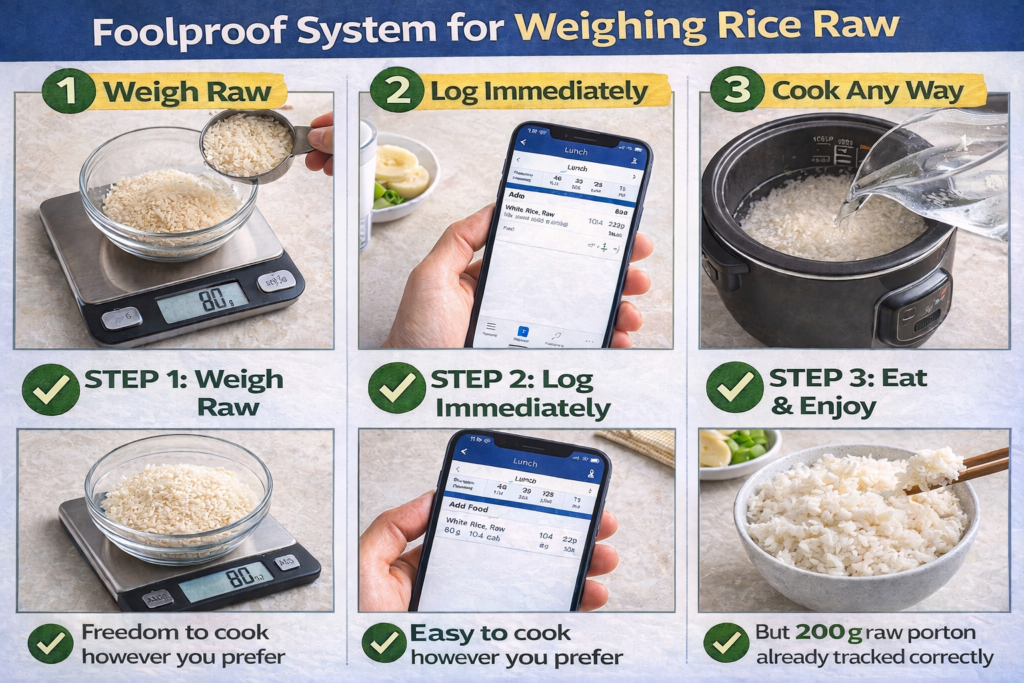
Step 1: Weigh your raw rice before cooking
Use a food scale:
- Place bowl on scale
- Tare to zero
- Add rice until you hit your target weight
- Log this weight in your tracking app
Example:
- Target: 80g raw rice
- Weigh out 80g dry rice
- Log 80g rice in MyFitnessPal
- Calories: 104, Carbs: 22g, Protein: 2g
Step 2: Cook the rice however you prefer
Now you have complete freedom:
- Use any amount of water
- Cook until you like the texture
- Don’t worry about absorption
- Your tracking is already done
The rice will expand to 160-240g cooked, but this doesn’t matter. You already logged the accurate amount.
Step 3: Eat and enjoy
No additional tracking needed:
- You’ve already logged the raw amount
- Cooked weight is irrelevant
- Your macros are accurate
- Your results will be predictable
Meal Prep Solution: Pre-Portion Raw Rice
If you meal prep, this system is even easier:
Sunday meal prep example:
Calculate your daily rice needs:
- Cutting diet: 80g raw rice per day
- You eat rice twice daily: 40g per meal
- Meal prepping for 5 days
Weigh and portion:
- Get 10 small containers or bags
- Weigh 40g raw rice into each
- Label them: “40g raw rice”
- Store in pantry
Daily use:
- Grab one container
- Cook the contents
- You already know it’s 40g raw = logged accurately
- No weighing needed during busy week
This eliminates any guesswork and makes tracking effortless.
Cooking for Multiple People: Batch Cooking System
What if you cook rice for your whole family?
The batch tracking method:
Step 1: Weigh total raw rice
- Cooking for family dinner
- Weigh total raw rice used (example: 300g)
- Log this total amount
Step 2: Cook the batch
- Cook all the rice together
- Doesn’t matter how much water or cooking method
Step 3: Weigh the total cooked rice
- Total cooked rice weight (example: 720g)
Step 4: Calculate your portion
- You want to eat 1/3 of the total
- Your portion: 720g ÷ 3 = 240g cooked rice
- This equals 100g raw rice (1/3 of 300g raw)
- Log 100g raw rice
Or use percentages:
- Total raw: 300g
- You eat 40% of the cooked rice
- Your portion: 300g × 0.40 = 120g raw rice
- Log 120g raw rice
This works perfectly for family meals while maintaining accurate tracking.
Does Rice Type Matter? (White, Brown, Parboiled)
Short answer: The principle applies to ALL rice types, but the specifics vary.
Different Rice Types and Water Absorption
White rice (most common):
- Absorbs 2-3x its weight in water
- 100g raw → 250-300g cooked (most variable)
- Cooking method heavily affects final weight
- Most inconsistent when measuring cooked
Brown rice:
- Absorbs 2-2.5x its weight in water
- 100g raw → 200-250g cooked
- Slightly more consistent than white
- Still unreliable when measured cooked
- Takes longer to cook (more absorption opportunity)
Parboiled rice:
- Absorbs 2-2.5x its weight in water
- 100g raw → 200-250g cooked
- Somewhat more consistent than white rice
- Pre-processing affects absorption
- Still should be weighed raw
Basmati rice:
- Absorbs ~2.5x its weight
- 100g raw → 250g cooked (approximately)
- Long grain affects texture
- Slightly different absorption than short grain
Jasmine rice:
- Absorbs 2-3x its weight
- 100g raw → 250-300g cooked
- Sticky texture when cooked
- Higher moisture retention
Wild rice (technically not rice, but often mixed):
- Absorbs 3-4x its weight
- Very different cooking properties
- Much longer cooking time
- Even more variable when cooked
Why Weighing Raw Matters Even More With Different Types
If you sometimes eat white rice, sometimes brown rice:
The problem compounds:
Monday: White rice
- 100g cooked white rice ≈ 40g raw
- Calories: ~52
Tuesday: Brown rice
- 100g cooked brown rice ≈ 45g raw
- Calories: ~50 (brown rice has similar calories per gram raw)
The weight difference seems small, but:
- Different types absorb different amounts of water
- Your 100g cooked portions represent different raw amounts
- Tracking becomes even less reliable
- Results become unpredictable
The solution remains the same:
Always weigh raw, regardless of type:
- 100g raw white rice = consistent tracking
- 100g raw brown rice = consistent tracking
- You know exactly what you’re eating
- Rice type doesn’t matter for tracking accuracy
Nutrition Label Considerations
Important: Nutrition labels are ALWAYS based on raw weight (unless specifically stated otherwise).
When you look at a rice package:
“Nutrition Facts: Per 100g”
This means 100g RAW rice, not cooked.
Calories per 100g raw:
- White rice: ~130 calories
- Brown rice: ~110 calories
- Parboiled rice: ~130 calories
- Basmati rice: ~120 calories
If you weigh cooked rice and use these nutrition values, you’ll be completely wrong.
Example of the mistake:
- Nutrition label: 100g = 130 calories (raw)
- You weigh 100g cooked rice
- You log 130 calories
- Actual calories: ~52 (you’re off by 78 calories)
Always weigh raw to match the nutrition label data.
Why “Raw to Cooked Conversion Formulas” Don’t Work
You’ll find countless online calculators and formulas claiming to convert raw rice to cooked rice.
Examples you might see:
- “100g raw rice = 250g cooked rice”
- “Multiply raw weight by 2.5 to get cooked weight”
- “Divide cooked weight by 2.5 to get raw equivalent”
These seem helpful, but they’re fundamentally flawed for diet tracking.
Why Conversion Formulas Exist
These formulas were created for cooking, not nutrition tracking.
Their intended purpose:
- Recipe scaling (“How much raw rice to feed 6 people?”)
- Restaurant portion planning
- General cooking guidance
- Estimating serving sizes
For these purposes, they work fine:
- Approximate amounts are sufficient
- Taste and appearance matter, not exact calories
- Small variations don’t matter
- Nobody’s tracking macros
Why They Fail for Diet Tracking
Problem 1: They assume standard cooking methods
Most formulas assume:
- Specific water ratio (usually 2:1)
- Specific cooking time
- Standard temperature
- Complete absorption
But in reality:
- You might use 1.5:1 or 3:1 water ratio
- You might cook longer or shorter
- Your rice cooker might work differently
- You might drain excess water
Each variation changes the final weight significantly.
Problem 2: They ignore rice variety differences
Conversion formulas often give one number for “rice.”
But:
- White rice ≠ brown rice absorption
- Basmati ≠ jasmine absorption
- Short grain ≠ long grain absorption
- Each variety is different
A single conversion factor can’t account for all varieties.
Problem 3: They don’t account for personal cooking preferences
Some people like rice:
- Firm and slightly dry (less water absorbed)
- Soft and fluffy (moderate water)
- Very soft and sticky (maximum water)
Your preference directly affects the cooked weight.
The same 100g raw rice might become:
- 200g cooked (firm, drier rice)
- 250g cooked (standard preparation)
- 300g cooked (very soft, wet rice)
A conversion formula can’t account for individual preferences.
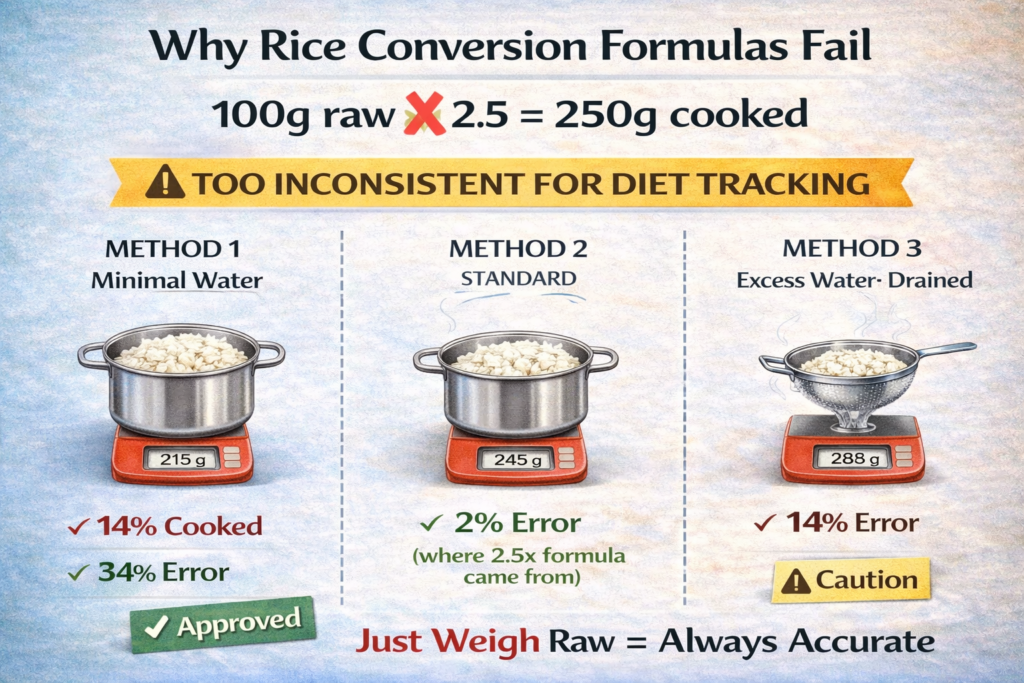
The Unreliability Demonstrated
Let’s test the common “multiply by 2.5” formula:
Experiment: Cook 100g raw white rice three different ways
Method 1: Minimal water (1.5:1 ratio)
- 100g raw rice
- 150ml water
- Cook until absorbed
- Result: 215g cooked rice
- Formula prediction: 250g
- Error: 35g (14% off)
Method 2: Standard water (2:1 ratio)
- 100g raw rice
- 200ml water
- Cook until absorbed
- Result: 245g cooked rice
- Formula prediction: 250g
- Error: 5g (2% off) [This is where the formula came from]
Method 3: Excess water, then drain
- 100g raw rice
- 500ml water
- Boil, then drain
- Result: 285g cooked rice
- Formula prediction: 250g
- Error: 35g (14% off)
The formula only works for Method 2 (the method it was based on).
For diet tracking, 14% error is unacceptable.
Why Even “Accurate” Conversions Aren’t Worth It
Some people argue:
“But I always cook rice the same way. Can’t I use a consistent conversion?”
Problems with this approach:
1. Requires perfect consistency:
- Same water amount every time
- Same cooking time
- Same rice variety
- Same brand
- No room for variation
2. One mistake ruins everything:
- Forgot exact water ratio one day
- Cooked it slightly longer
- Used a different pot
- Your conversion is now wrong
3. More complex than just weighing raw:
- Weigh cooked rice
- Calculate conversion
- Log converted amount
- Hope your conversion is accurate
Versus:
- Weigh raw rice
- Log raw amount
- Done (accurate every time)
Why add unnecessary complexity and potential error?
Common Questions and Objections Answered
“But I eat at restaurants. How do I track rice there?”
This is a legitimate challenge.
Options:
Option 1: Estimate conservatively
- Restaurant rice serving ≈ 150-200g cooked
- This equals roughly 60-80g raw rice
- Log 70-80g raw rice
- Accept slight imprecision for occasional meals
Option 2: Ask for rice on the side
- Request sauce/protein separate from rice
- Eyeball the rice portion
- Estimate based on volume (½ cup cooked ≈ 40g raw)
Option 3: Don’t sweat restaurant meals
- If eating out 1-2 times weekly, minor inaccuracy won’t matter
- Track everything else precisely
- Accept restaurants as approximate
The key: Restaurants are occasional. Your daily at-home tracking matters more.
“I meal prep and portion cooked rice into containers. Now what?”
You have two options:
Option 1: Switch to pre-portioning raw rice (recommended)
- Weigh raw rice portions before cooking
- Cook each portion separately or mark containers
- Much more accurate
Option 2: If you must pre-portion cooked rice
- Weigh TOTAL raw rice before cooking (example: 400g)
- Cook it all
- Weigh TOTAL cooked rice (example: 1,000g)
- Divide cooked rice into equal portions (example: 5 containers of 200g each)
- Each container = 400g ÷ 5 = 80g raw rice
- Log 80g raw rice per container
This maintains accuracy through ratio calculations.
“The app I use has entries for cooked rice. Can I use those?”
Be very careful with this.
Problems with “cooked rice” database entries:
They’re estimates based on:
- Unknown cooking method
- Unknown water absorption
- Someone’s guess at conversion
- No way to verify accuracy
Example MyFitnessPal entries you’ll find:
- “White Rice, Cooked” (various entries showing 130-150 cal per 100g)
- These are rough estimates
- Some may be completely wrong
- Many are user-submitted without verification
Safer approach:
- Use “White Rice, Raw” entries (these match nutrition labels)
- Weigh your rice raw
- Log raw weight
- Ignore cooked rice entries entirely
If you must use cooked entries:
- Understand you’re accepting significant imprecision
- Use consistently at least (same entry every time)
- Monitor results and adjust if needed
“I cook rice in a rice cooker. Does the same rule apply?”
Absolutely yes.
Rice cookers are more consistent than stovetop cooking, but:
- They still vary by model
- Water absorption still occurs
- Different rice types still behave differently
- The cooked weight still varies
The principle doesn’t change:
- Weigh rice raw before adding to rice cooker
- Log that raw weight
- Cook and eat
- Tracking is accurate
Rice cookers actually make this easier:
- More consistent results
- But still need to weigh raw for accurate tracking
“What if I’m eating leftovers and don’t know how much raw rice was used?”
If you cooked rice without weighing it raw:
Best option:
- Accept this meal as untracked or estimated
- Don’t try to reverse-engineer it
- Make a rough estimate if needed
- Commit to weighing raw going forward
Rough estimation method:
- 1 cup cooked rice (compact) ≈ 50-60g raw rice
- 1 cup cooked rice (fluffy) ≈ 40-50g raw rice
- Log conservatively (higher end of range)
Prevention:
- Always weigh and log raw rice when cooking
- Label meal prep containers with raw rice amount
- Keep a cooking log if needed
The Complete Rice Tracking System
Here’s the foolproof system for accurate rice tracking.
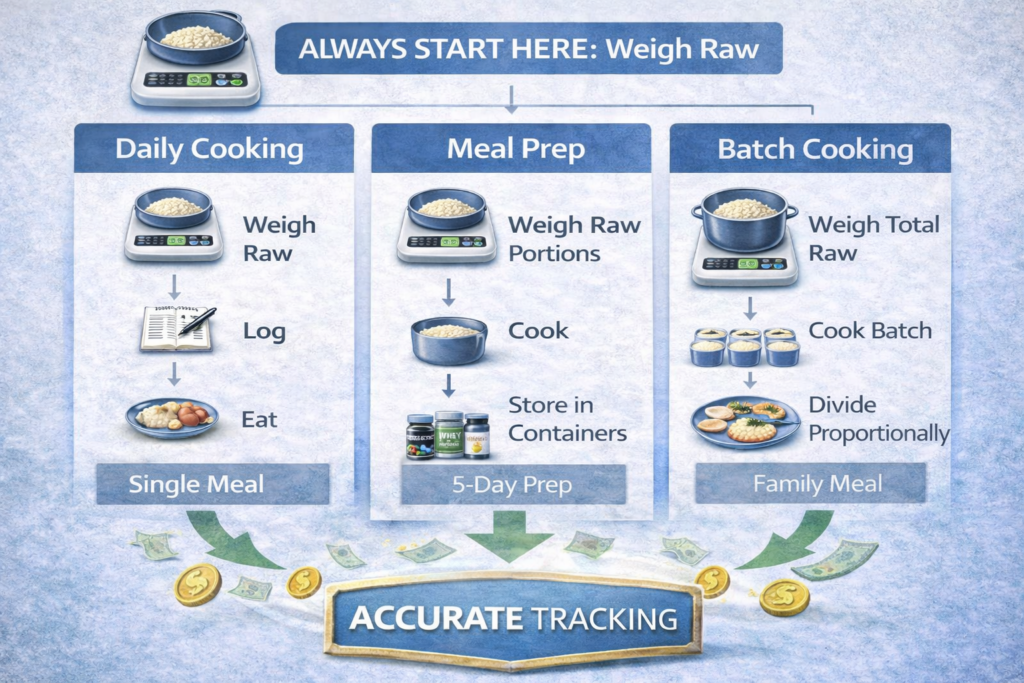
For Daily Cooking
Step 1: Plan your rice intake
- Check your meal plan
- Know how much rice you need (raw weight)
- Example: 80g raw rice for dinner
Step 2: Weigh raw rice
- Place bowl on food scale
- Tare to zero
- Add rice until you reach target weight
- You have exactly 80g raw rice
Step 3: Log immediately
- Open tracking app
- Search “white rice raw” or “brown rice raw”
- Enter 80g
- Macros logged: 104 calories, 22g carbs (for white rice)
Step 4: Cook as normal
- Add rice to pot/rice cooker
- Add water based on your preference
- Cook until done
- Rice is now 160-240g cooked (doesn’t matter)
Step 5: Eat and move on
- Portion is already logged accurately
- No additional tracking needed
- Results will be predictable
For Meal Prep
Sunday Prep Session:
Calculate weekly needs:
- Daily rice: 150g raw
- 5 days of meal prep
- Total needed: 750g raw rice
Method 1: Individual portions
- Use 5 containers
- Weigh 150g raw rice into each
- Cook each portion separately in rice cooker
- Each container = 150g raw rice logged
Method 2: Batch cooking
- Weigh total: 750g raw rice
- Cook all together
- Weigh total cooked rice: ~1,875g
- Divide into 5 equal portions: 375g cooked each
- Each portion = 150g raw rice (750g ÷ 5)
- Log 150g raw rice per container
Label containers:
- “Chicken and Rice: 150g raw rice, 200g chicken breast”
- You know exact macros
- No guessing during the week
For Restaurants and Social Situations
Strategy for unknown rice servings:
Visual estimation:
- Standard restaurant rice serving ≈ 1 cup cooked
- 1 cup cooked ≈ 50-60g raw rice
- Log 60g raw rice (conservative estimate)
Ask for details (if possible):
- “How much rice comes with this dish?”
- “Can I get a half portion of rice?”
- Request rice on the side for better estimation
Accept imperfection:
- Occasional restaurant meals won’t ruin progress
- Daily precision at home matters more
- Estimate conservatively and move on
The Bottom Line: Always Weigh Rice Raw
After examining all the evidence and practical considerations:
The rule is simple and non-negotiable:
✅ ALWAYS weigh rice raw (before cooking)
Why this matters:
- Rice absorbs 2-3x its weight in water during cooking
- Water content varies based on cooking method, time, water amount, and rice type
- Weighing cooked rice creates 15-25% tracking errors
- These errors compound daily, sabotaging your diet
- Nutrition labels are based on raw weight
Why raw weighing is superior:
- Completely consistent day to day
- No variables from cooking method
- Matches nutrition label data exactly
- Simple and foolproof
- Accurate enough for precise results
What doesn’t work:
- Weighing cooked rice (too inconsistent)
- Using conversion formulas (too many variables)
- Database entries for “cooked rice” (too imprecise)
- Guessing or eyeballing (terrible for results)
The practical system:
1. For daily meals:
- Weigh raw → Log raw → Cook → Eat
2. For meal prep:
- Weigh raw portions → Cook → Store → Already logged
3. For batch cooking:
- Weigh total raw → Cook → Divide proportionally → Log raw equivalent
This applies to:
- White rice
- Brown rice
- Basmati rice
- Jasmine rice
- Parboiled rice
- Wild rice
- ANY rice type
The difference this makes:
Weighing cooked (wrong):
- Daily tracking errors: 200-300 calories
- Monthly impact: Results don’t match effort
- Frustration from plateaus
- Wasted time and effort
Weighing raw (correct):
- Accurate tracking within 1-2%
- Predictable, consistent results
- Diet adjustments work as expected
- Success follows precision
If you want results, weigh rice raw. Every single time. No exceptions.
WEIGH IT RAW. TRACK IT ACCURATELY. GET THE RESULTS YOU DESERVE.
Ready to master every aspect of nutrition tracking for guaranteed results? Weighing rice correctly is just one piece of accurate macro tracking. Get a complete guide to food weighing, macro tracking, meal planning, and nutrition precision that ensures your diet actually delivers the results you’re working for. Stop guessing. Start knowing your exact intake and getting the body you want.



Leave a Reply
You must be logged in to post a comment.