Looking for whey protein alternatives that deliver the same muscle-building results? Here’s the complete guide to equivalent substitutes.
You’re trying to hit your protein targets. You reach for your whey protein.
But then you stop.
Maybe you’re out of whey. Maybe you’re trying to save money. Maybe you have lactose intolerance. Maybe you just want variety.
Whatever the reason, you need alternatives.
You wonder:
- “What provides the same protein as whey?”
- “Will other sources work as well?”
- “Can whole foods replace protein powder?”
- “Which alternatives are actually equivalent?”
Here’s the complete answer: A 30g serving of whey protein provides 20-25g of protein. This can be replaced by: 30g egg white protein, 30g soy protein isolate, 100g chicken breast, 100g lean beef, 4 whole eggs, or 200g cottage cheese. All provide equivalent protein with complete amino acid profiles. The main differences are digestion speed, cost, convenience, and additional nutrients, not muscle-building effectiveness.
In this comprehensive guide, I’ll reveal exactly what 30g of whey protein actually provides nutritionally, show you 7 complete alternatives with precise portions and nutritional breakdowns, explain which alternatives work best for different situations and goals, provide cost comparisons to help you save money without sacrificing results, and clarify why whey protein isn’t mandatory for muscle building despite marketing claims.
Whether you’re cutting costs, dealing with allergies, or just seeking variety, this article will give you proven whey alternatives.
Let’s find your perfect protein source.
TABLE OF CONTENTS
What’s Actually in 30g of Whey Protein?
Understanding the baseline before finding alternatives.
The Nutritional Breakdown
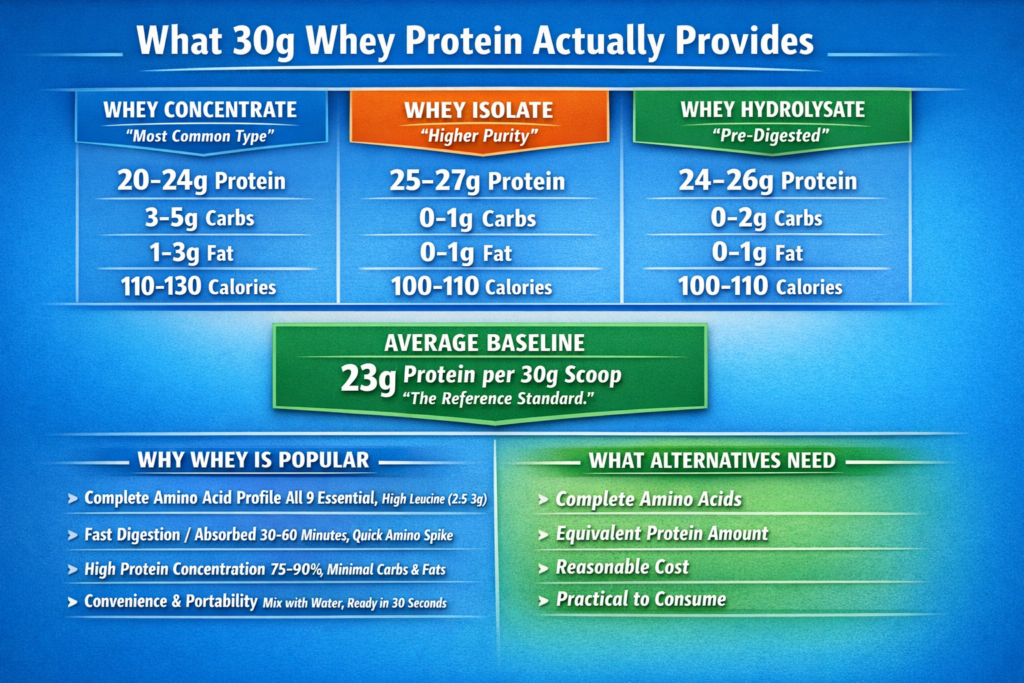
Important clarification: 30g refers to powder weight, not protein content.
Typical 30g whey protein scoop provides:
Whey concentrate (most common):
- Protein: 20-24g
- Carbohydrates: 3-5g
- Fat: 1-3g
- Calories: 110-130
Whey isolate (higher purity):
- Protein: 25-27g
- Carbohydrates: 0-1g
- Fat: 0-1g
- Calories: 100-110
Whey hydrolysate (pre-digested):
- Protein: 24-26g
- Carbohydrates: 0-2g
- Fat: 0-1g
- Calories: 100-110
For this article, we’ll use the average: 23g protein per 30g scoop.
Why Whey Is Popular
Understanding whey’s advantages helps identify what to look for in alternatives.
Advantage 1: Complete amino acid profile
- Contains all 9 essential amino acids
- High leucine content (2.5-3g per serving)
- Optimal ratios for muscle building
- Alternatives must match this
Advantage 2: Fast digestion
- Absorbed in 30-60 minutes
- Quick amino acid spike
- Ideal post-workout
- Some alternatives slower (not necessarily bad)
Advantage 3: High protein concentration
- 75-90% protein by weight
- Minimal carbs and fats
- Low calorie for protein provided
- Efficiency matters when cutting
Advantage 4: Convenience
- Mix with water, drink
- 30 seconds preparation
- Portable
- Convenience is key advantage
What alternatives need: Complete amino acids, equivalent protein amount, reasonable cost, practical to consume.
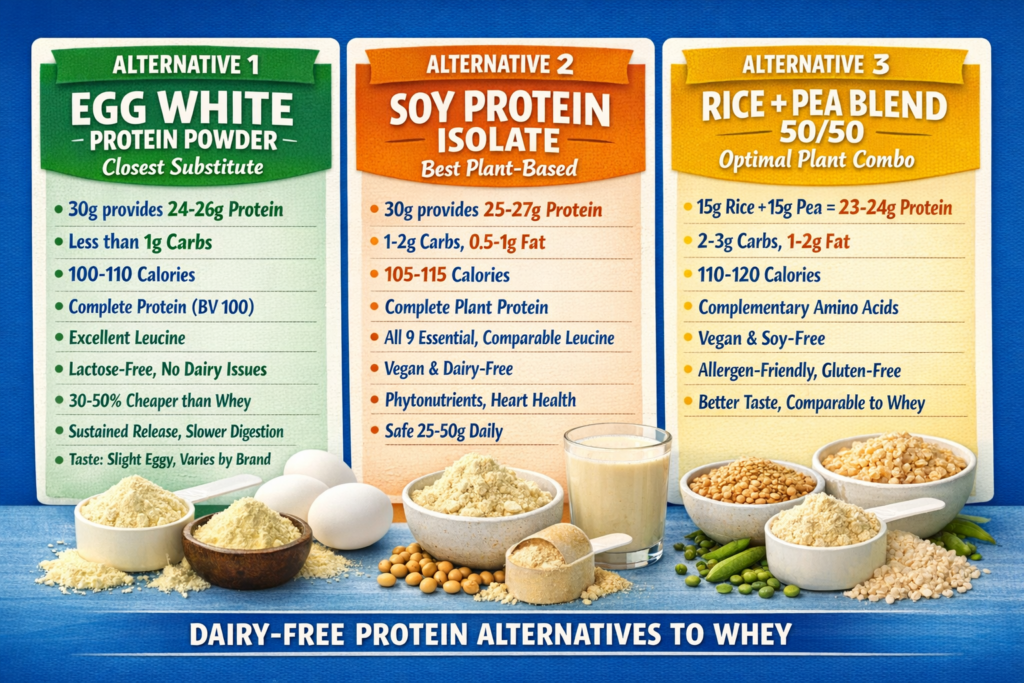
Alternative 1: Egg White Protein Powder (30g)
The closest supplement alternative to whey.
Nutritional Breakdown
30g egg white protein powder provides:
- Protein: 24-26g
- Carbohydrates: <1g
- Fat: <1g
- Calories: 100-110
Comparison to whey:
- Protein: Equal or slightly higher
- Carbs: Lower
- Fat: Equal
- Nutritionally very similar
Why This Works
Complete protein:
- All essential amino acids
- High biological value (100)
- Excellent leucine content
- Matches whey for muscle building
Quality and effectiveness:
- Studies show equal muscle-building results
- No significant difference in protein synthesis
- Supports recovery equally well
- Scientifically validated alternative
Advantages Over Whey
Lactose-free:
- No dairy whatsoever
- Perfect for lactose intolerant
- No digestive issues
- Broader usability
Often cheaper:
- $20-30 per 5 pounds typical
- Whey: $40-60 per 5 pounds
- 30-50% cost savings
Different amino acid timing:
- Slightly slower digestion than whey
- Sustained amino acid release
- Can be beneficial
- Less critical than once thought
Disadvantages
Taste:
- Less sweet than whey
- Can have slight “eggy” taste (varies by brand)
- Not as many flavor options
- Some people prefer whey flavor
Mixability:
- Can be slightly grittier
- Requires more shaking
- Not a deal-breaker
- Varies by brand
Best For
Use egg white protein when:
- Lactose intolerant or dairy sensitive
- Want to save money
- Prefer animal protein but not dairy
- Need variety from whey
Alternative 2: Soy Protein Isolate (30g)
The best plant-based protein powder alternative.
Nutritional Breakdown
30g soy protein isolate provides:
- Protein: 25-27g
- Carbohydrates: 1-2g
- Fat: 0.5-1g
- Calories: 105-115
Comparison to whey:
- Protein: Equal or higher
- Carbs: Similar
- Fat: Lower
- Nearly identical macros
Why This Works
Complete plant protein:
- Only common plant protein with complete amino acids
- All 9 essential amino acids
- Comparable leucine to whey
- Matches whey effectiveness
Research support:
- Multiple studies show equal muscle growth vs. whey
- No significant difference in strength gains
- Supports recovery equally
- Science-backed alternative
Advantages Over Whey
Plant-based:
- Vegan-friendly
- Vegetarian option
- No animal products
- Ethical choice for some
Lactose and dairy-free:
- No digestive issues from dairy
- Suitable for allergies
- Broader tolerance
Often cheaper:
- $25-35 per 5 pounds
- Similar or lower cost than whey
- Good value
Additional benefits:
- Contains phytonutrients
- May support heart health
- Additional antioxidants
- Beyond just protein
Addressing Soy Concerns
The hormone question:
Common concern:
- “Soy increases estrogen in men”
- Worries about testosterone
- Concerns about “man boobs”
The science:
- No significant hormonal effects in normal intake
- Studies show no testosterone reduction
- Phytoestrogens are NOT human estrogen
- Concerns are largely unfounded
Safe intake:
- 2-3 servings daily completely safe
- 25-50g soy protein daily: No issues
- Only extreme intakes (100g+ daily) need caution
- Normal use is fine
Best For
Use soy protein when:
- Vegan or vegetarian
- Lactose intolerant
- Want plant-based option
- Prefer non-dairy
Alternative 3: Rice + Pea Protein Blend (30g total, 50/50 mix)
The optimal plant-based protein combination.
Nutritional Breakdown
15g rice protein + 15g pea protein provides:
- Protein: 23-24g
- Carbohydrates: 2-3g
- Fat: 1-2g
- Calories: 110-120
Why the combination matters:
Rice protein alone:
- High in methionine
- Low in lysine
- Incomplete amino acid profile
Pea protein alone:
- High in lysine
- Low in methionine
- Incomplete amino acid profile
Combined (50/50):
- Complete amino acid profile
- All essentials in proper ratios
- Comparable to whey
Why This Works
Complementary amino acids:
- Rice fills pea’s gaps
- Pea fills rice’s gaps
- Together: Complete protein
- Synergistic combination
Research validation:
- Studies show equal muscle growth to whey
- No performance difference
- Supports recovery equally
- Scientifically proven alternative
Advantages
Plant-based and allergen-friendly:
- Vegan option
- Dairy-free
- Soy-free (for those avoiding soy)
- Gluten-free
Easier digestion than soy for some:
- Less gas and bloating (individual variation)
- Gentle on stomach
- Well-tolerated
Good taste:
- Better flavor than pea protein alone
- Less “earthy” than some plant proteins
- Comparable to whey (when flavored)
Best For
Use rice + pea blend when:
- Vegan avoiding soy
- Multiple allergies
- Want plant protein with complete aminos
- Prefer taste over pure pea protein
Alternative 4: Chicken Breast (100g)
The classic whole food protein source.
Nutritional Breakdown
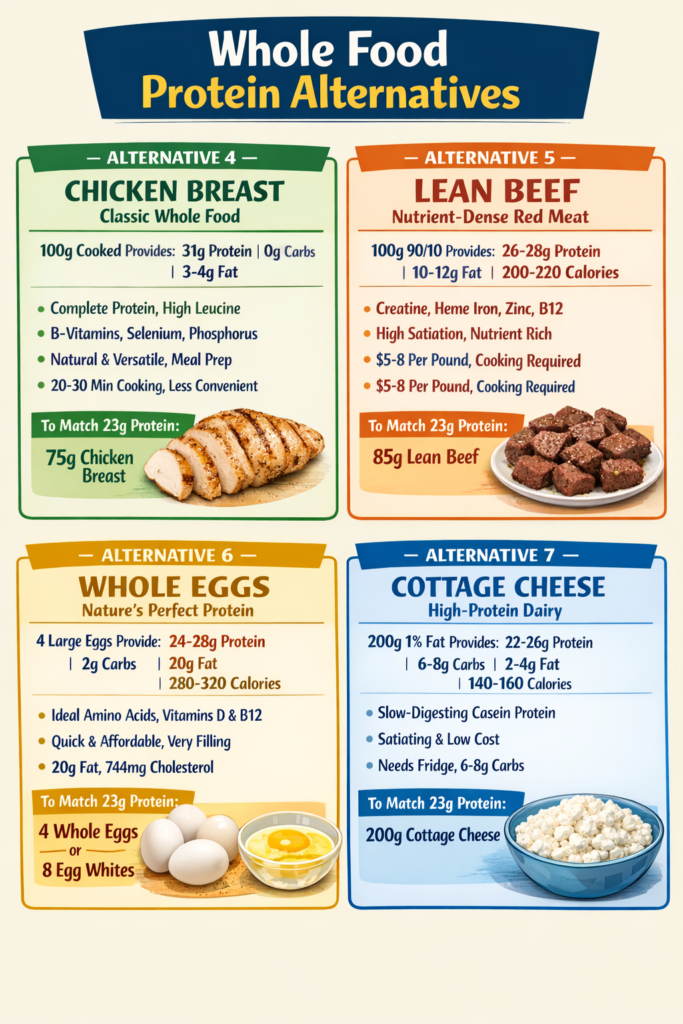
100g cooked chicken breast provides:
- Protein: 31g
- Carbohydrates: 0g
- Fat: 3-4g
- Calories: 165
Comparison to whey (23g protein):
- Protein: 35% MORE than whey scoop
- Carbs: Lower
- Fat: Slightly higher
- Calories: 50-55 more
To match whey exactly: ~75g chicken breast = 23g protein
Why This Works
Complete protein:
- All essential amino acids
- High biological value
- Excellent leucine content
- Equal muscle-building potential
Additional nutrients:
- B-vitamins (especially B6, niacin)
- Selenium
- Phosphorus
- More than just protein
Advantages Over Whey
Whole food:
- Natural, unprocessed
- More satiating than shake
- Part of complete meal
- Real food vs. supplement
Very versatile:
- Cook once, eat multiple ways
- Meal prep friendly
- Combines with any cuisine
- Never boring
Extremely lean:
- Only 3-4g fat per 100g
- Perfect for cutting
- High protein-to-calorie ratio
- Excellent macro efficiency
Disadvantages
Preparation time:
- Requires cooking
- 20-30 minutes typical
- Less convenient than shake
- Can meal prep in advance
Not instant:
- Can’t consume immediately post-workout
- Need planning
- Less portable
- Requires refrigeration
Cost (depending on location):
- $3-6 per pound typical
- 100g = ~$0.70-1.30
- Whey scoop = ~$0.70-1.00
- Similar or slightly more expensive
Best For
Use chicken when:
- Want whole food protein
- Meal prepping
- Training doesn’t require immediate post-workout nutrition
- Prefer satisfying solid food
Alternative 5: Lean Beef (100g)
Nutrient-dense red meat alternative.
Nutritional Breakdown
100g cooked lean beef (90/10 or leaner) provides:
- Protein: 26-28g
- Carbohydrates: 0g
- Fat: 10-12g (varies by leanness)
- Calories: 200-220
To match whey protein only: ~85g lean beef = 23g protein
Why This Works
Complete amino acids:
- All essentials present
- High bioavailability
- Excellent leucine
- Superior muscle-building potential
Unique nutrients not in whey:
- Creatine (naturally occurring, 1-2g per 100g)
- Heme iron (highly absorbable)
- Vitamin B12 (100%+ DV per 100g)
- Zinc (supports testosterone)
- Nutritionally superior to whey
Advantages Over Whey
Creatine content:
- Natural creatine in beef
- Don’t need separate creatine supplement (if eating beef regularly)
- Performance benefit
- Added value beyond protein
More satiating:
- Solid food more filling
- Higher fat content (sustained energy)
- Better for appetite control
- Supports adherence
Micronutrient density:
- Iron for oxygen transport
- B12 for energy metabolism
- Zinc for hormone production
- Comprehensive nutrition
Disadvantages
Higher fat content:
- 10-12g fat per 100g
- More calories than whey
- May not fit cutting macros
- Can choose leaner cuts (93/7, 96/4)
Cost:
- $5-8 per pound typical
- 100g = ~$1.10-1.75
- More expensive than whey
- Premium protein source
Preparation required:
- Cooking time needed
- Less convenient
- Planning required
- Not instant
Best For
Use beef when:
- Want nutrient-dense whole food
- Appreciate creatine content
- Can afford higher cost
- Not in aggressive cut (fat content acceptable)
Alternative 6: Whole Eggs (4 large)
Nature’s complete protein package.
Nutritional Breakdown
4 large whole eggs provide:
- Protein: 24-28g
- Carbohydrates: 2g
- Fat: 20g
- Calories: 280-320
Comparison to whey:
- Protein: Equal or higher
- Carbs: Similar
- Fat: MUCH higher
- Calories: 2-3x higher
Why This Works
Perfect amino acid profile:
- Biological value of 100 (reference standard)
- Complete amino acids in ideal ratios
- High leucine content
- Considered “perfect” protein
Nutrient powerhouse:
- Vitamin D (41 IU per egg)
- Vitamin B12 (0.6mcg per egg)
- Choline (147mg per egg, brain health)
- Selenium, iron, vitamins A, E
- Far more than just protein
Advantages Over Whey
Whole food:
- Natural, unprocessed
- Complete nutrition
- Extremely versatile
- Multiple preparation methods
Very affordable:
- $2-4 per dozen typical
- 4 eggs = $0.65-1.30
- Cheaper than whey in many locations
- Excellent value
Quick preparation:
- Scrambled eggs: 5 minutes
- Hard-boiled (meal prep): Grab and go
- Faster than cooking meat
- Reasonable convenience
Extremely satiating:
- Protein + fat combination
- Keeps you full for hours
- Excellent for cutting
- Supports adherence
Disadvantages
High fat content:
- 20g fat in 4 eggs
- 180 calories just from fat
- May not fit cutting macros
- Can use egg whites only for lower fat
Cholesterol (for some):
- 186mg per egg × 4 = 744mg
- Dietary cholesterol doesn’t affect blood cholesterol for most people
- But some are sensitive
- Individual consideration
Preparation needed:
- Not instant like shake
- Requires cooking (unless boiled in advance)
- Less convenient than powder
Best For
Use whole eggs when:
- Want whole food nutrition
- Can fit the fat into macros
- Appreciate satiety
- Budget-conscious
Use egg whites only when:
- Cutting aggressively
- Can’t fit 20g fat
- Want protein without fat
- Same protein, minimal calories
Alternative 7: Cottage Cheese (200g)
High-protein dairy alternative.
Nutritional Breakdown
200g (1% fat) cottage cheese provides:
- Protein: 22-26g
- Carbohydrates: 6-8g
- Fat: 2-4g
- Calories: 140-160
Comparison to whey:
- Protein: Equal
- Carbs: Higher
- Fat: Similar or higher
- Calories: 30-50 more
Why This Works
Complete protein:
- Primarily casein (slow-digesting)
- All essential amino acids
- High biological value
- Effective for muscle building
Slow-release benefit:
- Casein digests over 6-8 hours
- Sustained amino acid release
- Excellent before bed
- Different benefit than whey, still effective
Advantages Over Whey
Extremely satiating:
- High protein + some fat
- Thick, filling texture
- Keeps hunger away
- Perfect for cutting
Versatile:
- Eat plain
- Mix with fruit
- Add to recipes
- Sweet or savory
No preparation:
- Open container, eat
- Portable (with ice pack)
- Quick and easy
- Reasonable convenience
Affordable:
- $3-5 per pound (16oz)
- 200g = ~$0.90-1.20
- Similar to whey cost
- Good value
Disadvantages
Requires refrigeration:
- Not shelf-stable
- Less portable than powder
- Storage constraint
- Planning needed
Taste (individual preference):
- Some love it
- Others dislike texture
- Acquired taste for some
- Very polarizing food
Higher carbs:
- 6-8g per serving
- May not fit very low-carb diets
- Less “pure protein” than whey isolate
- Still manageable for most
Best For
Use cottage cheese when:
- Cutting and need satiety
- Before bed (slow-release protein)
- Want dairy but not whey
- Enjoy the taste
Cost Comparison: Finding the Best Value
Making economically smart choices.
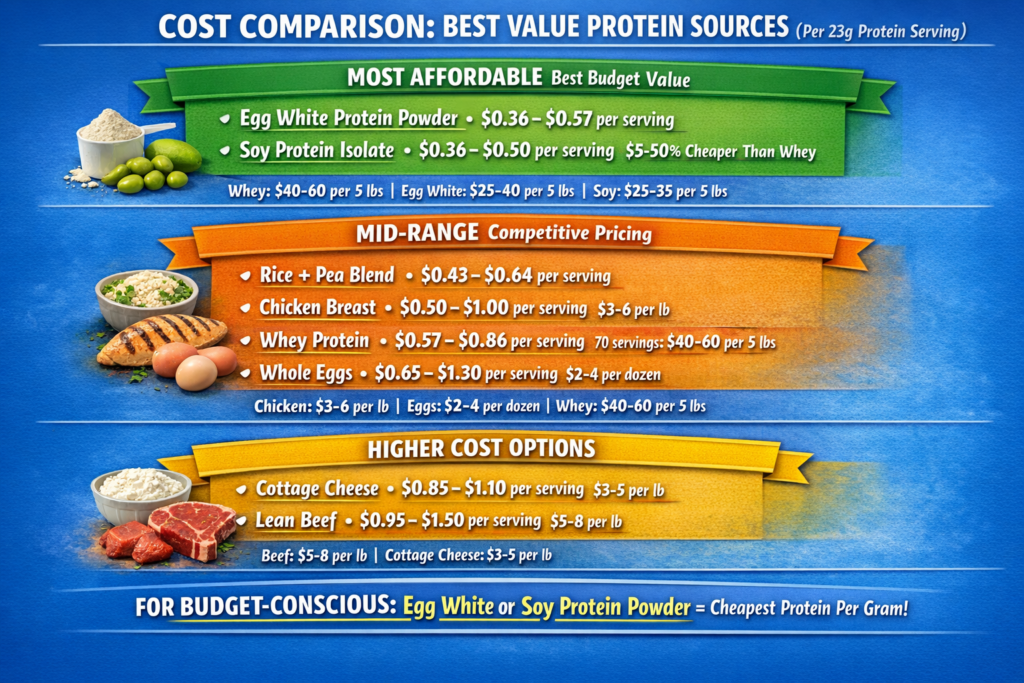
Price Per 23g Protein
Supplement options:
Whey protein:
- Cost: $40-60 per 5 pounds (70 servings)
- Per serving: $0.57-0.86
- Baseline for comparison
Egg white protein:
- Cost: $25-40 per 5 pounds (70 servings)
- Per serving: $0.36-0.57
- 30-40% cheaper than whey
Soy protein isolate:
- Cost: $25-35 per 5 pounds (70 servings)
- Per serving: $0.36-0.50
- 35-50% cheaper than whey
Rice + pea blend:
- Cost: $30-45 per 5 pounds (70 servings)
- Per serving: $0.43-0.64
- Similar or slightly cheaper than whey
Whole food options:
Chicken breast:
- Cost: $3-6 per pound
- 75g chicken = 23g protein
- Per serving: $0.50-1.00
- Similar to whey
Lean beef:
- Cost: $5-8 per pound
- 85g beef = 23g protein
- Per serving: $0.95-1.50
- 50-75% more expensive than whey
Whole eggs:
- Cost: $2-4 per dozen
- 4 eggs = 24g protein
- Per serving: $0.65-1.30
- Similar to slightly more than whey
Cottage cheese:
- Cost: $3-5 per pound (16oz)
- 200g cottage cheese = 24g protein
- Per serving: $0.85-1.10
- Similar to whey
Best Value Rankings
Most affordable to most expensive (per 23g protein):
- Egg white protein powder ($0.36-0.57)
- Soy protein isolate ($0.36-0.50)
- Rice + pea blend ($0.43-0.64)
- Chicken breast ($0.50-1.00)
- Whey protein ($0.57-0.86)
- Whole eggs ($0.65-1.30)
- Cottage cheese ($0.85-1.10)
- Lean beef ($0.95-1.50)
For budget-conscious: Egg white or soy protein powder offer best value.
Can You Get Same Results Without Whey?
The honest truth about protein source importance.
What Research Shows
Protein source matters less than you think:
Key studies:
- Comparisons of whey vs. soy vs. egg vs. casein
- No significant difference in muscle growth
- Equal strength gains
- Recovery equally supported
- As long as protein is complete and adequate
What matters most:
- Total daily protein intake (0.7-1g per pound)
- Complete amino acid profile
- Consistency over time
- Source is secondary
The Marketing Reality
Why whey is overhyped:
Supplement industry tactics:
- Whey heavily marketed
- Sponsored athletes promote it
- “Best protein” messaging everywhere
- Creates perception it’s mandatory
The truth:
- Whey is convenient and effective
- But NOT superior to other complete proteins
- Just one option among many
- Choose based on preference, cost, convenience
When Whey Actually Provides Advantage
Specific scenarios where whey is optimal:
Post-workout nutrition (questionable advantage):
- Fast digestion might help slightly
- But total daily protein matters more
- Advantage is marginal
- Not necessary for results
Convenience (real advantage):
- Fastest protein to prepare
- Most portable
- Longest shelf life
- This is whey’s main benefit
When cutting (moderate advantage):
- Very low calorie per gram protein
- Minimal carbs/fats
- Fits macros easily
- Helpful but not mandatory
The Bottom Line: Many Roads Lead to Muscle Growth
After examining all alternatives:
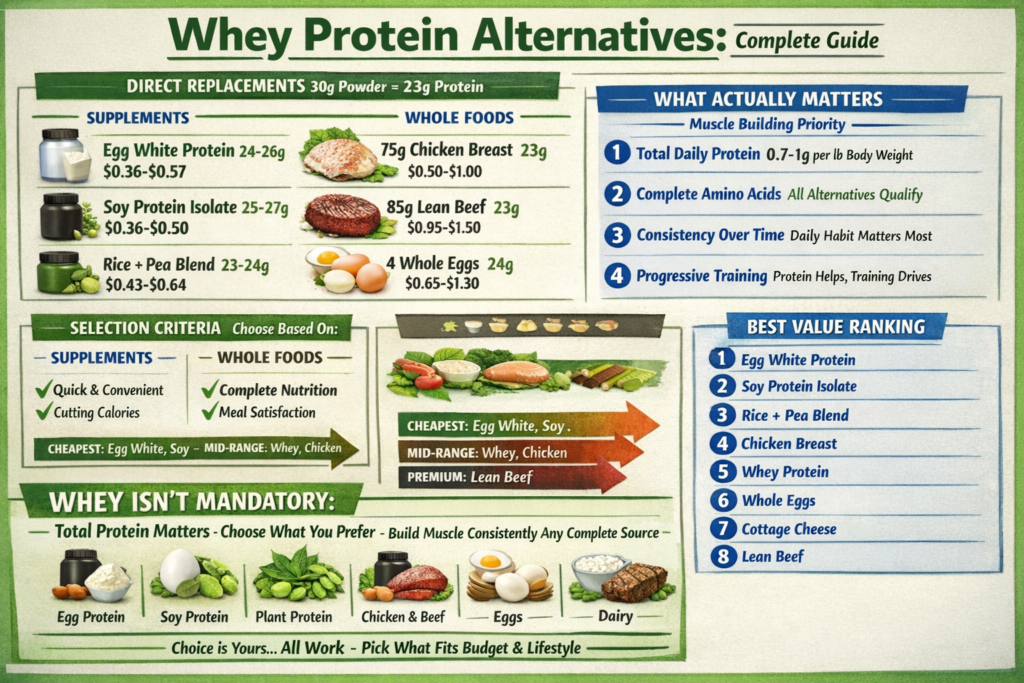
The truth about replacing whey protein:
✅ Many effective alternatives exist (supplements and whole foods)
✅ All complete proteins work equally well (when total intake adequate)
✅ Whey is not mandatory for muscle building (despite marketing claims)
✅ Choose based on preference, cost, convenience (not just effectiveness)
Direct whey replacements (30g powder = ~23g protein):
Supplement alternatives:
- 30g egg white protein (24-26g protein, $0.36-0.57)
- 30g soy protein isolate (25-27g protein, $0.36-0.50)
- 30g rice + pea blend (23-24g protein, $0.43-0.64)
Whole food alternatives:
- 75g chicken breast (23g protein, $0.50-1.00)
- 85g lean beef (23g protein, $0.95-1.50)
- 4 whole eggs (24g protein, $0.65-1.30)
- 200g cottage cheese (24g protein, $0.85-1.10)
Selection criteria:
Choose supplements when:
- Want convenience
- Need portability
- Prefer quick preparation
- Cutting (minimal calories)
Choose whole foods when:
- Want complete nutrition
- Prefer real food
- Can meal prep
- Value satiety
Choose based on cost:
- Cheapest: Egg white or soy protein powder
- Mid-range: Whey, chicken, rice + pea blend
- Premium: Beef (but provides extra nutrients)
What actually matters for muscle building:
Priority 1: Total daily protein (0.7-1g per pound body weight) Priority 2: Complete amino acid profile (all alternatives qualify) Priority 3: Consistency over time (eating protein every day) Priority 4: Progressive training (protein supports, doesn’t replace)
Whey’s rank: Convenience and familiarity, not superiority.
You can build equal muscle with:
- Egg protein powder
- Soy protein powder
- Plant protein blends
- Chicken and other lean meats
- Eggs
- Dairy products
The choice is yours. All work. Pick what fits your budget, preferences, and lifestyle.
WHEY ISN’T MANDATORY. TOTAL PROTEIN MATTERS. CHOOSE WHAT YOU PREFER. BUILD MUSCLE CONSISTENTLY.
Ready to build a complete, optimized nutrition plan that hits your protein targets with the most cost-effective sources, provides meal variety you’ll actually enjoy, and delivers maximum muscle-building results without dependency on expensive supplements? Knowing whey alternatives is just one piece. Get a comprehensive guide to calculating exact protein needs, building sustainable high-protein meal plans with whole foods and supplements, timing protein optimally, and achieving your physique goals without breaking the bank. Stop overpaying for protein. Start using smart, science-based nutrition strategies.
REFERENCES
SECTION 1 — Whey vs. soy protein: muscle growth and strength outcomes
[1] Messina M et al. — PubMed/International Journal of Sport Nutrition and Exercise Metabolism, 2018 Meta-analysis examining whey vs. soy protein supplementation during resistance exercise training; analysis of both protein sources in response to bench press and squat showed no significant difference in strength gains between groups; lean body mass increases were also statistically equivalent; the results confirm that soy protein supplementation produces similar gains in strength and lean mass to whey protein when training is the primary stimulus; directly supports the article’s claim of equivalence between soy and whey for muscle building https://pubmed.ncbi.nlm.nih.gov/29722584/
[2] Lynch HM et al. — PMC/Nutrients, 2020 Randomized 12-week trial comparing soy and whey supplements matched for leucine content in men and women performing resistance training; increases in isokinetic peak torque and strength were statistically comparable between soy and whey groups; when leucine content is equivalent, protein source did not produce significantly different training outcomes; supports the article’s argument that soy protein is an effective whey alternative when total intake and leucine content are matched https://pmc.ncbi.nlm.nih.gov/articles/PMC7312446/
SECTION 2 — Soy isoflavones and male hormones: debunking the estrogen concern
[3] Hamilton-Reeves JM et al. — PubMed/Fertility and Sterility, 2010 Meta-analysis of 15 placebo-controlled treatment groups examining effects of soy protein and isoflavone intake on testosterone, SHBG, free testosterone, and free androgen index in men; no significant effects on any hormonal outcome were detected regardless of statistical model; covers soy foods, isolated soy protein, and isoflavone extracts; foundational evidence directly refuting the common concern that soy protein raises estrogen or lowers testosterone in men https://pubmed.ncbi.nlm.nih.gov/19524224/
[4] Reed KE et al. — PubMed/Reproductive Toxicology, 2021 Updated and expanded meta-analysis with 41 studies, measuring total testosterone, free testosterone, estradiol, estrone, and SHBG in 1,753 men (testosterone) and 1,000 men (estradiol); no significant effects of soy protein or isoflavone intake on any measured hormonal outcome regardless of dose or study duration; subgroup analysis by isoflavone dose and study duration confirmed no effect; confirms the earlier meta-analysis findings with substantially more evidence https://pubmed.ncbi.nlm.nih.gov/33383165/
SECTION 3 — Egg protein quality, digestibility, and equivalence to whey
[5] Puglisi MJ & Fernandez ML — PMC/Nutrients, 2022 Review of egg protein nutritional value and health benefits; whole egg has a nitrogen protein utilization evaluation of 98%, comparable to whey and casein; biological value of egg protein rates between 88 and 100 — only whey and casein score higher; 20g of egg protein was sufficient to maximally stimulate muscle protein synthesis, consistent with studies showing 20g whey achieves the same; eggs are one of the most digestible protein sources at 97% (World Health Organization data), compared to 95% for dairy; directly validates the article’s characterization of egg protein as a high-quality whey alternative https://pmc.ncbi.nlm.nih.gov/articles/PMC9316657/
SECTION 4 — Plant protein amino acid profiles: rice + pea blend rationale
[6] Gorissen SHM et al. — PMC/Amino Acids, 2018 Comparative analysis of amino acid composition of 10 plant-based proteins (including pea and brown rice) against animal proteins and human skeletal muscle protein using UPLC-MS/MS; plant proteins show lower essential amino acid and leucine content individually; pea protein is deficient in methionine while brown rice protein is deficient in lysine; combining plant proteins to provide a more balanced essential amino acid profile (specifically complementing pea with rice) creates a higher-quality blend; directly provides the biochemical basis for the rice + pea 50/50 blend recommended in the article https://pmc.ncbi.nlm.nih.gov/articles/PMC6245118/
[7] Banaszek A et al. — PMC/Sports, 2019 Randomized double-blind pilot study comparing whey protein and pea protein supplementation during 8 weeks of HIFT (high-intensity functional training); both groups showed equivalent improvements in 1RM squat and deadlift strength; no group differences for body composition, muscle thickness, isometric force production, or WOD performance; pea and whey supplements were matched for leucine content (2.2g vs. 2.1g per dose); demonstrates that pea protein (a key component of the rice + pea blend) produces equivalent performance outcomes to whey when leucine content is controlled https://pmc.ncbi.nlm.nih.gov/articles/PMC6358922/



Leave a Reply
You must be logged in to post a comment.