Confused about which type of whey protein to buy? Here’s everything you need to know about the three main forms and which one is actually worth your money.
Walk into any supplement store and you’ll see dozens of whey protein options with wildly different prices.
Whey concentrate for $25. Whey isolate for $45. Whey hydrolysate for $70. All claiming to be the “best” for muscle building.
The price differences are massive, sometimes 2-3x between the cheapest and most expensive options. This leaves most people wondering: what’s the real difference? Is the expensive stuff actually better, or is it just marketing hype?
In this detailed guide, I’m going to break down the actual differences between whey concentrate, isolate, and hydrolysate. You’ll learn exactly what each type is, how they’re made, their pros and cons, and most importantly, which one you should actually buy based on your specific situation and goals.
No marketing BS. Just the scientific facts you need to make an informed decision.
Let’s cut through the confusion.
TABLE OF CONTENTS
Understanding Whey Protein: The Foundation
Before we compare the three types, you need to understand what whey protein actually is and where it comes from.
What Is Whey Protein?
When milk is processed to make foods like cheese and yogurt, it separates into two components:
1. Curds (solid parts): Used to make cheese, contains mostly casein protein
2. Whey (liquid part): The watery byproduct, contains whey protein
That liquid whey is what becomes whey protein powder after processing.
In raw milk, the protein composition is:
- 20% whey protein (fast-digesting)
- 80% casein protein (slow-digesting)
Both are high-quality proteins containing all essential amino acids needed for muscle growth, but whey gained popularity specifically because of its rapid absorption rate, making it particularly useful around training.
The Three Main Types: A Quick Overview
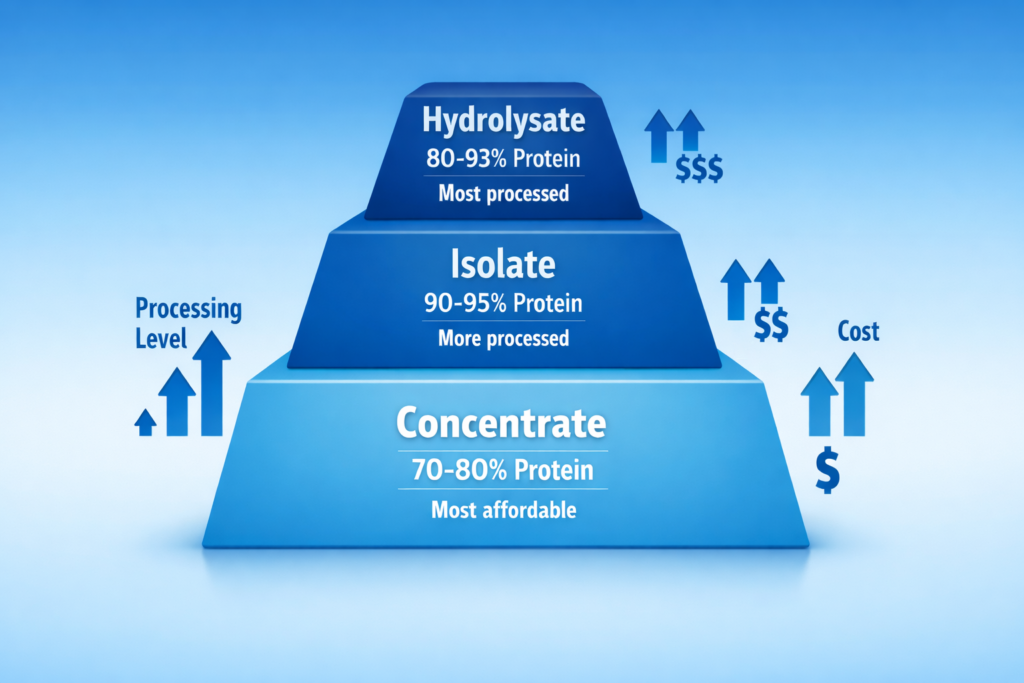
All three types start from the same source (liquid whey from milk), but they undergo different processing methods that affect:
- Protein concentration
- Lactose content
- Fat content
- Digestion speed
- Price
- Taste
Here’s the hierarchy:
Whey Concentrate (WPC): Least processed, most affordable
Whey Isolate (WPI): More processed, higher protein, more expensive
Whey Hydrolysate (WPH): Most processed, fastest absorption, most expensive
Let’s examine each in detail.
Whey Protein Concentrate: The Budget-Friendly Standard
Whey concentrate is the most basic and common form of whey protein on the market.
How It’s Made
After the liquid whey is collected, it goes through a filtration process to remove water and some impurities. This increases protein concentration while retaining some carbohydrates (lactose) and fats.
The result: A product that’s 70-80% protein by weight, with the remaining 20-30% being carbs and fats.
Nutritional Profile (Typical Per 30g Scoop)
Protein: 20-24 grams (70-80% of total weight)
Carbohydrates: 3-5 grams (mostly lactose)
Fats: 1-3 grams
Lactose: 3-4 grams
Calories: 120-140
Absorption time: 90-120 minutes
Advantages of Whey Concentrate
1. Most affordable option
Concentrate is significantly cheaper than isolate or hydrolysate, sometimes costing 30-50% less per serving.
Cost comparison example:
- Concentrate: $0.50-0.70 per 25g protein
- Isolate: $0.80-1.20 per 25g protein
- Hydrolysate: $1.20-1.80 per 25g protein
2. Retains beneficial compounds
The less aggressive processing preserves more of milk’s naturally occurring beneficial compounds:
- Immunoglobulins (support immune function)
- Lactoferrin (antimicrobial properties)
- Beta-lactoglobulin
- Growth factors
3. Better taste and texture
The small amounts of fat and lactose actually improve flavor and create a creamier texture. Most people find concentrate tastes better than isolate.
4. Excellent value for most people
Unless you have specific needs (lactose intolerance, extreme calorie restriction), concentrate provides all the benefits you need at the best price.
Disadvantages of Whey Concentrate
1. Lower protein percentage
You get slightly less protein per scoop compared to isolate (20-24g vs 25-30g).
2. More calories from carbs and fats
The additional lactose and fat add 20-40 extra calories per serving compared to isolate.
3. Contains more lactose
May cause digestive issues for people with lactose intolerance (though many tolerate the amounts fine).
4. Slightly slower absorption
Takes about 90-120 minutes to fully absorb compared to isolate’s 60-90 minutes (though this difference is minor and largely irrelevant).
Who Should Use Whey Concentrate?
Best for:
- People who tolerate dairy well
- Anyone wanting the best value for money
- Those not severely restricting calories
- Beginners to intermediate lifters
- People who prefer better-tasting protein
- Anyone on a budget
Not ideal for:
- Severe lactose intolerance
- Very aggressive calorie restriction
- People willing to pay significantly more for marginal benefits
Bottom line: Whey concentrate is the smart choice for 80-90% of people. It’s effective, affordable, and tastes good.
Whey Protein Isolate: The Premium Option
Whey isolate undergoes additional processing to increase protein concentration and remove more lactose and fat.
How It’s Made
Isolate uses more advanced filtration techniques (microfiltration or ion exchange) that remove almost all non-protein components from the whey.
The result: A product that’s 90-95% protein by weight, with minimal carbs and fats.
Nutritional Profile (Typical Per 30g Scoop)
Protein: 25-28 grams (90-95% of total weight)
Carbohydrates: <1 gram (very low lactose)
Fats: <1 gram
Lactose: <1 gram
Calories: 100-120
Absorption time: 60-90 minutes
Advantages of Whey Isolate
1. Higher protein concentration
You get more protein per scoop and per dollar spent (though total cost is still higher).
Example:
- 30g scoop concentrate: 22g protein (73% protein)
- 30g scoop isolate: 27g protein (90% protein)
2. Lower in lactose
Contains less than 1g lactose per serving, making it suitable for most people with lactose sensitivity (though not necessarily severe intolerance).
3. Fewer calories
The near-absence of carbs and fats means 20-40 fewer calories per serving, which adds up if you’re having 2-3 shakes daily.
Over time:
- 2 shakes daily = 40-80 fewer calories daily
- Over a week = 280-560 fewer calories
- This can matter during aggressive fat loss phases
4. Faster absorption
Digests slightly faster than concentrate (60-90 minutes vs 90-120 minutes). This is a minor advantage but exists nonetheless.
5. Cleaner ingredient profile
Fewer components mean there’s less chance of digestive issues or allergic reactions for sensitive individuals.
Disadvantages of Whey Isolate
1. Significantly more expensive
Typically costs 30-50% more than concentrate for only 10-20% more protein per serving.
Is it worth it? For most people, no. The extra protein can be achieved by simply using slightly more concentrate for less total cost.
2. Loses some beneficial compounds
The aggressive filtration removes not just lactose and fat, but also some of the naturally occurring immune-supporting compounds found in concentrate.
3. Often tastes blander
Without the small amounts of fat and lactose, isolate can taste thinner and less creamy. Many people prefer concentrate’s flavor.
4. Minimal practical advantage
Research shows no significant difference in muscle growth between concentrate and isolate when total daily protein is equated.
Who Should Use Whey Isolate?
Best for:
- People with lactose sensitivity (but not severe intolerance)
- Those in aggressive calorie deficits who need maximum protein with minimum calories
- Competitive athletes who need every slight advantage
- People willing to pay premium for slightly higher protein concentration
- Those who’ve tried concentrate and experienced digestive issues
Not necessary for:
- Most recreational lifters
- People who tolerate dairy well
- Anyone on a budget
- Those who can hit protein targets with concentrate
Bottom line: Whey isolate is a premium product with marginal practical advantages over concentrate for most people. It’s better, but not 30-50% better despite the price difference.
Whey Protein Hydrolysate: The Fastest (And Most Expensive)
Whey hydrolysate is the most processed and expensive form of whey protein available.
How It’s Made
Hydrolysate starts as either concentrate or isolate, then undergoes an additional process called hydrolysis (or pre-digestion).
The hydrolysis process: Enzymes or acids break down the protein chains into smaller peptides and amino acids. This “pre-digests” the protein, making it extremely fast to absorb.
Think of it like this: Your body normally has to break down whole proteins into smaller parts before absorption. Hydrolysate has this work already done, so it enters your bloodstream faster.
Nutritional Profile (Typical Per 30g Scoop)
Protein: 24-28 grams (80-93% of total weight)
Carbohydrates: <1 gram
Fats: <1 gram
Lactose: Trace amounts (almost none)
Calories: 100-120
Absorption time: 30-60 minutes (fastest of all three types)
Advantages of Whey Hydrolysate
1. Fastest absorption rate
Hydrolysate is absorbed significantly faster than concentrate or isolate, with amino acids entering the bloodstream in 30-60 minutes.
Does this matter? Only in very specific circumstances (more on this later).
2. Easiest on digestion
Because the protein is pre-broken down, it requires less digestive work. This can help people with:
- Sensitive stomachs
- Digestive issues with other whey forms
- Post-surgery recovery needs
3. Lowest allergenic potential
The hydrolysis process breaks down the protein structures that typically cause allergic reactions. This makes hydrolysate less likely to trigger dairy allergies (though not guaranteed).
4. Virtually lactose-free
Contains trace amounts of lactose, making it suitable even for people with more severe lactose intolerance.
5. May reduce muscle damage markers
Some research suggests hydrolysate may help reduce exercise-induced muscle damage and improve recovery markers. However, these effects are modest and don’t necessarily translate to better muscle growth.
Disadvantages of Whey Hydrolysate
1. Extremely expensive
Typically costs 50-100% more than concentrate and 30-60% more than isolate.
Price reality check:
- Concentrate: $25-35 per 2 lbs
- Isolate: $40-55 per 2 lbs
- Hydrolysate: $60-90 per 2 lbs
2. Often tastes bitter
The hydrolysis process creates bitter peptides. Companies try to mask this with sweeteners and flavors, but hydrolysate rarely tastes as good as concentrate or isolate.
3. No significant muscle-building advantage
Despite being the most expensive, research shows hydrolysate doesn’t build more muscle than concentrate or isolate when total daily protein is matched.
The key study: Research directly comparing all three types found no significant difference in muscle growth, strength gains, or body composition changes.
What you’re paying extra for: Faster absorption and easier digestion, not superior muscle-building effects.
4. Unnecessary for most people
Unless you have specific digestive issues or timing requirements, you’re paying a massive premium for minimal practical benefit.
Who Should Use Whey Hydrolysate?
Best for:
- People with severe digestive issues who can’t tolerate concentrate or isolate
- Those with diagnosed dairy allergies (but not lactose intolerance alone)
- Elite athletes with multiple training sessions daily requiring rapid nutrient delivery
- People with medical conditions requiring easy-to-digest protein
- Those with money to burn who want every minor advantage
Not necessary for:
- 95% of recreational lifters
- Anyone on a budget
- People who tolerate concentrate or isolate fine
- Those focused on best value for results
Bottom line: Whey hydrolysate is the most expensive and fastest-absorbing option, but it provides no superior muscle-building benefits for most people. Only consider it if you have specific digestive issues or very particular timing needs.
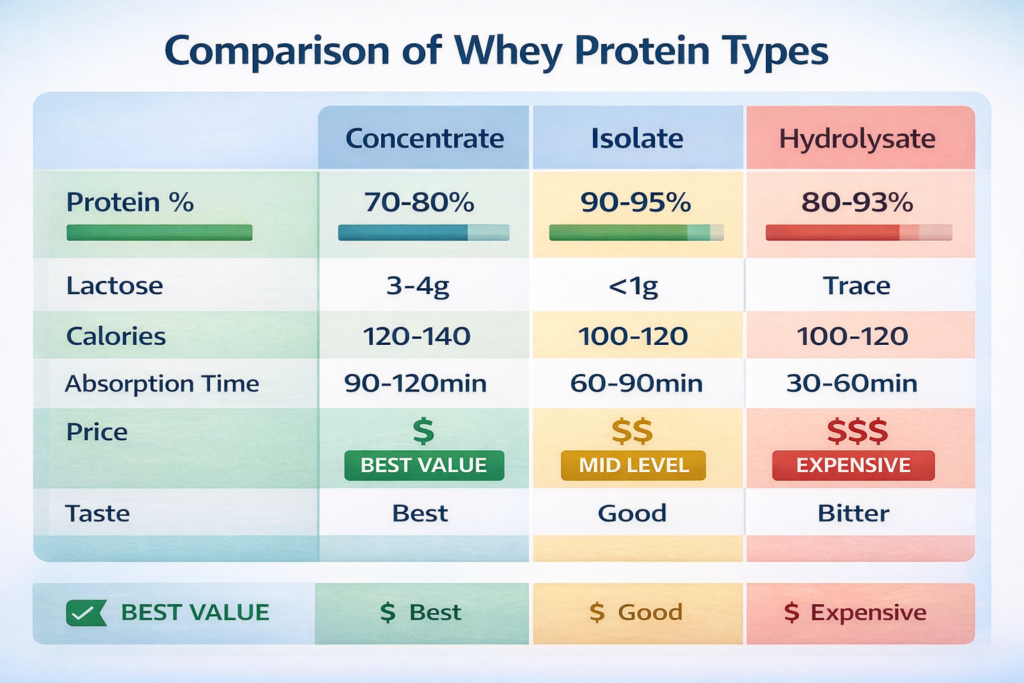
Head-to-Head Comparison: Which Is Best?
Let’s compare all three types across the factors that actually matter.
Protein Content Per Serving
Winner: Isolate
- Concentrate: 20-24g (70-80% protein)
- Isolate: 25-28g (90-95% protein)
- Hydrolysate: 24-28g (80-93% protein)
However: This difference is easily overcome by using slightly more concentrate, which still costs less total.
Calorie Content
Winner: Tie between Isolate and Hydrolysate
- Concentrate: 120-140 calories
- Isolate: 100-120 calories
- Hydrolysate: 100-120 calories
Matters if: You’re in an aggressive calorie deficit. Otherwise, the 20-40 calorie difference is negligible.
Lactose Content
Winner: Hydrolysate
- Concentrate: 3-4g (may cause issues for intolerant individuals)
- Isolate: <1g (tolerable for most with mild intolerance)
- Hydrolysate: Trace amounts (best for severe intolerance)
Matters if: You have lactose intolerance. Severity determines which type you need.
Absorption Speed
Winner: Hydrolysate
- Concentrate: 90-120 minutes
- Isolate: 60-90 minutes
- Hydrolysate: 30-60 minutes
Matters if: Rarely. The anabolic window is much wider than previously thought (24-48 hours). Total daily protein matters far more than absorption speed.
Taste and Mixability
Winner: Concentrate
- Concentrate: Best taste, creamiest texture
- Isolate: Thinner, blander flavor
- Hydrolysate: Often bitter, hardest to flavor
Matters because: If it tastes bad, you won’t drink it consistently. Adherence trumps minor advantages.
Cost Per Gram of Protein
Winner: Concentrate (by far)
- Concentrate: $0.50-0.70 per 25g protein
- Isolate: $0.80-1.20 per 25g protein
- Hydrolysate: $1.20-1.80 per 25g protein
Matters because: Most people are on a budget. Concentrate provides the best value by a significant margin.
Muscle Building Effectiveness
Winner: TIE (all three are equal)
Research directly comparing all three types shows no significant difference in:
- Muscle growth
- Strength gains
- Body composition changes
- Recovery rates
When total daily protein is matched, the type of whey makes no measurable difference in results.
This is the most important finding: you’re not getting better muscle-building effects by paying more for isolate or hydrolysate.
Overall Winner for Most People: Whey Concentrate
Unless you have specific needs (lactose intolerance, extreme calorie restriction), concentrate provides the best balance of:
- Effectiveness (equal to other types)
- Cost (significantly cheaper)
- Taste (generally best)
- Beneficial compounds (retains more)
Common Myths About Whey Types
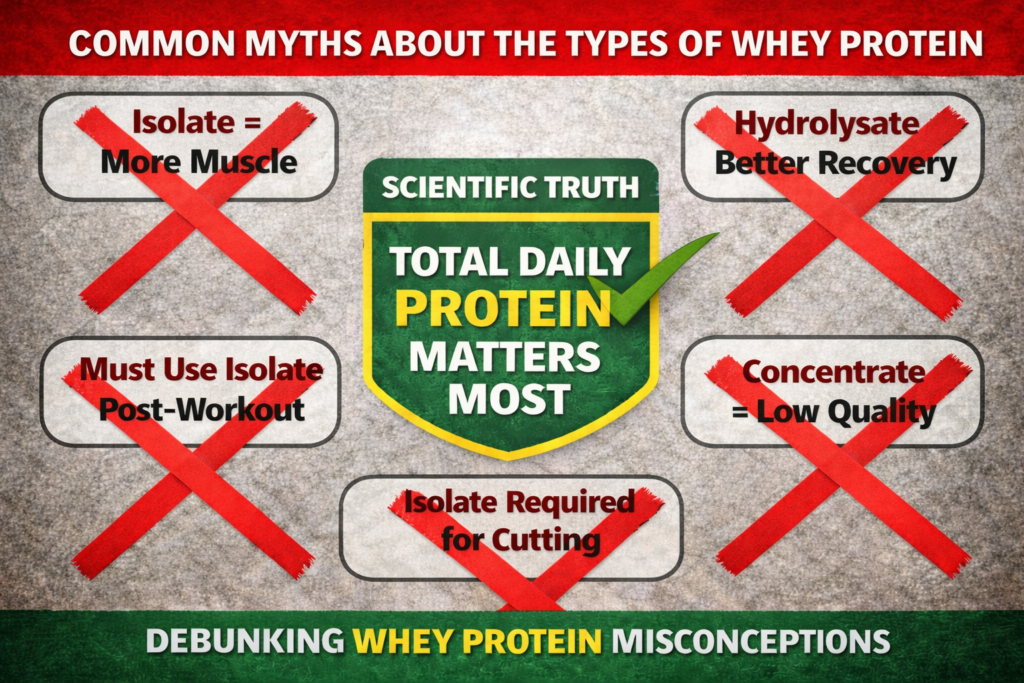
Let’s debunk the marketing nonsense you’ll hear.
Myth 1: “Isolate Builds More Muscle Than Concentrate”
The claim: The higher protein percentage and faster absorption of isolate leads to superior muscle growth.
The science: False. Multiple studies comparing concentrate and isolate found no significant difference in muscle or strength gains when total daily protein is equated.
Example study: 192 resistance-trained individuals using concentrate vs isolate for 10 weeks showed identical improvements in muscle mass and strength.
The truth: Total daily protein matters. The source is virtually irrelevant as long as it’s a complete protein.
Myth 2: “Hydrolysate Is Worth the Extra Cost for Better Recovery”
The claim: Hydrolysate’s rapid absorption dramatically improves recovery and reduces muscle soreness.
The science: Modest effects at best. Some studies show minor reductions in muscle damage markers, but these don’t translate to meaningfully better recovery or muscle growth.
The truth: Proper training, adequate total protein, sufficient sleep, and smart programming affect recovery far more than protein type. Save your money.
Myth 3: “You Must Use Isolate or Hydrolysate Post-Workout”
The claim: You need the fastest-absorbing protein immediately post-workout or you’ll lose gains.
The science: The “anabolic window” is much wider than the 30-60 minute window marketed by supplement companies. Your body remains sensitive to protein for 24-48 hours post-training.
The truth: As long as you consume adequate protein within a few hours of training, the specific type makes minimal difference. Concentrate works just fine.
Myth 4: “Concentrate Is Low Quality”
The claim: Concentrate is inferior because it’s less processed and contains “impurities.”
The science: False. Concentrate is high-quality protein that happens to retain more of milk’s naturally beneficial compounds. Less processing isn’t worse; it’s just different.
The truth: Concentrate is perfectly effective. The lactose and fat aren’t “impurities”; they’re normal milk components that many people tolerate fine.
Myth 5: “Isolate Is Always Better for Cutting”
The claim: You must use isolate when cutting because the extra calories in concentrate will ruin your diet.
The science: The 20-40 calorie difference per serving is minimal in the context of a total daily diet.
The math:
- 2 shakes daily = 40-80 extra calories with concentrate
- This equals one small apple or 10-15 almonds
- Easily adjusted by slightly reducing other foods
The truth: Concentrate is fine for cutting. Just account for the calories. The money saved can buy more high-quality whole foods.
How to Choose the Right Whey for Your Situation
Use this decision tree to determine which type makes sense for you.
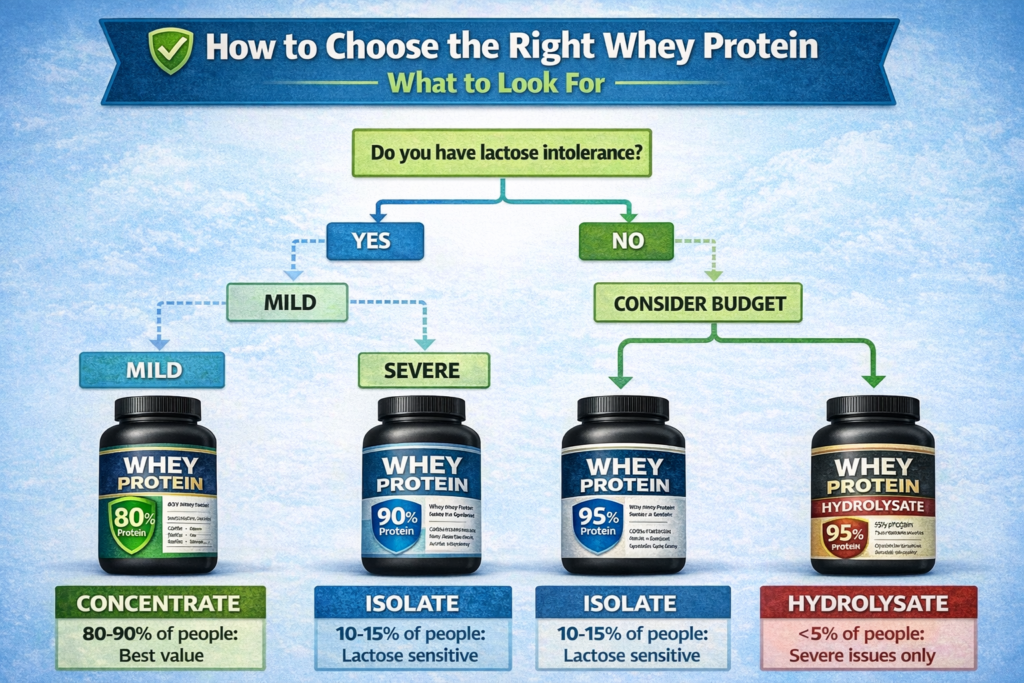
Choose Whey Concentrate If:
✅ You tolerate dairy products well
✅ You want the best value for money
✅ You’re not severely restricting calories
✅ You prefer better-tasting protein
✅ You’re on any kind of budget
✅ You want to retain beneficial milk compounds
This applies to 80-90% of people reading this.
Choose Whey Isolate If:
✅ You have mild to moderate lactose intolerance and concentrate causes issues
✅ You’re in an aggressive calorie deficit and every calorie matters
✅ You want maximum protein per scoop
✅ You’re willing to pay 30-50% more for 10-20% more protein per serving
✅ You’ve tried concentrate and experienced digestive problems
This applies to 10-15% of people.
Choose Whey Hydrolysate If:
✅ You have severe digestive issues with both concentrate and isolate
✅ You have diagnosed dairy allergies (not just lactose intolerance)
✅ You’re an elite athlete with multiple daily training sessions
✅ You have money to spare and want every minor advantage
✅ You have medical conditions requiring extremely easy-to-digest protein
This applies to <5% of people.
Special Circumstances
For lactose intolerance:
- Mild: Try concentrate first; many tolerate it fine
- Moderate: Go with isolate
- Severe: Consider hydrolysate or plant-based alternatives
For fat loss:
- Concentrate is fine; just track the calories
- Isolate makes calorie budgeting slightly easier but isn’t necessary
- Hydrolysate is overkill
For muscle gain:
- All three are equally effective
- Choose based on budget and taste preference
- Concentrate provides best value
For sensitive digestion:
- Start with concentrate
- If issues persist, try isolate
- Only consider hydrolysate if both others cause problems
The Practical Reality: What I Recommend
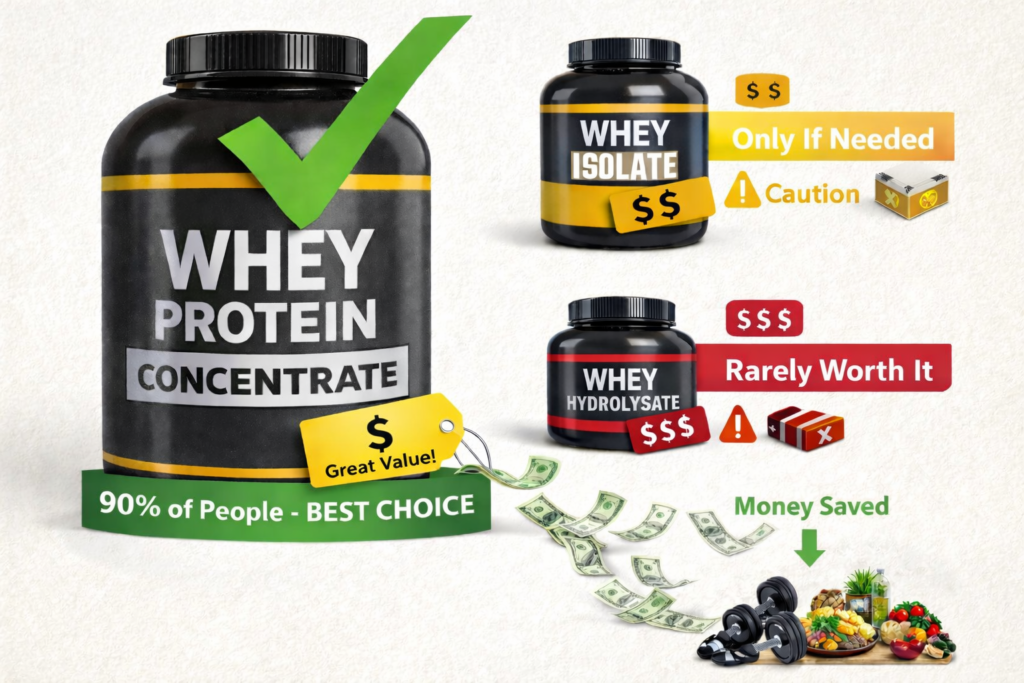
After analyzing the research, comparing costs, and considering real-world application, here’s my straightforward advice:
For 90% of people: Buy whey concentrate
It’s effective, affordable, tastes good, and builds just as much muscle as the expensive options.
The only exceptions:
If concentrate genuinely causes digestive issues, try isolate.
If you have severe lactose intolerance and isolate still causes problems, consider hydrolysate or plant-based alternatives.
Don’t fall for marketing hype claiming you “need” expensive isolate or hydrolysate for optimal results. The research doesn’t support it.
Spend the money you save on:
- More high-quality whole foods
- Better gym equipment
- Professional coaching
- Things that actually move the needle
My Buying Strategy
Primary protein: Whey concentrate
- Use for most daily shakes (post-workout, between meals)
- Best value for consistent protein intake
Optional isolate: Only if needed
- Keep on hand if I develop temporary digestive sensitivity
- Use during extremely aggressive cuts when every calorie matters
- Still not essential; just a tool
Never hydrolysate: Not worth the premium
- No practical advantage for my needs
- Would rather invest money elsewhere
How to Maximize Results Regardless of Type
Remember: the type of whey matters far less than these factors.
Priority 1: Total Daily Protein
Target: 0.7-1.0 grams per pound of body weight
Example: 180-pound person needs 126-180 grams daily
This matters infinitely more than whether you use concentrate, isolate, or hydrolysate.
Priority 2: Consistent Training
Progressive resistance training with proper programming builds muscle. Protein powder supports this process but doesn’t replace it.
Without training, protein type is irrelevant.
Priority 3: Adequate Calories
For muscle gain: Slight caloric surplus (200-400 above maintenance)
For fat loss: Moderate deficit (300-500 below maintenance)
Protein type can’t compensate for wrong calorie intake.
Priority 4: Quality Sleep
7-9 hours nightly. Sleep is when muscle growth actually occurs.
No protein powder fixes inadequate sleep.
Priority 5: Whole Food Foundation
Use protein powder to supplement a diet based primarily on whole foods, not replace meals.
Aim for 50-70% of protein from whole foods:
- Chicken, beef, fish
- Eggs and dairy
- Legumes and whole grains
Use whey for 30-50% of protein:
- Post-workout convenience
- Between-meal snacks
- When whole food isn’t practical
Priority 6: Long-Term Consistency
The most expensive protein powder used inconsistently produces worse results than cheap concentrate used daily for months.
Adherence beats optimization every single time.
The Bottom Line: Skip the Hype, Buy Smart
After cutting through all the marketing and examining the actual science, here’s the truth:
All three types of whey protein are effective for building muscle, supporting recovery, and meeting daily protein needs.
The differences are real but largely irrelevant for most people:
Concentrate: Slightly more lactose and calories, but significantly cheaper and equally effective.
Isolate: Slightly higher protein and lower lactose, but much more expensive for marginal benefits.
Hydrolysate: Fastest absorption and easiest digestion, but extremely expensive with no muscle-building advantage.
What actually matters:
- Hitting your total daily protein target consistently
- Training hard with progressive overload
- Eating appropriate calories for your goal
- Sleeping adequately
- Staying consistent for months
The smart approach:
✅ Start with whey concentrate (best value)
✅ Track your total daily protein intake
✅ Use whey to fill convenient gaps, not replace meals
✅ Only upgrade to isolate if you develop specific needs
✅ Skip hydrolysate unless you have rare digestive requirements
✅ Spend saved money on quality whole foods and better training
Don’t let supplement companies convince you that you need expensive forms to get results.
The research is clear: when total daily protein is matched, concentrate builds just as much muscle as isolate or hydrolysate.
Save your money. Train hard. Eat enough protein. Be consistent.
That’s what actually builds muscle. Not the fancy label on your protein powder.
MAKE INFORMED CHOICES. STOP OVERPAYING FOR MARKETING. BUILD REAL MUSCLE.
Ready to maximize muscle growth with an evidence-based approach that actually works? Stop worrying about minor supplement details and get a complete training and nutrition system that shows you exactly what matters, what doesn’t, and how to build serious muscle efficiently. Whey protein is a useful tool, but it’s just one small piece. Get the complete blueprint and start making real progress today.


Leave a Reply
You must be logged in to post a comment.