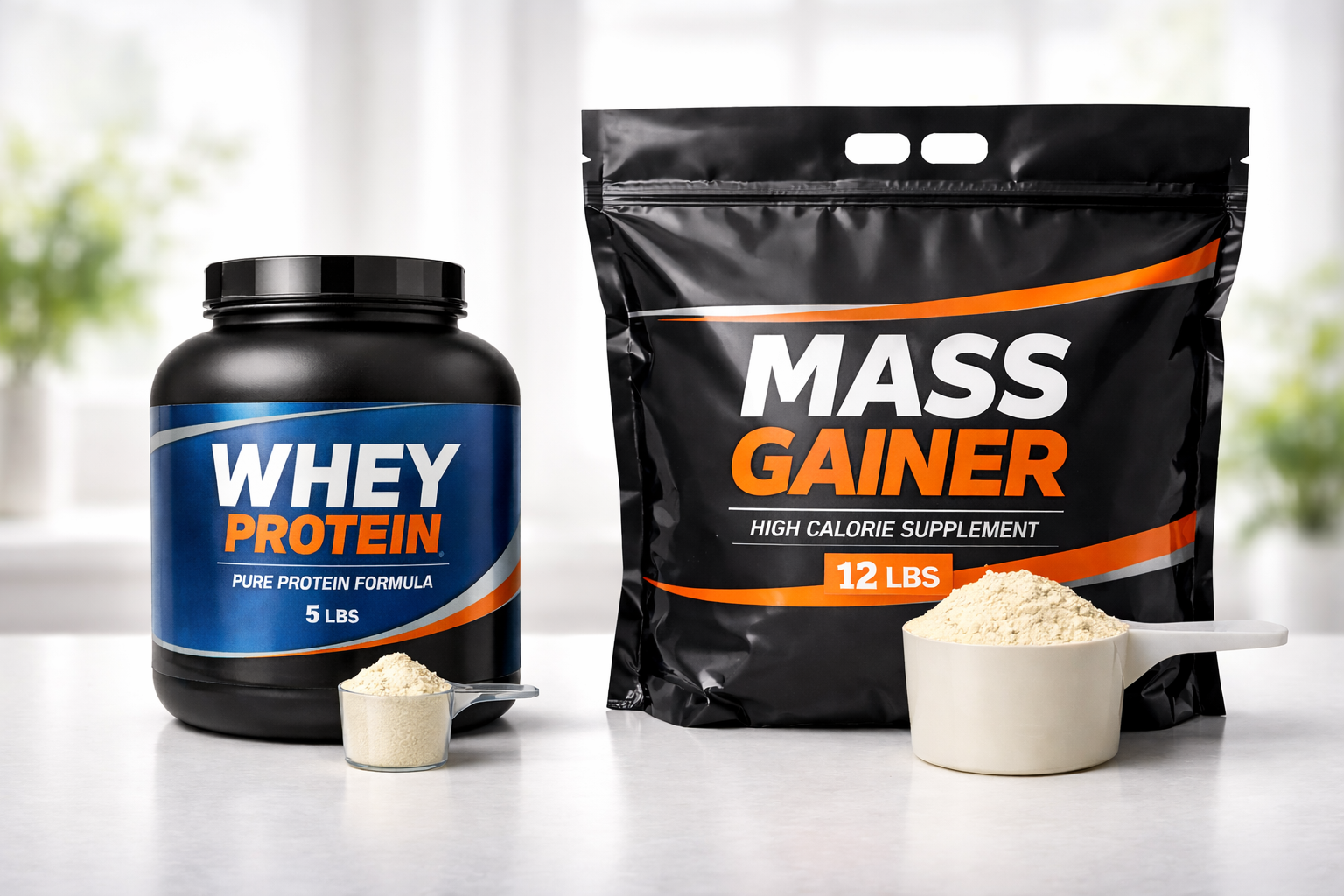
Confused about whether to buy whey protein or a mass gainer for muscle building? Here’s the truth about which one you actually need.
You’re standing in the supplement aisle (or browsing online) trying to decide between two options.
Whey protein: Clean, simple, mostly just protein.
Mass gainer: Massive serving sizes, 1,000+ calories, promises of rapid muscle growth.
Which one should you buy?
The salesperson says mass gainers are better for “serious muscle gain.” The bodybuilding forums are split. Your gym buddy swears by one while another recommends the opposite.
So what’s actually right for you?
Here’s the truth: The choice between whey protein and mass gainer depends entirely on whether you can eat enough calories from whole food. If you get adequate calories but lack protein, choose whey. If you struggle to eat enough despite trying, a mass gainer might help. For most people, whey protein is the smarter choice.
In this comprehensive guide, I’ll explain exactly what each supplement provides, compare them across every factor that matters, reveal who actually benefits from each option, break down the cost analysis, show you when combining both makes sense, and help you make the right decision for your specific goals.
Whether you’re bulking for the first time or reconsidering your current supplement stack, this article will end the confusion.
Let’s make the smart choice.
TABLE OF CONTENTS
What Is Whey Protein and What Does It Do?
Before comparing, you need to understand what whey protein actually provides.
The Basic Definition
Whey protein is a high-quality protein powder derived from milk during the cheese-making process.
What it contains (per 30g scoop):
- Protein: 24-25g
- Carbohydrates: 1-3g
- Fat: 1-3g
- Calories: 110-130
Types of whey:
- Whey concentrate (80% protein, some lactose and fat)
- Whey isolate (90%+ protein, minimal lactose)
- Whey hydrolysate (pre-digested for faster absorption)
It’s essentially pure protein with minimal other macronutrients.
How Whey Protein Works
Whey provides the building blocks (amino acids) your muscles need to grow.
Key benefits:
Complete amino acid profile:
- Contains all nine essential amino acids
- Especially high in leucine (2.5-3g per serving)
- Leucine triggers muscle protein synthesis via mTOR pathway
Fast absorption:
- Digests quickly (1-2 hours)
- Amino acids available rapidly
- Ideal for post-workout when muscles need nutrients
High biological value:
- Approximately 104 BV (higher than any whole food)
- Your body uses nearly all the protein you consume
- Minimal waste
Versatile usage:
- Mix with water or milk
- Blend into smoothies
- Add to recipes (pancakes, oatmeal, baked goods)
Who Whey Protein Is Designed For
Whey protein serves people who:
Need more protein:
- Struggling to eat 0.7-1g protein per pound of body weight
- Find it difficult to consume enough meat, eggs, dairy
- Want convenient protein between meals
Want convenience:
- Busy schedule prevents regular meals
- Need portable nutrition
- Prefer liquid nutrition sometimes
Can afford targeted supplementation:
- Don’t need massive calories
- Just need high-quality protein
- Want cost-effective protein source
Train for muscle building:
- Bodybuilders and physique athletes
- Anyone doing resistance training
- People optimizing protein for muscle growth
What Is a Mass Gainer and What Does It Do?
Now let’s examine the alternative option.
The Basic Definition
A mass gainer (weight gainer or hypercaloric supplement) is a high-calorie powder designed to help people gain weight.
What it contains (per serving, varies widely):
- Protein: 20-60g
- Carbohydrates: 75-250g
- Fat: 5-20g
- Calories: 400-1,250+
Primary ingredients:
- Protein blend (whey, casein, sometimes soy)
- Carbohydrate sources (maltodextrin, oats, etc.)
- Sometimes fats (MCT oil, etc.)
- Often vitamins and minerals
It’s designed to provide massive calories quickly and easily.
How Mass Gainers Work
Mass gainers create a caloric surplus to support muscle and weight gain.
The theory:
Building muscle requires:
- Adequate protein (whey provides this)
- Caloric surplus (mass gainer provides this)
- Progressive training (you provide this)
Mass gainer provides:
- 600-1,250 calories per shake
- Easier to drink than eat equivalent solid food
- All macros in one convenient drink
The pitch: If you can’t eat enough to grow, drink your calories instead.
Who Mass Gainers Are Designed For
Mass gainers target people who:
Cannot eat enough food:
- Hardgainers with small appetites
- Very high metabolism
- Struggle to consume 3,500+ calories from solid food
Need extreme calories:
- Bulking and need massive surplus
- Athletes burning 4,000-5,000+ calories daily
- Recovering from illness or injury
Want convenience:
- Busy schedule prevents frequent large meals
- Prefer liquid calories
- Don’t enjoy eating large amounts
Have specific body types:
- Ectomorphs (naturally very lean, struggle to gain weight)
- People under 10% body fat who can’t gain weight
- Those who’ve tried everything and still can’t bulk
Whey Protein vs Mass Gainer: Direct Comparison
Let’s compare these supplements across every relevant factor.
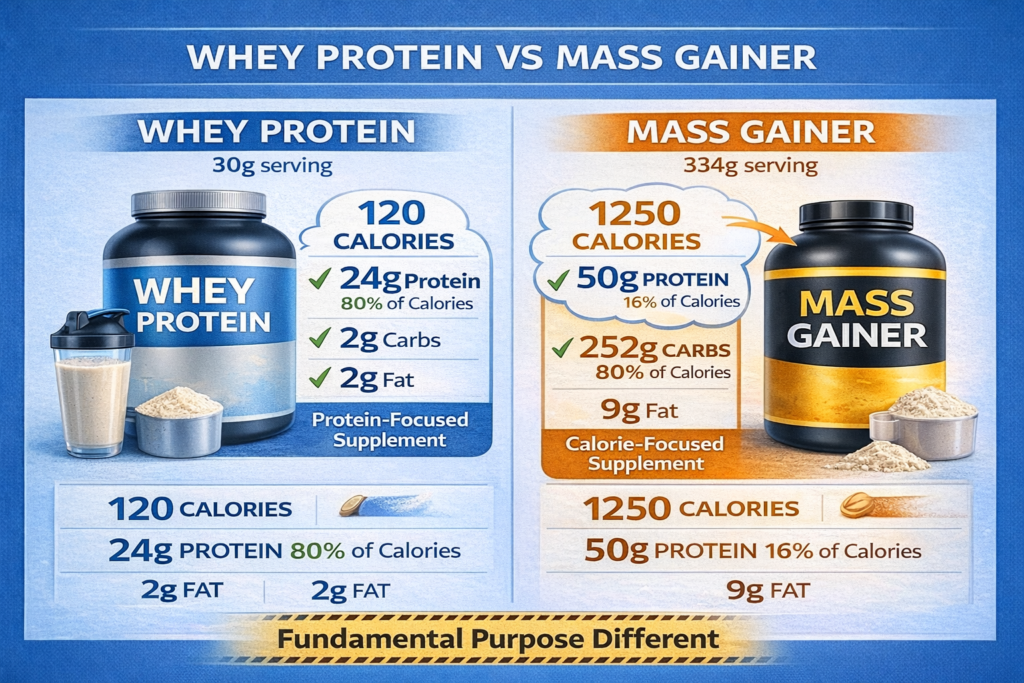
Comparison 1: Nutritional Composition
Whey protein (30g serving):
- Calories: 120
- Protein: 24g (80% of calories)
- Carbs: 2g (7% of calories)
- Fat: 2g (15% of calories)
Mass gainer (typical product, 334g serving):
- Calories: 1,250
- Protein: 50g (16% of calories)
- Carbs: 252g (80% of calories)
- Fat: 9g (6% of calories)
Key differences:
Whey is protein-focused:
- Provides protein with minimal extra calories
- Lets you control other macros through food
- Targeted supplementation
Mass gainer is calorie-focused:
- Provides massive calories (mostly from carbs)
- All-in-one macro delivery
- Less control over individual macros
Which is better? Depends on your needs. Need protein? Whey. Need calories? Mass gainer.
Comparison 2: Primary Purpose
Whey protein:
- Goal: Fill protein gaps in your diet
- Solves: Not eating enough protein
- Use case: You eat 2,500 calories easily but only get 100g protein (need 150g)
Mass gainer:
- Goal: Create caloric surplus
- Solves: Cannot eat enough total calories
- Use case: You need 3,500 calories but can only eat 2,800 from solid food
The fundamental difference: Whey adds protein. Mass gainer adds calories.
Comparison 3: Ingredient Quality
Whey protein:
Typical ingredients:
- Whey protein concentrate or isolate
- Natural or artificial flavors
- Sweeteners
- Minimal additives
Quality range:
- High-end: Grass-fed whey, natural flavors, stevia
- Mid-range: Standard whey, acceptable ingredients
- Low-end: Protein spiking, excessive fillers
Generally: Easier to find quality whey protein at reasonable price.
Mass gainer:
Typical ingredients:
- Protein blend (often includes cheap soy protein)
- Maltodextrin (processed corn starch)
- Dextrose or other simple sugars
- Thickeners, flavors, sweeteners
- Sometimes vitamins/minerals
Quality range:
- High-end: Oat flour, quality protein, real food ingredients
- Mid-range: Mix of quality and cheap ingredients
- Low-end: Mostly maltodextrin and minimal protein
Generally: Harder to find quality mass gainers. Many use cheap ingredients to maximize calories at low cost.
Comparison 4: Cost Per Serving
Let’s examine real costs:
Whey protein:
- 5-pound tub: $50-70
- Servings: 70-75
- Cost per serving: $0.70-1.00
- Protein per dollar: ~25g protein per $1
Mass gainer:
- 12-pound bag: $45-80
- Servings: 16-24
- Cost per serving: $2.50-4.00
- Protein per dollar: ~12-15g protein per $1
Cost per 1,000 calories:
- Whey: Not applicable (only 120 cal per serving)
- Mass gainer: $2.00-3.50
Cost per 50g protein:
- Whey: $1.50-2.00 (2 servings)
- Mass gainer: $2.50-4.00 (1 serving)
The verdict: Whey provides cheaper protein per dollar. Mass gainer provides calories but at premium price.
Comparison 5: Taste and Mixability
Whey protein:
Taste:
- Generally pleasant (chocolate, vanilla, strawberry, etc.)
- Mixes smoothly
- Not overly sweet
- Most people enjoy it
Mixability:
- Dissolves easily in water or milk
- Shaker bottle works fine
- Minimal clumping
- Smooth texture
Mass gainer:
Taste:
- Often overly sweet (due to high carb content)
- Can be cloying or sickening
- Thick, heavy texture
- Many people struggle to finish
Mixability:
- Large serving size (often 300-400g powder)
- Requires blender for best results
- Can be gritty or chalky
- Very thick when mixed
The verdict: Whey is easier and more pleasant to consume for most people.
Comparison 6: Digestive Tolerance
Whey protein:
Common issues:
- Lactose intolerance (use isolate to minimize)
- Mild bloating in some people
- Generally well-tolerated
Solutions:
- Switch to whey isolate (less lactose)
- Take with food
- Use digestive enzymes
- Try different brands
Mass gainer:
Common issues:
- Significant bloating (large serving size)
- Gas and digestive discomfort
- Blood sugar spikes and crashes (from simple carbs)
- Nausea from sweetness
- Diarrhea (especially with cheap products)
Solutions:
- Split serving into smaller doses
- Choose quality products with complex carbs
- Consume slowly over 20-30 minutes
- Some people never tolerate well
The verdict: Whey is much easier on digestion for most people.
Comparison 7: Versatility and Usage
Whey protein:
Usage options:
- Post-workout shake
- Between-meal snack
- Breakfast protein boost
- Before bed (if needed)
- In recipes (pancakes, oatmeal, baked goods)
- Works for cutting OR bulking
Flexibility:
- Add to any meal or drink
- Customize macros by what you mix it with
- Doesn’t dictate your diet structure
Mass gainer:
Usage options:
- Post-workout (if you need the calories)
- Between meals (if appetite allows)
- Meal replacement (emergency option)
- Really only useful for bulking
Flexibility:
- All-or-nothing macro delivery
- Harder to fit into specific macro targets
- Dictates large portion of daily calories
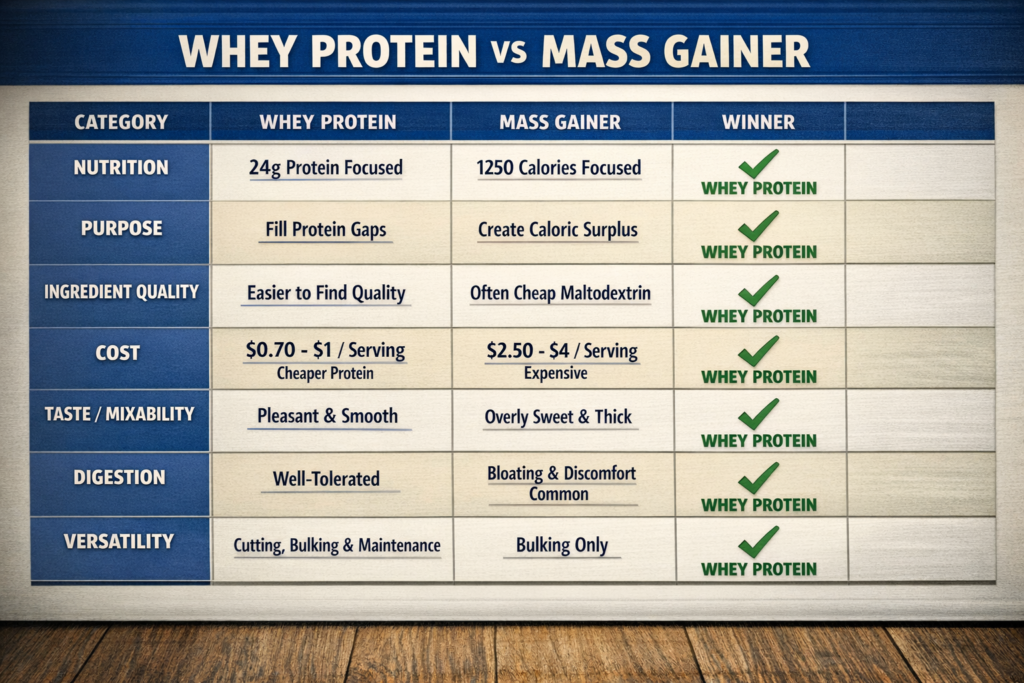
The verdict: Whey is far more versatile for different goals and situations.
Which Is Better for Building Muscle?
The question everyone wants answered.
The Short Answer
If you can eat enough calories from whole food: Whey protein is better.
If you absolutely cannot eat enough calories: Mass gainer might help.
For 80-85% of people: Whey protein is the right choice.
The Long Answer
Building muscle requires three things:
1. Adequate protein (0.7-1g per pound body weight) 2. Caloric surplus (200-500 calories above maintenance) 3. Progressive resistance training
Let’s examine how each supplement addresses these:
Whey protein:
- ✅ Addresses protein requirement directly
- ✅ Allows you to control caloric surplus through food
- ✅ Provides highest-quality protein for muscle building
- ❌ Doesn’t directly provide caloric surplus
Mass gainer:
- ✅ Addresses caloric surplus
- ⚠️ Provides some protein (but often lower quality)
- ⚠️ Makes hitting surplus easy (maybe too easy)
- ❌ Can lead to excessive fat gain if not careful
The Optimal Approach for Muscle Building
For most people:
Priority 1: Eat whole food meals that provide adequate calories
- Aim for 16-18 calories per pound of body weight for bulking
- Get protein from chicken, fish, eggs, beef, dairy
Priority 2: Use whey protein to ensure adequate total protein
- Fill gaps when whole food protein is insufficient
- Convenient post-workout or between meals
- Precise dosing
Priority 3: Only consider mass gainer if truly cannot eat enough
- Tried meal frequency increases
- Tried calorie-dense whole foods
- Still falling 500-800 calories short daily
- Confirmed through tracking for 2 weeks
This approach:
- Prioritizes nutrition quality
- Prevents excessive fat gain
- Costs less
- Develops sustainable eating habits
When Mass Gainer Might Be Better
Scenario 1: Genuine hardgainer
- 140 pounds, trying to bulk to 160
- Needs 3,800 calories daily
- Can only eat 3,000 comfortably from whole food
- Small appetite despite efforts
Solution: 600-800 calorie mass gainer shake fills the gap.
Scenario 2: Extreme caloric needs
- Athlete burning 4,500+ calories daily
- Needs 5,500 for muscle gain
- Impossible to eat this much solid food
Solution: Mass gainer provides necessary calories.
Scenario 3: Medical/recovery situation
- Recovering from illness or injury
- Need to regain weight quickly
- Appetite suppressed
Solution: Liquid calories easier to consume.
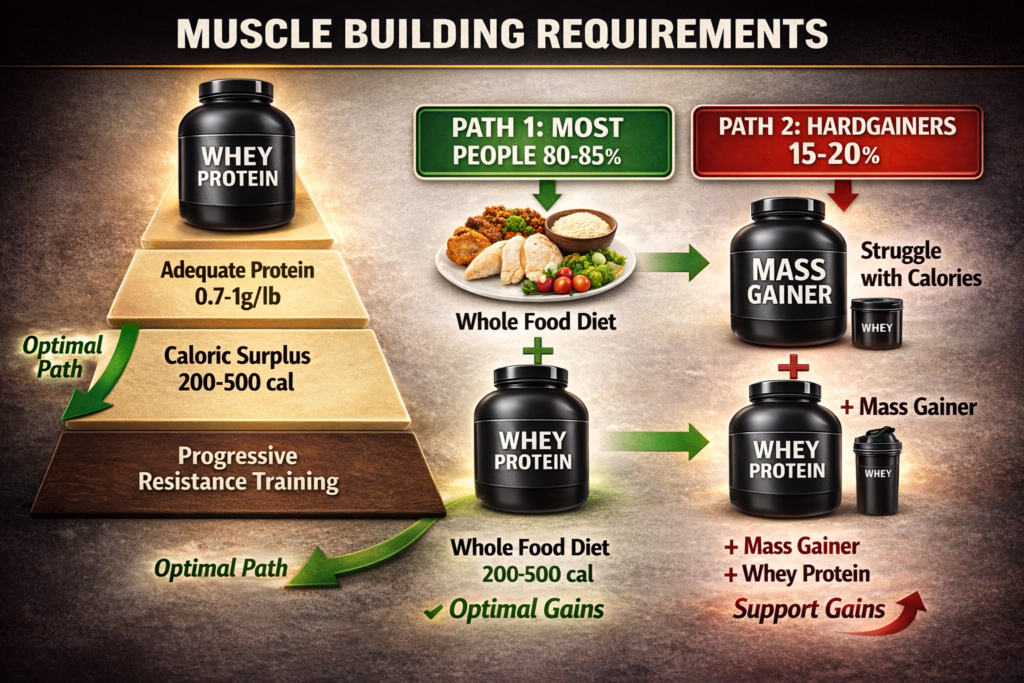
For these specific situations (maybe 15-20% of people), mass gainer makes sense.
Can You Take Whey Protein and Mass Gainer Together?
Yes, and this actually makes sense in certain situations.
Why Combining Can Work
Many mass gainers have poor protein content:
- Only 20-30g protein per serving
- Often includes low-quality protein (soy)
- Not enough to maximize muscle protein synthesis
Adding whey protein:
- Boosts total protein to optimal range (40-50g)
- Improves protein quality
- Ensures adequate leucine content
- Better supports muscle building
Example combination:
Mass gainer alone:
- 1,000 calories
- 25g protein (poor)
- 200g carbs
- 8g fat
Mass gainer + 1 scoop whey:
- 1,120 calories
- 49g protein (excellent)
- 202g carbs
- 10g fat
Much better macro ratio for muscle building.
When This Strategy Makes Sense
Scenario: Hardgainer needing massive calories but also optimal protein
Approach:
- Make mass gainer shake
- Add 1 scoop whey protein
- Consume post-workout or as meal replacement
- Gets both calories and quality protein
Cost consideration:
- More expensive than either alone
- But provides complete nutrition in one shake
- Worth it for specific goals
When This Is Wasteful
If you can eat adequate calories from whole food:
- Just use whey protein
- Get carbs from rice, oats, potatoes
- Save money
- Better nutrition from real food
If you’re cutting:
- Neither product is appropriate
- Focus on whole food protein
- Control calories precisely
- Save supplements for bulking
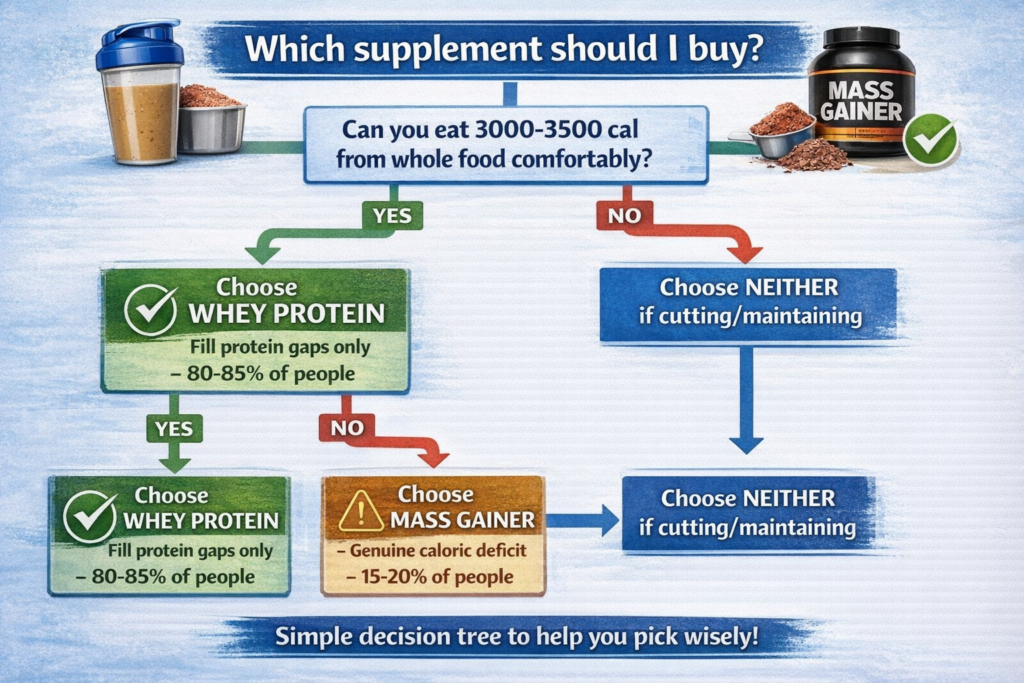
The Smart Decision Framework
Here’s exactly how to choose between whey and mass gainer.
Choose Whey Protein If:
✅ You can eat 3,000-3,500 calories from whole food comfortably
✅ Your protein intake falls short (under 0.7g per pound body weight)
✅ You want cost-effective protein supplementation
✅ You value versatility (cutting, bulking, or maintenance)
✅ You prefer quality over quantity
✅ You want to develop sustainable eating habits
✅ You’re on a budget
This describes 80-85% of people considering supplements.
Choose Mass Gainer If:
✅ You physically cannot eat 3,500+ calories from whole food
✅ You’ve tried for 2+ weeks and consistently fall 500-800 calories short
✅ You have very small appetite despite efforts to increase it
✅ You’re a confirmed hardgainer (under 12% body fat, fast metabolism)
✅ You’re an athlete with extreme caloric needs (4,500+ daily)
✅ Convenience is worth the premium cost
✅ You’re choosing a quality mass gainer (good macros, quality ingredients)
This describes 15-20% of people considering supplements.
Choose Both If:
✅ You need the calories from mass gainer
✅ Your mass gainer has insufficient protein
✅ You want to optimize muscle building
✅ Budget allows for both
✅ You can’t add more whole food protein
This describes maybe 5-10% of people.
Choose Neither If:
✅ You’re cutting or maintaining weight
✅ You can hit all nutrition targets with whole food
✅ You’re on a very tight budget
✅ You’re not training consistently
Focus on nutrition fundamentals first. Supplements are supplementary.
Cost-Benefit Analysis
Let’s examine the financial reality.
Monthly Cost Comparison
Scenario: 180-pound person bulking
Needs:
- 3,600 calories daily
- 144g protein daily
Option 1: Whey protein only
- 2 scoops whey daily (48g protein)
- Remaining 96g protein from whole food
- Remaining 3,360 calories from whole food
- Monthly cost: $40-60 (whey) + $300-400 (food) = $340-460
Option 2: Mass gainer
- 1 serving mass gainer (1,000 cal, 25g protein)
- Remaining 119g protein from whole food
- Remaining 2,600 calories from whole food
- Monthly cost: $120-180 (mass gainer) + $250-350 (food) = $370-530
Option 3: Mass gainer + whey
- 1 serving mass gainer + 1 scoop whey (1,120 cal, 49g protein)
- Remaining 95g protein from whole food
- Remaining 2,480 calories from whole food
- Monthly cost: $120-180 (mass gainer) + $20-30 (whey) + $240-340 (food) = $380-550
Option 4: Strategic whole food approach
- No supplements
- Calorie-dense whole foods (peanut butter, rice, olive oil, etc.)
- Monthly cost: $350-500 (food only)
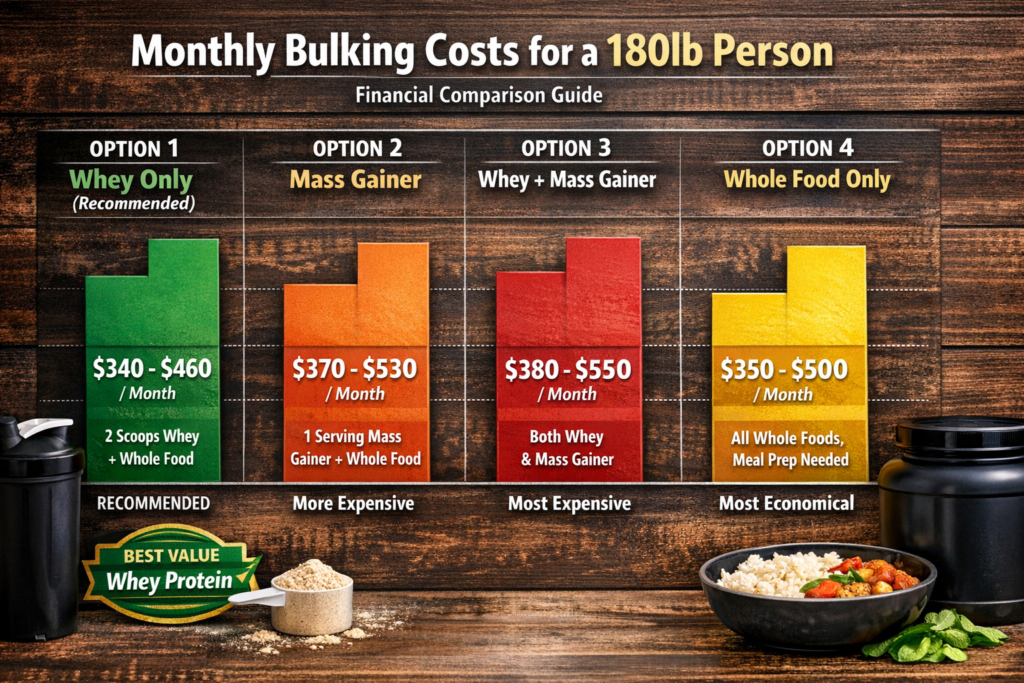
The verdict: Whey protein provides best value. Mass gainers are expensive. Whole food can be most economical.
The Bottom Line: Whey Wins for Most People
After examining all the evidence:
For 80-85% of people, whey protein is the better choice because:
✅ Most people can eat adequate calories from whole food
✅ Protein is the limiting factor for muscle building
✅ Whey provides highest-quality protein at best price
✅ More versatile (works for cutting, bulking, maintaining)
✅ Easier to digest and consume
✅ Better ingredient quality in most products
✅ Doesn’t create dependency on supplements
Mass gainers have a place for the 15-20% who:
✅ Genuinely cannot eat enough solid food
✅ Have very high caloric needs (athletes, hardgainers)
✅ Choose quality products (good macros, real food ingredients)
✅ Use strategically, not as dietary foundation
The optimal approach for most people:
Step 1: Eat whole food to hit calorie targets
- Use calorie-dense foods (rice, oats, nut butter, olive oil, meat)
- Eat 4-5 meals daily
- Track intake for 2 weeks to confirm
Step 2: Use whey protein to ensure adequate protein
- 1-2 servings daily as needed
- Post-workout, between meals, or morning
- Fill protein gaps, not calories
Step 3: Only add mass gainer if truly necessary
- Confirmed caloric shortfall after 2 weeks tracking
- Tried increasing meal frequency
- Tried calorie-dense whole foods
- Still fall 500-800 calories short daily
This approach:
- Prioritizes whole food nutrition
- Uses supplements strategically
- Prevents excessive fat gain
- Costs less long-term
- Develops sustainable habits
CHOOSE WHEY FOR MOST SITUATIONS. USE MASS GAINERS ONLY WHEN TRULY NEEDED. PRIORITIZE WHOLE FOOD ALWAYS.
Ready to optimize your entire supplement and nutrition strategy for maximum muscle building without wasting money on products you don’t need? Choosing between whey and mass gainers is just one decision in a complete nutrition system. Get a science-based guide to exactly what supplements actually work, how to calculate your precise nutrition needs, and how to build serious muscle with the most cost-effective approach. Stop guessing. Start growing.


Leave a Reply
You must be logged in to post a comment.