
Eating more, training hard, but the scale won’t budge? Here’s why your bulk isn’t working and exactly how to fix it.
You’re bulking. You’re eating “a lot.” You’re training consistently.
But you’re not gaining weight.
You check the scale weekly. Nothing. Maybe you even lost a pound.
What’s going wrong?
You’re frustrated and confused:
- “I’m eating so much food”
- “I feel full all the time”
- “I’m eating all the right foods”
- “My training is solid”
Yet the results aren’t showing up.
Here’s the uncomfortable truth: If you’re not gaining weight while bulking, you’re not in a caloric surplus, regardless of how much you think you’re eating. The most common culprits are underestimating calorie intake, tracking errors, metabolic adaptation without adjustment, unrealistic timelines, and excessive cardio negating your surplus. Fix these issues and weight gain becomes inevitable.
In this comprehensive guide, I’ll reveal the 5 critical mistakes preventing weight gain during bulking, explain exactly why each mistake sabotages your progress with scientific backing, show you how to identify which mistakes you’re making, provide step-by-step solutions to fix each problem immediately, and help you set realistic expectations for sustainable muscle-building progress.
Whether you’re a hardgainer, beginner bulker, or experienced lifter hitting a plateau, this article will get your bulk back on track.
Let’s diagnose and solve your bulking problems.
TABLE OF CONTENTS
The Foundation: Understanding Caloric Surplus
Before examining specific mistakes, understand the fundamental requirement.
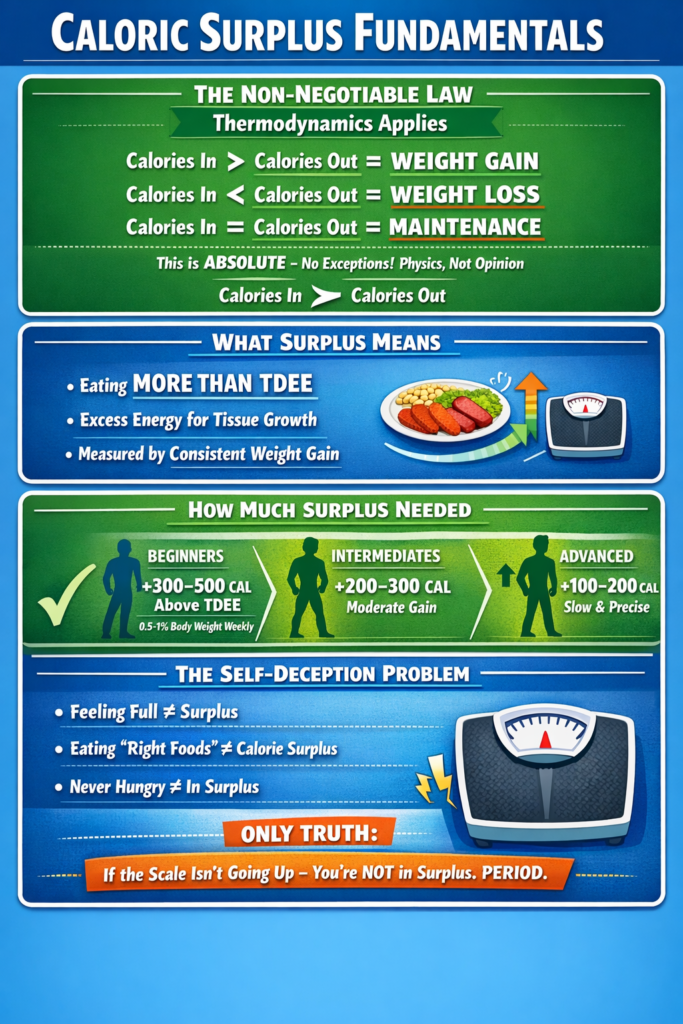
The Non-Negotiable Law of Weight Gain
Thermodynamics applies to your body.
The equation:
- Calories In > Calories Out = Weight Gain
- Calories In < Calories Out = Weight Loss
- Calories In = Calories Out = Weight Maintenance
This is absolute:
- No exceptions
- Cannot be violated
- Physics, not opinion
- If not gaining weight, you’re not in surplus
What surplus means:
- Eating more than your Total Daily Energy Expenditure (TDEE)
- Creating excess energy
- Body uses excess to build tissue (muscle + some fat)
- Measured by consistent weight gain
How much surplus:
- Beginners: 300-500 calories above TDEE
- Intermediates: 200-300 calories above TDEE
- Advanced: 100-200 calories above TDEE
- Results in 0.5-1% body weight gain weekly
The Self-Deception Problem
Why people think they’re eating enough when they’re not.
Common thought patterns:
“I’m eating so much food”
- Subjective perception
- Feeling full doesn’t equal surplus
- Individual stomach capacity varies
- Feeling ≠ Reality
“I’m eating the right foods”
- Food quality doesn’t create surplus
- Chicken and rice can be deficit, maintenance, or surplus
- Depends on quantity, not quality
- “Clean” eating doesn’t guarantee weight gain
“I’m never hungry”
- Satiety is not a calorie measure
- High-protein, high-fiber foods very satiating
- Can feel full on deficit calories
- Fullness ≠ Sufficient calories
The only truth: If scale not going up consistently, you’re not in surplus. Period.
Mistake 1: You’re Not Actually in a Caloric Surplus
The most common problem by far.
Why This Happens
Reason 1: Never calculated actual needs
The guessing approach:
- “I’ll just eat more than usual”
- No baseline established
- No target to hit
- Flying blind
Why this fails:
- “More than usual” is subjective
- Metabolism varies dramatically between people
- Active 180-pound person might need 3,500+ calories
- Same person sedentary might need 2,200
- Cannot eyeball a surplus
Reason 2: Underestimating maintenance calories
Common scenario:
- Calculate TDEE: 2,500 calories
- Add 300 for surplus: 2,800 calories
- Eat 2,800 daily
- No weight gain
What went wrong:
- TDEE calculation was incorrect
- Actually burn 2,900 calories
- “Surplus” is actually deficit
- Need to recalculate based on results
Reason 3: Inconsistent intake
The pattern:
- Monday-Friday: Eat 3,200 calories
- Saturday-Sunday: Eat 2,000 calories
- Weekly average: 2,829 calories
- Not enough for surplus despite good weekdays
Why weekends matter:
- Body responds to average intake
- Two low days can negate five good days
- Inconsistency prevents progress
- Need 7-day consistency
The Solution
Step-by-step process to establish real surplus:
Step 1: Calculate starting point
Use TDEE calculator:
- Input: Weight, height, age, activity level
- Output: Estimated maintenance calories
- Example: 2,500 calories for 170-pound active male
Step 2: Add appropriate surplus
Based on experience level:
- Beginner (0-2 years): +400-500 calories = 2,900-3,000
- Intermediate (2-4 years): +300-400 calories = 2,800-2,900
- Advanced (5+ years): +200-300 calories = 2,700-2,800
Step 3: Eat that amount consistently for 2 weeks
Track everything:
- Weigh all food
- Log all calories
- No cheat days (yet)
- No “eyeballing”
- Actual measurement required
Step 4: Assess results
After 2 weeks:
If gaining 0.5-1% body weight weekly:
- Surplus achieved
- Continue this intake
- Monitor and adjust as needed
If weight stable or losing:
- Increase calories by 200-300
- Repeat 2-week test
- Adjust until gaining
If gaining >1.5% body weight weekly:
- Surplus too aggressive
- Gaining excess fat
- Reduce by 100-200 calories
The key: Let results dictate, not calculations.
Calculations give starting point. Scale tells truth. Adjust based on actual weight change, not theoretical numbers.
Mistake 2: Tracking Errors Make You Think You’re Eating More
You’re tracking calories but making critical errors.
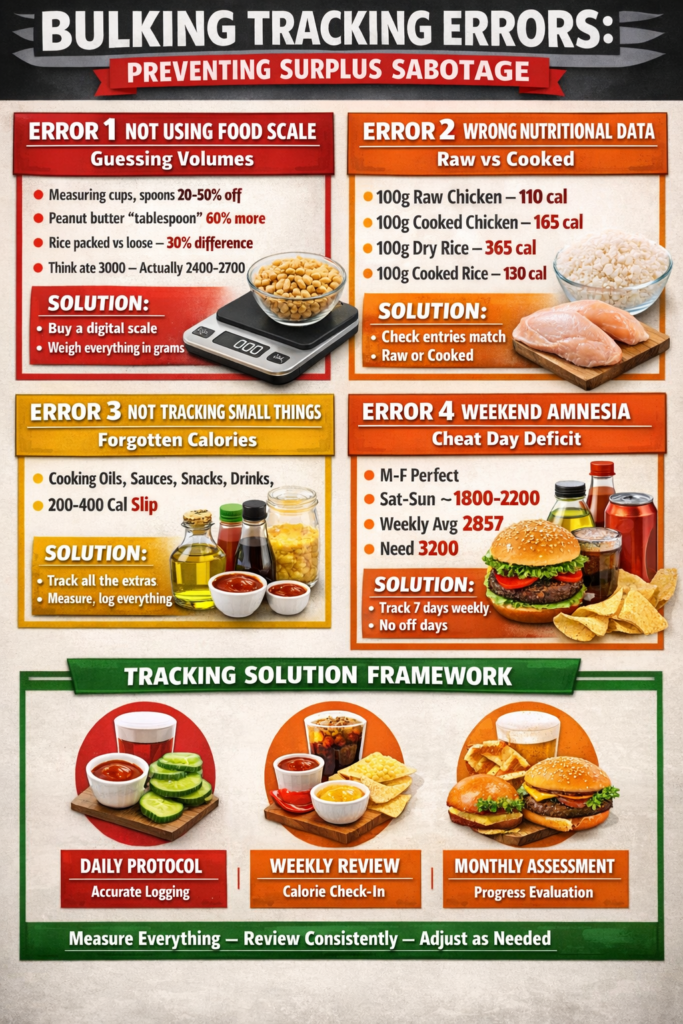
Common Tracking Mistakes
Error 1: Not using a food scale
The problem with measuring cups/spoons:
Example: Peanut butter
- “1 tablespoon” = supposed to be 16g
- Actual tablespoon heap: 25-30g
- Difference: 60% more calories than logged
- Off by 50-100 calories per serving
Example: Rice
- “1 cup cooked rice” varies wildly
- Packed vs. loose: 30% difference
- Your “cup” might be 1.3 cups
- Off by 50-80 calories
Multiply these errors across all meals:
- 5-10 foods per day
- Each 20-50% off
- Total: 300-600 calorie underestimation
- Think you ate 3,000, actually ate 2,400-2,700
The solution:
- Buy digital food scale ($10-20)
- Weigh everything in grams
- No more guessing
- Accurate within 5%
Error 2: Using wrong nutritional information
The raw vs. cooked problem:
Example: Chicken breast
- 100g raw chicken: 110 calories, 23g protein
- 100g cooked chicken: 165 calories, 31g protein
- If you weigh cooked but log raw data, you’re off by 50%
Why this happens:
- Cooking removes water
- Same weight, different composition
- Must match: weigh raw, log raw OR weigh cooked, log cooked
Example: Rice
- 100g dry rice: 365 calories
- 100g cooked rice: 130 calories
- Using wrong data = 235 calorie error
The solution:
- Log foods as weighed (raw as raw, cooked as cooked)
- MyFitnessPal: Check for “raw” or “cooked” in entry
- When meal prepping: weigh and log before cooking
- Consistency is key
Error 3: Not tracking “small” things
The forgotten calories:
Cooking oils:
- 1 tablespoon olive oil: 120 calories
- Use 2-3 tbsp daily cooking: 240-360 calories
- Never logged = hidden 300+ calories deficit
Condiments:
- Ketchup, mayo, sauces: 50-100 calories per serving
- Multiple times daily: 150-300 calories
- “Doesn’t count” mentality
Beverages:
- Orange juice: 110 calories per cup
- Sports drinks: 80 calories per bottle
- “Just a drink” adds up
Bites and tastes:
- Taste while cooking
- Finish kid’s food
- Sample at grocery store
- Can add 200-400 calories easily
The solution:
- Track literally everything that enters mouth
- Measure cooking oils
- Log all condiments
- Count all beverages
- If it has calories, it counts
Error 4: Weekend/cheat day amnesia
The pattern:
Monday-Friday:
- Perfect tracking
- Hit 3,200 calories daily
- Feel disciplined
Saturday-Sunday:
- “Cheat day, not tracking”
- Estimate “probably 2,500-3,000”
- Actually ate 1,800-2,200
- Massive deficit days
The math:
- 5 days × 3,200 = 16,000 calories
- 2 days × 2,000 = 4,000 calories
- Weekly total: 20,000 calories
- Daily average: 2,857 calories
- Need 3,200, averaging 2,857 = no surplus
The solution:
- Track 7 days weekly
- No “off” days from tracking
- Cheat meals fine (plan for them)
- But track everything
The Tracking Solution Framework
How to track accurately:
Daily protocol:
- Weigh all foods on scale (grams)
- Use correct database entries (raw vs. cooked)
- Log before eating
- Include oils, sauces, beverages
- Track 7 days weekly
Weekly review:
- Calculate daily average
- Compare to target
- Adjust if needed
- Check weight trend
Monthly assessment:
- Total weight change
- Average weekly gain
- Adjust calories if needed
- Fine-tune approach
Mistake 3: Unrealistic Expectations About Rate of Gain
You are gaining, just not as fast as you expected.
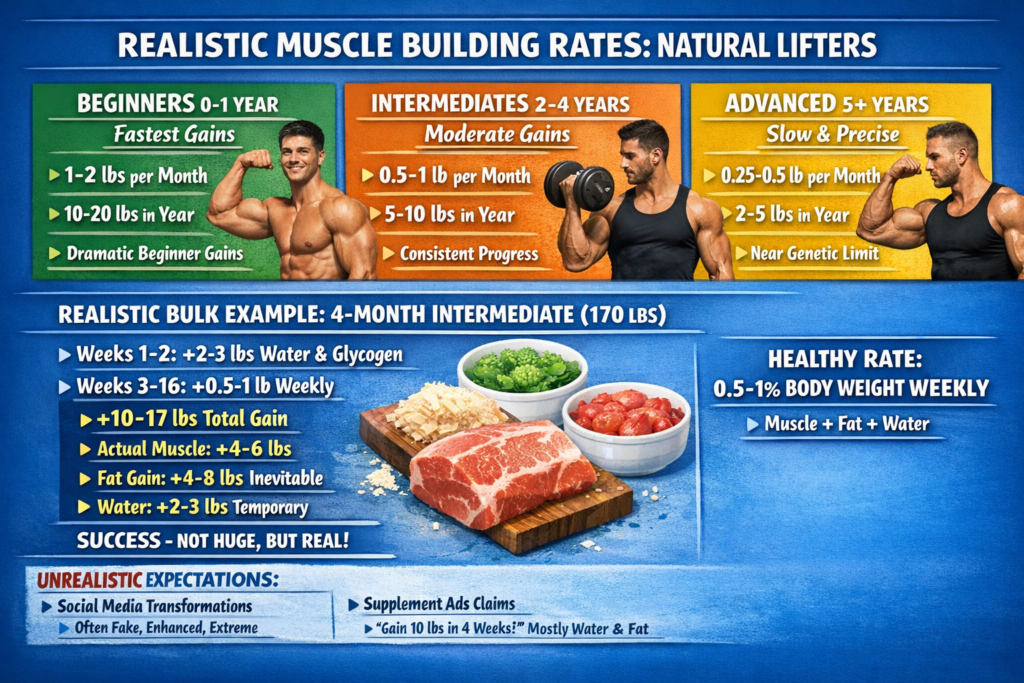
The Reality of Muscle Building
What’s actually possible:
Beginners (0-1 year training):
- 1-2 pounds muscle monthly
- 0.25-0.5 pounds weekly
- Most gain first year: 10-20 pounds muscle
Intermediates (2-4 years training):
- 0.5-1 pound muscle monthly
- 0.12-0.25 pounds weekly
- Yearly gain: 5-10 pounds muscle
Advanced (5+ years training):
- 0.25-0.5 pounds muscle monthly
- 0.06-0.12 pounds weekly
- Yearly gain: 2-5 pounds muscle
The implication:
If you’re intermediate and gaining 0.5 pounds weekly:
- That’s excellent progress
- On track for 26 pounds yearly (some fat, some muscle)
- Maybe 10-12 pounds actual muscle
- But feels “slow” compared to expectations
Where Unrealistic Expectations Come From
Source 1: Social media transformations
The deception:
- “8-week transformation” photos
- Often fake (different lighting, angles, pump)
- Sometimes enhanced athletes (steroids)
- Rarely shows timeframe accurately
Reality check:
- Dramatic 12-week transformations usually:
- Beginners (newbie gains)
- Enhanced users
- Extreme fat loss (not muscle gain)
- Photo manipulation
Actual natural muscle building:
- 12 weeks = 3-6 pounds muscle (beginners)
- 12 weeks = 1.5-3 pounds muscle (intermediates)
- Not dramatic in photos
- Consistent, slow progress
Source 2: Supplement marketing
The promise:
- “Gain 10 pounds in 4 weeks!”
- Shows dramatic before/after
- Implies supplement did it
The reality:
- Beginner gains + water weight + creatine
- Maybe 2-3 pounds actual muscle
- 4-5 pounds water/glycogen
- 2-3 pounds fat
- Total: 10 pounds, mostly not muscle
Setting Realistic Bulking Expectations
Healthy rate of gain:
Total weight gain (muscle + fat):
- 0.5-1% body weight weekly
- For 170-pound person: 0.85-1.7 pounds weekly
- Monthly: 3.5-7 pounds total
- Some muscle, some fat, some water
Actual muscle within total gain:
- Beginners: Maybe 50-60% is muscle
- Intermediates: Maybe 30-40% is muscle
- Advanced: Maybe 20-30% is muscle
- Rest is fat and water
Example realistic bulk:
4-month intermediate bulk (170 pounds starting):
- Week 1-2: Gain 2-3 pounds (water/glycogen)
- Week 3-16: Gain 0.5-1 pound weekly (8-14 pounds)
- Total gain: 10-17 pounds
- Actual muscle: 4-6 pounds
- Fat gain: 4-8 pounds
- Water: 2-3 pounds
This is success, even though it doesn’t feel dramatic.
The Solution: Patience and Consistency
Mindset shift required:
Instead of:
- “Why haven’t I gained 15 pounds in 6 weeks?”
- “I should look completely different by now”
- “This isn’t working fast enough”
Think:
- “Am I gaining 0.5-1% body weight weekly?”
- “Am I getting stronger consistently?”
- “Am I progressing compared to 8 weeks ago?”
Focus on process metrics:
- Weekly weight trend (not daily fluctuation)
- Strength progression in main lifts
- Measurements (arms, chest, thighs)
- Progress photos every 4 weeks
Celebrate small wins:
- Added 5 pounds to squat
- Gained 1.5 pounds this month
- Clothes fitting tighter (good)
- Visible size increase in photos
Remember: Building muscle naturally is a multi-year process. 6-month bulk adding 5-10 pounds muscle is excellent progress.
Mistake 4: Not Adjusting Calories as You Gain Weight
Your initial surplus becomes maintenance as you get bigger.
Why Calorie Needs Increase
Reason 1: Higher body weight
The math:
- TDEE partially based on body weight
- Heavier body = more energy to move and maintain
- Gain 20 pounds = burn ~100-200 more calories daily
Example:
- Start: 170 pounds, TDEE 2,500 calories
- Bulk with 3,000 calories (500 surplus)
- Gain 15 pounds over 3 months
- New weight: 185 pounds, TDEE now 2,650
- Still eating 3,000 = only 350 surplus
- Slower gain or plateau
Reason 2: More muscle mass
Muscle is metabolically active:
- Muscle burns more calories at rest than fat
- Add 10 pounds muscle = burn 50-100 more calories daily
- Over time, raises baseline metabolism
Reason 3: Increased training volume
As you get stronger:
- Lifting heavier weights
- More total volume
- More calories burned during training
- Higher TDEE
When to Adjust Calories
Signals you need to increase:
Signal 1: Weight plateau for 2+ weeks
- Was gaining consistently
- Now stable for 14+ days
- Clear plateau
- Time to increase
Signal 2: Weight gain slowing significantly
- Was gaining 1 pound weekly
- Now gaining 0.2 pounds weekly
- Below target rate
- Increase needed
Signal 3: Strength gains stalling
- Progressive overload stopping
- Not getting stronger
- Same weights for weeks
- May need more fuel
How to Adjust Calories
The protocol:
Step 1: Confirm plateau is real
- Track weight daily for 2 weeks
- Calculate weekly average
- Compare Week 1 avg to Week 2 avg
- If difference <0.3 pounds = plateau
Step 2: Increase calories moderately
- Add 200-300 calories daily
- Don’t jump 500+ (too aggressive)
- Small increases easier to manage
Step 3: Monitor for 2 weeks
- Continue tracking
- Assess new weight trend
- Check if gaining again
Step 4: Repeat if needed
- If still not gaining, add another 200
- Gradual increases find new surplus
- Better than overshooting
Example adjustment timeline:
Months 1-3:
- Eating 3,000 calories
- Gaining 1 pound weekly
- Good progress
Month 4:
- Weight plateaus
- Still 3,000 calories
- No gain for 2 weeks
Action:
- Increase to 3,200 calories
- Monitor 2 weeks
- Weight gain resumes at 0.7 pounds weekly
- Continue
Month 6:
- Another plateau
- Increase to 3,400
- Progress continues
This is normal and expected during extended bulks.
Mistake 5: Too Much Cardio Killing Your Surplus
Excessive aerobic activity negates your hard-earned surplus.
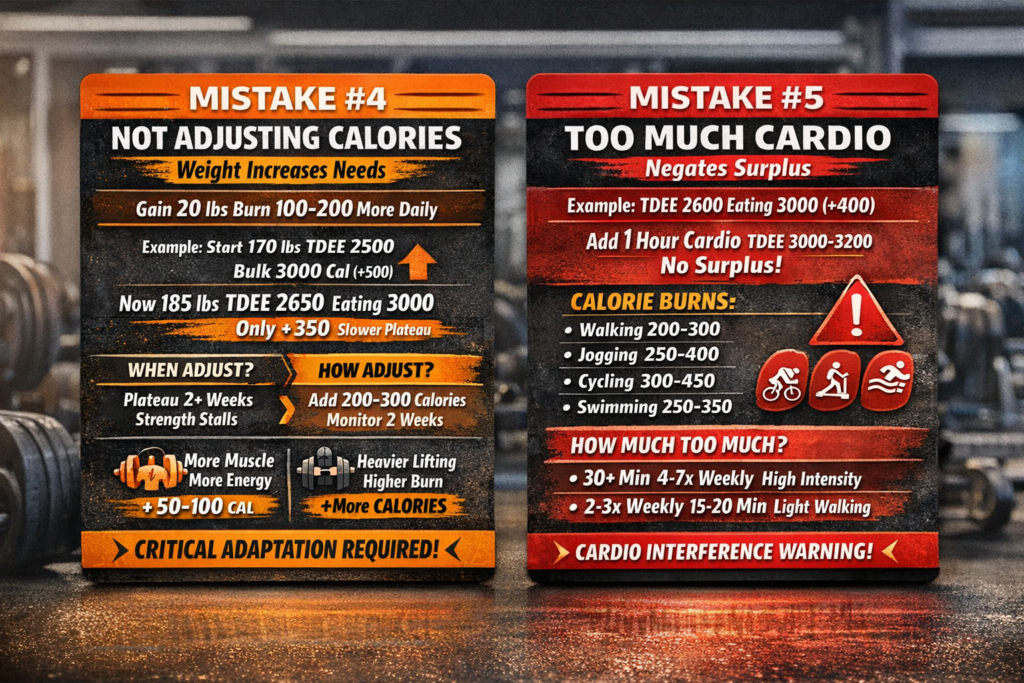
How Cardio Sabotages Bulking
The calorie burn problem:
Example scenario:
- TDEE: 2,600 calories
- Eating: 3,000 calories (400 surplus)
- Add 1 hour cardio daily: Burns 400-600 calories
- New TDEE: 3,000-3,200 calories
- Surplus eliminated or now in deficit
Common cardio calorie burns:
- Walking 1 hour: 200-300 calories
- Jogging 30 minutes: 250-400 calories
- Cycling 45 minutes: 300-450 calories
- Swimming 30 minutes: 250-350 calories
If not accounting for this expenditure:
- Think you’re in surplus
- Actually in maintenance or deficit
- No weight gain
- Frustration
The Recovery Interference
Beyond calories:
Cardio competes for recovery resources:
- Body needs energy and nutrients to build muscle
- Excessive cardio diverts these resources
- Recovery becomes split between:
- Repairing from lifting
- Recovering from cardio
- Less available for muscle building
Hormonal impact:
- Excessive cardio can elevate cortisol
- High cortisol impairs muscle building
- Can promote catabolic state
- Counterproductive during bulk
Research evidence:
- Concurrent training (weights + excessive cardio) blunts hypertrophy
- Interference effect documented
- Moderate cardio fine, excessive problematic
How Much Cardio Is Too Much?
Guidelines for bulking:
Minimal (ideal for bulking):
- 10-20 minutes, 2-3x weekly
- Light intensity (walking, easy cycling)
- For general health only
- Minimal interference
Moderate (acceptable):
- 20-30 minutes, 2-3x weekly
- Moderate intensity
- Account for calories burned
- Manageable
Excessive (problematic for bulking):
- 30+ minutes, 4-7x weekly
- High intensity
- Significant calorie burn
- Interferes with muscle building
Individual factors:
- Hardgainers: Less cardio better
- Easy gainers: More cardio tolerated
- Sport requirements: Adjust accordingly
The Solution
Option 1: Reduce cardio volume
Cut back to minimal:
- 2-3 sessions weekly
- 15-20 minutes each
- Light intensity (walking)
- Just for health benefits
Option 2: Account for cardio calories
If must do cardio:
- Estimate calories burned
- Add to daily intake
- Example: Burn 400 from cardio, eat 400 more
- Maintain surplus
Option 3: Strategic timing
Separate from lifting:
- Morning cardio, evening lifting (or vice versa)
- Different days (cardio on rest days)
- Minimizes interference
Option 4: Eliminate temporarily
During aggressive bulk:
- Stop cardio completely for 8-12 weeks
- Focus purely on muscle building
- Add back during maintenance or cut
- Simplifies calorie management
For most people bulking: Option 1 (minimal cardio) is optimal.
The Bottom Line: Fixing Your Stalled Bulk
After examining all mistakes:
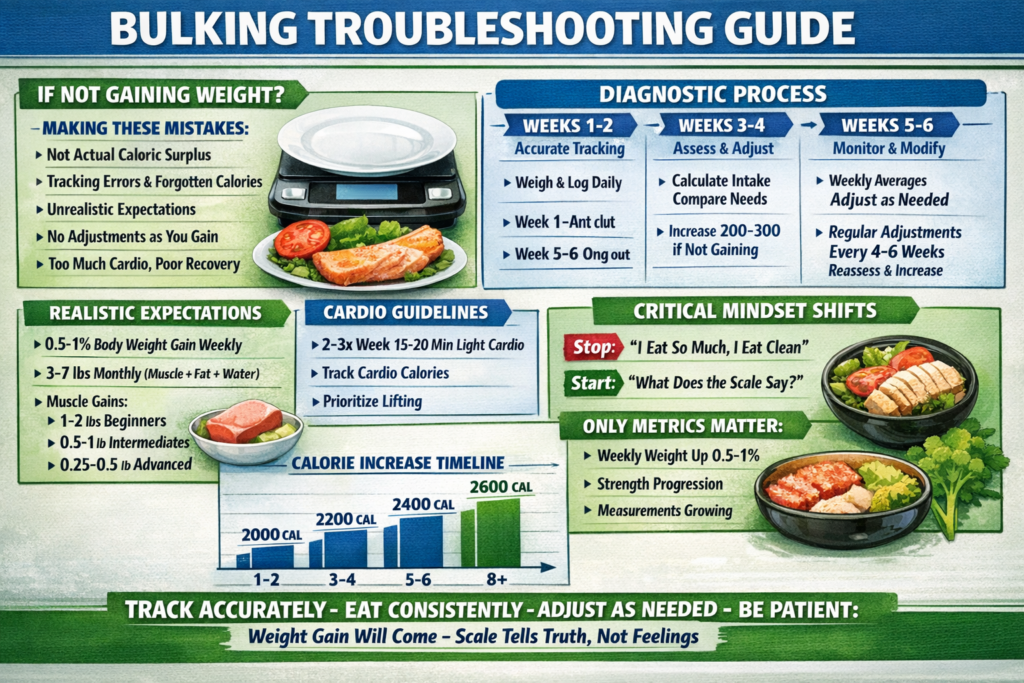
The truth about not gaining weight while bulking:
If you’re not gaining weight, you’re making at least one of these mistakes:
- Not in actual caloric surplus (most common)
- Tracking errors (think you’re eating more than you are)
- Unrealistic expectations (you are gaining, just slowly)
- Not adjusting as weight increases
- Too much cardio negating surplus
The diagnostic process:
Week 1-2: Establish accurate tracking
- Buy food scale
- Weigh everything in grams
- Use correct database entries
- Track 7 days weekly
- No exceptions
Week 3-4: Assess true intake
- Calculate daily average
- Compare to calculated needs
- Check weight trend
- If not gaining, increase 200-300 calories
Week 5-6: Monitor results
- Continue accurate tracking
- Daily weigh-ins
- Weekly average comparison
- Adjust if needed
Ongoing: Regular adjustments
- Every 4-6 weeks, reassess
- If plateaued, increase 200-300 calories
- If gaining too fast (>1.5% weekly), reduce slightly
- Let scale dictate adjustments
Realistic bulking expectations:
Aim for:
- 0.5-1% body weight gain weekly
- 170-pound person: 0.85-1.7 pounds per week
- 3-7 pounds monthly
- Some muscle, some fat, some water
Actual muscle gain:
- Beginners: 1-2 pounds muscle monthly
- Intermediates: 0.5-1 pound muscle monthly
- Advanced: 0.25-0.5 pounds muscle monthly
- This is excellent progress
Cardio guidelines:
- Minimal: 2-3 sessions, 15-20 min, light intensity
- Account for calories if doing more
- Prioritize lifting over cardio during bulk
Critical mindset shifts:
Stop thinking:
- “I’m eating so much”
- “I feel full”
- “I eat clean foods”
Start thinking:
- “What does the scale say?”
- “What’s my weekly average weight change?”
- “Am I tracking accurately?”
The only metrics that matter:
- Weekly weight trend (going up 0.5-1%?)
- Strength progression (adding weight/reps?)
- Measurements (increasing?)
If yes to above, bulk is working. If no, fix the mistakes.
TRACK ACCURATELY. EAT CONSISTENTLY. ADJUST AS NEEDED. BE PATIENT. WEIGHT GAIN WILL COME.
Ready to build a complete, foolproof bulking plan with exact calorie targets, accurate tracking systems, progressive training programming, and realistic timelines that guarantee muscle gain without excessive fat accumulation or trial-and-error frustration? Fixing tracking mistakes is just the beginning. Get a comprehensive guide to calculating your exact bulking calories, building sustainable high-calorie meal plans, programming your training for maximum muscle growth, and achieving consistent gains without spinning your wheels. Stop guessing why you’re not gaining. Start following a proven bulking system that delivers results.
REFERENCES
SECTION 1 — Calorie tracking errors and systematic underreporting
[1] Lichtman SW et al. — PubMed/New England Journal of Medicine, 1992 Seminal study; 10 “diet-resistant” obese subjects who reported eating <1,200 kcal/day; true intake measured via doubly labeled water and indirect calorimetry for 14 days; subjects underreported actual food intake by an average of 47% and overreported physical activity by 51%; failure to lose weight was entirely due to higher actual calorie intake than reported — not metabolic abnormalities; foundational evidence that self-reported intake is systematically inaccurate, directly supporting the article’s calorie deficit hypothesis https://pubmed.ncbi.nlm.nih.gov/1454084/
[2] Dhurandhar EJ et al. — PMC/Advances in Nutrition, 2020 Review of published data on dietary misreporting; strong and consistent systematic underreporting of energy intake across adults and children studies; approximately 30% of subjects are under-reporters; energy intake underestimated by an average of 15–28% depending on assessment method; high-energy-density foods are disproportionately omitted; underreporting is a global problem documented in the US, UK, Australia, Brazil, Germany, Japan, Norway, and others; demonstrates why “eating a lot” subjectively does not reliably equal actual caloric surplus https://pmc.ncbi.nlm.nih.gov/articles/PMC7350526/
[3] Champagne CM et al. — PubMed/Journal of the American Dietetic Association, 2002 Compared 7-day food records to doubly labeled water energy expenditure in 10 female registered dietitians vs. 10 non-dietitian controls; non-dietitians underreported by an average of 429 kcal/day (p<0.05); dietitians underreported by 223 kcal/day; even nutrition experts systematically underreport — confirming that untrained individuals underreporting by 300–600 calories/day (as described in the article) is entirely consistent with the scientific literature https://pubmed.ncbi.nlm.nih.gov/12396160/
SECTION 2 — Natural muscle gain rates by training experience
[4] Hubal MJ & Lopez P et al. — PMC/Journal of Strength and Conditioning Research, 2019 Systematic review and meta-analysis of whole-body muscle growth with resistance training in healthy adult males; hypertrophic response to resistance training diminishes significantly with training experience; beginners show the greatest hypertrophic response while intermediate athletes require more precise programming to achieve gains; confirms the experience-dependent decline in muscle gain rates described in the article — directly supporting realistic bulking expectations by training level https://pmc.ncbi.nlm.nih.gov/articles/PMC7068252/
[5] Schoenfeld BJ, Ogborn D, & Krieger JW — PMC/Sports Medicine, 2019 Comprehensive review of advanced resistance training techniques for maximizing hypertrophy; resistance training experience determines the rate of muscle adaptation, with beginners experiencing rapid early gains from both neurological and hypertrophic responses; advanced trainees require more sophisticated programming due to diminishing returns; confirms the article’s claim that muscle-building slows significantly with training experience and that intermediate/advanced lifters should expect 0.5–1 pound of muscle monthly at best https://pmc.ncbi.nlm.nih.gov/articles/PMC6950543/
SECTION 3 — Dynamic TDEE: why calorie needs increase with body weight
[6] Trexler ET, Smith-Ryan AE & Norton LE — PMC/Journal of the International Society of Sports Nutrition, 2014 Review of metabolic adaptation during weight loss in athletes; TDEE is composed of resting energy expenditure (REE), non-exercise activity thermogenesis (NEAT), exercise activity thermogenesis (EAT), and thermic effect of food (TEF); heavier body weight means more energy required to move and maintain; metabolic rate is dynamic — weight gain increases TDEE components predictably; directly explains why a fixed calorie intake that initially produced a surplus gradually becomes maintenance as body weight increases during a bulk https://pmc.ncbi.nlm.nih.gov/articles/PMC3943438/
[7] Müller MJ et al. — PubMed/Current Opinion in Clinical Nutrition and Metabolic Care, 2016 Review of energy expenditure changes with weight gain and loss; REE increases with weight gain proportional to increases in fat-free mass and fat mass; during overfeeding, TDEE increases through adaptive thermogenesis of the non-resting component; heavier individuals expend more calories both at rest and during activity; confirms the article’s mechanism that gaining 15–20 pounds during a bulk significantly elevates TDEE, requiring upward calorie adjustments to maintain a surplus https://pubmed.ncbi.nlm.nih.gov/27739007/
SECTION 4 — Concurrent training: cardio interference effect on muscle growth
[8] Wilson JM et al. — PubMed/Journal of Strength and Conditioning Research, 2012 Meta-analysis of 21 concurrent training studies with 422 effect sizes; mean effect size for hypertrophy was 1.23 for resistance training alone vs. 0.85 for concurrent training; significant negative correlations found between endurance training frequency (r=-0.26 to -0.35) and duration (r=-0.29 to -0.75) and both hypertrophy and strength gains; running-based cardio produced significantly greater interference than cycling; more cardio = less muscle growth; quantifies the interference effect that underpins the article’s advice to limit cardio during bulking https://pubmed.ncbi.nlm.nih.gov/22002517/
[9] Schumann M et al. — PMC/Sports Medicine, 2022 Updated systematic review and meta-analysis of 43 concurrent training studies; concurrent training does not significantly compromise overall muscle hypertrophy or maximal strength at moderate volumes; however, explosive strength (jump performance, rate of force development) was blunted by approximately 28%, especially when both training types were performed in the same session; caloric cost of added aerobic sessions must be accounted for; separating training modalities by at least 3 hours mitigates interference — informs the article’s practical recommendations for minimal, well-structured cardio during a bulk https://pmc.ncbi.nlm.nih.gov/articles/PMC8891239/





Leave a Reply
You must be logged in to post a comment.