Creatine prices doubled since 2022. If you’re wondering why your supplement budget is getting crushed, here’s the truth.
You go to buy creatine. The same 500g container you bought for $20 in 2021 now costs $45.
You think maybe you’re looking at the wrong product. Or the wrong brand. But every brand is expensive now.
You wonder:
- Is this price gouging?
- Are companies just being greedy?
- Is there a creatine shortage?
- Will prices ever go back down?
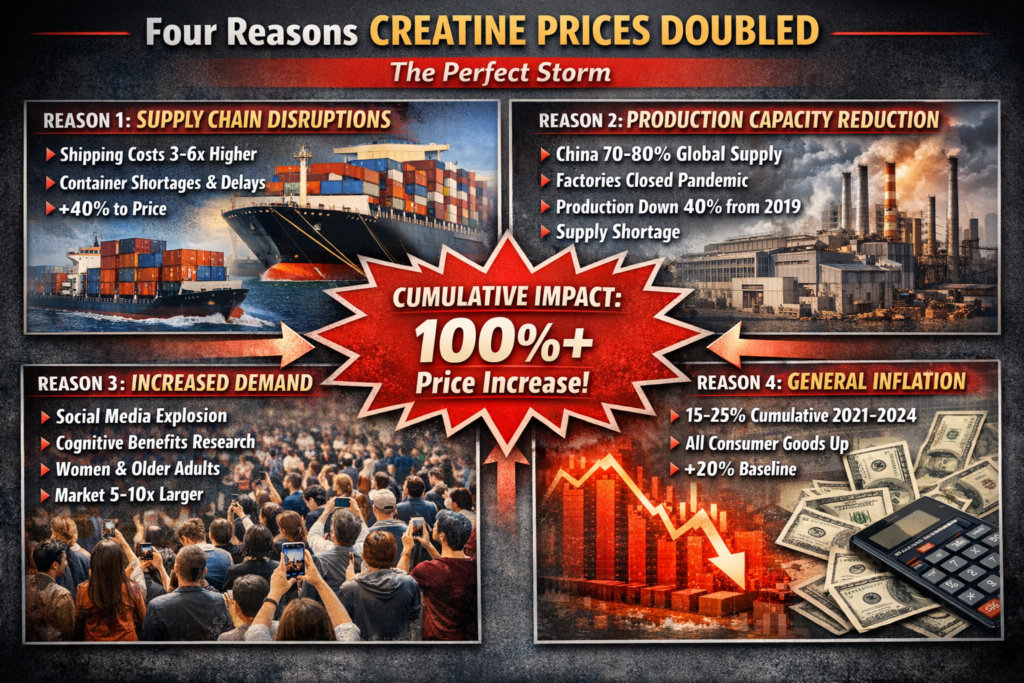
The truth is more complex. Creatine prices increased 100%+ from 2022 to 2024 due to four main factors: pandemic supply chain disruptions (still ongoing), production capacity reductions in China (main global supplier), massive demand increases (more people using creatine than ever), and general inflation. This created a perfect storm that sent prices skyrocketing.
In this comprehensive guide, I’ll explain the 4 reasons creatine is expensive now (the supply-demand breakdown), reveal whether prices will drop (short-term vs. long-term outlook), show you if it’s still worth buying (cost-benefit analysis), provide 4 strategies to save money on creatine (pay less without sacrificing quality), and explain alternatives if you can’t afford it (dietary creatine sources).
Whether you’re deciding if creatine is worth the current price or looking for ways to save money, understanding the economics helps.
Let’s break down the creatine price situation.
TABLE OF CONTENTS
The 4 Reasons Creatine Is Expensive Now
Understanding the economics.
Reason 1: Supply Chain Disruptions
What happened:
- COVID-19 pandemic (2020-2021)
- Global lockdowns
- Shipping disruptions
- Port closures and delays
- Container shortages
- Logistics collapse
The specific impacts:
Shipping costs skyrocketed:
- Pre-pandemic: $2,000-3,000 per container (China to US)
- Pandemic peak: $20,000+ per container
- Current: $8,000-12,000 per container (still elevated)
- 3-6x increase in shipping
Shipping times increased:
- Pre-pandemic: 2-3 weeks
- Pandemic: 2-3 months (or longer)
- Current: 4-6 weeks (improved but not normal)
- Massive delays
Raw material costs increased:
- Chemical precursors more expensive
- Packaging materials (plastic, labels) increased 30-50%
- Input cost increases
The result:
- Higher costs throughout supply chain
- Companies pass costs to consumers
- Prices increased 40-60% from shipping alone
- Consumer price impact
Why still affecting prices now (2024-2025):
- Supply chains haven’t fully normalized
- New normal is higher baseline costs
- Companies reluctant to lower prices once raised
- Persistent elevation
Reason 2: Production Capacity Reduction
The creatine production landscape:
- Only 2 major producing countries: China and Germany
- China: 70-80% of global supply
- Germany: 20-30% of global supply (higher quality, higher cost)
- Concentrated production
What happened in China:
Factory closures (2020-2022):
- Strict zero-COVID policy
- Manufacturing facilities closed for months
- Workers unable to operate facilities
- Production halted
Capacity reduction:
- Some facilities permanently closed
- Others reduced capacity
- Production down 40-50% from pre-pandemic
- Supply shock
Slow recovery:
- As of 2024, production still not at 2019 levels
- Regulatory changes made reopening difficult
- Some manufacturers exited market
- Incomplete recovery
The supply-demand imbalance:
- Global supply decreased 40%
- Global demand increased 30% (see Reason 3)
- Classic shortage scenario
- Perfect storm
The result:
- Limited supply + high demand = price increase
- Basic economics
- Retailers competing for limited supply
- Bidding war effect
German production:
- Higher quality (Creapure brand)
- But much smaller capacity
- Can’t replace Chinese production
- Already operating at capacity
- Can’t compensate
Reason 3: Increased Demand
Why more people are using creatine:
Reason 3A: Social media and influencer marketing
- Fitness influencers promoting creatine
- Viral content about creatine benefits
- Mainstream awareness increased
- Marketing explosion
The reach:
- YouTube fitness channels: Tens of millions of views
- TikTok fitness content: Hundreds of millions of views
- Instagram fitness community: Massive growth
- Unprecedented exposure
Reason 3B: Expanded research and benefits
- Traditional use: Muscle building, strength
- New research showing: Cognitive benefits, mental health, brain health, anti-aging
- Medical community taking notice
- Broader applications
The studies:
- Cognitive function improvements (especially with sleep deprivation)
- Potential depression treatment augmentation
- Neuroprotection against aging
- Brain injury recovery support
- Medical legitimacy
Reason 3C: Demographic expansion
- Originally: Young male bodybuilders/athletes
- Now: Women, older adults, non-athletes, students, professionals
- Market 5-10x larger than 2015
- Massively expanded user base
The numbers:
- Pre-2020: ~$300 million global market
- 2024: ~$700 million global market
- Growth trajectory: 15-20% annually
- Explosive growth
The supply-demand problem:
- Supply decreased 40%
- Demand increased 30-50%
- Gap between supply and demand widened
- Severe shortage
Reason 4: General Inflation
The macroeconomic context:
- 2021-2024: Historic inflation
- US: 15-20% cumulative inflation
- Europe: 20-25% cumulative inflation
- Global: Similar patterns
- Currency devaluation
Impact on creatine:
- All consumer goods increased in price
- Creatine is consumer good
- Would increase with inflation regardless
- Baseline increase
The calculation:
- Pre-pandemic: $20 for 500g
- With inflation alone: $24 for 500g
- 20% increase from inflation
Why creatine stood out:
- Inflation: +20%
- Supply chain: +40%
- Production reduction: +30%
- Demand increase: +20%
- Cumulative: 110%+ increase
Other supplements for comparison:
- Whey protein: +30-40% (similar supply chain, but more suppliers)
- Pre-workout: +25-35% (more competition, diverse ingredients)
- BCAAs: +20-30% (similar to whey)
- Creatine: +100-120% (worst affected)
- Creatine hit hardest
Why creatine worse:
- Concentrated production (only China/Germany)
- No easy substitutes in production
- Demand explosion unique to creatine
- Perfect storm convergence
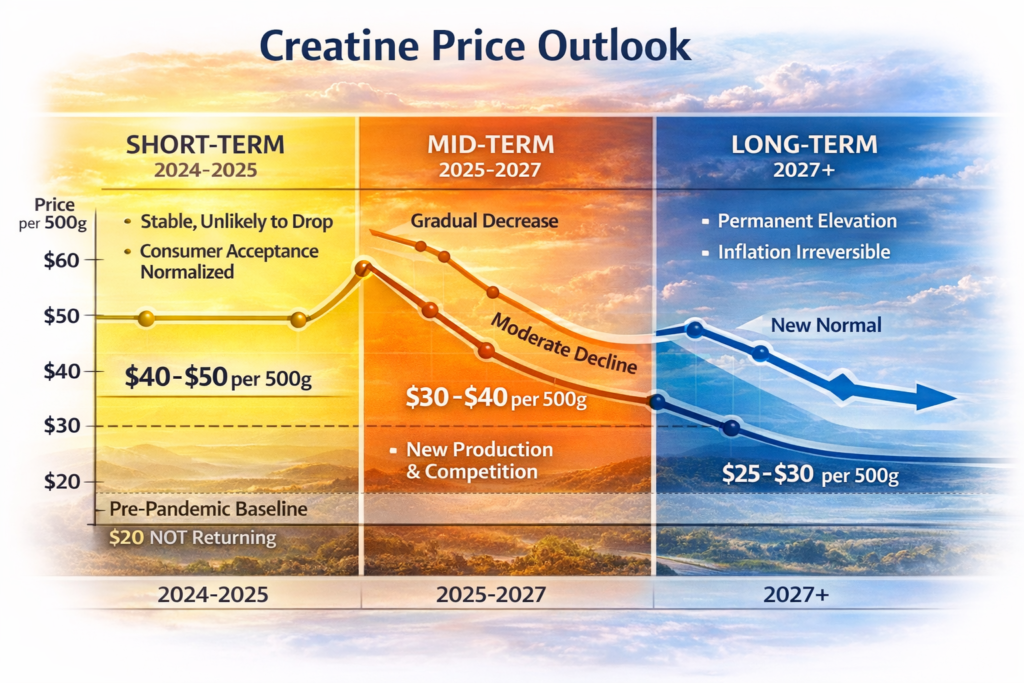
Will Creatine Prices Drop?
The outlook.
Short-Term (2024-2025): Unlikely
Why prices won’t drop immediately:
Reason 1: Consumer acceptance
- People are now paying $40-50 for creatine
- Normalized to new price point
- Companies have no incentive to lower prices
- Price anchoring
Reason 2: Retailer margins
- Retailers increased margins when could blame “shortages”
- Reluctant to reduce margins now
- Profit maximization
- Margin protection
Reason 3: Brand positioning
- Some brands positioned as “premium” at higher prices
- Lowering price damages brand perception
- Marketing strategy
Reason 4: Continued input costs
- Shipping still elevated (not back to 2019 levels)
- Raw materials still expensive
- Labor costs increased (won’t decrease)
- Persistent costs
Expected short-term:
- Prices stabilize at current levels
- Slight decreases possible (5-10%)
- But not returning to pre-2022 prices
- New baseline
Mid-Term (2025-2027): Gradual Decrease Possible
Factors that could lower prices:
Factor 1: Production capacity increases
- New facilities coming online in Germany
- China ramping up production (slowly)
- By 2026, could approach 2019 production levels
- Supply increase
Factor 2: New competitors entering market
- High prices attract new manufacturers
- If profitable, more companies will produce
- Increased competition = lower prices
- Competition effect
Factor 3: Alternative production locations
- Some companies exploring production in India, US
- Diversification of supply
- Reduces dependence on China
- Geographic diversification
Factor 4: Market saturation
- Demand can’t grow infinitely
- Eventually market saturates
- Growth slows
- Demand plateau
Expected mid-term:
- Gradual price decrease (10-20%)
- Stabilization around 50-60% above pre-pandemic
- New competitors force price competition
- Moderate reduction
Long-Term (2027+): New Normal
The likely outcome:
- Prices won’t return to pre-2022 levels
- Settle at 40-50% above historical prices
- Inflation + new baseline costs
- Permanent increase (but lower than now)
Why not back to old prices:
- Inflation irreversible (2024 $20 ≠ 2019 $20)
- Some supply chain costs permanent
- Labor costs won’t decrease
- New cost structure
The silver lining:
- Still will decrease from current peak
- More competition will help
- Alternative sources may emerge
- Improvement from today
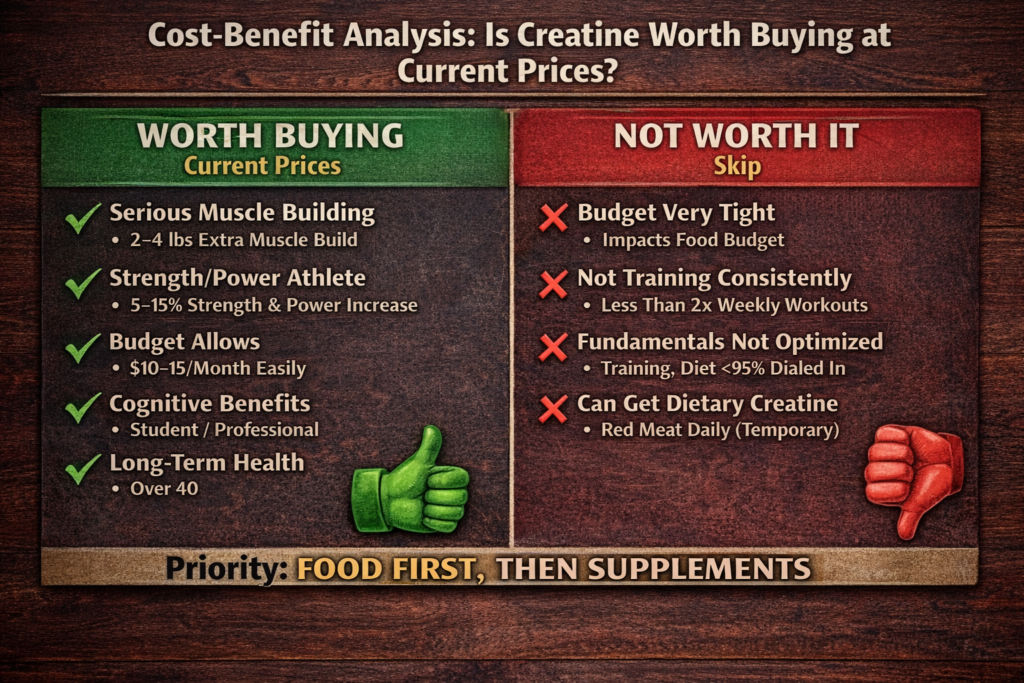
Is Creatine Still Worth It at Current Prices?
The cost-benefit analysis.
The Current Cost
Typical prices (2024-2025):
- 500g creatine: $35-50
- 1kg creatine: $60-90
- Per serving (5g): $0.35-0.45
- Monthly cost (5g daily): $10.50-13.50
- Current economics
Historical comparison:
- 2019: $0.10-0.15 per serving
- 2024: $0.35-0.45 per serving
- 3-4x increase
The Benefits (Unchanged)
Performance benefits:
- Strength increase: 5-15%
- Power output: 5-15%
- Muscle gain: 2-4 lbs additional over 12 weeks (vs. training alone)
- Work capacity: 10-20% increase
- Measurable performance
Cognitive benefits:
- Working memory improvement (especially in sleep-deprived)
- Processing speed increase
- Mental fatigue reduction
- Potential mood improvement
- Brain benefits
Health benefits:
- Muscle preservation with aging
- Potential neuroprotection
- May support bone health
- Generally safe long-term
- Longevity support
The value proposition:
- Most researched supplement
- Proven effectiveness (not placebo)
- Safe profile (decades of research)
- Broad benefits (not just muscle)
- High-value supplement
When It’s Worth It
Worth buying if:
Serious about muscle building:
- Creatine adds 2-4 lbs muscle over 12 weeks
- That’s significant progress
- Worth $10-15/month if building muscle is priority
- Goal alignment
Strength/power athlete:
- 5-15% strength increase
- Competitive advantage
- Performance-dependent income/goals
- ROI positive
Budget allows without sacrifice:
- Can afford $10-15/month easily
- Doesn’t impact food budget
- Discretionary income available
- Financial comfort
Using for cognitive benefits:
- Student during exams (mental performance)
- High cognitive demand job
- Sleep-deprived regularly
- Brain performance priority
Long-term health investment:
- Over 40 (muscle preservation important)
- Family history of cognitive decline
- Preventive health focus
- Longevity orientation
When It’s NOT Worth It
Skip creatine if:
Budget is very tight:
- $10-15/month impacts food budget
- Can’t afford optimal nutrition
- Food comes first
Priority order:
- Adequate calories
- Sufficient protein (0.8-1g per lb)
- Micronutrient-rich foods
- Then supplements
- Hierarchy of needs
Not training consistently:
- Training <2x per week
- No progressive overload
- Diet not optimized
- Fix fundamentals first
Realistic impact:
- Creatine adds ~5% to results
- Training and diet = 95%
- If 95% not optimized, 5% doesn’t matter
- Foundation missing
Can get dietary creatine:
- Eat red meat daily (see below)
- Temporary solution while prices high
- Save money for other priorities
- Alternative source
The Break-Even Analysis
Cost per month: $12 (average) Benefit: 2-4 lbs extra muscle over 12 weeks
Alternative spending:
- $12/month on extra chicken breast: +600 calories, +120g protein monthly
- $12/month saved: Accumulates to $144/year
- Opportunity cost
For serious lifters:
- Extra muscle worth far more than $12/month
- Creatine is worth it
- Clear value
For casual gym-goers:
- May prefer to save money
- Or spend on other things (better food quality)
- Individual choice
4 Ways to Save Money on Creatine
Pay less without sacrificing quality.
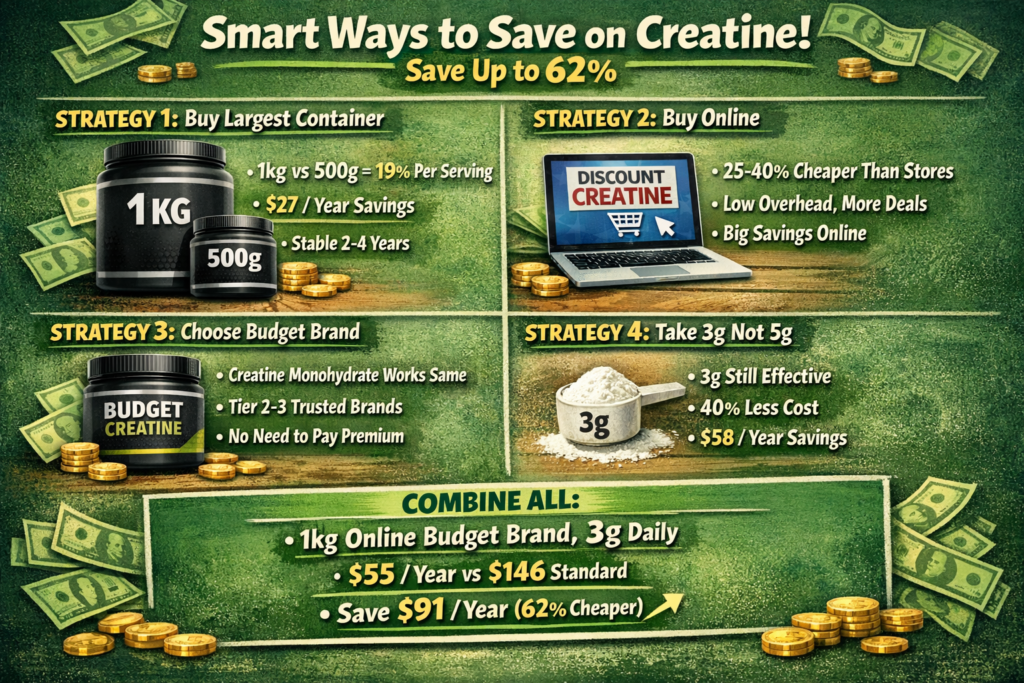
Strategy 1: Buy the Largest Container Available
The principle:
- Bulk discount
- Larger containers = lower per-serving cost
- Economy of scale
The numbers:
500g container:
- Price: $40
- Servings (5g): 100
- Cost per serving: $0.40
- Standard pricing
1kg container:
- Price: $65
- Servings (5g): 200
- Cost per serving: $0.325
- Savings: $0.075 per serving (19% cheaper)
Over time:
- Daily use: Save $27.38 per year with 1kg
- Significant savings
- Annual impact
The consideration:
Shelf life:
- Creatine monohydrate: Stable for 2-4 years
- Even past “expiration”: Often still effective if stored properly
- 1kg = 200 days (6.5 months at 5g daily)
- Well within shelf life
- No waste concern
Storage:
- Cool, dry place
- Airtight container
- Away from moisture
- Maintains potency
- Proper storage extends life
Only buy bulk if:
- Retailer actually offers discount (check per-serving price)
- You’ll use it (committed to creatine)
- Can afford upfront cost
- Verify value
Strategy 2: Buy Online
Why online is cheaper:
Lower overhead:
- No physical storefront (no rent, utilities, in-store staff)
- Warehouse model cheaper
- Pass savings to customers
- Operational efficiency
Higher competition:
- Easy to compare prices online
- Forces competitive pricing
- Brick-and-mortar less competitive (local monopoly)
- Market pressure
Direct-to-consumer:
- Some brands sell directly online
- Eliminates retailer markup
- Manufacturer direct pricing
- Fewer intermediaries
The savings:
- Online: $35-45 for 500g
- Retail store: $50-70 for 500g
- Savings: 25-40%
- Substantial difference
Where to buy online:
- Amazon (check sellers, reviews)
- Bodybuilding.com
- iHerb
- MyProtein
- Bulk Supplements
- Direct from manufacturer
- Established retailers
Important:
- Check seller reputation
- Read reviews
- Verify authenticity (especially on Amazon, third-party sellers)
- Quality verification
Strategy 3: Choose Cheapest Reputable Brand
The truth about creatine:
- Creatine monohydrate is creatine monohydrate
- If it’s real creatine, it works the same
- Brand doesn’t affect efficacy
- Commodity product
Why price varies:
- Marketing/branding costs
- Packaging (fancy vs. simple)
- Retailer margins
- Country of origin (German = premium price)
- Non-functional differences
The quality hierarchy:
Tier 1: Premium (Creapure – German)
- Highest purity (99.99%)
- Most tested
- Price: $50-70 per kg
- Best quality, highest price
Tier 2: Reputable generic
- Good purity (99.5%+)
- Established brands
- Price: $40-60 per kg
- Good balance
Tier 3: Budget brands
- Acceptable purity (99%+)
- Less testing/certification
- Price: $30-45 per kg
- Cheapest reliable option
Tier 4: Unknown brands
- Questionable purity
- No testing
- Risk of contamination or filler
- Avoid
The strategy:
- Choose Tier 2 or 3 from known retailer
- Avoid Tier 4 completely
- Tier 1 unnecessary (marginal benefit for price premium)
- Optimize value
How to verify brand:
- Established supplement companies (Optimum Nutrition, Dymatize, MyProtein, Bulk Supplements)
- Check online reviews
- Look for third-party testing (Informed-Sport, NSF)
- If never heard of brand, skip it
- Reputation check
Strategy 4: Take Minimum Effective Dose (3g)
The dosing range:
- Standard recommendation: 3-5g daily
- Most people default to 5g (one scoop)
- Habit, not requirement
The research:
- 3g daily sufficient for most people
- Fully saturates muscles (just takes slightly longer)
- 5g provides no additional benefit once saturated
- 3g is enough
The math:
5g daily:
- 500g container = 100 days
- Cost: $40
- Cost per day: $0.40
- Standard approach
3g daily:
- 500g container = 167 days
- Cost: $40
- Cost per day: $0.24
- 40% cheaper
Annual savings:
- 5g daily: $146/year
- 3g daily: $88/year
- Savings: $58/year
- Meaningful difference
When 5g better:
- Very large/muscular individuals (>220 lbs)
- During loading phase (first week, 20g daily)
- Preference (minor benefit possible)
- Edge cases
For most people:
- 3g perfectly adequate
- Maintains saturation
- Saves money
- Optimal dose
Implementation:
- Use 3/5 of a scoop
- Or measure 3g
- Daily consistency
- Simple adjustment
Dietary Sources: Can You Get Creatine from Food?
The food alternative.
How Much Creatine in Food?
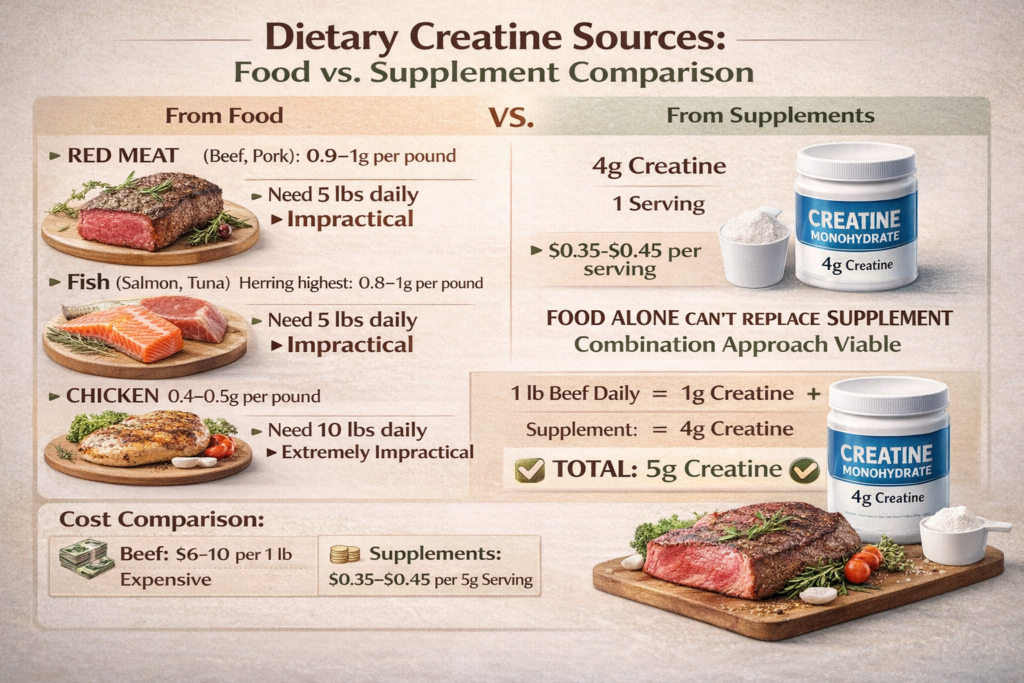
Red meat:
- Beef: 0.9-1.0g per pound
- Pork: 0.9-1.0g per pound
- Best source
Fish:
- Salmon: 0.9-1.0g per pound
- Tuna: 0.8-0.9g per pound
- Herring: 1.1-1.2g per pound (highest)
- Good source
Chicken:
- 0.4-0.5g per pound
- Lower than red meat/fish
- Moderate source
Can You Get 5g from Food?
To get 5g creatine:
- Need: 5 lbs beef daily
- Or: 5 lbs salmon daily
- Or: 10 lbs chicken daily
- Impractical amounts
The realistic approach:
- 1 lb beef daily: ~1g creatine
- Supplement with 4g: Total 5g
- Combination approach
OR temporarily:
- 1-2 lbs red meat/fish daily
- Get 1-2g from food
- Not optimal, but something
- Save money while prices high
- Temporary solution
The drawbacks:
- Expensive (1 lb beef = $6-10)
- High in saturated fat (if only source)
- Impractical
- Incomplete saturation (only 1-2g)
- Not ideal
The reality:
- Food alone can’t replace supplement
- But can reduce supplement need
- Combination approach viable
- Partial solution
Alternatives to Consider
If creatine too expensive.
Option 1: Wait for Price Decrease
The approach:
- Pause creatine supplementation
- Wait 12-24 months
- Resume when prices lower
- Temporary break
The impact:
- Lose ~2-4 lbs muscle (creatine-specific gain)
- Lose ~5-10% strength
- Reversible when resume
- Temporary loss
When this makes sense:
- Budget very tight
- Recreational lifter (not competitive)
- Can allocate money to better food
- Priority adjustment
Option 2: Cycle Creatine
The protocol:
- 3 months on
- 1 month off
- Repeat
- Periodic use
The savings:
- 25% reduction in annual cost
- $146/year → $110/year (at 5g dose)
- Modest savings
The research:
- No need to cycle for safety
- But cycling doesn’t harm
- Lose benefits during off month
- Optional strategy
Option 3: Load Only When Needed
The approach:
- Maintain baseline (no creatine most of year)
- Load before important periods (competition, goal cycle)
- 20g daily for 1 week
- Maintains saturation for 4-6 weeks
- Strategic timing
The cost:
- 140g for load + 4 weeks maintenance (5g daily)
- 280g total per cycle
- 2-3 cycles per year = 560-840g annually
- Vs. 1,825g year-round
- 54-69% savings
The trade-off:
- Only have benefits 3-4 months per year
- Miss cognitive and health benefits rest of year
- Partial benefits
Option 4: Focus on Training and Diet
The reminder:
- Creatine adds ~5% to results
- Training and diet = 95%
- If budget limited, prioritize 95%
- Foundation first
Better spending:
- $12/month on creatine
- Or $12/month on higher quality protein
- Or $12/month on more vegetables
- Allocation question
For beginners:
- First 1-2 years, training and diet alone produce massive gains
- Creatine marginal benefit
- Can wait
- Priorities
The Bottom Line: Expensive But Still Valuable
After explaining everything:
The truth about creatine prices:
✅ Creatine prices doubled 2022-2024 (100%+ increase)
✅ Four main causes: Supply chain, production reduction, demand explosion, inflation (perfect storm)
✅ Prices won’t return to pre-2022 levels (new baseline)
✅ Still the most effective supplement (cost increased but value unchanged)
✅ Multiple strategies to save money (pay less without lower quality)
Key takeaways:
The 4 reasons creatine is expensive:
1. Supply chain disruptions
- Shipping costs 3-6x higher than pre-pandemic
- Delays and container shortages
- Still not fully normalized
- +40% to price
2. Production capacity reduction
- China produces 70-80% of global supply
- Factories closed during pandemic
- Production still down 40% from 2019
- Supply shortage
3. Increased demand
- Social media exposure (massive reach)
- New research (cognitive, mental health benefits)
- Demographic expansion (women, older adults, non-athletes)
- Market 5-10x larger than 2015
- Demand explosion
4. General inflation
- 15-25% cumulative inflation 2021-2024
- All consumer goods increased
- Creatine affected like everything
- +20% baseline
Price outlook:
- Short-term (2024-2025): Stable, unlikely to drop significantly
- Mid-term (2025-2027): Gradual decrease 10-20% possible
- Long-term (2027+): Settle 40-50% above pre-pandemic (not returning to old prices)
- New normal higher
Is it still worth it:
- Yes if: Serious about muscle building, athlete, budget allows, cognitive benefits needed
- No if: Budget very tight (food first), not training consistently, can get dietary creatine
- Individual decision
4 ways to save money:
1. Buy largest container
- 1kg vs. 500g saves 19% per serving
- Creatine stable for 2-4 years
- $27/year savings
2. Buy online
- 25-40% cheaper than retail stores
- Lower overhead, higher competition
- Substantial savings
3. Choose cheapest reputable brand
- Creatine monohydrate is commodity (works the same)
- Avoid Tier 4 (unknown brands)
- Tier 2-3 optimal (known brands, lower price)
- Quality without premium
4. Take 3g instead of 5g
- 3g fully saturates muscles
- 40% less cost
- $58/year savings
Combining all strategies:
- Buy 1kg online (budget brand): $50
- Take 3g daily: 333 days supply
- Cost per day: $0.15
- Annual cost: $55
- Vs. standard approach: $146
- Total savings: $91/year (62% cheaper)
Dietary sources:
- Red meat/fish: ~1g per pound
- Need 5 lbs daily for 5g (impractical)
- Can reduce supplement need but not replace
- Partial solution only
Alternatives if can’t afford:
- Wait for price decrease (temporary break)
- Cycle on/off (25% savings)
- Load only when needed (54-69% savings)
- Focus on training/diet instead (foundation first)
- Options exist
Priority actions:
- Calculate if creatine fits budget ($10-15/month at current prices)
- If yes: Buy 1kg online from reputable brand, take 3g daily
- If no: Increase red meat/fish intake temporarily, wait for prices to drop
- Track results (worth it or not is personal)
- Reassess in 12 months (prices may improve)
- Strategic approach
CREATINE IS EXPENSIVE NOW. BUT IT’S STILL THE MOST EFFECTIVE SUPPLEMENT. BUY SMART: LARGE CONTAINERS, ONLINE, BUDGET BRANDS, 3G DOSES. SAVE 60% WITHOUT SACRIFICING QUALITY.
Ready to optimize your entire supplement strategy with cost-benefit analyses, budget allocation frameworks, quality verification protocols, and evidence-based supplement selection that maximizes results per dollar spent? Understanding creatine pricing is just the beginning. Get comprehensive supplement guidance that fits your budget. Stop overpaying for supplements. Start spending strategically.
REFERENCES
SECTION 1 — Supply Chain Disruptions and Price History
[1] Glazier M (NutraBio Labs CEO) — NutraBio Supply Chain Blog Series, 2021 Dietary supplement supply chain update: creatine and citrulline are getting out of control — creatine price per kilo tripled since April 2021; three major Chinese manufacturers (Yongan, Baosui, Hengkang) rationing outputs; shortages from HAN and cyanimide raw material reductions enforced by Chinese anti-pollution regulations https://blog.nutrabio.com/2021/06/23/dietary-supplement-supply-chain-update-creatine-and-citrulline-are-getting-out-of-control/
[2] Glazier M (NutraBio Labs CEO) — NutraBio Supply Chain Blog, October 2021 Still can’t get the creatine — container cost rose from $85,500 to $630,000 (700% increase) between January and October 2021; Chinese factories reduced to 2-day production weeks due to coal energy crisis; domestic freight increased 80-85% in first half of 2021 https://blog.nutrabio.com/2021/10/12/still-cant-get-the-fn-creatine/
[3] Murphy C (Nutra Holdings LLC) — BarBend Supply Chain Report, February 2022 Inside the creatine shortage affecting consumers and supplement brands — creatine maintained ~$5/kg in early 2021, rising to $42/kg by early 2022 “with more increases to come”; shortage expected to remain in full effect throughout 2022; Optimum Nutrition and BSN products out of stock https://barbend.com/creatine-supply-shortage/
[4] NutraBio Labs — Supply Chain Update, August 2021 Dietary supplement industry supply chain update — shipping cost from China to US increased 4-7x since pre-COVID; container wait times over 3 weeks with costs increasing $1,000 every 2 weeks; analysts predict freight will not return to pre-pandemic levels; new norm is higher baseline costs https://nutrabio.com/blogs/blog/dietary-supplement-industry-supply-chain-update
SECTION 2 — Production Geography and Raw Material Constraints
[5] Krask S (Alzchem/Creapure CEO) — NutraIngredients, September 2022 Creatine supply remains tight, but new production capacity could ease situation — China produces majority of global supply; Alzchem (Germany) produces remainder under Creapure brand; cyanamide and sarcosinate are key precursor raw materials; Alzchem investing €12M to double capacity; Rick Kreider (Texas A&M): “creatine monohydrate is by far the most effective and cheapest form” https://www.nutraingredients.com/Article/2022/09/22/Creatine-supply-remains-tight-but-new-production-capacity-could-ease-situation/
[6] Alzchem Group — NutraIngredients, December 2025 Alzchem Group invests €120M in creatine value chain — constructing new automated plant for creatine and precursors (sodium sarcosinate and cyanamide); commissioning planned in stages from 2027; Alzchem described as “only producer outside Asia” of high-purity creatine; investment expected to generate hundreds of millions in additional annual sales https://www.nutraingredients.com/Article/2025/12/16/alzchem-group-invests-120m-in-creatine-value-chain/
[7] Caloong Chemical Co. — China Creatine Price Analysis, 2025 Creatine monohydrate price trend 2025 — 2021 price peak at RMB 41,200/ton caused by raw material shortages; four new Chinese production projects launched 2023-2024; overcapacity now primary driver of falling prices; China production capacity reached 28,949 tons in 2021 and continued expanding; 30% year-on-year price decline in 2025 https://caloongchem.com/creatine-monohydrate-price-trend-2025-market-analysis-historical-data-future-outlook/
SECTION 3 — Demand Expansion and Market Growth
[8] Cognitive Market Research / Research and Markets — Global Creatine Market Reports, 2024 Global creatine market valued at $502–515 million in 2024, projected to reach $700.5 million by 2030 at 5.7% CAGR; North America holds ~40% share; powder format dominates at 68-80% of global unit sales; market driven by rising fitness awareness and expanding use beyond athletics https://www.researchandmarkets.com/report/creatine
[9] Grand View Research — Creatine Supplements Market Report, 2025 Global creatine supplements market estimated at $1.37 billion in 2025, projected to reach $8.68 billion by 2033 at 26.2% CAGR; powder segment leads with 80.4% share; expanding consumer base including women and older adults drives growth beyond traditional athletic use https://www.grandviewresearch.com/industry-analysis/creatine-supplements-market-report
SECTION 4 — Scientific Efficacy of Creatine (Value Justification)
[10] Kreider RB et al. — Journal of the International Society of Sports Nutrition (ISSN), 2017 International Society of Sports Nutrition position stand: safety and efficacy of creatine supplementation in exercise, sport, and medicine — creatine monohydrate is the most effective ergogenic supplement for increasing high-intensity exercise capacity and lean body mass; supplementation up to 30g/day for 5 years is safe and well-tolerated; 3g/day maintenance sufficient for most individuals https://pmc.ncbi.nlm.nih.gov/articles/PMC5469049/
[11] Hultman E et al. — Journal of Applied Physiology, 1996 Muscle creatine loading in men — 20g/day for 6 days increases muscle total creatine by ~20%; same 20% increase achieved with 3g/day for 28 days; elevated levels maintained at 2-3g/day; established the scientific basis for both loading and maintenance dosing protocols https://pubmed.ncbi.nlm.nih.gov/8828669/
[12] Vilar Neto JO et al. — Asian Journal of Sports Medicine, 2018 Effects of low-dose creatine monohydrate on muscle strength and endurance — 36 male bodybuilders randomized to 3g/day, 5g/day, or placebo for 35 days; both 3g and 5g groups showed statistically equivalent strength gains (Δ% 1RM = 20.0 ± 4.0 vs. 19.9 ± 1.5); 3g/day confirmed as sufficient maintenance dose for most individuals https://brieflands.com/journals/asjsm/articles/62739
SECTION 5 — Cognitive and Brain Benefits (Demand Driver)
[13] Xu C et al. — Frontiers in Nutrition, 2024 The effects of creatine supplementation on cognitive function in adults: a systematic review and meta-analysis — 16 RCTs, 492 participants; significant improvements in memory (SMD = 0.31), attention time, and processing speed; creatine more beneficial in females and those aged 18-60; confirmed creatine monohydrate as the universally used form across all included studies https://pmc.ncbi.nlm.nih.gov/articles/PMC11275561/
[14] Gordji-Nejad A et al. — Scientific Reports, 2024 Single dose creatine improves cognitive performance and induces changes in cerebral high energy phosphates during sleep deprivation — 15 healthy adults; single dose 0.35g/kg creatine during 21 hours sleep deprivation significantly increased brain PCr levels, reduced subjective fatigue, and improved cognitive performance and processing speed vs. placebo https://pubmed.ncbi.nlm.nih.gov/38418482/
[15] Prokopidis K et al. — Nutrition Reviews (Oxford), 2023 Effects of creatine supplementation on memory in healthy individuals: a systematic review and meta-analysis of randomized controlled trials — 10 RCTs; creatine supplementation significantly improved overall memory vs. placebo; most pronounced effects in older adults aged 66-76; brain bioenergetics mechanism via augmented phosphocreatine stores https://pubmed.ncbi.nlm.nih.gov/35984306/


Leave a Reply
You must be logged in to post a comment.