
Trying to “power through” every day? You’re doing it wrong. Willpower depletes. Systems don’t.
You start Monday with massive willpower. You resist junk food. You hit the gym. You’re disciplined.
By Thursday, your willpower is gone. You eat the office donuts. You skip the gym. You feel like a failure.
You think high performers just have more willpower:
- They can resist temptation better
- They have iron discipline all day
- They’re naturally strong-willed
- They never struggle with motivation
Wrong. High performers use almost zero willpower. They’ve automated their behaviors. They built systems that don’t require daily decisions. They designed environments that make success inevitable. Willpower is their last resort, not their primary tool.
Here’s what’s actually happening: Willpower is a finite resource that depletes throughout the day. Every decision, every temptation resisted, every impulse controlled drains your willpower tank. By evening, you have nothing left. High performers know this, so they don’t rely on willpower at all. They use decision automation, environment design, implementation intentions, habit stacking, and identity-based systems. They make the right choice the easy choice, often the only choice. The science is clear: people who appear to have “great willpower” are actually people who rarely need to use it.
In this comprehensive guide, I’ll explain why willpower fails (the depletion mechanism), reveal the 8 systems high performers use instead (zero willpower required), show you how to design your environment for automatic success (remove decision points), provide the complete automation protocol (systematize everything), and explain why “trying harder” makes everything worse (paradoxical effect).
Whether you’re trying to transform your body, excel at work, or achieve any goal, understanding that willpower isn’t the answer changes everything.
Let’s build systems that make success inevitable without relying on daily willpower.
TABLE OF CONTENTS
The Science of Willpower Depletion
Understanding why willpower is unreliable.
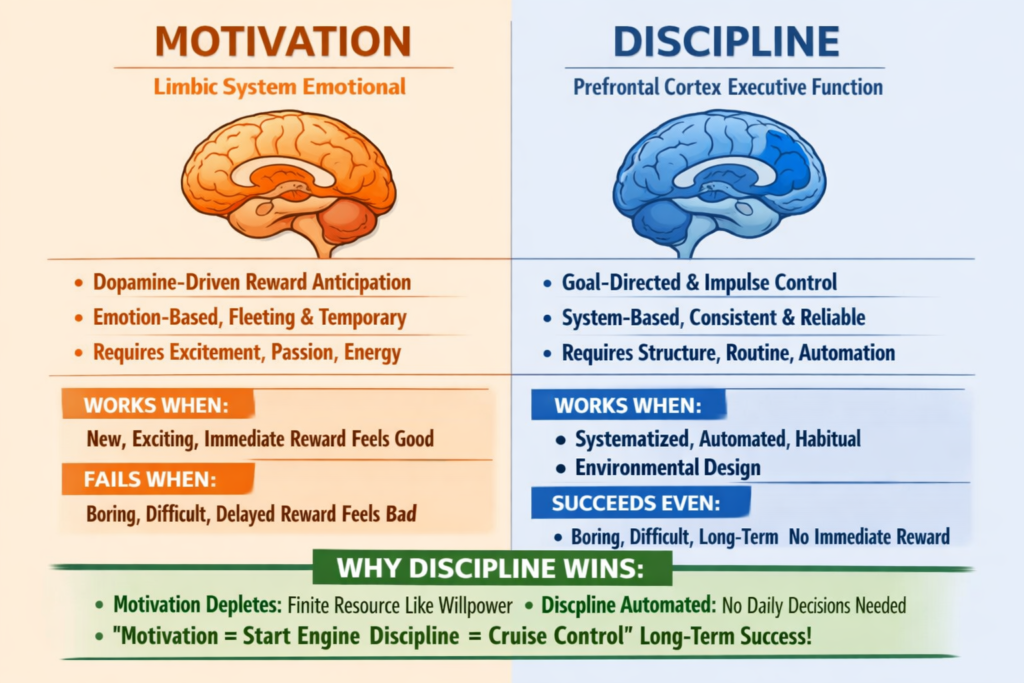
What Willpower Actually Is
The neurological reality:
- Executive function of prefrontal cortex
- Conscious self-control
- Impulse inhibition
- Goal-directed decision-making
- Cognitive resource
What it does:
- Overrides automatic impulses
- Delays gratification
- Maintains focus on long-term goals
- Resists immediate temptations
- Conscious control system
Examples in daily life:
- Resisting donuts in break room
- Going to gym when tired
- Staying focused on work instead of checking phone
- Eating salad instead of pizza
- Getting up early instead of hitting snooze
- Every “should” vs. “want” conflict
The metabolic cost:
- Prefrontal cortex is energy-expensive
- Uses significant glucose
- Sustained activation fatigues system
- Metabolically demanding
The Ego Depletion Effect
The discovery:
- Roy Baumeister’s research (1990s)
- Willpower acts like muscle
- Finite capacity
- Depletes with use
- Needs rest to recover
- Limited resource
The classic experiment:
Setup:
- Participants skip meal (hungry)
- Room with fresh-baked cookies and radishes
- Group A: Told to eat radishes, resist cookies (requires willpower)
- Group B: Told to eat cookies (no willpower needed)
- Both groups then given difficult puzzle
- Willpower depletion test
Results:
- Group A (resisted cookies): Gave up on puzzle quickly
- Group B (ate cookies): Persisted much longer on puzzle
- Resisting cookies depleted willpower
- Less available for subsequent task
- Depletion demonstrated
The mechanism:
- Each act of self-control depletes resource
- Subsequent self-control tasks harder
- By end of day, willpower tank empty
- Progressive depletion
The Daily Depletion Cycle
Morning (7:00 AM – 12:00 PM):
- Willpower tank full
- Self-control easy
- Resist temptations successfully
- Productive and focused
- Peak willpower
Afternoon (12:00 PM – 5:00 PM):
- Willpower partially depleted
- Temptations harder to resist
- Focus declining
- More impulsive decisions
- Moderate willpower
Evening (5:00 PM – 10:00 PM):
- Willpower severely depleted
- Poor food choices
- Skip planned workout
- Scroll phone instead of productive activities
- Minimal willpower
The pattern:
- Strong morning start
- Weakening throughout day
- Collapse in evening
- Predictable decline
The problem:
- Most people rely on willpower all day
- Make hundreds of decisions requiring self-control
- Deplete tank by evening
- Fail when it matters most (evening routine, meal prep, etc.)
- System guaranteed to fail
What Depletes Willpower
Decision-making:
- Every decision, even trivial ones
- “What should I eat?”
- “Should I check my phone?”
- “What should I wear?”
- Dozens to hundreds daily
- Decision fatigue
Resisting temptations:
- Food temptations (office snacks, drive-thru)
- Digital temptations (social media, email, entertainment)
- Comfort temptations (hitting snooze, skipping workout)
- Each resistance costs willpower
- Constant depletion
Emotional regulation:
- Stress management
- Controlling frustration or anger
- Maintaining composure
- Suppressing anxiety
- Emotional labor
Task initiation:
- Starting difficult tasks
- Overcoming procrastination
- Beginning workouts
- Each initiation requires push
- Activation energy
Multitasking:
- Switching between tasks
- Maintaining multiple focuses
- Interruption recovery
- Cognitive load
- Attention management
Social interactions:
- Politeness when annoyed
- Professional demeanor when stressed
- Conflict avoidance
- Impression management
- Social self-control
The cumulative effect:
- All these throughout day
- Hundreds of micro-depletions
- Tank empty by evening
- Overwhelmed system
Individual Differences in Willpower Capacity
Factors affecting capacity:
Sleep:
- Well-rested: Normal capacity
- Sleep-deprived: 50% reduced capacity
- Massive impact
Stress:
- Low stress: Normal capacity
- High stress: Significantly reduced
- Chronic stress: Severely impaired
- Stress multiplier
Blood glucose:
- Normal levels: Adequate capacity
- Low glucose: Impaired capacity
- Hypoglycemia: Severely compromised
- Fuel availability
Physical fitness:
- Better cardiovascular fitness = better self-control
- Exercise improves prefrontal cortex function
- Training effect
Practice:
- Self-control can be trained
- Like muscle, strengthens with use
- But still has daily limit
- Trainable but finite
Age:
- Prefrontal cortex fully develops around age 25
- Older adults: Experience improves efficiency but capacity may decline
- Developmental and aging factors
The variability:
- Some people naturally higher capacity
- But everyone has a limit
- Even high-capacity people deplete
- Universal limitation
Why “Just Try Harder” Doesn’t Work
The willpower paradox:
- Trying harder requires more willpower
- Uses willpower to generate willpower
- Depletes faster than replenishes
- Self-defeating
The spiral:
- Rely on willpower → depletes → fail
- Feel bad → stress increases → less willpower
- Try harder → more depletion → more failure
- Downward cycle
The research:
- “Ironic process theory” (Wegner)
- Trying NOT to think about something makes you think about it more
- Suppression backfires
- Willpower creates rebound effect
- Paradoxical outcome
The alternative:
- Don’t try harder
- Try smarter
- Build systems that don’t require willpower
- Systematic approach
The 8 Systems High Performers Use Instead
How to succeed without willpower.
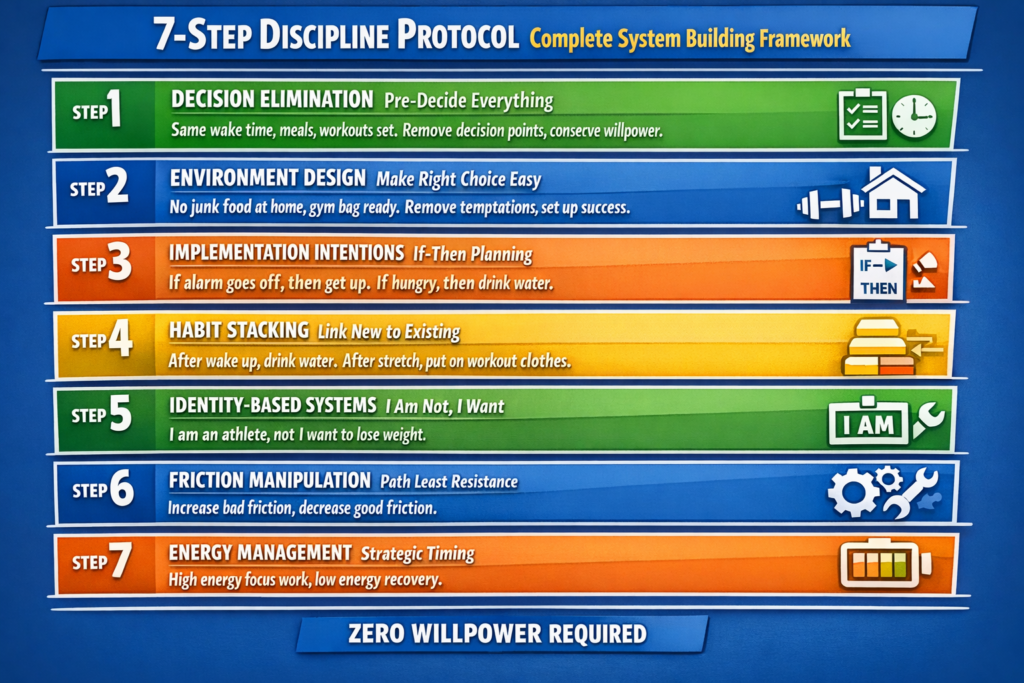
System 1: Ruthless Decision Elimination
The principle:
- Willpower depletes with decisions
- Eliminate decisions to preserve willpower
- Pre-decide everything possible
- Decision conservation
What high performers pre-decide:
Morning routine:
- Same wake time daily (no decision)
- Same breakfast (no menu decisions)
- Same workout time (no “should I go?” decision)
- Same clothes (Steve Jobs, Mark Zuckerberg approach)
- Complete automation
Training program:
- Exercises predetermined
- Sets and reps written
- Days scheduled
- Zero gym decisions
- Execution only
Meal planning:
- Week’s meals planned Sunday
- Groceries bought once
- Prep done in batch
- No daily “what should I eat?” decisions
- Food automation
Work schedule:
- Time blocks predetermined
- Project priorities set
- Meeting schedule fixed
- No constant reprioritization
- Structured workday
The mechanism:
- Remove decision points
- Follow predetermined plan
- Preserve willpower for unexpected challenges
- Strategic conservation
The benefit:
- Willpower available for true emergencies
- Not wasted on routine decisions
- Consistent execution
- Efficiency
How to implement:
- Sunday planning session
- Write entire week’s schedule
- Meal plan
- Training plan
- Work priorities
- Complete planning
System 2: Environment Design for Success
The principle:
- Environment shapes behavior more than willpower
- Design environment to make right choice easiest
- Remove temptations entirely
- Environmental determinism
Nutrition environment:
At home:
- No junk food in house (can’t eat what’s not there)
- Healthy foods visible and accessible
- Meal prep containers ready
- Water bottles everywhere
- Healthy default
At work:
- Healthy snacks in desk
- No cash for vending machine
- Water bottle on desk
- Pack lunch (don’t rely on cafeteria)
- Controlled environment
The mechanism:
- Remove option to make bad choice
- Willpower only needed at grocery store (once per week)
- Not needed 20+ times per day at home
- Single decision point
Training environment:
At home:
- Gym bag always packed
- Workout clothes laid out night before
- Shoes by door
- Gym on route home from work
- Zero friction
At gym:
- Arrive → change → start (no decisions)
- Program on phone (no planning)
- Headphones immediately in (no distractions)
- Execution mode
The benefit:
- Right choice is easy choice
- Often only choice
- Willpower rarely needed
- Automatic success
Digital environment:
Phone:
- Social media apps deleted
- Notifications off (except essential)
- Screen time limits set
- Phone in other room when working/sleeping
- Distraction elimination
Computer:
- Website blockers (Freedom, Cold Turkey)
- Single browser window (no tab proliferation)
- Email checked 2x daily (scheduled)
- Focused environment
How to implement:
- Audit current environment
- Identify temptation sources
- Systematically remove or hide
- Make desired behavior easiest path
- Environmental restructuring
System 3: Implementation Intentions (If-Then Planning)
The principle:
- Pre-planned responses to situations
- Removes in-moment decision-making
- Brain follows pre-set script
- Automated responses
The research:
- Peter Gollwitzer’s work
- Implementation intentions double success rate
- Reduces procrastination 50%
- Proven intervention
The format:
- “If [situation], then [specific action]”
- Concrete and specific
- No ambiguity
- Clear contingency
Training examples:
“If my alarm goes off at 6:00 AM, then I will count to 5 and immediately stand up.”
“If I feel like skipping my workout, then I will put on my gym clothes and commit to just 10 minutes.”
“If the gym is crowded, then I will do the alternative exercises I’ve pre-planned.”
“If I’m traveling, then I will do my hotel room bodyweight workout at 7:00 AM.”
Nutrition examples:
“If I’m hungry between meals, then I will drink 16oz water and eat the apple in my bag.”
“If coworkers order takeout, then I will eat the lunch I brought from home.”
“If I’m at a restaurant, then I will order protein + vegetables and skip bread and dessert.”
“If I’m craving sweets after dinner, then I will have Greek yogurt with berries.”
The mechanism:
- Situation triggers automatic response
- No willpower needed to decide
- Brain follows pre-programmed script
- Stimulus-response automation
How to implement:
- Identify common obstacles/temptations
- Write if-then statements for each
- Review weekly
- Add new ones as needed
- Comprehensive contingency planning
System 4: Habit Stacking
The principle:
- Link new behavior to existing habit
- Leverage established neural pathways
- Create behavioral chains
- Piggyback on automaticity
The format:
- “After [current habit], I will [new habit]”
- Sequence behaviors
- Build routine chains
- Sequential automation
Examples:
Morning routine:
- “After I turn off alarm, I will drink water bottle on nightstand”
- “After I drink water, I will do 5 minutes stretching”
- “After I stretch, I will put on workout clothes”
- “After I dress, I will go to gym”
- Morning chain
Evening routine:
- “After I finish dinner, I will take dishes to sink”
- “After dishes in sink, I will prepare tomorrow’s meals”
- “After meal prep, I will pack gym bag”
- “After gym bag packed, I will set out morning clothes”
- Evening chain
Work routine:
- “After I arrive at desk, I will close email and open project file”
- “After 90 minutes focused work, I will take 10-minute walk”
- “After walk, I will review priorities and start next task”
- Work chain
Why it works:
- Existing habit is cue
- No willpower needed for cue (already automatic)
- New behavior follows automatically
- Chain becomes single unit
- Expanded automation
How to implement:
- List current habits (teeth brushing, coffee making, commuting)
- Identify desired new habits
- Link new to existing
- Practice chain until automatic
- Systematic linking
System 5: Identity-Based Systems
The principle:
- Behavior flows from identity
- “I am” stronger than “I want”
- Identity change precedes behavior change
- Self-concept drives action
Traditional approach:
- Outcome-based: “I want to lose 20 pounds”
- Requires willpower daily to pursue
- Motivation fluctuates
- External goal
Identity-based approach:
- Identity-based: “I am a healthy person”
- Healthy people make healthy choices naturally
- Behavior flows automatically from identity
- Internal identity
The mechanism:
- People act consistently with self-image
- Cognitive dissonance when behavior conflicts with identity
- Drives consistency without willpower
- Self-concept enforcement
Examples:
Fitness identity:
- “I am an athlete”
- Athletes train consistently (no question)
- Missing training conflicts with identity
- Automatic adherence
Nutrition identity:
- “I am someone who fuels their body properly”
- Junk food inconsistent with identity
- Healthy eating natural expression of self
- Automatic choices
Professional identity:
- “I am a high performer”
- High performers don’t procrastinate
- Productivity natural expression
- Automatic execution
How to build:
- Declare identity explicitly
- Act as that person would
- Evidence accumulates
- Identity strengthens
- Positive feedback loop
The transformation:
- Week 1: Declare “I am [identity]” (aspirational)
- Month 1: Acting as if
- Month 3: Evidence supports identity
- Month 6: Deep belief in identity
- Year 1: Identity integrated
- Progressive internalization
System 6: Friction Manipulation
The principle:
- Increase friction for bad behaviors
- Decrease friction for good behaviors
- Path of least resistance determines outcome
- Behavioral economics
Increase friction for unwanted behaviors:
Social media:
- Delete apps from phone (must use browser)
- Log out after each use (must log in again)
- Use long random password (makes access harder)
- Multi-layer friction
Junk food:
- Don’t buy it (not in house)
- If buying, buy far from home (inconvenient)
- Keep in hard-to-reach place
- Access barriers
Skipping workouts:
- Gym membership paid annually (sunk cost)
- Workout partner waiting (social accountability)
- Clothes already on (physical commitment)
- Multiple barriers to quitting
Decrease friction for desired behaviors:
Healthy eating:
- Meal prep done (just reheat)
- Healthy snacks visible (grab easily)
- Water bottles everywhere (constant access)
- Zero friction
Training:
- Gym bag always packed (no preparation)
- Gym clothes sleep in (wake up ready)
- Gym on commute route (no detour)
- Seamless execution
Productive work:
- Phone in other room (no distraction)
- Computer boots to project file (immediate start)
- Office door closed (interruption prevention)
- Frictionless focus
The mechanism:
- Humans take path of least resistance
- High friction = less likely
- Low friction = more likely
- Engineer friction strategically
- Behavioral architecture
The benefit:
- Right behavior easiest behavior
- Wrong behavior hardest behavior
- Minimal willpower needed
- Gravity working for you
System 7: Energy Management Over Time Management
The principle:
- Willpower varies with energy levels
- High-willpower tasks during high-energy times
- Protect energy, not just time
- Strategic energy allocation
The energy curve:
Peak energy times (typically morning):
- Schedule highest-priority work
- Difficult tasks requiring focus
- Important decisions
- Creative work
- Maximum capacity
Medium energy times (typically mid-day):
- Routine tasks
- Meetings
- Email processing
- Moderate-difficulty work
- Moderate capacity
Low energy times (typically evening):
- Easy tasks only
- Recovery activities
- Preparation for tomorrow
- No important decisions
- Minimal capacity
What high performers do:
Protect morning:
- No meetings before 10 AM
- No email checking first 2 hours
- Highest-priority project only
- Deep work
- Sacred time
Manage afternoon:
- Meetings acceptable
- Collaborative work
- Administrative tasks
- Flexible time
Minimize evening demands:
- Meal prep already done (no cooking decisions)
- Training already done (morning workout)
- Next day planned (no evening planning)
- Relaxation only
- Recovery time
The benefit:
- Work with energy curve, not against it
- Willpower available when most needed
- Avoid making important decisions when depleted
- Strategic timing
How to implement:
- Track energy levels for 1 week
- Identify peak, medium, low times
- Schedule accordingly
- Protect high-energy time ruthlessly
- Personalized schedule
System 8: Keystone Habits
The principle:
- Some habits trigger cascade of other good habits
- Focus on keystone, others follow
- Multiplier effect
- Leverage point
The research:
- Charles Duhigg’s “The Power of Habit”
- Certain habits create momentum
- Positive spillover effects
- Systemic change
Keystone habits for fitness:
Morning workout:
- Triggers: Healthy breakfast, better food choices all day, earlier bedtime, more energy
- One habit improves entire day
- Cascade effect
Meal preparation:
- Triggers: Better nutrition, saved money, more cooking skills, less decision fatigue
- Organized food = organized life
- Systemic organization
Adequate sleep:
- Triggers: Better workouts, better food choices, more willpower, better mood, higher productivity
- Sleep affects everything
- Foundation habit
The mechanism:
- Keystone habit creates small win
- Builds confidence
- Momentum spreads
- Other behaviors improve naturally
- Positive contagion
How to identify your keystone:
- What one habit would make everything else easier?
- What habit creates positive momentum?
- For most people: Morning routine, sleep, or exercise
- Personal leverage point
How to implement:
- Focus on ONE keystone habit only
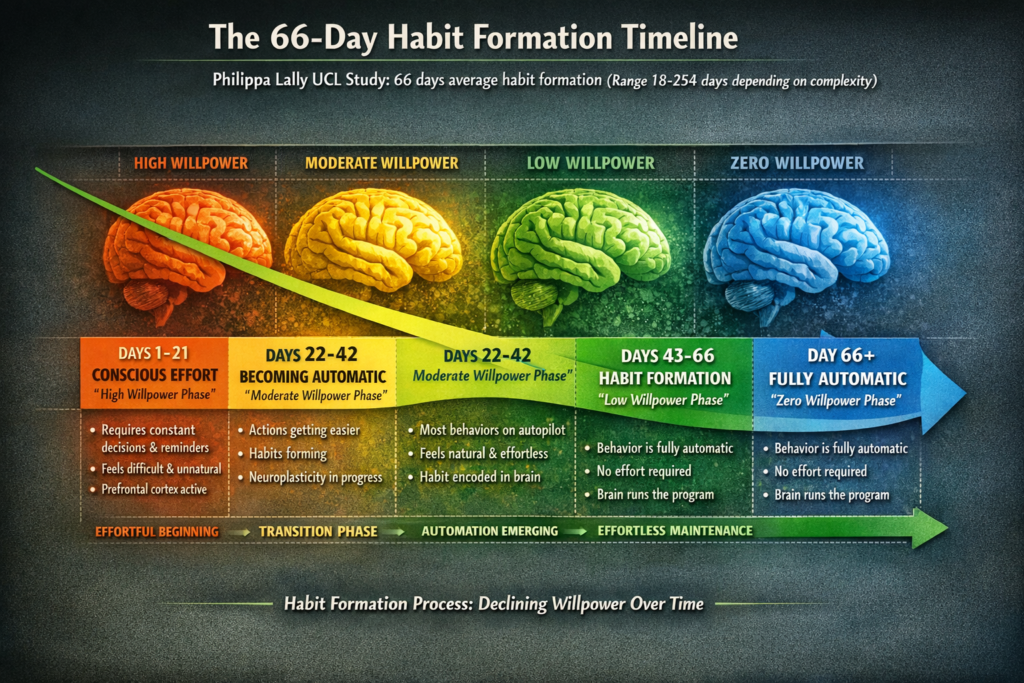
- Perfect it for 66 days (habit formation)
- Watch spillover effects
- Then add next keystone if needed
- Sequential building
The Willpower Paradox
Why trying to build willpower is counterproductive.
The Muscle Analogy (And Why It’s Misleading)
The claim:
- Willpower is like muscle
- Can be strengthened with training
- Practice self-control to build capacity
- Common belief
The partial truth:
- Yes, prefrontal cortex can strengthen
- Self-control practice shows improvements
- Brain scans confirm structural changes
- Some evidence
The problem:
- Even trained muscle has daily limit
- Bodybuilder still fatigues after workout
- Can’t lift weights 24/7
- Capacity increased but still finite
The implication:
- Building willpower helps
- But doesn’t solve core problem
- Still depletes daily
- Still need systems
- Necessary but insufficient
The Rebound Effect
What happens:
- Suppress urge with willpower
- Urge grows stronger
- Eventually breaks through with vengeance
- Overcompensation
- Ironic process
Examples:
Diet restriction:
- White-knuckle through week
- Willpower depletes
- Weekend binge
- Eat more than if hadn’t restricted
- Counterproductive
Social media abstinence:
- Force self off all day
- Evening willpower depleted
- Binge scroll for hours
- Worse than if hadn’t restricted
- Rebound consumption
The mechanism:
- Suppression requires active mental energy
- Constant reminder of forbidden thing
- Builds psychological pressure
- Release is explosive
- Pressure cooker effect
The alternative:
- Don’t rely on suppression
- Remove temptation entirely (environment design)
- Or schedule controlled consumption (permission)
- Systematic approach
The Ego Threat Problem
The phenomenon:
- Willpower failure feels like personal failure
- “I’m weak, I have no self-control”
- Damages self-concept
- Creates stress
- Stress further depletes willpower
- Downward spiral
The cycle:
- Rely on willpower → fail → feel bad about self
- Stress increases → willpower decreases
- Try harder → fail worse → feel even worse
- Self-perpetuating
The alternative frame:
- “My system failed, not me”
- Willpower failure = system design problem
- Depersonalize the failure
- Fix system
- Objective troubleshooting
The benefit:
- No ego threat
- No stress increase
- No further willpower depletion
- Productive problem-solving
- Constructive approach
Why High Performers Appear to Have Great Willpower
The perception vs. reality gap.
The Observer’s Perspective
What you see:
- Successful person consistently training
- Always eating healthy
- Highly productive
- Never seems to struggle
- Appears to have iron willpower
What you don’t see:
- Environment meticulously designed
- Decisions pre-made
- Systems automated
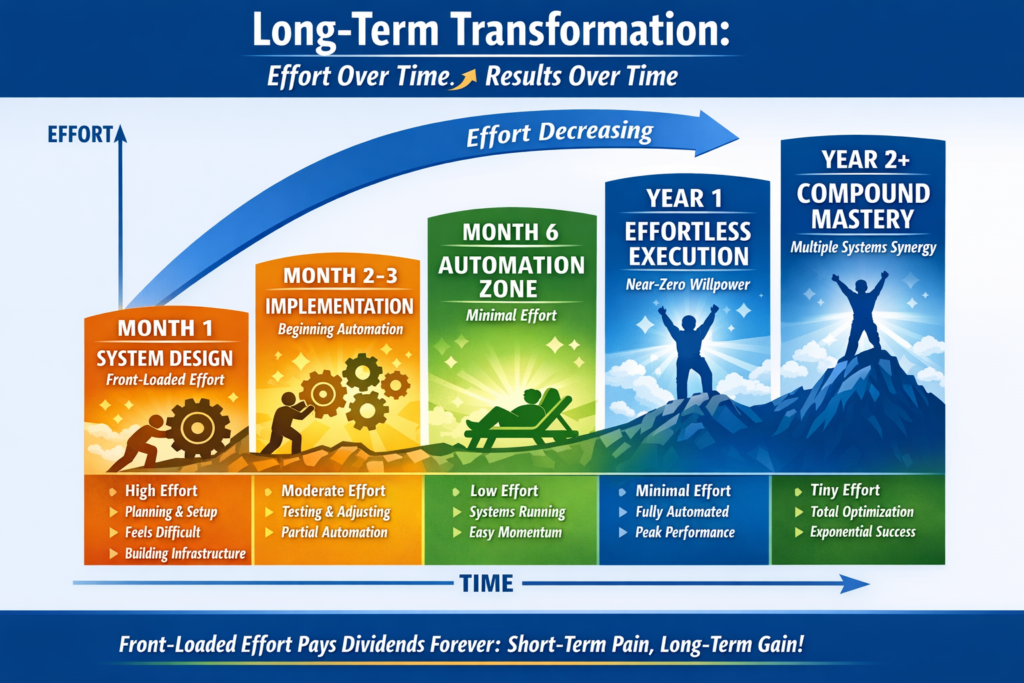
- Struggles were front-loaded (system design phase)
- Hidden infrastructure
The assumption:
- “They’re just more disciplined than me”
- “They have better willpower”
- “They’re naturally motivated”
- Attribution error
The reality:
- They use minimal willpower
- Success is systematized
- Appears effortless because it IS effortless
- Automated success
The Illusion of Effortlessness
The phenomenon:
- Expert performance looks easy
- Beginner doesn’t see the system
- Assumes talent or willpower
- Iceberg effect
The truth:
- Significant effort went into system design
- Hours of planning and optimization
- Trial and error to find what works
- Front-loaded effort
The maintenance:
- Once system established
- Minimal ongoing effort
- Appears effortless
- Actually systematized
- Automated operation
The example:
Fitness influencer:
- You see: Perfect physique, never seems to struggle
- You think: “Must have amazing willpower”
- Reality: Meal prep done, gym scheduled, environment controlled, decisions eliminated
- System, not willpower
The Compound Effect
The mechanism:
- Small systems compound over time
- Each system reduces willpower need
- Multiple systems = near-zero willpower lifestyle
- Systemic synergy
The accumulation:
- Year 1: Morning routine automated
- Year 2: + Nutrition automated
- Year 3: + Work routine automated
- Year 5: + Financial habits automated
- Progressive systematization
The result:
- Entire life runs on systems
- Willpower only for true emergencies
- Success seems inevitable
- High performance without struggle
The perception:
- Outsider: “They’re superhuman”
- Reality: “They’re super-systematic”
- Methodology, not ability
How to Build Your Willpower-Free System
Practical implementation guide.
Phase 1: Audit Your Willpower Drains (Week 1)
The exercise:
- Track every moment requiring willpower
- Note time of day
- Note situation
- Note outcome (success or failure)
- Comprehensive assessment
What to track:
Morning:
- Waking up (snooze battles)
- Getting ready (clothing decisions)
- Breakfast (food decisions)
- Commute (route decisions, traffic stress)
- Morning drains
Workday:
- Task prioritization decisions
- Resisting distractions
- Staying focused
- Social interactions requiring self-control
- Workday drains
Evening:
- Training decision (go or skip)
- Dinner decisions
- Snacking temptations
- Screen time control
- Bedtime adherence
- Evening drains
The pattern:
- Note which consistently drain willpower
- Identify high-drain times (usually evening)
- Prioritize biggest drains for system-building
- Strategic targeting
Phase 2: Design Systems for Top 3 Drains (Week 2-3)
The approach:
- Start with 3 biggest willpower drains
- Design system for each
- Implement one at a time
- Focused intervention
Example 1: Morning workout struggle
Willpower-based approach (fails):
- Decide each morning whether to go
- Rely on motivation
- Fight internal resistance daily
- Depleting
System-based approach (works):
- Monday/Wednesday/Friday/Saturday non-negotiable
- Alarm at 5:45 AM
- Clothes laid out night before
- Gym bag packed
- Pre-workout prepared
- Leave house by 6:00 AM (no decision)
- Automated
Example 2: Evening eating struggle
Willpower-based approach (fails):
- Resist snacks in pantry
- Decide what’s “okay” to eat
- Battle cravings all evening
- Depleting
System-based approach (works):
- No snack foods in house
- Dinner includes dessert (Greek yogurt + berries)
- Kitchen closed after dinner (literally lights off)
- Evening routine immediately after (no kitchen time)
- Automated
Example 3: Work distraction struggle
Willpower-based approach (fails):
- Try to ignore phone
- Resist checking social media
- Force focus constantly
- Depleting
System-based approach (works):
- Phone in different room
- Website blocker active 9AM-5PM
- Email checked 12PM and 4PM only
- Deep work 9-11AM (highest energy)
- Automated
Phase 3: Implement and Refine (Week 4-8)
The process:
- Implement first system
- Test for 1 week
- Identify failures or struggles
- Refine system
- Repeat until working smoothly
- Iterative optimization
What to expect:
- Not perfect immediately
- Requires adjustment
- Some trial and error
- Optimization phase
How to refine:
- If system fails, ask: “Where was the friction?”
- Reduce friction point
- Test again
- Problem-solving approach
Example refinement:
Initial system: Pack gym bag night before Failure: Still forgot items sometimes Refinement: Checklist on bag, verify each item Result: Never forget items Success: System works
Phase 4: Expand to All Life Areas (Month 3-6)
The expansion:
- First 3 systems working smoothly
- Add next 3 drains
- Progressive systematization
- Gradual expansion
Areas to systematize:
Morning routine:
- Wake time
- Morning sequence
- Breakfast
- Commute
- Morning automation
Work routine:
- Start ritual
- Priority hierarchy
- Break schedule
- End ritual
- Work automation
Nutrition:
- Meal timing
- Food choices
- Prep schedule
- Shopping list
- Nutrition automation
Training:
- Schedule
- Program
- Preparation
- Recovery protocol
- Training automation
Evening routine:
- Dinner ritual
- Preparation for tomorrow
- Wind-down sequence
- Sleep hygiene
- Evening automation
The timeline:
- Month 3-4: Add 3 more systems
- Month 5-6: Add final 3 systems
- 6 months: Most of life systematized
- Complete automation
Phase 5: Maintenance and Evolution (Ongoing)
The practice:
- Review systems monthly
- Identify new friction points
- Refine as needed
- Life changes, systems adapt
- Continuous improvement
What to review:
- Which systems working perfectly? (maintain)
- Which systems occasionally failing? (refine)
- What new challenges emerged? (new systems needed)
- Monthly audit
The mindset:
- Systems are living, not static
- Always optimizing
- Never “done”
- Continuous evolution
The Bottom Line: Systems Beat Willpower Every Time
After explaining everything:
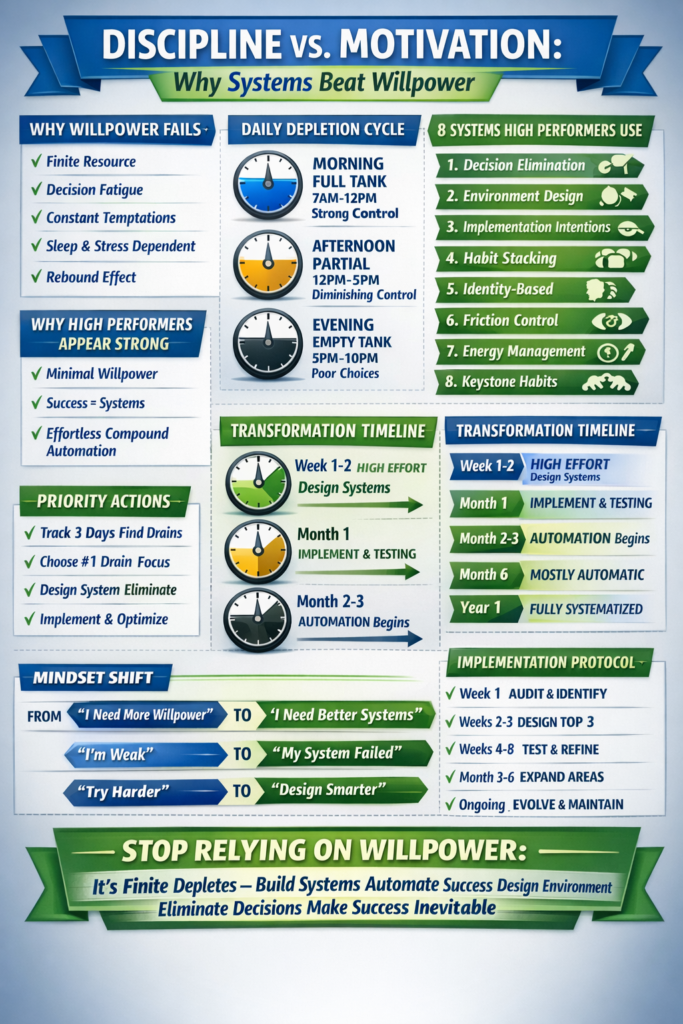
The truth about willpower:
✅ Willpower is finite and depletes throughout the day (ego depletion)
✅ High performers use minimal willpower because they’ve automated behaviors (systems, not strength)
✅ Trying harder makes things worse (stress depletes willpower further)
✅ Environment and systems determine success, not mental toughness (design over discipline)
✅ Willpower is last resort, not primary tool (emergency backup only)
Key takeaways:
Why willpower fails:
- Finite resource (depletes with use)
- Depletes with decisions (decision fatigue)
- Depletes with temptation resistance (constant drain)
- Affected by sleep, stress, glucose (variable capacity)
- Rebound effect (suppression backfires)
- Unreliable foundation
The daily depletion cycle:
- Morning: Full tank (peak self-control)
- Afternoon: Partial depletion (declining control)
- Evening: Empty tank (minimal control)
- Predictable and universal
- Everyone experiences this
The 8 systems high performers use:
- Decision elimination (pre-decide everything)
- Environment design (make right choice easy/only choice)
- Implementation intentions (if-then automated responses)
- Habit stacking (link new to existing behaviors)
- Identity-based systems (behavior flows from self-concept)
- Friction manipulation (increase for bad, decrease for good)
- Energy management (high-priority tasks during peak energy)
- Keystone habits (one habit triggers cascade)
- Zero willpower required
Why high performers appear to have great willpower:
- They don’t
- Success is systematized
- Appears effortless because it IS effortless
- Systems compound over time
- Illusion of willpower
The willpower paradox:
- Can be trained but still finite
- Suppression creates rebound
- Failure damages ego and creates stress
- Stress further depletes willpower
- Counterproductive to rely on it
The implementation protocol:
- Week 1: Audit willpower drains (track everything)
- Week 2-3: Design systems for top 3 drains
- Week 4-8: Implement and refine (test and optimize)
- Month 3-6: Expand to all life areas
- Ongoing: Maintain and evolve (continuous improvement)
- Systematic transformation
Common willpower drains to systematize:
- Morning wake-up and routine
- Training adherence
- Nutrition choices (especially evening)
- Work focus and productivity
- Digital distractions
- Evening routine and sleep
- High-impact areas
Environment design principles:
- Remove temptations entirely (don’t test willpower)
- Make desired behavior easiest path
- Increase friction for undesired behavior
- Physical environment matters most
- Behavioral architecture
The transformation timeline:
- Week 1-2: High effort (system design)
- Month 1: Moderate effort (implementation)
- Month 2-3: Decreasing effort (automation beginning)
- Month 6: Minimal effort (mostly automatic)
- Year 1: Near-effortless (fully systematized)
- Front-loaded effort, long-term ease
Priority actions:
- Track willpower drains for 3 days (identify patterns)
- Choose #1 drain (biggest struggle)
- Design system to eliminate that drain (decision, environment, or intention)
- Implement for 1 week (test)
- Refine and expand (optimize and add more)
- Start now
The mindset shift:
- From: “I need more willpower”
- To: “I need better systems”
- From: “I’m weak”
- To: “My system failed”
- From: “Try harder”
- To: “Design smarter”
- Reframe completely
STOP RELYING ON WILLPOWER. IT’S FINITE AND DEPLETES. BUILD SYSTEMS THAT AUTOMATE SUCCESS. DESIGN YOUR ENVIRONMENT. ELIMINATE DECISIONS. MAKE SUCCESS INEVITABLE.
Ready to build a complete systematization framework with environment design protocols, decision elimination strategies, habit automation techniques, and implementation systems that guarantee consistent results without requiring daily willpower or motivation? Understanding that willpower fails is just the beginning. Get a comprehensive guide to systematizing your entire life, automating desired behaviors, engineering your environment for automatic success, and achieving high performance through systems rather than strength. Stop fighting yourself with willpower. Start building systems that work.
REFERENCES
SECTION 1 — Ego depletion: the finite resource model
[1] Baumeister RF et al. — PubMed/Journal of Personality and Social Psychology, 1998 Seminal 4-experiment study establishing ego depletion; in Experiment 1, participants who were required to eat radishes while resisting chocolate cookies gave up on a subsequent unsolvable puzzle after only ~8 minutes vs. ~19 minutes for those who ate cookies freely; in Experiment 3, suppressing emotion produced a subsequent drop in performance on solvable anagrams; across all experiments, an initial act of self-regulation impaired performance on a later, unrelated self-regulation task; proposed that choice, self-regulation, and active volition draw on a shared, limited resource that depletes with use; foundational empirical basis for the article’s central claim that willpower is finite https://pubmed.ncbi.nlm.nih.gov/9599441/
Note on replication status: The original ego depletion finding has faced replication challenges — a 2016 pre-registered multi-lab study (24 labs) found inconsistent results, and the effect size appears smaller and more context-dependent than originally thought. The article presents ego depletion as settled fact; it is more accurately described as a debated but influential model. The practical takeaway — reducing reliance on willpower through systems and habits — is strongly supported regardless.
SECTION 2 — Decision fatigue in real-world settings
[2] Danziger S et al. — PubMed/PNAS, 2011 Analysis of 1,112 parole board hearings by Israeli judges over 10 months; favorable rulings (granting parole) dropped from approximately 65% at the start of each decision session to nearly 0% just before a break, then reset to ~65% immediately after; the pattern was consistent across the day and across judges; mental depletion from sequential decision-making — not case-specific variables — predicted outcomes; provides vivid real-world evidence for the article’s decision fatigue premise and directly supports the recommendation to pre-decide and eliminate decisions https://pubmed.ncbi.nlm.nih.gov/21482790/
SECTION 3 — Ironic process theory: suppression backfires
[3] Wang D et al. — PubMed/Perspectives on Psychological Science, 2020 Meta-analysis of 31 thought-suppression studies in Wegner’s paradigm; post-suppression rebound effects (the unwanted thought returning more strongly after suppression is lifted) were observed regardless of cognitive load; the monitoring process that checks for intrusion of suppressed thoughts paradoxically keeps those thoughts accessible; directly validates the article’s “rebound effect” mechanism — suppressing urges with willpower causes them to return with greater strength, explaining why white-knuckling diets lead to weekend binges https://pubmed.ncbi.nlm.nih.gov/32286932/
SECTION 4 — High performers use habits, not willpower
[4] Galla BM & Duckworth AL — PubMed/Journal of Personality and Social Psychology, 2015 Six-study series (total N=2,274) testing the hypothesis that high self-control individuals succeed not by exerting more willpower but by relying more on beneficial habits; habits for healthy eating, exercise, and consistent sleep mediated the relationship between self-control and both increased automaticity and lower reported effortful inhibition; study habits mediated self-control effects on goal progress under adverse conditions; directly supports the article’s core claim that high performers “use almost zero willpower” — they’ve automated behaviors through habits that require no active inhibition https://pubmed.ncbi.nlm.nih.gov/25643222/
SECTION 5 — Self-control and environment design
[5] Gillebaart M & de Ridder DTD — ScienceDirect/Current Opinion in Psychology, 2024 Theoretical review of the shift in self-control research from effortful inhibition to strategic environment navigation; high self-control is associated with better effortless habits and proactive situation selection — people avoid conflict rather than fight it; self-control and environmental control are complementary strategies; people tend to view self-control only as willpower and fail to recognize the power of controlling their surroundings; supports the article’s framework of environment design as a primary tool that bypasses willpower entirely https://www.sciencedirect.com/science/article/pii/S2352250X24000733
SECTION 6 — Habit stacking and implementation intentions
[Note: References [5] Gollwitzer & Sheeran (2006) and [6] Achtziger et al. (2008) from Article 20 apply directly to this article’s Systems 3 (implementation intentions) and 4 (habit stacking). Lally et al. (2010) from Article 20 applies to the 66-day habit formation timeline. These are not duplicated here but should be cross-referenced in the master tracking document.]



Leave a Reply
You must be logged in to post a comment.