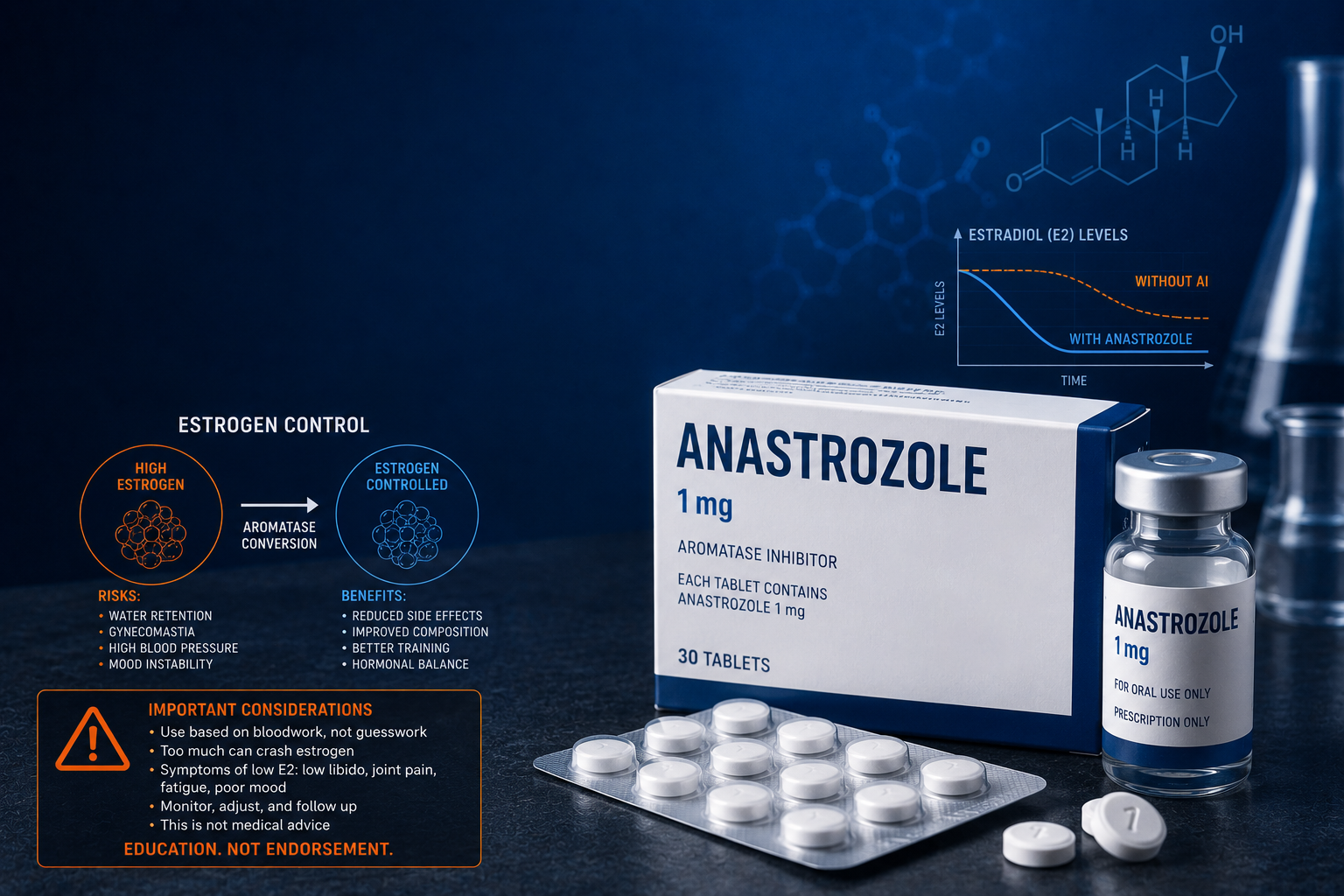
Considering anastrozole during your cycle? This aromatase inhibitor controls estrogen, but using it wrong causes worse problems than high estrogen. Here’s the complete protocol.
You’ve heard you need an AI (aromatase inhibitor) during cycles. Everyone uses anastrozole. It prevents gyno and bloat.
You’re unclear when to start, what dose to use, and whether you even need it at all. Some say use it from day one, others say only if problems arise.
You’ve been told:
- “Always use AI from start of cycle”
- “0.5mg twice weekly is standard”
- “Prevents all estrogen side effects”
- “Can’t hurt to use preventatively”
Dangerously oversimplified. The truth: Anastrozole (Arimidex) is aromatase inhibitor that blocks conversion of testosterone to estradiol (estrogen). When used correctly, prevents gynecomastia, reduces water retention, manages estrogen-related issues. BUT using it without need or at excessive doses crashes estrogen (causes worse problems: destroyed libido, erectile dysfunction, joint pain, mood issues, impaired muscle gains). Proper protocol: Start cycle WITHOUT AI, monitor for high estrogen symptoms (sensitive/puffy nipples, excessive water retention, emotional changes), confirm with bloodwork (estradiol levels), then use lowest effective dose (typically 0.25-0.5mg 2-3x weekly). Target estradiol: 20-30 pg/mL (not zero). Many people don’t need AI at all, especially on moderate testosterone doses (250-400mg weekly). Individual aromatization varies dramatically (genetics determine how much you convert).
In this comprehensive guide, I’ll explain what anastrozole does (aromatase inhibition mechanism), reveal when you actually need it (symptoms and bloodwork), detail proper dosing protocols (individualized approach), show the dangers of crashed estrogen (why too low is worse than too high), compare anastrozole to alternatives (letrozole, exemestane), address the tamoxifen question (AI vs. SERM for gyno), and provide the honest recommendation (most people overuse AI).
Whether you’re planning your first cycle or optimizing current protocols, understanding AI use properly is essential.
Let’s examine anastrozole with scientific honesty about proper use and common mistakes.
TABLE OF CONTENTS
What Is Anastrozole?
The aromatase inhibitor.
The Basic Definition
What it is:
- Anastrozole (generic name)
- Arimidex (brand name)
- Aromatase inhibitor (AI)
- Oral medication (tablet)
- Anti-estrogen drug
Medical use:
- Breast cancer treatment (postmenopausal women)
- Reduces estrogen to slow cancer growth
- Prescription medication
- Pharmaceutical drug
Performance use:
- Estrogen control during steroid cycles
- Gynecomastia prevention
- Water retention reduction
- Ancillary compound
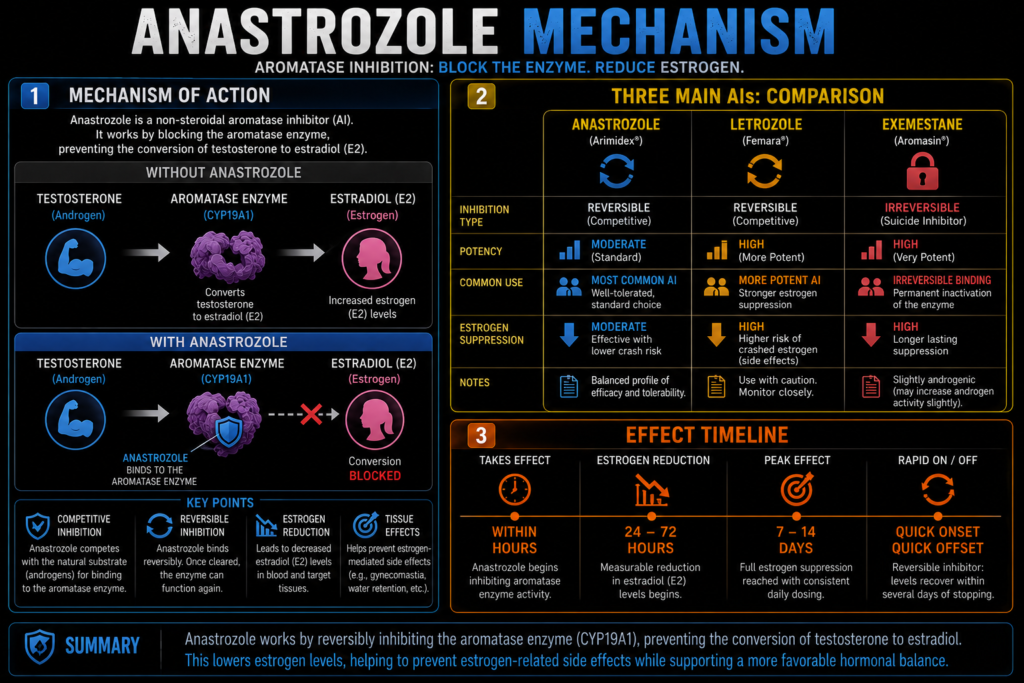
The Mechanism of Action
What aromatase is:
- Enzyme in body (aromatase/CYP19A1)
- Converts testosterone to estradiol (estrogen)
- Present in fat tissue, liver, muscle, brain
- Conversion enzyme
What anastrozole does:
- Binds to aromatase enzyme
- Blocks testosterone from being converted
- Reversible inhibition (can restart when stopped)
- Aromatase blockade
The effect:
- Less testosterone converted to estrogen
- Estrogen levels decrease
- Testosterone levels may increase slightly (less being converted)
- Estrogen reduction
The timeline:
- Takes effect: Within hours
- Estrogen reduction noticeable: 24-72 hours
- Peak effect: 7-14 days of consistent use
- Rapid action
Anastrozole vs. Other AIs
The AI options:
Anastrozole (Arimidex):
- Reversible inhibitor
- Moderate potency
- Most commonly used
- Standard AI
Letrozole (Femara):
- Reversible inhibitor
- More potent than anastrozole (stronger)
- Higher risk of crashed estrogen
- Aggressive option
Exemestane (Aromasin):
- Irreversible inhibitor (suicide inhibitor)
- Binds permanently to aromatase
- Different side effect profile
- Slightly androgenic (DHT-like)
- Alternative AI
The choice:
- Anastrozole most common (balance of efficacy and control)
- Letrozole for stubborn high estrogen
- Exemestane for those who prefer suicide inhibitor
- Anastrozole standard
Why Anastrozole Is Used in Cycles
The estrogen problem.
Aromatization During Cycles
What happens:
- Testosterone (and some other steroids) aromatize
- Convert to estradiol via aromatase enzyme
- Higher testosterone = more aromatization (dose-dependent)
- Estrogen elevation
The math:
- Natural testosterone (500 ng/dL): Normal estrogen
- On cycle (2000 ng/dL testosterone): 4x more substrate for aromatization
- Result: Estrogen levels can become very elevated
- Proportional increase
Individual variation:
- Some people aromatize heavily (high aromatase activity)
- Some barely aromatize (low aromatase activity)
- Genetics determine aromatase expression
- Body fat percentage matters (fat tissue has aromatase)
- Highly individual
Problems from High Estrogen
Side effect 1: Gynecomastia
- Estrogen stimulates breast tissue growth
- Develops as lumps under nipples
- Can become permanent if not addressed
- Primary concern
Side effect 2: Water retention
- Estrogen affects kidney sodium handling
- Increased water retention
- Bloated appearance
- Elevated blood pressure
- Cosmetic and health issue
Side effect 3: Emotional changes
- Estrogen affects mood
- Increased emotionality
- Mood swings
- Psychological effects
Side effect 4: Sexual dysfunction
- Paradoxically, very high estrogen can reduce libido
- Erectile function may decline
- Sexual issues
Why Not Just Eliminate All Estrogen?
Estrogen is essential for men:
- Bone health (prevents osteoporosis)
- Lipid management (helps maintain HDL)
- Brain function (neuroprotection, mood)
- Sexual function (libido, erectile function)
- Muscle growth (yes, estrogen helps muscle building)
- Joint health (lubrication)
- Multiple critical functions
The crash:
- Zero estrogen = severe problems
- Worse than high estrogen in many ways
- Balance required
Normal Estrogen Levels and Targets
The healthy range.
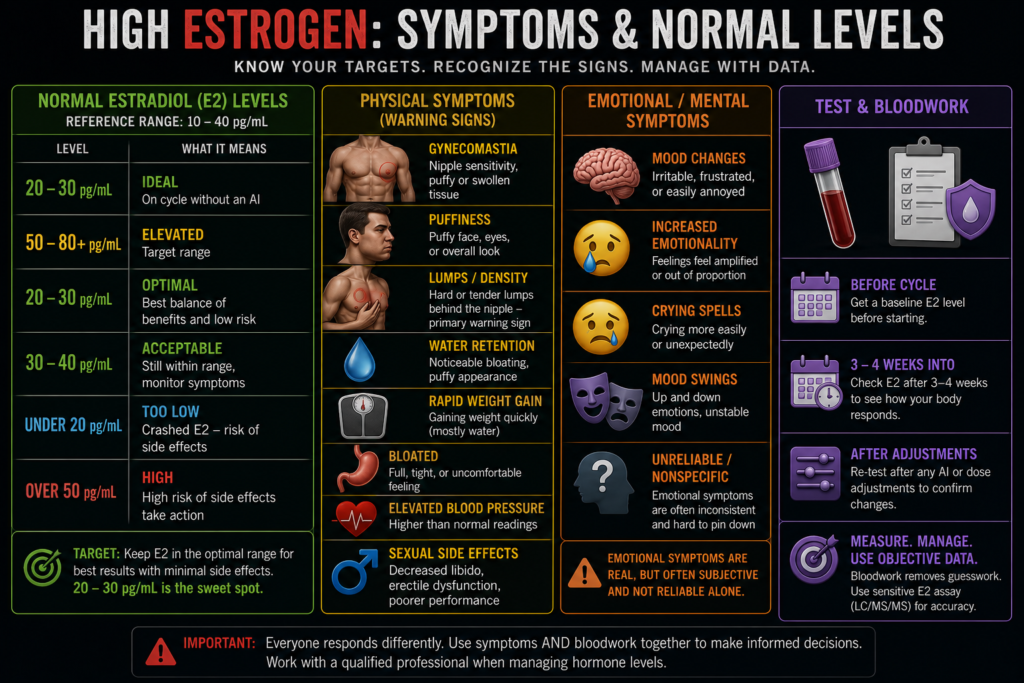
Normal Estradiol Levels (Men)
The reference range:
- 10-40 pg/mL (varies slightly by lab)
- Typical healthy range: 20-30 pg/mL
- Normal values
On cycle without AI:
- Can reach 50-80+ pg/mL (dose-dependent)
- Sometimes higher
- Elevated levels
The target on cycle:
- 20-30 pg/mL ideal
- 30-40 pg/mL acceptable
- <20 pg/mL too low (approaching crash)
- 50 pg/mL high (side effects likely)
- Optimal range
Testing Estradiol
The test:
- Blood test: Estradiol (E2)
- Sensitive assay preferred (LC/MS-MS method)
- Standard assay acceptable
- Bloodwork essential
When to test:
- Before cycle (baseline)
- 3-4 weeks into cycle (assess need for AI)
- After AI dose adjustments (verify levels)
- Regular monitoring
The importance:
- Can’t manage what you don’t measure
- Symptoms alone unreliable
- Bloodwork confirms estrogen status
- Objective data required
Symptoms of High Estrogen
Warning signs (before bloodwork).
Physical Symptoms
Gynecomastia (early stage):
- Sensitivity under nipples
- Slight puffiness
- Small lump formation
- Itching or tingling
- Primary warning sign
Water retention:
- Rapid weight gain (5-10 lbs water)
- Bloated appearance (face, midsection)
- Tight rings (fingers swelling)
- Elevated blood pressure
- Obvious bloating
Sexual changes:
- Decreased libido (paradoxical)
- Erectile dysfunction
- Sexual dysfunction
Emotional Symptoms
Mood changes:
- Increased emotionality
- Crying easily
- Mood swings
- Irritability
- Emotional lability
The unreliability:
- Many factors affect mood on cycle
- Not specific to high estrogen
- Can’t diagnose from mood alone
- Nonspecific symptom
The Problem with Symptoms
Why symptoms alone insufficient:
- Many symptoms overlap with other issues
- Water retention could be diet (sodium)
- Mood changes could be stress, other hormones
- Low estrogen causes similar symptoms to high estrogen
- Ambiguous indicators
The solution:
- Use symptoms as trigger to test
- Confirm with bloodwork
- Don’t dose AI based on symptoms alone
- Test, don’t guess
When to Use Anastrozole
The proper protocol.
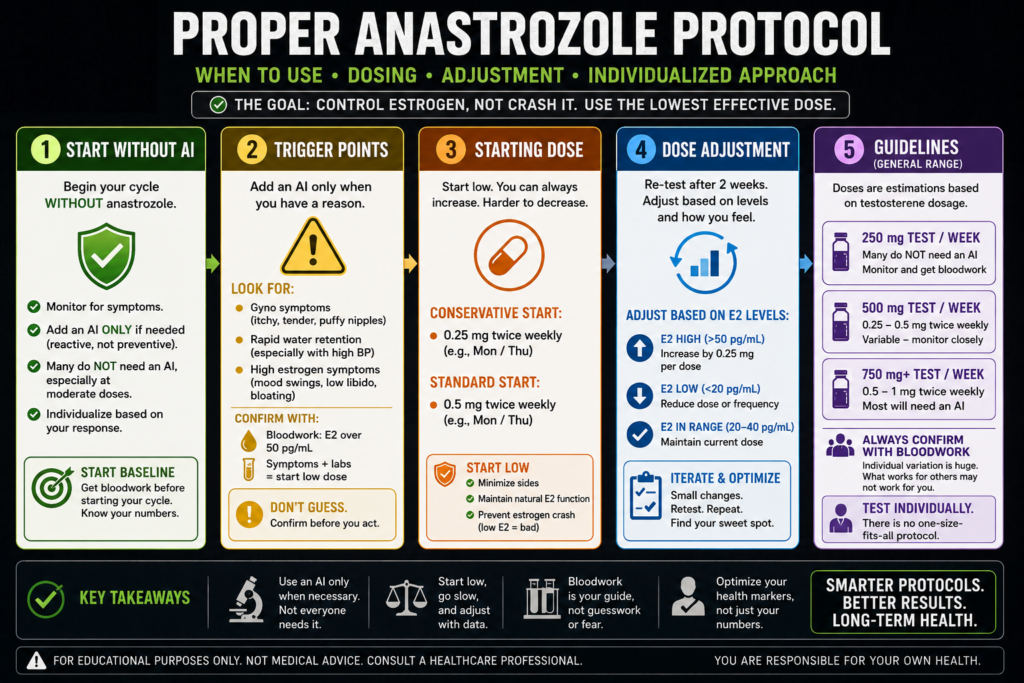
Start WITHOUT AI
The recommendation:
- Begin cycle with no AI
- Monitor for symptoms
- Add only if needed
- Reactive, not preventive
Why this approach:
- Many people don’t need AI (especially moderate doses)
- Prevents unnecessary estrogen suppression
- Allows assessment of individual aromatization
- Individualized approach
The doses that often don’t need AI:
- 250mg testosterone weekly or less
- TRT doses (100-200mg weekly)
- Some people even at 500mg weekly
- Dose-dependent
Trigger Points to Add AI
Scenario 1: Gyno symptoms
- Nipple sensitivity, puffiness, lumps
- Add AI immediately (don’t wait for bloodwork in this case)
- Urgent intervention
Scenario 2: Excessive water retention
- Rapid bloat, BP elevation
- Test estradiol
- Add AI if confirmed high
- Confirmed need
Scenario 3: Bloodwork shows high estrogen
- Estradiol >50 pg/mL (even without symptoms)
- Start AI at low dose
- Preventive at this point
When NOT to Use AI
Scenario 1: No symptoms, normal bloodwork
- Estradiol 20-40 pg/mL
- No gyno, minimal water retention
- No intervention needed
Scenario 2: Mild water retention, normal estradiol
- Water retention from sodium/carbs, not estrogen
- AI won’t help
- Dietary issue
Scenario 3: Using non-aromatizing steroids
- Anavar, Winstrol, Masteron, Primobolan (don’t aromatize)
- Unless also using testosterone
- No aromatization = no AI needed
Proper Anastrozole Dosing
Individualized protocols.
Starting Dose
Conservative approach:
- 0.25mg twice weekly (Monday/Thursday)
- Very low dose
- Minimal estrogen reduction
- Start low
Standard approach:
- 0.5mg twice weekly
- Moderate estrogen reduction
- Most common starting dose
- Typical dose
Why start low:
- Easier to increase than decrease
- Prevents estrogen crash
- Allows fine-tuning
- Safety first
Dose Adjustment
The protocol:
- Start at low dose
- Test estradiol after 2 weeks
- Adjust based on levels
- Iterative approach
If estradiol still high (>40-50 pg/mL):
- Increase to 0.5mg 3x weekly
- Or 1mg twice weekly
- Retest in 2 weeks
- Escalate gradually
If estradiol too low (<20 pg/mL):
- Reduce dose (skip doses or lower amount)
- Retest in 2 weeks
- De-escalate
If estradiol in range (20-40 pg/mL):
- Maintain dose
- Retest monthly
- Monitor and hold
Dose Examples by Testosterone Dose
These are GUIDELINES (individual variation huge):
250mg testosterone weekly:
- Many need no AI
- If needed: 0.25mg 2x weekly
- Minimal AI
500mg testosterone weekly:
- 0.25-0.5mg 2-3x weekly typical
- Some need no AI, some need more
- Variable
750mg+ testosterone weekly:
- 0.5-1mg 2-3x weekly typical
- Most need AI at this dose
- Higher AI requirement
The critical reminder:
- These are averages
- Individual needs vary 10-fold
- Always confirm with bloodwork
- Test individually
The Dangers of Crashed Estrogen
Why too low is worse than too high.
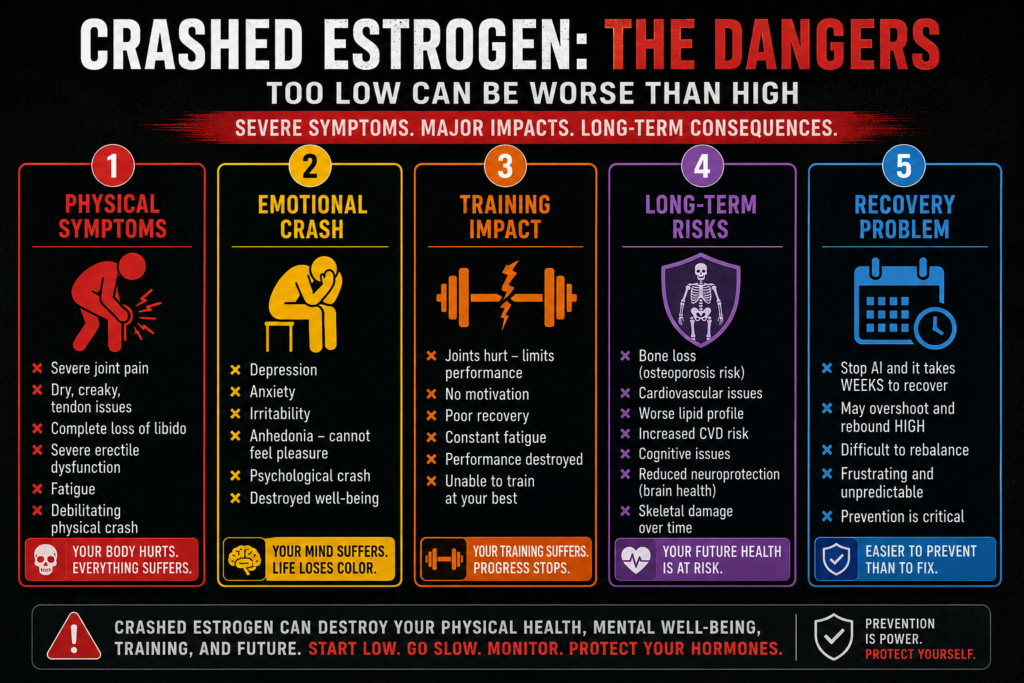
Symptoms of Low Estrogen
Physical symptoms:
- Severe joint pain (dry, creaky joints)
- Tendon issues
- Loss of libido (complete)
- Erectile dysfunction (severe)
- Fatigue
- Debilitating effects
Emotional symptoms:
- Depression
- Anxiety
- Irritability
- Anhedonia (can’t feel pleasure)
- Psychological crash
Training impact:
- Joints hurt (limits performance)
- No motivation
- Poor recovery
- Performance destroyed
Long-Term Risks
Bone health:
- Estrogen essential for bone density
- Crashed estrogen = bone loss
- Osteoporosis risk
- Skeletal damage
Cardiovascular health:
- Estrogen helps maintain HDL cholesterol
- Low estrogen = worse lipid profile
- CVD risk increase
Cognitive effects:
- Estrogen neuroprotective
- Low levels = cognitive issues
- Brain health
The Recovery Problem
Getting estrogen back up:
- Stop AI
- Takes time to recover (weeks)
- May overshoot (rebound high)
- Difficult to rebalance
The lesson:
- Much easier to prevent crash than fix it
- Start low, go slow with AI
- Prevention critical
Anastrozole vs. Tamoxifen (Nolvadex)
AI vs. SERM for gyno.
Different Mechanisms
Anastrozole (AI):
- Blocks estrogen production
- Reduces total estrogen levels
- Source control
Tamoxifen (SERM):
- Blocks estrogen receptors in breast tissue
- Doesn’t reduce overall estrogen
- Selective tissue action
- Receptor blockade
For Gyno Prevention
If no gyno yet:
- AI preferred (prevents by reducing estrogen)
- Tamoxifen can work but less ideal
- AI for prevention
For Existing Gyno
If gyno developing:
- Tamoxifen superior for treating
- Directly blocks estrogen at breast tissue
- Can reverse early-stage gyno
- SERM for treatment
The protocol:
- Gyno appears: Add tamoxifen 20mg daily immediately
- Also add/increase AI (prevent further estrogen elevation)
- Continue tamoxifen until gyno resolves
- Combination approach
The Combination
Using both:
- AI controls estrogen levels (prevention)
- Tamoxifen blocks breast tissue (treats existing gyno)
- Synergistic
- Belt and suspenders
Alternatives to Anastrozole
Other AI options.
Letrozole (Femara)
Characteristics:
- More potent than anastrozole (2-3x stronger)
- Higher risk of estrogen crash
- Reversible inhibitor
- Aggressive AI
When to use:
- Stubborn high estrogen unresponsive to anastrozole
- Existing gyno (combined with tamoxifen)
- Advanced users
- Second-line option
Dosing:
- 0.5-1.25mg 2-3x weekly
- Start low (very potent)
- Careful dosing
Exemestane (Aromasin)
Characteristics:
- Irreversible (suicide) inhibitor
- Permanently deactivates aromatase
- Slightly androgenic (DHT-like properties)
- Different side effect profile
- Alternative mechanism
Advantages:
- Less lipid impact (doesn’t worsen HDL as much)
- Slight androgenic benefit
- Some prefer
Dosing:
- 12.5mg every other day or 25mg 2x weekly
- Standard aromasin dosing
The Choice
Anastrozole for most:
- Well-studied
- Reversible (easier to manage)
- Widely available
- Default AI
Letrozole for stubborn cases:
- When anastrozole insufficient
- Escalation option
Exemestane for lipid-conscious:
- Less HDL suppression
- Alternative mechanism
Common Mistakes with AI Use
What not to do.
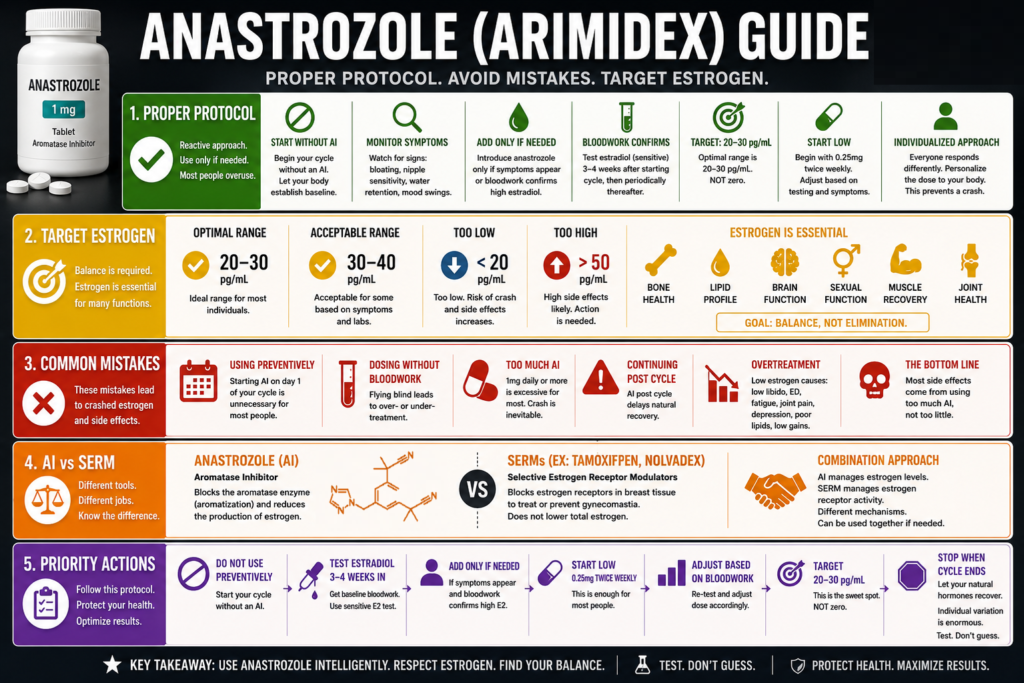
Mistake 1: Using AI Preventively
The error:
- Starting AI on day 1 of cycle
- “Just to be safe”
- Unnecessary suppression
Why wrong:
- May not need AI at all
- Risks estrogen crash
- Can’t assess individual needs
- Overtreatment
The fix:
- Start without AI
- Add only if needed
- Reactive approach
Mistake 2: Dosing Without Bloodwork
The error:
- Guessing AI dose based on symptoms
- Never testing estradiol
- Flying blind
Why wrong:
- Can’t know if estrogen high or low
- Similar symptoms
- Easy to crash estrogen
- No objective data
The fix:
- Test estradiol regularly
- Adjust based on numbers
- Data-driven decisions
Mistake 3: Too Much AI
The error:
- Using aggressive doses (1mg daily, etc.)
- Trying to drive estrogen to zero
- Excessive suppression
Why wrong:
- Estrogen crash inevitable
- Severe side effects
- Worse than high estrogen
- Harmful
The fix:
- Lowest effective dose
- Target 20-30 pg/mL, not zero
- Balanced approach
Mistake 4: Continuing AI Post-Cycle
The error:
- Using AI during PCT or after
- Keeping estrogen suppressed
- Prolonged suppression
Why wrong:
- Need estrogen for recovery
- Estrogen important for natural testosterone production
- Delays recovery
- Counterproductive
The fix:
- Stop AI when cycle ends
- Allow estrogen to normalize during PCT
- Recovery priority
This article is informational only. We do not condone or recommend steroid use. If using steroids, anastrozole can manage estrogen-related side effects, but only when actually needed and dosed properly based on bloodwork. Crashed estrogen causes severe problems worse than high estrogen. Most people overuse AI. Individual variation is enormous. Work with qualified medical professionals and understand serious health risks involved.
REFERENCES
SECTION 1 — Anastrozole mechanism: aromatase inhibition reduces estradiol in men
[1] Leder BZ et al. — PubMed/Journal of Clinical Endocrinology and Metabolism, 2004 Randomized double-blind placebo-controlled trial in 37 healthy older men examining the effects of anastrozole on gonadal steroid and gonadotropin levels; anastrozole 1 mg daily raised testosterone concentrations by approximately 58% and reduced estradiol by approximately 47% from baseline; LH and FSH increased significantly, consistent with reduced estrogenic negative feedback; the dose-response was evident; provides the primary human pharmacological evidence establishing that anastrozole effectively suppresses aromatization in men, directly validating the mechanism and target of use described in the article https://pubmed.ncbi.nlm.nih.gov/14764771/
SECTION 2 — Estrogen is essential for male health: bone, libido, and cardiovascular function
[2] Finkelstein JS et al. — PMC/New England Journal of Medicine, 2013 RCT in 400 men aged 20 to 50 years with pharmacologically suppressed endogenous testosterone; graded testosterone replacement doses were administered with or without anastrozole (to separately manipulate testosterone and estradiol); estradiol deficiency caused by anastrozole specifically impaired sexual desire, erectile function, and bone mineral density independently of testosterone; low estradiol was responsible for increased fat accumulation and reduced libido; testosterone deficiency separately caused muscle mass loss; the most informative human study separating the independent contributions of testosterone and estradiol in men, providing the mechanistic foundation for the article’s warnings about the consequences of crashed estrogen https://pmc.ncbi.nlm.nih.gov/articles/PMC3770770/
SECTION 3 — Estradiol target ranges and the consequences of suppression
[3] Ramasamy R et al. — PubMed/Journal of Sexual Medicine, 2014 Cross-sectional study in 155 men undergoing testosterone therapy, examining the relationship between estradiol levels and sexual function; estradiol concentrations below 5.8 ng/dL (approximately 21.3 pg/mL) were associated with significantly lower sexual desire, frequency of sexual activity, and overall sexual satisfaction; estradiol levels above this threshold were associated with normal sexual function; the study provides a laboratory-based threshold for the lower boundary of acceptable estradiol during testosterone therapy, directly supporting the article’s target range of 20 to 30 pg/mL and the warning that estradiol below 20 pg/mL constitutes a problematic crash https://pubmed.ncbi.nlm.nih.gov/24697970/
SECTION 4 — Selective estrogen receptor modulators for gynecomastia: tamoxifen vs. anastrozole
[4] Plourde PV et al. — PubMed/Journal of Clinical Endocrinology and Metabolism, 2004 Comparison study of anastrozole versus tamoxifen for treating pubertal gynecomastia; tamoxifen was significantly more effective than anastrozole for reducing breast tissue volume; anastrozole had minimal effect on existing breast tissue because it reduces estrogen production without directly blocking estrogen receptors at the breast; tamoxifen acts as a selective estrogen receptor modulator, directly blocking the estrogen receptor in breast tissue where gynecomastia has already developed; provides the mechanistic and clinical evidence for the article’s protocol distinguishing AI use for prevention (anastrozole, reduces estrogen levels) from SERM use for treatment of existing gynecomastia (tamoxifen, blocks receptors at the breast) https://pubmed.ncbi.nlm.nih.gov/15356028/






Leave a Reply
You must be logged in to post a comment.