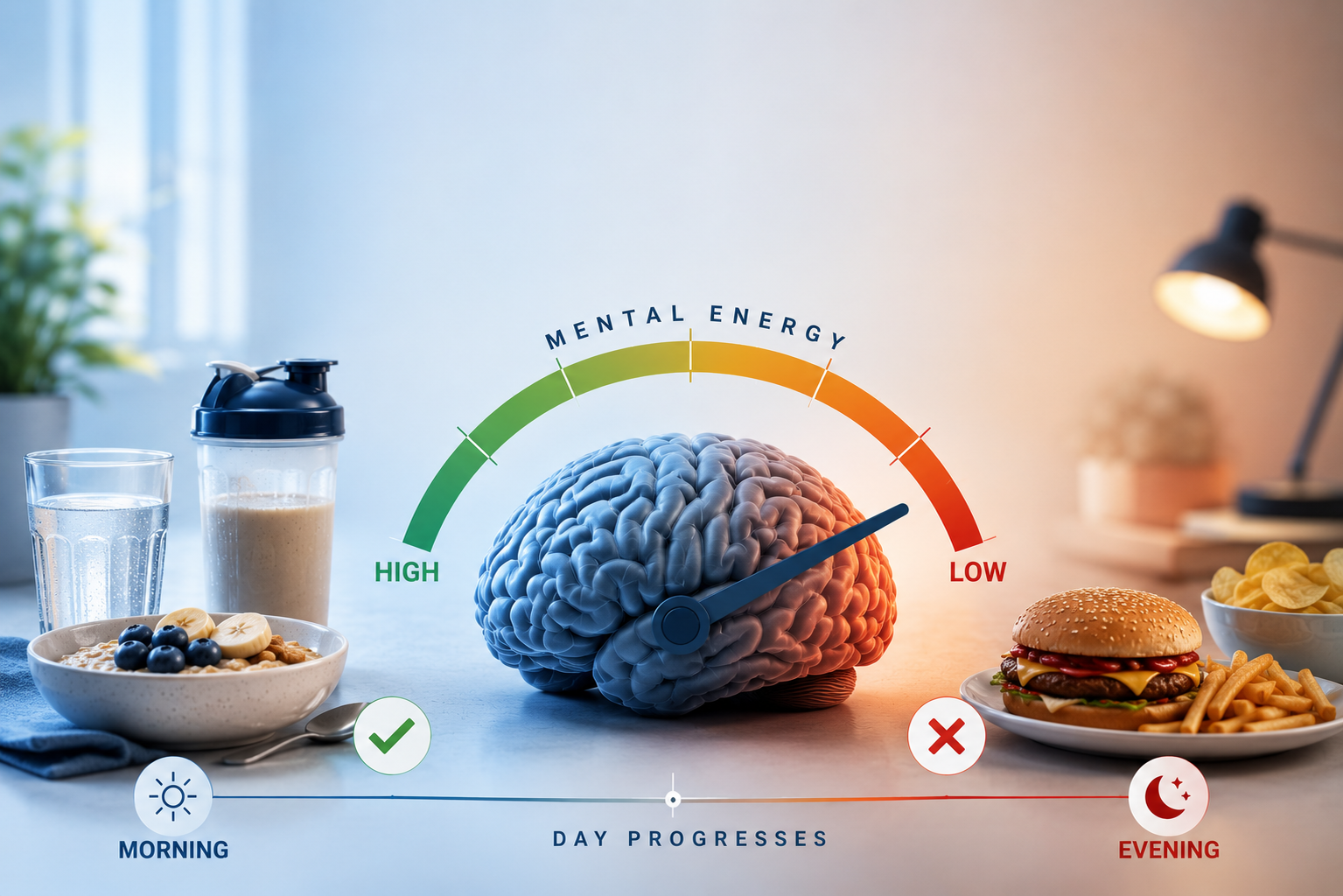
You start every morning with perfect discipline. Breakfast is on point: eggs, oatmeal, everything weighed and tracked. Lunch is meal prepped chicken and rice, macros dialed in. You feel unstoppable, wondering why people say dieting is hard. Then 3 PM hits. Someone brings cookies to the office. Your coworker suggests ordering pizza. The vending machine starts calling your name. By 7 PM, you’re standing in front of the refrigerator eating peanut butter straight from the jar with a spoon, wondering what happened to the iron willpower you had at 7 AM.
You blame yourself. You think you lack discipline. You assume something is wrong with your character because you can’t stick to a diet for an entire day. The truth is far more interesting and far less your fault: your brain is running out of decision making fuel, and every choice you made since waking up drained the tank a little more until there was nothing left to resist the cookies.
This phenomenon is called decision fatigue, and understanding it is one of the most underrated strategies for improving diet adherence, training consistency, and overall progress toward physique goals. It explains why you can crush your diet from Monday morning through Wednesday afternoon but fall apart by Thursday evening. It explains why bodybuilders who eat the same 4 meals every day seem robotic but stay lean year round. It explains why the person with the most complicated, “optimal” meal plan often gets worse results than the person eating boring, simple food consistently.
For people cutting who break their diet every evening, bulking who can’t stop adding unnecessary calories at night, trying to maintain consistency with training and nutrition, or simply frustrated that willpower seems to evaporate as the day progresses, understanding decision fatigue and implementing strategies to combat it will transform your adherence from inconsistent to automatic.
In this comprehensive guide, I’ll explain exactly what decision fatigue is and why it affects your diet more than anything else, the science of willpower depletion and how your brain processes decisions throughout the day, why afternoon and evening are when most diets fail (and the biological reasons behind it), seven evidence based strategies to eliminate decision fatigue from your fitness routine, how meal prep and food automation protect your results, why simplicity beats optimization every single time, and practical systems that remove willpower from the equation entirely.
Whether you’re a disciplined person who mysteriously loses control every evening, someone who has tried dozens of diets but always breaks them at the same time of day, or a lifter wondering why some people seem to effortlessly maintain their physique while you struggle daily, this guide will show you that the problem was never your discipline. It was your strategy.
Let’s examine why your willpower runs out and how to make it irrelevant.
TABLE OF CONTENTS
- Strategy 1: Eat the Same Meals Repeatedly
- Strategy 2: Meal Prep on Sundays (Remove Real Time Decisions)
- Strategy 3: Create Environmental Defaults
- Strategy 4: Front Load Important Decisions to Morning
- Strategy 5: Reduce Non Food Decisions
- Strategy 6: Create "If Then" Rules for Danger Zones
- Strategy 7: Strategic Calorie Placement
- THE BOTTOM LINE: DECISION FATIGUE AND YOUR DIET
What Is Decision Fatigue? (The Science)
Decision fatigue is the deterioration of decision making quality after making many decisions over a period of time. Every choice you make throughout the day, from what to wear to how to respond to an email to what to eat for lunch, draws from the same limited pool of mental energy. When that pool runs low, your brain starts taking shortcuts, defaulting to the easiest option rather than the best one.
How Your Brain Makes Decisions
The mental energy model:
Your brain operates on glucose and mental resources:
The prefrontal cortex (decision center):
- Located behind your forehead
- Responsible for planning, impulse control, logical reasoning
- Where “should I eat the cookie or stick to my diet?” gets decided
- This region has LIMITED energy and processing capacity
- Fatigues with repeated use throughout the day
- When fatigued, defaults to path of least resistance
The limbic system (impulse center):
- Deeper brain structures
- Handles emotions, cravings, immediate rewards
- Where “that cookie looks amazing, eat it NOW” comes from
- Does NOT fatigue in the same way
- Always active, always pushing for immediate gratification
- Gets relatively STRONGER as prefrontal cortex weakens
The daily battle:
- Morning: Prefrontal cortex is fresh and strong, easily overrides impulses
- Midday: Prefrontal cortex starting to tire, impulses require more effort to resist
- Evening: Prefrontal cortex is depleted, impulses win most battles
- This is why you’re a diet champion at breakfast and a diet disaster at dinner
The Research on Decision Fatigue
Study: The famous judge study:
- Researchers analyzed 1,112 judicial rulings over 10 months
- Judges made favorable rulings 65% of the time after breaks (morning, after lunch)
- Favorable rulings dropped to nearly 0% just before breaks
- Judges defaulted to the easiest decision (deny parole) when fatigued
- Same pattern appeared regardless of case severity
- Their decision quality deteriorated predictably throughout decision making sessions
Study: Decision fatigue and food choices:
- Participants made a series of choices (product comparisons, tradeoffs)
- After many decisions, they were offered snacks
- Fatigued group chose candy and chips significantly more than fresh group
- Fatigued group also ate more total calories
- Their ability to resist tempting food was directly linked to prior decision load
Study: Self control as limited resource:
- Participants who resisted eating freshly baked cookies (willpower task)
- Then had to solve difficult puzzles
- Cookie resisters gave up on puzzles 50% faster than control group
- Using willpower for one task depleted it for the next
- Self control draws from a shared, limited pool
Study: Grocery shopping and decision fatigue:
- Shoppers who made more decisions during shopping trip
- Were more likely to buy impulse items at checkout
- More likely to choose unhealthy snacks
- Decision fatigue accumulated throughout the shopping experience
- This is why grocery stores put candy at the checkout line
Why Decision Fatigue Hits Your Diet Hardest
Of all the areas decision fatigue affects, diet adherence is by far the most vulnerable.
Why food decisions are uniquely susceptible:
Frequency:
- You make food decisions 200+ times per day (studies suggest up to 226)
- What to eat, how much, when, where, how to prepare
- Whether to eat something offered to you
- Whether to have seconds
- Whether to snack
- Each decision, no matter how small, depletes the pool
Emotional component:
- Food is tied to emotions, comfort, reward
- When willpower is depleted, emotional eating increases
- Stress eating is decision fatigue in action
- Your brain seeks the quickest dopamine hit (sugar, fat, salt)
Social pressure:
- Coworkers offering food
- Friends suggesting restaurants
- Family wanting to share meals
- Each social food situation requires a decision
- Saying “no” costs more willpower than saying “yes”
Constant availability:
- Food is everywhere, all the time
- Unlike other temptations, you can’t avoid food entirely
- Must engage with food multiple times daily
- Each engagement requires decisions
Biological drive:
- Hunger is a fundamental survival drive
- When decision making is depleted, survival instincts dominate
- Body pushes for high calorie foods (evolutionary advantage)
- Resisting this requires the exact cognitive resource that’s depleted
The perfect storm:
- High frequency decisions (200+ daily)
- Strong emotional and biological drive
- Constant environmental temptation
- Social pressure adding additional decisions
- Depleted willpower from non food decisions throughout the day
- Result: Evening diet breakdown is essentially inevitable without proper strategy
Why 3 PM Is the Breaking Point
There’s a reason why most diet violations happen between 3 PM and bedtime. Understanding this timing unlocks the solution.
The Daily Willpower Curve
How willpower typically depletes throughout a day:
6 to 8 AM: Peak willpower
- Brain is rested from sleep
- Prefrontal cortex fully recharged
- Few decisions made yet
- Maximum self control available
- This is why breakfast is the easiest meal to eat healthy
8 AM to 12 PM: Gradual decline
- Work decisions accumulating (emails, meetings, problem solving)
- Social interactions requiring choices
- Minor food decisions (coffee, snack?)
- Willpower still adequate but decreasing
- Lunch is usually still manageable because moderate willpower remains
12 to 3 PM: Accelerating decline
- Morning’s decision load catches up
- Post lunch energy dip (circadian rhythm low point)
- Blood sugar fluctuation from lunch
- Afternoon slump compounds cognitive fatigue
- More work decisions, meetings, problems
- The critical vulnerability window opens
3 to 6 PM: The danger zone
- Willpower significantly depleted
- Afternoon cortisol drop reduces alertness
- Brain actively seeking quick energy (cravings)
- Environmental cues everywhere (vending machines, coworker snacks, drive through on commute)
- Most impulsive food decisions happen here
- This is when most diets die
6 PM to bedtime: The collapse
- Decision making capacity at lowest point
- Tired from full day of work, responsibilities, commute
- Home environment offers unlimited food access
- No external structure (nobody watching what you eat)
- TV, relaxation, and snacking become paired behaviors
- Emotional eating peaks
- “I’ll start again tomorrow” happens here
The Biological Amplifiers
Several biological factors make the afternoon and evening worse:
Blood sugar fluctuation:
- After lunch, blood sugar rises then falls
- The fall triggers hunger signals and cravings
- Brain interprets low blood sugar as “need food immediately”
- Combined with depleted willpower = poor food choices
- This is amplified if lunch was high glycemic (white bread, sugary drinks)
Cortisol patterns:
- Cortisol naturally peaks in morning (wakes you up, provides energy)
- Declines throughout afternoon
- Low cortisol = lower alertness, reduced cognitive function
- Already depleted willpower + reduced alertness = vulnerability
- Some people experience a cortisol spike in late afternoon (stress related)
- This cortisol spike increases cravings for comfort food
Circadian energy dip:
- Most humans experience energy low between 1 and 3 PM
- Built into circadian rhythm (many cultures have afternoon siesta)
- Reduced cognitive performance across the board
- Worst time for complex decisions (including food choices)
- Aligns perfectly with the willpower depletion curve
Accumulated stress:
- Stress hormones build throughout a demanding day
- Each stressor depletes willpower independently
- Work problems, traffic, relationship issues, financial concerns
- By evening, stress load is at daily maximum
- Comfort eating is a stress response, not a discipline failure
The Cutting Amplification Effect
Decision fatigue during cutting is dramatically worse:
Why cutting multiplies decision fatigue:
Constant hunger:
- Calorie deficit creates persistent hunger signals
- Each hunger pang requires a decision: eat or resist
- Dozens of resist decisions throughout the day
- Each one depletes the pool further
- By evening, you’ve made 50+ “don’t eat” decisions already
Restricted food environment:
- Fewer foods “allowed” means more deliberation per meal
- “Can I eat this? Does it fit my macros? How many calories?”
- Every food encounter becomes a calculation
- Calculations consume mental energy
- More restriction = more decisions = faster depletion
Psychological deprivation:
- Wanting foods you can’t have creates ongoing mental load
- Background processing: “I wish I could eat pizza, but I can’t, but I want it”
- This constant low level rumination drains willpower passively
- Even when you’re not actively making food decisions
The math of cutting willpower:
Normal day (not cutting):
- Food decisions: 200+ (mostly automatic, low effort)
- Non food decisions: 300+ (work, life, etc.)
- Total willpower drain: Moderate
- Evening vulnerability: Moderate
Cutting day:
- Food decisions: 200+ (now HIGH effort because every one matters)
- Active resistance decisions: 30 to 50 extra (resisting cravings, declining offers)
- Macro calculations: 15 to 20 extra decisions
- Non food decisions: 300+ (same as always)
- Total willpower drain: Severe
- Evening vulnerability: Extreme
This is why cuts fail. Not because people lack discipline. Because the cognitive load of dieting in a complex food environment with a depleted willpower budget is unsustainable without systems that reduce the decision burden.
The 7 Strategies That Actually Fix Decision Fatigue
Now let’s move from understanding the problem to implementing solutions. These strategies don’t increase your willpower (you can’t really do that). Instead, they reduce the number of decisions you need to make, preserving willpower for the moments that matter.
Strategy 1: Eat the Same Meals Repeatedly
This is the single most powerful strategy against decision fatigue, and it’s the one most people resist because it sounds boring.
Why repetitive eating works:
Eliminates decisions entirely:
- If you eat the same breakfast every day, that’s zero decisions at breakfast
- Same lunch? Zero decisions at lunch
- You’ve just eliminated 50+ food decisions before 1 PM
- Your willpower pool is significantly fuller entering the afternoon danger zone
Removes calculation overhead:
- No need to calculate macros (you already know them)
- No need to weigh portions (you’ve done it before, can estimate accurately)
- No need to wonder “does this fit my macros?”
- The answer is always yes because you designed the meals to fit
Eliminates grocery shopping decisions:
- Buy the same groceries every week
- No standing in aisles deliberating
- No impulse purchases from decision fatigue
- Shopping takes 20 minutes instead of 60
Creates automaticity:
- After 2 to 3 weeks, meal preparation becomes automatic
- Like brushing your teeth, requires no willpower
- Brain shifts from “deliberate decision” to “habitual action”
- Habitual actions don’t deplete willpower
How bodybuilders have always known this:
The classic bodybuilder approach:
- Meal 1: Eggs, oatmeal, fruit
- Meal 2: Chicken, rice, broccoli
- Meal 3: Chicken, sweet potato, green beans
- Meal 4: Fish, rice, salad
- Meal 5: Casein shake, peanut butter
It looks boring because it IS boring. But these people stay lean year round while everyone with “exciting, varied” meal plans falls off their diet every 2 weeks.
The boring diet paradox:
- Exciting meal plan = lots of decisions = faster willpower depletion = diet breaks down
- Boring meal plan = few decisions = willpower preserved = diet sustained indefinitely
- The “boring” approach delivers better results because it’s actually followed
Practical implementation:
Start with 3 to 4 rotating meal templates:
Template 1 (Breakfast options, pick one and repeat daily):
- Option A: 4 eggs, 2 slices toast, fruit
- Option B: Protein shake, oatmeal, banana
- Option C: Greek yogurt, granola, berries
- Pick ONE. Eat it every day. Stop deciding.
Template 2 (Lunch options, pick one and repeat daily):
- Option A: Chicken breast, rice, vegetables
- Option B: Turkey sandwich, fruit, yogurt
- Option C: Tilapia, sweet potato, salad
- Pick ONE. Eat it every day. Stop deciding.
Template 3 (Dinner options, pick 2 to 3 and rotate):
- Option A: Salmon, quinoa, asparagus
- Option B: Lean beef stir fry with rice
- Option C: Chicken thighs, potatoes, green beans
- Rotate between 2 to 3. Slight variety without excessive decisions.
Template 4 (Snacks, pick 1 to 2 and repeat):
- Option A: Protein bar
- Option B: Greek yogurt
- Option C: Apple with peanut butter
- Same snacks daily. Zero decisions.
After 2 to 3 weeks: These meals become automatic. You stop thinking about food. Willpower is preserved for actual challenges.
The common objection:
“But I’ll get bored eating the same things!”
The response:
- Are you bored of brushing your teeth the same way every day?
- Are you bored of driving the same route to work?
- Repetitive actions become invisible, not boring
- After a few weeks, you stop noticing
- And you’re leaner while everyone with “exciting” diets is struggling
If variety is truly important to you:
- Rotate between 2 to 3 options per meal slot weekly
- Change your rotation every 4 to 6 weeks
- Still dramatically fewer decisions than daily improvisation
- Provides enough variety to prevent food fatigue
- While maintaining the decision reduction benefit
Strategy 2: Meal Prep on Sundays (Remove Real Time Decisions)
Meal preparation eliminates the most dangerous type of food decision: the real time decision made when hungry and tired.
Why real time food decisions are the most dangerous:
The worst case scenario:
- It’s 6:30 PM
- You just got home from work
- You’re tired, stressed, and hungry
- Nothing is prepared
- You need to decide what to eat, buy ingredients, prepare food
- This process takes 45 to 60 minutes
- Your willpower is at daily minimum
- Result: Order delivery, eat whatever’s fastest, blow your macros
The meal prep solution:
- It’s 6:30 PM
- You just got home from work
- You’re tired, stressed, and hungry
- Open refrigerator: Pre portioned container of chicken, rice, and vegetables
- Microwave 3 minutes
- Eat
- Decision required: Zero. Just heat and eat.
How to meal prep efficiently:
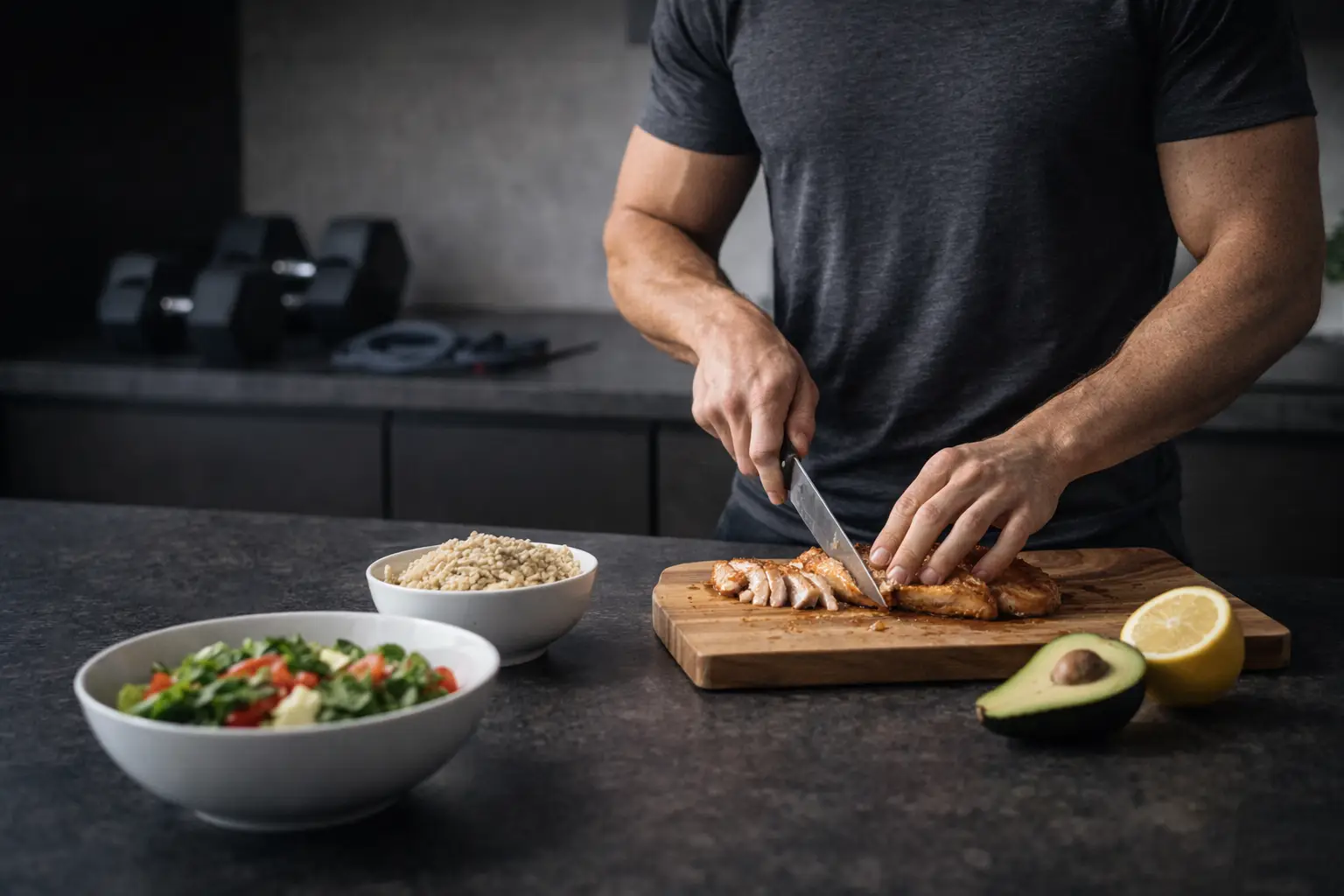
Sunday prep session (90 to 120 minutes):
Proteins (cook in bulk):
- 2 lbs chicken breast (baked at 400°F, 25 minutes)
- 2 lbs ground turkey (cooked in pan, 15 minutes)
- 12 hard boiled eggs (batch cook, 12 minutes)
- Total protein prep: 30 to 40 minutes
Carbohydrates (cook in bulk):
- 4 cups rice (rice cooker, hands off)
- 4 sweet potatoes (baked alongside chicken)
- 2 cups oats (pre portioned into containers, no cooking)
- Total carb prep: 10 minutes active (rest is hands off)
Vegetables (wash, cut, cook some):
- 2 heads broccoli (steamed, 8 minutes)
- 1 lb green beans (steamed, 6 minutes)
- Large bag mixed salad greens (pre washed, just portion)
- Total vegetable prep: 15 to 20 minutes
Assembly (most important step):
- Portion into individual meal containers
- Each container = one complete meal with correct macros
- Label if desired (Lunch Monday, Dinner Tuesday, etc.)
- Stack in refrigerator
- Total assembly: 15 to 20 minutes
Total time: 90 to 120 minutes on Sunday Decisions eliminated during the week: 100+ food decisions Meals covered: 10 to 15 complete meals (lunches and dinners)
The math of meal prep:
Without meal prep (daily):
- Decide what to eat: 5 minutes (x 3 meals = 15 minutes deciding)
- Shop for ingredients: 30 minutes (if needed)
- Prepare meal: 30 to 45 minutes per meal
- Total daily: 1.5 to 2 hours + 100+ decisions
- Total weekly: 10 to 14 hours + 700+ decisions
With Sunday meal prep:
- Sunday: 2 hours + minimal decisions (same meals each week)
- Monday to Saturday: 3 minutes per meal (microwave) + 0 decisions
- Total weekly: 2.5 to 3 hours + fewer than 50 food decisions
- Save 7 to 11 hours per week AND preserve willpower
Strategy 3: Create Environmental Defaults
Your environment makes decisions for you. Design it to make the right choice the easy choice.
The environmental influence on eating:
Research: Proximity and visibility study:
- Office workers with candy dishes on their desk ate 48% more than those with candy in a drawer
- Candy in a drawer (out of sight, minor effort to access) = dramatically less consumption
- Same people, same candy, same day
- Only difference: Visibility and proximity
- Environment beats willpower every time
How to design your food environment:
At home:
Make healthy food visible and accessible:
- Pre cut fruits and vegetables at eye level in refrigerator
- Protein sources ready to eat (hard boiled eggs, cooked chicken)
- Healthy snacks on counter (fruit bowl, protein bars)
- Water bottle filled and visible
Make unhealthy food invisible and inconvenient:
- Don’t buy it (strongest strategy)
- If others in household need it, put in separate cabinet
- Top shelf, back of pantry, opaque containers
- Every barrier (even small ones) reduces consumption
The “don’t buy it” principle:
- You cannot eat what isn’t in your house
- Willpower at the grocery store (one decision) is easier than willpower every evening (dozens of decisions)
- If cookies aren’t in the pantry, the 9 PM craving has no target
- You won’t drive to the store for cookies (too much effort when tired)
- The single decision not to buy eliminates hundreds of resist decisions later
At work:
Control what’s available:
- Bring pre portioned snacks (removes vending machine temptation)
- Keep protein bars or nuts in desk drawer (healthy default when hungry)
- Don’t walk past the break room when you know there are treats
- When offered food, have a default response ready (“No thanks, I just ate”)
The “default response” technique:
- Pre decide your answer to common food offers
- “No thanks” requires zero willpower when it’s automatic
- Deliberating “should I or shouldn’t I?” costs willpower
- Having a rehearsed response eliminates the deliberation
- Practice until it’s automatic
At restaurants:
Pre decide before arriving:
- Look at menu online before going
- Choose your meal at home (when willpower is higher)
- Don’t open the menu at the restaurant (you’ve already decided)
- This single habit prevents thousands of calories of impulse ordering
- Menu browsing when hungry and socially stimulated is a willpower disaster
Default restaurant orders:
- Have a go to order at your most visited restaurants
- “I always get the grilled chicken salad at this place”
- Zero decisions, zero willpower drain
- Frees mental energy for enjoying the social experience
Strategy 4: Front Load Important Decisions to Morning
Since willpower is highest in the morning, make your most important diet decisions before noon.
What to decide in the morning (when willpower is fresh):
Decide everything about today’s food:
- What you’ll eat for every meal today (decide all at once)
- Whether you’ll have snacks and what they’ll be
- How you’ll handle any known food situations (work lunch, dinner out)
- Log everything in your tracking app BEFORE eating it
Pre logging technique:
The pre logging system:
- Wake up, open MyFitnessPal or Cronometer
- Log every meal you plan to eat today
- Adjust portions until macros align with targets
- Now the day’s food is decided. No more decisions needed.
- Just eat what you already logged
- If something changes, adjust in the app (one decision vs many)
Why pre logging works:
- Transforms dozens of real time decisions into one morning session
- Morning willpower handles all decisions at once
- Rest of day is just executing, not deciding
- Removes the dangerous “what should I eat?” question at 6 PM
- Creates accountability (deviating from log feels like “cheating”)
The 5 minute morning food planning session:
- Open tracking app
- Log planned breakfast (already know because it’s the same daily)
- Log planned lunch (from meal prep containers)
- Log planned dinner (from meal prep or pre planned)
- Log planned snacks
- Check totals: Calories and protein on target?
- Adjust if needed
- Done. Day is decided.
Total time: 5 minutes Decisions saved throughout the day: 50 to 100+ Willpower preserved: Enormous amount
Strategy 5: Reduce Non Food Decisions
Remember: Willpower is a shared resource. Every decision, food or otherwise, draws from the same pool. Reducing non food decisions preserves willpower for food decisions.
Areas where you can eliminate daily decisions:
Clothing:
- Wear the same style daily (Steve Jobs, Mark Zuckerberg approach)
- Prepare outfit the night before
- Have a “uniform” for work (5 of the same shirt, 3 of the same pants)
- Sounds boring but eliminates 10 to 15 morning decisions
Commute:
- Same route daily (stop evaluating alternatives)
- Same departure time (stop deciding when to leave)
- Automate as much as possible
Work decisions:
- Batch similar tasks (all emails at once, all calls at once)
- Use templates for recurring communications
- Create standard operating procedures for routine tasks
- Delegate decisions you don’t need to make personally
Personal care:
- Same hygiene routine daily (don’t think about it)
- Same grooming products (don’t evaluate options)
- Same morning sequence (becomes automatic)
The cumulative effect:
Typical day without optimization:
- Clothing decisions: 10 to 15
- Commute decisions: 5 to 10
- Morning routine decisions: 10 to 15
- Work decisions: 100 to 200+
- Social decisions: 20 to 30
- Food decisions: 200+
- Total: 350 to 470+ decisions
Optimized day:
- Clothing: 0 (pre planned/uniform)
- Commute: 0 (automated/routine)
- Morning routine: 0 (automated)
- Work: 50 to 100 (batched, templated)
- Social: 10 to 15 (default responses)
- Food: 5 to 10 (pre planned, meal prepped)
- Total: 65 to 125 decisions
That’s 70 to 75% fewer decisions. Your willpower pool that used to run dry by 3 PM now lasts until 9 PM or later. The evening vulnerability window shrinks dramatically or disappears entirely.
Strategy 6: Create “If Then” Rules for Danger Zones
Instead of relying on real time decision making during vulnerable moments, create pre made rules that trigger automatically.
The “if then” implementation intention technique:
What it is:
- A pre decided response to a specific situation
- “IF [trigger situation], THEN [predetermined response]”
- Removes the decision from the moment it’s needed
- Decision was already made when willpower was high
Research on implementation intentions:
- Studies show “if then” plans double or triple follow through rates
- More effective than motivation or goal setting alone
- Work because they bypass the depleted decision making system
- Trigger automatic response instead of requiring deliberation
Examples for diet adherence:
Trigger: Coworker offers treats
- Rule: “IF someone offers me food at work, THEN I say ‘No thanks, I just ate’ and walk away”
- No deliberation needed. Response is automatic.
- Decision was made once (when creating the rule), not daily
Trigger: Craving hits after dinner
- Rule: “IF I crave something sweet after dinner, THEN I eat a protein bar and drink 16 oz water”
- Satisfies the craving with a macro friendly option
- No willpower needed to resist (you’re eating something, just a better option)
- Pre decided, automatic
Trigger: Passing fast food on commute home
- Rule: “IF I pass McDonald’s on the way home, THEN I keep driving because dinner is already prepped”
- The existence of prepped dinner removes the need for fast food
- Rule prevents the “should I or shouldn’t I?” deliberation
- Decision already made
Trigger: Late night hunger while watching TV
- Rule: “IF I feel hungry after 9 PM, THEN I drink a casein shake and go to bed within 30 minutes”
- Provides protein (beneficial for overnight muscle protein synthesis)
- Satisfies hunger
- Creates bedtime trigger (prevents prolonged snacking window)
Trigger: Bad day at work
- Rule: “IF I had a stressful day, THEN I go for a 15 minute walk before opening the refrigerator”
- Walk reduces cortisol (addresses the actual stress)
- Delay allows the impulse to pass
- Often after walking, the craving has diminished
- If still hungry after walking, eat your planned meal (not stress food)
Trigger: Social pressure at restaurants
- Rule: “IF friends pressure me to order dessert, THEN I say ‘I’m full but you should get one’ and order coffee instead”
- Pre decided response eliminates social deliberation
- Doesn’t create awkwardness (supportive of their choice)
- Coffee satisfies the “having something” social need
Creating your own rules:
Step 1: Identify your top 5 diet failure scenarios Step 2: For each, create an “IF THEN” rule Step 3: Write them down and review daily for 1 week Step 4: Practice until they become automatic (2 to 3 weeks) Step 5: Add new rules for new scenarios as they arise
Strategy 7: Strategic Calorie Placement
If willpower depletes throughout the day, place your most satisfying and flexible calories when willpower is lowest.
The conventional approach (and why it fails):
Traditional diet structure:
- Big breakfast (front load calories for energy)
- Moderate lunch
- Small dinner (save calories, don’t eat before bed)
- Tiny or no evening snacks
Why this fails:
- Large breakfast when willpower is high (don’t need it)
- Small dinner when willpower is lowest (exactly when you need satisfying food)
- Restriction in the evening creates the strongest cravings at the worst time
- Evening is when environment offers most temptation (home, relaxed, TV)
- You’re restricting most when your resistance is weakest
The decision fatigue adjusted approach:
Restructured calorie distribution:
- Moderate breakfast (enough to function, not excessive)
- Moderate lunch (enough to perform, not excessive)
- Larger dinner (most satisfying meal, when willpower is lowest)
- Planned evening snack (removes the “should I snack?” decision)
Example for 2,000 calorie cutting diet:
Traditional structure (fails):
- Breakfast: 600 calories (30%)
- Lunch: 600 calories (30%)
- Dinner: 500 calories (25%)
- Snacks: 300 calories (15%)
Decision fatigue optimized structure:
- Breakfast: 400 calories (20%)
- Lunch: 450 calories (22.5%)
- Afternoon snack: 200 calories (10%)
- Dinner: 650 calories (32.5%)
- Evening snack: 300 calories (15%)
Why the optimized structure works:
- Breakfast and lunch are manageable (willpower is still adequate)
- Afternoon snack prevents the 3 PM crash (bridges the danger zone)
- Dinner is the largest, most satisfying meal (when you need it most)
- Planned evening snack eliminates “should I snack?” deliberation
- You end the day feeling satisfied instead of deprived
- Total calories are identical, just redistributed
The evening snack strategy:
Why planning a night snack is critical:
Without planned snack:
- Finish dinner at 7 PM
- By 9 PM: “I’m a little hungry. Should I eat something?”
- Decision required (willpower at absolute minimum)
- If you eat: Guilt, untracked calories, potential binge
- If you resist: Misery, obsessive food thoughts, possible breaking point later
- Lose lose situation
With planned snack:
- Finish dinner at 7 PM
- By 9 PM: “Time for my planned casein shake and peanut butter”
- Zero decision required (it’s already in the plan)
- Eat it, enjoy it, feel satisfied
- Go to bed content
- No guilt (it was tracked and planned)
- Win win situation
Best evening snack options (high protein, satisfying):
- Casein shake with peanut butter: 300 calories, 35g protein
- Greek yogurt with berries and honey: 250 calories, 25g protein
- Cottage cheese with fruit: 200 calories, 28g protein
- Protein ice cream (like the anabolic protein ice cream recipe): 150 calories per pint, 25g protein
- Protein bar: 200 to 250 calories, 20g protein
These are built into the plan. Not cheating, not failing, not breaking the diet. Just eating your planned evening nutrition at the time your brain needs it most.
How This Applies to Training Decisions
Decision fatigue doesn’t just affect your diet. It affects training consistency too.
Why You Skip Workouts in the Evening
The same willpower depletion that kills your diet also kills your training motivation:
Morning training advantage:
- Willpower fresh (haven’t made many decisions yet)
- No opportunity for “life to get in the way”
- Training happens before excuses accumulate
- Becomes automatic habit more easily
- Research shows higher long term adherence for morning exercisers
Evening training challenge:
- Full day of decisions already made
- Willpower depleted
- Body tired from work
- Brain generating excuses: “I’ll go tomorrow,” “I had a hard day,” “One day off won’t matter”
- Social invitations compete (“come to happy hour instead”)
- Couch and Netflix are easier default
The solution (same principles apply):
Automate the training decision:
- Don’t decide IF you’ll train today. You already decided when you wrote your program.
- Training days are non negotiable (like going to work)
- The decision was made once (when you wrote your training plan)
- Daily execution is just following the plan
Remove friction:
- Gym bag packed the night before
- Gym clothes laid out
- Training program written and accessible
- No deciding what to do at the gym (follow the program)
- Same gym, same time, same routine
“If then” rules for training:
- “IF it’s Monday, Wednesday, or Friday, THEN I go to the gym at 6 PM regardless of how I feel”
- “IF I feel too tired to train, THEN I go to the gym and do at least the first exercise. If I still want to leave after that, I can”
- (Most people never leave after the first exercise, the hardest part is starting)
Putting It All Together: The Decision Fatigue Proof System
Here’s a complete system that minimizes decisions across diet and training.
The Weekly Setup (Sunday, 2 to 3 hours)
Step 1: Plan the week’s meals (15 minutes)
- Choose meals for each slot (same as last week if it worked)
- Write grocery list (same as last week if it worked)
- Confirm training schedule for the week
Step 2: Grocery shop (30 to 45 minutes)
- Buy from the list only
- Same store, same route through store
- Don’t browse (list only)
- Zero impulse decisions
Step 3: Meal prep (90 to 120 minutes)
- Cook proteins in bulk
- Cook carbohydrates in bulk
- Prepare vegetables
- Portion into individual containers
- Label if helpful
Step 4: Prepare the week’s defaults (15 minutes)
- Pack Monday’s gym bag
- Lay out Monday’s clothes
- Pre log Monday’s food in tracking app
- Set training reminders on phone
Total Sunday investment: 2.5 to 3 hours Decisions eliminated throughout the week: 500+ Result: Near automatic diet and training adherence
The Daily Execution (15 minutes total decision making)
Morning (5 minutes of decisions):
- Wake at consistent time (no decision, alarm set)
- Drink water (no decision, automatic habit)
- Eat pre planned breakfast (no decision, same daily)
- Pre log today’s food in app (5 minutes, done for the day)
- Take supplements with breakfast (no decision, automatic)
Midday (5 minutes of decisions):
- Eat pre prepped lunch (no decision, container from fridge)
- Handle any unexpected food situations with default responses
- Eat pre planned afternoon snack if applicable
Evening (5 minutes of decisions):
- Train if training day (no decision, follow program)
- Eat pre planned dinner (minimal decisions, meals rotated)
- Eat planned evening snack (no decision, already tracked)
- Prepare tomorrow’s gym bag (2 minutes, automatic)
Contrast with the unstructured approach:
Unstructured person’s daily decisions:
- “What should I eat for breakfast?” (10 minutes deliberating)
- “Should I have a snack?” (5 minutes deliberating)
- “What should I eat for lunch?” (15 minutes deliberating)
- “Someone brought donuts, should I have one?” (10 minutes deliberating)
- “Should I go to the gym or skip today?” (20 minutes deliberating)
- “What should I make for dinner?” (15 minutes deliberating)
- “Should I have dessert?” (10 minutes deliberating)
- “I’m hungry before bed, what should I eat?” (10 minutes deliberating)
- Total: 95+ minutes of active food deliberation, willpower obliterated by 3 PM
Structured person’s daily decisions:
- Eat pre planned breakfast (0 minutes deliberating)
- Pre log day’s food (5 minutes, one session)
- Eat pre prepped lunch (0 minutes deliberating)
- Default response to donut offer (0 minutes deliberating, automatic)
- Go to gym (0 minutes deliberating, it’s on the schedule)
- Eat planned dinner (0 minutes deliberating)
- Eat planned snack (0 minutes deliberating)
- Total: 5 minutes of deliberation, willpower intact all day
THE BOTTOM LINE: DECISION FATIGUE AND YOUR DIET
✅ Willpower Is a Limited Resource (Depletes With Every Decision Throughout The Day)
✅ 3 PM Is The Breaking Point (Decision Load Plus Biological Factors Create Vulnerability)
✅ Evening Diet Failures Are Predictable (Not Character Flaws)
✅ Reducing Decisions Is Better Than Increasing Willpower (Systems Beat Discipline)
✅ Meal Prep Eliminates Real Time Food Decisions (The Most Dangerous Kind)
✅ Boring Diets Win (Repetitive Eating Removes Hundreds Of Daily Decisions)
Why Your Diet Breaks Down Every Evening: • 200+ Food Decisions Made Before Dinner • 300+ Non Food Decisions Made During Work Day • Prefrontal Cortex (Willpower Center) Depleted By Afternoon • Limbic System (Impulse Center) Runs Unopposed • Hunger, Stress, Fatigue All Peak In Evening • Environment Offers Maximum Temptation At Home
The 7 Strategies That Fix Decision Fatigue:
- Eat The Same Meals Repeatedly: • Eliminates 50 to 100+ Daily Food Decisions • Creates Automaticity (No Willpower Needed) • Boring But Extraordinarily Effective • Rotate 2 to 3 Options Per Meal Slot If Variety Needed
- Meal Prep On Sundays: • 2 Hours Of Prep Eliminates 10+ Hours Of Weekly Cooking • Removes All Real Time Dinner Decisions • Containers In Fridge = Zero Willpower Required • Just Heat And Eat
- Create Environmental Defaults: • Don’t Buy Tempting Foods (One Decision Prevents Hundreds) • Healthy Food Visible And Accessible • Unhealthy Food Invisible And Inconvenient • Environment Beats Willpower Every Time
- Front Load Decisions To Morning: • Pre Log All Meals In Tracking App Before Eating • 5 Minute Morning Session Decides Entire Day • Uses Peak Willpower For All Food Decisions At Once • Rest Of Day Is Just Execution
- Reduce Non Food Decisions: • Automate Clothing, Commute, Routine Tasks • Fewer Total Decisions = More Willpower For Food Choices • 70 to 75% Decision Reduction Is Achievable
- Create “If Then” Rules: • Pre Decided Responses To Common Temptation Scenarios • Bypass Depleted Decision Making System • Double Or Triple Follow Through Rates • Become Automatic After 2 to 3 Weeks Of Practice
- Strategic Calorie Placement: • Larger Dinner (When Willpower Is Lowest) • Planned Evening Snack (Removes Decision) • Don’t Restrict Most When Resistance Is Weakest • Same Total Calories, Better Distribution
The Decision Fatigue Proof System:
Sunday Setup (2 to 3 Hours): • Plan meals for the week • Grocery shop from list • Meal prep in bulk • Prepare next day’s defaults
Daily Execution (15 Minutes Total): • Pre log food in app (5 minutes, morning) • Eat pre planned meals (0 decisions each) • Follow training program (0 decisions) • Use default responses for food offers (0 decisions)
The Key Insight: • You don’t need more willpower • You need fewer decisions • Systems make discipline irrelevant • Automation beats motivation • The person eating boring meals consistently will always outperform the person with the exciting plan they can’t follow
STOP BLAMING YOUR DISCIPLINE. START REDUCING YOUR DECISIONS. MEAL PREP ON SUNDAYS. EAT THE SAME MEALS. PRE LOG YOUR FOOD EVERY MORNING. CREATE DEFAULT RESPONSES TO TEMPTATION. PLACE YOUR LARGEST MEAL IN THE EVENING. PLAN YOUR EVENING SNACK. YOUR WILLPOWER ISN’T BROKEN. YOUR STRATEGY WAS ASKING TOO MUCH OF IT.
Ready To Build A Complete Nutrition And Training System That Removes Willpower From The Equation Entirely? Understanding decision fatigue is one piece of building sustainable fitness habits. Get a comprehensive system covering meal prep templates that eliminate all daily food decisions, training programs that run on autopilot once written, macro setups that are simple enough to follow without constant calculation, grocery lists that never change and never require deliberation, and psychological strategies for long term adherence without relying on motivation. Stop trying to willpower your way through fitness. Start building systems that make the right choice the easy choice, every single time.
REFERENCES
SECTION 1 — Decision fatigue depletes self-control across the day: the judicial rulings study
[1] Danziger S, Levav J & Avnaim-Pesso L — PMC/PNAS, 2011 Analysis of 1,112 judicial rulings across 50 court sessions showing that favorable parole decisions fell from approximately 65% at the start of each session to nearly 0% just before breaks, then returned to 65% immediately after; the pattern repeated reliably across sessions regardless of case type or defendant characteristics; judges defaulted to the cognitively conservative “deny” decision as decision-making resources depleted; provides the most compelling real-world evidence that decision quality degrades predictably as cognitive load accumulates throughout a decision-making session, directly supporting the article’s central claim that willpower depletes throughout the day and defaults to the easiest choice under fatigue https://pmc.ncbi.nlm.nih.gov/articles/PMC3084045/
SECTION 2 — The strength model of self-regulation: willpower as a finite shared resource
[2] Baumeister RF et al. — PubMed/Current Directions in Psychological Science, 2018 Review of two decades of ego depletion research; acts of self-control draw from a shared limited resource such that exertion on one self-regulatory task reduces capacity for subsequent tasks; dietary restraint, resisting temptation, and decision-making all draw from the same pool; depletion is worsened by stress, sleep deprivation, and hunger — precisely the conditions that converge by late afternoon and evening; the model explains why individuals who appear disciplined in the morning fail predictably in the evening, and why reducing the number of decisions (not increasing willpower) is the effective solution; directly supports the article’s core framework https://pubmed.ncbi.nlm.nih.gov/29592652/
SECTION 3 — Implementation intentions double follow-through on behavioral goals
[3] Gollwitzer PM & Sheeran P — Advances in Experimental Social Psychology, 2006 Meta-analysis of 94 independent tests of implementation intentions across health, academic, and interpersonal domains; forming specific “if situation X, then I will do Y” plans produced a medium-to-large effect on goal attainment (d=0.65) compared to goal intentions alone; implementation intentions work by pre-programming responses to situational cues, enabling action initiation without deliberate thought and bypassing the depleted decision-making system; directly validates the article’s Strategy 6 (creating if-then rules for temptation scenarios), explaining why pre-decided automatic responses to food offers and cravings succeed where real-time willpower fails https://www.sciencedirect.com/science/article/abs/pii/S0065260106380021
SECTION 4 — Environment shapes behavior more than willpower: proximity and visibility effects
[4] Thaler RH & Sunstein CR — American Economic Review, 2003 Foundational paper establishing that choice architecture — how choices are structured, what is visible, and what requires the least effort — profoundly influences decisions independently of preferences or intentions; people systematically take the path of least resistance; making unhealthy food less visible and accessible, and healthy food the default option, produces robust behavior change without requiring ongoing willpower; the paper established that a single structural decision (not buying junk food at the grocery store) eliminates hundreds of subsequent resistance decisions at home; provides the behavioral economics basis for the article’s Strategy 3 (environmental defaults) and the principle that environment beats willpower every time https://www.jstor.org/stable/3132847— Sleep duration determines fat loss vs. muscle loss ratio during caloric restriction




Leave a Reply
You must be logged in to post a comment.