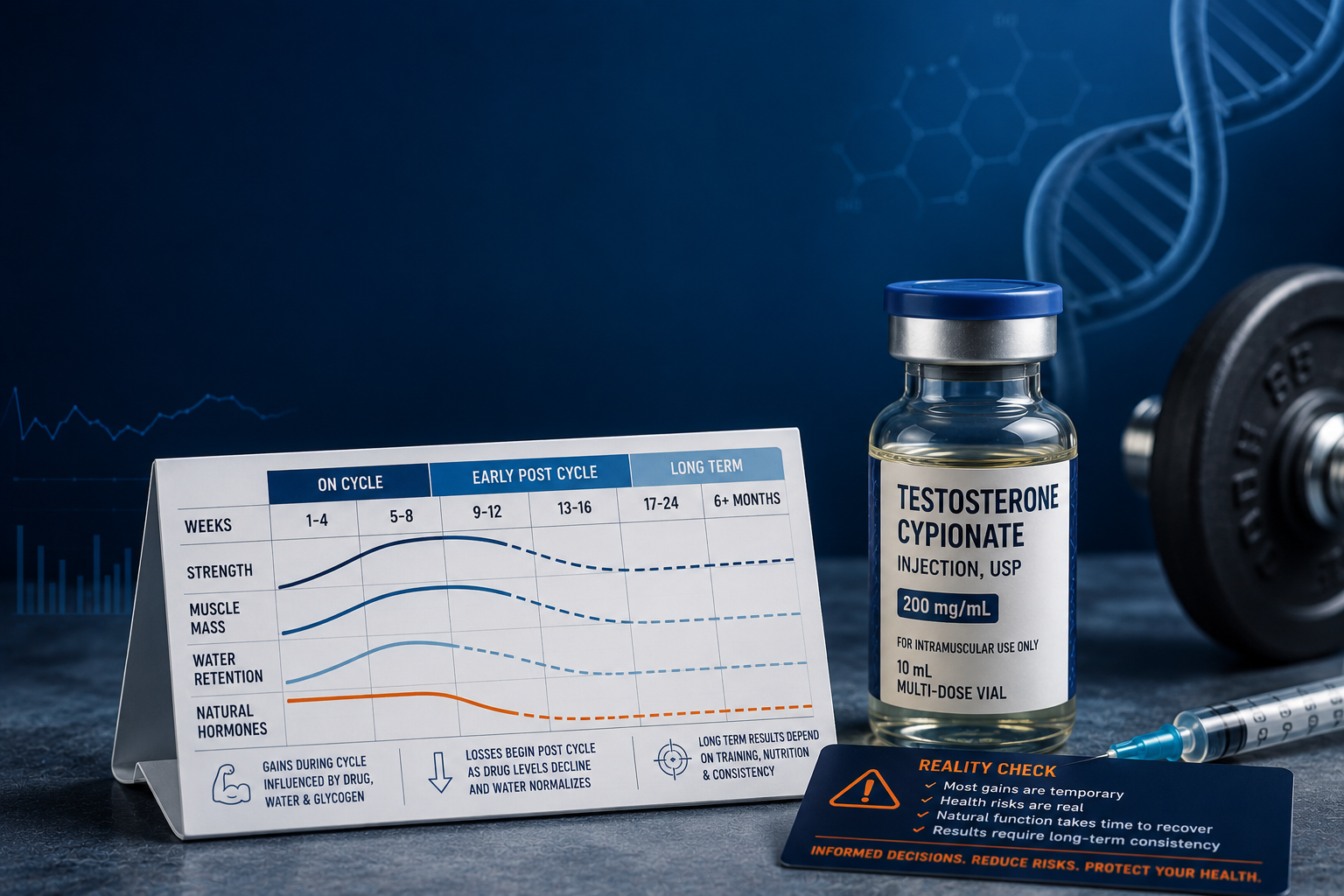
Thinking one steroid cycle will give you permanent gains without long-term commitment? The biology doesn’t work that way. Here’s why “just one cycle” rarely makes sense.
You’re tempted to do one steroid cycle. Get the gains, keep them forever, never touch steroids again. Best of both worlds.
You believe one cycle will accelerate your progress permanently, avoid the health risks of long-term use, and let you keep most of the muscle you build.
You’ve been told:
- “One cycle to jumpstart, then maintain naturally”
- “You’ll keep 80% of your gains”
- “Just one cycle won’t cause permanent damage”
- “It’s the smart way to use steroids”
Almost entirely false. The truth: A single steroid cycle will build muscle rapidly (5-20+ lbs depending on compound and dose), but you’ll lose most gains within months post-cycle as testosterone normalizes. You only keep gains you could have achieved naturally (you just got there faster) or gains maintained by continued training at your natural hormone levels (minimal). The costs remain: Complete testosterone suppression during cycle, recovery period of weeks to months post-cycle (low libido, fatigue, potential muscle loss), side effects during cycle (even “mild” cycles stress cardiovascular system, alter lipids), financial cost (gear, PCT, bloodwork), and potential long-term effects even from single cycle. The fundamental issue: Muscle built with supraphysiological hormones requires supraphysiological hormones to maintain. Once hormones normalize, muscle mass regresses toward natural genetic limit.
In this comprehensive guide, I’ll explain what happens during a steroid cycle (hormonal elevation and adaptation), reveal what happens after (the inevitable regression), show why “keeping gains” is mostly myth (biology of muscle maintenance), detail the actual costs of one cycle (financial, health, time), address the exceptions (rare scenarios where one cycle makes sense), and provide the honest recommendation (for whom one cycle might be rational).
Whether you’re considering “just one cycle” or trying to understand steroid biology, the complete picture is essential.
Let’s examine the “one cycle” question with brutal honesty about what actually happens.
TABLE OF CONTENTS
What Happens During a Steroid Cycle
The physiological changes.
Hormonal Elevation
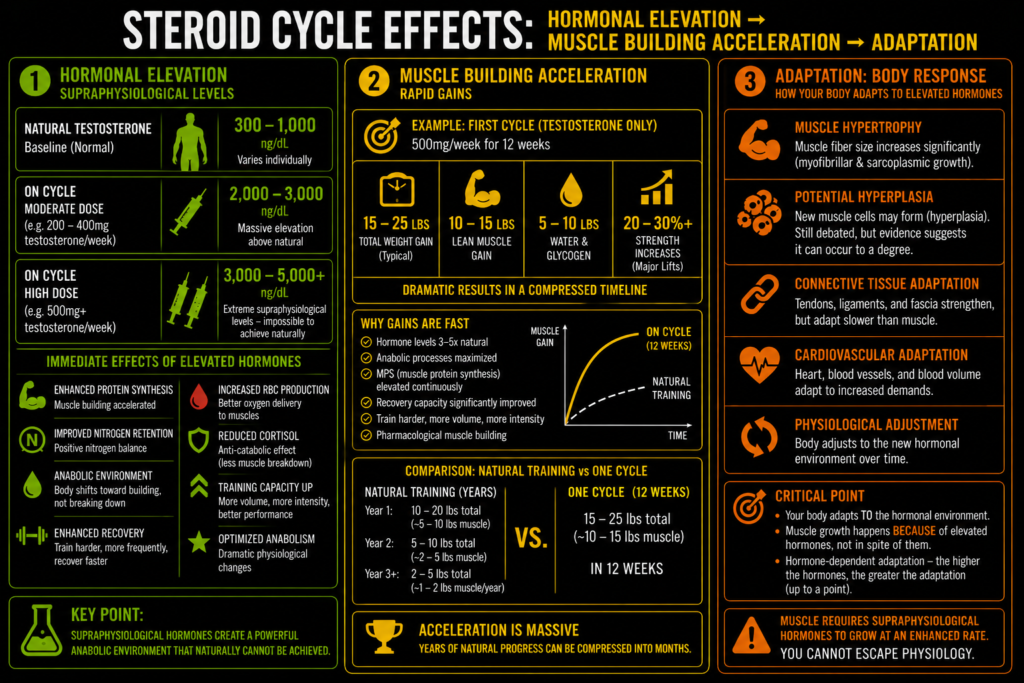
Supraphysiological levels:
- Natural testosterone: 300-1000 ng/dL (varies individually)
- On cycle (moderate dose): 2000-3000 ng/dL
- On cycle (high dose): 3000-5000+ ng/dL
- Massive elevation above natural
What “supraphysiological” means:
- Above what body produces naturally
- Levels impossible to achieve without exogenous hormones
- Pharmacological doses
The immediate effects:
- Enhanced protein synthesis (muscle building accelerated)
- Improved nitrogen retention (anabolic environment)
- Increased red blood cell production (better oxygen delivery)
- Reduced cortisol impact (anti-catabolic)
- Enhanced recovery (train harder, more frequently)
- Optimized anabolism
The Muscle-Building Acceleration
The gains:
- First cycle (testosterone only, 500mg/week, 12 weeks): 15-25 lbs total weight gain typical
- Lean mass: 10-15 lbs (rest is water, glycogen)
- Strength increases: 20-30%+ on major lifts
- Dramatic results
Why gains happen so fast:
- Hormones at 3-5x natural levels
- Anabolic processes maximized
- Muscle protein synthesis elevated continuously
- Recovery dramatically improved (can train harder)
- Pharmacological muscle building
The comparison:
- Natural training: 10-20 lbs muscle in first year (beginner), 5-10 lbs year two, 2-5 lbs year three
- One cycle: 10-15 lbs muscle in 12 weeks
- Years of progress compressed into months
The Adaptation
The body’s response:
- Muscle cells grow (hypertrophy)
- New muscle cells may form (hyperplasia, debated)
- Connective tissue strengthens (slower than muscle)
- Cardiovascular system adapts
- Physiological adjustment
The critical point:
- Body adapts TO the hormonal environment
- Muscle growth happens BECAUSE of elevated hormones
- Hormone-dependent adaptation
What Happens After the Cycle
The inevitable regression.
Hormonal Crash
The timeline:
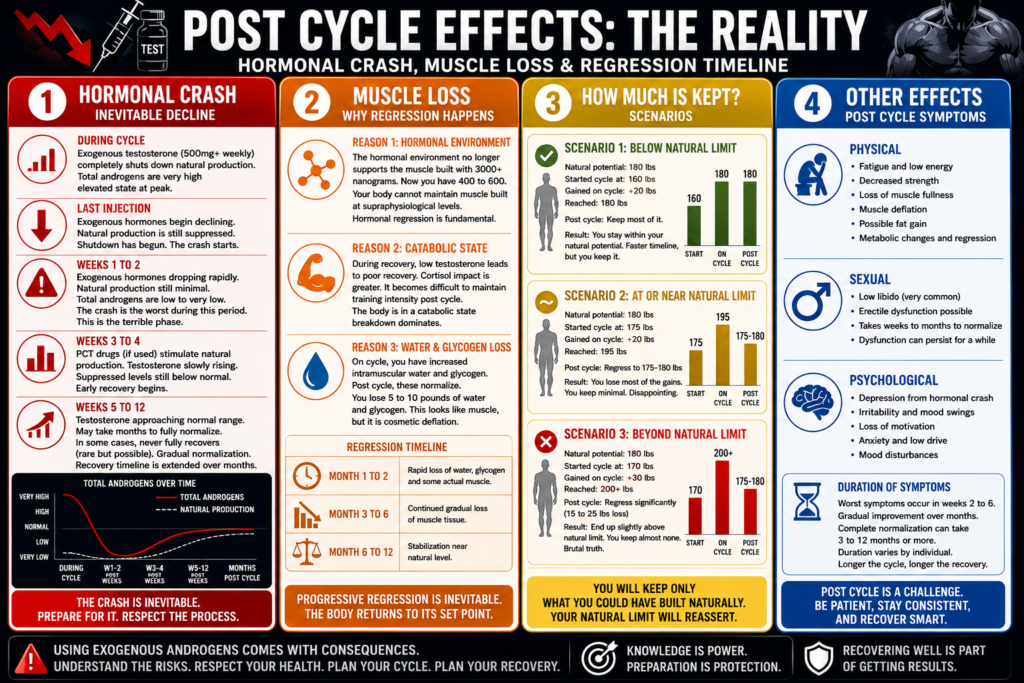
During cycle:
- Exogenous testosterone: 500mg+ weekly
- Natural production: Completely shut down
- Total androgens: Very high
- Elevated state
Last injection:
- Exogenous hormones begin declining
- Natural production still suppressed (shutdown)
- Beginning of crash
Weeks 1-2 post-cycle:
- Exogenous hormones dropping rapidly
- Natural production still minimal
- Total androgens: Low to very low
- The crash
Weeks 3-4 post-cycle:
- PCT drugs (if used) stimulating natural production
- Testosterone slowly rising from suppressed levels
- Still below normal
- Early recovery
Weeks 5-12 post-cycle:
- Testosterone approaching normal range
- May take months to fully normalize
- Some cases: Never fully recovers (rare but possible)
- Gradual normalization
The Muscle Loss
Why muscle is lost:
Reason 1: Hormonal environment no longer supports that much muscle
- Built muscle with 3000 ng/dL testosterone
- Now have 400-600 ng/dL (normal)
- Body can’t maintain muscle built at supraphysiological levels
- Hormonal regression
Reason 2: Catabolic state during recovery
- Low testosterone = poor recovery
- Cortisol impact greater (testosterone normally suppresses it)
- Difficult to maintain training intensity
- Post-cycle catabolism
Reason 3: Water and glycogen loss
- On cycle: Increased intramuscular water and glycogen
- Post-cycle: Water and glycogen normalize
- Lose 5-10 lbs water/glycogen (looks like muscle loss)
- Cosmetic deflation
The timeline:
- Month 1-2 post-cycle: Rapid loss (water, glycogen, some muscle)
- Month 3-6: Continued gradual loss
- Month 6-12: Stabilization near natural level
- Progressive regression
How much muscle is actually kept:
Scenario 1: Below natural limit before cycle
- Example: Could build to 180 lbs naturally, started cycle at 160 lbs
- Gained 20 lbs on cycle (reached 180 lbs)
- Post-cycle: Keep most of it (was within natural potential)
- Kept gains = natural potential reached faster
Scenario 2: At or near natural limit before cycle
- Example: Natural limit 180 lbs, started cycle at 175 lbs
- Gained 20 lbs on cycle (reached 195 lbs)
- Post-cycle: Regress to 175-180 lbs (natural limit)
- Lost most gains
- Kept gains = minimal
Scenario 3: Well beyond natural limit on cycle
- Example: Natural limit 180 lbs, reached 200+ lbs on cycle
- Post-cycle: Regress significantly (15-25 lbs loss)
- End up at or slightly above natural limit
- Kept gains = almost none
The brutal truth:
- You keep muscle you could have built naturally (just got there faster)
- You don’t keep muscle beyond natural genetic limit
- Natural limit reasserts itself
Other Post-Cycle Effects
Physical symptoms:
- Fatigue (low testosterone)
- Decreased strength
- Loss of “fullness” (muscle deflation)
- Possible fat gain (metabolic changes)
- Physical regression
Sexual symptoms:
- Low libido (very common)
- Erectile dysfunction (possible)
- Takes months to normalize
- Sexual dysfunction
Psychological symptoms:
- Depression (hormonal crash)
- Irritability
- Loss of motivation
- Mood disturbances
The duration:
- Symptoms worst weeks 2-6 post-cycle
- Gradual improvement over months
- Complete normalization: 3-12 months (varies)
- Extended recovery period
The Math: Costs vs. Benefits
The realistic accounting.
Financial Costs
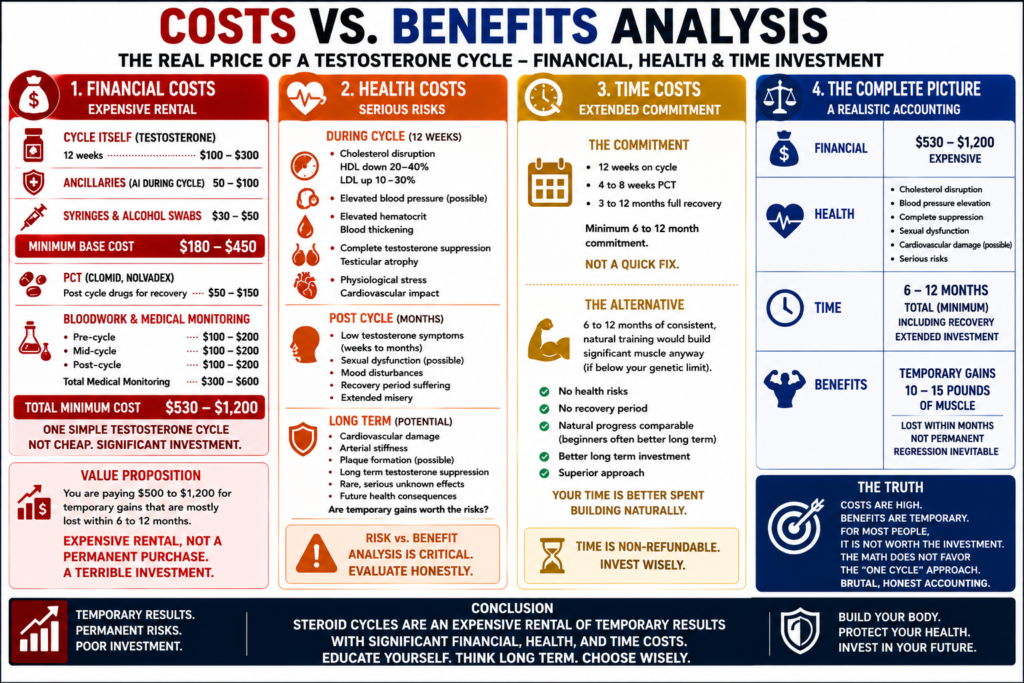
The cycle itself:
- Testosterone (12 weeks): $100-300
- Ancillaries (AI during cycle): $50-100
- Syringes, alcohol swabs, etc.: $30-50
- Minimum: $180-450
PCT:
- Clomid/Nolvadex: $50-150
- Post-cycle drugs
Bloodwork:
- Pre-cycle: $100-200
- Mid-cycle: $100-200
- Post-cycle: $100-200
- Medical monitoring: $300-600
Total minimum cost:
- $530-1200 for one “simple” testosterone cycle
- Not cheap
The value proposition:
- Paying $500-1200 for temporary gains
- Most gains lost within 6-12 months
- Expensive rental
Health Costs
During cycle (12 weeks):
- Cholesterol disruption (HDL down 20-40%, LDL up 10-30%)
- Elevated blood pressure (possible)
- Elevated hematocrit (blood thickening)
- Complete testosterone suppression
- Testicular atrophy
- Physiological stress
Post-cycle (months):
- Low testosterone symptoms (weeks to months)
- Sexual dysfunction (possible)
- Mood disturbances
- Recovery period suffering
Long-term (potentially):
- Cardiovascular damage (arterial stiffness, plaque formation)
- Possible long-term testosterone suppression (rare but serious)
- Unknown effects on future health
- Lasting consequences possible
The question:
- Are temporary gains worth these risks?
- Risk-benefit analysis
Time Costs
The commitment:
- 12 weeks on cycle
- 4-8 weeks PCT
- 3-12 months full recovery
- Minimum 6-12 month commitment
The alternative:
- 6-12 months consistent natural training
- Would build significant muscle anyway (if below genetic limit)
- No health risks
- No recovery period
- Natural progress comparable for beginners
The Exceptions: When One Cycle Might Make Sense
Rare scenarios where the math changes.
Exception 1: Financial Incentive
The scenario:
- Professional photo shoot (modeling contract)
- Movie role requiring physique transformation
- Specific one-time event with significant financial reward
- Economic justification
The calculation:
- Payment: $10,000+ for the job
- Cycle cost: $1,000
- Health risk: Calculated and accepted
- Profit motive
The reality:
- Still lose gains afterward
- But short-term appearance achieved goal
- Financial gain potentially worth temporary health cost
- Rational transaction
Exception 2: Competitive Event
The scenario:
- One specific competition (physique, powerlifting)
- Not planning competitive career
- One-time performance goal
- Specific performance target
The rationalization:
- Achieve competitive level for one event
- Understand gains are temporary
- Goal is event performance, not permanent physique
- Temporary peak accepted
Exception 3: Very Late Starter
The scenario:
- Age 45-50+ starting training
- Natural testosterone declining with age
- Limited time to build physique naturally
- Age-related considerations
The potential logic:
- Natural testosterone already suboptimal
- One cycle might approach TRT levels (therapeutic)
- May transition to medical TRT afterward
- Age-appropriate use case
The caveat:
- Should pursue legitimate TRT through doctor
- One cycle still temporary
- Medical route preferred
Why “Just One Cycle” Rarely Works
The psychological and practical reality.
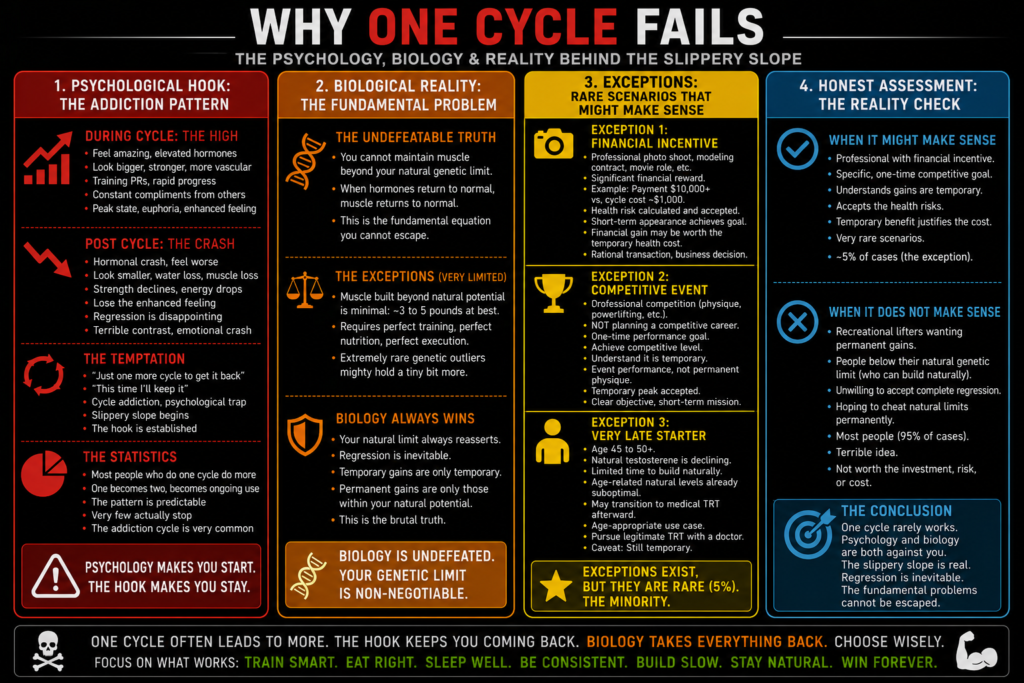
The Psychological Hook
What actually happens:
During cycle:
- Feel amazing (elevated hormones)
- Look bigger, stronger
- Training PRs constantly
- Compliments from others
- Peak state
Post-cycle:
- Feel worse (hormonal crash)
- Look smaller (water loss, muscle loss)
- Strength declines
- Lose the “enhanced” feeling
- Regression disappointing
The temptation:
- “Just one more cycle to get it back”
- “This time I’ll keep it”
- Cycle addiction
The statistics:
- Most people who do “one cycle” do more
- One becomes two becomes ongoing use
- Slippery slope
The Biological Reality
The fundamental problem:
- Can’t maintain muscle beyond natural genetic limit
- Hormones return to normal = muscle returns to normal
- Biology is undefeated
The exceptions:
- Muscle built within natural potential (just accelerated timeline)
- Minimal (3-5 lbs) above natural limit with perfect training/diet
- Very limited
The Honest Assessment
For whom one cycle makes sense:
- Professional with financial incentive
- Specific one-time competitive goal
- Understands gains are temporary
- Accepts health risks for temporary benefit
- Rare scenarios
For whom one cycle doesn’t make sense:
- Recreational lifters wanting “permanent gains”
- People below natural genetic limit (can build naturally)
- Those unwilling to accept complete regression
- Anyone hoping to “cheat” natural limits permanently
- Most people
The Alternative: Natural Training
The superior long-term approach.
What Natural Training Achieves
The timeline:
- Year 1: 10-20 lbs muscle (beginner gains)
- Year 2: 5-10 lbs muscle
- Year 3: 2-5 lbs muscle
- Year 4-5: 1-3 lbs muscle annually
- Progressive development
The total potential:
- 5-7 years reach near-genetic limit
- 30-50 lbs muscle above untrained baseline (varies by genetics)
- Substantial physique
The advantages:
- All gains permanent (maintained with training)
- No health risks from hormones
- No hormonal disruption
- No financial cost (beyond gym/food)
- Sustainable indefinitely
- Long-term stability
The Patience Factor
The cultural problem:
- Instant gratification society
- Want results now
- Unwilling to wait years
- Impatience
The reality:
- Building impressive physique takes years (natural or enhanced)
- Enhanced just compresses timeline
- If unwilling to maintain muscle with continued cycles, enhanced gains disappear anyway
- Time investment required regardless
The better approach:
- Train naturally for 2-3 years minimum
- Assess actual genetic potential
- Then decide about enhancement (if at all)
- Informed decision after natural progress
The Recommendation
Evidence-based guidance.
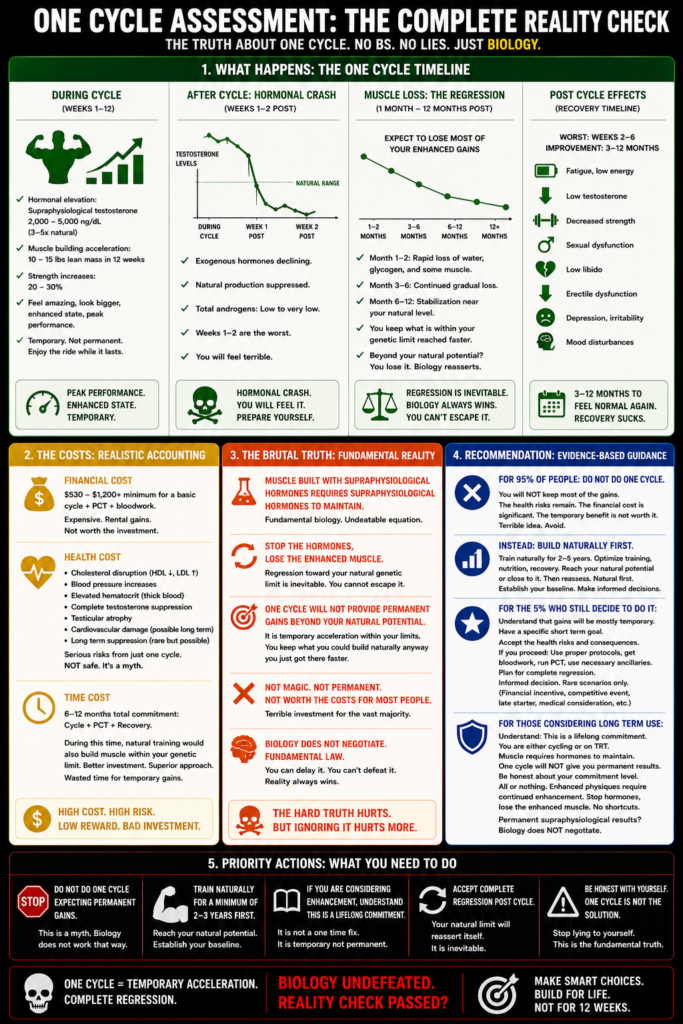
For 95% of People
Don’t do one cycle:
- Won’t keep most gains
- Health risks remain
- Financial cost significant
- Better to train naturally
- Not worth it
Instead:
- Train naturally 2-5 years
- Optimize training and nutrition
- Reach natural potential (or close)
- Reassess then
- Natural first
For the 5% Exception
If you still decide to do one cycle:
- Understand gains are mostly temporary
- Have specific short-term goal
- Accept health risks for temporary benefit
- Use proper protocols (bloodwork, PCT, ancillaries)
- Plan for complete regression
- Informed decision
For Those Considering Long-Term Use
If serious about enhanced physique:
- Understand it’s lifelong commitment (cycling or TRT)
- Muscle requires hormones to maintain
- One cycle won’t give permanent results
- Be honest about commitment level
- All or nothing
The reality:
- Enhanced physiques require continued enhancement
- Stop hormones = lose enhanced muscle
- No shortcuts to permanent supraphysiological results
- Biology doesn’t negotiate
This article is informational only. We do not condone or recommend steroid use. The biological reality is clear: muscle built with supraphysiological hormones requires supraphysiological hormones to maintain. One cycle will not provide permanent gains beyond your natural genetic potential. The health risks, financial costs, and recovery period apply even to single cycles. For most people, natural training is superior long-term. If considering any steroid use, understand the complete picture and make fully informed decisions.
REFERENCES
SECTION 1 — Supraphysiological testosterone produces rapid muscle growth: the dose-response in humans
[1] Bhasin S et al. — PubMed/New England Journal of Medicine, 1996 Landmark RCT in 43 men receiving graded testosterone doses across 4 groups (placebo, testosterone 600 mg per week, exercise alone, testosterone plus exercise); testosterone alone without exercise produced significant increases in fat-free mass compared to placebo; the testosterone-plus-exercise group produced the greatest gains; the dose-response was clear and supraphysiological testosterone substantially exceeded what exercise alone could produce; provides the primary controlled human evidence for the article’s description of rapid muscle gain during a cycle, establishing that testosterone at 600 mg per week (a common first-cycle dose) causes measurable hypertrophy within weeks https://pubmed.ncbi.nlm.nih.gov/8637535/
SECTION 2 — AAS-induced hypogonadism: testosterone suppression and recovery timeline after cessation
[2] Rasmussen JJ et al. — PubMed/Journal of Clinical Endocrinology and Metabolism, 2016 Scoping review and prospective data synthesis on recovery from anabolic steroid-induced hypogonadism (ASIH); near-complete recovery of endogenous testosterone occurs over months, with full gonadotropin recovery expected over 3 to 6 months; physical changes including testicular atrophy are expected to recover over months to years; libido typically returns to baseline over several months but often remains less robust than during AAS use; gynecomastia is unlikely to reverse; recovery is variable and depends on age and the degree and duration of androgen abuse; provides the timeline evidence for the article’s description of post-cycle hormonal crash and the months-long recovery period during which testosterone suppression causes fatigue, mood disturbances, and muscle regression https://pubmed.ncbi.nlm.nih.gov/26468553/
SECTION 3 — Muscle loss after AAS cessation and the cellular memory mechanism
[3] Egner IM et al. — PMC/Journal of Physiology, 2013 Controlled animal study demonstrating the cellular mechanism underlying muscle memory after AAS-induced hypertrophy; after testosterone propionate administration induced a 66% increase in myonuclei number and a 77% increase in fiber cross-sectional area, drug removal caused fiber size to return to baseline within 3 weeks; however, the elevated myonuclei count persisted for at least 3 months (over 10% of the mouse lifespan), and when muscles were re-exposed to overload exercise at this point, they grew 31% while controls did not; the study confirms the article’s two simultaneous points: muscle size regresses to baseline when hormones normalize (fiber area returned to sham levels 3 weeks post-drug), but cellular memory persists (myonuclei retained); explains why gains within natural potential can be maintained while gains beyond it regress https://pmc.ncbi.nlm.nih.gov/articles/PMC3892473/
SECTION 4 — Withdrawal syndrome: psychological and physical post-cycle effects driving re-use
[4] Kanayama G et al. — PubMed/Drug and Alcohol Dependence, 2010 Review of AAS dependence and withdrawal syndromes documenting that approximately 30% of AAS users develop dependence; the withdrawal syndrome includes two overlapping components: affective symptoms (depression, anxiety, irritability, diminished drive) and hypogonadal symptoms (fatigue, low libido, erectile dysfunction); these symptoms emerge when users discontinue AAS and may persist for months until endogenous testosterone normalizes; the combination of feeling worse and looking worse post-cycle creates a powerful psychological incentive to resume use; directly validates the article’s “slippery slope” argument that “just one cycle” frequently leads to continued use because users experience intolerable withdrawal symptoms and lose gains, making cessation psychologically very difficult https://pubmed.ncbi.nlm.nih.gov/20031348/



Leave a Reply
You must be logged in to post a comment.