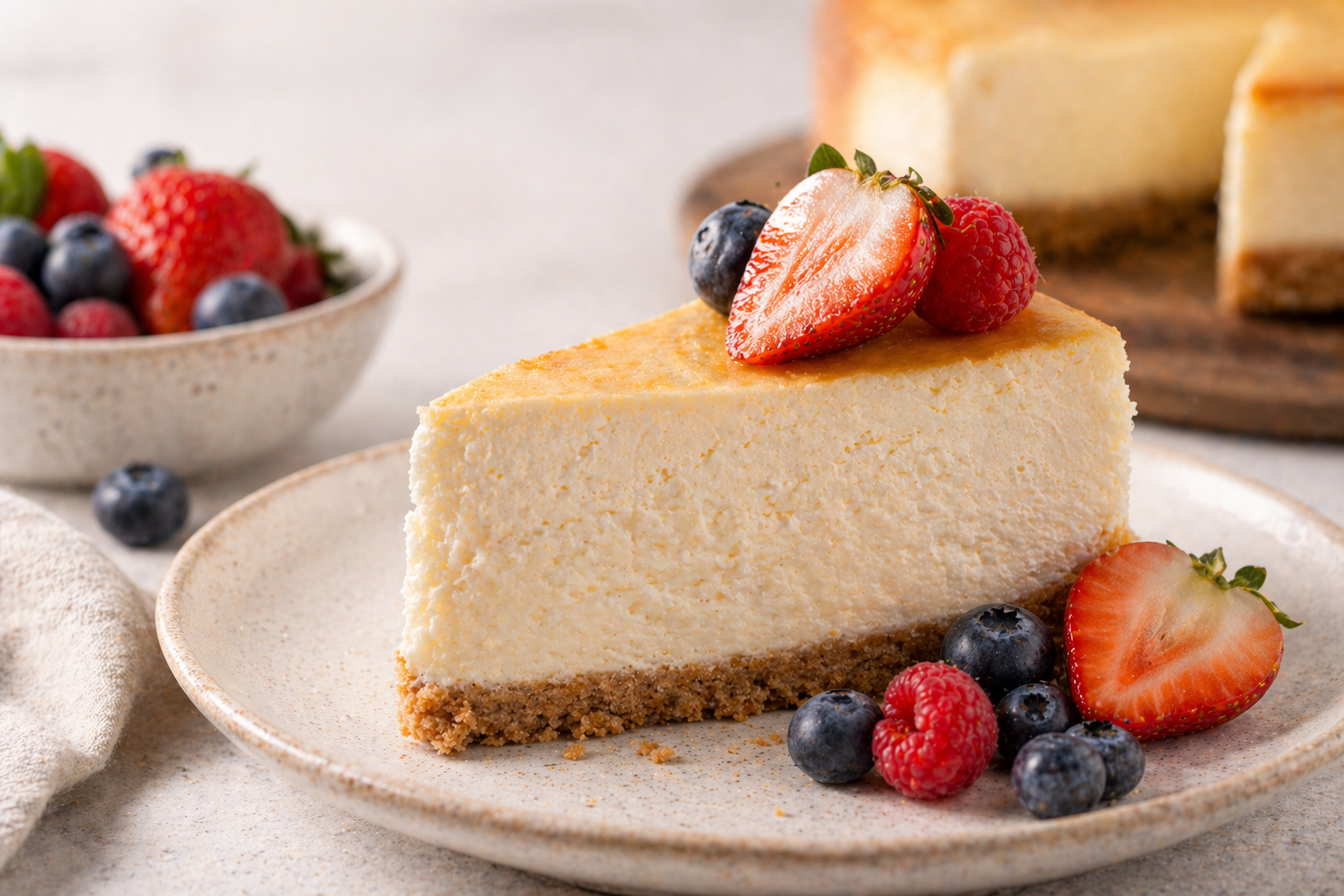
Want real cheesecake without destroying your diet? This protein cheesecake is creamy, rich, and actually fits your macros.
You’re craving cheesecake. Real, dense, New York-style cheesecake. Not protein fluff pretending to be cheesecake.
But regular cheesecake is 500+ calories per slice, mostly fat and sugar. Completely off-limits when cutting.
You think your only options are:
- Suffer without cheesecake entirely
- Blow your entire day’s calories on one slice
- Make “protein cheesecake” that tastes like flavored Greek yogurt
- Accept that dieting means no desserts
Wrong. You can have dense, creamy cheesecake that supports your goals. This anabolic protein cheesecake is genuinely rich and satisfying (not “good for a protein dessert”). Each slice: 110 calories, 14g protein, 8g carbs, 3g fat. The secret: Cottage cheese blended smooth for creaminess, Greek yogurt for tang, cream cheese for authentic flavor, and proper baking technique that creates actual cheesecake texture. Not mousse. Not yogurt. Actual cheesecake.
In this comprehensive recipe guide, I’ll provide the complete ingredient list (with exact ratios and substitutions), show you the step-by-step process (critical techniques for texture), reveal the nutritional breakdown (per slice and full cake), explain what makes this actually creamy (the science of cheesecake), provide flavor variations (5+ different versions), and give you storage and serving instructions (makes 12 perfect slices).
Whether you’re cutting hard or just want high-protein desserts that taste real, this cheesecake delivers.
Let’s make cheesecake that actually tastes like cheesecake and fits your diet.
TABLE OF CONTENTS
Why This Cheesecake Actually Works
The problems with both regular and “healthy” cheesecake.
What Makes Regular Cheesecake “Unfitable”
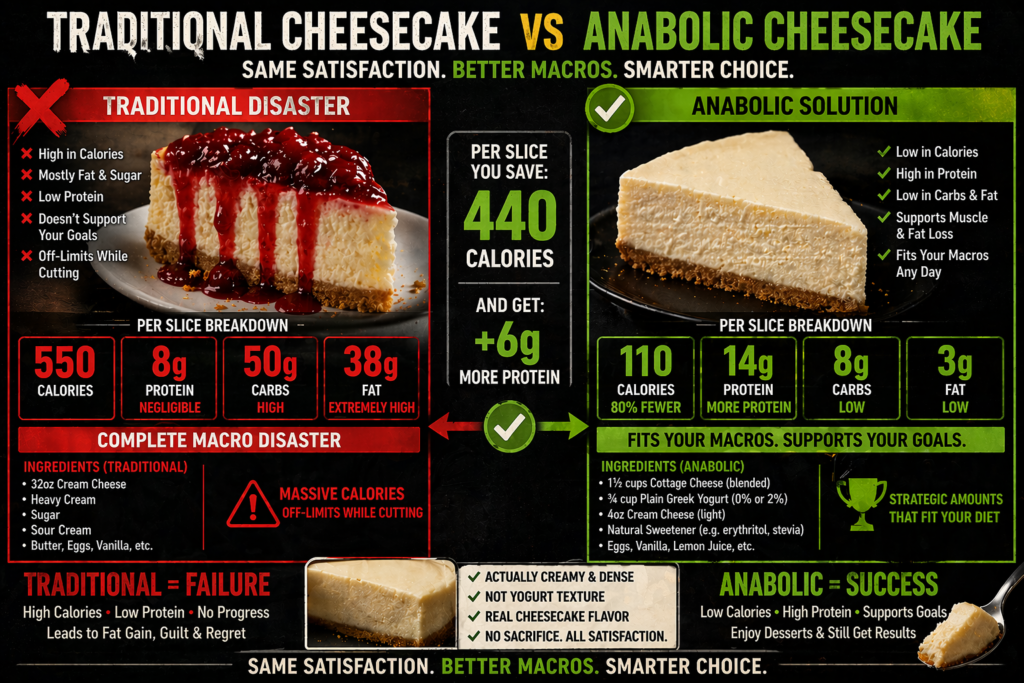
The typical cheesecake slice (1/12 of 9-inch cake):
- Calories: 500-650
- Protein: 6-8g
- Carbs: 45-55g (mostly sugar)
- Fat: 35-45g (mostly saturated)
- Complete macro disaster
The problems:
Problem 1: Fat bomb
- 35-45g fat per slice
- Mostly from cream cheese and heavy cream
- One slice = entire day’s fat allowance
- Fat budget destroyed
Problem 2: Sugar overload
- 40-50g sugar per slice
- Blood sugar spike followed by crash
- Triggers more cravings
- Metabolic nightmare
Problem 3: Zero protein
- 6-8g protein negligible
- Doesn’t support muscle maintenance
- Purely recreational food
- No anabolic benefit
Problem 4: Calorie dense
- 500-650 calories for one slice
- Two slices = half your daily calories
- Can’t fit into any diet
- Unsustainable
The ingredient breakdown (why so bad):
- 32oz (4 blocks) full-fat cream cheese: 3,200 calories
- 1 cup heavy cream: 800 calories
- 1.5 cups sugar: 1,200 calories
- Graham cracker crust: 800 calories
- Total: 6,000+ calories for whole cake
The result:
- 500+ calories per slice (12 slices)
- Can’t fit cutting diet
- Even bulking, not optimal
- Off-limits for serious training
What Makes Most “Protein Cheesecake” Bad
The typical problems:
Problem 1: Yogurt texture
- Just Greek yogurt in a pan
- Not creamy, just thick yogurt
- No cheesecake texture
- Texture failure
Problem 2: Protein powder grit
- Too much protein powder
- Grainy texture
- Chalky mouthfeel
- Unpleasant texture
Problem 3: Artificial flavor
- Tastes like sweetened protein shake
- No cream cheese tang
- Chemical aftertaste from sweeteners
- Flavor failure
Problem 4: Falls apart
- Doesn’t set properly
- Crumbles when sliced
- Not cohesive
- Structural failure
Problem 5: Still high calorie
- Use too much nut butter in crust
- Use full-fat cream cheese
- End up 250-300 calories anyway
- Marginal improvement
The result:
- Technically fits macros
- But tastes nothing like cheesecake
- People give up and eat real cheesecake
- Unsustainable substitute
What Makes This Cheesecake Different
The solutions:
Solution 1: Cottage cheese base (blended smooth)
- High protein, low fat
- Blends completely smooth (no curds)
- Creates creamy texture
- Protein and texture foundation
Solution 2: Strategic cream cheese use
- Small amount (4oz, not 32oz)
- Provides authentic cheesecake flavor
- Just enough for tang and richness
- Flavor authentication
Solution 3: Greek yogurt addition
- Adds protein
- Contributes to tang
- Improves texture
- Multi-functional ingredient
Solution 4: Proper baking technique
- Water bath (prevents cracking)
- Low temperature (325°F)
- Gradual cooling (prevents sinking)
- Professional technique
Solution 5: Minimal crust (optional)
- Crushed protein cereal or graham crackers
- Thin layer (not thick)
- Or crustless (even lower calorie)
- Calorie control
The result:
- 110 calories per slice
- 14g protein per slice
- Actually creamy and dense
- Real cheesecake flavor
- Optimal cheesecake
The Complete Recipe
Ingredients and instructions.
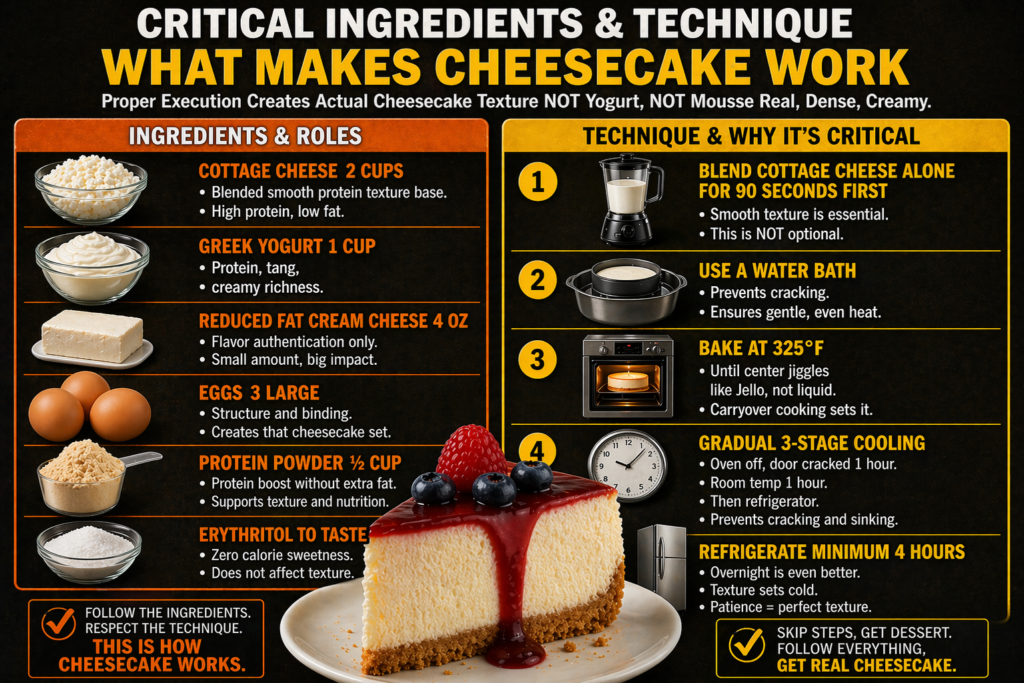
Ingredients (Makes 12 Slices)
For the filling:
- 2 cups (450g) low-fat cottage cheese
- 1 cup (227g) nonfat Greek yogurt
- 4oz (113g) reduced-fat cream cheese (or light cream cheese), softened
- 3 large eggs
- 1/2 cup (120g) vanilla whey protein powder
- 1/2 cup (100g) granulated erythritol (or sweetener of choice)
- 2 tbsp (30ml) lemon juice
- 1 tbsp vanilla extract
- 1/4 tsp salt
- Creamy filling base
For the crust (optional):
- 1 cup (30g) crushed protein cereal (like Magic Spoon or Catalina Crunch)
- OR 3/4 cup (90g) graham cracker crumbs
- 2 tbsp (28g) melted butter or coconut oil
- 1 tbsp erythritol
- Optional crust
Equipment needed:
- 9-inch springform pan
- High-powered blender or food processor
- Large roasting pan (for water bath)
- Aluminum foil
- Mixing bowl
- Essential tools
Step-by-Step Instructions
Step 1: Prep (10 minutes)
Preheat oven:
- Set to 325°F (163°C)
- Lower temp prevents cracking
- Critical temperature
Prepare springform pan:
- Wrap bottom and sides in 2 layers aluminum foil
- Prevents water seepage during water bath
- Spray inside with cooking spray
- Water bath prep
Bring ingredients to room temperature:
- Cream cheese should be soft
- Eggs should be room temp
- Helps smooth blending
- Temperature matters
Step 2: Make crust (optional, 5 minutes)
If making crust:
Crush cereal or crackers:
- Process until fine crumbs
- Should be sand-like consistency
- Fine texture
Mix crust:
- Combine crumbs, melted butter, erythritol
- Mix until resembles wet sand
- Cohesive mixture
Press into pan:
- Press firmly into bottom of pan
- Even layer, compact
- Thin, firm base
Pre-bake:
- Bake at 325°F for 8 minutes
- Let cool while making filling
- Set crust
If going crustless:
- Skip this step entirely
- Saves 25 calories per slice
- Lower calorie option
Step 3: Blend filling (5 minutes)
Add to blender in order:
- Cottage cheese (blend first until completely smooth, 60-90 seconds)
- Greek yogurt
- Softened cream cheese
- Eggs (one at a time)
- Protein powder
- Erythritol
- Lemon juice
- Vanilla extract
- Salt
- Sequential blending
Blend until completely smooth:
- 2-3 minutes total
- Stop and scrape sides halfway
- Should be silky smooth, no lumps
- No cottage cheese curds visible
- Critical step for texture
The consistency:
- Thick, pourable batter
- Like thick pancake batter
- Completely homogeneous
- Proper texture
Step 4: Pour and prep for baking (5 minutes)
Pour filling:
- Pour into prepared pan (over crust if using)
- Smooth top with spatula
- Tap pan gently on counter (releases air bubbles)
- Even distribution
Prepare water bath:
- Place springform pan in large roasting pan
- Fill roasting pan with hot water
- Water should come halfway up sides of springform
- Water bath setup
Why water bath matters:
- Gentle, even heat
- Prevents cracking
- Creates creamy texture
- Essential for quality
Step 5: Bake (50-60 minutes)
Baking:
- Bake at 325°F for 50-60 minutes
- Edges should be set
- Center should jiggle slightly (like Jello)
- Doneness test
Visual cues:
- Edges puffed and set
- Center moves as one unit (not liquid)
- Surface may have slight golden color
- Appearance check
Don’t overbake:
- Overbaking = dry, cracked cheesecake
- Center will firm up as cools
- Better to slightly underbake
- Temperature precision
Step 6: Cool gradually (3-4 hours)
Turn off oven:
- When done, turn off oven
- Crack oven door open
- Leave cheesecake in oven for 1 hour
- Gradual cooling prevents cracking
Remove from oven:
- After 1 hour, remove from water bath
- Remove foil
- Cool on counter for 1 hour
- Continued cooling
Refrigerate:
- Cover with plastic wrap
- Refrigerate for minimum 4 hours (overnight best)
- Texture sets completely when cold
- Final setting
Why gradual cooling matters:
- Sudden temperature change = cracking
- Gradual cooling = smooth top
- Patience rewarded
- Critical for appearance
Step 7: Slice and serve
Release from pan:
- Run knife around edge
- Release springform
- Clean release
Slice:
- Use sharp knife
- Wipe knife between slices (clean edges)
- Cut into 12 equal slices
- Portion control
Serve:
- Cold from refrigerator (best texture)
- Optional toppings (see variations below)
- Ready to enjoy
Nutritional Information
Per slice WITH crust (1/12 of cake):
- Calories: 135
- Protein: 14g
- Carbohydrates: 10g
- Fat: 5g
- Fiber: 0.5g
- Sugar: 2g
- With crust macros
Per slice WITHOUT crust (1/12 of cake):
- Calories: 110
- Protein: 14g
- Carbohydrates: 8g
- Fat: 3g
- Fiber: 0g
- Sugar: 2g
- Crustless macros (recommended)
Full cake (12 slices, no crust):
- Calories: 1,320
- Protein: 168g
- Carbohydrates: 96g
- Fat: 36g
- Total cake macros
Comparison to regular cheesecake:
- Regular: 550 cal, 8g protein, 50g carbs, 38g fat
- This (no crust): 110 cal, 14g protein, 8g carbs, 3g fat
- Savings: 440 calories, +6g protein, -42g carbs, -35g fat per slice
Macro breakdown (crustless):
- 51% protein
- 29% carbohydrates
- 20% fat
- Protein-dominant dessert
The Science of Creamy Texture
Why this actually works.
The Role of Each Ingredient
Cottage cheese (protein + creaminess):
- High protein (14g per cup)
- Low fat (when using low-fat)
- Blends completely smooth (no curds when blended properly)
- Creates thick, creamy base
- Foundation ingredient
Greek yogurt (protein + tang):
- Adds protein (17g per cup)
- Provides authentic cheesecake tang
- Contributes to creamy texture
- Slight acidity balances sweetness
- Multi-functional
Cream cheese (flavor authentication):
- Small amount provides huge flavor
- Authentic cheesecake taste
- Creates richness
- Only 4oz vs. 32oz in regular cheesecake
- Strategic flavor use
Eggs (binding + structure):
- Bind ingredients together
- Create structure as bake
- Contribute to creamy texture
- Essential for setting
- Structural support
Protein powder (protein boost):
- Adds protein without liquid
- Helps absorb moisture
- Slight vanilla flavor enhancement
- Contributes to structure
- Protein delivery
Erythritol (sweetness):
- Zero calorie sweetener
- No blood sugar impact
- Slight cooling effect (characteristic of erythritol)
- Bulk similar to sugar
- Clean sweetness
Lemon juice (tang):
- Enhances cheesecake flavor
- Slight acidity brightens flavor
- Authentic taste
- Flavor enhancer
Vanilla extract (flavor depth):
- Classic cheesecake flavor
- Rounds out taste
- Aromatic component
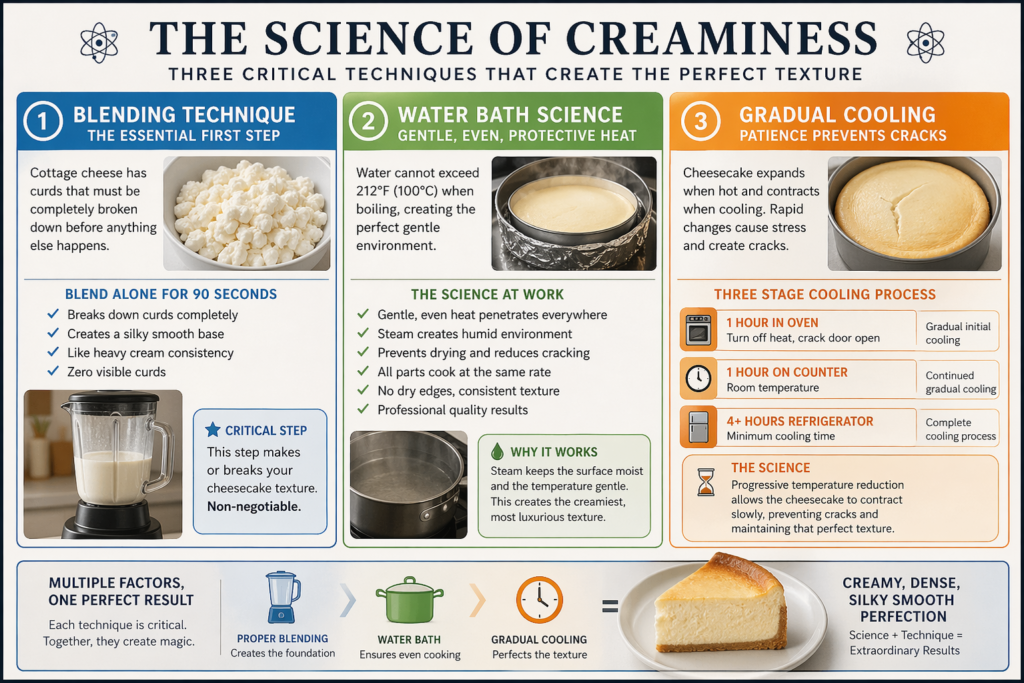
The Blending Technique
Why blend cottage cheese alone first:
- Cottage cheese has curds
- Must break down completely
- 60-90 seconds solo blending essential
- Creates silky smooth base
- Critical first step
What happens if you don’t:
- Visible curds in final cheesecake
- Grainy texture
- Not smooth
- Texture failure
The test:
- After blending cottage cheese, check
- Should look like heavy cream
- Zero visible curds
- Smoothness check
The Water Bath Science
Why water bath (bain-marie) matters:
Temperature regulation:
- Water can’t exceed 212°F (boiling point)
- Creates gentle, even heat
- Prevents overcooking edges
- Temperature control
Moisture:
- Steam in oven creates humid environment
- Prevents surface from drying
- Reduces cracking risk
- Humidity control
Even cooking:
- All parts of cheesecake cook at same rate
- No overcooked edges, undercooked center
- Consistent texture throughout
- Even heat distribution
The result:
- Smooth, crack-free top
- Creamy texture
- No dry edges
- Professional quality
The Gradual Cooling Technique
Why gradual cooling prevents cracking:
The science:
- Cheesecake expands when hot
- Contracts when cooling
- Rapid cooling = rapid contraction = cracks
- Gradual cooling = gradual contraction = no cracks
- Thermal expansion management
The three-stage cooling:
- In oven with door cracked (1 hour): Slow initial cooling
- On counter (1 hour): Continued gradual cooling
- In refrigerator (4+ hours): Final cooling and setting
- Progressive temperature reduction
The patience:
- Can’t rush this
- Attempting to speed cool = cracked top
- Worth the wait
- Time investment necessary
Flavor Variations
Make it your own.
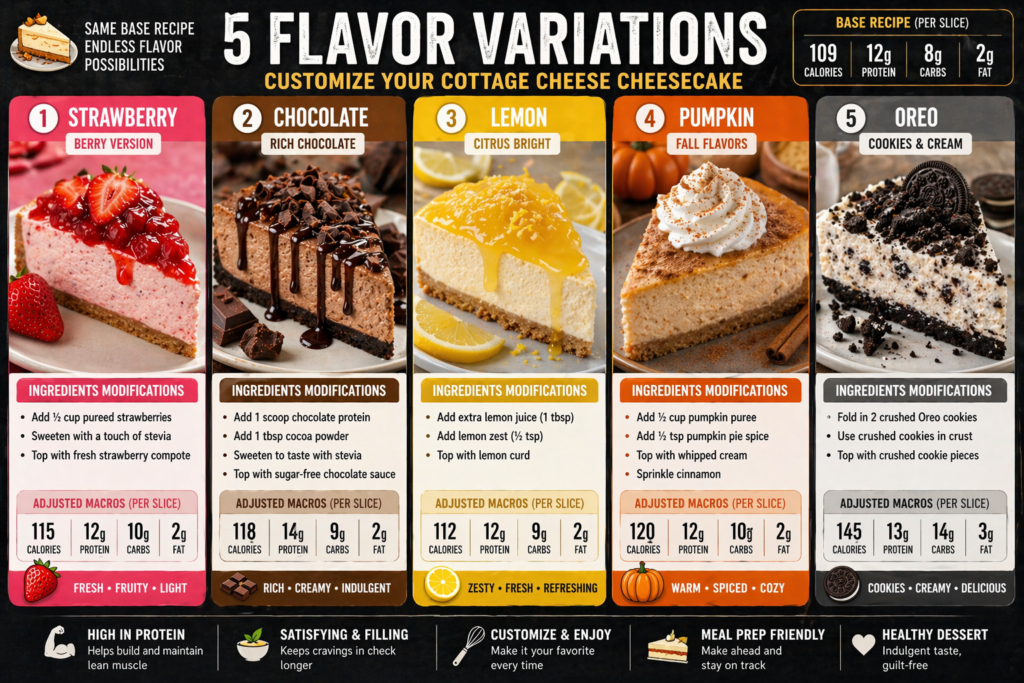
Variation 1: Strawberry Cheesecake
Add to filling:
- 1/2 cup (80g) frozen strawberries (thawed, pureed)
- Reduce Greek yogurt by 1/4 cup
- Blend strawberry puree with other ingredients
- Strawberry base
Topping:
- Fresh strawberry compote (strawberries + erythritol, cooked down)
- Sugar-free strawberry jam
- Fresh sliced strawberries
- Berry topping
Macros per slice:
- Calories: 115 (crustless)
- Protein: 13g
- Carbs: 10g
- Fat: 3g
- Minimal change
Variation 2: Chocolate Cheesecake
Add to filling:
- Replace vanilla protein with chocolate protein
- Add 3 tbsp (18g) unsweetened cocoa powder
- Add extra 2 tbsp erythritol (cocoa is bitter)
- Chocolate version
Topping:
- Sugar-free chocolate sauce
- Cocoa powder dusting
- Sugar-free chocolate chips
- Chocolate finish
Macros per slice:
- Calories: 118 (crustless)
- Protein: 14g
- Carbs: 10g
- Fat: 3g
- Slight increase from cocoa
Variation 3: Lemon Cheesecake
Add to filling:
- Increase lemon juice to 1/4 cup (60ml)
- Add 1 tbsp lemon zest
- Add 1/4 tsp lemon extract (optional, for intense lemon)
- Lemon enhancement
Topping:
- Lemon curd (sugar-free version)
- Fresh lemon slices
- Lemon zest
- Citrus topping
Macros per slice:
- Calories: 112 (crustless)
- Protein: 14g
- Carbs: 9g
- Fat: 3g
- Virtually same
Variation 4: Pumpkin Cheesecake
Add to filling:
- 1 cup (245g) pumpkin puree (not pumpkin pie filling)
- 1 tsp pumpkin pie spice
- Reduce Greek yogurt by 1/2 cup
- Pumpkin version
Topping:
- Whipped cream (sugar-free)
- Cinnamon dusting
- Crushed pecans
- Fall flavors
Macros per slice:
- Calories: 120 (crustless)
- Protein: 13g
- Carbs: 11g
- Fat: 3g
- Pumpkin addition
Variation 5: Oreo Cheesecake
Add to filling:
- 6 reduced-fat Oreos, crushed (mixed into batter)
- Cookies and cream
Topping:
- 3 reduced-fat Oreos, crushed (sprinkle on top)
- Cookie topping
Macros per slice:
- Calories: 145 (crustless)
- Protein: 13g
- Carbs: 14g
- Fat: 4g
- Higher from Oreos but still reasonable
Topping Options (All Variations)
Sugar-free whipped cream:
- Light, airy
- Adds minimal calories
- +10 calories per 2 tbsp
Fresh berries:
- Strawberries, blueberries, raspberries
- Antioxidants, fiber
- +15 calories per 1/4 cup
Sugar-free fruit compote:
- Berries cooked with erythritol
- Thick, jammy
- +20 calories per 2 tbsp
Sugar-free chocolate drizzle:
- Melted sugar-free chocolate chips
- Indulgent
- +25 calories per 1 tbsp
Crushed nuts:
- Almonds, pecans, walnuts
- Crunch
- +30 calories per 1 tbsp
Troubleshooting
Common problems and solutions.
Problem 1: Cracked Top
Causes:
- Overbaked (most common)
- No water bath used
- Rapid cooling (didn’t use gradual method)
- Oven temperature too high
- Temperature or cooling issue
Solutions:
- Use water bath (essential)
- Bake at 325°F, not higher
- Don’t overbake (center should jiggle)
- Use gradual cooling method (3 stages)
- Prevent rapid temperature changes
If already cracked:
- Cover with topping (whipped cream, fruit)
- Taste and texture still perfect
- Cosmetic issue only
Problem 2: Grainy or Gritty Texture
Causes:
- Cottage cheese not blended smooth enough
- Protein powder not fully incorporated
- Low-quality protein powder (doesn’t dissolve)
- Blending inadequate
Solutions:
- Blend cottage cheese alone for 90 seconds first
- Use high-powered blender
- Use quality protein powder (Optimum Nutrition, Dymatize)
- Blend total mixture 2-3 minutes
- Thorough blending
Prevention:
- Check cottage cheese after solo blending (should be silky)
- No shortcuts on blending time
- Quality blending equipment
Problem 3: Sunken Center
Causes:
- Overbaked
- Cooled too quickly
- Opened oven door during baking
- Temperature fluctuation
Solutions:
- Don’t overbake (jiggle test)
- Use gradual cooling (3-stage method)
- Don’t open oven during baking
- Stable environment
If already sunken:
- Fill center with topping
- Structurally fine, just cosmetic
- Easy fix
Problem 4: Won’t Set/Too Soft
Causes:
- Underbaked
- Not refrigerated long enough
- Too much liquid added
- Insufficient setting
Solutions:
- Bake until edges set, center jiggles as one unit
- Refrigerate minimum 4 hours (overnight better)
- Measure ingredients accurately
- Proper setting time
If too soft:
- Refrigerate longer (up to 24 hours)
- Freeze for 1-2 hours (firms up dramatically)
- Extended cooling
Problem 5: Tastes Too Tangy
Causes:
- Too much lemon juice
- Very fresh Greek yogurt (more tangy)
- Personal taste preference
- Acidity level
Solutions:
- Reduce lemon juice to 1 tbsp
- Use aged Greek yogurt (less tangy)
- Increase sweetener by 2 tbsp
- Add extra vanilla (1 tsp)
- Balance acidity
Problem 6: Water Leaked Into Cheesecake
Causes:
- Springform pan not wrapped properly in foil
- Foil tore during handling
- Old springform pan with gaps
- Seal failure
Solutions:
- Use 2 layers heavy-duty foil
- Wrap carefully, seal completely
- Check for tears before adding water
- Use new springform pan if old one leaky
- Proper sealing
Prevention:
- Test seal before using (fill with water, check for leaks)
- Replace foil between uses
- Quality equipment
Storage and Meal Prep
Make ahead friendly.
Storage Methods
Refrigerator (best for texture):
- Cover tightly with plastic wrap
- Or store in airtight container
- Lasts 5-7 days
- Best texture maintained
- Primary storage
Freezer (long-term):
- Wrap individual slices in plastic wrap
- Place in freezer bag
- Lasts 2-3 months
- Thaw in refrigerator overnight
- Texture slightly different (more dense) but still good
- Long-term option
Room temperature:
- Not recommended (dairy-based, spoils quickly)
- Maximum 2 hours out
- Avoid
Serving Temperature
Cold from refrigerator (recommended):
- Best texture (firm, creamy)
- Most like traditional cheesecake
- Optimal serving temp
Frozen (alternative):
- More like ice cream cheesecake
- Dense, frozen texture
- Interesting variation
- Frozen dessert
Room temperature:
- Softer texture
- Let sit 20-30 minutes before serving
- Some prefer this
- Personal preference
Meal Prep Strategy
Make Sunday, eat all week:
- Bake Saturday or Sunday
- Cut into 12 slices Monday
- Store in refrigerator
- One slice daily as dessert
- Weekly dessert sorted
Individual portioning:
- Wrap each slice separately
- Easy grab-and-go
- Portion control automatic
- Convenience
Freezer stash:
- Keep frozen slices
- Thaw one at a time as needed
- Never without cheesecake
- Emergency dessert
Prep ahead timeline:
- Day 1: Bake and cool gradually
- Day 2: Refrigerate overnight, slice and serve
- Days 3-7: Enjoy throughout week
- Two-day prep
Substitutions Guide
Adapt to your needs.
Cottage Cheese Substitutions
Low-fat cottage cheese (recommended):
- Best protein-to-fat ratio
- Affordable
- Optimal choice
Full-fat cottage cheese:
- Richer flavor
- Higher fat (+2g per slice)
- Slightly higher calorie (+15 cal per slice)
- Richer version
Ricotta cheese:
- Similar texture when blended
- Slightly different flavor
- Same macros approximately
- Italian alternative
Silken tofu (vegan):
- Blend until smooth
- Lower protein (add extra protein powder)
- Different flavor
- Vegan option
Greek Yogurt Substitutions
Nonfat Greek yogurt (recommended):
- Highest protein, lowest fat
- Best choice
Low-fat Greek yogurt:
- Slightly higher fat (+1g per slice)
- Minor difference
Regular yogurt:
- Thinner consistency (reduce by 1/4 cup)
- Less protein
- Lower protein
Sour cream:
- Richer, tangier
- Higher fat (+3g per slice)
- Traditional flavor
- Indulgent version
Cream Cheese Substitutions
Reduced-fat cream cheese (recommended):
- Good balance of flavor and macros
- Optimal
Full-fat cream cheese:
- Richer flavor
- Higher fat (+2g per slice)
- More authentic
- Traditional version
Neufchâtel cheese:
- Slightly lower fat than full-fat cream cheese
- Very similar flavor
- Good middle ground
Vegan cream cheese:
- Dairy-free option
- Similar texture
- Different flavor
- Vegan alternative
Omit entirely:
- Can omit for lower calories
- Reduces authentic flavor significantly
- Add extra Greek yogurt
- Lower calorie but less authentic
Protein Powder Substitutions
Vanilla whey (recommended):
- Best flavor for cheesecake
- Smooth texture
- Optimal
Unflavored whey:
- Neutral flavor (works well)
- Let other flavors shine
- Versatile
Casein protein:
- Thicker texture
- May need extra 2 tbsp liquid
- Dense option
Vegan protein:
- Plant-based option
- May have grittier texture
- Add extra 2-3 tbsp liquid
- Vegan alternative
Omit protein powder:
- Replace with 1/2 cup (60g) flour
- Protein drops to ~8g per slice
- Still lower calorie than regular
- Lower protein version
Sweetener Substitutions
Erythritol (recommended):
- Zero calorie
- Slight cooling effect (characteristic)
- Bulk like sugar
- Best zero-calorie option
Monk fruit sweetener:
- Zero calorie
- No cooling effect
- Use same amount
- Alternative zero-calorie
Stevia:
- Zero calorie
- Much more concentrated (use 1/4 cup, not 1/2 cup)
- Possible aftertaste
- Concentrated option
Allulose:
- Near-zero calorie
- Tastes most like sugar
- Expensive
- Premium option
Regular sugar:
- Use 1/2 cup (100g)
- Adds ~35 calories per slice
- Better texture but not “anabolic”
- Traditional sweetener
Honey or maple syrup:
- Use 1/3 cup
- Adds ~40 calories per slice
- Changes flavor profile
- Natural sweetener
Tips for Best Results
Optimization strategies.
Equipment Matters
High-powered blender:
- Vitamix, Blendtec, Ninja
- Essential for smooth cottage cheese
- Cheap blenders won’t get smooth enough
- Critical tool
Springform pan:
- Must use (can’t unmold regular pan)
- 9-inch standard size
- Check for leaks before using
- Essential pan
Aluminum foil:
- Heavy-duty recommended
- 2 layers for security
- Prevents water bath leakage
- Proper wrap
Roasting pan:
- Large enough for springform + water
- Deep enough for water halfway up sides
- Water bath vessel
Technique Tips
Blending cottage cheese:
- Blend alone first (90 seconds minimum)
- Check smoothness (should be silky)
- This step makes or breaks texture
- Non-negotiable
Room temperature ingredients:
- Cream cheese must be soft
- Eggs should be room temp
- Easier blending, smoother texture
- Temperature prep
Don’t overmix after adding eggs:
- Incorporate eggs just until combined
- Overmixing incorporates air (causes cracks)
- Gentle folding
- Minimal mixing
Water bath:
- Use hot water (not cold)
- Faster to oven temp
- More steam
- Hot water
The jiggle test:
- Gently shake pan
- Center should jiggle like Jello (not liquid)
- Edges should be firm
- Doneness indicator
Quality Ingredients
Cottage cheese:
- Good quality brand (Daisy, Friendship, Good Culture)
- Low-fat, not nonfat (texture better)
- Fresh (check date)
- Quality base
Greek yogurt:
- Quality brand (Fage, Chobani)
- Nonfat
- Plain unsweetened
- Thick yogurt
Cream cheese:
- Philadelphia or store brand
- Reduced-fat
- Soft (leave out 30 min before using)
- Authentic flavor
Protein powder:
- Quality brand (Optimum Nutrition, Dymatize)
- Vanilla flavor fresh
- Not expired or stale
- Clean protein
Erythritol:
- Quality brand (Swerve, Lakanto)
- Granulated, not powdered
- No aftertaste
The Bottom Line: Cheesecake That Fits Your Macros
After explaining everything:
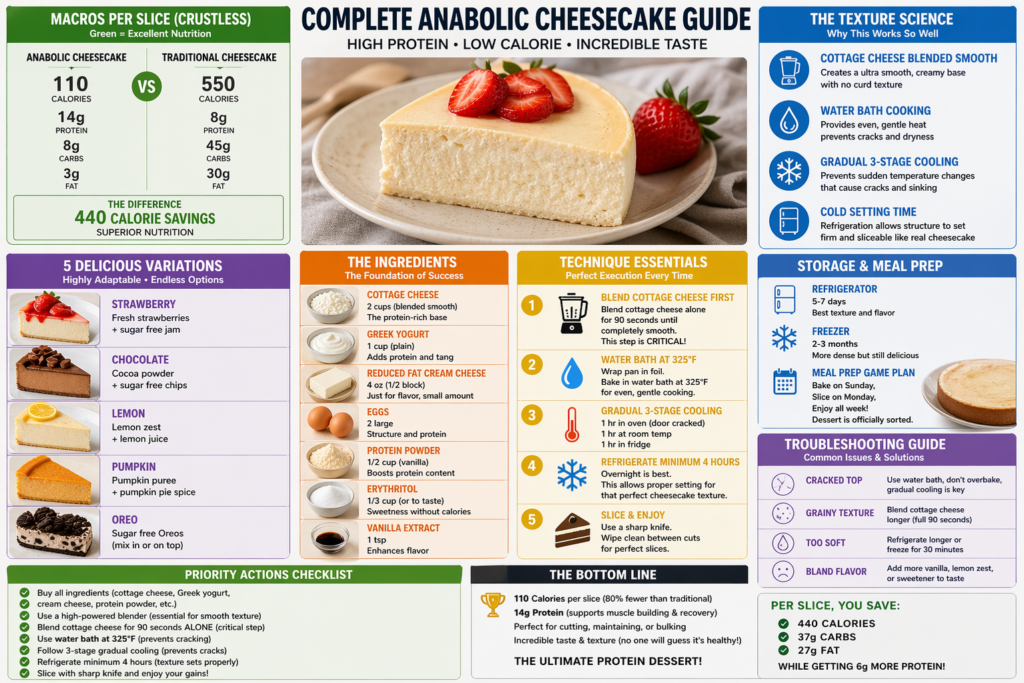
The truth about anabolic protein cheesecake:
✅ 110 calories and 14g protein per slice (crustless) (80% lower calories than regular)
✅ Actually creamy and dense, not yogurt-like (proper technique creates real texture)
✅ Authentic cheesecake flavor (strategic cream cheese use)
✅ Makes 12 perfect slices (weekly dessert sorted)
✅ Meal prep friendly (lasts 5-7 days refrigerated)
Key takeaways:
The macros per slice (crustless):
- Calories: 110 (vs. 550 regular)
- Protein: 14g (vs. 8g regular)
- Carbs: 8g (vs. 50g regular)
- Fat: 3g (vs. 38g regular)
- 440 calorie savings per slice
Critical ingredients:
- Cottage cheese (blended smooth, protein + texture base)
- Greek yogurt (protein + authentic tang)
- Reduced-fat cream cheese (flavor authentication, only 4oz)
- Eggs (structure and binding)
- Protein powder (protein boost without liquid)
- Erythritol (zero-calorie sweetness)
- Strategic ingredient selection
Technique essentials:
- Blend cottage cheese alone 90 seconds first (smooth texture critical)
- Use water bath (prevents cracking)
- Bake at 325°F until center jiggles (not liquid, not firm)
- Gradual 3-stage cooling (prevents cracking)
- Refrigerate minimum 4 hours (texture sets when cold)
- Execution critical for quality
Texture science:
- Cottage cheese blended smooth = creamy base
- Water bath = even, gentle heat = creamy texture
- Gradual cooling = no cracks
- Cold setting = firm, sliceable texture
- Multiple factors create creaminess
Variations:
- Strawberry (add pureed strawberries)
- Chocolate (chocolate protein + cocoa powder)
- Lemon (extra lemon juice + zest)
- Pumpkin (pumpkin puree + spice)
- Oreo (crushed cookies mixed in)
- Highly customizable
Topping options:
- Sugar-free whipped cream (+10 cal)
- Fresh berries (+15 cal)
- Fruit compote (+20 cal)
- Chocolate drizzle (+25 cal)
- Crushed nuts (+30 cal)
- Optional enhancements
Storage:
- Refrigerator: 5-7 days (best texture)
- Freezer: 2-3 months (more dense when frozen)
- Serve cold or frozen (both good)
- Flexible storage
Troubleshooting:
- Cracked top: Use water bath, gradual cooling
- Grainy texture: Blend cottage cheese longer
- Sunken center: Don’t overbake, gradual cooling
- Too soft: Refrigerate longer or freeze briefly
- Too tangy: Reduce lemon juice, add sweetener
- Water leaked in: Wrap pan properly in 2 layers foil
- Common fixes
Substitutions:
- Cottage cheese: Ricotta or silken tofu (vegan)
- Greek yogurt: Sour cream (richer) or regular yogurt
- Cream cheese: Neufchâtel, vegan, or omit
- Protein powder: Any flavor or omit (lower protein)
- Sweetener: Any zero-calorie or regular sugar
- Flexible recipe
Meal prep strategy:
- Bake Saturday or Sunday (2-day prep with cooling)
- Cut into 12 slices Monday
- Store in refrigerator
- One slice daily as dessert for week
- Or freeze slices for longer storage
- Weekly dessert sorted
With vs. without crust:
- With crust: 135 calories, 14g protein
- Without crust: 110 calories, 14g protein
- Recommend crustless (saves 25 calories)
- Crustless preferred
Priority actions:
- Buy ingredients (cottage cheese, Greek yogurt, reduced-fat cream cheese, protein powder, erythritol)
- Use high-powered blender (essential for smooth texture)
- Blend cottage cheese alone 90 seconds first (critical step)
- Use water bath and bake at 325°F (prevents cracking)
- Use 3-stage gradual cooling (prevents cracking and sinking)
- Refrigerate minimum 4 hours before slicing (texture sets)
- Success checklist
STOP AVOIDING CHEESECAKE WHILE DIETING. START MAKING ANABOLIC VERSIONS. 110 CALORIES, 14G PROTEIN, ACTUALLY CREAMY. REAL CHEESECAKE THAT FITS YOUR MACROS.
Ready to build a complete high-protein dessert collection with anabolic recipes for ice cream, cookies, cakes, and more that deliver authentic texture and flavor while supporting your fitness goals? This cheesecake is just the beginning. Get comprehensive anabolic recipe guides. Stop choosing between dessert and progress. Start having both.

Leave a Reply
You must be logged in to post a comment.