
Want results now? That’s exactly why you don’t have them. Elite performers master one skill: waiting.
You start a diet. By day 3, you’re frustrated. “Why haven’t I lost weight yet?” You quit.
You want immediate feedback. Instant results. Visible progress NOW. But transformation doesn’t work that way.
You think successful people are just luckier:
- They have better genetics
- They have more time
- They have more resources
- They have more willpower
Wrong. They’re not special. They just mastered delayed gratification. They can do hard things now for rewards later. You can’t. That’s the only difference.
Here’s what’s actually happening: Your brain is wired for immediate rewards. Dopamine fires when reward is near. Distant rewards barely register. Modern life has made this worse everything is instant (food, entertainment, information, validation). Your tolerance for waiting has atrophied. Elite performers have the same wiring, but they’ve trained their prefrontal cortex to override the limbic system’s demand for immediate pleasure. They’ve built the neural pathways to value future rewards as much as present ones. This is a trainable skill, not an innate trait.
In this comprehensive guide, I’ll explain why your brain sabotages long-term goals (the neuroscience of temporal discounting), reveal the marshmallow test and what it actually predicts (life outcomes), show you the 6-step protocol to build delayed gratification capacity (training the skill), provide strategies for each phase of transformation (when temptation is highest), and explain why this matters more than talent, genetics, or resources (the ultimate meta-skill).
Whether you’re trying to transform your body, build wealth, master a skill, or achieve any long-term goal, delayed gratification is the bottleneck.
Let’s train your brain to value the future as much as the present.
TABLE OF CONTENTS
The Neuroscience of Instant vs. Delayed Rewards
Understanding why waiting is so hard.
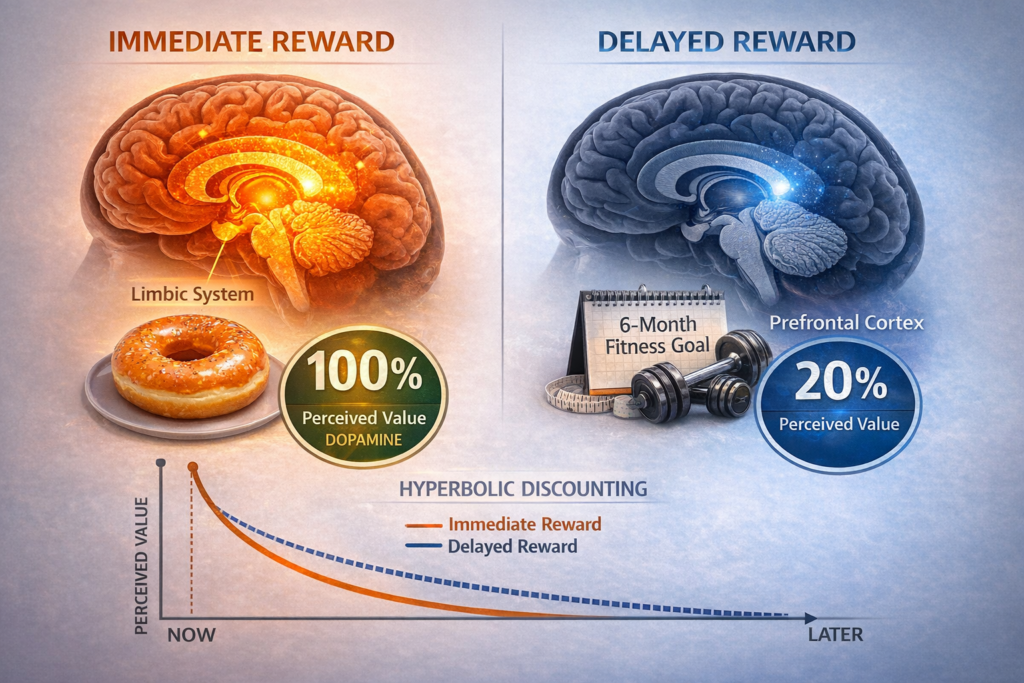
Your Brain’s Time Discounting Problem
What temporal discounting means:
- Brain values rewards less the farther away they are
- $100 today > $120 in a year (mathematically irrational)
- Immediate pleasure > greater future pleasure
- Biological time preference
The mechanism:
Immediate reward scenario:
- See donut → limbic system activates
- Dopamine surges (anticipation)
- “I want that NOW”
- Prefrontal cortex (rational brain) attempts override
- Limbic system usually wins
- Present bias
Delayed reward scenario:
- Think about being fit in 6 months
- Minimal limbic activation
- Weak dopamine response
- Abstract, not visceral
- Prefrontal cortex says “this is valuable”
- But limbic system doesn’t care
- Future discount
The conflict:
- Limbic system: Powerful, emotional, immediate
- Prefrontal cortex: Weak, rational, abstract
- Unequal match
- Evolutionary mismatch
Why this evolved:
- Ancestral environment: Uncertain future
- Resources scarce
- Bird in hand worth two in bush
- Immediate consumption evolutionarily adaptive
- Survival wiring
Modern problem:
- Future is relatively certain
- Resources abundant
- Long-term thinking now adaptive
- But brain hasn’t updated
- Stone Age brain, space age world
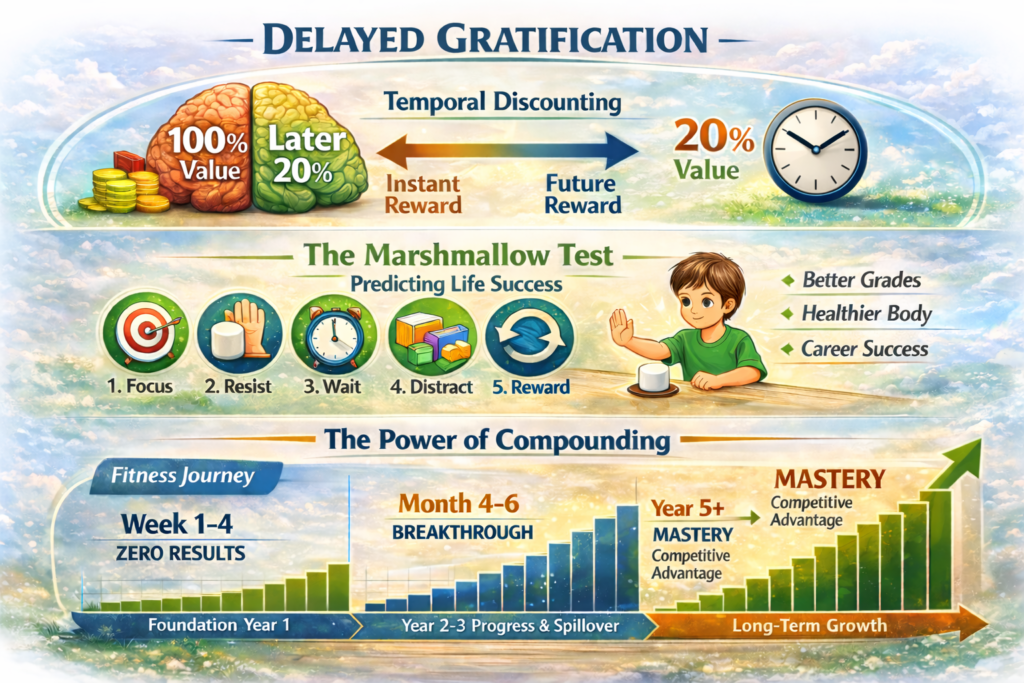
The Hyperbolic Discounting Curve
What it shows:
- Value of reward decreases hyperbolically with time
- Not linear decrease
- Steep drop initially, then flattens
- Non-linear devaluation
The math:
Reward in 1 day:
- Perceived value: 95% of actual value
- Minimal discount
Reward in 1 week:
- Perceived value: 70% of actual value
- Moderate discount
Reward in 1 month:
- Perceived value: 40% of actual value
- Significant discount
Reward in 6 months:
- Perceived value: 20% of actual value
- Severe discount
Reward in 5 years:
- Perceived value: 5% of actual value
- Nearly worthless psychologically
The implication:
- 6-month physique transformation: 20% perceived value
- Donut right now: 100% perceived value
- Donut wins 5:1
- Mathematically rigged against long-term goals
The tragedy:
- The longer-term goal often MORE valuable
- But brain can’t perceive it
- Short-term pleasure wins despite being less valuable
- Irrational decision-making
The Dual-Process Model
System 1 (Limbic/Hot System):
- Fast, automatic, emotional
- Immediate gratification seeking
- Present-focused
- High dopamine sensitivity
- “I want it NOW”
- Impulsive system
System 2 (Prefrontal/Cool System):
- Slow, effortful, rational
- Long-term planning
- Future-focused
- Low dopamine sensitivity to distant rewards
- “This is better for my future self”
- Deliberative system
The battle:
- System 1 activates automatically (no effort)
- System 2 requires activation (effortful)
- System 1 usually wins by default
- System 2 wins only with deliberate effort
- Unequal contest
Factors affecting which wins:
System 1 more likely to win when:
- Tired (ego depletion)
- Stressed (cortisol)
- Sleep-deprived
- Hungry (low blood glucose)
- Distracted
- Weakened self-control
System 2 more likely to win when:
- Well-rested
- Low stress
- Fed (adequate glucose)
- Focused attention
- Remind of long-term goals
- Strengthened self-control
The training opportunity:
- Can strengthen System 2
- Train prefrontal cortex
- Practice delayed gratification
- Trainable capacity
The Marshmallow Test
The original study (Walter Mischel, 1960s-70s):
- 4-year-old children
- One marshmallow now, or two marshmallows in 15 minutes
- Choice to wait or not
- Delayed gratification assessment
The results:
- ~30% waited full 15 minutes
- ~70% couldn’t wait
- Clear individual differences
- Varied capacity
The strategies of successful waiters:
- Looked away from marshmallow
- Distracted themselves (sang, played)
- Imagined marshmallow as picture (not real)
- Self-talk (“I can wait”)
- Self-regulation techniques
The follow-up (decades later):
- Tracked participants into adulthood
- Children who waited had:
- Higher SAT scores (210 points higher)
- Better educational attainment
- Lower BMI
- Better stress management
- Higher income
- Lower substance abuse rates
- Life-outcome prediction
What it predicts:
- Not just success in one domain
- Success across ALL life domains
- Single best predictor of life outcomes
- Meta-skill
The controversy:
- Recent research: Also influenced by environment/trust
- Children from unstable homes less likely to wait (rational)
- But capacity still matters and is trainable
- Nature and nurture
The key insight:
- Delayed gratification capacity is foundational
- Predicts success better than IQ
- Trainable skill, not fixed trait
- Critical life skill
Why Fitness Requires Extreme Delayed Gratification
The timeline mismatch.
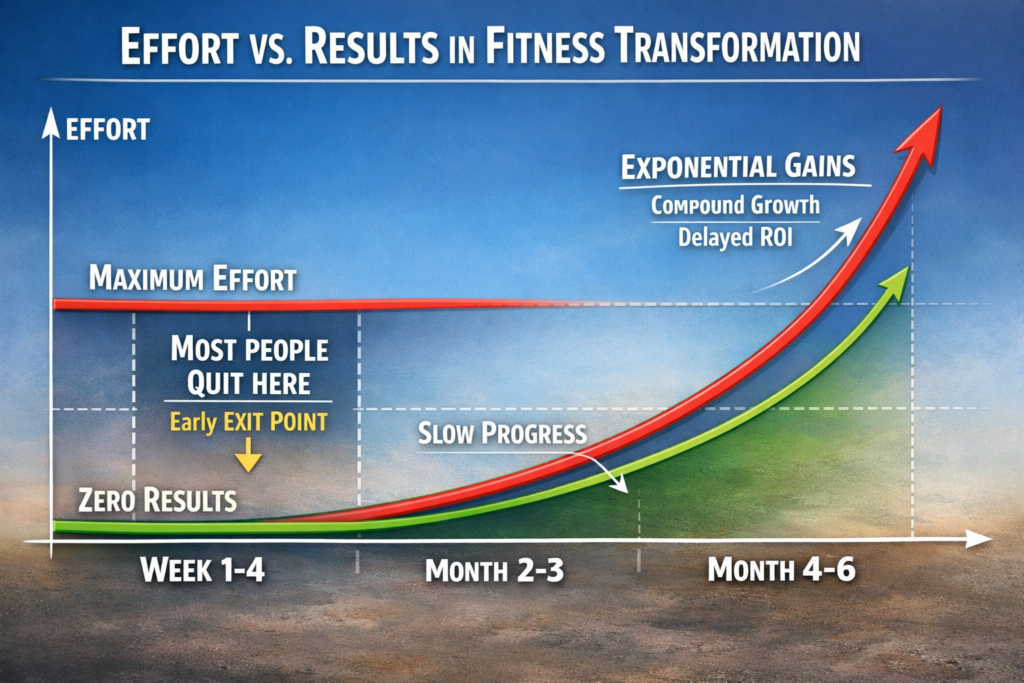
The Reality of Physique Transformation
Week 1:
- Effort: Maximum (new routine, uncomfortable)
- Visible results: Zero (no physical changes)
- Reward: None (only effort)
- Pure investment, no return
Week 2-3:
- Effort: High (still uncomfortable)
- Visible results: Minimal (maybe slight change)
- Reward: Tiny (if any)
- Mostly investment
Week 4-6:
- Effort: Moderate (adapting)
- Visible results: Slight (clothes fit differently)
- Reward: Small (some satisfaction)
- Beginning returns
Week 8-12:
- Effort: Consistent (routine established)
- Visible results: Noticeable (others comment)
- Reward: Significant (visible progress)
- Meaningful returns
Month 4-6:
- Effort: Sustainable (lifestyle integrated)
- Visible results: Dramatic (clear transformation)
- Reward: Major (confidence, appearance, strength)
- Full return realized
The problem:
- Maximum effort required when rewards are zero
- Must persist through 4-8 week “results void”
- Most quit before returns materialize
- Delayed ROI
The contrast with modern life:
Social media:
- Post → instant feedback (likes, comments)
- Dopamine within seconds
- Immediate reward
Food delivery:
- Order → 30 minutes later, eating
- Craving satisfied quickly
- Minimal delay
Entertainment:
- Click → instant streaming
- Boredom resolved immediately
- Zero delay
Online shopping:
- Click → dopamine from purchase
- Item arrives in days
- Short delay
The training effect:
- Modern life trains AGAINST delayed gratification
- Everything instant
- Tolerance for waiting atrophies
- Capacity erosion
The Compound Nature of Fitness Results
Why results are delayed:
Week 1 training:
- Creates microscopic adaptations
- Invisible to naked eye
- Measurable only with precision tools
- Cellular level only
Week 4 training:
- Accumulation of microscopic adaptations
- Beginning to become visible
- But still subtle
- Tissue level emerging
Week 12 training:
- Months of adaptations compounded
- Clearly visible
- Measurable progress
- Organism level obvious
The compounding:
- 1% improvement daily
- Day 1-30: Barely noticeable (1.01^30 = 1.35 = 35% improvement, but gradual)
- Day 1-90: Significant (1.01^90 = 2.45 = 145% improvement)
- Day 1-365: Transformative (1.01^365 = 37.8 = 3,778% improvement)
- Exponential, not linear
The perception problem:
- Linear expectation: Week 1 = 10% better, Week 10 = 100% better
- Exponential reality: Week 1 = 1% better, Week 10 = 10% better, Week 50 = 150% better
- Expectation-reality mismatch
The quit point:
- Most quit Week 2-4
- Right before exponential curve inflects upward
- Right before results compound visibly
- Tragedy of timing
Why Immediate Gratification Dominates
The immediate option (skipping workout):
- Immediate comfort (stay in bed)
- Immediate entertainment (scroll phone)
- Immediate pleasure (eat tasty food)
- Zero effort required
- 100% reward NOW
The delayed option (training):
- Immediate discomfort (effort, sweating)
- Delayed reward (physique in months)
- High effort required
- Uncertain outcome (will it work?)
- 0% reward NOW, uncertain % later
The math:
- Immediate: 100% value now
- Delayed: 20% perceived value (6 months away, discounted)
- Immediate wins 5:1
- Stacked against discipline
Additional factors:
Effort-reward asymmetry:
- Effort: Immediate and certain
- Reward: Delayed and uncertain
- All pain now, uncertain gain later
Social validation timing:
- Posting on social media: Instant likes
- Physique transformation: Delayed recognition
- Validation delay
Comparison timing:
- See others’ results: Immediate
- Own results: Delayed
- Feel behind
- Perceived inadequacy
The 6-Step Protocol to Build Delayed Gratification Capacity
Training the skill systematically.
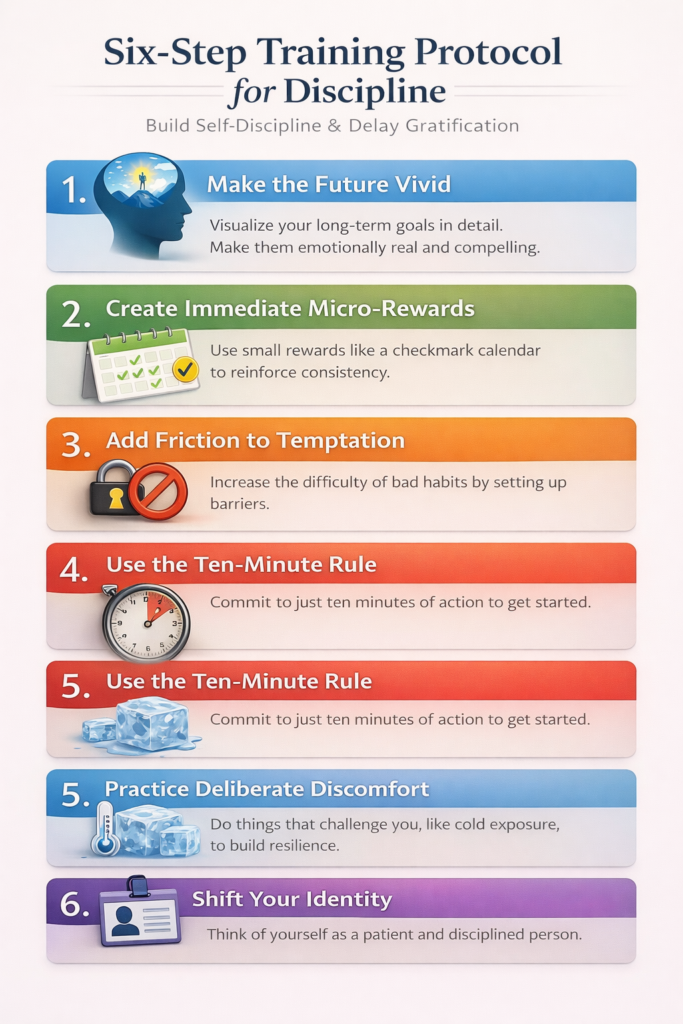
Step 1: Make Future Rewards Vivid and Concrete
The problem:
- Future rewards are abstract
- Brain doesn’t emotionally connect
- Limbic system unmoved
- Psychological distance
The solution:
- Make future concrete and visceral
- Activate limbic system with future imagery
- Bridge psychological distance
- Vividness intervention
Techniques:
Visualization (daily):
- Close eyes
- Imagine future self in detail
- See yourself fit, strong, confident
- Feel the emotions (pride, satisfaction)
- 5-10 minutes daily
- Emotional connection
Future self letter:
- Write letter from future self to present self
- “Dear past me, thank you for…”
- Describe life as fit person
- Read weekly
- Narrative connection
Progress images:
- Look at transformation photos (not yourself, others with similar starting point)
- “This could be me”
- Concrete possibility
- Visual proof
Specific scenario imagination:
- Not just “be fit”
- But “walk confidently on beach”
- Or “lift my child easily”
- Or “wear that outfit”
- Concrete situations
Why it works:
- Abstract future → Concrete future
- Activates limbic system
- Increases perceived value of future reward
- Reduces discounting
The research:
- Seeing aged photos of self increases retirement savings
- Imagining future self reduces temporal discounting
- Concreteness increases delayed gratification
- Evidence-based
Step 2: Create Immediate Micro-Rewards
The problem:
- All rewards 6 months away
- Nothing to reinforce daily
- Motivation unsustainable
- Reward void
The solution:
- Engineer immediate rewards for right actions
- Satisfy System 1 while pursuing System 2 goals
- Reward bridge
Techniques:
Check-mark satisfaction:
- Physical calendar on wall
- Big X for each training day completed
- Visual progress
- Immediate satisfaction
- Daily reward
Immediate tracking:
- Log workout immediately after
- See numbers increase (weights, reps)
- Immediate feedback
- Progress visibility
Micro-celebrations:
- Finished workout → “I’m proud I showed up”
- Ate healthy meal → “I made a good choice”
- Went to bed on time → “I’m taking care of myself”
- Acknowledge actions
Habit stacking rewards:
- After workout → Favorite coffee
- After healthy dinner → Enjoyable tea
- After productive day → Favorite podcast
- Immediate pleasure paired
Social accountability:
- Text accountability partner after workout
- Immediate response/encouragement
- Social reward
- Connection reward
Why it works:
- Provides immediate dopamine
- Reinforces behavior
- Bridges gap to long-term reward
- Sustainable motivation
The balance:
- Rewards don’t sabotage goal (not food rewards for fitness)
- Small but meaningful
- Consistent
- Strategic reinforcement
Step 3: Increase the Cost of Immediate Gratification
The problem:
- Immediate gratification too easy
- No friction
- Default path
- Path of least resistance
The solution:
- Add friction to immediate gratification
- Make it harder to choose short-term pleasure
- Reverse engineering willpower
Techniques:
Physical barriers:
- Junk food: Don’t buy it (can’t eat what’s not there)
- TV: Unplug it (requires effort to plug in)
- Phone: Other room (must walk to get it)
- Access friction
Time delays:
- Want junk food? Wait 10 minutes, then decide
- Want to skip workout? Wait 5 minutes, then decide
- Usually urge passes
- Impulse cooling
Financial cost:
- Commitment contract (forfeit money if skip workout)
- Bet with friend
- Pre-paid training sessions
- Monetary friction
Social cost:
- Public commitment
- Accountability partner who knows
- Shame of breaking word
- Reputational friction
Implementation intention:
- “If I want to skip workout, then I will put on gym clothes and commit to just 10 minutes”
- Pre-decided response
- Automatic override
Why it works:
- Immediate gratification no longer “immediate”
- Added friction gives System 2 time to activate
- Leveling playing field
Step 4: Use the 10-Minute Rule
The principle:
- When tempted by immediate gratification
- Commit to just 10 minutes of right action
- Re-evaluate after 10 minutes
- Almost always continue
- Lower activation barrier
Application examples:
Workout temptation:
- Don’t want to train
- “Just 10 minutes”
- Get dressed, start warmup
- After 10 minutes, usually complete workout
- 90% completion rate
Food temptation:
- Craving junk food
- “Wait 10 minutes”
- Distract or drink water
- After 10 minutes, craving usually passed
- Impulse management
Procrastination:
- Don’t want to work
- “Just 10 minutes of focused work”
- After 10 minutes, momentum built
- Usually continue
- Activation energy overcome
Why it works:
Psychological:
- 10 minutes feels manageable
- Reduces overwhelm
- Gets through resistance
- Threshold lowering
Physiological:
- Action generates dopamine
- Motivation follows action (not vice versa)
- Momentum builds
- Reverse causation
Practical:
- Most resistance is anticipatory
- Actual action less aversive than imagined
- Once started, easier to continue
- Reality vs. imagination
The commitment:
- Truly just 10 minutes
- Can quit after if really want to
- Honesty matters
- Usually don’t quit
- Authentic option
Step 5: Practice Deliberate Discomfort
The principle:
- Delayed gratification is tolerating discomfort now for reward later
- Train discomfort tolerance directly
- Builds general capacity
- Meta-skill training
Techniques:
Cold exposure:
- Cold showers (30-90 seconds)
- Ice baths (10-15 minutes)
- Uncomfortable but safe
- Train “I can handle this”
- Discomfort training
Fasting windows:
- 16:8 intermittent fasting
- Or OMAD (one meal a day)
- Hunger is discomfort
- Practice not immediately satisfying
- Appetite control training
Boredom tolerance:
- Sit with nothing (no phone, no entertainment)
- 15-30 minutes
- Tolerate understimulation
- Patience building
Extended focus sessions:
- 90-minute deep work
- No distractions
- Mental discomfort
- Attention endurance
Physical challenges:
- Hold plank as long as possible
- Wall sits to failure
- Discomfort with no injury
- Pain tolerance
Why it works:
- Generalizable discomfort tolerance
- Proves to self “I can endure”
- Strengthens prefrontal cortex
- Capacity building
The transfer:
- Practice discomfort in one domain
- Applies to all domains
- General self-regulation improvement
- Cross-domain benefit
Important:
- Must be safe discomfort
- Not harmful
- Controlled challenge
- Strategic stress
Step 6: Identity Shift to “Patient Person”
The problem:
- See self as “impatient”
- Identity drives behavior
- Self-fulfilling prophecy
- Identity constraint
The solution:
- Redefine identity
- “I’m someone who can wait”
- “I’m patient”
- “I play the long game”
- Identity transformation
The language shift:
Old:
- “I’m so impatient”
- “I want results now”
- “I can’t wait”
- Impatient identity
New:
- “I’m patient”
- “I’m willing to wait for what matters”
- “I play the long game”
- “Delayed gratification is my advantage”
- Patient identity
The mechanism:
- Identity shapes behavior
- “Patient person” delays gratification naturally
- Behavior flows from identity
- Identity-behavior alignment
The practice:
- Catch impatient thoughts
- Reframe: “I’m someone who waits”
- Act as patient person would
- Evidence accumulates
- Identity reinforcement
Social declaration:
- Tell others “I’m focused on long-term results”
- Public commitment
- Social pressure to maintain
- External reinforcement
The transformation:
- Week 1: Acting patient (forced)
- Month 1: Becoming patient (emerging)
- Month 3: Being patient (natural)
- Identity integration
Phase-by-Phase Delayed Gratification Challenges
When temptation is highest and strategies for each.
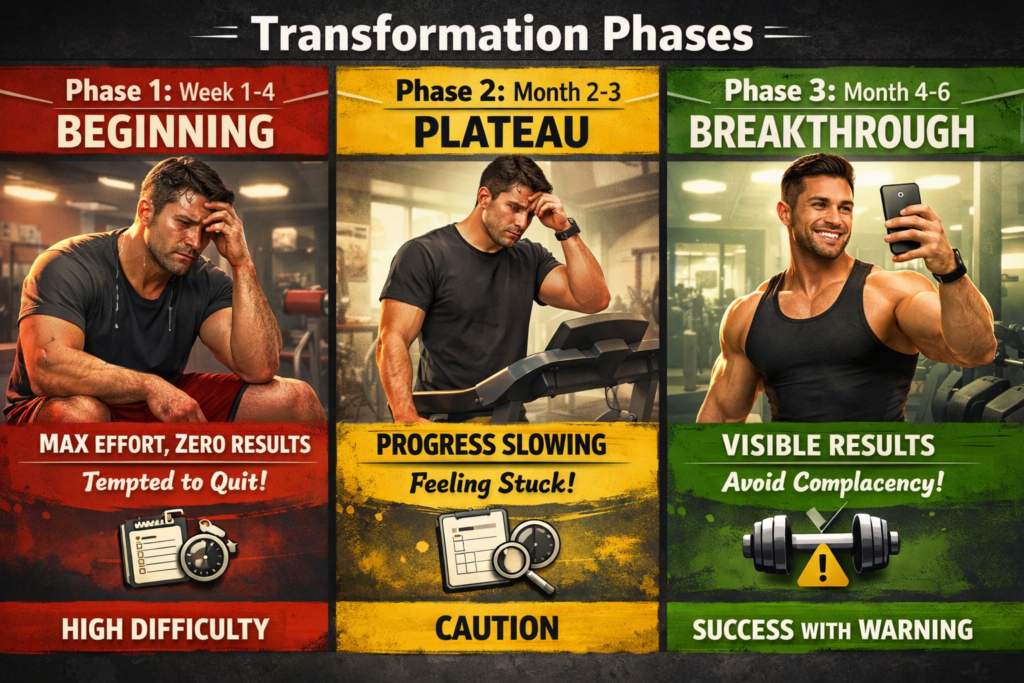
Phase 1: The Beginning (Week 1-4)
The challenge:
- Maximum effort, zero results
- Novelty wearing off quickly
- Reality of work setting in
- Pure investment phase
Why it’s hardest:
- All pain, no gain yet
- Impatience peak
- Doubt strongest (“Is this even working?”)
- Critical quit period
Specific temptations:
Week 1:
- Soreness extreme
- “My body can’t handle this”
- Want to quit
- Physical overwhelm
Week 2:
- Still no visible results
- “Nothing is changing”
- Frustration
- Impatience
Week 3:
- Motivation declining
- Routine not yet established
- Hard to maintain
- Motivation valley
Week 4:
- Slight results maybe
- But expected more
- “This is taking forever”
- Unmet expectations
Survival strategies:
Process focus:
- “Did I train today? Yes = success”
- Not “Did I lose weight? No = failure”
- Action-based success
Compare to nothing, not to end:
- Not “I should be further”
- But “I’m further than if I hadn’t started”
- Relative comparison
Daily wins:
- Celebrate showing up
- Each day is victory
- Micro-celebrations
Support system:
- Accountability partner
- Share struggles
- External encouragement
- Social support
Reminder of why:
- Review goals daily
- Visualize future self
- Reconnect to purpose
- Motivation refresh
Phase 2: The Plateau (Month 2-3)
The challenge:
- Initial newbie gains slowing
- Progress less obvious
- Feeling stuck
- Deceptive plateau
Why it happens:
- Body adapting
- Progress still occurring but slower
- Expectations vs. reality
- Adaptation phase
Specific temptations:
- “This isn’t working anymore”
- Consider quitting
- Try radical changes
- Jump programs
- Plateau panic
The truth:
- Progress IS happening
- Just slower and less visible
- Compound effect building
- Hidden progress
Survival strategies:
Objective tracking:
- Photos (monthly)
- Measurements (weekly)
- Strength logs (every session)
- Progress exists in data
- Evidence collection
Patience reminder:
- “This is when most quit”
- “This is exactly when I must persist”
- “Plateau precedes breakthrough”
- Persistence mindset
Program trust:
- Don’t change program
- Trust the process
- Consistency wins
- Stay the course
Long-term examples:
- Look at 1-year transformations
- Remind that you’re 2-3 months in
- Still time needed
- Timeline perspective
Phase 3: The Breakthrough (Month 4-6)
The reward:
- Results becoming obvious
- Others commenting
- Clothes fitting differently
- Strength gains significant
- Visible transformation
The risk:
- Success breeds complacency
- “I’ve made it” mentality
- Reduce effort
- Premature satisfaction
The temptation:
- “I can relax now”
- Revert to old habits
- Regression risk
Why dangerous:
- Results took months to build
- Can be lost in weeks
- Fragile gains
Survival strategies:
Maintenance mindset:
- “This is forever, not temporary”
- Keep going
- Lifestyle integration
Raise the bar:
- New goals
- Next level
- Continue progress
- Continued growth
Remember the struggle:
- How hard it was
- Don’t want to repeat
- Maintain to protect investment
- Loss aversion
Identity integration:
- “I’m someone who trains”
- Not “I trained to achieve X”
- Permanent identity
The Long-Term Compounding of Delayed Gratification
Why it gets easier and more valuable.
Year 1: Building the Foundation
Months 1-3:
- Delayed gratification capacity building
- Still difficult
- Practicing the skill
- Training phase
Months 4-6:
- Capacity improving
- Getting easier
- Results visible
- Emerging capacity
Months 7-12:
- Significantly easier
- Habit formed
- Identity integrated
- Results substantial
- Foundation established
The transformation:
- Began: Can barely delay gratification 1 day
- End: Can delay gratification months
- Capacity expansion
Year 2-3: Reaping Compound Benefits
The physical:
- Dramatic transformation (2+ years consistent training)
- Elite physique possible
- Strength advanced
- Peak physical form
The psychological:
- Delayed gratification second nature
- Patience developed
- Trust in process
- Psychological maturity
The lifestyle:
- Training integral to life
- Automatic behaviors
- Sustainable indefinitely
- Permanent integration
The spillover:
- Delayed gratification in fitness → applies to career
- Patience with body → patience with projects
- Long-term thinking habitual
- Cross-domain transfer
Year 5+: Mastery and Advantage
The results:
- Physique maintenance with less effort
- Muscle memory from years of training
- Metabolic adaptations permanent
- Established results
The capability:
- Can delay gratification indefinitely
- Long-term projects easy
- Willing to wait years for outcomes
- Elite capacity
The competitive advantage:
- Others quit in months
- You persist for years
- Compounding advantage
- Exponential differentiation
The life outcomes:
- Career success (patience with skill development)
- Financial success (patience with investing)
- Relationship success (patience with conflicts)
- All domains improved
The meta-realization:
- Delayed gratification IS the skill
- Not just means to fitness
- Fundamental life capability
- Ultimate meta-skill
The Bottom Line: Wait, Win, Repeat
After explaining everything:
The truth about delayed gratification:
✅ Your brain heavily discounts future rewards (temporal discounting wiring)
✅ Modern life has destroyed your capacity to wait (everything instant)
✅ Delayed gratification predicts life success better than IQ (marshmallow test findings)
✅ Fitness requires 3-6 months before significant results (compound nature)
✅ This is a trainable skill, not fixed trait (capacity building possible)
Key takeaways:
Why waiting is hard:
- Temporal discounting (brain values immediate > future)
- Hyperbolic discounting curve (steep drop in perceived value)
- Limbic system (immediate) stronger than prefrontal cortex (future)
- Modern life trains against waiting (instant everything)
- Neurologically challenging
The marshmallow test:
- 4-year-olds: wait for 2 marshmallows vs. take 1 now
- 30% could wait
- Those who waited: Higher SAT scores, better BMI, higher income, lower substance abuse
- Single best predictor of life outcomes
- Foundational life skill
Why fitness requires extreme delayed gratification:
- Week 1-4: Maximum effort, zero results
- Month 2-3: Plateau, slow progress
- Month 4-6: Breakthrough, visible transformation
- Compound nature (exponential, not linear)
- Most quit Week 2-4 (right before inflection)
- Timeline mismatch
The 6-step protocol:
Step 1: Make future vivid
- Daily visualization (5-10 min)
- Future self letter
- Specific scenario imagination
- Increase limbic activation for future
Step 2: Create immediate micro-rewards
- Check-mark calendar
- Immediate tracking
- Micro-celebrations
- Habit stacking rewards
- Bridge reward gap
Step 3: Increase cost of immediate gratification
- Physical barriers (junk food not in house)
- Time delays (wait 10 min before deciding)
- Financial cost (commitment contracts)
- Social cost (public accountability)
- Add friction
Step 4: 10-minute rule
- Commit to just 10 minutes
- Almost always continue full session
- Overcomes activation energy
- Lower threshold
Step 5: Practice deliberate discomfort
- Cold exposure
- Fasting windows
- Boredom tolerance
- Extended focus sessions
- Train discomfort capacity
Step 6: Identity shift
- “I’m a patient person”
- “I play the long game”
- Identity drives behavior
- Patient identity
Phase-specific challenges:
- Week 1-4: Zero results (focus on process, daily wins)
- Month 2-3: Plateau (objective tracking, patience)
- Month 4-6: Breakthrough (maintenance mindset, raise bar)
- Strategic navigation
Long-term compounding:
- Year 1: Building foundation, capacity developing
- Year 2-3: Reaping benefits, spillover to other domains
- Year 5+: Mastery, competitive advantage, life transformation
- Exponential returns
Priority actions:
- Visualize future self daily (5 minutes)
- Create check-mark calendar (track daily)
- Remove junk food from house (eliminate temptation)
- Use 10-minute rule when tempted to skip
- Declare “I’m patient, I play the long game”
- Start training capacity now
The fundamental truth:
- Elite results require waiting
- Not weeks, months or years
- Most can’t wait
- Those who can win everything
- Patience is competitive advantage
STOP EXPECTING INSTANT RESULTS. TRAIN YOUR BRAIN TO WAIT. MASTER DELAYED GRATIFICATION. COMPOUND YOUR SUCCESS.
Ready to build complete delayed gratification capacity with neuroscience-based training protocols, phase-specific strategies, identity transformation techniques, and long-term compounding systems that guarantee elite results in fitness and all life domains? Understanding delayed gratification is just the beginning. Get a comprehensive guide to systematically training patience, building future-orientation, overcoming temporal discounting, and achieving outcomes impossible for those who can’t wait. Stop chasing instant results. Start building delayed gratification capacity.
REFERENCES
SECTION 1 — Neuroscience: temporal discounting and the limbic vs. prefrontal conflict
[1] McClure SM et al. — PubMed/Journal of Neuroscience, 2007 fMRI study extending the dual-system temporal discounting model to primary rewards (juice and water) with delays of minutes; limbic areas (ventral striatum, medial prefrontal cortex) showed greater activation when an immediate reward was available versus when both options were delayed, while lateral prefrontal and parietal cortex responded to intertemporal choice regardless of immediacy; relative activation of the two regions predicted actual choice behavior; a second experiment removed all immediate options from choice sets and found that limbic regions no longer differentiated options, confirming the “present bias” effect is specifically triggered by now-available rewards; directly maps onto the article’s dual-process model of limbic System 1 versus prefrontal System 2, and explains why the brain is neurologically biased to prefer a donut now over a physique goal six months away https://pubmed.ncbi.nlm.nih.gov/17522323/
SECTION 2 — The marshmallow test: original longitudinal findings and replication
[2] Mischel W, Shoda Y & Peake PK — PubMed/Journal of Personality and Social Psychology, 1988 First longitudinal follow-up of preschool delay-of-gratification experiments conducted at Stanford; 95 children assessed in preschool were re-evaluated approximately 10 years later via parental personality ratings; consistent correlations were found between seconds of delay time at age 4 to 5 and adolescent ratings of academic and social competence, verbal fluency, rationality, attentiveness, planfulness, and stress tolerance; established that a child’s capacity to wait for a second marshmallow predicts a coherent cluster of cognitive and self-regulatory competencies a decade later, providing the longitudinal foundation for the article’s claims about delayed gratification as a foundational life skill https://pubmed.ncbi.nlm.nih.gov/3367285/
[3] Shoda Y, Mischel W & Peake PK — Developmental Psychology, 1990 Foundational follow-up extending the Stanford marshmallow longitudinal dataset to SAT scores; delay time in preschool predicted approximately 210 additional SAT points for the longest versus shortest delayers, and superior self-regulatory competence in adolescence; by systematically varying the delay situation, the study identified the specific conditions under which individual differences in delay behavior are most diagnostically predictive; provides the primary empirical source for the article’s claims that children who waited longer scored higher on SAT, and for the broader case that delayed gratification predicts academic achievement https://scholarworks.smith.edu/psy_facpubs/79/
[4] Watts TW, Duncan GJ & Quan H — PMC/Psychological Science, 2018 Conceptual replication in a larger, more socioeconomically diverse sample (n=918); the correlation between preschool delay time and adolescent achievement was half the effect size of the original Stanford studies; after controlling for family background, early cognitive ability, and home environment, the effect was reduced by two thirds and most behavioral outcome associations became nonsignificant; the strongest predictor of outcomes was waiting at least 20 seconds rather than the total time waited; findings confirm that delayed gratification capacity matters but that socioeconomic stability confounds the original effect size estimates, and that the trait is partly determined by environmental trust rather than innate capacity alone; directly supports the article’s note that the marshmallow test is influenced by environment and trust, not just willpower https://pmc.ncbi.nlm.nih.gov/articles/PMC6050075/
SECTION 3 — Ego depletion and the strength model of self-regulation
[5] Baumeister RF et al. — PubMed/Current Directions in Psychological Science, 2018 Review of two decades of research on the strength model of self-control; self-control operates like a muscle: prior exertion depletes a limited resource (ego depletion), reducing subsequent self-regulatory capacity; the model has been refined from simple energy exhaustion toward strategic conservation; ego depletion is more pronounced under stress, sleep deprivation, hunger, and interpersonal conflict; repeated exercise strengthens the self-control capacity over time; provides the scientific basis for the article’s dual-process model claims that tired, stressed, or hungry states cause System 1 to overpower System 2, and that the capacity for delayed gratification can be built through systematic practice https://pubmed.ncbi.nlm.nih.gov/29592652/
SECTION 4 — Habits as the mechanism linking self-control to life outcomes
[6] Galla BM & Duckworth AL — PubMed/Journal of Personality and Social Psychology, 2015 Six-study investigation (n=2,274) demonstrating that beneficial habits mediate the relationship between trait self-control and positive life outcomes; individuals with high self-control succeed less by effortfully resisting temptation in the moment and more by building automatic routines that reduce the need for resistance; habits for exercising, eating healthy, studying, and sleeping consistently all mediated the self-control effect; prospective longitudinal Study 6 showed that homework habits mediated the effect of self-control on GPA and first-year college persistence; directly supports the article’s identity-shift step and the argument that the ultimate goal of delayed gratification training is automating patient behavior through habit formation, not perpetual willpower exertion https://pubmed.ncbi.nlm.nih.gov/25643222/




Leave a Reply
You must be logged in to post a comment.