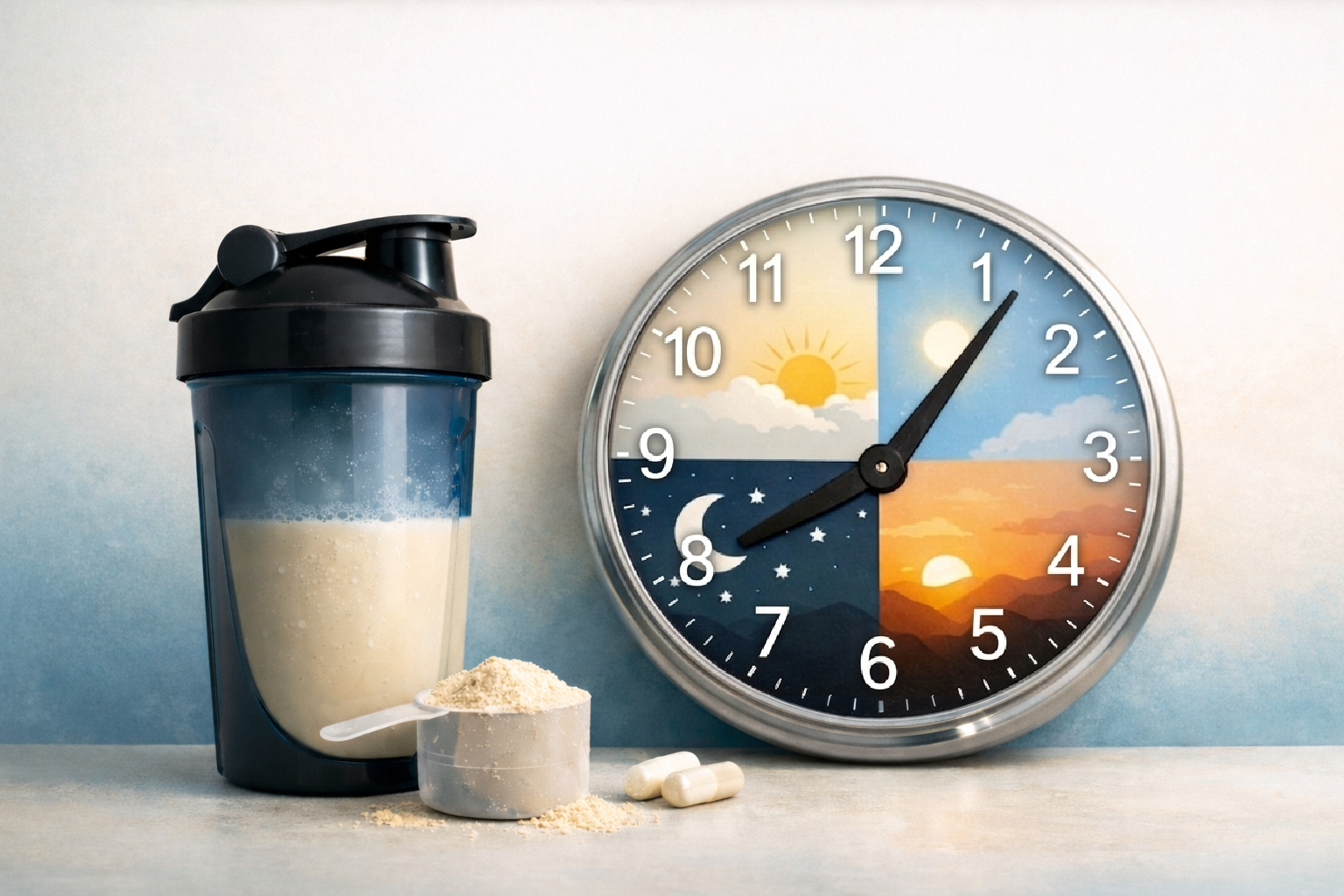
Wondering when to drink your protein shake for maximum muscle growth? Here’s the science-backed truth about protein timing.
You’ve got your protein shake mixed and ready. You’re about to drink it.
But then you pause. Is this the right time?
You’ve heard conflicting advice:
- “You MUST drink it within 30 minutes post-workout”
- “Timing doesn’t matter at all”
- “Pre-workout is better than post-workout”
- “Before bed builds more muscle”
So which is it? When should you actually drink your protein shake?
Here’s the evidence-based answer: Post-workout (within 2-3 hours after training) is the most practical and slightly beneficial time for a protein shake, primarily because it’s convenient when you can’t eat solid food immediately. However, total daily protein intake (0.7-1g per pound) matters far more than precise timing. The “anabolic window” lasts hours to days, not minutes. You can drink protein shakes at breakfast, between meals, before bed, or any time that helps you hit daily protein targets.
In this comprehensive guide, I’ll explain what a protein shake actually is (it’s not just powder and water), reveal the science-backed truth about the anabolic window and protein timing myths, show you the best times to drink protein shakes for different goals and situations, provide a complete protein shake recipe with optimal nutrition for muscle building, and help you avoid the common mistakes that waste money and sabotage results.
Whether you’re bulking, cutting, or maintaining, this article will optimize your protein shake strategy.
Let’s separate timing facts from fiction.
TABLE OF CONTENTS
What Is a Protein Shake? (Important Clarification)
Defining terms prevents confusion.
Not Just Powder and Water
Common misconception:
- Protein shake = protein powder + water
- Minimalist approach
- Just protein, nothing else
Reality of effective protein shakes:
- Protein powder (whey, casein, egg, soy, etc.)
- Liquid base (water, milk, plant milk)
- Additional ingredients (oats, fruit, nut butter)
- Complete liquid meal, not just isolated protein
What a Proper Protein Shake Contains
Complete nutrition:
Protein source:
- 20-40g protein from powder
- Whey, casein, egg white, soy, pea, etc.
- Provides amino acids for muscle building
Carbohydrate source:
- Oats, banana, berries, honey
- Provides energy
- Spares protein from being used as fuel
- Supports glycogen replenishment
Healthy fats (optional):
- Peanut butter, almond butter, avocado
- Provides sustained energy
- Supports hormone production
- Increases calories (good for bulking)
Micronutrients:
- Vitamins and minerals from whole food ingredients
- Fiber from oats and fruit
- Antioxidants from berries
- Makes it a meal, not just protein
Example complete protein shake:
- 1 scoop whey protein (24g protein)
- 1 banana (27g carbs)
- 2 tbsp oats (10g carbs)
- 1 tbsp peanut butter (8g protein, healthy fats)
- 1 cup milk (8g protein, 12g carbs)
- Total: 40g protein, 49g carbs, complete nutrition
The Truth About Protein Timing
What science actually says versus what marketing claims.

The Anabolic Window Myth
What you’ve been told:
The claim:
- Must consume protein within 30-60 minutes post-workout
- This is the “anabolic window”
- Miss it and gains are lost
- Critical for muscle building
The reality:
Research shows:
- Anabolic window lasts 24-48+ hours, not 30 minutes
- Muscle protein synthesis elevated for hours to days after training
- Timing precision vastly overrated
- Total daily protein matters infinitely more
Key study findings:
- No significant difference between immediate post-workout vs. 2-3 hours later
- Pre-workout protein equally effective as post-workout
- Multiple daily protein doses more important than single post-workout dose
- Precision timing is marketing, not science
What Actually Matters for Muscle Building
Priority hierarchy:
Priority 1: Total daily protein (90% of results)
- 0.7-1g protein per pound body weight
- Distributed throughout day
- From any quality source
- This determines muscle growth
Priority 2: Consistent daily intake (8% of results)
- Hitting protein target every single day
- Not just training days
- Long-term consistency
- Builds muscle over months and years
Priority 3: Distribution across meals (1.5% of results)
- 3-5 protein-containing meals daily
- 20-40g protein per meal
- Spacing throughout day
- Minor optimization
Priority 4: Precise timing (0.5% of results)
- Post-workout slightly beneficial
- But difference is tiny
- Convenience matters more
- Nearly irrelevant for natural lifters
The implication: Stop stressing about drinking your shake in the locker room 18 minutes post-workout. Just hit your daily protein target.
Best Times to Drink Protein Shakes
Practical timing based on your situation.

Time 1: Post-Workout (Most Common and Convenient)
Why this is popular:
Practical advantages:
- Already at gym
- Don’t want to cook immediately
- Quick and easy
- Portable nutrition
Physiological benefits (modest):
- Muscle protein synthesis elevated post-training
- Providing amino acids during this window helpful
- Supports recovery processes
- Small advantage, not game-changing
Optimal window:
- Within 2-3 hours after training
- No need to rush
- Can wait until home if prefer
- Flexibility is fine
What to include in post-workout shake:
Protein:
- 20-40g depending on body weight
- Whey ideal (fast-digesting)
- But any complete protein works
Carbohydrates:
- 30-60g to replenish glycogen
- Banana, oats, berries
- Supports recovery
- Restores energy
Example post-workout shake:
- 1-2 scoops whey protein (24-48g protein)
- 1-2 bananas (27-54g carbs)
- 1 cup milk (8g protein, 12g carbs)
- Total: 32-56g protein, 39-66g carbs
Time 2: Breakfast (Excellent for Consistency)
Why morning shakes work:
Convenience factor:
- No time to cook breakfast
- Running late for work
- Quick meal solution
- 3 minutes preparation
Breaking overnight fast:
- 8+ hours without protein
- Muscle protein synthesis declined overnight
- Morning protein kickstarts recovery
- Starts day with protein target progress
Appetite management:
- High-protein breakfast reduces daily hunger
- Better calorie control
- Supports fat loss goals
- Improved adherence
What to include in breakfast shake:
For muscle building:
- 2 scoops whey (48g protein)
- 1 cup oats (27g carbs, 300 calories)
- 2 tbsp peanut butter (190 calories, 8g protein)
- 1 banana (105 calories, 27g carbs)
- 1 cup whole milk (150 calories, 8g protein)
- Total: 64g protein, 793 calories, complete meal
For fat loss:
- 1 scoop whey (24g protein)
- 1/2 cup oats (13g carbs)
- 1 cup unsweetened almond milk (30 calories)
- Berries (15g carbs)
- Total: 24g protein, 250 calories, filling meal
Time 3: Between Meals (Snack Replacement)
Prevents gaps in protein intake.
Why this works:
Maintaining protein distribution:
- Ideally eat protein every 3-5 hours
- Shake fills 4-hour gap
- Keeps muscle protein synthesis elevated
- Easy and convenient
Preventing poor snack choices:
- Hungry between meals
- Tempted by junk food
- Shake provides nutrition
- Satisfies hunger
Example mid-morning or mid-afternoon shake:
- 1 scoop protein powder (24g protein)
- 1 banana
- 1 cup milk or water
- Quick, portable, 250-350 calories
Time 4: Before Bed (Supports Overnight Recovery)
Slow-release protein during sleep.
Why nighttime shakes help:
Overnight fasting:
- 8 hours without food
- Muscle protein breakdown can exceed synthesis
- Bedtime protein provides amino acids
- Reduces overnight catabolism
Slow-digesting protein ideal:
- Casein protein powder (6-8 hour digestion)
- Provides sustained amino acid release
- Supports muscle maintenance overnight
- Better than whey for this purpose
Research support:
- Studies show bedtime protein improves muscle growth
- 30-40g before sleep beneficial
- Particularly useful when training intensity high
- Small but real benefit
Best bedtime shake:
- 1-2 scoops casein protein (24-48g protein)
- 1 cup milk (slows digestion further)
- Optional: 1 tbsp almond butter (healthy fats, flavor)
- Slow-release nutrition overnight
Alternatives if no casein:
- Greek yogurt (200g = 20g protein, mostly casein)
- Cottage cheese (200g = 24g protein)
- Regular whey is fine too (not optimal but works)
Time 5: Pre-Workout (Underrated Option)
Provides energy and prevents breakdown.
Why pre-workout shakes work:
Prevents muscle breakdown:
- Training in fasted state increases catabolism
- Pre-workout protein provides amino acids
- Reduces muscle protein breakdown during training
- Supports performance
Provides energy:
- Carbs in shake fuel workout
- Better training quality
- More intensity possible
- Improved performance
Research findings:
- Pre-workout protein as effective as post-workout
- May provide slight advantage
- Reduces need to rush post-workout shake
- Equally valid approach
Timing considerations:
- 60-90 minutes before training ideal
- Allows digestion
- Energy available during workout
- No stomach discomfort
Pre-workout shake example:
- 1 scoop whey protein (24g protein, fast-digesting)
- 1 banana (quick energy)
- Water or light milk
- Light, energizing, no heaviness
How Much Protein Should a Shake Contain?
Optimizing protein dosage.
General Guideline: 20-40g Per Shake
Research-backed range:
20-30g minimum:
- Sufficient to maximize muscle protein synthesis
- Threshold for triggering mTOR pathway
- Most cost-effective dose
- Works for most people
30-40g optimal:
- Larger individuals benefit
- Higher protein needs
- Maximizes response
- Still efficient
40g+ (special cases only):
- Very large individuals (220+ pounds)
- Multiple hours until next meal
- Replacing substantial meal
- More isn’t always better
Adjusting for Body Weight
Customize to your size:
Smaller individuals (120-150 pounds):
- 20-25g per shake
- Lower absolute needs
- Still effective dose
- Cost-efficient
Average individuals (150-200 pounds):
- 25-35g per shake
- Standard recommendation
- Matches research
- Optimal for most
Larger individuals (200-250+ pounds):
- 35-45g per shake
- Higher absolute needs
- Scaled appropriately
- Maintains efficiency
Timing and Meal Context
Adjust based on situation:
Between meals (snack):
- 20-30g sufficient
- Just filling gap
- Not replacing meal
- Moderate dose
Meal replacement:
- 30-50g protein
- Replacing entire meal
- Add carbs and fats too
- Complete nutrition
Post-workout:
- 25-40g protein
- Support recovery
- With carbs
- Standard effective dose
Complete Protein Shake Recipe
Optimized for muscle building.

Muscle-Building Shake (Post-Workout or Meal)
Ingredients:
- 1 scoop whey protein powder (30g protein)
- 1 medium banana
- 200ml whole milk (or plant milk)
- 2 tbsp rolled oats
- 1 tbsp natural peanut butter
- 1 tsp cocoa powder (optional, for flavor)
- Ice cubes to taste
Preparation:
- Add milk, banana, oats, peanut butter, and cocoa to blender
- Blend until smooth
- Add whey protein and ice
- Blend again until creamy
- Serve immediately
Nutritional information (approximate):
- Calories: 450
- Protein: 35g
- Carbohydrates: 50g
- Fats: 15g
- Fiber: 5g
Why this recipe works:
Complete macros:
- High protein for muscle building
- Adequate carbs for energy and recovery
- Healthy fats for satiety and hormones
- Balanced nutrition
Quality ingredients:
- Whole food carbs (banana, oats)
- Natural fats (peanut butter)
- Complete protein (whey)
- Not just powder and water
Variations for Different Goals
For cutting (fat loss):
- 1 scoop whey (24g protein)
- 1/2 banana
- 200ml unsweetened almond milk (30 calories)
- 1 tbsp oats
- No peanut butter
- Total: ~250 calories, 26g protein
For aggressive bulking:
- 2 scoops whey (48g protein)
- 2 bananas
- 300ml whole milk
- 1/2 cup oats
- 2 tbsp peanut butter
- Total: ~850 calories, 65g protein
For variety (flavor options):
- Chocolate: Add 1 tbsp cocoa powder
- Berry: Replace banana with 1 cup mixed berries
- Coffee: Add 1 shot espresso or cold brew
- Vanilla: Use vanilla protein + cinnamon
- Prevent flavor fatigue
Which Protein Powder to Use?
Choosing the right protein.
Best Options Ranked
1. Whey Protein (Most Popular)
Advantages:
- Fast absorption (30-60 minutes)
- Complete amino acid profile
- High leucine content
- Great taste options
- Proven effectiveness
Best for:
- Post-workout shakes
- Any time convenience matters
- Most people, most situations
Cost: $40-60 per 5 pounds
2. Casein Protein (Best Before Bed)
Advantages:
- Slow digestion (6-8 hours)
- Sustained amino acid release
- Excellent before bed
- Reduces overnight catabolism
Best for:
- Bedtime shakes
- Long periods without food
- Sustained release needs
Cost: $40-70 per 5 pounds
3. Egg White Protein (Great Alternative)
Advantages:
- Complete amino acids
- Lactose-free
- Often cheaper than whey
- Effective for muscle building
Best for:
- Lactose intolerant individuals
- Want to save money
- Prefer non-dairy
Cost: $25-40 per 5 pounds
4. Soy Protein Isolate (Vegan Option)
Advantages:
- Complete plant protein
- Often cheapest
- Effective as whey
- Vegan-friendly
Best for:
- Vegans
- Budget-conscious
- Plant-based diet
Cost: $25-35 per 5 pounds
5. Pea/Rice Protein Blend (Vegan Alternative)
Advantages:
- Soy-free vegan option
- Complete when blended
- Good digestibility
- Allergen-friendly
Best for:
- Vegans avoiding soy
- Multiple allergies
- Plant preference
Cost: $30-45 per 5 pounds
The choice: Whey for most people. Casein before bed. Egg white or soy for alternatives. All work equally well for muscle building when protein total is adequate.
How Many Protein Shakes Per Day?
Finding the right frequency.

General Recommendation: 1-2 Shakes Daily
The principle:
Whole foods should be primary:
- 70-80% protein from whole foods
- Chicken, fish, eggs, dairy, legumes
- Better satiety
- More complete nutrition
Shakes as supplement:
- 20-30% protein from shakes
- Fill gaps in diet
- Convenience when needed
- Not primary source
One Shake Daily (Most Common)
When this works:
Good diet foundation:
- Eating 3-4 solid meals
- Each with 20-40g protein
- Shake fills one gap
- Hits daily total
Example schedule:
- Breakfast: Eggs and oatmeal (30g protein)
- Lunch: Chicken and rice (40g protein)
- Shake: Post-workout (30g protein)
- Dinner: Beef and vegetables (45g protein)
- Total: 145g protein, mostly whole food
Two Shakes Daily (Acceptable)
When this makes sense:
Very high protein needs:
- 200+ pound individual
- Need 180-220g protein
- Difficult to eat all from food
- Two shakes help reach target
Extremely busy schedule:
- Work 60+ hour weeks
- Travel frequently
- Limited meal prep time
- Shakes provide convenience
Example schedule:
- Breakfast: Shake 1 (30g protein)
- Lunch: Chicken (35g protein)
- Post-workout: Shake 2 (30g protein)
- Dinner: Fish (40g protein)
- Snack: Greek yogurt (20g protein)
- Total: 155g protein, manageable
Three+ Shakes Daily (Not Recommended)
Why this is problematic:
Excessive reliance on supplements:
- Missing whole food nutrients
- Poor dietary habits
- Unsustainable long-term
- Less satiating
Cost:
- 3 shakes = $3-6 daily
- $90-180 monthly
- Whole food often cheaper
- Wasteful spending
Better approach:
- Improve meal planning
- Meal prep on weekends
- Use more whole foods
- Maximum 2 shakes daily
Can You Replace Meals With Protein Shakes?
The meal replacement question.
Occasionally: Yes. Regularly: No.
When meal replacement works:
Emergency situations:
- Running late for work
- Traveling without food access
- Between meetings
- Occasional convenience
Well-designed shake:
- 30-50g protein
- 40-80g carbs
- 10-20g fats
- Vitamins and minerals
- Complete nutrition, not just protein
Why Regular Meal Replacement Is Problematic
Missing whole food benefits:
Nutrient density:
- Whole meals provide more micronutrients
- Fiber from vegetables
- Phytonutrients
- Complete nutrition
Satiety:
- Solid food more filling
- Chewing triggers satiety signals
- Liquid calories less satisfying
- Easier to overeat later
Long-term sustainability:
- Shakes get boring
- Miss food enjoyment
- Social eating difficult
- Adherence suffers
The Smart Approach
Use shakes to supplement, not replace:
80/20 rule:
- 80% whole food meals
- 20% shakes/supplements
- Sustainable balance
- Best long-term results
Reserve meal replacement for:
- True emergencies
- Occasional travel
- Rare time constraints
- Not daily habit
Common Protein Shake Mistakes
Avoid these errors.
Mistake 1: Obsessing Over Precise Timing
The error:
- Rushing to gym locker room
- Chugging shake immediately
- Stressing about 30-minute window
- Unnecessary anxiety
The reality:
- Timing matters very little
- Total daily protein matters most
- 2-3 hour window is fine
- Relax and hit daily targets
Mistake 2: Using Only Protein Powder and Water
The problem:
- Just whey + water
- No carbs, no fats
- Incomplete nutrition
- Missing meal potential
The solution:
- Add banana (carbs)
- Add oats (carbs, fiber)
- Add nut butter (healthy fats)
- Make it a complete meal
Mistake 3: Too Many Shakes, Not Enough Whole Food
The issue:
- 3-4 shakes daily
- Minimal solid meals
- Excessive supplement reliance
- Poor nutrition habits
The fix:
- Maximum 1-2 shakes daily
- Prioritize whole foods
- Use shakes strategically
- Supplements supplement, don’t replace
Mistake 4: Ignoring Total Daily Protein
The error:
- Focus only on shake timing
- Ignore other meals
- Total daily protein insufficient
- Missing the forest for the trees
The reality:
- Daily total matters most
- 0.7-1g per pound body weight
- Shake is just one contribution
- Track total, not just shake
Mistake 5: Expensive Protein When Cheaper Works Equally
The waste:
- Buying premium whey at $70+ per 5 pounds
- Same effectiveness as $35 options
- Overpaying for marketing
- Wasting money
The solution:
- Egg white protein: $25-40
- Soy protein: $25-35
- Budget whey: $35-45
- All work equally well
The Bottom Line: Timing Matters Less Than You Think
After examining all the evidence:

The truth about protein shake timing:
✅ Post-workout is most common and convenient (but not mandatory)
✅ Anabolic window is 24-48 hours, not 30 minutes (relax about precise timing)
✅ Total daily protein matters 100x more than timing (0.7-1g per pound body weight)
✅ Any time that helps hit daily targets works (breakfast, between meals, before bed)
✅ 1-2 shakes daily is optimal (not 3-4+)
Best times to drink protein shakes:
Post-workout (within 2-3 hours):
- Most convenient
- Slight physiological benefit
- When you don’t want solid food
- Most popular for good reason
Breakfast:
- Quick meal solution
- Breaks overnight fast
- Supports appetite control
- Excellent for consistency
Between meals:
- Fills 4+ hour gaps
- Maintains protein distribution
- Prevents poor snack choices
- Strategic supplement use
Before bed:
- Use casein if possible
- Supports overnight recovery
- Reduces catabolism
- Minor but real benefit
Pre-workout:
- Equally effective as post-workout
- Provides training energy
- Prevents breakdown
- Underrated option
What actually matters (priority order):
- Total daily protein (90%): 0.7-1g per pound daily
- Consistency (8%): Every single day
- Distribution (1.5%): 3-5 meals with protein
- Precise timing (0.5%): Minor optimization
Optimal shake composition:
- 20-40g protein (based on body weight)
- 30-60g carbs (banana, oats, berries)
- 10-20g fats (peanut butter, optional)
- Complete nutrition, not just protein powder
How many shakes per day:
- 1 shake: Most people
- 2 shakes: High protein needs or very busy schedule
- 3+ shakes: Not recommended
Can replace meals:
- Occasionally: Yes (emergencies, travel)
- Regularly: No (poor long-term strategy)
- 80% whole foods, 20% shakes ideal
STOP STRESSING ABOUT TIMING. HIT YOUR DAILY PROTEIN TARGET. DRINK SHAKES WHEN CONVENIENT.
Ready to build a complete, evidence-based nutrition plan that optimizes protein intake with the right balance of whole foods and supplements, eliminates expensive waste on unnecessary products, and delivers maximum muscle-building results without obsessing over irrelevant details? Understanding protein shake timing is just one small piece. Get a comprehensive guide to calculating exact protein needs, building sustainable meal plans with optimal food choices, timing all nutrients intelligently, and achieving your physique goals with science-based strategies. Stop overthinking protein timing. Start following proven nutrition principles that actually matter.
REFERENCES
SECTION 1 — The anabolic window: timing evidence and limits
[1] Schoenfeld BJ, Aragon AA & Krieger JW — PMC/Journal of the International Society of Sports Nutrition, 2013 Multi-level meta-regression of 23 RCTs (525 participants) on protein timing and muscular adaptations; total protein intake was the strongest predictor of hypertrophy effect size; when total daily protein intake was adequately controlled, the apparent benefit of post-workout protein timing disappeared; results refute the claim that immediate peri-workout protein consumption is critical to muscular adaptations; the peri-workout window, if it exists, extends well beyond one hour; foundational meta-analysis establishing that total daily protein intake is the primary driver of muscle growth, not precise timing https://pubmed.ncbi.nlm.nih.gov/24299050/
[2] Aragon AA & Schoenfeld BJ — PubMed/Journal of Orthopaedic and Sports Physical Therapy, 2018 Review and updated commentary on the post-workout anabolic window; a pooled analysis of 23 studies showed timing within 1 hour of exercise conferred a small but statistically significant hypertrophy benefit; however, subsequent regression analysis controlling for all covariates eliminated virtually the entire effect; concludes the anabolic window may span 4-6 hours around a training session depending on the composition of the pre-workout meal; practical summary of the current state of evidence on timing, directly supporting the article’s characterization of the anabolic window as lasting hours rather than minutes https://www.jospt.org/doi/10.2519/jospt.2018.0615
SECTION 2 — Total daily protein as the primary determinant of muscle building
[3] Morton RW et al. — PMC/British Journal of Sports Medicine, 2018 Meta-analysis of 49 RCTs with 1,863 participants; dietary protein supplementation significantly increased fat-free mass, one-repetition maximum strength, and muscle fiber cross-sectional area during resistance training; gains in fat-free mass plateaued at approximately 1.62 g/kg/day of total protein intake; protein supplementation beyond this threshold provided no additional benefit; directly validates the article’s core claim that total daily protein (0.7-1g per pound) matters far more than timing precision for muscle building outcomes https://pmc.ncbi.nlm.nih.gov/articles/PMC5867436/
SECTION 3 — Pre-sleep protein: casein and overnight muscle protein synthesis
[4] Res PT et al. — PubMed/Medicine and Science in Sports and Exercise, 2012 Mechanistic study in 16 healthy young men using intrinsically labeled casein protein (40g) consumed 30 minutes before sleep following evening resistance exercise; casein protein was effectively digested and absorbed during sleep, producing a sustained rise in circulating amino acid levels throughout the overnight period; whole-body protein synthesis increased and net protein balance was improved; muscle protein synthesis rates were approximately 22% higher in the protein vs. placebo group; the first direct evidence that pre-sleep protein is digested and increases overnight muscle protein synthesis, providing the mechanistic foundation for the article’s bedtime shake recommendation https://pubmed.ncbi.nlm.nih.gov/22330017/
[5] Snijders T et al. — PubMed/Journal of Nutrition, 2015 12-week randomized controlled trial in 44 young men performing progressive resistance training; one group consumed 27.5g protein before sleep each night, the other received a non-caloric placebo; the pre-sleep protein group showed significantly greater increases in muscle fiber cross-sectional area, lean body mass, and leg press strength; this is the first long-term RCT demonstrating that nightly pre-sleep protein supplementation augments chronic resistance training adaptations in muscle mass and strength, not just acute overnight protein synthesis rates https://pubmed.ncbi.nlm.nih.gov/25926415/
SECTION 4 — Protein distribution across the day
[6] Jager R et al. — PMC/Journal of the International Society of Sports Nutrition, 2017 ISSN Position Stand on protein and exercise; recommends 1.4-2.0 g/kg/day for exercising individuals, with an optimal range of 0.25-0.40 g/kg per meal (20-40g per serving) distributed across 3-4 meals to maximize 24-hour muscle protein synthesis; pre-sleep protein (casein or milk protein) specifically recommended to augment overnight recovery; position that peri-workout protein within 2 hours of training remains a practical strategy even if its independent contribution beyond total intake is modest; provides the institutional evidence base for the article’s distribution and dosing recommendations https://pmc.ncbi.nlm.nih.gov/articles/PMC5477153/



Leave a Reply
You must be logged in to post a comment.