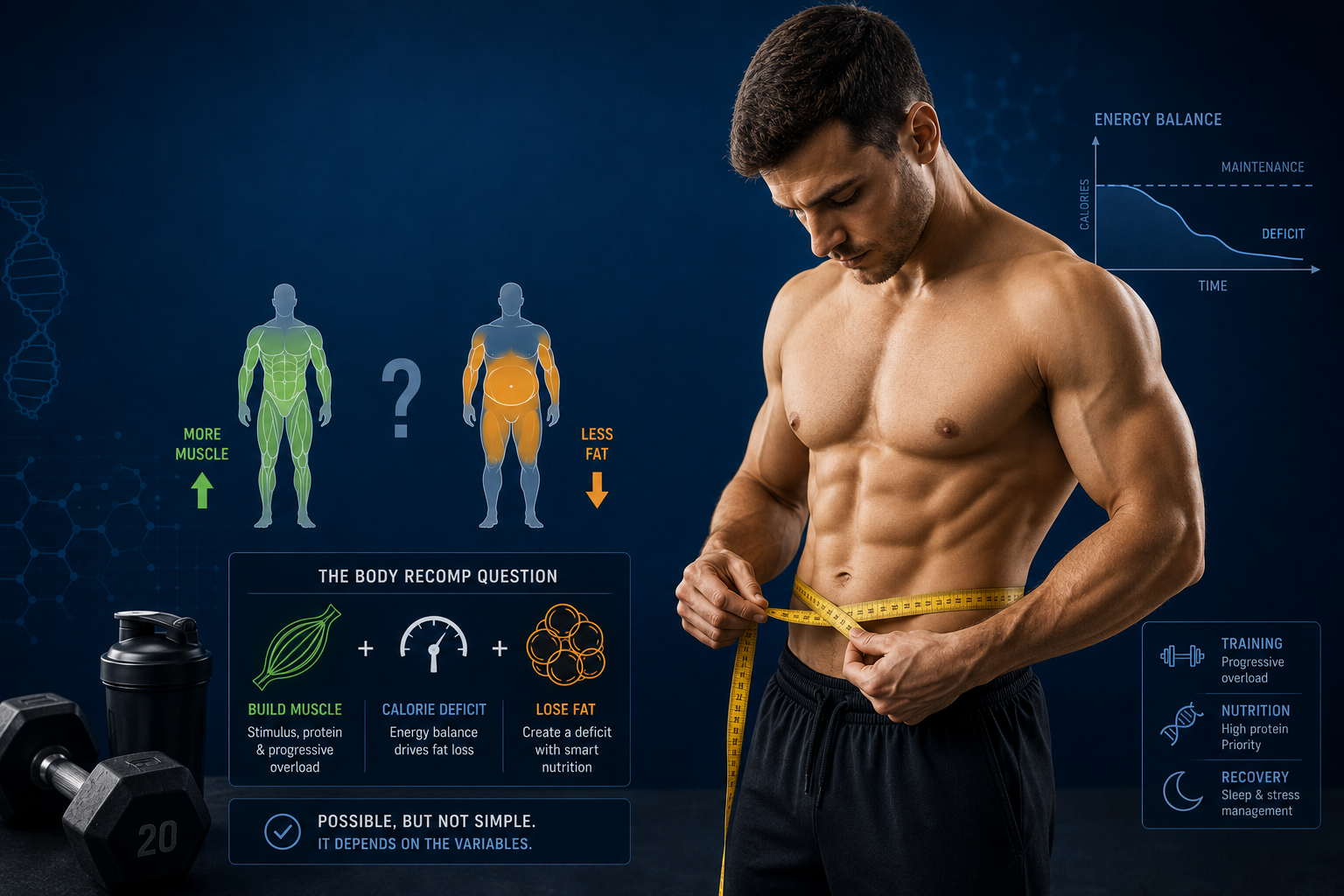
You’re cutting to reveal abs, eating 500 calories below maintenance, training hard, and wondering: am I wasting my gym time? Can I actually build muscle while losing fat, or am I just spinning my wheels trying to chase two goals simultaneously?
A highly controversial question in the bodybuilding world is whether you can gain muscle mass while in a calorie deficit, that is, while cutting.
Yes, it is possible to gain muscle mass during a cut. However, depending on your body composition, genetics, and training experience, this may not be possible for you, and it may be more productive to focus on just one goal at a time.
For people trying to get lean while preserving or even building muscle, understanding when muscle growth in a deficit is possible versus when it’s a pipe dream can save months of wasted effort. Many lifters either give up on training intensity while cutting (losing muscle unnecessarily) or maintain unrealistic expectations about gaining size (leading to frustration when the scale doesn’t move up).
In this comprehensive guide, I’ll explain what a calorie deficit actually is and how it affects your body, the complete science on building muscle in a deficit (what research actually shows), the specific scenarios where muscle gain during cutting is realistic, why most experienced lifters cannot build muscle while cutting, strategies to maximize muscle retention or growth during a deficit, and how to know which goal you should prioritize based on your current situation.
Whether you’re a beginner wondering if you can lose fat and build muscle simultaneously, an intermediate lifter confused about body recomposition, or an advanced athlete trying to optimize your approach, understanding the truth about muscle building in a calorie deficit will help you set realistic expectations and make better progress.
Let’s examine everything you need to know.
TABLE OF CONTENTS
What Is a Calorie Deficit? (Understanding the Fundamentals)
Before diving into whether muscle growth is possible, we need to understand exactly what a calorie deficit is and how it affects your body.
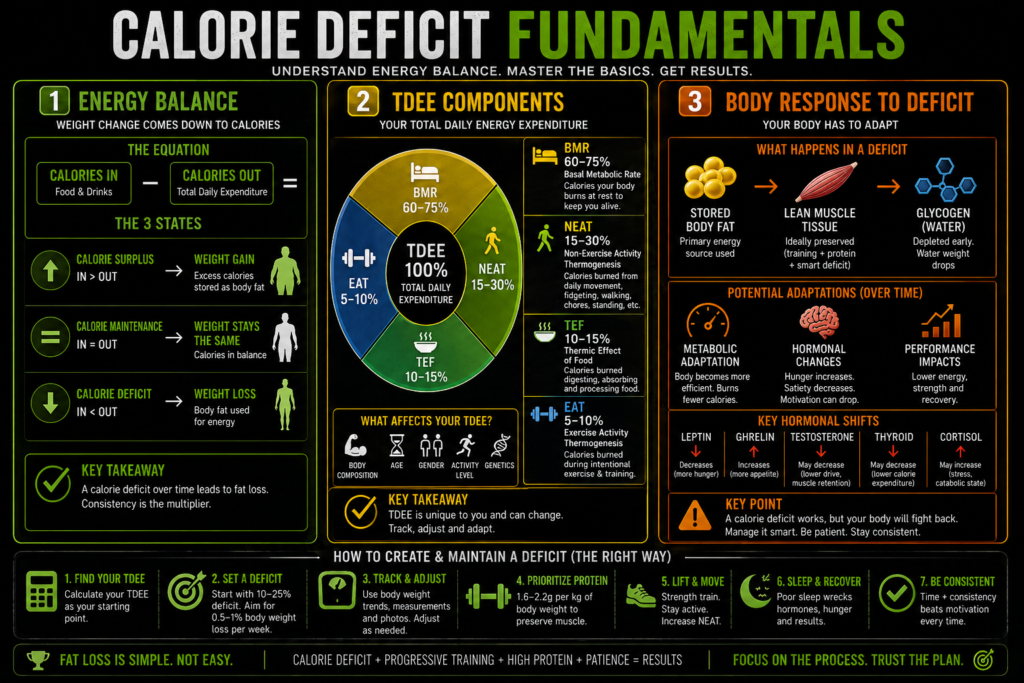
A calorie deficit occurs when you consume fewer calories than your body needs to maintain its current weight, thus leading to weight loss.
How Calorie Deficits Work
The energy balance equation:
Your body weight is determined by the balance between calories consumed and calories expended. This is often simplified as:
Weight change = Calories in – Calories out
Three possible states:
Calorie surplus (eating more than you burn):
- Energy available for growth and storage
- Weight increases (muscle, fat, or both)
- Anabolic environment
- Optimal for muscle building
Calorie maintenance (eating exactly what you burn):
- Energy balanced
- Weight stays stable
- Can maintain muscle mass
- Body composition can change slowly
Calorie deficit (eating less than you burn):
- Energy shortfall must be made up from body stores
- Weight decreases (fat, muscle, or both)
- Catabolic environment
- Challenging for muscle building
This deficit is achieved through a combination of diet and physical exercise. When you consume fewer calories than your body requires to function—to breathe, move, and perform physical activities—the body begins to use fat stores as an energy source, resulting in weight loss.
The Components of Energy Expenditure
Your total daily energy expenditure (TDEE) consists of:
Basal Metabolic Rate (BMR) – 60 to 75% of TDEE:
- Calories burned at complete rest
- Breathing, heartbeat, organ function, cellular processes
- Largest component for most people
- Example: 175 lb male, BMR approximately 1,750 calories
Non-Exercise Activity Thermogenesis (NEAT) – 15 to 30% of TDEE:
- Calories from daily movement (not formal exercise)
- Walking, fidgeting, standing, occupational activity
- Highly variable between individuals
- Office worker: Low NEAT (200 to 300 cal)
- Construction worker: High NEAT (800 to 1,200 cal)
Thermic Effect of Food (TEF) – 10 to 15% of TDEE:
- Calories burned digesting and processing food
- Protein: 20 to 30% of calories consumed
- Carbs: 5 to 10% of calories consumed
- Fats: 0 to 3% of calories consumed
- Higher protein diet = higher TEF
Exercise Activity Thermogenesis (EAT) – 5 to 10% of TDEE:
- Calories from intentional exercise
- Resistance training, cardio, sports
- Smaller than most people think
- 1 hour lifting: 200 to 400 calories
- 1 hour moderate cardio: 300 to 600 calories
Example calculation for 180 lb moderately active male:
- BMR: 1,800 calories
- NEAT: 400 calories
- TEF: 250 calories (assuming 2,500 cal intake)
- EAT: 300 calories (1 hour training)
- TDEE: 2,750 calories
To create deficit: Eat 2,250 calories (500 below TDEE)
How the Body Responds to a Calorie Deficit
When you create a calorie deficit, your body must get energy from somewhere:
Primary energy sources in deficit:
Stored body fat (ideal):
- 1 lb body fat = approximately 3,500 calories stored
- Body preferentially uses fat when deficit is moderate
- Fat oxidation increases in calorie deficit
- This is the goal (lose fat, preserve muscle)
Muscle tissue (problematic):
- Muscle can be broken down for energy
- Provides amino acids for gluconeogenesis (making glucose)
- Body more likely to sacrifice muscle if:
- Deficit is too large (over 25% below TDEE)
- Protein intake inadequate (below 0.7g per lb)
- Training stimulus insufficient
- Individual is already lean (under 10 to 12% body fat)
Glycogen stores (temporary):
- Liver and muscle glycogen depleted first
- 1 to 2 days to significantly deplete
- Glycogen depletion also releases water
- Explains rapid initial weight loss on diet
The body’s adaptation mechanisms:
Metabolic adaptation (adaptive thermogenesis):
- TDEE decreases beyond what’s expected from weight loss
- BMR reduces 5 to 15% below predicted
- NEAT decreases unconsciously (less fidgeting, more sitting)
- Exercise efficiency improves (burn fewer calories for same work)
- Makes further fat loss harder over time
Hormonal changes:
- Leptin decreases (hunger increases, metabolism slows)
- Ghrelin increases (appetite stimulation)
- Testosterone may decrease (especially in men under 10% body fat)
- Thyroid hormone (T3) decreases (metabolism slows)
- Cortisol may increase (stress hormone, promotes catabolism)
In practical terms, a calorie deficit is achieved primarily through reducing caloric intake through diet. Aerobic exercise and resistance training are only supporting factors in this process.
Why diet is primary:
The math favors dietary restriction:
- Reducing intake by 500 calories: Skip 2 slices pizza
- Burning 500 calories through exercise: 60 to 90 minutes intense cardio
- Diet is faster, easier, more sustainable
You cannot out-train a bad diet:
- 1 hour intense cardio: 500 to 700 calories burned
- 1 fast food burger meal: 1,200+ calories
- Much easier to not eat the burger than burn it off
Exercise serves different purposes:
- Resistance training: Preserves muscle mass during deficit
- Cardio: Creates additional deficit, improves health, aids recovery
- Both: Important but secondary to diet for fat loss
Creating an Effective Calorie Deficit
Recommended deficit sizes:
Aggressive deficit (750 to 1,000 cal below TDEE):
- Weight loss: 1.5 to 2 lbs per week
- Pros: Faster results, shorter diet duration
- Cons: Higher muscle loss risk, harder to adhere, more metabolic adaptation
- Best for: Obese individuals (over 25% body fat) with lots to lose
Moderate deficit (500 to 750 cal below TDEE):
- Weight loss: 1 to 1.5 lbs per week
- Pros: Good balance of fat loss and muscle preservation
- Cons: Takes longer to reach goal
- Best for: Most people (15 to 25% body fat)
Conservative deficit (250 to 500 cal below TDEE):
- Weight loss: 0.5 to 1 lb per week
- Pros: Maximum muscle preservation, sustainable, minimal metabolic adaptation
- Cons: Very slow progress, requires patience
- Best for: Lean individuals (under 15% body fat), recomposition attempts
Deficit as percentage of TDEE:
- 10 to 15%: Very conservative (good for lean individuals)
- 20 to 25%: Moderate (sweet spot for most)
- 30%+: Aggressive (only for very overweight)
Example for 180 lb male with 2,750 TDEE:
- Conservative: 2,475 calories (10% deficit)
- Moderate: 2,200 calories (20% deficit)
- Aggressive: 1,925 calories (30% deficit)
Can You Build Muscle in a Calorie Deficit? (The Complete Answer)
Yes, it is possible to gain muscle mass in a calorie deficit, while doing a cut. However, this is a complex topic and the efficiency of the process will depend on several factors.
The Traditional Understanding
There is a well established consensus that to gain muscle mass, you need to be in a calorie surplus, that is, consume more calories than your body uses in a day, to provide the body with the necessary energy for the synthesis of new muscle tissue.
Why calorie surplus is traditionally recommended for muscle building:
Muscle protein synthesis requires energy:
- Building new protein structures costs energy (ATP)
- Estimated 5 to 10 calories per gram of muscle protein synthesized
- Muscle is approximately 20% protein by weight
- Building 1 lb muscle requires approximately 2,000 to 2,500 total calories (including inefficiencies)
Anabolic hormones are optimized in surplus:
- Testosterone higher when well fed
- Insulin promotes nutrient storage and protein synthesis
- IGF-1 (growth hormone pathway) elevated
- mTOR pathway (muscle growth signal) activated
Recovery is enhanced:
- More energy available for repairing training damage
- Glycogen stores stay full (supports training intensity)
- Immune function better (less illness interrupting training)
- Sleep quality often better when well fed
Training performance is maximized:
- Strength and power higher when glycogen replete
- Can push harder in gym (better stimulus for growth)
- Recovery between sets faster
- Progressive overload easier to achieve
In a calorie deficit, you don’t have extra energy available. In other words, you have an unfavorable environment for building muscle mass.
Why deficit is challenging for muscle growth:
Energy is prioritized for survival:
- Body must maintain vital functions first
- Breathing, heartbeat, brain function, immune system
- Building new muscle is not a survival priority
- Body may sacrifice muscle before fat in some situations
Anabolic resistance:
- Muscle protein synthesis (MPS) response to protein feeding is blunted
- Takes more protein to stimulate same MPS response
- Recovery from training is slower
- Muscle growth signals (mTOR) are inhibited
Hormonal environment less favorable:
- Leptin low (signals starvation to body)
- Testosterone may decrease (especially when lean)
- Growth hormone increases (sounds good but actually promotes fat burning, not muscle building)
- Cortisol may increase (catabolic, breaks down tissue)
Simultaneous muscle gain and fat loss requires:
- Building new tissue (anabolic process)
- While breaking down tissue (catabolic process)
- These are opposite processes
- Body is not optimized to do both simultaneously
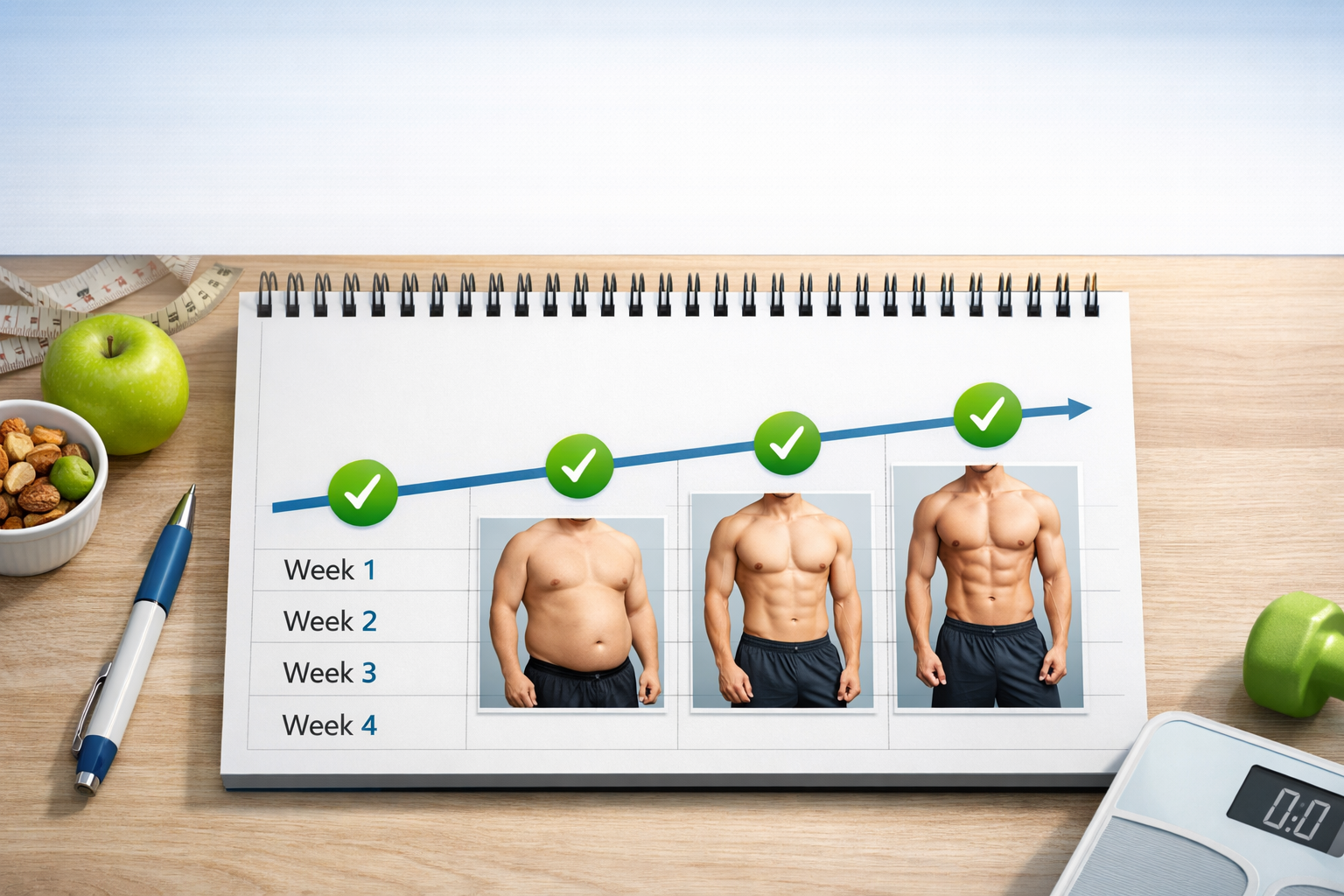
Even so, in some specific circumstances, you can achieve what is known as body recomposition, gaining muscle while losing fat, even in a calorie deficit.
When Muscle Gain in a Deficit IS Possible
The research shows that body recomposition (simultaneous muscle gain and fat loss) is possible, but primarily in specific populations:
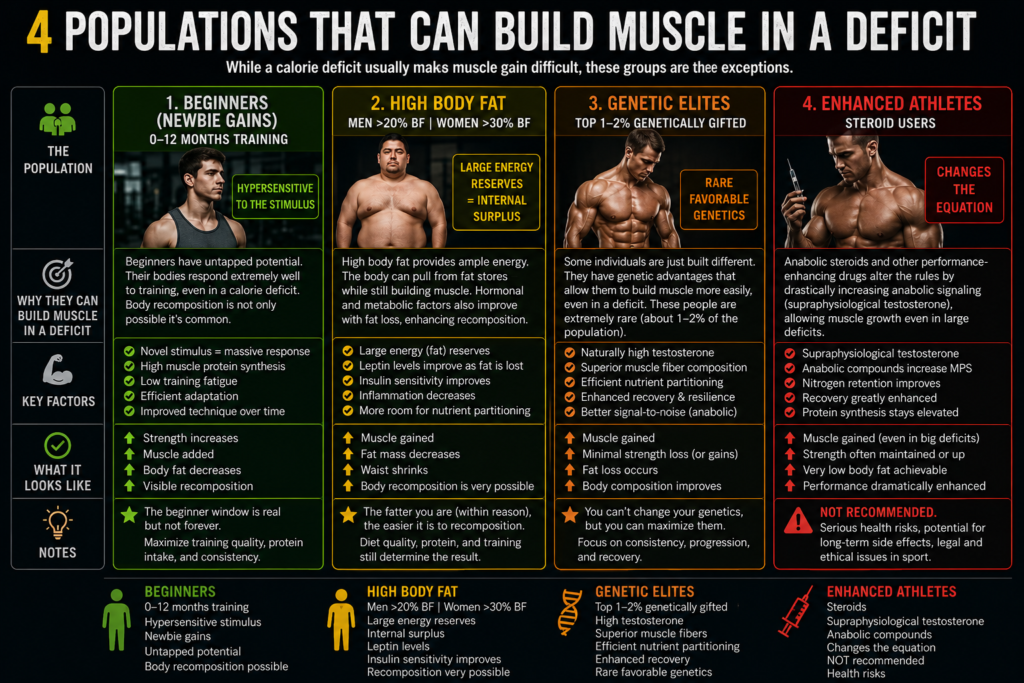
Population 1: Complete Beginners (Newbie Gains)
Beginners in resistance training (who have never trained before) or those returning to training after a long period of inactivity can gain muscle mass even while in a calorie deficit.
This occurs because their bodies are hypersensitive to the training stimulus, allowing muscular gains even without the calorie surplus traditionally recommended for hypertrophy.
The science of newbie gains:
Neuromuscular adaptations:
- First 6 to 8 weeks: Strength gains primarily neural
- Learning movement patterns
- Recruiting muscle fibers more efficiently
- Improving coordination
- These happen regardless of calorie state
Untapped growth potential:
- Never trained muscles respond dramatically to stimulus
- Satellite cell activation (muscle stem cells) is very high
- Muscle protein synthesis elevated for 48+ hours after training
- Body prioritizes muscle building response even in slight deficit
Research evidence:
Study 1: Overweight beginners:
- Subjects: Untrained, overweight men (25% body fat)
- Intervention: 8 weeks resistance training, 500 calorie deficit, high protein (1g per lb)
- Results: Lost 4 kg fat, gained 2 kg muscle
- Conclusion: Body recomposition clearly possible in overweight beginners
Study 2: Previously trained returning after layoff:
- Subjects: Individuals who trained 2+ years ago, now untrained for 6+ months
- Intervention: 12 weeks training, moderate deficit
- Results: Regained significant muscle (muscle memory) while losing fat
- Conclusion: Muscle memory allows recomposition in returning trainees
How long do newbie gains last?
- 6 to 12 months of proper training
- Varies by individual genetics and training quality
- After this period, recomposition becomes much harder
- Must choose surplus or deficit for continued progress
Population 2: Individuals With High Body Fat Percentage
Additionally, people with more body fat have more stored energy and may be able to lose fat and gain muscle simultaneously, especially if they follow a high protein diet and appropriate training program.
Why high body fat individuals can recomposition:
Large energy reserves:
- Someone at 25% body fat has massive stored energy
- 200 lb person at 25% body fat = 50 lbs fat = 175,000 stored calories
- Body can access this energy to fuel muscle protein synthesis
- Effectively has “internal calorie surplus” from fat stores
Leptin levels:
- Leptin is a hormone produced by fat cells
- Higher body fat = higher leptin
- Higher leptin = less metabolic slowdown in deficit
- Preserves anabolic hormones better than lean individuals
Insulin sensitivity improves:
- Overweight individuals often insulin resistant
- As they lose fat, insulin sensitivity improves
- Better insulin sensitivity = better nutrient partitioning
- More nutrients directed to muscle, less to fat
Research evidence:
Study: Overweight individuals, body recomposition:
- Subjects: Men at 27% body fat, untrained
- Intervention: 16 weeks, resistance training 4x per week, 25% calorie deficit, 2.4g protein per kg
- Results: Lost 16 lbs fat, gained 9 lbs muscle
- Conclusion: Significant recomposition possible in overweight, untrained individuals
The body fat threshold:
- Men over 20% body fat: Recomposition very possible
- Men 15 to 20%: Recomposition possible but slower
- Men 12 to 15%: Recomposition difficult, unlikely
- Men under 12%: Recomposition essentially impossible
Women (add 7 to 10% to above numbers):
- Women over 30% body fat: Recomposition very possible
- Women 25 to 30%: Possible but slower
- Women 20 to 25%: Difficult
- Women under 20%: Essentially impossible
Population 3: Genetically Gifted Individuals
People with very favorable genetics for muscle gain will have more chances of achieving both goals simultaneously.
Genetic factors that enable recomposition:
High natural testosterone:
- Some men naturally have testosterone at top of normal range (900 to 1,100 ng/dL)
- Enables muscle building even in suboptimal conditions
- Maintains anabolic environment despite deficit
Superior muscle fiber composition:
- Higher percentage of Type IIx fibers (most growth potential)
- More satellite cells (muscle stem cells)
- Better neuromuscular efficiency
Efficient nutrient partitioning:
- Calories preferentially directed to muscle over fat
- Better insulin sensitivity
- Superior glycogen storage capacity
Enhanced recovery:
- Lower cortisol response to training
- Better sleep quality
- Faster repair of training damage
The reality:
- True genetic elites are rare (top 1 to 2% of population)
- Most people who think they’re genetic elites are not
- Can’t change genetics, but can optimize what you have
Population 4: Enhanced Athletes (Steroid Users)
Anabolic steroid users will also have much higher chances of achieving both goals at the same time.
How steroids change the equation:
Supraphysiological testosterone:
- Testosterone levels 3 to 10x normal range
- Massively enhanced protein synthesis
- Reduced protein breakdown
- Can build muscle even without training in some studies
Other anabolic compounds:
- Trenbolone, nandrolone, etc. have additional muscle building effects
- Some enhance nutrient partitioning dramatically
- Some reduce cortisol signaling
- Combination effects are synergistic
Research on muscle building in deficit with steroids:
Study: Testosterone enanthate during calorie restriction:
- Subjects receiving 600mg testosterone weekly
- Maintained on 40% calorie deficit for 12 weeks
- Results: Significant muscle gain despite severe deficit
- Control group (no steroids): Lost muscle as expected
The ethical and health considerations:
- Steroids have significant health risks
- Illegal in most countries without prescription
- Not recommended for aesthetic or performance goals
- Mentioned here only for completeness
However, as you can see, all the situations mentioned are exceptions.
Why Most People CANNOT Build Muscle in a Deficit
For the majority of people, especially those who are already training regularly and are relatively lean, gaining muscle mass in a calorie deficit is unlikely.
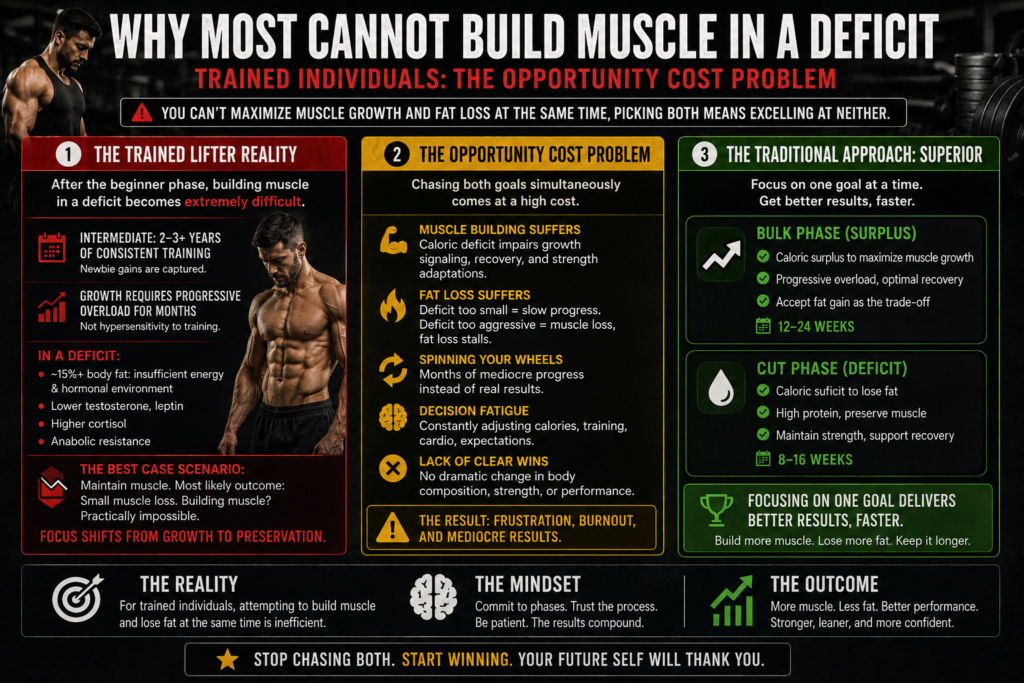
The reality for trained, lean individuals:
Scenario: Intermediate lifter, 2 to 3 years training, 15% body fat
Training status:
- Has captured most newbie gains
- Muscle growth now requires progressive overload over months
- Body no longer hypersensitive to training stimulus
- Gains measured in pounds per year, not pounds per month
Body composition:
- Not enough body fat to serve as meaningful internal energy source
- 15% body fat on 180 lb male = 27 lbs fat = 94,500 calories stored
- Sounds like a lot, but body is reluctant to use this for muscle building
- Gets more reluctant as body fat drops further
Hormonal environment in deficit:
- Testosterone dropping as calories restricted and body fat lowers
- Leptin suppressed (signals starvation)
- Cortisol elevated (catabolic)
- Thyroid function reduced
- Anabolic resistance increases
The actual outcome:
- Best case: Maintain muscle mass (huge success)
- Likely case: Small amount of muscle loss (acceptable if fat loss is significant)
- Worst case: Significant muscle loss (deficit too aggressive, protein too low, training inadequate)
- Muscle gain: Extremely unlikely, essentially impossible
Why the goal shifts to preservation:
During cutting, success is defined differently:
- Not gaining muscle (that requires surplus)
- Preserving existing muscle while losing fat
- Maintaining strength (or losing minimal strength)
- Achieving desired leanness without looking flat or depleted
Advanced lifters understand this:
- Bulk to build muscle (surplus)
- Cut to reveal muscle (deficit, focus on preservation)
- Don’t try to do both simultaneously
- Accept some strength loss during cut
The Opportunity Cost Problem
Gaining muscle mass and losing fat are goals that require opposite dietary strategies.
It’s worth remembering that many people, even when focusing on one goal, still have difficulty seeing results. Trying to pursue both goals often is not worth the cost benefit, unless you fit the situations mentioned earlier.
Why chasing both goals simultaneously often fails:
Suboptimal for both goals:
Muscle building suffers:
- Calorie deficit too small to lose fat meaningfully
- But still large enough to impair muscle growth
- End up gaining very little muscle
- While losing very little fat
- “Spinning wheels” for months
Fat loss suffers:
- Trying to maintain performance and eat more
- Deficit becomes too small
- Fat loss stalls
- Frustration and diet fatigue
Example: The recomposition trap
Person A tries recomposition:
- Eats at exactly maintenance or tiny deficit (100 calories)
- Trains hard, eats high protein
- After 12 weeks: Lost 2 lbs (could be water weight), maybe gained 0.5 lb muscle
- Frustrated, no visible progress
Person B uses traditional approach:
Phase 1: Bulk (8 weeks):
- 300 calorie surplus
- Result: Gained 8 lbs (maybe 4 lbs muscle, 4 lbs fat)
- Visibly bigger, stronger
Phase 2: Cut (8 weeks):
- 500 calorie deficit
- Result: Lost 10 lbs (mostly the 4 lbs fat gained, plus 6 lbs fat from before)
- Net: Gained 4 lbs muscle, lost 6 lbs fat
- Bigger and leaner than when started
Person B has dramatically better results in the same timeframe by focusing on one goal at a time.
The psychological burden:
Decision fatigue:
- Constantly wondering if deficit is too large
- Questioning if calories are too low or too high
- Uncertainty about whether progress is happening
- No clear metric to track (scale goes up? Down? Stays same? What’s good?)
Lack of clear wins:
- Bulking: Scale goes up, lifts go up (clear progress)
- Cutting: Scale goes down, physique gets leaner (clear progress)
- Recomposition: Everything changes very slowly, hard to see progress
When does recomposition make sense?
Limited scenarios where it’s the right choice:
Scenario 1: Beginner with high body fat:
- Training age: Under 6 months
- Body fat: Men over 20%, women over 30%
- Recomposition will happen naturally even in deficit
- Makes sense to focus on fat loss while capturing newbie gains
Scenario 2: Long term approach, not worried about speed:
- Happy to progress very slowly
- No deadline or time pressure
- Maintenance calories with great training and high protein
- Willing to wait 6 to 12+ months for subtle changes
Scenario 3: Contest prep exceptions:
- Late stage bodybuilding prep
- Already very lean (under 10% body fat)
- Using drugs that enable muscle gain in deficit
- Working with coach who knows how to manipulate this
For most natural, intermediate to advanced lifters:
- Pick a goal: Build muscle OR lose fat
- Execute that goal with full commitment
- Then switch to the other goal
- This approach delivers better results faster
Strategies to Maximize Muscle During a Deficit
Even if you cannot build new muscle in a deficit, you can minimize muscle loss and, in some cases, optimize for recomposition. Here are evidence based strategies.
Strategy 1: High Protein Intake (Non Negotiable)
Protein requirements increase significantly when in a calorie deficit.
Why protein needs increase:
Increased turnover:
- Body breaks down more protein for energy in deficit
- Must consume more to maintain muscle mass
- Protein has highest thermic effect (burns calories to digest)
Anabolic resistance:
- Muscles less sensitive to protein feeding in deficit
- Takes more protein to trigger same muscle protein synthesis
- Higher baseline protein intake needed
Satiety and adherence:
- Protein is most satiating macronutrient
- Helps control hunger during deficit
- Improves diet adherence
Recommended protein intake during deficit:
Maintenance or bulking:
- 0.7 to 1g per pound body weight
- Example: 180 lb person = 126 to 180g daily
Aggressive cut (over 500 calorie deficit):
- 1 to 1.2g per pound body weight
- Example: 180 lb person = 180 to 216g daily
Very lean (under 12% body fat men, under 20% women):
- 1.2 to 1.5g per pound body weight
- Example: 180 lb person = 216 to 270g daily
Research supporting high protein in deficit:
Study: High vs normal protein during deficit:
- Group A: 0.8g per lb body weight
- Group B: 1.6g per lb body weight
- Both groups: Same calorie deficit, same training
- Result: Group B maintained significantly more muscle mass
Practical application:
- Make protein target non negotiable
- Hit protein target every single day
- Adjust carbs and fats as needed
- Protein powder can help reach target
Strategy 2: Aggressive Resistance Training
Training stimulus becomes even more critical during a deficit.
Why training matters more when cutting:
Signal to preserve muscle:
- Body needs reason to keep muscle
- If you don’t use it (train it), body will sacrifice it
- Training signals: “This tissue is necessary”
- Without training, deficit will eat muscle
Maintain or build strength:
- Strength maintenance = muscle maintenance
- If strength stays same or increases, muscle is preserved
- Strength loss = probable muscle loss
What training should look like during a deficit:
Volume:
- Maintain or slightly reduce training volume
- Don’t increase volume significantly (recovery compromised in deficit)
- 10 to 20 sets per muscle per week is sufficient
Intensity:
- Keep intensity high (relative to your capabilities)
- Focus on 5 to 12 rep range
- Push close to failure (1 to 3 reps in reserve)
- Don’t back off too much
Frequency:
- Train each muscle 2x per week minimum
- More frequency can work if recovery is good
- Monitor recovery carefully
Progressive overload:
- Try to progress when possible
- May not always be possible in deficit
- At minimum, maintain your lifts
- Even small progressions are big wins during cut
What to avoid:
- High volume, low intensity (won’t preserve muscle)
- Only doing cardio (recipe for muscle loss)
- Drastically reducing training because “cutting”
- Training to failure every set (recovery is harder in deficit)
Strategy 3: Moderate Calorie Deficit
The size of your deficit dramatically impacts muscle preservation.
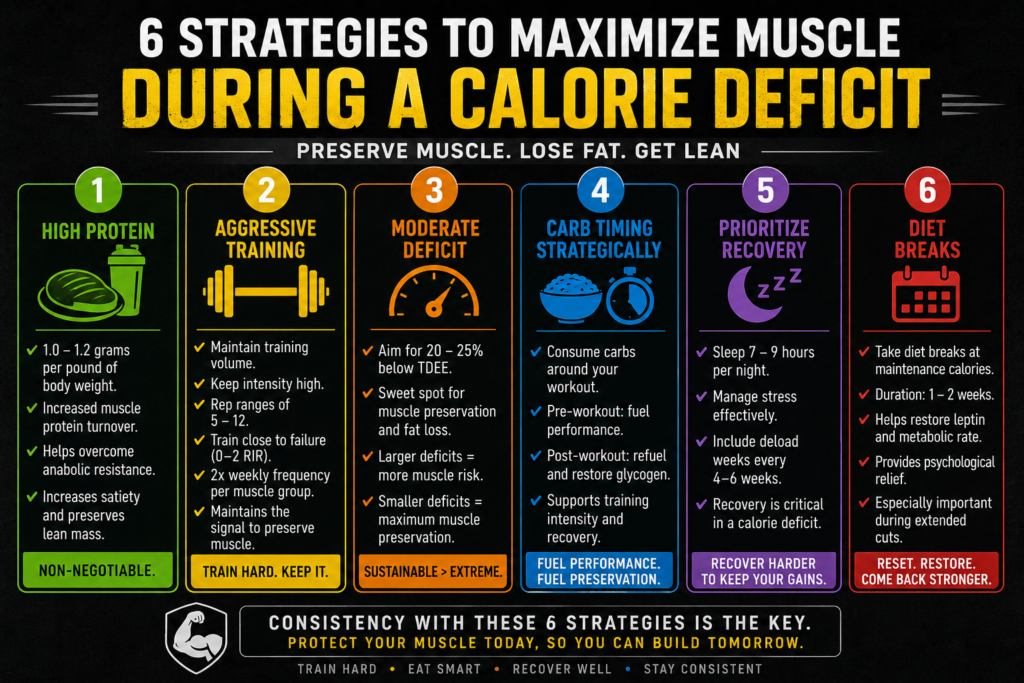
Deficit size and muscle loss relationship:
Small deficit (10 to 15% below TDEE):
- Maximum muscle preservation
- Very slow fat loss (0.5 to 0.75 lb per week)
- Best for lean individuals
- Patience required
Moderate deficit (20 to 25% below TDEE):
- Good muscle preservation with proper protein and training
- Reasonable fat loss (0.75 to 1.5 lbs per week)
- Sweet spot for most people
- Sustainable
Large deficit (30 to 40% below TDEE):
- Higher risk of muscle loss
- Rapid fat loss (1.5 to 2+ lbs per week)
- Only appropriate for very overweight individuals
- Hard to sustain
Very large deficit (over 40% below TDEE):
- Significant muscle loss almost guaranteed
- Unsustainable
- Metabolic adaptation severe
- Not recommended for anyone
The leaner you are, the smaller your deficit should be:
Body fat and appropriate deficit:
- Men over 15% body fat: 20 to 25% deficit fine
- Men 12 to 15%: 15 to 20% deficit better
- Men 10 to 12%: 10 to 15% deficit recommended
- Men under 10%: 10% deficit maximum
Women (add 7 to 9% to above numbers for equivalent):
- Women over 25%: 20 to 25% deficit fine
- Women 22 to 25%: 15 to 20% deficit better
- Women 18 to 22%: 10 to 15% deficit recommended
- Women under 18%: 10% deficit maximum
Strategy 4: Strategic Carb Timing
When you eat carbs can impact training performance and recovery during a deficit.
Why carb timing matters:
Glycogen and performance:
- Muscle glycogen fuels high intensity training
- Depleted glycogen = reduced performance
- Reduced performance = weaker stimulus = more muscle loss risk
Strategic approaches:
Approach 1: Carbs around training:
- 40 to 50% of daily carbs in pre and post workout meals
- Supports training performance
- Aids recovery
- Rest of day lower carb
Approach 2: Carb cycling:
- Higher carbs on training days (maintenance or slight surplus)
- Lower carbs on rest days (larger deficit)
- Weekly deficit still maintained
- May improve adherence and performance
Approach 3: Carb backloading:
- Majority of carbs in evening
- May improve sleep
- Next day training performance benefits from overnight glycogen replenishment
- Some individual preference involved
The evidence:
- Carb timing may provide 5 to 10% benefit
- Not as critical as total carbs and total calories
- More important when very lean or performance is priority
- Can be ignored by beginners
Strategy 5: Adequate Recovery
Recovery becomes harder in a deficit, but is more important than ever.
Sleep becomes critical:
Aim for 7 to 9 hours nightly:
- Sleep deprivation increases muscle loss in deficit
- Growth hormone released during deep sleep
- Testosterone production occurs during sleep
- Appetite hormones regulated by sleep quality
Research on sleep and muscle preservation:
Study: Sleep duration during calorie deficit:
- Group A: 8.5 hours sleep nightly
- Group B: 5.5 hours sleep nightly
- Both: Same diet, same deficit
- Result: Group A lost 55% more fat, 60% less muscle than Group B
Stress management:
- Chronic stress elevates cortisol
- Cortisol is catabolic (breaks down muscle)
- Find stress reduction techniques that work for you
- Meditation, walking, hobbies, socializing
Deload weeks:
- Every 4 to 8 weeks, reduce training volume by 40 to 50%
- Maintain intensity but do fewer sets
- Allows recovery and supercompensation
- Returns fresh for next training block
Strategy 6: Consider Diet Breaks
Extended dieting causes metabolic adaptation. Strategic breaks can help.
What is a diet break:
- 1 to 2 weeks eating at maintenance calories
- Not a cheat week (still hitting protein, eating clean)
- Structured pause in the deficit
- Then return to deficit
Benefits of diet breaks:
- Leptin levels partially recover
- Metabolic rate increases slightly
- Psychological relief
- Improved gym performance
- May improve long term adherence
When to use diet breaks:
Scenario 1: Extended cut:
- Cutting for 12+ weeks
- Take 1 week break at maintenance every 6 to 8 weeks
- Returns to deficit refreshed
Scenario 2: Very lean:
- Below 12% body fat for men, 20% for women
- Take 1 week maintenance every 4 to 6 weeks
- Necessary to preserve hormones and sanity
Scenario 3: Feeling terrible:
- Energy very low
- Performance dropped significantly
- Mood affected
- Sleep disrupted
- Take break immediately
Don’t confuse diet breaks with:
- Cheat meals or days (unstructured overeating)
- Giving up
- Diet breaks are planned, structured, purposeful
THE BOTTOM LINE: BUILDING MUSCLE IN A CALORIE DEFICIT
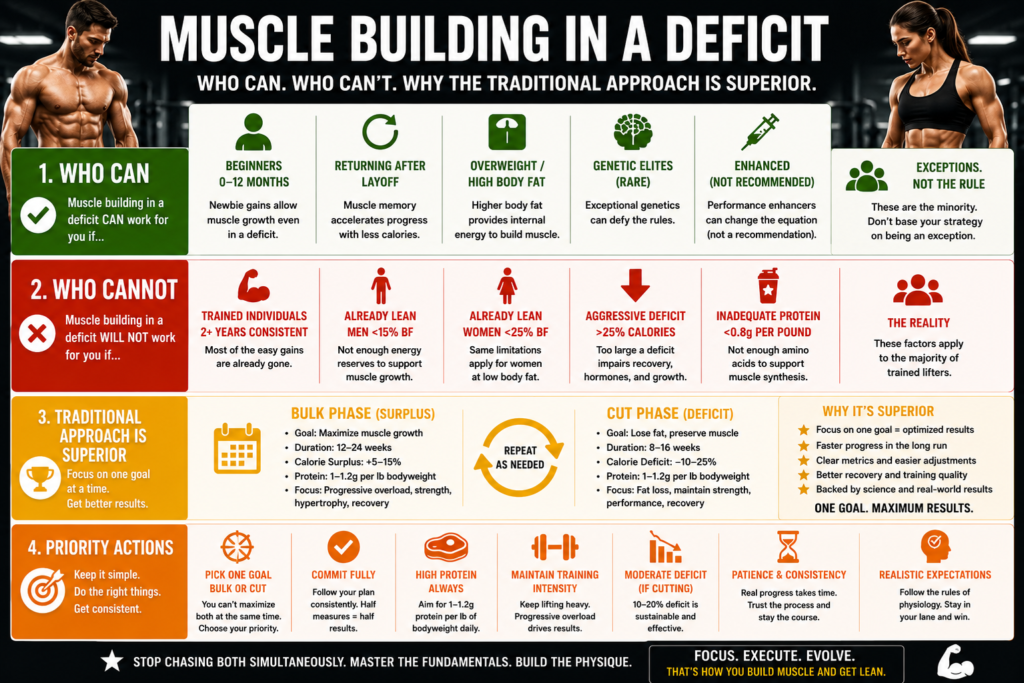
✅ Possible For Beginners (First 6 to 12 Months Training)
✅ Possible For High Body Fat Individuals (Men Over 20%, Women Over 30%)
✅ Very Unlikely For Intermediate to Advanced Lifters
✅ Nearly Impossible When Already Lean (Men Under 12%, Women Under 20%)
✅ Focus On One Goal Usually Better (Build Muscle OR Lose Fat)
✅ High Protein Is Non Negotiable (1 to 1.2g Per Pound During Cut)
Who CAN Build Muscle in a Deficit: • Complete Training Beginners (Newbie Gains) • Returning After Long Layoff (Muscle Memory) • Overweight Individuals (High Body Fat Provides Energy) • Genetic Elites (Rare, Top 1 to 2%) • Enhanced Athletes (Not Recommended)
Who CANNOT Build Muscle in a Deficit: • Trained Individuals (2+ Years Consistent Training) • Already Lean (Men Under 15%, Women Under 25%) • Aggressive Deficit (Over 25% Below Maintenance) • Inadequate Protein (Under 0.8g Per Pound)
Key Scientific Principles:
Energy Balance: • Muscle building requires energy (anabolic process) • Deficit means energy shortfall (catabolic environment) • Body prioritizes survival over muscle growth • Surplus is optimal state for muscle building
Protein Requirements: • Increase significantly in deficit • 1 to 1.2g per pound body weight minimum • Up to 1.5g per pound when very lean • Higher protein offsets anabolic resistance
Training Stimulus: • Must signal body to preserve muscle • Maintain intensity during cut • Volume can decrease slightly • Strength maintenance = muscle maintenance
Recovery Factors: • Sleep 7 to 9 hours nightly • Manage stress (cortisol is catabolic) • Consider deload weeks every 4 to 8 weeks • Diet breaks for extended cuts
The Traditional Approach Works Better:
Bulking Phase: • Calorie surplus (300 to 500 above maintenance) • Focus: Maximize muscle gain • Accept some fat gain • Duration: 12 to 24 weeks • Result: Significant muscle growth
Cutting Phase: • Calorie deficit (20 to 25% below maintenance) • Focus: Lose fat, preserve muscle • High protein (1 to 1.2g per lb) • Duration: 8 to 16 weeks • Result: Reveal muscle built during bulk
Why It’s Superior: • Each phase optimized for one goal • Faster progress on both fronts • Clear metrics to track (scale goes up during bulk, down during cut) • Less psychological stress • Better long term results
The Recomposition Scenarios:
When Recomp Makes Sense: • Beginner with high body fat (over 20 to 30%) • No time pressure or deadline • Maintenance calories with perfect training and protein • Willing to wait 6 to 12+ months for slow changes
When It Doesn’t: • Intermediate to advanced lifter • Already relatively lean • Want results in reasonable timeframe • Limited training time or suboptimal recovery
Practical Recommendations By Category:
Beginner (Under 6 Months Training): • Eat at maintenance or small deficit if overweight • Protein: 1g per pound minimum • Train consistently, progressive overload • Expect recomposition to happen naturally
Intermediate (1 to 3 Years Training): • Pick one goal: bulk or cut • If bulking: 300 to 500 calorie surplus • If cutting: 20 to 25% deficit, 1 to 1.2g protein per pound • Accept you won’t build muscle during cut
Advanced (3+ Years Training): • Definitely pick one goal • Bulk: Slower surplus (300 calories), minimize fat gain • Cut: Moderate deficit (20%), very high protein (1.2 to 1.5g per pound) • Use diet breaks every 6 to 8 weeks if cutting
Very Lean (Men Under 12%, Women Under 20%): • Small deficit only (10 to 15%) • Highest protein (1.2 to 1.5g per pound) • Reduce training volume slightly • Diet breaks every 4 to 6 weeks • Progress will be very slow
STOP TRYING TO CHASE TWO GOALS SIMULTANEOUSLY IF YOU’RE PAST THE BEGINNER STAGE. START FOCUSING ON ONE GOAL AT A TIME. BULK TO BUILD MUSCLE. CUT TO REVEAL MUSCLE. MAKE REAL PROGRESS INSTEAD OF SPINNING YOUR WHEELS FOR MONTHS.
Ready To Build A Complete Training And Nutrition Strategy That Maximizes Muscle Growth During Bulking And Preserves Muscle During Cutting? Understanding when muscle gain is possible in a deficit is just the beginning. Get a comprehensive system that includes personalized bulking and cutting protocols based on your training age and body composition, evidence based training programs optimized for muscle growth and preservation, meal planning templates for both bulking and cutting phases, strategies to minimize fat gain during bulks and muscle loss during cuts, and complete transition guides for moving between phases. Stop wasting time trying to build muscle in a deficit when a focused approach would deliver better results faster.
REFERENCES
SECTION 1 — Body recomposition in untrained overweight individuals: simultaneous fat loss and muscle gain
[1] Barakat C et al. — Strength and Conditioning Journal, 2020 Comprehensive narrative review of body recomposition across multiple populations; substantial evidence demonstrates simultaneous fat loss and muscle gain in untrained and overweight individuals, with the primary moderating variables being initial fat mass, training status, and protein intake; the degree of caloric restriction that permits recomposition is greatest in individuals with high fat mass (greater than 20% in men, greater than 30% in women), who can access adipose energy stores to partially fund muscle protein synthesis; trained individuals at lower body fat levels show progressively less capacity for recomposition; directly validates the article’s Population 1 and Population 2 classifications, establishing the scientific basis for why beginners and overweight individuals represent the primary candidates for muscle gain during a deficit https://journals.lww.com/nsca-scj/fulltext/2020/10000/body_recomposition__can_trained_individuals_build.3.aspx
[2] Longland TM et al. — PMC/American Journal of Clinical Nutrition, 2016 RCT in 40 overweight young men undergoing a 4-week 40% caloric restriction with 6 days per week intensive training; the high protein group (2.4 g/kg/day) gained 1.2 kg of lean mass while losing 4.8 kg of fat; the lower protein group (1.2 g/kg/day) maintained lean mass with 3.5 kg fat loss; the high protein group simultaneously gained muscle and lost fat in a severe energy deficit; provides the primary controlled human evidence for body recomposition in overweight individuals with resistance training and high protein intake, directly supporting the article’s body fat threshold framework https://pmc.ncbi.nlm.nih.gov/articles/PMC4807704/
SECTION 2 — Muscle memory: returning trainees regain muscle rapidly via myonuclear retention
[3] Bruusgaard JC et al. — PubMed/PNAS, 2010 Foundational in vivo imaging study demonstrating that new myonuclei acquired during resistance training are not lost during subsequent detraining; newly formed nuclei were retained even during severe atrophy lasting a considerable portion of the animal’s lifespan; this myonuclear permanence retarded disuse atrophy and provided a cellular mechanism for rapid muscle regrowth when training resumed; explains why returning trainees can regain muscle significantly faster than their initial rate, enabling a muscle memory advantage that supports the article’s returning-trainees population as a category where muscle gain during deficit is feasible https://pubmed.ncbi.nlm.nih.gov/20713720/
SECTION 3 — High protein intake during caloric restriction preserves muscle mass
[4] Mettler S, Mitchell N & Tipton KD — PubMed/Medicine and Science in Sports and Exercise, 2010 RCT in 20 lean resistance-trained male athletes undergoing a 2-week severe caloric restriction (60% of energy requirements); athletes consuming approximately 2.3 g/kg/day protein lost only 0.3 kg of lean body mass compared to 1.6 kg in those consuming 1.0 g/kg/day, despite similar fat mass losses of approximately 1.4 kg in both groups; higher protein provided a five-fold greater lean mass preservation with no difference in fat loss; provides the protein dose evidence for the article’s Strategy 1, directly supporting protein targets of 1.0 to 1.5 g per pound body weight during cutting https://pubmed.ncbi.nlm.nih.gov/19927027/
SECTION 4 — Sleep duration during caloric restriction: fat vs. lean tissue loss
[5] Nedeltcheva AV et al. — PMC/Annals of Internal Medicine, 2010 Crossover RCT in 10 overweight adults spending two 14-day periods of caloric restriction in a sleep laboratory, one with 8.5 hours of sleep and one with 5.5 hours of sleep; total weight loss was similar between conditions, but body composition differed substantially; during adequate sleep, 55% of lost weight was fat mass; during sleep restriction, only 25% of lost weight was fat mass while 75% was lean (predominantly muscle); sleep restriction also increased ghrelin and appetite; provides the controlled experimental evidence for the article’s Strategy 5 and the striking statistic that sleep duration determines whether weight lost during cutting comes predominantly from fat or muscle https://pmc.ncbi.nlm.nih.gov/articles/PMC2951287/

Leave a Reply
You must be logged in to post a comment.