
Trying to force yourself to the gym every day? Stop. You’re fighting your identity. Change who you are, not what you do.
You set a goal: “I’m going to train 4 times a week.” You start strong. By week 3, you’re skipping sessions.
You’re trying to act like someone who trains consistently. But you’re not that person. Your identity doesn’t match your behavior.
You think you just need more discipline:
- “I need to try harder”
- “I need more willpower”
- “I need better motivation”
- “I just need to push through”
Wrong. You’re trying to override your identity with willpower. Willpower always loses. Identity always wins. If you see yourself as “someone trying to get fit,” you’ll act like someone trying. If you see yourself as “an athlete,” you’ll act like an athlete. The behavior follows automatically.
Here’s what’s actually happening: Identity is your internal story about who you are. Every action you take is a vote for or against that identity. When behavior conflicts with identity, your brain creates psychological dissonance. You’ll either change the behavior (quit training) or change the identity. Most people quit because their identity never changed. The solution isn’t trying harder to act differently it’s becoming a different person at the identity level. Then the behaviors flow naturally.
In this comprehensive guide, I’ll explain how identity shapes behavior (the neuroscience and psychology), reveal why outcome-based goals fail (they’re backward), show you the 5-step identity transformation protocol (actionable system), provide the exact language patterns to use (how you talk matters), and explain how to make the identity permanent (integration process).
Whether you’ve failed every fitness attempt or just want consistency, understanding identity-based change is the breakthrough.
Let’s transform who you are, not just what you do.
TABLE OF CONTENTS
Understanding Identity and Behavior
The foundation of sustainable change.
What Identity Actually Is
The definition:
- Your internal story about who you are
- Your beliefs about your character
- Your self-concept
- What you consider “you” vs. “not you”
- The “I am” statements
Where it comes from:
Past actions:
- What you’ve done repeatedly
- Your track record
- Evidence accumulates
- “I’ve done X many times, therefore I’m someone who does X”
- Historical behavior patterns
Social feedback:
- What others call you
- How you’re labeled
- Roles you occupy
- Family, friends, culture
- External reinforcement
Self-narrative:
- Stories you tell about yourself
- How you explain your past
- What you emphasize
- Internal storytelling
Beliefs about capability:
- What you think you can/can’t do
- Natural vs. unnatural to you
- Your “type”
- Perceived capacity
Examples of identity:
- “I’m an athlete”
- “I’m not a morning person”
- “I’m someone who loves junk food”
- “I’m naturally lazy”
- “I’m disciplined”
- “I’m a reader”
- Self-descriptors
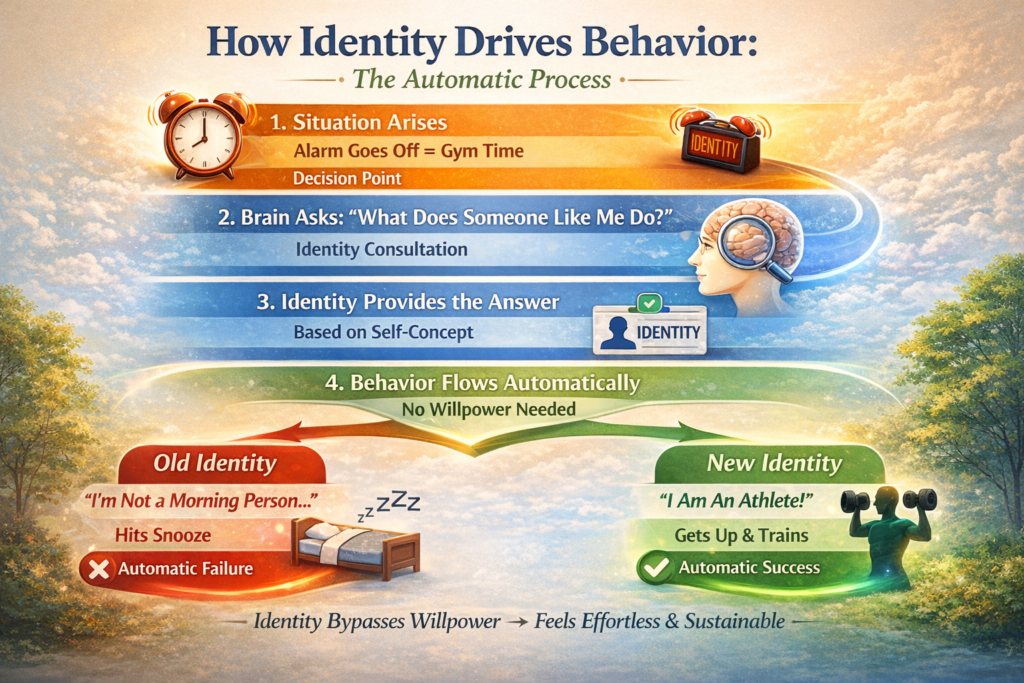
How Identity Drives Behavior
The mechanism:
Identity → Automatic behavior filtering
Step 1: Situation arises
- Alarm goes off at 6 AM for gym
- Decision point
Step 2: Identity consulted
- Brain asks: “What does someone like me do in this situation?”
- Searches identity for answer
- Identity query
Step 3: Identity provides answer
- If identity: “I’m not a morning person”
- Answer: “Someone like me doesn’t wake up early”
- Identity-congruent response
Step 4: Behavior flows automatically
- Hit snooze
- Feels natural and right
- No internal conflict
- Identity-aligned action
The power:
- Bypasses willpower
- Feels effortless
- Sustainable
- No internal struggle
- Automatic consistency
The opposite scenario:
If identity: “I’m an athlete”
- Alarm at 6 AM
- Identity answer: “Athletes train in the morning”
- Wake up
- Feels natural
- Identity-aligned behavior
Why Outcome-Based Goals Fail
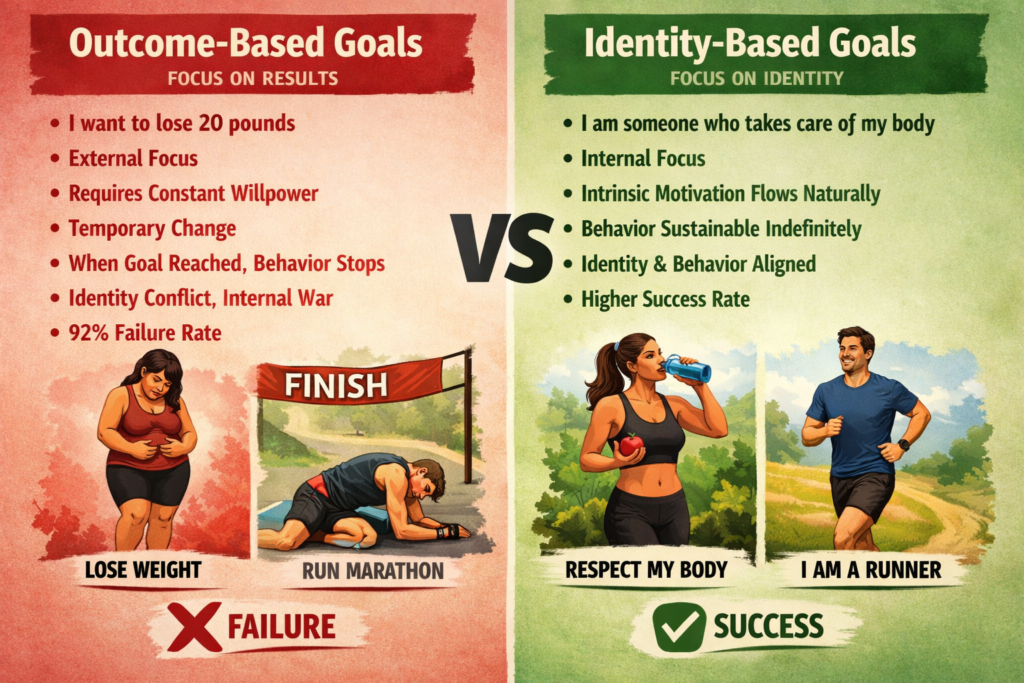
Traditional approach:
- “I want to lose 20 pounds”
- “I want to bench press 225”
- “I want six-pack abs”
- Outcome focus
The problem:
Problem 1: External focus
- Goal is about outcome, not identity
- Who you are doesn’t change
- Behavior requires constant willpower
- When goal reached (or given up), behavior stops
- Temporary change
Problem 2: Identity conflict
- Goal says: “I want to be fit”
- Identity says: “I’m someone who hates exercise”
- Cognitive dissonance
- Identity wins (most comfortable)
- Internal war
Problem 3: No intrinsic motivation
- Chasing external result
- When result delayed, motivation fades
- No internal drive
- Willpower dependence
The pattern:
- Set outcome goal
- Use willpower to pursue
- Willpower depletes
- Identity unchanged
- Return to baseline behavior
- Predictable failure
The research:
- Most New Year’s resolutions fail by February
- 92% of goals never achieved
- Weight loss regain rate >80%
- High failure rate
Why they fail:
- Outcome-based
- Identity-neglecting
- Willpower-dependent
- Fundamentally flawed approach
Identity-Based Goals: The Alternative
The shift:
- From: “I want to lose 20 pounds” (outcome)
- To: “I’m becoming someone who takes care of their body” (identity)
- Process over outcome
Why it works:
Advantage 1: Internal focus
- About who you are, not what you achieve
- Identity-behavior alignment
- No internal conflict
- Congruent system
Advantage 2: Process-oriented
- Every action reinforces identity
- Progress is daily
- Not dependent on distant outcome
- Immediate feedback
Advantage 3: Intrinsic motivation
- Behavior flows from self-concept
- Feels natural
- Sustainable indefinitely
- Self-reinforcing
The examples:
Outcome-based: “I want to run a marathon” Identity-based: “I’m a runner”
- Runner runs (regardless of race)
- Training becomes expression of identity
- Marathon is byproduct
- Identity drives behavior
Outcome-based: “I want to lose 30 pounds” Identity-based: “I’m someone who respects their body”
- Eat well because that’s who I am
- Train because that’s what I do
- Weight loss is byproduct
- Identity drives behavior
Outcome-based: “I want to get stronger” Identity-based: “I’m an athlete”
- Athletes train consistently
- Progressive overload natural
- Strength gain is byproduct
- Identity drives behavior
The evidence:
- Study: Voters vs. people who vote
- “Be a voter” more effective than “go vote”
- Identity > action instruction
- Research-backed
The 5-Step Identity Transformation Protocol
How to actually change who you are.
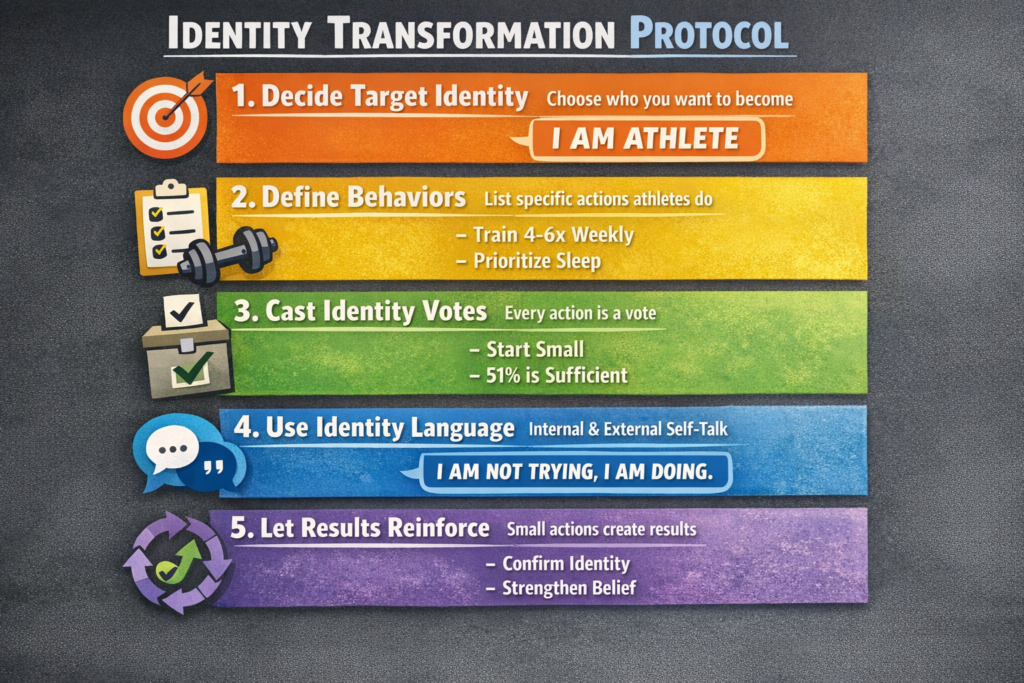
Step 1: Decide Your Target Identity
The process:
- Who do you want to become?
- Not what you want to achieve
- What TYPE of person?
- Identity selection
The questions:
Core question:
- “What type of person could achieve the outcomes I want?”
- Work backward from outcomes to identity
- Reverse engineering
Examples:
Want to: Lose fat and build muscle Target identity: “I’m an athlete” or “I’m someone who trains seriously”
Want to: Be productive and successful Target identity: “I’m a high performer” or “I’m someone who executes”
Want to: Be healthy long-term Target identity: “I’m someone who takes care of their body”
Want to: Be strong and capable Target identity: “I’m a strength athlete”
The specificity spectrum:
Too vague:
- “I’m a good person”
- Not actionable
- Insufficient specificity
Too specific:
- “I’m someone who squats 405 for reps”
- Too narrow
- Outcome-focused
- Overly narrow
Right level:
- “I’m an athlete”
- “I’m a lifter”
- “I’m someone who trains”
- Specific enough to guide behavior
- Broad enough to be flexible
- Optimal specificity
Multiple identities:
- Can have several
- “I’m an athlete” (fitness)
- “I’m a professional” (work)
- “I’m a reader” (learning)
- Don’t conflict
- Multiple domains
The commitment:
- Write it down
- “I am [target identity]”
- Present tense (not “becoming”)
- Declaration
Step 2: Define What That Person Does
The process:
- List behaviors aligned with identity
- Be specific and concrete
- Observable actions
- Behavioral definition
The template:
- “Someone who is [identity] does [specific behaviors]”
- Action specification
Example: “I’m an athlete”
What athletes do:
- Train 4-6 times per week consistently
- Prioritize sleep (7-9 hours)
- Eat to fuel performance (high protein, nutrient-dense)
- Track progress and adjust
- Push through discomfort
- Recover intentionally
- Don’t skip sessions
- Take training seriously
- Behavioral profile
Example: “I’m someone who takes care of their body”
What that person does:
- Exercises regularly (doesn’t need to be intense)
- Eats mostly whole foods
- Stays hydrated
- Gets adequate sleep
- Manages stress
- Doesn’t abuse body with substances
- Listens to body’s signals
- Care-based behaviors
Example: “I’m a lifter”
What lifters do:
- Follow structured program
- Progressive overload focus
- Compound movements priority
- Track weights and reps
- Consistent training schedule
- Learn proper technique
- Respect the process
- Lifting-specific behaviors
Why this matters:
- Makes identity actionable
- Removes ambiguity
- Clear behavioral standards
- Operational definition
The specificity:
- Not just “exercise”
- But “train 4x weekly following program”
- Specific > vague
- Concrete actions
Step 3: Start Taking Small Identity Votes
The concept:
- Every action is a vote for type of person you become
- Votes accumulate as evidence
- Evidence builds identity
- Behavioral voting
The mechanism:
Each action asks:
- “What type of person does this?”
- Brain categorizes action
- Adds to identity evidence
- Self-concept updating
Examples of identity votes:
Vote for “I’m an athlete”:
- ✓ Wake up for morning training
- ✓ Choose protein over junk food
- ✓ Go to gym even when tired
- ✓ Track workout performance
- ✓ Prioritize sleep over Netflix
- Positive votes
Vote against “I’m an athlete”:
- ✗ Hit snooze, skip workout
- ✗ Eat fast food regularly
- ✗ Stay up late scrolling
- ✗ Skip gym because “don’t feel like it”
- Negative votes
The math:
- Need more votes FOR than AGAINST
- 51% sufficient to begin shift
- 70%+ for strong identity
- 90%+ for automatic identity
- Vote accumulation
Starting small (critical):
Don’t start with:
- Train 6 days per week immediately
- Perfect diet overnight
- Complete transformation Day 1
- Unsustainable
Start with:
- 3x weekly training (achievable)
- One meal daily optimized
- Consistent wake time
- Sustainable beginning
Why small matters:
- Builds evidence quickly
- Success breeds success
- Avoids overwhelm and failure
- Momentum building
The 2-minute rule:
- Make it so easy you can’t say no
- “I’m someone who exercises” → Do 2 pushups
- 2 pushups is vote for identity
- Minimum viable vote
The compound effect:
- Day 1: One vote for new identity
- Week 1: 7 votes
- Month 1: 30 votes
- Year 1: 365 votes
- Evidence accumulation
Step 4: Use Identity Language Constantly
The power of language:
- How you talk about yourself shapes identity
- Self-talk is self-fulfilling
- Language precedes belief
- Linguistic programming
The shift:
From outcome language:
- “I’m trying to get in shape”
- “I want to be fit”
- “I’m working on it”
- Aspirational (weak)
To identity language:
- “I’m an athlete”
- “I’m someone who trains”
- “I take care of my body”
- Declarative (strong)
Internal self-talk:
Old pattern:
- Alarm goes off
- Think: “Ugh, I have to go to the gym”
- Obligation mindset
- External pressure
New pattern:
- Alarm goes off
- Think: “I’m someone who trains in the morning”
- Identity statement
- Internal alignment
Responding to temptation:
Old pattern:
- See donuts
- Think: “I shouldn’t eat those” (restriction)
- Willpower battle
- Internal conflict
New pattern:
- See donuts
- Think: “I’m someone who fuels their body properly”
- Identity reminder
- No internal struggle
- Identity-congruent choice
External language:
When others ask:
Weak response:
- “I’m trying to get to the gym more”
- Signals uncertainty
- Tentative identity
Strong response:
- “I train four times a week”
- States fact about who you are
- Confident identity
Social situations:
Weak:
- “I can’t have that, I’m on a diet”
- Temporary restriction
- Diet mindset
Strong:
- “I don’t eat that” or “That’s not my thing”
- Identity statement
- Permanent, not temporary
- Identity mindset
The research:
- “I don’t” more effective than “I can’t”
- Identity-based refusal stronger than rule-based
- Psychological empowerment
- Language matters
Daily affirmations:
- Morning: State identity
- “I am [identity]”
- Before challenges: Remind yourself
- Evening: Reflect on votes cast
- Constant reinforcement
Step 5: Let Results Reinforce Identity
The flywheel:
- Small actions create small results
- Results confirm identity
- Confirmed identity drives more action
- More action creates more results
- Self-reinforcing cycle
The progression:
Week 1:
- Declare: “I’m someone who trains”
- Action: Train 3x
- Result: Completed workouts, slight strength gain
- Reinforcement: “I actually am someone who trains”
- Evidence emerges
Week 2-4:
- Identity stronger from evidence
- Actions feel more natural
- Results accumulating (weight loss, strength gain, energy)
- Reinforcement: “This is who I am now”
- Identity solidifying
Month 2-3:
- Identity integrated
- Actions automatic
- Results significant (visible physique change)
- Reinforcement: “I can’t imagine not being this person”
- Identity internalized
The mechanism:
- Results are proof
- Proof strengthens belief
- Belief drives action
- Action creates results
- Positive spiral
Tracking for reinforcement:
- Progress photos (visual evidence)
- Workout log (strength gains)
- Body measurements (quantified change)
- How you feel (subjective improvement)
- Evidence collection
Celebrating identity-congruent actions:
- Not just outcomes
- Celebrate the FACT that you trained
- “I’m proud I showed up” (identity vote)
- Not just “I’m proud I lost a pound” (outcome)
- Process celebration
The danger:
- Outcome-only focus undermines identity
- “I trained but didn’t lose weight = failure”
- Misses the point
- Identity is about actions, not results
- Identity-action link
The reframe:
- “Did I act like someone who [identity]?”
- If yes, success (regardless of outcome)
- If no, miss (outcome irrelevant)
- Identity-based success metrics
Common Identity Roadblocks
Obstacles and how to overcome them.
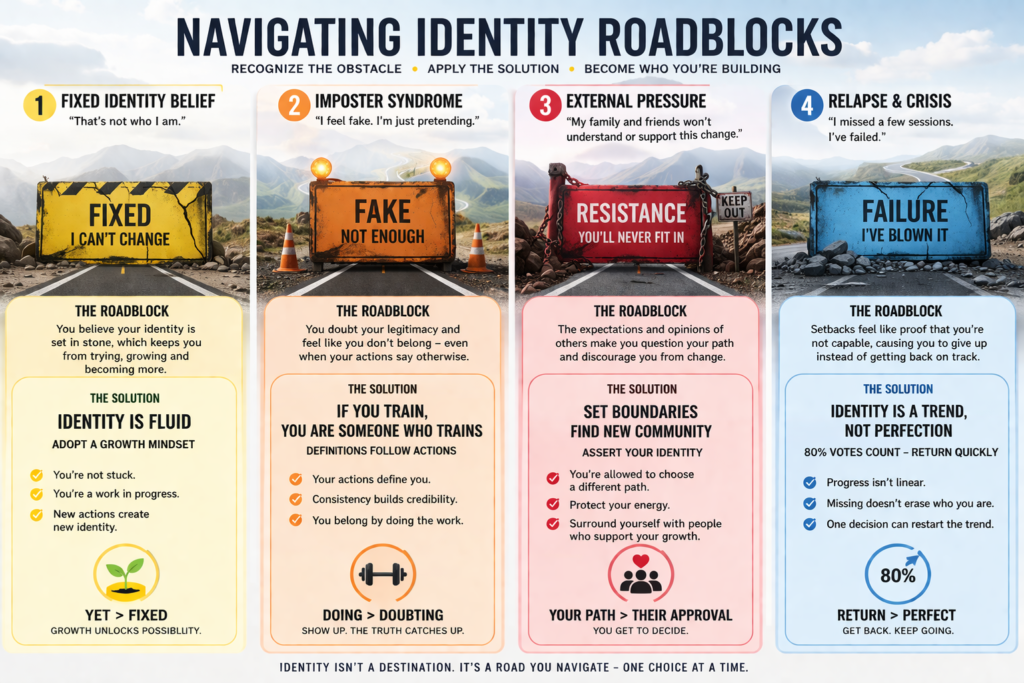
Roadblock 1: “That’s Not Who I Am”
The belief:
- “I’m not athletic”
- “I’m not a morning person”
- “I’m naturally lazy”
- “That’s just not me”
- Fixed identity
Why it’s limiting:
- Identity treated as immutable
- Past determines future
- Change seems impossible
- Self-fulfilling prophecy
The truth:
- Identity is fluid and changeable
- Based on accumulated evidence
- Can be rewritten with new evidence
- Malleable self-concept
The reframe:
- From: “I’m not athletic”
- To: “I haven’t been athletic YET”
- Growth mindset
- Possibility opened
The intervention:
- Acknowledge old identity
- “I have been [old identity]”
- “I’m becoming [new identity]”
- “With each action, I’m voting for new identity”
- Transition language
The evidence:
- Point to any small action aligned with new identity
- “Today I trained, therefore I AM someone who trains”
- One vote is enough to start
- Immediate evidence
Roadblock 2: Imposter Syndrome
The feeling:
- “I’m not REALLY an athlete”
- “I’m just pretending”
- “Real athletes are different”
- “Who am I kidding?”
- Fraudulent feeling
Why it happens:
- Comparing inside to outside
- Seeing others’ results, not their struggles
- New identity not yet integrated
- Comparison trap
The truth:
- Every athlete started as beginner
- Identity is about actions, not achievements
- If you train, you’re someone who trains (tautology)
- Definitional truth
The reframe:
- “An athlete is someone who trains”
- “I train, therefore I’m an athlete”
- No minimum qualification
- Inclusive definition
The stages:
- Acting like [identity] → Being [identity]
- At first, “acting”
- Eventually, just “being”
- Fake it till you become it
- Integration process
The timeline:
- Week 1: Feels like pretending
- Month 1: Starting to believe
- Month 3: Feels natural
- Month 6: Fully integrated
- Gradual internalization
Roadblock 3: Social Identity Pressure
The conflict:
- Friends/family see you as old identity
- They reinforce old self-concept
- Social pressure to remain consistent
- External resistance
Examples:
Family:
- “You never stick with anything”
- “You’re not the athletic type”
- “Just have the cake, one won’t hurt”
- Undermining comments
Friends:
- “Come on, skip the gym, hang out”
- “You’ve changed” (negative connotation)
- Peer pressure to old behaviors
- Social sabotage
The mechanism:
- Others invested in old identity
- Change threatens their worldview
- Consciously or unconsciously undermine
- Homeostasis seeking
The solution:
Boundary setting:
- “I appreciate your concern, but training is important to me”
- “This is who I am now”
- Firm but kind
- Assert new identity
Selective disclosure:
- Don’t announce transformation
- Just quietly do it
- Let results speak
- Under the radar
New social circle:
- Spend time with people aligned with new identity
- Gym buddies, training partners
- Supportive community
- Environmental alignment
Prove them wrong:
- Consistency over time
- Eventually they accept new identity
- Some never will (that’s okay)
- Persistence wins
Roadblock 4: Relapse and Identity Crisis
What happens:
- Miss several workouts
- Eat poorly for week
- “I guess I’m not that person after all”
- Identity destabilization
The cognitive distortion:
- All-or-nothing thinking
- One miss = total failure
- Identity shattered
- Catastrophizing
The truth:
- Identity based on trend, not perfection
- 80% votes for identity is strong
- 20% votes against doesn’t erase identity
- Aggregate voting
The recovery:
Acknowledge, don’t catastrophize:
- “I missed three workouts”
- Not: “I’m a failure and not really an athlete”
- Fact vs. interpretation
- Objective assessment
Reaffirm identity:
- “I’m someone who trains”
- “This week didn’t reflect that”
- “Tomorrow I return to who I am”
- Identity reassertion
Immediate action:
- Next scheduled session, show up
- One vote for identity
- Restarts momentum
- Quick return
Learn from relapse:
- What triggered it?
- How to prevent next time?
- Adjust system
- Improvement iteration
The key principle:
- Identity isn’t all-or-nothing
- It’s the trend over time
- Misses happen to everyone
- Just return quickly
- Resilience
Integrating the Athletic Identity
Making it permanent.
Physical Markers
Create visible reminders:
Clothing:
- Workout clothes always visible
- Athletic brands
- Identity signal to self and others
- Environmental cue
Equipment:
- Gym bag always packed
- Visible in home
- Constant reminder
- Physical presence
Space:
- Dedicated workout area (if home training)
- Or gym membership card visible
- Space reflects identity
- Environmental design
Body:
- Progress photos
- Tracking data
- Physical changes visible
- Evidence of identity
- Proof accumulation
Social Integration
Tell people:
- “I train 4x per week”
- State as fact
- Public commitment
- Social accountability
Find community:
- Training partners
- Gym community
- Online fitness communities
- Shared identity
- Tribal belonging
Share journey:
- Not bragging
- But owning identity
- “I’m someone who trains”
- Normalizing in social context
- Identity broadcasting
Behavioral Consistency
Non-negotiable schedule:
- Training days fixed
- Same time if possible
- Calendar blocked
- Systematic consistency
Identity-based decisions:
- Every choice: “What would [identity] do?”
- Food choices
- Sleep timing
- Activity decisions
- Decision framework
Streak building:
- Track consecutive weeks training
- Visible progress
- Pride in consistency
- Momentum visualization
Cognitive Integration
Automatic self-talk:
- “I’m someone who trains” becomes default thought
- No longer conscious affirmation
- Subconscious belief
- Deep integration
Identity-first, not goal-first:
- Not “I need to train to lose weight”
- But “I train because that’s who I am”
- Intrinsic vs. extrinsic
- Motivation shift
Comfortable in identity:
- Feels natural
- No internal resistance
- Can’t imagine being different
- Full embodiment
Timeline to Full Integration
Week 1-2:
- Conscious effort
- Feels like acting
- Requires reminders
- Initiation phase
Week 3-6:
- Becoming easier
- Some automatic behaviors
- Starting to believe
- Transition phase
Week 7-12:
- Mostly automatic
- Strong belief
- Others noticing change
- Consolidation phase
Month 4-6:
- Fully integrated
- Identity feels natural
- Can’t imagine old self
- Complete transformation
Maintenance:
- Continue voting for identity
- Never take for granted
- One vote at a time
- Ongoing process
The Bottom Line: Be Don’t Try
After explaining everything:
The truth about identity-based fitness:
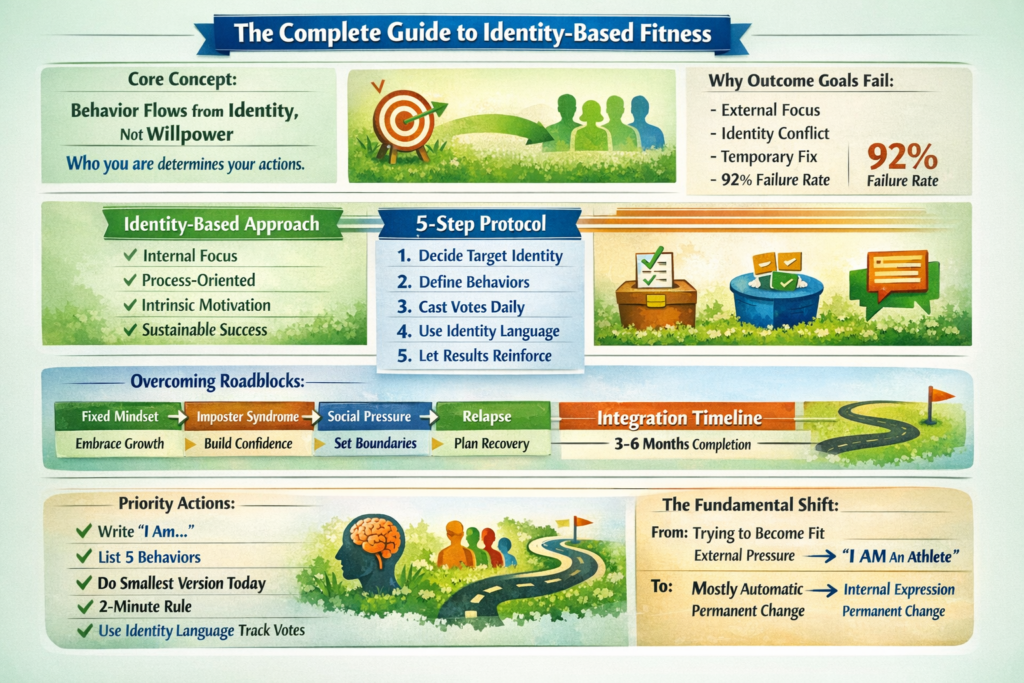
✅ Behavior flows from identity, not willpower (who you are determines what you do)
✅ Outcome-based goals fail because identity doesn’t change (trying to act different vs. being different)
✅ Every action is a vote for or against your identity (evidence accumulation)
✅ Language shapes identity as much as action (how you talk about yourself matters)
✅ Identity transformation takes 3-6 months to fully integrate (gradual process)
Key takeaways:
What identity is:
- Your internal story about who you are
- Beliefs about your character
- Self-concept determining behavior
- Based on accumulated evidence from actions
- “I am” statements
How identity drives behavior:
- Situation → Identity consulted → Behavior flows automatically
- “What does someone like me do here?”
- Identity-congruent action feels natural
- No willpower needed
- Automatic consistency
Why outcome-based goals fail:
- External focus (about results, not self)
- Identity conflict (goal conflicts with self-concept)
- No intrinsic motivation (willpower-dependent)
- Temporary behavior change
- 92% failure rate
Identity-based alternative:
- Internal focus (about who you are)
- Process-oriented (daily votes)
- Intrinsic motivation (flows from self-concept)
- Sustainable indefinitely
- Higher success rate
The 5-step transformation protocol:
Step 1: Decide target identity
- “I’m an athlete”
- “I’m someone who trains”
- “I’m a lifter”
- Present tense, specific enough to guide behavior
- Identity declaration
Step 2: Define what that person does
- Athletes train 4-6x weekly
- Prioritize sleep and nutrition
- Track progress
- Don’t skip sessions
- Behavioral specification
Step 3: Start casting identity votes
- Every action is a vote
- Start small (2-minute rule)
- 51% votes FOR is enough to begin
- Build to 90% for strong identity
- Evidence accumulation
Step 4: Use identity language
- Internal: “I’m someone who trains”
- External: “I train 4x weekly” (not “trying to”)
- Refusals: “I don’t eat that” (not “I can’t”)
- Constant linguistic reinforcement
- Self-talk matters
Step 5: Let results reinforce
- Small actions → Small results → Identity confirmation
- Results prove identity
- Strengthens belief
- Drives more action
- Self-reinforcing flywheel
Common roadblocks:
- “That’s not who I am” (fixed mindset) → Identity is fluid, use “yet”
- Imposter syndrome (feeling fake) → If you train, you’re someone who trains
- Social identity pressure (others resist) → Set boundaries, find new community
- Relapse crisis (misses = failure) → Identity is trend, not perfection
- Obstacles and solutions
Integration markers:
- Physical: Visible equipment, clothing, body changes
- Social: Tell people, find community, public commitment
- Behavioral: Non-negotiable schedule, identity-based decisions
- Cognitive: Automatic self-talk, intrinsic motivation, natural feeling
- Full embodiment
Timeline:
- Week 1-2: Conscious effort, feels like acting
- Week 3-6: Becoming easier, starting to believe
- Week 7-12: Mostly automatic, strong belief
- Month 4-6: Fully integrated, natural identity
- 3-6 months to completion
Priority actions:
- Write down target identity: “I am [identity]”
- List 5 behaviors that person does
- Do smallest version today (2-minute rule)
- Use identity language in self-talk
- Track votes (did I act like [identity] today?)
- Start transformation now
The fundamental shift:
- From: “I’m trying to become fit” (outcome-based, temporary)
- To: “I’m an athlete” (identity-based, permanent)
- From: External pressure (have to train)
- To: Internal expression (this is who I am)
- Paradigm shift
STOP TRYING TO ACT LIKE SOMEONE WHO TRAINS. BECOME SOMEONE WHO TRAINS. CHANGE YOUR IDENTITY. THE BEHAVIOR FOLLOWS AUTOMATICALLY.
Ready to build a complete identity transformation system with evidence-based psychology protocols, linguistic programming techniques, behavioral architecture strategies, and integration frameworks that guarantee permanent change at the identity level? Understanding identity is just the beginning. Get a comprehensive guide to systematically transforming who you are, building unshakeable self-concept, aligning behavior with identity automatically, and achieving lasting fitness transformation without willpower. Stop trying to change behavior. Start changing identity.
REFERENCES
SECTION 1 — Identity-framing increases behavior: the voter study
[1] Bryan CJ et al. — PMC/PNAS, 2011 Three randomized experiments demonstrating that framing a behavior as an identity enactment rather than a mere action significantly increases behavior; survey items phrased as “being a voter” (identity noun) versus “voting” (behavior verb) were tested across voter registration interest and two statewide US elections verified through official state records; the identity-phrasing condition significantly increased both registration interest and actual turnout in both elections; the paper concludes that people are continually managing their self-concepts and seeking to affirm valued personal identities, and that this process can be channeled through subtle linguistic means to motivate socially relevant behavior; provides the empirical foundation for the article’s core claim that “being an athlete” is more behaviorally potent than “training to get fit” https://pmc.ncbi.nlm.nih.gov/articles/PMC3150938/
SECTION 2 — Identity-based language: “I don’t” vs. “I can’t”
[2] Patrick VM & Hagtvedt H — Journal of Consumer Research, 2012 Four-study investigation of identity-framed self-talk in goal pursuit; language used to describe choices functions as a behavioral feedback mechanism that either enhances or impedes goal progress; participants who used “I don’t” refusal framing (identity-based, internally motivated) showed greater goal-directed behavior than those using “I can’t” (externally imposed restriction); the “I don’t” framing increased healthy snack choice (64% vs. 39%) and outperformed “I can’t” in a 10-day real-world fitness intervention; the mechanism was psychological empowerment: “don’t” connotes a firmly entrenched attitude and affirms personal will, while “can’t” connotes temporary restriction; directly validates the article’s Step 4 language protocol and the shift from “I can’t have that” to “I don’t eat that” https://academic.oup.com/jcr/article/39/2/371/1797950
SECTION 3 — Identity-based motivation: how identity cues automatic action
[3] Oyserman D — PMC/Journal of Consumer Psychology, 2011 Theoretical review of the identity-based motivation model; a cued identity carries with it a general readiness to act and make sense of the world in identity-congruent terms, including the norms, values, strategies, and goals associated with that identity; identity-relevant behaviors are more valued and therefore more likely to be enacted, as the subjective value of a goal-directed behavior increases when it is perceived as self-relevant; behaviors that feel identity-congruent are interpreted as important rather than as signs of difficulty or failure; the model predicts that aligning goals with identity, particularly the working self-concept, is a critically important step toward goal achievement; provides the theoretical neurocognitive mechanism behind the article’s claim that identity-aligned behaviors feel effortless while identity-conflicting behaviors require willpower https://pmc.ncbi.nlm.nih.gov/articles/PMC3079278/
SECTION 4 — Habit formation: how identity-aligned action becomes automatic
[4] Lally P et al. — PubMed/European Journal of Social Psychology, 2010 Study of 96 participants monitoring a chosen eating, drinking, or activity behavior daily for 12 weeks; automaticity of behaviors increased in a curvilinear pattern approaching an asymptote over time; the median time for a new behavior to reach 95% of its asymptote was 66 days, with substantial individual variation (range 18 to 254 days); missing a single day of performing the behavior had no meaningful impact on the habit formation process; findings support the article’s integration timeline of 3 to 6 months and the claim that identity voting accumulates into effortless automatic behavior; also provides the scientific basis for the “small consistent actions” Step 3 protocol by showing that frequency and repetition, not perfection, determines habit formation speed https://pubmed.ncbi.nlm.nih.gov/19379254/
SECTION 5 — Self-control through habits, not willpower
[5] Galla BM & Duckworth AL — PubMed/Journal of Personality and Social Psychology, 2015 Six studies (n=2,274) demonstrating that individuals with high trait self-control succeed primarily through beneficial habits rather than effortful inhibition; habits for exercising, eating healthy, and sleeping mediated the relationship between self-control and positive outcomes; high self-control does not mean constantly resisting temptation, but rather building routines that make goal-aligned behavior automatic; the study directly supports the article’s central proposition that the goal of identity transformation is to make athletic behavior automatic rather than willpower-dependent, and that the identity shift from “trying to train” to “being someone who trains” produces this automaticity https://pubmed.ncbi.nlm.nih.gov/25643222/







Leave a Reply
You must be logged in to post a comment.